Hubbry Logo
Vandalia (colony)Vandalia (colony)Main
Open search
Vandalia (colony)
Community hub
Vandalia (colony)
logo
8 pages, 0 posts
0 subscribers
Be the first to start a discussion here.
Vandalia (colony)
Vandalia (colony)
from Wikipedia
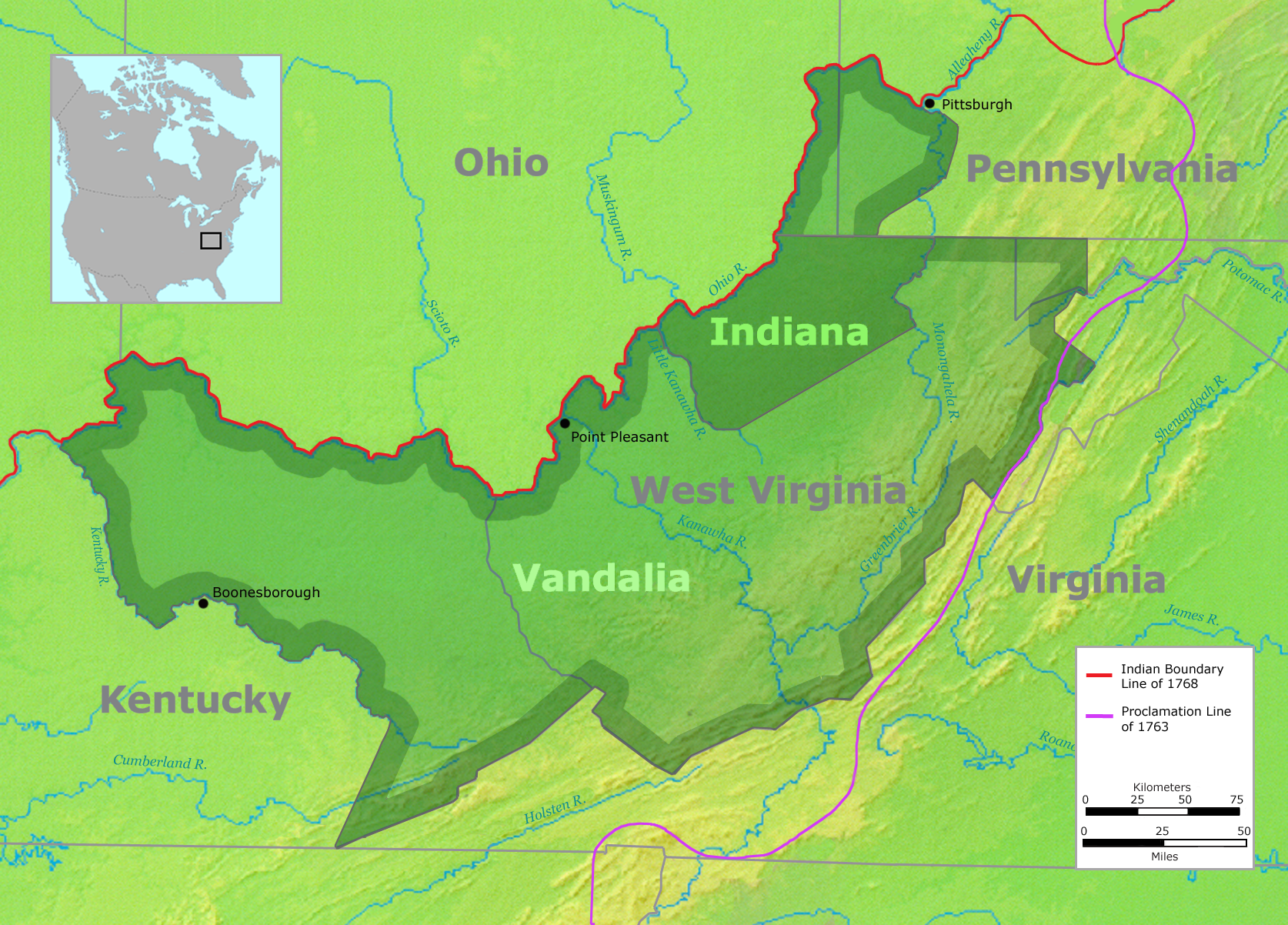
Map

Vandalia was the name in the late 18th century of a proposed British colony in North America. The colony would have been located south of the Ohio River, primarily in what are now West Virginia and northeastern Kentucky.

Vandalia was never approved by the British Crown and had no colonial government, although some Virginians and Pennsylvanians had already settled there. After the American Revolutionary War, the Vandalia settlers sought unsuccessfully to be admitted as a state called Westsylvania. However, they had no legal title to the land and were opposed by the governments of Virginia and Pennsylvania, which both claimed the area as their own under colonial charters. Ultimately, the federal government split the area between Pennsylvania and Virginia according to the Mason–Dixon line.[1] Kentucky was later settled by Virginians and admitted as a state; West Virginia was admitted as a state in 1863, during the American Civil War.

History

[edit]
1755 Fry-Jefferson map showing earlier established colonial borders before the French And Indian War.

In the 18th century, British land speculators several times attempted to colonize the Ohio Valley, most notably in 1748 when the British Crown granted a petition of the Ohio Company for 200,000 acres (800 km2) near the "Forks of the Ohio" (present-day Pittsburgh, Pennsylvania).[2] The French and Indian War (1754–63) and Pontiac's Rebellion (1763–66) delayed settlement of the region.[3]

After Pontiac's Rebellion, merchants who had lost their trade items during the conflict formed a group known as the "suffering traders", later to become the Indiana Company. In the Treaty of Fort Stanwix (1768), the British required the Iroquois to give the "suffering traders" a grant of land. Those who benefited the most were Samuel Wharton and William Trent. Known as the "Indiana Grant", this land was located along the Ohio River and included part of the Iroquois' hunting ground, which they had controlled since the 17th century.[4] When Wharton and Trent sailed to England in 1769 seeking to have their grant confirmed, they joined forces with the Ohio Company to form the Grand Ohio Company, also called the Walpole Company.

The Grand Ohio Company eventually received a larger area of land than the Indiana Grant.[5] The development companies planned a new colony, initially called "Pittsylvania" (Wright 1988:212) but later known as Vandalia, in honor of the British queen Charlotte of Mecklenburg-Strelitz (1744–1818), who was thought to be descended from Vandalic tribesmen.[6][7][8]

Opposition from rival interest groups[9] and the outbreak of the American Revolutionary War (1775–83) prevented the development of Vandalia as a full colony.[10] During the Revolutionary War, some settlers in the region petitioned the American Continental Congress to recognize a new province to be known as Westsylvania, which had approximately the same borders as the earlier Vandalia proposal. As both the states of Virginia and Pennsylvania claimed the region, they blocked recognition of a new state.[11] The Indiana Company presented a bill in equity against the State of Virginia concerning their claims, but the ruling in Chisholm v. Georgia led to the Eleventh Amendment forbidding suits by citizens of another State, and the Supreme Court dismissed the Indiana Company's suit, holding the constitutional amendment applied retroactively.

The formation of the state of Kentucky in 1792 and the separation of West Virginia from Virginia in 1863, established the present political borders in the region.

See also

[edit]

References

[edit]

Sources

[edit]
  • Alvord, Clarence W. The Mississippi Valley in British Politics, vol. 1. Cleveland, Ohio: Arthur Clark, 1917.
  • Marshall, Peter. "Lord Hillsborough, Samuel Wharton, and the Ohio Grant, 1769- 1775", English Historical Review (1965) Vol. 80, No. 317 pp. 717–739 in JSTOR
  • Steeley, James V., "Old Hanna's Town and the Westward Movement, 1768 - 1787: Vandalia the Proposed 14th American Colony", Westmoreland History, Spring 2009, pp. 20–26, published by Westmoreland County Historical Society
  • Wright, Esmond, 'Franklin of Philadelphia' , Harvard University Press, 1988
[edit]
Revisions and contributorsEdit on WikipediaRead on Wikipedia
from Grokipedia
Vandalia was a proposed British colony in , intended as the fourteenth colony and located south of the in the Valley, encompassing areas now part of modern , eastern , and portions of and . The scheme emerged in from efforts by British and colonial land speculators to secure vast tracts for settlement following the and the 1768 Treaty of , which opened lands previously controlled by Indigenous nations. Sponsored primarily by the Grand Ohio Company—formed in 1769 through the merger of the Indiana Company and interests led by figures such as Thomas Walpole—the proposal sought a for approximately 20 million acres to establish a new colonial government west of the Alleghenies. Key proponents, including Samuel Wharton, William Trent, and , petitioned the British government in 1769, leveraging claims of compensation for traders' losses during to justify the land grant. The name evolved from "Indiana" to "Pittsylvania" before becoming "Vandalia" around 1773, possibly to appeal to Queen Charlotte's purported German heritage linked to the ancient . The conditionally approved the charter in 1772, envisioning Vandalia as a landlocked with its capital at Point Pleasant and structured to manage frontier expansion. However, opposition from colonial officials like Lord Hillsborough, rival land companies such as Virginia's interests, and escalating tensions leading to the stalled final ratification; by 1775, the outbreak of war rendered the project obsolete, leaving it unrealized despite preliminary surveys and informal settlements. This abortive endeavor highlighted the speculative fervor of pre-Revolutionary land schemes and the fragility of imperial plans amid growing colonial autonomy.

Background

Land Treaties and Speculative Ventures Prior to Proposal

The , a land speculation venture organized in 1747 by prominent including Thomas Lee and the Washington brothers, received a on May 19, 1749, granting 200,000 acres in the Ohio Valley, with an option to expand to 500,000 acres upon settling 100 families and building a fort. To secure Indian consent, company agent participated in the from June 10 to July 1752, where representatives of the Six Nations (), , and confirmed the company's rights to trade and settle in the region, though the agreement emphasized peaceful coexistence and did not fully extinguish competing tribal claims. These efforts culminated in the construction of a fort at the Forks of the Ohio (modern ) in 1754, but French forces seized it, initiating the and stalling the venture. Following the 1763 Treaty of Paris, which ended the war but left the contested, Britain's Royal Proclamation of October 7, 1763, prohibited private settlement west of the Appalachians to avoid further Indian conflicts, prompting speculators to pursue direct purchases from tribes while seeking crown ratification. Philadelphia-based "suffering traders," merchants like Samuel Wharton and William Trent who claimed losses during (1763–1766), formed the Indiana Company around 1766, petitioning for a 1.4 million-acre grant (later expanded to 2 million acres) along the as compensation, leveraging connections with Indian agent . This group, emphasizing restitution for wartime depredations, positioned their claims as economically viable for settlement and trade, though critics later noted the inflated nature of loss estimates and the lack of broad tribal consensus. The pivotal Treaty of Fort Stanwix, signed November 5, 1768, between British Superintendent Sir William Johnson and the Six Nations, ceded over 20 million acres south of the to , establishing a boundary line that opened parts of modern , , , and to potential colonization. Influenced by speculator lobbying, the treaty incorporated the Indiana Company's tract by compensating traders within the cession, with the receiving £10,000 from despite their tenuous overlordship over the lands, which were primarily occupied by , , and groups uninvolved in the negotiations. This private purchase, totaling around 2.5 million acres for the speculators at approximately 40 shillings per 100 acres, fueled ambitious plans for a new colony but sowed seeds of intertribal resentment, as southern tribes disputed the ' authority to sell unpossessed territories.

Economic Motivations and British Colonial Policy

The economic motivations for proposing Vandalia stemmed primarily from land speculators' desire to capitalize on the vast, fertile territories in the Ohio Valley, acquired by Britain through the Treaty of Paris in 1763, by purchasing large tracts from at low cost and reselling subdivided parcels to settlers for substantial profit. Investors in the Grand Ohio Company, formed in 1769, envisioned settlement driving agricultural development, leveraging navigable rivers for trade, and alleviating population pressures in established eastern colonies, thereby fostering through expanded farming, , and inland commerce. These speculators, including figures like Samuel Wharton and Thomas Walpole, drew on pre-war claims from "suffering traders" who had lost goods during the , seeking compensation via land grants confirmed through the 1768 . British colonial policy initially constrained such ambitions through the Royal Proclamation of 1763, issued on October 7 by King George III, which forbade private land purchases or settlements west of the to avert costly conflicts with Native American tribes, as demonstrated by Pontiac's Rebellion earlier that year, and to centralize land alienation under Crown authority. This measure aimed to stabilize imperial finances strained by debts—totaling over £130 million—by minimizing military expenditures in frontier zones and preserving Native alliances for monopolies beneficial to British mercantilism. However, widespread settler encroachments and speculative pressures prompted policy considerations for regulated expansion, as uncontrolled risked anarchy and revenue loss, while organized colonies could impose quit-rents and grant fees to generate imperial income. The Vandalia proposal, petitioned on May 7, 1770, by the Grand Ohio Company for approximately 20 million acres—encompassing modern and parts of —sought to align with this evolving policy by offering a chartered under royal oversight, promising economic benefits like systematic settlement to boost duties and to the metropole. Proponents argued that a new with as capital would enable efficient administration and supply chains, converting speculative holdings into productive assets while circumventing restrictions through Crown-sanctioned grants. Despite initial opposition from Lord Hillsborough, who prioritized frontier peace and resigned in 1772, the approved the scheme on July 1, 1772, reflecting a pragmatic shift toward leveraging colonial expansion for revenue amid fiscal pressures, though implementation stalled with the of 1774 and revolutionary tensions.

Proposal Development

Formation of the Grand Ohio Company

The Grand Ohio Company, also known as the Walpole Company, emerged from the reorganization of the Indiana Company on December 27, 1769, consolidating claims by "suffering traders" who had incurred losses from Native American raids during (1763–1766). These traders, primarily merchants, sought compensation through land grants in the Ohio Valley, prompting American agent Samuel Wharton to travel to in 1769 alongside William Trent to negotiate with British officials. Wharton partnered with Thomas Walpole, a British MP and relative of , who provided political leverage and capital to expand the venture into a joint Anglo-American enterprise. The company's formation involved recruiting prominent investors, including , who assisted in drafting petitions and reports to the , and figures such as Sir George Colebrooke, a wealthy banker and MP. This structure aimed to petition for a proprietary grant exceeding 20 million acres—roughly twice the size of —south of the and west of the Alleghenies, with the intent of establishing a new colony named Pittsylvania (later Vandalia) under feudal-like tenure paying quitrents to the king. Initial discussions traced to mid-1769, when Walpole and Wharton envisioned merging trader claims with broader speculative interests to bypass competing Virginia-based ventures like the of . By incorporating British proprietors, the Grand Ohio Company positioned itself to navigate imperial policy favoring organized settlement over unregulated speculation, while American partners like Wharton emphasized through and . The group's negotiations sought exclusive rights to purchase the land at a fixed per hundred acres, with provisions for a colonial featuring a , , and assembly, though internal divisions over profit-sharing and boundaries persisted among the roughly two dozen shareholders. This formation marked a strategic escalation from ad hoc trading losses to a formalized colonial project, reliant on Walpole's in and Franklin's diplomatic advocacy.

Petition to the Crown and Charter Negotiations

In June 1769, the newly formed Grand Ohio Company, comprising "suffering traders" from and prominent English associates, petitioned King George III for a to establish a proprietary colony on 2,400,000 acres south of the , lands purportedly purchased from the under the 1768 Treaty of . Key petitioners included Thomas Walpole as a major shareholder, as a drafter and advocate, Samuel Wharton as a merchant lobbyist, and William Trent, with the petition read before the on July 24, 1769. The petition outlined incentives such as a 20-year exemption from quit rents to spur settlement, trade, and revenue for , while proposing as the capital for administrative efficiency over distant eastern seats like Williamsburg or . Negotiations centered on the , where the company lobbied against rival schemes like the and companies, which were rejected by May 1770; the colony's name was adjusted to Vandalia by 1773 to honor Queen Charlotte's Mecklenburg-Strelitz heritage and gain royal favor. A report on June 24, 1772, endorsed the 's benefits, prompting approval on July 1, 1772, over objections from Lord Hillsborough, who resigned amid the controversy. Further progress stalled due to Alexander Wedderburn's delays, competing territorial claims from and , and intensifying colonial unrest, with a provisional approval noted by May 1, 1775, but no issued before disruptions.

Proposed Structure

Territorial Boundaries and Capital

The proposed territorial boundaries of Vandalia encompassed approximately 20 million acres, primarily situated south of the and west of the , corresponding largely to modern-day along with portions of northeastern and southwestern . The eastern limit followed the crest of the (or Laurel Ridge), serving as a from colonial settlements east of the Appalachians; the northern boundary adhered to the from westward; the southern extent projected into , potentially along lines approximating the and extending toward the ; and the western boundary reached the mouth of the in present-day , though some proposals envisioned further extension toward the based on Iroquois cessions at in 1768. These boundaries derived from the Grand Ohio Company's consolidated land purchases, including the Indiana Company's earlier 2.5 million-acre claim between the Monongahela and Little Kanawha rivers, expanded through negotiations to form a compact facilitating settlement and trade via river access while mitigating Native American hostilities by concentrating development in ceded territories. The proposed capital was situated at Point Pleasant, at the confluence of the and Great Kanawha rivers, selected for its strategic centrality, navigable access, and defensibility amid the colony's riverine geography, though administrative arguments in deliberations favored for logistical efficiency in governance.

Governance and Administrative Plans

The proposed governance for Vandalia was structured as a royal colony, modeled on established British North American colonies such as and , with a bicameral empowered to enact laws subject to royal oversight. The executive branch would be headed by a appointed by , vested with civil and authority to maintain order and defend the , particularly amid ongoing Native American conflicts and settler encroachments west of the Alleghenies. An advisory council of 12 members, also appointed by , would assist the , while legislative power resided in an elected initially comprising 24 members chosen by Protestant freeholders owning at least 200 acres of land; this body was set to expand with settlement, allocating two deputies per county. Administrative plans emphasized judicial uniformity and land management to accommodate an estimated 30,000 existing settlers and facilitate orderly expansion. Superior and inferior courts of were to be established, with judges appointed by the in consultation with proprietors of the Grand Ohio Company, which held primary land rights under the scheme; local magistrates would be selected by these courts to handle routine affairs. The was designated as established, with vestrymen elected by parishioners to oversee religious and parochial matters, reflecting British policy to integrate colonial administration with imperial religious norms. Land administration tied closely to the company's proprietary interests, derived from the 1768 Treaty of cessions, whereby the Grand Ohio Company proposed purchasing vast tracts from Native tribes to distribute to settlers under structured quit-rents and surveys, aiming to generate revenue for colonial infrastructure while resolving overlapping claims from and charters. The Privy Council's draft charter, advanced through petitions led by figures like Thomas Walpole and Samuel Wharton, outlined these elements in reports dated May 6, 1773, following an August 14, 1772, order to certify the and colonial establishment; final royal approval came via a king's order in October 1773, though implementation stalled amid pre-revolutionary tensions. Proponents, including , argued this framework would prevent in the Ohio Valley by providing dedicated separate from eastern colonies, prioritizing empirical settlement needs over expansive proprietary autonomy. Voting and officeholding qualifications ensured property-based representation, with laws requiring gubernatorial assent and Privy Council review to align with imperial standards, though the structure preserved settler rights akin to those in older colonies.

Opposition

Rival Colonial Claims and Political Resistance

The proposed Vandalia colony faced significant opposition from established British colonies, particularly and , whose charters granted them expansive western claims extending from the Atlantic to the , encompassing the Valley territory targeted by Vandalia speculators. asserted dominion through early explorations by figures like and land ventures such as the of , which had secured a 200,000-acre grant in 1749 and conducted surveys led by in the , viewing the new colony as an infringement on these pre-existing rights. similarly contested the region based on its charter's latitudinal boundaries, with Philadelphia-based speculators and settlers pushing westward, leading to direct clashes over areas like the upper watershed. Rival land companies intensified these territorial disputes, as groups like the Mississippi Company, led by Arthur Lee, petitioned on March 1, 1770, for 2.5 million acres in the overlapping Ohio Valley region, only to face rejection amid competing interests. The Company, formed in 1766 by "suffering traders" seeking compensation for losses during (1763–1766), initially targeted lands from Little Kanawha Creek to Laurel Hill but evolved into pressures that and countered by accelerating their own grants to veterans and settlers to preempt Vandalia's 20 million-acre ambitions by 1770. These speculators, including Samuel Wharton and William Trent, leveraged the 1768 Treaty of to bolster claims, yet colonial authorities in issued bounties dating back to 1754, racing to establish control. Political resistance emerged prominently from British officials wary of destabilizing colonial balances, with Lord Hillsborough, as for the Colonies, opposing the scheme in a December 1769 memorial by citing conflicts with Virginia's established dominion and the restrictive Proclamation Line of 1763, which aimed to limit western settlement to prevent Indian conflicts. Colonial leaders amplified this, as warned Virginia's Lieutenant Governor Lord Botetourt on October 5, 1770, that Vandalia threatened broader American interests by fragmenting . Pennsylvania's fur traders in the vicinity, reliant on unregulated commerce, resisted potential new governance that could impose licensing and taxes, echoing earlier "suffering traders'" grievances post-1763 uprisings. The delayed deliberations into 1773, and despite Privy Council approval on July 1, 1772, Hillsborough's refusal to endorse the charter—leading to his resignation on August 13, 1772—reflected fears of provoking unrest among rival claimants. Virginia and Pennsylvania governments formalized resistance through legislative actions, with Virginia's declaring Vandalia and similar purchases invalid in 1777, asserting exclusive sovereignty over western lands under their charters, while Pennsylvania's expansionist policies similarly prioritized direct control to counter speculative interlopers. This opposition, compounded by Governor Dunmore's 1774 maneuvers in the region, underscored a broader colonial aversion to Crown-sanctioned fragmentation that could dilute their authority and economic stakes in the trans-Appalachian frontier.

Native American Objections and Conflicts

The proposed Vandalia colony relied on land cessions obtained from the (Haudenosaunee) Confederacy through the Treaty of Fort Stanwix, signed on November 5, 1768, which transferred approximately 13 million acres south of the to the British Crown in compensation for "suffering traders" and to facilitate colonial expansion. However, Valley tribes including the , (), and rejected the treaty's validity, asserting that the Iroquois lacked authority to alienate lands occupied and used by these groups, whom they viewed as independent rather than subordinates. These tribes had not participated in the negotiations and regarded the cession as an infringement on their hunting grounds and villages, prompting immediate diplomatic protests and warnings against settlement. Objections manifested in intertribal councils and direct communications with British officials, where and leaders emphasized their sovereignty over the region and demanded adherence to prior agreements like the Proclamation of 1763, which had reserved the area west of the Appalachians for Native use to prevent conflict. The Grand Ohio Company, central to the Vandalia petition, derived its claims from the treaty's provisions for trader compensation, but this ignored the western tribes' occupancy, fueling perceptions of British duplicity and eroding fragile post-Pontiac's War alliances. British colonial secretary Lord Hillsborough cited unresolved Native claims as a key rationale for opposing the colony's charter, arguing that premature settlement risked reigniting frontier warfare amid fiscal strains from the recent . Tensions escalated into armed resistance as speculative surveys and early settler encroachments violated the boundary, leading to raids on survey parties and isolated farms by warriors under leaders like Cornstalk. These skirmishes intensified in 1774, culminating in , where Governor John Murray, 4th , mobilized 1,200 militia against a -Mingo confederacy, resulting in the on October 10, 1774, with approximately 215 colonial and 140 Native casualties. The subsequent Treaty of Camp Charlotte on October 20, 1774, forced concessions of hunting rights south of the but did not resolve underlying grievances, as tribes viewed it as coerced under threat of annihilation. This conflict, rooted in the same disputed lands underpinning Vandalia's boundaries, demonstrated the practical barriers to the colony's viability and contributed to its indefinite postponement by the Crown.

Failure

Pre-Revolutionary Delays and Rejections

The Grand Ohio Company's petition for a to establish the Vandalia colony, submitted in late by promoters including Wharton and William Trent, encountered immediate bureaucratic resistance from the British . Lord Hillsborough, as President of the Board and for the Colonies, vehemently opposed the proposal, arguing that it would exacerbate Native American hostilities and encourage speculative land grabs in violation of the Proclamation of 1763, which barred settlement west of the Appalachians to maintain peace after . In 1770, the Board, under Hillsborough's influence, formally opposed the grant, citing overlapping claims by rival speculators such as the Indiana Company and the older of , whose petitions for adjacent lands were also under review but ultimately withdrawn or denied. Colonial governments further stalled progress by asserting proprietary rights over the proposed territory. Virginia's governor and assembly protested the grant, as it encroached on bounty lands promised to soldiers from the , totaling hundreds of thousands of acres surveyed along the . Pennsylvania similarly objected, having extended its surveys into the region via Westmoreland County, viewing Vandalia as a threat to its western expansion ambitions. These jurisdictional disputes, combined with fears of renewed frontier violence—evidenced by ongoing skirmishes with and other tribes—prompted the to delay hearings, referring the matter back for additional reports amid competing petitions from the Mississippi Company. Despite these obstacles, the approved a provisional grant of approximately 20 million acres on July 1, 1772, overriding Hillsborough's resistance and prompting his resignation on August 13, 1772. However, implementation faltered due to persistent administrative inertia and shifting political priorities in , where colonial taxation disputes increasingly diverted attention. Benjamin Franklin's public humiliation in the Hutchinson letters affair on January 29, 1774—before Alexander Wedderburn, who later reviewed the Vandalia documents—undermined the lobbyists' influence, as Franklin's dismissal from his post as deputy eroded support for the scheme. Wedderburn provided a tentative endorsement on May 1, 1775, but with no royal warrant issued and revolutionary tensions boiling over after Lexington and Concord on April 19, 1775, the proposal lapsed without formal rejection, effectively shelved amid the encroaching war.

Disruption by the American Revolution

As the Vandalia proposal advanced through British administrative channels in the early 1770s, it faced mounting delays from colonial policy debates, but the escalating crisis between Britain and its North American colonies ultimately derailed its final implementation. The had endorsed the Grand Ohio Company's petition for a in July 1772, following recommendations from the , though opposition from figures like Lord Hillsborough— who resigned as for the Colonies on August 13, 1772—had previously stalled progress. By October 1773, further action outlined Vandalia as a separate colonial , contingent on resolving rival claims and Native American land purchases stemming from the 1768 Treaty of . The on December 16, 1773, marked a pivotal escalation in colonial resistance to British authority, shifting imperial priorities away from new colonial ventures like Vandalia toward coercive measures against unrest in existing colonies. This was followed by the in September 1774, which coordinated colonial grievances and boycotts, further distracting British officials from routine charter approvals. Proponents such as , who had lobbied vigorously for Vandalia since 1769, increasingly aligned with revolutionary sentiments; Franklin's public humiliation in the Cockpit scandal of January 1774 over leaked Hutchinson letters eroded his influence in . Open hostilities erupted with the on April 19, 1775, prompting an immediate suspension of the Vandalia grant, which had received tentative approval as late as May 1, 1775, but was placed on indefinite hiatus amid declarations of . The ensuing eight-year war rendered British governance in the proposed territory untenable, as royal authority collapsed in the colonies and military resources focused on reconquest rather than expansion. Settlers in the Ohio Valley region petitioned authorities in 1775 for protection against Native American raids allied with Britain, effectively bypassing Vandalia's framework and integrating the area into revolutionary governance structures. The Revolution not only halted administrative momentum but also invalidated speculative land claims underpinning Vandalia; Virginia's House of Burgesses enacted legislation in 1777 declaring such western grants void, prioritizing wartime defense and state sovereignty over pre-war imperial schemes. Investors in the Grand Ohio Company, including Thomas Walpole and Samuel Wharton, faced financial ruin without royal enforcement, as the conflict dissolved the legal basis for their 20 million-acre ambitions along the Ohio River. By the war's end in 1783, the territory envisioned for Vandalia—encompassing much of modern West Virginia and eastern Kentucky—remained contested frontier land, ceded to the United States under the Treaty of Paris and later organized under federal policies like the Northwest Ordinance of 1787.

Legacy

Immediate Aftermath and Land Claim Resolutions

The outbreak of the on April 19, 1775, at Lexington and Concord derailed the Vandalia project mere weeks after the Privy Council's approval of the grant on May 1, 1775. British officials indefinitely postponed implementation amid escalating hostilities, redirecting resources to quell the rebellion rather than establish a new colony. In the ensuing years, associated land companies—including the Indiana Company and proponents of the Walpole Grant—lobbied the Continental Congress for validation of their claims, rooted in the 1768 Treaty of Fort Stanwix purchases from the , but met staunch resistance from , which invoked its colonial to prioritize bounty lands for veterans of the and Revolution. organized the territory into counties, such as Kentucky County in 1776, asserting administrative control without recognizing external speculative titles. Postwar resolutions solidified the invalidation of these claims: ceded its western territories to the in 1784, enabling Congress to classify the lands as federal under the , which facilitated surveys and sales while disregarding pre-Revolutionary Indian deeds lacking colonial or crown patents. No patents were ever issued by Britain, leaving investors without or compensation. Financial fallout was severe for key figures; Thomas Walpole, nominal head of the Walpole Grant syndicate, incurred unrecoverable debts and sold his Carshalton Park estate in 1785 to stave off bankruptcy. The speculators' aggregated claims—encompassing millions of acres from entities like the Indiana Company's 2 million acres—yielded no returns, underscoring the venture's collapse into unfulfilled speculation. The Vandalia-designated region, spanning much of present-day and eastern , integrated into Virginia's domain before contributing to those states' formations in the late 18th and early 19th centuries.

Long-Term Impact on Western Expansion and Historiography

The proposed Vandalia colony, though unrealized due to the , exemplified the speculative impulses and organized settlement schemes that propelled trans-Appalachian expansion in the early . Its advocates, through the Grand Ohio Company, sought a for over 20 million acres encompassing modern , eastern , and southwestern , with a draft approved by King George III on May 6, , but suspended amid escalating colonial tensions by 1775. This venture challenged the Royal Proclamation of 1763's restrictions on western lands, signaling a potential legal framework for British property claims on Indigenous territories and foreshadowing federal oversight of settlement. Post-independence, the collapse of Vandalia contributed to a reconfiguration of land policies that facilitated rapid growth. Virginia's invalidation of competing claims in 1777 and subsequent cessions of western territories—totaling approximately 222 million acres from states between 1781 and 1802—transferred control to the federal government, averting fragmented colonial rivalries and enabling systematic expansion. Elements of the Vandalia model, such as organization and rectangular land surveys, influenced the , while its emphasis on new states achieving with originals shaped the of 1787, providing a template for admitting territories like (1803) and (1792) as sovereign entities. These policies rejected perpetual colonial dependencies in favor of republican governance, as outlined in Thomas Jefferson's 1784 report requiring 20,000 free inhabitants for territorial organization, thus accelerating settlement in the Ohio Valley and beyond. In , Vandalia is analyzed as a critical juncture in the transition from British imperial regulation to American national expansionism, highlighting the interplay of , Indigenous land disputes, and constitutional innovation. Scholars trace its conceptual roots to Benjamin Franklin's 1754 and view it as a preview of unitary territorial systems, where private companies' ambitions yielded to centralized authority, influencing interpretations of the Revolution as partly a contest over western resources. Rather than a mere , it underscores causal tensions between metropolitan oversight and colonial , with the scheme's rejection of sea-to-sea claims paving the way for equitable statehood and mitigating post-war land bubbles through federal sales. This perspective emphasizes empirical patterns of adaptation, where failed colonial ventures informed resilient U.S. frameworks for continental dominion.

References

Add your contribution
Related Hubs
User Avatar
No comments yet.