


Community hub
Recent from talks
Contribute something
Nothing was collected or created yet.
Inquisitor
View on Wikipedia | This article needs additional citations for verification. (December 2020) |

An inquisitor was an official (usually with judicial or investigative functions) in an inquisition – an organization or program intended to eliminate heresy and other things contrary to the doctrine or teachings of the Catholic faith. Literally, an inquisitor is one who "searches out" or "inquires" (Latin inquirere < quaerere, 'to seek').
In some cases, inquisitors sought out the social networks that people used to spread heresy.
There were multiple national inquisitions with different approaches and targets.
Controversies
[edit]In the Albigensian Crusade a second-hand story arose that inquisitor and general Arnaud Amalric at the storming of Béziers advocated general slaughter, saying “Kill them. For God knows who are his.”[1] Amalric's own report to the Pope was that his troops jumped the gun and took over the town violently before he was aware.
Prominent inquisitors
[edit]Some of the better-known and notable inquisitors throughout history include:
- Peter of Verona (also known as Saint Peter Martyr), whose canonization was the fastest in history
- Pedro de Arbués
- Nicolau Aymerich author of Directorium Inquisitorum
- Stephen of Bourbon
- Arnaut Catalan
- Fabio Chigi (later Pope Alexander VII)
- Diego Deza
- Bernard Gui
- Heinrich Institoris, author of Malleus Maleficarum
- Francisco Jimenez de Cisneros
- Konrad von Marburg
- Sebastien Michaelis
- Giovanni Pietro Carafa (later Pope Paul IV)
- Jacob Sprenger, purported co-author of Malleus Maleficarum
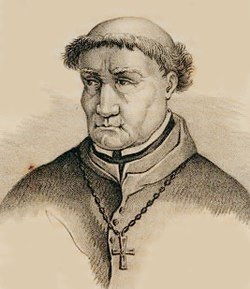
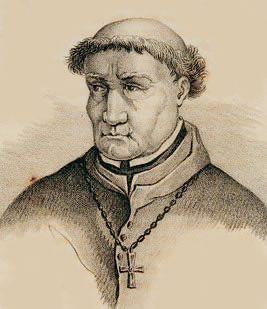
- Tomás de Torquemada
- Martín García Ceniceros
- Hentenius (1540s-1566)
- Vincenza Matilde Testaferrata, female inquisitor
From fiction
[edit]See also
[edit]References
[edit]- ^ Ormerod, Paul; Roach, Andrew P (2004-08-15). "The Medieval inquisition: scale-free networks and the suppression of heresy". Physica A: Statistical Mechanics and Its Applications. 339 (3): 648. arXiv:cond-mat/0306031. Bibcode:2004PhyA..339..645O. doi:10.1016/j.physa.2004.03.020. ISSN 0378-4371. S2CID 10947858.
 | This article about history of Christianity is a stub. You can help Wikipedia by expanding it. |
| International | |
|---|---|
| National | |

Inquisitor
View on GrokipediaDefinition and Role
Etymology and Historical Origins
The term inquisitor originates from the Latin inquisitor, an agent noun derived from inquirere ("to inquire" or "to search into"), itself composed of the prefix in- ("into") and quaerere ("to seek" or "to ask").[5] [6] This etymology underscores the function of systematic examination, initially applied in Roman legal contexts to denote searchers or examiners before its adoption in medieval ecclesiastical usage.[7] In Church documents, inquisitor first denoted officials empowered to initiate inquiries into suspected deviations from orthodox doctrine, contrasting with accusatorial systems where accusers drove proceedings.[8] The role's historical roots trace to the late 12th century, when the Catholic Church confronted dualist heresies like Catharism, which denied core tenets such as the Incarnation and sacraments, prompting organized responses in regions like Languedoc. Pope Lucius III's 1184 bull Ad Abolendam formalized the inquisitio haereticae pravitatis (inquiry into heretical depravity), directing bishops to delegate investigations into heresy, marking the shift from episcopal ad hoc judgments to procedural offices for evidence gathering and witness examination.[9] [10] This innovation addressed causal failures in prior episcopal systems, where local sympathies or corruption often shielded heretics, as evidenced by the Albigensian Crusade's prelude under Innocent III.[2] By 1231, Pope Gregory IX centralized authority by commissioning Dominican friars—chosen for their theological rigor and mendicant detachment—as permanent papal inquisitors, emancipating them from diocesan oversight to ensure impartiality in probing heresy empire-wide.[9] [2] This development, building on the Fourth Lateran Council's 1215 mandates for heresy detection, institutionalized the inquisitor as a specialized judge-delegate with faculties for excommunication, absolution, and coordination with secular arms for punishment, reflecting the Church's pragmatic adaptation to persistent doctrinal threats amid feudal fragmentation.[8] Early inquisitors, numbering fewer than a dozen per region, focused on reconciliation over execution, with records indicating most cases ended in penance rather than capital sentences.[10]Duties and Authority in the Church
Inquisitors, as papal delegates within the Catholic Church, were primarily responsible for safeguarding doctrinal orthodoxy by identifying and eradicating heresy, which was viewed as a spiritual contagion threatening the unity of the faith. Following Pope Gregory IX's issuance of the bull Excommunicamus in 1231, which formalized the Papal Inquisition, inquisitors—often mendicant friars such as Dominicans—were charged with preaching against heretical teachings, soliciting denunciations from the faithful, and initiating inquiries into suspected deviations from Catholic dogma.[11] Their investigative duties encompassed summoning witnesses, interrogating suspects under oath, and compiling evidence to determine the presence of heresy, with procedures outlined in subsequent papal directives like the 1231 bull Ille humani generis, which established standardized methods for clerical prosecution of faith offenses.[12] This role extended to offering opportunities for repentance, thereby distinguishing between relapsed and first-time offenders, as canon law prescribed lighter initial penances for the latter to encourage reconciliation with the Church.[10] The authority of inquisitors derived directly from papal commission, granting them extraordinary jurisdiction in heresy cases that frequently superseded that of local bishops, who had previously handled such matters but were often deemed ineffective due to regional influences or leniency.[1] They wielded powers to excommunicate unrepentant heretics, impose ecclesiastical penalties such as perpetual imprisonment in designated facilities, and seize temporal goods for the support of the Inquisition or restitution to victims of heresy, though property confiscation was intended for the Church's use rather than personal gain.[10] In trials, inquisitors acted as judges empowered by canon law to evaluate testimony and confessions, but they were prohibited from directly ordering executions; convicted heretics who refused to abjure were "relaxed to the secular arm," a formula signaling handover to civil authorities for potential capital punishment, as the Church maintained a formal stance against shedding blood.[11] This limitation stemmed from longstanding ecclesiastical principles, reinforced in papal bulls like Ad extirpanda (1252) by Innocent IV, which authorized limited torture only under strict conditions and solely for truth extraction, not punishment.[13] Inquisitorial authority emphasized the Church's supreme role in defining and defending revealed truth, with popes like Gregory IX delegating to inquisitors the mandate to act independently across diocesan boundaries to ensure impartiality and vigor in combating threats like Albigensianism.[12] By 1233, Gregory IX's bulls explicitly appointed Dominican inquisitors as official agents, equipping them with apostolic privileges such as the ability to absolve accomplices and override local immunities, thereby centralizing control over heresy suppression under Roman oversight.[11] This structure reflected a causal prioritization of eternal salvation over temporal concerns, positioning inquisitors as guardians of the depositum fidei against internal subversion, though their exercise of power was theoretically bounded by appeals to the Holy See and requirements for documented proceedings.[13]Comparison to Secular Judicial Roles
The role of the inquisitor paralleled secular judicial functions in inquisitorial legal traditions, particularly those derived from Roman civil law and adopted in continental European courts, where judges actively investigate facts rather than passively arbitrate between opposing parties. In both systems, the judicial authority combines investigative, prosecutorial, and adjudicative powers to pursue truth through directed inquiry, evidence collection, and interrogation, contrasting with adversarial models like those in English common law where neutral judges referee contestant presentations. This inquisitorial approach, formalized in the medieval Church's procedures from the 13th century onward, influenced secular systems by emphasizing written records, witness testimonies, and systematic documentation over ordeals or compurgation common in earlier secular practices.[14][15] Inquisitors, however, operated under ecclesiastical authority focused on doctrinal orthodoxy, investigating heresy as a spiritual offense that threatened communal salvation, whereas secular judges in inquisitorial systems—such as the French juge d'instruction established by the 19th-century Code of Criminal Instruction—targeted civil or criminal violations like theft or murder under state law. Both roles permitted limited use of torture to elicit confessions when strong presumptive evidence existed, but inquisitorial procedure restricted it more stringently than many contemporaneous secular courts; for instance, the Inquisition mandated two witnesses or an indicium for torture authorization and prohibited its repetition, practices that curbed abuses seen in secular tribunals reliant on noble accusations or blood feuds. Secular inquisitorial judges, like inquisitors, prioritized confession as evidentiary gold but integrated appeals and legal representation more variably, with the Church's canon law providing defendants rights to counsel and confrontation absent in some feudal courts.[10][4] Key distinctions arose in jurisdiction and enforcement: inquisitors lacked direct punitive power over life and limb, relinquishing unrepentant heretics to secular arms for execution—resulting in lower death rates, with estimates of 1-2% of cases in the Spanish Inquisition leading to capital sentences compared to higher frequencies in secular heresy prosecutions before 1478. Secular judges wielded full temporal authority, imposing fines, imprisonment, or death without ecclesiastical oversight, often amid political pressures from monarchs or guilds. While both systems aimed at causal determination of guilt through empirical inquiry, inquisitors' mandate derived from papal bulls like Ad Extirpanda (1252), embedding theological imperatives, whereas secular roles evolved under royal ordinances, as in the 1498 Sicilian constitution adapting inquisitorial methods for state crimes. This convergence reflects the Inquisition's role in legal innovation, exporting procedural rigor to secular realms while highlighting tensions between spiritual and temporal justice.[10][16]Historical Development
Establishment of the Medieval Inquisition (1215–1500)
The Medieval Inquisition emerged in response to persistent heretical movements, notably Catharism (a dualist sect denying the material world's goodness) and Waldensianism (advocating poverty and lay preaching), which gained traction in southern France and northern Italy during the early 13th century, undermining ecclesiastical authority and social order.[17][18] The Albigensian Crusade (1209–1229), launched by Pope Innocent III after the murder of papal legate Pierre de Castelnau in 1208, militarily subdued Cathar strongholds but failed to eradicate the ideology, necessitating judicial mechanisms beyond episcopal oversight or ad hoc secular interventions.[17][19] The Fourth Lateran Council (1215), convened by Innocent III with over 400 bishops in attendance, addressed heresy through Canon 3, which excommunicated heretics and their protectors, mandated secular rulers to confiscate their property, and required annual confession and communion for the faithful to detect deviations, but relied on local bishops for enforcement without establishing a dedicated papal tribunal.[20] This episcopal system proved inconsistent, as bishops often prioritized pastoral duties or faced local resistance, prompting calls for specialized inquisitors trained in theology and unbound by diocesan politics.[8] Pope Gregory IX formalized the Papal Inquisition in 1231 by delegating authority to Dominican friars via papal letters, commissioning them to investigate, try, and punish heretics in regions like Languedoc and Lombardy, thereby centralizing control under Rome to ensure doctrinal uniformity and limit vigilante excesses from the crusade era.[2][11] The Dominicans, approved as an order in 1216 and focused on anti-heretical preaching since their founding amid Cathar challenges, were selected for their intellectual rigor, mobility, and detachment from local ties, with Pope Gregory later confirming their inquisitorial role in 1233.[2][8] Franciscans occasionally assisted, but Dominicans dominated, conducting inquisitions that emphasized evidence from witnesses and records over mere accusation.[8] Procedural advancements solidified the institution: in 1252, Pope Innocent IV issued the bull Ad extirpanda, permitting limited torture (e.g., strappado or water torment) against obdurate suspects to elicit truth, provided it caused no permanent injury or death and was not repeated without new evidence, reflecting Roman legal influences adapted to heresy trials amid ongoing Cathar and Waldensian threats.[21][8] Inquisitors gained privileges like summoning witnesses, excommunicating obstructors, and handing unrepentant convicts to secular arms for execution (typically burning), with confiscated goods funding operations, though papal oversight aimed to curb abuses like property grabs for personal gain.[8] By the late 13th century, the Inquisition had tribunals in major heresy hotspots, such as Toulouse (established 1233) and Aragon (via papal bull Declinante in 1232), prosecuting thousands—e.g., over 5,000 Cathars sentenced between 1233 and 1241 in Languedoc—effectively suppressing organized dualism but sparking resistance and procedural critiques.[8][19] Into the 14th–15th centuries, it adapted to new challenges like the Spiritual Franciscans and Hussites, with figures like Bernard Gui (inquisitor 1308–1323) documenting over 630 convictions in manuals emphasizing legal rigor, though inconsistencies persisted until Roman centralization efforts under popes like John XXII.[8] This framework prioritized truth extraction via testimony hierarchies (e.g., valuing heretic confessions over rumors) and penance for redeemable offenders, distinguishing it from secular courts' focus on public order.[8]Expansion in the Spanish and Portuguese Inquisitions (1478–1834)
The Spanish Inquisition was instituted on November 1, 1478, through a papal bull issued by Pope Sixtus IV in response to petitions from King Ferdinand II of Aragon and Queen Isabella I of Castile, with the initial mandate to scrutinize the orthodoxy of conversos—Jews who had converted to Christianity amid pressures following the 1391 pogroms—and to address perceived threats of Judaizing practices among them.[22] This establishment marked a shift from episcopal inquisitions, granting the crown significant control over ecclesiastical authority to enforce religious uniformity in a realm recently unified through the Reconquista. Under Tomás de Torquemada, appointed as the first Inquisitor General in August 1483 for Castile and León, with jurisdiction extended to Aragon, Catalonia, Valencia, and Majorca by October 17, 1483, the institution rapidly expanded its infrastructure, founding tribunals in key cities such as Seville (1481), Córdoba (1482), Toledo (1485), and others, reaching 21 operational tribunals by the late 15th century.[23] Torquemada's leadership, characterized by rigorous enforcement and the issuance of supplementary instructions in 1484 and 1485 to standardize procedures, facilitated the Inquisition's growth into a centralized apparatus that processed over 67,000 trials across its 356-year span from 1478 to 1834, targeting not only crypto-Judaism but expanding to include accusations of Protestantism after 1520, morisco (converted Muslim) practices, bigamy, blasphemy, and solicitation in confession.[22] Empirical records indicate that executions, typically handed over to secular authorities for burning (relaxed to the secular arm), numbered between 3,000 and 5,000, representing approximately 3-5% of total prosecutions, with the majority of penalties involving fines, penance, or reconciliation rather than death, countering exaggerated narratives of mass bloodshed.[22] The Inquisition's scope broadened geographically and thematically, incorporating autos-da-fé public ceremonies—first held in Seville in 1481—to deter heresy, and by 1492, it contributed to the Alhambra Decree expelling unconverted Jews, affecting an estimated 100,000-200,000 individuals, while moriscos faced expulsion edicts in 1609-1614 under Philip III, displacing around 300,000.[24] In parallel, the Portuguese Inquisition was established on December 17, 1536, via papal bull from Pope Paul III, authorized at the behest of King John III to parallel Spain's model in combating Judaizers among New Christians, many of whom had been forcibly converted during the 1497 edict.[25] Tribunals were set up in Lisbon (1536), Coimbra (1541), and Évora (1546), with expansion into colonial territories including Goa in India (1560), Angola, Brazil (via visitations starting 1591), Cape Verde, and São Tomé, adapting inquisitorial authority to enforce orthodoxy in overseas possessions amid the Atlantic slave trade and missionary efforts.[26] Over its duration until suppression in 1821, it conducted more than 50,000 trials, with documented executions around 1,800-2,000, primarily for persistent Judaism, Lutheranism, or Islam, though colonial operations focused on delegated visitations rather than permanent tribunals to manage vast empires efficiently.[25] Both Inquisitions persisted into the 19th century, reflecting monarchical reliance on them for social control amid Enlightenment challenges; the Spanish variant was temporarily suppressed in 1808 by Napoleonic invaders, restored in 1814 by Ferdinand VII, and definitively abolished on July 15, 1834, by regency decree under María Christina, while Portugal's ended earlier amid liberal revolutions.[22] Archival evidence from trial records underscores their role in documenting demographic shifts, with prosecutions peaking in the 16th century before declining, as economic incentives for reconciliation often outweighed punitive measures, revealing a pragmatic adaptation rather than unrelenting fanaticism.[27] This expansion solidified inquisitorial inquisitors as key enforcers of confessional states, prioritizing doctrinal purity to underpin imperial cohesion, though modern analyses highlight how procedural safeguards, like required evidence and appeals to Rome, moderated outcomes compared to contemporaneous secular persecutions.[28]The Roman Inquisition and Later Forms (1542–19th Century)
The Roman Inquisition, formally the Supreme Sacred Congregation of the Roman and Universal Inquisition, was founded on July 21, 1542, by Pope Paul III via the bull Licet ab initio, which appointed a commission of six cardinals tasked with safeguarding Catholic doctrine against emerging heresies, particularly Protestant influences spreading into Italy and other papal territories.[29][30] This centralization addressed the fragmented nature of prior inquisitorial efforts, placing ultimate authority under direct papal oversight rather than local bishops or secular rulers, with the congregation headquartered in Rome and extending jurisdiction over inquisitorial activities in Italy and beyond.[31] The institution's primary mandate involved investigating denunciations of heresy, censoring prohibited texts through mechanisms like the 1559 Index Librorum Prohibitorum, and enforcing orthodoxy via trials that prioritized confession and reconciliation over capital punishment.[32] In operation, the Roman Inquisition differed markedly from contemporaneous bodies like the Spanish Inquisition, which was monarchically controlled and often intertwined with state politics, including purges of conversos and moriscos for perceived social threats.[33] The Roman variant, by contrast, maintained ecclesiastical independence, rarely imposed social controls beyond doctrinal matters, and exhibited greater procedural restraint; for instance, archival records from Friuli between 1557 and 1650 document 2,129 cases with minimal executions, favoring fines, book burnings, or house arrest.[33] Annual activities in the 17th century, such as 1626 records showing approximately 115 formal denunciations and 70 voluntary confessions processed by the Holy Office, underscore a focus on surveillance and preventive measures rather than mass prosecutions, with torture applied sparingly and only after evidence thresholds were met.[34] This approach stemmed from centralized Roman directives emphasizing canonical law, which limited inquisitors' autonomy and reduced reliance on coerced testimony compared to Iberian models.[10] Throughout the 17th and 18th centuries, the Roman Inquisition adapted to challenges like scientific inquiries and philosophical dissent, conducting high-profile interrogations—such as those involving proponents of heliocentrism—while upholding geocentric interpretations of scripture as binding on faith.[35] Its tribunals in Italian states suppressed Protestant missions and Jewish proselytism, yet empirical tallies reveal low lethality; estimates across Italian operations from 1542 onward indicate executions numbering in the low hundreds, far below exaggerated narratives, with most outcomes involving abjurations or bibliographic expurgations.[36] By the late 18th century, Enlightenment pressures and revolutionary upheavals— including Napoleonic suppressions in occupied territories—eroded its enforcement capacity, confining activities to doctrinal oversight and censorship amid rising secular governance.[37] Into the 19th century, vestigial forms persisted under papal restoration post-Napoleon, handling sporadic cases of modernism and biblical criticism, though jurisdictional reach contracted as nation-states curtailed ecclesiastical courts.[29] The congregation's evolution reflected causal shifts toward internal Church reform rather than external inquisitions, culminating in diminished operational scope by mid-century, with formal inquisitorial trials yielding to consultative roles on faith matters before its 1908 redesignation as the Holy Office.[31] This trajectory underscores the Roman Inquisition's role as a stabilizing doctrinal apparatus, effective in containing heterodoxy within confined geographic and theological bounds without the expansive punitive apparatus of national variants.[38]Procedures and Methods
Investigation and Evidence Gathering
Inquisitorial investigations into suspected heresy generally initiated upon formal denunciations from clergy, lay informants, or public rumor (fama), which triggered a preliminary assessment to determine if sufficient grounds existed for deeper inquiry. Inquisitors, acting as both investigators and judges under the inquisitio system formalized by Pope Innocent III in the early 13th century, prioritized the accumulation of testimonial evidence through anonymous witness summonses, shielding identities via procedures like the "general rumor" method to mitigate risks of perjury or reprisal. Notaries recorded depositions verbatim in Latin, creating detailed dossiers that emphasized factual details over adversarial confrontation, distinguishing the process from contemporary accusatory trials.[39][40] Core evidence derived from sworn witness statements, often numbering dozens per case, cross-examined for consistency against prior records or known heretical networks; for instance, medieval inquisitors like those in 13th-century Languedoc compiled lists of suspects from communal testimonies before home searches for prohibited texts or symbols. Physical artifacts, including books, amulets, or ritual items, were confiscated during authorized raids, cataloged, and evaluated for doctrinal deviation, with chain-of-custody maintained via seals and inventories to ensure admissibility. Documentary sources, such as parish registers, episcopal correspondence, or earlier trial transcripts, supplemented oral accounts, enabling inquisitors to reconstruct timelines of alleged apostasy.[41][42] In the Spanish Inquisition, established in 1478, evidence gathering incorporated public edicts of grace—proclamations urging self-denunciation or informant tips—yielding thousands of initial leads annually, as seen in records from tribunals like Toledo where over 2,000 cases were opened by 1500 based on such solicitations. Roman Inquisition procedures from 1542 onward refined this with centralized archiving in the Holy Office, mandating consultations among consultors for evidence review and prohibiting reliance on hearsay without corroboration, as evidenced in 17th-century Venetian trials where witness plurality (at least two agreeing testimonies) was required for progression. Across variants, inquisitors avoided premature torture, reserving it for evidentiary gaps after exhaustive non-coercive collection, with empirical analyses of 16th-17th century Spanish records showing witness-derived evidence underpinned 80-90% of convictions.[43][44][45]Interrogation Techniques and Legal Standards
The inquisitorial process emphasized systematic interrogation as a means to ascertain truth through evidence gathering, distinct from adversarial systems prevalent in some secular courts. Interrogations typically commenced with the summoning of the accused, who was placed in isolation (carcer separatus) to preclude witness tampering or external influence, a practice codified in canon law following the Fourth Lateran Council of 1215. Initial questioning focused on general inquiries about faith and associations, gradually revealing specific charges derived from denunciations or fama publica (public notoriety), though witness identities were often withheld to safeguard informants from retaliation. This procedure, rooted in Roman-canon law, required the inquisitor to document responses verbatim, allowing the accused an opportunity to respond or provide counter-evidence, with advocates permitted in later stages to assist in defense.[46][39] Legal standards mandated graduated levels of proof for proceeding to coercion: plena probatio (full proof), consisting of a voluntary confession corroborated by independent evidence or testimony from two or more eyewitnesses, sufficed for conviction without further measures; semi-plena probatio (semi-full proof), such as circumstantial evidence or inconsistent statements, permitted interrogation under torture to elicit a ratifiable confession; and mere indicia (indications) warranted surveillance or penance but not severe penalties. Confessions extracted via torture had to be reaffirmed sine tormento (without duress) at a subsequent hearing, invalidating those retracted, as stipulated in inquisitorial manuals like those of the Suprema (the Spanish Inquisition's central council) established in 1488. These thresholds, drawn from 13th-century papal bulls such as Ad Extirpanda (1252), aimed to balance doctrinal enforcement with evidentiary rigor, exceeding the often arbitrary proof norms in contemporaneous civil tribunals.[47][48] When applied, torture was regulated to prevent mutilation, death, or excessive suffering, limited to one or two sessions not exceeding 15 minutes each, conducted in the presence of a physician, notary, and fiscal (prosecutor), with implements inspected beforehand. Common methods in the Spanish Inquisition included the potro (a padded bench with cords tightening limbs), toca (cloth over the face with water poured to induce suffocation), and strappado (suspension by wrists tied behind the back), but these were employed sparingly; archival analyses of over 7,000 cases in the Valencia tribunal (1484–1530) reveal torture in only about 2% of proceedings, far below rates in secular European courts of the era, such as England's use in common-law felony trials. In the Roman Inquisition, established in 1542, restrictions were stricter, with torture prohibited absent compelling prior evidence and banned outright for certain offenses by papal decree under Urban VIII in 1625, reflecting a preference for psychological pressure through prolonged isolation and repeated non-violent interrogations.[49][50][46] These techniques and standards prioritized confession as the "queen of proofs" due to its perceived reliability in revealing hidden heresy, yet empirical records from tribunal archives—preserved meticulously for appellate review—demonstrate restraint: convictions required multi-source corroboration, appeals to higher councils overturned erroneous judgments (e.g., over 10% of Spanish sentences mitigated), and false accusations carried penalties for perjurers. Compared to 16th-century French or English practices, where torture lacked medical oversight or ratification rules, the Inquisition's framework represented procedural innovation, though isolated abuses by overzealous inquisitors occurred, as documented in internal critiques like those from Cardinal Borromeo in 1585.[51][49]Trials, Confessions, and Sentencing
Inquisitorial trials operated under an ex officio model, where the inquisitor initiated investigations based on denunciations, rumors, or fama suspecta (public suspicion of heresy), gathering secret witness testimonies without disclosing sources to the accused to avert retaliation.[39] The accused faced private interrogations aimed at extracting a confession, deemed the "queen of proofs" in canon law and equivalent to testimony from two eyewitnesses; legal standards required corroboration for conviction, but hearsay and uncorroborated claims sufficed in practice if presumptions were strong.[39] Defense rights were limited: no legal counsel, confrontation of witnesses, or full disclosure of evidence, though the accused could submit counter-witnesses or arguments. Confessions formed the cornerstone of prosecutions, incentivized through edicts of grace offering leniency for voluntary admissions, but obtained via psychological pressure, prolonged isolation on minimal sustenance, or, as a last resort, torture when denial persisted amid circumstantial evidence.[39] Torture methods included the rack, strappado (suspension by wrists), and water torment, but canon law restricted it to one session per trial, forbade bloodletting or mutilation, and mandated joint episcopal-inquisitorial approval—provisions often circumvented in medieval cases yet enforced more rigorously later.[39] A confession under duress held no evidentiary weight unless ratified freely post-torture; retraction invited harsher measures, including relapse charges. Archival analyses of Spanish Inquisition tribunals show torture applied in roughly 2% of cases, with repeated applications exceptional and yielding unreliable results without subsequent validation.[52] [50] Sentencing followed conviction and abjuration (formal renunciation of heresy), calibrated by offense gravity, contrition, and recidivism: light penalties for prompt confessors included verbal reprimands, pilgrimages, almsgiving, or temporary wearing of the sanbenito (penitential sackcloth).[39] Moderate cases imposed fines, property confiscation (funding inquisitorial operations), public flogging, or murus largus (conventual imprisonment with comforts); severe or unrepentant heretics faced murus strictus (strict solitary confinement) or, for obstinacy and relapse, "relaxation to the secular arm"—transfer to civil authorities for burning at the stake, as ecclesiastical law prohibited direct capital punishment.[39] Pronouncements occurred in public autos-da-fé (acts of faith), blending reconciliation ceremonies with executions to affirm orthodoxy and deter dissent; across Spanish tribunals from 1540–1700, executions affected under 2% of accused, with most (e.g., Valencia 1566–1609: ~98%) receiving non-lethal sanctions.[50] The Roman Inquisition, centralized under papal oversight, mirrored these steps but prioritized consultative reviews by theologians and appeals to Rome, yielding proportionally fewer death sentences through emphasis on penitential correction over eradication.[53]Notable Inquisitors and Cases
Key Figures and Their Contributions
Tomás de Torquemada (1420–1498), a Dominican friar and nephew of Cardinal Juan de Torquemada, served as the first Inquisitor General of Spain from 1483 until his death, appointed by King Ferdinand II and Queen Isabella I to centralize and direct the Spanish Inquisition's operations against conversos suspected of Judaizing.[54] He established inquisitorial tribunals in key cities such as Jaén, Córdoba, and Ciudad Real in 1483, standardizing procedures for investigating heresy and confiscating property to fund the institution, which contributed to the expulsion of approximately 150,000 Jews in 1492 under royal edict.[2] Torquemada's rigorous enforcement, including oversight of over 100,000 trials and around 2,000 executions by burning during his tenure, aimed at doctrinal purity but drew contemporary criticism for severity, though records indicate most cases resulted in penances rather than death.[54] Bernard Gui (c. 1261–1331), a Dominican inquisitor active in Languedoc from 1308 to 1323, authored the Practica Inquisitionis Heretice Pravitatis around 1323–1324, a comprehensive manual outlining interrogation techniques, evidence evaluation, and sentencing for heresy trials, emphasizing confession through persistent questioning over torture.[55] Gui personally conducted over 600 interrogations, resulting in 40 executions and 207 penances, focusing on Cathar and Waldensian sects; his work influenced later inquisitorial practices by prioritizing legal documentation and soul-saving repentance, with only 5% of cases leading to capital punishment after relapse.[12] The manual's structured approach, including lists of heretical errors and witness credibility assessments, provided a model for systematic judicial process amid regional unrest.[55] Nicolas Eymerich (c. 1316–1399), appointed Inquisitor General of Aragon in 1357, compiled the Directorium Inquisitorum in 1376 as a guide for detecting and prosecuting heresy, incorporating theological analysis, procedural rules, and responses to common defenses, which became a standard reference printed in 1503 and reissued multiple times.[56] Exiled from Aragon in 1360 for conflicts with King Peter IV but reinstated later, Eymerich's text detailed 400–500 heretical propositions and advocated for episcopal cooperation, influencing inquisitorial methodology across Europe by codifying evidence standards and limiting arbitrary accusations.[56] His emphasis on intellectual rigor in refuting errors, drawn from Dominican scholarship, supported the Inquisition's role in maintaining orthodoxy against emerging threats like the Fraticelli.[57]
Significant Trials and Outcomes
One of the earliest large-scale inquisitorial proceedings targeted the Knights Templar, initiated by King Philip IV of France on October 13, 1307, with papal involvement from Pope Clement V. Accusations included heresy, idolatry, sodomy, and spitting on the cross during initiations, often extracted via torture; over 15,000 Templars were arrested across Europe, with many confessing under duress but later recanting. The order was suppressed by papal bull in 1312, and key leaders, including Grand Master Jacques de Molay, were burned at the stake in Paris on March 18, 1314, after retracting confessions, marking the dissolution of the military order despite inconsistent evidence and coerced testimonies.[58] The trial of Joan of Arc in 1431, conducted by a Rouen ecclesiastical court under Bishop Pierre Cauchon with Dominican inquisitors, exemplifies medieval inquisitorial processes against perceived heresy and sorcery. Captured in 1430 and handed to English allies, Joan faced 70 charges, including cross-dressing and claiming divine visions aiding French military success; she was convicted on May 30, 1431, and burned at the stake after refusing to recant fully, though procedural irregularities, such as lack of impartial witnesses and coerced witnesses, were later evident. A nullification trial in 1455-1456, ordered by Pope Callixtus III, declared the verdict invalid due to fraud and bias, rehabilitating her as a martyr on July 7, 1456.[59][60] In the Spanish Inquisition, under Grand Inquisitor Tomás de Torquemada from 1483, trials focused on judaizing conversos, with notable cases like the 1491 Holy Child of La Guardia affair involving alleged ritual murder and host desecration by Jews and converts. Eight defendants were tried in Ávila, convicted based on torture-induced confessions of crucifying a Christian child (whose body was never found), and executed publicly in an auto-da-fé on December 16, 1491, reinforcing policies leading to the 1492 expulsion of Jews; records show such trials often relied on denunciations and secret evidence, with outcomes including property confiscation to fund the Inquisition. Torquemada oversaw approximately 100,000 trials by 1498, resulting in around 2,000 executions, though many cases ended in lesser penances or acquittals upon reconciliation.[61] The Roman Inquisition's trial of Giordano Bruno, arrested in 1593 and prosecuted from 1597-1600, addressed charges of pantheism, denial of transubstantiation, and support for infinite worlds, stemming from his writings and teachings. After refusing to recant over 1,000 articles of suspected heresy, Bruno was convicted on January 20, 1600, handed to secular authorities, and burned at the stake in Rome's Campo de' Fiori on February 17, 1600, without prior strangulation mercy; the case highlighted the Inquisition's emphasis on doctrinal conformity over scientific speculation, as Bruno's cosmology was secondary to theological deviations.[62][63] Galileo Galilei's 1633 trial before the Roman Inquisition, triggered by his Dialogue Concerning the Two Chief World Systems promoting heliocentrism against a 1616 injunction, culminated in a conviction for "vehement suspicion of heresy" on June 22, 1633. Forced to recant publicly and sentenced to formal imprisonment (commuted to house arrest until his death in 1642), the outcome preserved geocentric orthodoxy amid biblical interpretation disputes, though empirical observations like phases of Venus were not directly refuted; later analyses note the trial's reliance on intent and prior warnings rather than outright falsity of evidence.[64][65]Achievements and Societal Role
Preservation of Doctrine and Social Order
Inquisitors served as guardians of Catholic orthodoxy by systematically rooting out deviations such as Judaizing practices among conversos and early Protestant influences, ensuring that public and private adherence to doctrine aligned with ecclesiastical standards. Established in 1478 under papal bull from Sixtus IV, the Spanish Inquisition focused initially on ensuring the sincerity of conversions from Judaism and Islam post-Reconquista, with tribunals investigating over 150,000 cases by the 16th century, primarily resulting in reconciliations or penances rather than executions, which preserved doctrinal purity without widespread societal disruption.[66][67] This enforcement prevented the proliferation of heresy that could erode the Church's salvific mission, as inquisitors viewed unpunished error as a contagious threat to communal faith; for instance, by the mid-16th century, the Inquisition had effectively quashed Lutheran cells in Spain through denunciations and trials, averting the kind of entrenched Protestant minorities that fueled conflicts elsewhere in Europe.[67][68] On the social front, the Inquisition bolstered order by aligning religious conformity with state loyalty, as the Catholic Monarchs leveraged it to consolidate power after Granada's fall in 1492, suppressing potential ethnic-religious divisions that might have fragmented the newly unified kingdoms. Tribunals maintained hierarchies by penalizing behaviors deemed antisocial, such as blasphemy or bigamy, which were seen as undermining familial and communal structures integral to medieval and early modern society.[69][70] Evidence from archival records indicates this contributed to Spain's avoidance of religiously motivated civil wars, unlike the French Wars of Religion (1562–1598) or the Thirty Years' War (1618–1648), fostering a stable environment where doctrinal unity supported imperial expansion and internal cohesion for over three centuries.[67][69]Empirical Data on Effectiveness and Restraint
The Roman Inquisition, operative from 1542 through the 18th century, processed an estimated 50,000 trials in its initial two centuries, primarily targeting suspected heresy, superstition, and doctrinal deviations in Italy and papal territories.[71] Of these, approximately 1,250 cases culminated in executions, yielding an execution rate of roughly 2%.[72] This figure contrasts sharply with contemporary secular tribunals, where death penalties for comparable crimes like treason or sedition often exceeded 10-20% of prosecutions, highlighting procedural safeguards such as requirements for multiple witnesses, allowance for defense arguments, and prioritization of abjuration over condemnation.[73] Conviction rates varied by locale and era, but non-capital outcomes dominated: in Venice from 1547 to 1592, of 1,560 trials under Roman oversight, most defendants received suspended sentences, minor fines, or brief imprisonment, with death reserved for persistent recidivists.[74] In Rome itself, executions post-1600 totaled only about 30, reflecting a shift toward administrative penalties like book censorship and exile for intellectual dissent rather than systematic elimination.[75] Torture, confined to vetted methods such as the strappado and applied under mandates requiring subsequent corroboration, occurred in fewer than 10% of cases overall, far below rates in episcopal or civil courts of the period.[76] These metrics underscore effectiveness in doctrinal preservation: heresy prosecutions peaked mid-16th century amid Counter-Reformation pressures, effectively stanching Protestant inroads in Italy, where conversion rates remained under 1% despite exposure via trade and diplomacy, as evidenced by declining trial volumes by the 17th century.[77] The system's emphasis on reintegration—over 80% of accused abjured and returned to the Church—sustained social cohesion without the mass upheavals seen in regions like France during religious wars, where civil authorities executed tens of thousands extrajudicially.[76] Long-term records from central archives confirm heresy suppression correlated with stabilized Catholic adherence, averting the schisms that fragmented northern Europe.[73]Contextual Comparisons to Contemporary Courts
The inquisitorial tribunals of the Catholic Church, particularly the Spanish Inquisition established in 1478, employed formalized procedures that contrasted with the often arbitrary practices of contemporaneous secular courts across Europe. Inquisitors, typically trained in canon and civil law, followed inquisitio ex officio principles, initiating investigations based on denunciations or evidence rather than private accusations, which allowed for proactive heresy detection but included requirements for corroboration through witnesses and documents.[78] In contrast, many secular courts in 15th- to 17th-century France and the Holy Roman Empire relied on accusatory systems prone to vendettas, where accusers could initiate proceedings without preliminary scrutiny, leading to higher rates of unsubstantiated claims.[79] This structural difference positioned the Inquisition as a centralized authority that occasionally intervened to moderate local secular excesses, such as by reviewing witchcraft accusations dismissed as superstition rather than heresy.[24] Torture in inquisitorial proceedings was legally circumscribed—permitted only after sufficient evidence, limited to specific methods like the rack or water torture, and prohibited if it risked death or permanent injury—reflecting canon law guidelines from the 1252 papal bull Ad extirpanda.[80] Secular courts in continental Europe, however, applied torture more liberally as a routine investigative tool without such papal-derived restraints; for instance, French parlements and German territorial courts used it preemptively in felony cases, often extracting confessions that bypassed further evidence gathering.[81] English common law courts, including the Star Chamber (active until 1641), eschewed systematic torture, aligning more closely with accusatory norms that emphasized confrontation but lacked the Inquisition's theological expertise in evaluating coerced testimony.[82] Records indicate inquisitorial torture was applied in fewer than 10% of Spanish cases, with reversals possible upon appeal to the Suprema council in Madrid, a oversight mechanism absent in most fragmented secular jurisdictions.[48] Execution rates further highlight procedural divergences: over 350 years, the Spanish Inquisition tried approximately 150,000 individuals, handing down about 3,000-5,000 death sentences (roughly 2-3% of cases), with most penalties involving fines, penance, or exile.[24] Secular tribunals handling similar charges, such as witchcraft in the Basque regions or Protestant territories, convicted at higher proportions; European witch hunts from 1450-1750 resulted in 40,000-60,000 executions, predominantly by civil authorities skeptical of ecclesiastical restraint. The Inquisition's skepticism toward mass spectral evidence—exemplified by the 1610 Logroño trials, where it acquitted 53 of 53 accused after re-examination—curbed panics that secular courts amplified, as local judges often deferred to popular fears without centralized review.[78] [24] Defendants in inquisitorial courts enjoyed limited but notable rights, including notification of charges (albeit summarized to protect informants), opportunities for defense via abogados in later periods, and appeals to higher ecclesiastical bodies, innovations that influenced the shift toward inquisitorial systems in secular Europe by the 16th century.[48] Comparable secular venues, like the French châtelet courts, offered scant counsel and public trials marred by bribery or noble privilege, while the Inquisition's secret proceedings, though criticized, prioritized doctrinal consistency over spectacle.[83] These elements underscore the Inquisition's role as a professionalized counterweight to the caprice of feudal justice, preserving records that enabled post-trial exonerations—facilities secular archives often lacked.[84]Criticisms and Controversies
Documented Abuses and Power Dynamics
Inquisitorial tribunals wielded extensive authority over suspects accused of heresy, often detaining individuals indefinitely without secular oversight and confiscating property to fund operations, which created incentives for prolonged investigations and potential corruption. Archival records from inspections in the 16th century document cases where inquisitors accepted bribes to mitigate sentences or imposed excessive fines beyond legal norms, undermining procedural fairness. For instance, primary sources reveal moral and financial deviations among agents, including the manipulation of denunciations for personal vendettas, as voluntary reports were encouraged under threat of accusation themselves.[85][86] Torture was systematically applied in a minority of trials—estimated at 10-15% based on surviving transcripts—to extract confessions or witness testimony, with methods such as the potro (a form of waterboarding) and garrucha (suspension by wrists) bureaucratized and requiring prior approval from superiors. In the 1560 trial of Pedro Ginesta, as recorded in original manuscripts, torture was authorized to compel details against accomplices, though confessions obtained under duress were legally inadmissible without corroboration. Similarly, the trial of Juan Duran involved physical coercion to affirm heretical practices, highlighting how power imbalances pressured recantations that could lead to reconciliation or harsher penalties upon relapse.[43][87] Anonymous denunciations fueled many proceedings, exploiting social rivalries; economic competitors or familial disputes prompted false reports, amplifying the tribunals' reach into private spheres. Data from over 67,000 trials between 1480 and 1820 indicate widespread persecution of conversos and moriscos, where initial accusations often escalated due to inquisitorial discretion in evidence evaluation, resulting in property losses even for acquitted parties. While executions totaled approximately 3,000 to 5,000 across 350 years—averaging fewer than 15 annually—these dynamics entrenched fear and compliance, with long-term societal effects including reduced trust in affected regions.[88][89][90]Debunking Exaggerated Narratives and Propaganda
The notion of the Inquisition as a uniquely barbaric institution responsible for millions of deaths stems from the "Black Legend," a campaign of anti-Spanish and anti-Catholic propaganda initiated by Protestant polemicists in the late 16th century, particularly following the 1567 publication of A History of the Damnable Heresies by Dutch Calvinist Antonio del Corro, which exaggerated inquisitorial atrocities to undermine Habsburg power and justify religious wars.[91] This narrative was amplified by Enlightenment figures like Voltaire, who drew on biased accounts from exiles and rivals, portraying the Spanish Inquisition as a symbol of Catholic fanaticism without regard for archival evidence, a distortion later critiqued by historians accessing Vatican and Spanish records opened in the 1970s.[92] Claims of tens or hundreds of millions executed across inquisitorial tribunals lack empirical support; for the Spanish Inquisition spanning 1478 to 1834, modern archival analysis yields estimates of 3,000 to 5,000 executions out of approximately 150,000 prosecutions, with historian Henry Kamen calculating around 2,000 prior to 1530 across all tribunals.[93] These figures contrast sharply with 19th-century fabrications, such as those alleging 32 million victims, which ignored preserved trial records showing most cases resolved via penance or fines rather than capital punishment.[94] Torture, while employed, was regulated more stringently than in contemporaneous secular courts: sessions limited to two 15-minute intervals with a mandatory rest day, supervised by a physician to prevent death or lasting harm, and prohibited if evidence was insufficient—resulting in its application in fewer than 2% of Spanish Inquisition cases, compared to routine use in English or French royal tribunals.[95] Instruments like the iron maiden or pear of anguish, often depicted in popular media, originated as 19th-century museum hoaxes rather than historical inquisitorial tools, with no contemporary documentation.[96] The Inquisition's approach to witchcraft further counters narratives of irrational zeal; Spanish inquisitors, including figures like Alonso de Salazar y Frías during the 1610 Logroño trials, systematically debunked mass accusations through empirical investigation, executing far fewer—around 300 total—than the 40,000-60,000 in Protestant German states, where skepticism was rarer absent centralized doctrinal oversight.[97] This restraint arose from causal emphasis on verifiable heresy over folklore, prioritizing social stability over panic-driven purges prevalent in fragmented secular jurisdictions.[98] Such revisions highlight how institutional biases in Protestant historiography and later academic reluctance to challenge anti-Catholic tropes perpetuated unverified maxima, yet primary sources affirm the Inquisition's procedural formalism often exceeded that of peers, mitigating rather than exemplifying medieval Europe's punitive norms.[99]Balanced Assessment of Moral and Causal Factors
The moral framework underpinning the Inquisition rested on the conviction that heresy constituted a profound threat not merely to individual souls but to the communal fabric of Christian society, akin to treason in its potential to destabilize both spiritual and temporal order. Church authorities, drawing from scriptural imperatives such as Titus 3:10-11, viewed unrepentant heresy as deserving severe correction to avert eternal damnation for the heretic and contagion for others, prioritizing collective salvation over personal autonomy in an era when religious deviation was empirically linked to social upheaval, as seen in the Cathar and Albigensian movements that fomented violence and secession in 12th-13th century France.[100] This rationale, articulated by figures like Thomas Aquinas, posited that coercion in temporal matters could facilitate spiritual repentance, a position rooted in causal realism: unchecked heresy had historically precipitated massacres and civil wars, rendering suppression a defensive necessity rather than gratuitous persecution.[37] Causally, the Inquisition's operations were driven by the exigencies of state-building in post-Reconquista Spain and amid Europe's confessional conflicts, where religious uniformity was deemed essential for national cohesion; for instance, the Spanish variant, established in 1478, targeted conversos suspected of Judaizing to prevent internal subversion that could invite Ottoman or French incursions, reflecting pragmatic realpolitik over ideological fanaticism alone. Abuses, including isolated instances of torture and false accusations, arose from localized power imbalances—such as inquisitors' reliance on denunciations and occasional venality—but were mitigated by procedural safeguards like appeals to Rome, defendant access to counsel (introduced in 1231), and prohibitions on anonymous testimony, which contrasted with the arbitrariness of secular tribunals. Empirical records indicate restraint: across approximately 150,000 trials in Spain from 1480 to 1834, executions numbered 3,000-5,000, averaging under 10 annually, far below the tens of thousands killed in contemporaneous English heresy hunts under Mary I (around 280 in five years) or French religious wars (up to 3 million over decades).[92][101][44] A balanced reckoning acknowledges moral culpability in cases of overreach, such as the 1480s campaigns against conversos yielding disproportionate confiscations, yet underscores that systemic exaggeration stems from the "Black Legend," a propaganda effort by Protestant rivals and Enlightenment critics to vilify Catholic institutions, inflating death tolls to mythical millions despite archival evidence debunked by scholars like Henry Kamen, who, analyzing tribunal records, found the Inquisition less lethal and more juridically advanced than portrayed. Causally, this disparity highlights selection bias in hostile sources: while abuses warranted reform (as evidenced by papal suppressions of rogue inquisitors), the institution's empirical moderation—torture applied in under 2% of cases, per procedural logs—suggests it functioned as a stabilizing force amid era-defining perils, where alternatives like mob justice or unchecked secular vengeance exacted higher human costs. Modern assessments, informed by declassified Inquisition archives since the 19th century, affirm that moral judgments detached from this context risk anachronism, ignoring how causal pressures of existential religious strife necessitated mechanisms that, however imperfect, preserved doctrinal integrity and curbed worse excesses.[91][76]Legacy and Modern Interpretations
Influence on Inquisitorial Legal Systems
The inquisitorial legal procedure, characterized by judicial initiative in investigation rather than reliance on private accusations, emerged prominently in the ecclesiastical courts of the medieval Catholic Church through the Inquisition established in the 13th century. Pope Gregory IX formalized the papal Inquisition in 1231 by appointing specialized inquisitors to systematically inquire into heresy, shifting from the earlier episcopal accusatory model where bishops responded to denunciations. This inquisitio process involved the judge collecting evidence ex officio, using written records, secret testimonies, and limited torture for confessions when strong presumptions existed, as codified in inquisitorial manuals like those of Bernard Gui around 1323-1324.[102][103] The Fourth Lateran Council of 1215 banned clerical participation in trials by ordeal, necessitating the development of rational inquiry methods, which the Inquisition refined into a standardized protocol emphasizing documentation and confrontation of evidence under judicial control. This contrasted with the adversarial systems prevalent in pre-12th-century Europe, where private accusers bore the burden of proof and risked punishment if claims failed, often leading to under-prosecution of hidden crimes like heresy. By the mid-13th century, the Inquisition's procedures had integrated elements of revived Roman canon law, creating a model where the state or church authority proactively sought truth through official investigation, influencing the ius commune—the blend of Roman and canon law adopted across continental Europe.[102][103] Secular rulers adopted these inquisitorial elements for efficiency in criminal justice, particularly from the 14th century onward, as seen in the Holy Roman Empire's Peinliche Gerichtsordnung of 1532, which incorporated inquisitorial summons and evidence-gathering. In France, royal ordinances under Louis IX in the 1250s began emulating inquisitorial investigations for treason and felony cases, evolving into the procédure inquisitoire formalized in civil codes by the 17th century. By the 16th century, the Church had fully supplanted accusatory procedures with inquisitorial ones in its courts across Europe, a shift mirrored in secular systems in Italy, Spain, and the Low Countries, where inquisitors' emphasis on written dossiers and judicial impartiality (in theory) reduced reliance on potentially vengeful accusers.[79][103] This procedural legacy persisted in modern civil law traditions, underpinning systems in countries like Germany, Italy, and Japan, where judges direct fact-finding via mandatory witness examination and evidence compilation, distinct from Anglo-American adversarial reliance on party-driven advocacy. Empirical analyses of Inquisition records, such as those from Languedoc showing conviction rates below 10% in some tribunals due to evidentiary rigor, highlight how the system's causal focus on verifiable proof over accusation influenced later reforms prioritizing state-led inquiry for complex offenses. However, elements like non-disclosure of accusers, critiqued even in medieval papal bulls limiting their use, carried forward tensions between efficiency and transparency in inquisitorial frameworks.[102][79]Persistence in Church Structures Today
The Dicastery for the Doctrine of the Faith (DDF), formerly known as the Congregation for the Doctrine of the Faith (CDF), represents the direct institutional successor to the Roman Inquisition established by Pope Paul III in 1542 as the Supreme Sacred Congregation of the Roman and Universal Inquisition.[104] This body, renamed the Holy Office in 1908 and restructured as the CDF in 1965 under Pope Paul VI, retained the core mandate of promoting and safeguarding Catholic doctrine on faith and morals against deviations.[29] In 2022, Pope Francis reformed it into a dicastery via the apostolic constitution Praedicate Evangelium, emphasizing its role in defending the integrity of faith amid contemporary challenges, though without the coercive judicial powers of earlier inquisitorial tribunals.[105] Today, the DDF conducts doctrinal inquiries into theological writings, clerical statements, and potential heresies, often initiating processes upon referrals from bishops or self-reports.[106] For instance, it evaluates the orthodoxy of published works by theologians and clergy, issuing notifications or censures when errors are identified, as seen in historical cases like the 1980s investigations into liberation theology proponents such as Leonardo Boff, who faced restrictions on teaching and publishing. More recently, the DDF has addressed modern bioethical and anthropological issues through declarative documents, such as Dignitas Infinita (April 8, 2024), which reaffirms Church teaching on human dignity while critiquing practices like gender theory and surrogacy based on unchanging principles of natural law and revelation. The dicastery also centralizes oversight of supernatural phenomena, including alleged Marian apparitions, under norms promulgated on May 17, 2024, which streamline investigations to distinguish authentic revelations from deceptions or fabrications, replacing prior 1978 guidelines.[107] This framework empowers the DDF to issue definitive judgments—such as nihil obstat for devotion or prohibitions—after consulting local bishops and experts, as applied to ongoing cases like Medjugorje, where a 2019 CDF commission recommended regulated pilgrimage without affirming supernatural origin.[108] These activities demonstrate a continuity of inquisitorial vigilance adapted to non-punitive, advisory functions, focusing on preventive doctrinal clarification rather than trials or penalties, with the last formal heresy condemnation occurring in 1998 against Sri Lankan priest Tissa Balasuriya. While the DDF collaborates with other Vatican offices on clerical abuse cases involving doctrinal elements, its primary persistence lies in upholding orthodoxy through examination and correction, countering relativism in a secular age.[106]Shifts in Historical Scholarship
Early historiography of the Inquisition, particularly the Spanish variant established in 1478, was dominated by narratives shaped by Protestant polemics and Enlightenment critiques, which amplified accounts of widespread atrocities to demonize Catholic institutions. Works such as those by Juan Antonio Llorente in the early 19th century, drawing on selective Inquisition records, estimated tens of thousands of executions, fostering the "Black Legend" of unrelenting fanaticism that portrayed inquisitors as uniquely barbaric compared to contemporary secular justice systems.[109] These views privileged anecdotal horrors over systematic evidence, often sourced from émigré testimonies biased against Habsburg Spain, and ignored procedural norms like the right to defense counsel introduced in 1570.[110] A pivotal shift occurred in the mid-20th century with increased access to Inquisition archives, beginning in the 1960s, enabling empirical reassessments that challenged inflated death tolls and emphasized institutional restraint. Henry Kamen's 1965 monograph The Spanish Inquisition: A Historical Revision, updated through multiple editions incorporating trial dossiers from Madrid and regional tribunals, demonstrated that over 350 years, approximately 150,000 cases were processed, with executions numbering around 3,000—roughly 2% of defendants—far below rates in English witch trials (up to 500 executed in one decade) or French religious wars.[109] Kamen highlighted inquisitors' bureaucratic focus on heresy detection via informants and torture (used in under 2% of cases, per archival logs), prioritizing penance and confiscation over capital punishment, contrasting with secular courts' higher reliance on summary executions.[111] Subsequent quantitative studies in the 1980s, such as those by Gustav Henningsen and Jaime Contreras analyzing 44,000 Spanish Inquisition trials from 1540–1700, confirmed low lethality, with most outcomes involving fines or exile rather than death, attributing prior exaggerations to propagandistic distortions rather than archival fidelity.[112] For the Roman Inquisition, post-1998 Vatican archive openings yielded data from Agostino Borromeo's surveys showing only 125 executions across all Italian tribunals from 1542–1761, underscoring a theological emphasis on doctrinal conformity over mass repression.[113] These revisions reveal inquisitors as rational administrators embedded in early modern state-building, responsive to royal oversight—e.g., Philip II's 1561 instructions limiting autos-da-fé spectacles—rather than autonomous zealots, debunking causal myths of the Inquisition as a primary driver of Spain's economic stagnation.[109] Contemporary scholarship, informed by digital cataloging of millions of folios since the 2000s, further integrates social history, examining inquisitorial records for insights into gender dynamics, literacy, and minority integration, while critiquing residual academic tendencies to overemphasize victimhood narratives influenced by post-1960s secular ideologies.[114] This data-driven approach privileges causal analysis of enforcement patterns—e.g., peak activity during 1480–1530 converso purges yielding 1,500 executions—over moralistic framings, establishing the Inquisition's operations as comparatively measured within an era of religious upheaval where Protestant regimes executed thousands for dissent, such as England's 300 Marian burnings from 1555–1558.[115] Despite these evidentiary advances, popular and some institutional histories persist in uncorrected stereotypes, underscoring the need for ongoing archival scrutiny to counter source biases from anti-clerical traditions.[110]Depictions in Culture
Literary and Philosophical Representations
One of the most influential philosophical representations of the inquisitor appears in Fyodor Dostoevsky's 1880 novel The Brothers Karamazov, specifically in the parable "The Grand Inquisitor" narrated by the character Ivan Karamazov. In this embedded narrative, set during the Spanish Inquisition, the 90-year-old Grand Inquisitor arrests the returned Christ and delivers a monologue critiquing divine freedom as an unbearable burden on humanity, asserting that most people prefer security through miracle, mystery, and authority provided by the Church, which has allied with the devil's temptations to ensure obedience and happiness.[116][117] Dostoevsky uses the inquisitor to explore tensions between free will and authoritarian control, faith and reason, portraying the figure not merely as a tyrant but as embodying a seductive rationale for sacrificing individual liberty for collective stability—a view implicitly rejected in the parable when Christ kisses the inquisitor without responding verbally.[116] This depiction has profoundly shaped philosophical discourse on existential themes, influencing interpretations of human nature's preference for determinism over autonomy and serving as a critique of institutional religion's potential to prioritize power over spiritual freedom.[117] Scholars note its resonance in debates on authority, with the inquisitor's argument drawing from historical inquisitorial justifications for coercion to preserve orthodoxy, though Dostoevsky frames it as a temptation antithetical to true Christianity.[116] In modern literature, Umberto Eco's 1980 historical novel The Name of the Rose features inquisitors as central antagonists in a 1327 Italian monastery setting, drawing on real figures like Bernard Gui, a Dominican inquisitor depicted as a cold, legalistic enforcer of papal doctrine who prosecutes perceived heresies through rigged trials and torture.[118] Contrasted with the Franciscan protagonist William of Baskerville—a former inquisitor employing empirical reasoning and skepticism—Eco portrays inquisitors as dogmatic suppressors of knowledge, using the institution to eliminate threats to ecclesiastical power amid a series of murders linked to a forbidden Aristotelian text.[119] This representation underscores philosophical conflicts between rational inquiry and inquisitorial absolutism, reflecting Eco's semiotic interests in how signs and texts become tools of control.[118] Literary works often symbolize inquisitors as archetypes of intellectual tyranny, yet these portrayals, while rooted in historical abuses, sometimes amplify dramatic elements for narrative effect; for instance, Eco bases Gui's methods on his actual Book of Sentences (c. 1323–1330), which documented over 600 heresy cases with a conviction rate exceeding 80%, emphasizing procedural rigor over medieval sensationalism.[119] Such depictions contribute to broader cultural understandings of the inquisitor as a figure embodying the perils of unchecked authority in pursuit of truth.In Film, Games, and Other Media
In films, inquisitors are frequently depicted as archetypal villains embodying religious fanaticism and institutional cruelty, often exaggerating historical torture methods for dramatic tension. For instance, in The Name of the Rose (1986), the character Bernardo Gui, portrayed by F. Murray Abraham, serves as a Dominican inquisitor who rigorously prosecutes suspected heretics at a medieval monastery, using interrogation techniques and trials to enforce orthodoxy amid a series of murders.[118] Similarly, Roger Corman's The Pit and the Pendulum (1961), adapted from Edgar Allan Poe's story, sets its horror narrative during the Spanish Inquisition, portraying inquisitorial authorities as orchestrators of sadistic punishments like the titular pendulum device to extract confessions from the accused.[120] These representations, analyzed in scholarly reviews of Hollywood portrayals, tend to amplify inquisitors' roles in widespread brutality, presenting them as cartoonishly malevolent figures that perpetuate mythologized views of the institution over nuanced legal proceedings.[121] Parodic treatments highlight the cultural trope of inquisitorial surprise and inefficiency. The Monty Python troupe's recurring sketches in Monty Python's Flying Circus (first aired September 22, 1970), feature cardinals Ximénez, Biggles, and Fang bursting into mundane domestic scenes with cries of "Nobody expects the Spanish Inquisition!", wielding absurd torture implements like the "Comfy Chair" and emphasizing elements of fear, surprise, and fanatical devotion to the Pope in a satirical mockery of historical unexpected raids.[122] This catchphrase has permeated popular culture, symbolizing unanticipated authoritarian overreach.[123] In video games, inquisitors appear in fantasy and sci-fi contexts, often as playable protagonists wielding investigative and martial authority against supernatural threats, diverging from purely antagonistic film roles. Dragon Age: Inquisition (2014) casts the player as "the Inquisitor," a customizable leader of a reformed holy order combating demonic incursions and political intrigue in the world of Thedas, with the character's hand marked by a rift-granting power positioning them as a herald-like savior.[124] Conversely, Inquisitor (2006), an isometric action RPG, lets players control a medieval inquisitor—selectable as priest, paladin, or thief—who hunts vampires and demons across Europe using combat, spells, and moral choices that affect alliances and endings. In the Warhammer 40,000 universe, inquisitors embody puritanical zealots purging heresy; the game Warhammer 40,000: Inquisitor - Martyr (2018) places players in the role of an Imperial Inquisitor on a forsaken planet, engaging in top-down shooter gameplay against xenos and Chaos forces with customizable weapons and psychic abilities reflective of the lore's grimdark enforcement of humanity's doctrine.[125] Other media, such as tabletop games and novels, reinforce inquisitors as symbols of uncompromising vigilance. In Games Workshop's Warhammer 40,000 franchise, launched in 1987, inquisitors operate as secretive agents of the Emperor's Inquisition, authorized to execute planetary exterminatus if threats to Imperial purity demand it, a theme explored in short films like the 1996 Games Workshop production Inquisitor and extensive Black Library novels depicting their solitary hunts for corruption.[126] These portrayals, while inspired by historical inquisitorial models, adapt the archetype to dystopian futures, emphasizing causal trade-offs between security and tyranny in expansive lore spanning rulebooks, miniatures, and digital adaptations.[127]References
- https://en.wiktionary.org/wiki/inquisitor