


Community hub
Recent from talks
Contribute something
Nothing was collected or created yet.
Online piracy
View on Wikipedia

Online piracy (also called digital piracy, internet piracy or software piracy) is the practice of downloading and digitally distributing copyrighted works, such as music, movies or software, without permission.[1][2][3]
History
[edit]Nathan Fisk traces the origins of modern online piracy back to similar problems posed by the advent of the printing press. Quoting from legal standards in MGM Studios, Inc. v. Grokster, Ltd., he notes that there have historically been a number of technologies which have had a "dual effect" of facilitating legitimate sharing of information, but which also facilitate the ease with which copyright can be violated. He likens online piracy to issues faced in the early 20th century by stationers in England, who tried and failed to prevent the large scale printing and distribution of illicit sheet music.[4]: 9–10
WordStar was so widely pirated that many books on how to use the software appeared, their authors knowing that they were selling documentation for illicit copies.[5] Starting in the 1980s, the availability of dial-up modems led to the creation of the first warez distribution groups.[6][7] Piracy of Atari 8-bit and Atari ST software was so rampant that it discouraged publishers from releasing products for those computers.[8][9] ST-Log warned that "we had better put a stop to piracy now ... it can have harmful effects on the longevity and health of your computer".[10] Internet Relay Chat featured file servers and XDCC prior to numerous methods and still continue to be used.
The release of Napster in 1999 caused a rapid upsurge in online piracy of music, films and television, though it always maintained a focus on music in the MP3 format.[11][12] It allowed users to share content via peer-to-peer (P2P) file sharing and was one of the first mainstream uses of this distribution method as it made it easy for regular users to get free music. Napster's popular use would only be short lived, as on July 27, 2000, it was ordered to be shut down by a federal judge; it was officially shut down July 11, 2001 in order to comply with the order and the case was officially settled on September 24, 2001.[13]
Although it was short-lived, Napster's reign allowed its users to dive into the grey area of content piracy. Following its shutdown, many other popular P2P file sharing programs arose: the creation and usage of Limewire quickly followed suit. Learning from the mistakes of Napster, Limewire decentralized their servers by implementing the Gnutella network.[14] The success of the BitTorrent communication protocol led to the rise of many other popular programs that are still widely used today including μTorrent, Transmission, Deluge, qBittorrent, and Tixati. Digital piracy as a continuing problem significantly impacts various stakeholders, enterprises, and countries. This global problem can impact media- and content-oriented industries.[15]
Scope
[edit]The economic loss caused by digital piracy before the year 2000 is estimated to be worth $265B and in 2004 it was found that 4% of box office receipts were lost. Both piracy and economic losses due to piracy are trending upwards. Lost revenues due to digital piracy were estimated to reach $5 billion by the end of 2005.[1][16] Understanding digital privacy can be supplemented by the exploration of the consequences of digital piracy, using a base model and several extensions (with consumer sampling, network effects, and indirect appropriation).[17] According to the IP Commission Report the annual cost of intellectual property theft to the U.S. economy "continues to exceed $225 billion in counterfeit goods, pirated software, and theft of trade secrets and could be as high as $600 billion."[18]
A 2019 study sponsored by the U.S. Chamber of Commerce Global Innovation Policy Center (GIPC), in partnership with NERA Economic Consulting "estimates that global online piracy costs the U.S. economy at least $29.2 billion in lost revenue each year."[19] An August 2021 report by the Digital Citizens Alliance states that "online criminals who offer stolen movies, TV shows, games, and live events through websites and apps are reaping $1.34 billion in annual advertising revenues." The DCA claims that they consist of "risky advertising that exposes consumers to fraud and malware."[20]
The groups and individuals who operate piracy websites potentially earn millions of dollars from their efforts. This revenue can come from a number of sources, such as advertising, subscriptions, and the sale of content.[21] Piracy behavior demonstrated that economic theory explains a notable part of the individual variation in a survey study. Individuals with a low net valuation of an original when a copy is available are more prone to engage in piracy than individuals with a higher valuation. Individuals with a low cost of obtaining and handling copies are also more engaged in piracy. The country-wise variation can also be explained by economic variables; GNI/capita and judicial efficiency explain a substantial part of this variation.[22] While these sites are occasionally shut down, they are often quickly replaced, and may move through successive national legal jurisdictions to avoid law enforcement. These efforts at detection and enforcement are further complicated by the often prohibitive amount of time, resources and number of personnel required.[23]
Some jurisdictions, such as Thailand and Malaysia, have no legislation in place to address online piracy, and others, such as the Philippines and Vietnam, have oversight regimes in place that have proven largely ineffective.[24]: 62–5
Implications
[edit]Online piracy has led to improvements into file sharing technology that has bettered information distribution as a whole. Additionally, pirating communities tend to model market trends well, as members of those communities tend to be early adopters. Piracy can also lead to businesses developing new models that better account for the current market.[1] It has been argued that online piracy may help in preventing businesses from investing in unnecessary marketing campaigns. In addition to helping screen businesses, research proposes that some organizations may be better off servicing only their most valued and legitimate customers, or those who buy legitimate copies of their products. Because pirated copies of software are expected to attract customers who are sensitive to price, it may not be to businesses' best interest to engage in extraneous price wars with their competitors or invest heavily in anti-piracy campaigns to win target customers.[25]
Despite the discourse on the digital threat of piracy, it has been shown that innovation and the creation of new works is flourishing more than ever on the Internet.[26] Piracy has also benefited users in countries where content is either unavailable or delayed. In the case of ABC's Lost, the fear of its last episode being pirated in European and Middle Eastern countries pushed the network to accelerate the episode's distribution to those countries, resulting in the episode being available in those countries 24–48 hours after the original American broadcast.[26]
Ethics
[edit]In many countries the laws on copyright are clear and penalties are heavy. The prevalence of piracy in face of these potential penalties is due to the fact that individuals do not see piracy as inappropriate, let alone agreeing on its illegality, instead viewing it as ethically acceptable due to the core execution of piracy: it creates a copy of the file, thus nothing tangible is being taken away from the inventor of the work.[26][27] Additionally, despite the massive realm of copying and sharing digital content, consumers who pirate are more willing to pay for legal content when the content is consumer-friendly.[28] A person's ethical and moral predispositions and the judgments that they use to make decisions may indicate consistency across various ethical dilemmas and also indicate their likelihood to pirate software.[29]
Conversely, those same individuals[who?] cited that the prevalence of piracy is due to the industry's inability to cater to the consumer. Many[who?] cite unsatisfactory industry practices such as obtrusive DRM in paid software, overpriced media, and split markets as their reason for pirating.[26][30] Digital piracy has posed a significant threat to the development of the software industry and the growth of the digital media industry, it has, for the last decade,[timeframe?] held considerable interest for researchers and practitioners.[31] In the context of Indonesia, moral equity has affected digital piracy behavior negatively. Therefore, efforts to reduce piracy have been focused on highlighting the importance of fairness and justice.[32]
Studying the causes and effects of digital piracy is one way of evaluating the ethics of how our society consumes and spreads media to one another. Ample research in the study of digital piracy can help better understand the psychology and ethics of digital ethics. One of the research approaches that has provided a theoretical framework for studying software piracy has been to place the illegal copying of software within the domain of ethical decision making assumes that a user must be able to recognize software piracy as a moral issue. A person who cannot recognize a moral issue will fail to use moral decision-making schemata. There is evidence that many individuals do not perceive software piracy to be an ethical problem.[33] Research findings published in the International Journal of Electronic Commerce Studies' suggested that personal morals decrease digital piracy mainly in the first phase, whereas neutralization is used by individuals to support their behavior throughout other phases.[34]
As more content is fractured into different services, consumers gravitate more towards piracy due to the inconvenience and prohibitive cost of managing multiple service subscriptions to different entities that provide their own content service such as Netflix, Apple TV+, Amazon Prime Video, Hulu, Fandango at Home, Peacock, Max and Disney+.[35] A surge in this practice occurred in 2023, where nearly 229 billion visits to piracy-related websites were recorded, and Quartz partly attributed certain platforms' subscriber losses, namely Disney+ and Hulu, to increased piracy.[36]
See also
[edit]References
[edit]- ^ a b c Choi, David Y.; Perez, Arturo (April 2007). "Online piracy, innovation, and legitimate business models". Technovation. 27 (4): 168–178. doi:10.1016/j.technovation.2006.09.004. ISSN 0166-4972.
- ^ "Definition of: Internet piracy". PC Magazine Encyclopedia. Retrieved October 26, 2018.
- ^ Jennings, Kevin; Bossler, Adam M. (2020). "Digital Piracy". The Palgrave Handbook of International Cybercrime and Cyberdeviance. Cham: Palgrave Macmillan. pp. 1025–1045. doi:10.1007/978-3-319-78440-3_44. ISBN 978-3-319-78440-3.
- ^ Fisk, Nathan (June 8, 2009). Understanding Online Piracy: The Truth about Illegal File Sharing: The Truth about Illegal File Sharing. ABC-CLIO. ISBN 978-0-313-35474-8.
- ^ Dvorak, John C. "Whatever Happened to WordStar?". Dvorak Uncensored. John C. Dvorak. Retrieved July 9, 2020.
- ^ Choi, David Y.; Perez, Arturo (April 1, 2007). "Online piracy, innovation, and legitimate business models". Technovation. 27 (4): 168–178. doi:10.1016/j.technovation.2006.09.004. ISSN 0166-4972. Archived from the original on January 20, 2022. Retrieved August 2, 2022.
- ^ Nikkel, Bruce. "History of Hacking, Part 2: Dial-up Modems" (PDF). HISTEC. 2 (1). Switzerland: 7. Archived from the original (PDF) on February 11, 2022. Retrieved August 2, 2022 – via Enter Museum.
- ^ "Survey of Game Manufacturers" (PDF). Computer Gaming World. No. 27. April 1986. p. 32. Archived (PDF) from the original on October 9, 2022. Retrieved April 17, 2016.
- ^ Levitan, Arlan (September 1988). "Levitations". Compute!. p. 86. Retrieved November 10, 2013.
- ^ Leyenberger, Arthur (June 1988). "ST User". ST-Log. p. 97. Retrieved November 11, 2013.
- ^ Giesler, Markus (September 1, 2006). "Consumer Gift Systems". Journal of Consumer Research. 33 (2): 283–290. doi:10.1086/506309. S2CID 144952559.
- ^ Fusco, Patricia (March 13, 2000). "The Napster Nightmare". ISP-Planet. Archived from the original on October 19, 2011.
- ^ "Napster Shut Down". ABC News. Retrieved January 30, 2020.
- ^ "How LimeWire Works". HowStuffWorks. January 25, 2008. Retrieved January 30, 2020.
- ^ Kos Koklic, M., Kukar-Kinney, M. & Vida, I. Three-Level Mechanism of Consumer Digital Piracy: Development and Cross-Cultural Validation. J Bus Ethics 134, 15–27 (2016). https://doi.org/10.1007/s10551-014-2075-1
- ^ Al-Rafee, S., Cronan, T.P. Digital Piracy: Factors that Influence Attitude Toward Behavior. J Bus Ethics 63, 237–259 (2006). https://doi.org/10.1007/s10551-005-1902-9
- ^ Belleflamme, Paul and Peitz, Martin, Digital Piracy: Theory (October 27, 2010). CESifo Working Paper Series No. 3222. Available at SSRN: https://ssrn.com/abstract=1698618
- ^ "IP Commission Report" (PDF). NBR.org. Retrieved September 1, 2021.
- ^ "Impacts of Digital Piracy on the U.S. Economy" (PDF). GlobalInnovationPolicyCenter.com. Retrieved September 2, 2021.
- ^ "Advertising Fuels $1.34 Billion Illegal Piracy Market, Report by Digital Citizens Alliance and White Bullet Finds". Digital Citizens Alliance. Retrieved September 2, 2021.
- ^ McCOYD, Ed (January 2012). "Online piracy of publishers' content: a primer". Learned Publishing. 25 (1): 21–28. doi:10.1087/20120104. ISSN 0953-1513. S2CID 2912597.
- ^ Holm, H. J. (2003). Can economic theory explain piracy behavior?, The B.E. Journal of Economic Analysis & Policy, 3(1). doi: https://doi.org/10.2202/1538-0653.1082
- ^ Scott, Gini Graham (March 22, 2016). Internet Book Piracy: The Fight to Protect Authors, Publishers, and Our Culture. Allworth Press. ISBN 978-1-62153-495-2.
- ^ Ballano, Vivencio O. (December 26, 2015). Sociological Perspectives on Media Piracy in the Philippines and Vietnam. Springer. ISBN 978-981-287-922-6.
- ^ Ernan Haruvy, Vijay Mahajan, and Ashutosh Prasad (2004), “The effect of piracy on the market penetration of subscription software”, Journal of Business, Vol. 77 No. 2, pp. 81–107.
- ^ a b c d Frosio, G. F. (2016). Digital piracy debunked: a short note on digital threats and intermediary liability. Internet Policy Review, 5(1). doi:10.14763/2016.1.400
- ^ M. Limayem; M. Khalifa; W. W. Chin (November 2004). "Factors motivating software piracy: a longitudinal study". IEEE Transactions on Engineering Management. 51 (4): 414–425. Bibcode:2004ITEM...51..414L. doi:10.1109/TEM.2004.835087. S2CID 12666182.
- ^ P. D. M. Fetscherin; P. D. C. Lattemann (November 2007). Motives and Willingness to Pay for Digital Music. Third International Conference on Automated Production of Cross Media Content for Multi-Channel Distribution (AXMEDIS'07). Barcelona. pp. 189–196. doi:10.1109/AXMEDIS.2007.41.
- ^ Wagner, S.C.; Sanders, G.L. (January 2001). "Considerations in Ethical Decision-Making and Software Piracy". Journal of Business Ethics. 29 (1–2): 161–167. doi:10.1023/A:1006415514200. S2CID 141745605.
- ^ Al-Rafee, Sulaiman; Cronan, Timothy Paul (February 2006). "Digital Piracy: Factors that Influence Attitude Toward Behavior". Journal of Business Ethics. 63 (3): 237–259. doi:10.1007/s10551-005-1902-9. ISSN 0167-4544. S2CID 143769363.
- ^ Yoon, C. (November 21, 2011). "Theory of Planned Behavior and Ethics Theory in Digital Piracy: An Integrated Model". Journal of Bus Ethics. 100 (3): 405–417. doi:10.1007/s10551-010-0687-7. S2CID 14395090.
- ^ Arli, D.; Tjiptono, F.; Porto, R. (2015). "The impact of moral equity, relativism and attitude on individuals' digital piracy behaviour in a developing country". Marketing Intelligence & Planning. 33 (3): 348–365. doi:10.1108/MIP-09-2013-0149. hdl:10072/169704..
- ^ Glass, R.S.; Wood, W.A. (November 1996). "Situational determinants of software piracy: An equity theory perspective". Journal of Bus Ethics. 15 (11): 1189–1198. doi:10.1007/BF00412817. S2CID 145568208..
- ^ Mathupayas Thongmak (2017). "Ethics, neutralization, and digital piracy". International Journal of Electronic Commerce Studies. 8 (1): 1–24. doi:10.7903/ijecs.1436.
- ^ Hern, Alex (October 2, 2021). "Streaming was supposed to stop piracy. Now it is easier than ever". The Guardian. Archived from the original on August 2, 2022. Retrieved August 2, 2022.
- ^ "Disney+ and Hulu are losing subscribers as people flock to piracy sites". Quartz. February 10, 2024. Retrieved April 24, 2024.
Online piracy
View on GrokipediaDefinition and Technical Foundations
Core Definition and Distinctions
Online piracy refers to the unauthorized reproduction, distribution, or public performance of copyrighted digital content via internet-connected networks, encompassing materials such as films, music, software, e-books, and video games. This practice, distinct from maritime piracy involving physical acts of robbery or violence at sea against vessels, violates the exclusive rights granted to copyright holders under laws like the U.S. Copyright Act of 1976, as amended by the Digital Millennium Copyright Act (DMCA) of 1998, which prohibits circumvention of technological protection measures on digital works.[15][16][17][18] Legally, online piracy constitutes a subset of copyright infringement, but the term typically denotes intentional, scalable dissemination rather than incidental or private use; for instance, uploading a film to a file-hosting site for others to download qualifies as piracy due to its enabling of widespread unauthorized access, whereas scanning a personal book for private reading might infringe but not rise to piratical levels without distribution.[19][20] Industry groups like the Recording Industry Association of America (RIAA) classify actions such as peer-to-peer sharing of unlicensed tracks as piracy, emphasizing the economic harm from displaced sales, though critics argue the label conflates non-rivalrous digital copying with physical theft.[17] It is distinct from legal file sharing, which operates under licensing agreements on platforms like Spotify or Steam, where users access content through paid subscriptions or purchases that compensate creators via revenue-sharing models.[17] Online piracy also contrasts with fair use doctrines, which permit limited unauthorized uses for purposes like criticism or education without constituting infringement, provided they meet statutory factors such as transformative nature and market impact; mass torrent distribution, however, rarely qualifies as it substitutes for licensed consumption.[21] Unlike offline counterfeiting of physical goods, online variants exploit digital reproducibility for near-zero marginal costs, enabling exponential spread without inventory constraints.[15]Primary Methods and Technologies
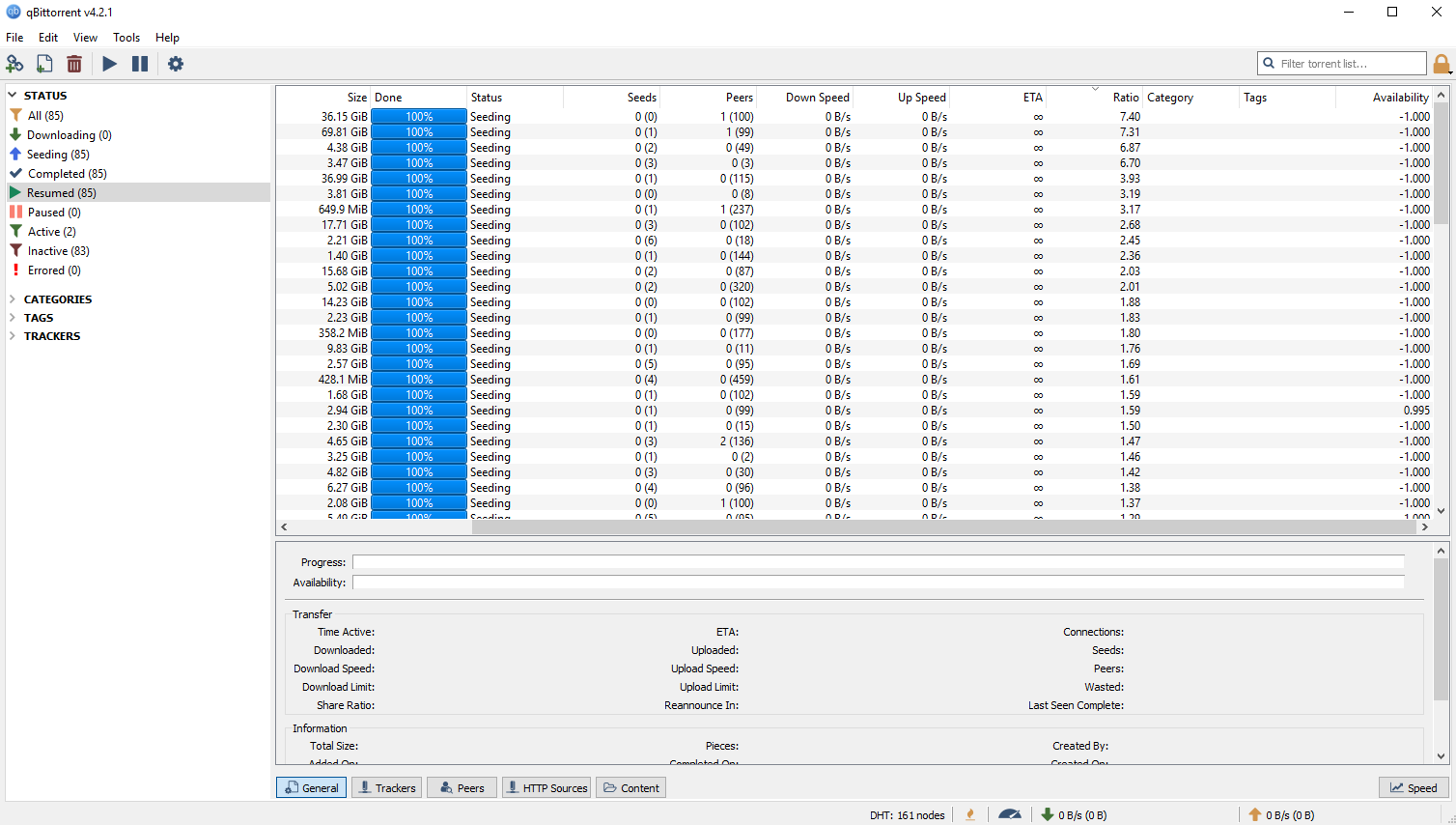
Online piracy primarily occurs through peer-to-peer (P2P) file sharing, direct downloads from unauthorized file-hosting services, illegal streaming platforms, and Usenet networks. These methods leverage internet protocols and software tools to distribute copyrighted material such as movies, music, software, and e-books without permission from rights holders. P2P systems, in particular, enable decentralized distribution where users simultaneously download and upload file pieces from multiple sources, reducing reliance on central servers. Prominent torrent indexing hubs, such as The Pirate Bay, 1337x, and RARBG (which announced closure in May 2023), aggregate and provide access to .torrent files and magnet links, facilitating user discovery and organization of pirated content; these sites have been designated in U.S. Trade Representative notorious markets reviews for enabling substantial volumes of copyright infringement.[22][23] The BitTorrent protocol, developed by Bram Cohen and released in 2001, underpins much of P2P piracy through torrenting. It operates by breaking files into small pieces tracked via .torrent metadata files or magnet links, which contain hashes and tracker information to connect peers. Users employ client software, such as qBittorrent—an open-source, ad-free application supporting multiple protocols—to initiate downloads; the client queries trackers or distributed hash tables (DHTs) to locate seeders (complete file holders) and leechers (partial holders), facilitating efficient, resilient sharing even as individual participants join or leave. Torrenting's scalability stems from its incentive structure, where uploaders gain faster access by contributing bandwidth, though it exposes IP addresses, prompting use of anonymization tools.[23][24] Direct download methods involve retrieving complete files from centralized cyberlockers or file-hosting sites like those using services akin to Mega or MediaFire, often linked via index aggregators or forums. These platforms store user-uploaded content on high-capacity servers, providing one-click HTTP downloads that bypass P2P coordination; access typically requires premium accounts for speed or occurs via free tiers with throttling and ads. Pirated files are pre-packaged, sometimes with cracks for software, and distributed through temporary links to evade takedowns, though server-side hosting increases vulnerability to legal seizures compared to decentralized alternatives.[25] Illegal streaming employs web technologies like HTML5 video players and content delivery networks (CDNs) to deliver pirated audiovisual content in real-time without permanent local storage. Rogue sites embed streams sourced from cam recordings, screen captures, or leaked high-quality rips, often using adaptive bitrate streaming (e.g., HLS or DASH protocols) for quality adjustment over varying connections; some integrate P2P elements via WebRTC for peer-assisted delivery to reduce bandwidth costs. These platforms monetize via ads or subscriptions, with piracy-as-a-service models emerging where operators sell access to modified set-top boxes or apps that aggregate streams.[26] Usenet, a distributed discussion system originating in 1979 via UUCP but adapted for binary file sharing, serves as an older yet persistent piracy vector through newsgroups hosting encoded content. Users download via NZB index files—XML metadata pointing to posts split into parts across servers—and clients like SABnzbd or NZBGet, which reassemble and repair files using PAR2 parity data for integrity. Usenet's backbone of interconnected providers offers retention periods exceeding 2000 days by 2025, enabling archival access, with paid subscriptions providing high speeds and privacy via server-side operations that obscure peer interactions.[27]Historical Evolution
Origins in Pre-Digital Copying
The unauthorized duplication of printed works emerged shortly after the invention of the movable-type printing press by Johannes Gutenberg around 1440, as printers in Europe quickly exploited popular titles through reprints without permission from authors or original publishers, driven by the technology's low marginal costs for replication.[28] One of the earliest documented instances involved a counterfeit edition of the Phoenix sive Dicta cuiusdam sapientis printed in Venice around 1480 by unauthorized parties, illustrating how the press enabled rapid, widespread infringement that undermined exclusive rights.[29] By the Elizabethan era in England, systematic book piracy flourished, with printers like John Wolfe producing illegal editions of works in the 1580s to meet demand for affordable copies, often evading stationers' guild controls through operations abroad or under false imprints.[30] These practices highlighted the causal tension between technological reproducibility and proprietary control, as unauthorized reprints flooded markets and eroded revenues for originators, prompting rudimentary legal privileges that prefigured modern copyright. In the music sector, pre-digital copying manifested through bootleg recordings, which gained traction in the early 20th century but proliferated after World War II with advancements in recording technology. Bootleggers captured live performances or studio outtakes on acetate discs and later magnetic tape, distributing them via underground networks; by the late 1960s, this included high-fidelity tapes of artists like Bob Dylan and the Grateful Dead, capitalizing on fan demand for unreleased material unavailable commercially.[31] The advent of consumer cassette recorders in the 1970s amplified personal duplication, enabling widespread home taping from radio broadcasts or vinyl records, which the recording industry estimated caused significant sales displacement—though empirical data on exact losses remained contested due to the private nature of copies.[32] In response, the British Phonographic Industry initiated the "Home Taping Is Killing Music" campaign in 1981, featuring propaganda stickers on cassettes warning of revenue erosion from an estimated millions of illicit copies annually, reflecting industry fears of a shift from purchase to duplication without compensation.[33] Film and video media followed suit, with mechanical duplication emerging in the silent era as exhibitors and pirates re-photographed prints to create unauthorized copies for resale or alternative screenings. Thomas Edison's 1903 lawsuit against a Philadelphia distributor for duplicating his films marked an early judicial expansion of copyright to motion pictures, underscoring how physical copying enabled geographic arbitrage and profit diversion.[34] The 1970s introduction of VHS technology further democratized infringement, allowing household VCRs to copy broadcast or rental tapes en masse; by the mid-1980s, U.S. industry surveys reported over 50% of households engaging in such practices, correlating with stalled video sales growth amid debates over fair use versus economic harm.[33] These analog precedents established patterns of causal infringement—where accessible duplication tools incentivized non-commercial sharing and small-scale commerce—foreshadowing digital scalability, though constrained by degradation in copies and logistical distribution costs that limited prevalence compared to later file-sharing.[35]Rise of Peer-to-Peer Networks (Late 1990s–Early 2000s)
The peer-to-peer (P2P) model for file sharing emerged prominently with Napster, a service developed by Shawn Fanning, an 18-year-old Northeastern University student, who coded its prototype during late 1998 and early 1999 to enable efficient searching and downloading of MP3 music files among users' computers.[36] Napster launched publicly on June 1, 1999, utilizing a centralized index server to catalog shared files while actual transfers occurred directly between users' machines, bypassing traditional client-server limitations and allowing rapid dissemination of copyrighted audio tracks without permission from rights holders.[37] This hybrid architecture quickly attracted widespread adoption, as broadband internet access expanded and MP3 compression made music files compact for dial-up connections, fostering unauthorized sharing on a scale unprecedented for digital media.[38] Napster's growth precipitated immediate legal action from the recording industry, with the Recording Industry Association of America (RIAA) filing a copyright infringement lawsuit against the company on December 6, 1999, alleging contributory and vicarious liability for facilitating massive unauthorized distribution of protected works.[39] The U.S. District Court issued a preliminary injunction on July 26, 2000, requiring Napster to block infringing files, but appeals delayed full enforcement until February 12, 2001, when the Ninth Circuit Court of Appeals upheld the ruling, citing evidence of direct infringement enabled by the platform.[40] Unable to comply without dismantling its core functionality, Napster ceased operations in July 2001, though its shutdown highlighted the vulnerability of centralized P2P systems to single points of failure and legal targeting, while demonstrating the model's potential to disrupt content monopolies through user-driven replication.[41] In response, developers shifted toward fully decentralized protocols to evade shutdown risks, with Gnutella launching on March 14, 2000, as an open-source network created by Nullsoft engineers that relied on flooding queries across interconnected peers without any central directory, enabling resilient file discovery for music and beyond.[42] This approach inspired further innovations, including Bram Cohen's BitTorrent protocol, first demonstrated in April 2001, which introduced torrent files containing metadata trackers to coordinate piecemeal downloads from multiple seeders, optimizing bandwidth for larger files like software and video by incentivizing upload contributions through rare-piece prioritization.[43] These advancements proliferated unauthorized sharing into the early 2000s, as networks like these scaled to handle terabytes of pirated content daily, challenging enforcement by distributing liability across anonymous participants rather than operators.[44]Maturation and Adaptation (2000s–2010s)
In the wake of Napster's 2001 shutdown, peer-to-peer networks evolved toward decentralization to evade centralized liabilities, with protocols like Gnutella launching in March 2000 and KaZaA gaining prominence by 2001 for distributing music files. The BitTorrent protocol, introduced by Bram Cohen in 2001, marked a significant advancement by segmenting large files—such as movies and software—into smaller pieces for simultaneous sharing among users, reducing bandwidth strain on individual seeders and enabling efficient dissemination of high-volume media. This efficiency propelled torrent-based sharing to dominate unauthorized file distribution, with sites like The Pirate Bay launching in November 2003 as resilient indexes for torrent metadata.[45] Legal challenges intensified in response, exemplified by the U.S. Supreme Court's 2005 ruling in MGM Studios, Inc. v. Grokster, Ltd., which held distributors liable for inducing copyright infringement if they promoted software for illegal uses, leading to the shutdown of services like Grokster and Morpheus. Despite such rulings, piracy adapted through private trackers, encrypted traffic, and proliferation of index sites, while direct download platforms known as cyberlockers—such as RapidShare and Megaupload—emerged in the mid-2000s to host files accessible via HTTP links, bypassing P2P altogether. The 2012 FBI seizure of Megaupload, which had amassed over 50 million daily visitors and facilitated billions in alleged infringing downloads, temporarily disrupted cyberlocker dominance but spurred migration to alternatives like Putlocker and 4shared.[46][47] By the late 2000s and into the 2010s, streaming variants adapted to user preferences for immediacy, with sites offering unauthorized video embeds or progressive downloads, though torrent usage remained robust, accounting for a substantial share of global bandwidth—estimated at up to 3.6% of internet traffic by some analyses in the period. Enforcement efforts, including proposed U.S. legislation like SOPA and PIPA in 2011–2012, faced widespread opposition from tech advocates citing overreach, ultimately stalling amid protests that highlighted tensions between access and control. These adaptations underscored piracy's resilience, driven by technological circumvention and demand for free content amid rising legitimate subscription costs.[48][49]Contemporary Shifts (2020s Onward)
The COVID-19 pandemic triggered a marked surge in online piracy, particularly in early 2020, as lockdowns confined populations indoors and heightened demand for entertainment amid disrupted legal access. Global film and TV piracy visits increased significantly during this period, with MUSO reporting a substantial uptick in unauthorized streams and downloads coinciding with stay-at-home orders. In some countries, online piracy crimes rose by over 60 percent in the 12 months following April 2020, according to Interpol data. Academic analysis of consumer surveys indicated that 6-8 percent of illegal consumers during the pandemic were new participants, often linked to income losses or expanded leisure time rather than pre-existing habits.[50][51][11] Post-2020, piracy volumes rebounded from an initial dip—reaching 130 billion website visits in 2020—to 216 billion by 2024, driven by fragmentation in legal streaming services, escalating subscription fees, and content siloing across platforms. Approximately 96 percent of pirated TV and film content in this era originated from streaming rips, reflecting a consumer shift away from traditional peer-to-peer downloads toward convenience-oriented illegal streams. This resurgence particularly affected live sports and premium series, where geographic restrictions and paywalls exacerbated dissatisfaction with licensed options. Industry trackers like MUSO noted an 18 percent year-over-year increase in global piracy visits to 215 billion in 2022 alone, underscoring sustained growth despite maturing anti-piracy tools.[52][53][54] Methodologically, the 2020s saw piracy evolve toward seamless, browser-based streaming via dedicated apps, modified smart devices, and "stream-host" sites that mimic legitimate platforms, reducing reliance on torrent clients and file-sharing networks. Illegal streaming now accounts for about 80 percent of all piracy incidents, prioritizing instant access over downloads and appealing to mobile users, though desktops remain dominant at over 50 percent of traffic. This adaptation circumvents traditional detection by leveraging decentralized hosting and user-generated indexing, complicating enforcement. U.S. Trade Representative reports highlighted dramatic pandemic-era spikes in film piracy, attributing persistence to these agile delivery mechanisms.[55][56][57] Enforcement responses intensified, with legislative pushes like the 2025 U.S. Foreign Anti-Digital Piracy Act aiming to enable site blocking for foreign rogue platforms and bolster international cooperation. Partnerships between entities such as the IPR Center and RIAA expanded joint operations, training, and digital ecosystem safeguards against unauthorized distribution. Technological countermeasures advanced, including forensic watermarking for tracing leaks and automated takedown services, yet piracy rates climbed from 25 percent in 2022 to 32 percent in 2023 per some behavioral studies, signaling ongoing challenges in matching pirates' innovation.[58][59][60]Measurement and Prevalence
Quantitative Metrics and Data Sources
Measuring online piracy presents inherent challenges due to its clandestine nature, reliance on anonymizing technologies like VPNs and private networks, and underreporting in surveys influenced by social desirability bias. Empirical metrics primarily derive from web traffic analysis of known infringing sites, download logs from public trackers, and self-reported consumer behavior studies, though these methods capture only observable activity and may exclude decentralized or encrypted sharing. Credible sources emphasize traffic volume to piracy domains as a proxy for prevalence, with adjustments for repeat visits and geographic distribution.[61][62] Global visits to piracy websites reached 229.4 billion in 2023, marking a 6.7% increase from 215 billion in 2022, according to MUSO's industry data review based on proprietary web crawling and analytics. This figure declined modestly to 216.3 billion visits in 2024, a 5.7% drop, reflecting shifts toward licensed streaming amid content fragmentation, though subsectors like publishing saw a 4.3% rise driven by manga (over 70% of publishing piracy visits). Television content accounted for 45% of 2023 visits, films 13%, with streaming comprising the majority of access methods over downloads.[63][64][65] In the European Union, the EUIPO's 2023 survey of over 30,000 internet users estimated average monthly accesses to pirated content at 10 per person across TV shows, films, music, software, and publications, stable from prior years but reversing earlier declines. Film piracy specifically fell 25% to 0.9 accesses per user monthly, while music infringement rates dropped to about one-quarter of 2017 levels, attributed to improved legal alternatives; live sports and TV series remained hotspots. These EUIPO findings, derived from randomized respondent recall validated against traffic data, highlight regional variations, with higher rates in southern and eastern member states.[66][62][67] Additional metrics from peer-reviewed studies, such as a 2018 global survey replicated in later analyses, indicate that pirates often overlap with legal consumers, with per capita piracy correlating inversely with income levels; however, absolute volumes persist in emerging markets like Indonesia and Egypt, where weekly piracy exceeds 16% of consumers. Software piracy, tracked separately by the BSA, showed 37% unlicensed usage globally in recent surveys, though media-focused data dominates online metrics. Cross-verification across sources like MUSO and EUIPO reveals consistency in trends but variances in scale due to methodological differences—traffic counts versus user surveys—necessitating caution against overreliance on any single estimate.[9][68][69]Global and Regional Patterns
In 2024, global visits to online piracy websites totaled 216.3 billion, marking a 5.7% decline from 229.4 billion in 2023, primarily driven by shifts toward legal streaming options amid content fragmentation.[65] Video piracy dominated, with sites hosting films and TV series attracting 141 billion visits in 2023 alone, representing about 45% of total piracy traffic for television content and 13% for films.[70] [71] These figures, tracked via site analytics and traffic monitoring by firms like MUSO, highlight piracy's persistence despite legal alternatives, though absolute volumes remain substantial relative to global internet usage, consuming nearly 24% of bandwidth in major regions.[72] Regional patterns vary by factors including enforcement rigor, content availability, and economic development, with higher per capita income generally correlating to lower piracy intensity among users who also consume legal content.[9] The United States and India led in absolute traffic sources, accounting for 12.3% and 8.12% of global illegal visits respectively in 2024 data, reflecting large populations and widespread broadband access despite varying domestic regulations.[73] In Europe, EU Intellectual Property Office surveys show piracy stabilizing at 10.2 illegal content accesses per internet user per month across EU member states, with reversals in downward trends for TV shows and live sports due to subscription fatigue and regional blackouts.[62] [74] Higher relative rates persist in emerging markets; for instance, countries like Russia, Indonesia, and Egypt exhibit elevated prevalence, with 16% of consumers in Indonesia and Egypt reporting weekly piracy of media content.[68] Software-focused metrics from BSA indicate unlicensed usage exceeding 90% in nations such as Russia and Georgia, though media piracy follows similar geographic concentrations tied to lax enforcement and limited affordable legal access.[75] [69] Asia-Pacific and Latin America show disproportionate growth in streaming-based infringement, while North America maintains high absolute engagement despite stronger legal deterrents, underscoring that user overlap between pirated and licensed consumption complicates regional attributions of causality.[9]| Region | Key Metric (Recent Data) | Source Notes |
|---|---|---|
| North America | 24% of internet bandwidth to piracy; high absolute visits from US | Bandwidth share reflects infrastructure scale[72] |
| Europe | 10.2 accesses/user/month; rising TV/sports piracy | EUIPO consumer surveys, 2017-2023[62] |
| Asia-Pacific | India 8.12% global traffic; Indonesia 16% weekly pirates | Traffic tracking; self-reported high in developing hubs[73] [68] |
| Other Emerging | >90% unlicensed software in Russia/Georgia | BSA estimates, indicative of broader digital norms[69] |