


Community hub
Recent from talks
Contribute something
Nothing was collected or created yet.
Iraqi Counter Terrorism Service
View on Wikipedia| Counter Terrorism Service Iraqi Special Operations Forces CTS-ISOF | |
|---|---|
| جهاز مكافحة الإرهاب قوات العمليات الخاصة العراقية | |
 Emblem of the Counter Terrorism Bureau | |
| Founded | April 2007 (CTS established) |
| Country |  Iraq Iraq |
| Type | Special Operations Forces |
| Role | |
| Size | 14,000 (2024)[1] |
| Part of | Iraqi Armed Forces[a] |
| Garrison/HQ | Green Zone, Baghdad |
| Nickname | The Golden Division |
| Motto | "Raise The Black" |
| Colors | Black |
| Engagements | |
| Commanders | |
| Commander-in-chief | Mohammed Shia' Al Sudani |
| Head of CTS | Gen. Karim Abboud al-Tamimi[3] |
| Commander of CTC | Lt. Gen. Hassan Makenzi |
| Notable commanders | Talib Shaghati Abdul-Wahab al-Saadi Abdul Ghani al-Asadi |
| Insignia | |
| ICTB Flag |  |
| ISOF Flag |  |
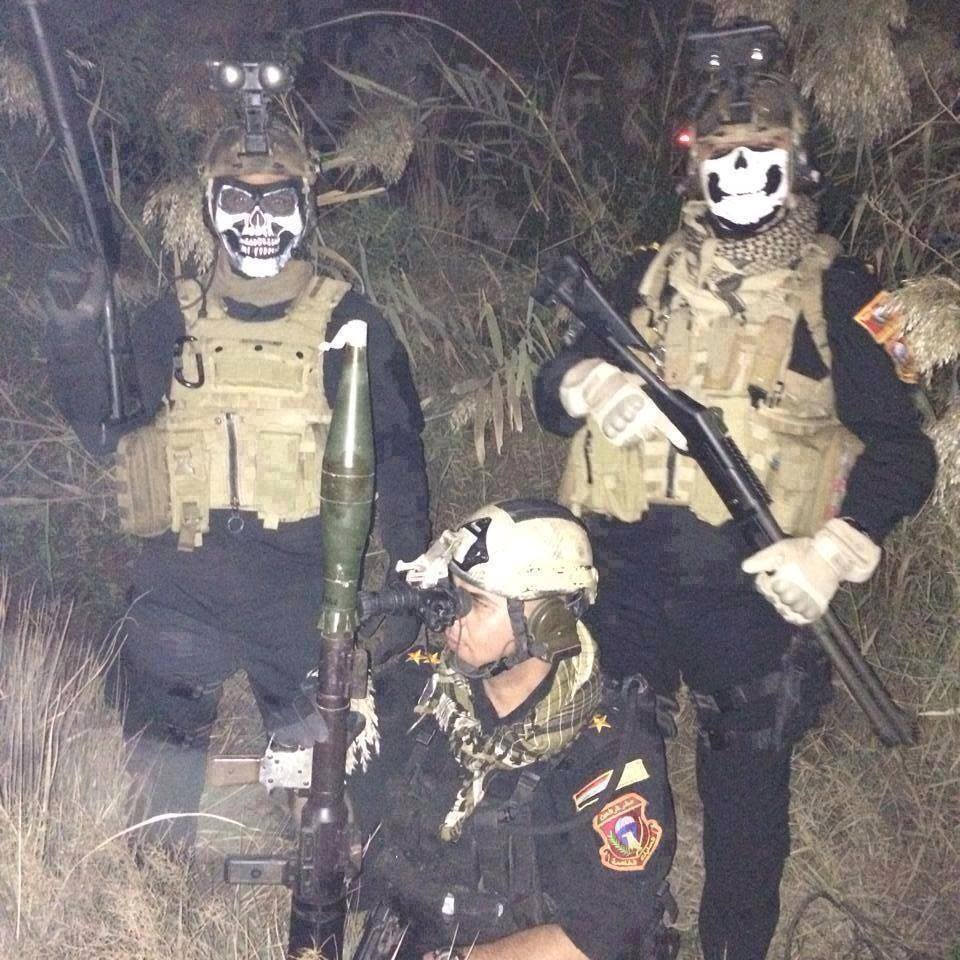
The Counter Terrorism Service (CTS; Arabic: جهاز مكافحة الارهاب) is an Iraqi security and intelligence agency tasked with counterterrorism.[4] The Service’s operational arm is called the Iraqi Special Operations Forces (ISOF; Arabic: قوات العمليات الخاصة العراقية). They are an elite special operations force composed of three brigades based in several governorates, and who are often collectively referred to as the Golden Division.[5][6][7]
During the occupation of Iraq, all military, security, and intelligence entities of the country were dissolved by the Coalition Provisional Authority following the issuance of CPA Order 2, and rebuilt from scratch. CTS was created in 2007 and is funded by the Ministry of Defence.[8] The Service played a crucial role in combatting terrorism during the war in Iraq (2013-2017). ISOF have conducted joint operations with the Green Berets.[9]
History
[edit]Special operations troops of the Iraqi Army were first established when Colonel Khalil Dabbagh built the first royal special units in the name of "Queen Alia Forces" in the mid-1950s. It consisted of Sunni and Shia Arabs, as well as other components of the Iraqi population. They were mainly used on an emergency basis to carry out special missions inside of Iraq and outside when the country was at war.
The 65th Special Forces Brigade, 76th Special Forces Brigade, 78th Special Forces Brigade, and 450th Marine Brigade were active during the Gulf War.[10]

After the 2003 Invasion of Iraq, the Saddam Hussein-era Iraqi Army was disbanded by the occupation authorities. In late 2003, a commando battalion was recruited from scratch, mostly from Arabs (Shias and Sunnis), but also Kurds, Assyrians and Turkmen.[11] Another more clandestine battalion named the Iraqi Counter Terrorism Force (ICTF), with robust intelligence capabilities and specialised in counterterrorism and hostage rescue, was also formed at the same time. The aforementioned commando battalion was placed in a supporting role to the latter, with the aim that a premier counterinsurgency force would eventually be developed around the two battalions.[12] The first Iraqi Special Operations Forces brigade (ISOF-1) was formed by the Iraqi Army with the help of U.S special operations forces in July 2005.[13] In November 2005, after training in Jordan with Jordanian Special Forces and U.S. Army Special Forces ("Green Berets"), the Iraqi Special Operations Force had 1,440 men trained, composed of two combat battalions, considered equal in training and combat effectiveness to an average U.S. Army infantry battalion, and two support battalions.[14]
In April 2007, the Counter Terrorism Service (CTS) was established with ISOF as its operational arm, and by March 2008, it consisted of a single brigade which in turn was made up of Iraqi Counter-Terrorism Force (ICTF) battalion, three commando battalions, a support battalion and a special reconnaissance unit.[15]
The 2nd Special Operations Forces brigade (ISOF-2) was formed in July 2009.
On April 18, 2010, ISOF troops, supported by U.S. troops, carried out a night-time raid on a terrorist safe house near Tikrit. The ISOF surrounded the building and called on them to surrender, but instead the terrorists fired on them. The ISOF returned fire and assaulted the building. The ISOF killed Abu Ayyub al-Masri and Abu Omar al-Baghdadi, the leaders of the Islamic State of Iraq, 16 others were also arrested.[16][17][18]


After the U.S. left in 2011, the CTS struggled without American intelligence, air strikes, logistical capabilities, and medical care.[19] Journalist/researcher Michael R. Gordon was told that with the withdrawal of the U.S. Army and Air Force, and the fraying of Iraqi capabilities, Maliki had saddled the CTS "with a burgeoning array of missions that included manning checkpoints, escorting convoys, protecting voting centres, and doing battle with militants in densely populated Iraqi cities. A specialised force that had been designed to carry out lightning raids against terrorist cells (with considerable [U.S.] support) had become a jack-of-all-trades that was being tasked to deal with the upheaval in Iraq."[19] Well-respected U.S. Army special operations Major General Mike Nagata found Major General Fadhil Jamil al-Barwari, who led the 1st ISOF Brigade of the CTS, "no longer the confident commander" that he had been in years past.[20]

The 3rd Special Operations Forces brigade (ISOF-3) was formed in spring 2013.
2016 Battle of Mosul
[edit]In the Battle of Mosul that began in October 2016, the special ops forces were the first division into the city of Mosul, which had been occupied by Islamic State since 2014.[21] After the fall of Mosul, the ISOF battalions increasingly took up an infantry role the Iraqi army and militias weren't able to provide during operations, a role the unit was unfamiliar with for most of the war against terror. This resulted in a greater number of casualties than in previous operations, which were smaller in scale and shorter in duration.
On 1 November 2016, the 1st Iraqi Special Forces Brigade fought its way into the Gogjali quarter of the city, becoming the first Iraqi unit to enter the city during the offensive.[22] On 10 July 2017, the Iraqi prime minister declared the liberation of Mosul from ISIS.[23] By the end of the battle, CTS forces suffered a 40 percent casualty rate.[24]
Command Structure
[edit]
The Iraqi Special Operations Forces (ISOF) are organized into three primary brigades, each responsible for operations in different regions of Iraq. The structure includes specialized battalions for commando, support, reconnaissance, and tactical operations.
- 1st Special Operations Brigade (ISOF-1)
 1st Battalion (Commando) – Former 36th Battalion
 2nd Battalion (ICTF)
 3rd Battalion (Support)
 5th Battalion (Reconnaissance)


They are based in Baghdad, often referred to as the Golden Division, previously known as the Golden Brigade.[25]
- 2nd Special Operations Brigade (ISOF-2)
- 6th Regional Commando Battalion
- 7th Regional Commando Battalion
- 8th Regional Commando Battalion
- 9th Regional Commando Battalion
They operate in Nineveh, Saladin, Kirkuk, Karbala, Diyala, and Al Asad.
- 3rd Special Operations Brigade (ISOF-3)
- 10th Regional Commando Battalion
- 20th Regional Commando Battalion
- 36th Regional Commando Battalion
- 45th Regional Commando Battalion
They operate in Basra, Babylon, Najaf, Maysan, Dhi Qar, Muthanna and Qadisiyah. Additionally, the brigade maintains a reconnaissance battalion, a support battalion, and a Special Tactics Unit.[26] [27]

There’s also a hostage rescue and maritime piracy response brigade.[28]
| External videos | |
|---|---|
 Anti-hijack training Anti-hijack training |
 Academia – Formerly the 4th Battalion of the 1st ISOF Brigade, this unit is responsible for screening and training new recruits for the Counter-Terrorism Command (CTC).[29]

Equipment
[edit]Handguns
[edit]- Beretta 92FS pistol
- Tariq pistol
- S&W M&P9 pistol[30]
- Glock 17 & Glock 19
- HS2000 pistol
Assault rifles and battle rifles
[edit]- M4A1 carbine
- M16A2/M16A4
- Remington R4[31]
- Rock River Arms LAR-15[32]
- SIG Sauer SIGM400[33]
- VHS-K2/D2 bullpup assault rifle[34]
- K2C carbine[35]
- OTs-14 Groza
Submachine guns
[edit]Shotguns
[edit]Sniper rifles and anti material rifles
[edit]- HSR Cyclone sniper rifle[39]
- Steyr HS .50/AM50 anti-material rifle[40]
- M24 SWS[41]
- ORSIS T-5000 sniper rifle[42]
- Barrett M82A1/M107 SASR
- K14 sniper rifle[43]
- Mk 14 Enhanced Battle Rifle
Machine guns
[edit]- PKM
- M249 light Machine gun
- M240 GPMG
- DShKM heavy machine gun
- Browning M2HB
Launchers and grenade launchers
[edit]- M203 grenade launcher
- RPG-7
- RPG-27
- M136 AT4
- Mk 153 Shoulder-Launched Multipurpose Assault Weapon
- Milkor MGL
- Daewoo Precision Industries K4
- Mk 47 Striker
Vehicles
[edit]Notes
[edit]- ^ Reports directly to Prime Minister of Iraq
References
[edit]
- ^ Knights, Michael (2024-12-03). "How Washington Can Salvage Iraq's Counter Terrorism Service". The Washington Institute.
- ^ "Report: Altun Kupri town seized from Kurdish Peshmerga". Al Jazeera. 20 October 2017.
- ^ "Changes in Senior Military Positions in Iraq". Alsharqiya.
- ^ "Counter Terrorism Service Law (2016)" (PDF). Ministry of Justice.
- ^ "Video: Iraq's 'Golden Division' troops in the battle for Mosul". France24. 8 December 2016.
- ^ "The force leading the Iraq army's fight against ISIS went from 'dirty division' to golden boys". The Washington Post.
- ^ "With Isis plotting a comeback, Iraq's famed 'Golden Division' prepares for the long fight". The Independent.
- ^ Witty 2015, p. 10.
- ^ "Tip of The Spear" (PDF). SOCOM.
- ^ Eisenstadt, Jane's Intelligence Review.
- ^ Witty, David (2016). "The Iraqi Counter Terrorism Service" (PDF). Brookings Institution.
- ^ "United States Special Operations Command History" (PDF). USSOCOM.
- ^ "United States Special Operations Command History" (PDF). USSOCOM. pg.123
- ^ "Special Operations: Iraqi Special Operations Forces". StrategyPage. StrategyWorld.com. 17 November 2005. Retrieved 5 June 2016.
- ^ Measuring Stability and Security in Iraq - March 2008 Report to Congress.
- ^ Neville 2015, p. 226.
- ^ "2 Most Wanted Al Qaeda Leaders in Iraq Killed by U.S., Iraqi Forces" FoxNews, 19 April 2010.
- ^ Waleed Ibrahim. "Al Qaeda's top two leaders in Iraq have been killed, officials said Monday, in a strike the United States called a "potentially devastating blow" but whose impact analysts said may be limited". Thomson Reuters.
- ^ a b Gordon 2022, p. 10.
- ^ Gordon 2022, p. 11.
- ^ Ramsay, Stuart (20 October 2016). "Elite troops strengthen battle for Mosul". Sky News. Retrieved 20 October 2016.
- ^ "Iraqi Army enters Mosul: Live updates day 16".
- ^ "Iraqi PM declares victory over Islamic State in Mosul". Reuters. 10 July 2017. Retrieved 1 January 2018.
- ^ https://comptroller.defense.gov/Portals/45/Documents/defbudget/fy2018/fy2018_CTEF_J-Book_Final_Embargoed.pdf [bare URL PDF]
- ^ Witty 2015, p. 12.
- ^ Witty 2015, p. 25.
- ^ "DVIDS - Images - Iraqi Special Operations Special Tactics Unit [Image 3 of 6]". dvidshub.net. Retrieved 1 January 2018.
- ^ https://icts.gov.iq/?magazine=15
- ^ "Golden Division / Iraqi National Counter-Terrorism Force (INCTF) Counter-Terrorism Service [CTS]".
- ^ "Iraqi Military using S&W M&P9 Pistol". www.thefirearmblog.com. 31 October 2008.
- ^ "Remington R4s Reach Iraq". Silah Report. 18 April 2020. Retrieved 27 May 2021.
- ^ "ISOF Arms & Equipment Part 1 – Personal Equipment". Armament Research Services. 27 November 2016. Retrieved 27 May 2021.
- ^ "ISOF Arms & Equipment Part 1 – Personal Equipment – Armament Research Services". 27 November 2016. Retrieved 31 May 2021.
- ^ "VHS K2 Bullpup in Iraq". www.thefirearmblog.com. 21 October 2016.
- ^ "Korean K2C in Iraq, on both sides". www.thefirearmblog.com. 30 September 2016.
- ^ Jones & Ness 2009, p. 514.
- ^ Cite error: The named reference
biccwas invoked but never defined (see the help page). - ^ https://armamentresearch.com/wp-content/uploads/2016/11/6.jpg
- ^ "Iraq Loses Two Valued Snipers in the fight against IS". www.thefirearmblog.com. Archived from the original on 2021-02-05. Retrieved 2021-01-07.
- ^ "Iraqi CT Sniper in Comfy Action". www.thefirearmblog.com. 13 October 2017.
- ^ Vining, Miles (April 22, 2017). "ISOF Arms & Equipment Part 2 – Precision Rifles". armamentresearch.com.
- ^ "Iranian AM50 and Russian ORSIS T-5000 rifles in Iraq". www.thefirearmblog.com. 18 June 2014.
- ^ "Iraqi Special Operations Forces (ISOF) member armed with K14 sniper rifle and K2C Carbine". www.pinterest.com.
- ^ "Iraq parades new South Korean-made armoured vehicles". Jan 15, 2021.
Further reading
[edit]- Gordon, Michael (R.) (2022). Degrade and Destroy: The Inside Story of the War Against the Islamic State, from Barack Obama to Donald Trump. New York: Farrar, Straus, and Giroux. ISBN 978-0374279899.
- Neville, Leigh (2015). Special Forces in the War on Terror. General Military. Osprey Publishing. ISBN 978-1-4728-0790-8.
- Witty, David (2015). The Iraqi Counter Terrorism Service (PDF). Washington, D.C.: The Brookings Institution. Retrieved 5 June 2016.
| Military | |
|---|---|
| Paramilitary |
|
| Law enforcement | |
| Intelligence | |
Iraqi Counter Terrorism Service
View on GrokipediaThe Iraqi Counter Terrorism Service (CTS) is an independent Iraqi security agency operating at a quasi-ministerial level, specializing in counterterrorism intelligence, precision raids, hostage rescues, and special operations against terrorist networks.[1] Its operational component, the Iraqi Special Operations Forces (ISOF), comprises three brigades structured for rapid deployment across provinces, emphasizing non-sectarian recruitment and professional standards modeled on U.S. special operations training.[2] Established in the post-2003 era through U.S.-led mergers of initial units like the Iraqi Counter Terrorism Force into ISOF brigades by May 2004, the CTS was formalized in 2006 under the Prime Minister's office to insulate it from broader military politicization.[1] The CTS distinguished itself during the rise of the Islamic State (ISIS) in 2014 as the sole major Iraqi security element that retained cohesion and combat effectiveness, avoiding the collapses that afflicted conventional forces due to entrenched corruption and sectarian influences elsewhere in the Iraqi Security Forces.[2] It spearheaded ground operations to liberate over 70 cities from ISIS control, including pivotal battles for Ramadi, Fallujah, Tikrit, and Mosul, often integrating U.S.-provided intelligence, air support, and advisory embeds from Special Operations Joint Task Force - Operation Inherent Resolve.[3] Between 2004 and 2011 alone, CTS/ISOF units conducted thousands of targeted missions, detaining over 9,000 suspects and disrupting insurgent leadership.[1] Post-caliphate, it continues proactive hunts for ISIS remnants, such as the October 2024 joint operation that eliminated multiple senior figures with coalition assistance.[4] Despite its successes, the CTS faces ongoing strains from equipment attrition in high-intensity fights like Mosul—where it suffered heavy casualties—and dependency on external partnerships for advanced capabilities, amid broader Iraqi political efforts to subordinate it to militia-influenced structures.[2] U.S. support, totaling around $800 million in materiel over two decades, has sustained its edge as Iraq's premier non-partisan force, enabling operations against Iran-aligned groups like Kata'ib Hezbollah as well.[2] This resilience underscores the causal impact of merit-based selection and external mentorship in countering ideologically driven threats, contrasting with the failures of less disciplined units.[3]