



Community hub
Recent from talks
Contribute something
Nothing was collected or created yet.
Isospin
View on Wikipedia| Flavour in particle physics |
|---|
| Flavour quantum numbers |
|
| Related quantum numbers |
|
| Combinations |
|
| Flavour mixing |
In nuclear physics and particle physics, isospin ( I ) is a quantum number related to the up- and down quark content of the particle. Isospin is also known as isobaric spin or isotopic spin. Isospin symmetry is a subset of the flavour symmetry seen more broadly in the interactions of baryons and mesons.
The name of the concept contains the term spin because its quantum mechanical description is mathematically similar to that of angular momentum (in particular, in the way it couples; for example, a proton–neutron pair can be coupled either in a state of total isospin 1 or in one of 0[1]). But unlike angular momentum, it is a dimensionless quantity and is not actually any type of spin.
Before the concept of quarks was introduced, particles that are affected equally by the strong force but had different charges (e.g. protons and neutrons) were considered different states of the same particle, but having isospin values related to the number of charge states.[2] A close examination of isospin symmetry ultimately led directly to the discovery and understanding of quarks and to the development of Yang–Mills theory. Isospin symmetry remains an important concept in particle physics.
Isospin invariance
[edit]To a good approximation the proton and neutron have the same mass: they can be interpreted as two states of the same particle.[2]: 141 These states have different values for an internal isospin coordinate. The mathematical properties of this coordinate are completely analogous to intrinsic spin angular momentum. The component of the operator, , for this coordinate has eigenvalues +1/2 and −1/2; it is related to the charge operator, : which has eigenvalues for the proton and zero for the neutron.[2]: 144 For a system of n nucleons, the charge operator depends upon the mass number A: Isobars, nuclei with the same mass number like 40K and 40Ar, only differ in the value of the eigenvalue. For this reason isospin is also called "isobaric spin".


The internal structure of these nucleons is governed by the strong interaction, but the Hamiltonian of the strong interaction is isospin invariant. As a consequence the nuclear forces are charge independent. Properties like the stability of deuterium can be predicted based on isospin analysis.[2]: 149 However, this invariance is not exact and the quark model gives more precise results.
Relation to hypercharge
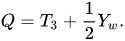
[edit]The charge operator can be expressed in terms of the projection of isospin and hypercharge, : This is known as the Gell-Mann–Nishijima formula. The hypercharge is the center of splitting for the isospin multiplet:[2]: 187 This relation has an analog in the weak interaction where T is the weak isospin.




Quark content and isospin
[edit]In the modern formulation, isospin (I) is defined as a vector quantity in which up and down quarks have a value of I = 1/2, with the 3rd-component (I3) being +1/2 for up quarks, and −1/2 for down quarks, while all other quarks have I = 0. Therefore, for hadrons in general,[3] where nu and nd are the numbers of up and down quarks respectively,
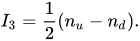
In any combination of quarks, the 3rd component of the isospin vector (I3) could either be aligned between a pair of quarks, or face the opposite direction, giving different possible values for total isospin for any combination of quark flavours. Hadrons with the same quark content but different total isospin can be distinguished experimentally, verifying that flavour is actually a vector quantity, not a scalar (up vs down simply being a projection in the quantum mechanical z axis of flavour space).
For example, a strange quark can be combined with an up and a down quark to form a baryon, but there are two different ways the isospin values can combine – either adding (due to being flavour-aligned) or cancelling out (due to being in opposite flavour directions). The isospin-1 state (the Σ0
) and the isospin-0 state (the Λ0
) have different experimentally detected masses and half-lives.
Isospin and symmetry
[edit]Isospin is regarded as a symmetry of the strong interaction under the action of the Lie group SU(2), the two states being the up flavour and down flavour. In quantum mechanics, when a Hamiltonian has a symmetry, that symmetry manifests itself through a set of states that have the same energy (the states are described as being degenerate). In simple terms, the energy operator for the strong interaction gives the same result when an up quark and an otherwise identical down quark are swapped around.
Like the case for regular spin, the isospin operator I is vector-valued: it has three components Ix, Iy, Iz, which are coordinates in the same 3-dimensional vector space where the 3 representation acts. Note that this vector space has nothing to do with the physical space, except similar mathematical formalism. Isospin is described by two quantum numbers: I – the total isospin, and I3 – an eigenvalue of the Iz projection for which flavor states are eigenstates. In other words, each I3 state specifies certain flavor state of a multiplet. The third coordinate (z), to which the "3" subscript refers, is chosen due to notational conventions that relate bases in 2 and 3 representation spaces. Namely, for the spin-1/2 case, components of I are equal to Pauli matrices divided by 2, and so Iz = 1/2 τ3, where
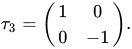
While the forms of these matrices are isomorphic to those of spin, these Pauli matrices only act within the Hilbert space of isospin, not that of spin, and therefore is common to denote them with τ rather than σ to avoid confusion.
Although isospin symmetry is actually very slightly broken, SU(3) symmetry is more badly broken, due to the much higher mass of the strange quark compared to the up and down. The discovery of charm, bottomness and topness could lead to further expansions up to SU(6) flavour symmetry, which would hold if all six quarks were identical. However, the very much larger masses of the charm, bottom, and top quarks means that SU(6) flavour symmetry is very badly broken in nature (at least at low energies), and assuming this symmetry leads to qualitatively and quantitatively incorrect predictions. In modern applications, such as lattice QCD, isospin symmetry is often treated as exact for the three light quarks (uds), while the three heavy quarks (cbt) must be treated separately.
Hadron nomenclature
[edit]Hadron nomenclature is based on isospin.[4]
- Particles of total isospin 3/2 are named Delta baryons and can be made by a combination of any three up or down quarks (but only up or down quarks).
- Particles of total isospin 1 can be made from two up quarks, two down quarks, or one of each:
- certain mesons – further differentiated by total spin into pions (total spin 0) and rho mesons (total spin 1)
- with an additional quark of higher flavour – Sigma baryons
- Particles of total isospin 1/2 can be made from:
- a single up or down quark together with an additional quark of higher flavour – strange (kaons), charm (D meson), or bottom (B meson)
- a single up or down quark together with two additional quarks of higher flavour – Xi baryon
- an up quark, a down quark, and either an up or a down quark – nucleons. Note that three identical quarks would be forbidden by the Pauli exclusion principle due to requirement of anti-symmetric wave function
- Particles of total isospin 0 can be made from
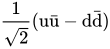
- a neutral quark-antiquark pair: or [note 1] – eta mesons
- one up quark and one down quark, with an additional quark of higher flavour – Lambda baryons
- anything not involving any up or down quarks


- ^ The flavour wave-function must be of the form for an isospin-0 combination, as yields


History
[edit]Origin of isospin
[edit]In 1932, Werner Heisenberg[5] introduced a model for binding of the proton and the then newly discovered neutron (symbol n). His model resembled the bonding model for molecule Hydrogen ion, H2+: a single electron was shared by two protons. Heisenberg's theory had several problems, most notable it incorrectly predicted the exceptionally strong binding energy of He2+, alpha particles. However, its equal treatment of the proton and neutron gained significance when several experimental studies showed these particles must bind almost equally.[6]: 39 In response, Eugene Wigner used Heisenberg's concept in his 1937 paper where he introduced the term "isotopic spin" to indicate how the concept is similar to spin in behavior.[7]
The particle zoo
[edit]These considerations would also prove useful in the analysis of meson-nucleon interactions after the discovery of the pions in 1947. The three pions (π+
, π0
, π−
) could be assigned to an isospin triplet with I = 1 and I3 = +1, 0 or −1. By assuming that isospin was conserved by nuclear interactions, the new mesons were more easily accommodated by nuclear theory.
As further particles were discovered, they were assigned into isospin multiplets according to the number of different charge states seen: 2 doublets I = 1/2 of K mesons (K−
, K0
), (K+
, K0
), a triplet I = 1 of Sigma baryons (Σ+
, Σ0
, Σ−
), a singlet I = 0 Lambda baryon (Λ0
), a quartet I = 3/2 Delta baryons (Δ++
, Δ+
, Δ0
, Δ−
), and so on.
The power of isospin symmetry and related methods comes from the observation that families of particles with similar masses tend to correspond to the invariant subspaces associated with the irreducible representations of the Lie algebra SU(2). In this context, an invariant subspace is spanned by basis vectors which correspond to particles in a family. Under the action of the Lie algebra SU(2), which generates rotations in isospin space, elements corresponding to definite particle states or superpositions of states can be rotated into each other, but can never leave the space (since the subspace is in fact invariant). This is reflective of the symmetry present. The fact that unitary matrices will commute with the Hamiltonian means that the physical quantities calculated do not change even under unitary transformation. In the case of isospin, this machinery is used to reflect the fact that the mathematics of the strong force behaves the same if a proton and neutron are swapped around (in the modern formulation, the up and down quark).
An example: Delta baryons
[edit]For example, the particles known as the Delta baryons – baryons of spin 3/2 – were grouped together because they all have nearly the same mass (approximately 1232 MeV/c2) and interact in nearly the same way.
They could be treated as the same particle, with the difference in charge being due to the particle being in different states. Isospin was introduced in order to be the variable that defined this difference of state. In an analogue to spin, an isospin projection (denoted I3) is associated to each charged state; since there were four Deltas, four projections were needed. Like spin, isospin projections were made to vary in increments of 1. Hence, in order to have four increments of 1, an isospin value of 3/2 is required (giving the projections I3 = +3/2, +1/2, −1/2, −3/2). Thus, all the Deltas were said to have isospin I = 3/2, and each individual charge had different I3 (e.g. the Δ++
was associated with I3 = +3/2).
In the isospin picture, the four Deltas and the two nucleons were thought to simply be the different states of two particles. The Delta baryons are now understood to be made of a mix of three up and down quarks – uuu (Δ++
), uud (Δ+
), udd (Δ0
), and ddd (Δ−
); the difference in charge being difference in the charges of up and down quarks (+2/3 e and −1/3 e respectively); yet, they can also be thought of as the excited states of the nucleons.
Gauged isospin symmetry
[edit]Attempts have been made to promote isospin from a global to a local symmetry. In 1954, Chen Ning Yang and Robert Mills suggested that the notion of protons and neutrons, which are continuously rotated into each other by isospin, should be allowed to vary from point to point. To describe this, the proton and neutron direction in isospin space must be defined at every point, giving local basis for isospin. A gauge connection would then describe how to transform isospin along a path between two points.
This Yang–Mills theory describes interacting vector bosons, like the photon of electromagnetism. Unlike the photon, the SU(2) gauge theory would contain self-interacting gauge bosons. The condition of gauge invariance suggests that they have zero mass, just as in electromagnetism.
Ignoring the massless problem, as Yang and Mills did, the theory makes a firm prediction: the vector particle should couple to all particles of a given isospin universally. The coupling to the nucleon would be the same as the coupling to the kaons. The coupling to the pions would be the same as the self-coupling of the vector bosons to themselves.
When Yang and Mills proposed the theory, there was no candidate vector boson. J. J. Sakurai in 1960 predicted that there should be a massive vector boson which is coupled to isospin, and predicted that it would show universal couplings. The rho mesons were discovered a short time later, and were quickly identified as Sakurai's vector bosons. The couplings of the rho to the nucleons and to each other were verified to be universal, as best as experiment could measure. The fact that the diagonal isospin current contains part of the electromagnetic current led to the prediction of rho-photon mixing and the concept of vector meson dominance, ideas which led to successful theoretical pictures of GeV-scale photon-nucleus scattering.
The introduction of quarks
[edit]

The discovery and subsequent analysis of additional particles, both mesons and baryons, made it clear that the concept of isospin symmetry could be broadened to an even larger symmetry group, now called flavor symmetry. Once the kaons and their property of strangeness became better understood, it started to become clear that these, too, seemed to be a part of an enlarged symmetry that contained isospin as a subgroup. The larger symmetry was named the Eightfold Way by Murray Gell-Mann, and was promptly recognized to correspond to the adjoint representation of SU(3). To better understand the origin of this symmetry, Gell-Mann proposed the existence of up, down and strange quarks which would belong to the fundamental representation of the SU(3) flavor symmetry.
In the quark model, the isospin projection (I3) followed from the up and down quark content of particles; uud for the proton and udd for the neutron. Technically, the nucleon doublet states are seen to be linear combinations of products of 3-particle isospin doublet states and spin doublet states. That is, the (spin-up) proton wave function, in terms of quark-flavour eigenstates, is described by[2]

and the (spin-up) neutron by

Here, is the up quark flavour eigenstate, and is the down quark flavour eigenstate, while and are the eigenstates of . Although these superpositions are the technically correct way of denoting a proton and neutron in terms of quark flavour and spin eigenstates, for brevity, they are often simply referred to as "uud" and "udd". The derivation above assumes exact isospin symmetry and is modified by SU(2)-breaking terms.


Similarly, the isospin symmetry of the pions are given by:
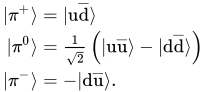
Although the discovery of the quarks led to reinterpretation of mesons as a vector bound state of a quark and an antiquark, it is sometimes still useful to think of them as being the gauge bosons of a hidden local symmetry.[8]
Weak isospin
[edit]In 1961 Sheldon Glashow proposed that a relation similar to the Gell-Mann–Nishijima formula for charge to isospin would also apply to the weak interaction:[9][10]: 152 Here the charge is related to the projection of weak isospin and the weak hypercharge . Isospin and weak isospin are related to the same symmetry but for different forces. Weak isospin is the gauge symmetry of the weak interaction which connects quark and lepton doublets of left-handed particles in all generations; for example, up and down quarks, top and bottom quarks, electrons and electron neutrinos. By contrast (strong) isospin connects only up and down quarks, acts on both chiralities (left and right) and is a global (not a gauge) symmetry.[11]


References
[edit]- ^ Povh, Bogdan; Klaus, Rith; Scholz, Christoph; Zetsche, Frank (2008) [1993]. "Chapter 2". Particles and Nuclei. Springer. p. 21. ISBN 978-3-540-79367-0.
- ^ a b c d e f Greiner, W.; Müller, B. (1994). Quantum Mechanics: Symmetries (2nd ed.). Springer. p. 279. ISBN 978-35405-8080-5.
- ^ Pal, Palash Baran (29 July 2014). An Introductory Course of Particle Physics. CRC Press. p. 226. ISBN 978-1-4822-1698-1.
- ^ Amsler, C.; et al. (Particle Data Group) (2008). "Review of Particle Physics: Naming scheme for hadrons" (PDF). Physics Letters B. 667 (1): 1–6. Bibcode:2008PhLB..667....1A. doi:10.1016/j.physletb.2008.07.018. hdl:1854/LU-685594. S2CID 227119789.
- ^ Heisenberg, W. (1932). "Über den Bau der Atomkerne". Zeitschrift für Physik (in German). 77 (1–2): 1–11. Bibcode:1932ZPhy...77....1H. doi:10.1007/BF01342433. S2CID 186218053.
- ^ Brown, L.M. (1988). "Remarks on the history of isospin". In Winter, Klaus; Telegdi, Valentine L. (eds.). Festi-Val: Festschrift for Val Telegdi; essays in physics in honour of his 65th birthday; [a symposium ... was held at CERN, Geneva on 6 July 1987]. Amsterdam: North-Holland Physics Publ. ISBN 978-0-444-87099-5.
- ^ Wigner, E. (1937). "On the Consequences of the Symmetry of the Nuclear Hamiltonian on the Spectroscopy of Nuclei". Physical Review. 51 (2): 106–119. Bibcode:1937PhRv...51..106W. doi:10.1103/PhysRev.51.106.
- ^ Bando, M.; Kugo, T.; Uehara, S.; Yamawaki, K.; Yanagida, T. (1985). "Is the ρ Meson a Dynamical Gauge Boson of Hidden Local Symmetry?". Physical Review Letters. 54 (12): 1215–1218. Bibcode:1985PhRvL..54.1215B. doi:10.1103/PhysRevLett.54.1215. PMID 10030967.
- ^ Glashow, Sheldon L. (1961-02-01). "Partial-symmetries of weak interactions". Nuclear Physics. 22 (4): 579–588. Bibcode:1961NucPh..22..579G. doi:10.1016/0029-5582(61)90469-2. ISSN 0029-5582.
- ^ Greiner, Walter; Müller, Berndt; Greiner, Walter (1996). Gauge theory of weak interactions (2 ed.). Berlin Heidelberg New York Barcelona Budapest Hong Kong London Milan Paris Santa Clara Singapore Tokyo: Springer. ISBN 978-3-540-60227-9.
- ^ Robson, B. A. (Oct 2004). "Relation Between Strong and Weak Isospin". International Journal of Modern Physics E. 13 (5): 999–1018. Bibcode:2004IJMPE..13..999R. doi:10.1142/S0218301304002521. ISSN 0218-3013.
Further reading
[edit]- Itzykson, C.; Zuber, J.-B. (1980). Quantum Field Theory. McGraw-Hill. ISBN 978-0-07-032071-0.
- Griffiths, D. (1987). Introduction to Elementary Particles. John Wiley & Sons. ISBN 978-0-471-60386-3.
See also
[edit]External links
[edit]- i8 iNuclear Structure and Decay Data - IAEA Nuclides' Isospin
| International | |
|---|---|
| Other | |

Isospin
View on GrokipediaDefinition and Symmetry
Isospin as a Quantum Number
In particle physics, isospin is an internal quantum number that classifies hadrons according to their transformation properties under the SU(2) symmetry group, treating protons and neutrons—or, more fundamentally, up and down quarks—as two states of the same particle differing only in their charge.[4] The total isospin quantum number specifies the representation, while the third component distinguishes the states within a multiplet, analogous to the spin quantum numbers and in angular momentum. For the nucleon, the proton is assigned , , and the neutron , , forming an isospin doublet.[5] This approximate symmetry arises because the up quark mass MeV and down quark mass MeV are nearly equal and much smaller than the QCD scale MeV, where non-perturbative strong interaction effects dominate.[6][7] Consequently, the strong interaction Hamiltonian is nearly invariant under SU(2) transformations that rotate between up and down quark flavors, making isospin a good quantum number for processes governed by the strong force, though it is broken by electromagnetic interactions and the small difference.[4] A basic example is the nucleon doublet , where the states transform into each other under isospin rotations, reflecting their similar strong-interaction properties. Another is the pion triplet, with the charged pions () and (), and the neutral (), all sharing .[8] These multiplets have degenerate states, with degeneracy lifted slightly by isospin-violating effects. Isospin multiplets are manipulated using raising and lowering operators and , which act on states as follows: changing by while preserving , similar to spin ladder operators.[9] For instance, converts a neutron state to a proton state in the nucleon doublet.Isospin Invariance
Isospin invariance arises in the strong nuclear force, which treats the up (u) and down (d) quarks as identical particles when their masses are equal (), as is approximately the case since both are much smaller than the QCD scale. This approximate SU(2) symmetry implies that the strong interaction Hamiltonian is invariant under continuous rotations in isospin space, generated by the isospin operators . The corresponding unitary transformation for an isospin rotation by an angle is given by which leaves unchanged, ensuring conservation of the total isospin and its third component in strong processes.[10][3] A key consequence of this invariance is the predicted degeneracy in the masses of particles within the same isospin multiplet, as the strong force does not distinguish between states differing only in their u/d quark content or charge. For example, the proton and neutron, forming an isospin doublet with , exhibit nearly identical masses under pure strong interactions; the observed neutron-proton mass difference of approximately 1.29 MeV is primarily attributed to electromagnetic corrections, with the strong isospin-breaking contribution estimated at about 2.5 MeV, partially offsetting the electromagnetic effect of -1.0 MeV.[11][10] This symmetry is broken by several sources beyond the ideal limit of equal quark masses. The dominant strong-interaction breaking stems from the small but nonzero quark mass difference, MeV, which introduces explicit isospin violation in the QCD Lagrangian. Additional breaking arises from electromagnetic interactions, which couple differently to the charged u and d quarks, and from higher-order QCD effects such as quark loops and gluon anomalies that amplify mass differences in hadrons.[6][12][11] Experimental evidence for isospin invariance is provided by the near-equality of scattering cross-sections in processes involving isospin-related particles, particularly at high energies where strong interactions dominate. For instance, the total cross-sections for and elastic scattering are observed to be approximately equal above a few GeV, consistent with isospin conservation predictions, with deviations below 1% attributable to symmetry-breaking effects.[3][13]Mathematical Formulation
SU(2) Representations and Multiplets
Isospin symmetry arises from the approximate invariance of the strong interaction under the Lie group SU(2), where the proton and neutron are treated as two states of the same particle, analogous to spin up and down.[14] The irreducible representations of SU(2) are labeled by the isospin quantum number , which takes non-negative integer or half-integer values, determining the structure of particle multiplets under this symmetry.[15] Each multiplet corresponding to a given has dimension and consists of states distinguished by the third component of the isospin operator, , which ranges from to in steps of 1.[15] For , the multiplet is a singlet with a single state at ; for , it forms a doublet with states at ; and for , a triplet emerges with states at .[15] The kaons provide another example, with the charged and neutral members forming an doublet at , respectively.[4] The isospin operators obey the Lie algebra of SU(2), with commutation relations where is the Levi-Civita symbol and .[16] The eigenvalue of the Casimir operator is for all states in a given multiplet.[16] When combining particles from different multiplets, the total isospin is determined using Clebsch-Gordan coefficients, which provide the overlap amplitudes between the coupled states.[4] For instance, two nucleons can couple to total (triplet) or (singlet) states; the deuteron ground state corresponds to the configuration, with the wave function involving a Clebsch-Gordan coefficient of for the antisymmetric isospin combination.[4]Relation to Hypercharge
Hypercharge is a conserved quantum number in the strong and electromagnetic interactions, defined as the sum of the baryon number and various flavor quantum numbers, initially where is the strangeness, and later extended to include charm , bottomness , and topness as .[3] This quantity combines with the third component of isospin to determine the electric charge of a particle via the relation . The introduction of hypercharge allows for a unified description of particle charges within multiplets where varies but remains constant across the members.[3] The foundational expression connecting these quantities is the Gell-Mann–Nishijima formula, originally formulated as , which successfully predicted charges for newly discovered strange particles in the early 1950s. Independently derived by Murray Gell-Mann and published later, this relation provided a key tool for classifying hadrons under approximate symmetries. With the discovery of charmed, bottom, and top quarks, the formula generalized naturally to incorporate the additional flavor quantum numbers, maintaining its form as and enabling consistent charge assignments across all quark flavors. Within the SU(3) flavor symmetry framework, known as the Eightfold Way, isospin corresponds to an SU(2) subgroup acting on the up and down quarks, while hypercharge is associated with a U(1) generator orthogonal to this subgroup, specifically where is one of the eight SU(3) generators. This structure embeds the isospin symmetry into the larger SU(3) group, allowing particles to be organized into irreducible representations such as the octet (8) or decuplet (10), where hypercharge distinguishes different strangeness levels.[3] The orthogonality ensures that SU(3) transformations preserve the overall symmetry while mixing states within multiplets according to both and . Particles in these SU(3) representations are visualized in weight diagrams plotted in the plane, forming characteristic hexagonal patterns that reflect the group's structure.[3] For example, the nucleon octet includes the proton at with , the neutron at with , and extends to strange baryons like the at with , illustrating how the formula assigns charges consistently within the multiplet. These diagrams facilitated the prediction and identification of particles, such as the in the decuplet, before their experimental discovery.[3] The SU(3) flavor symmetry is approximate and breaks down to the SU(2) × U(1) symmetry of isospin and hypercharge primarily due to the significantly larger mass of the strange quark, , which introduces explicit breaking terms in the QCD Lagrangian proportional to the quark mass differences.[17] This mass hierarchy lifts the degeneracy in multiplet masses, making strange particles noticeably heavier—typically by about 150–200 MeV compared to their non-strange counterparts—while preserving the approximate SU(2) symmetry for the lighter up and down quarks.[3] Such breaking effects are quantified in chiral perturbation theory expansions, where the leading corrections scale with (with ).[17]Applications to Particles
Quark Model Assignments
In the quark model, the lightest quarks, up (u) and down (d), form an isospin doublet under the SU(2) flavor symmetry group, with each having total isospin ; specifically, the u quark carries third-component isospin , while the d quark has .[18] The strange (s) quark, along with the heavier charm (c), bottom (b), and top (t) quarks, are isospin singlets with and , as they lack isospin partners in the light quark sector.[18] Mesons, composed of a quark-antiquark pair, derive their isospin from the combination of the quark and antiquark isospins, noting that antiquarks have opposite . For instance, the pion () mesons emerge from u, , and combinations, forming an triplet with respectively.[18] Baryons, built from three quarks, obtain their total isospin through the coupling of the individual quark isospins. The nucleons—proton (uud) and neutron (udd)—constitute an doublet with and , while the resonances (uuu, uud, udd, ddd) form a symmetric quartet with .[18] Within quantum chromodynamics (QCD), hadrons must be color singlets for physical states, achieved by antisymmetric color wavefunctions (e.g., for mesons, 1 for baryons), while isospin arises separately from the approximate SU(2) symmetry in the u-d flavor sector.[18] Isospin symmetry is mildly broken by the small but nonzero mass difference between the u and d quarks ( MeV), which introduces mass splittings in hadron multiplets, such as the observed ∼1.3 MeV difference between the neutron and proton masses.[19][20][21] The composite isospin for a hadron is determined by vector addition of the quark isospins, analogous to angular momentum coupling, using Clebsch-Gordan coefficients in the wavefunction: (for a three-quark baryon, where denotes the quark flavor and the sum is over compatible values; similar for mesons with quark-antiquark).[18]Hadron Classification and Nomenclature
Hadrons are organized into isospin multiplets according to their total isospin quantum number , where particles sharing the same , along with identical values for other quantum numbers such as spin and parity, but differing in the third component , form a representation of the SU(2) group.[18] For instance, the rho mesons constitute an triplet comprising (), (), and (), while the Delta baryons form an quartet including (), (), (), and ().[22] These groupings arise because the up and down quarks, which carry , combine to produce higher values in light hadrons, with heavier quarks like strange contributing .[18] Standard nomenclature for these multiplets employs a base symbol for the particle family, followed by a superscript indicating the electric charge, which directly corresponds to via the relation , where is the hypercharge.[22] Charged states are denoted explicitly, such as for the up-up-up quark combination, with the positive superscript reflecting its . Neutral members within multiplets are typically linear mixtures of quark-antiquark or quark states to ensure orthogonality, for example, the as a combination of up-antiquark-up and down-antiquark-down.[22] In SU(3) flavor extensions, light hadrons appear in octets or decuplets that decompose into isospin submultiplets; the spin-1/2 baryon octet includes the nucleon doublet (proton and neutron) alongside an sigma triplet and lambda singlet, while the spin-3/2 decuplet features the Delta alongside sigma-star and other components, all focused on u, d, and s quarks for light hadrons.[18] The isospin classification has key experimental implications in strong decays, where the invariance of the strong interaction under SU(2) leads to conservation of () and allows transitions with total isospin change or , forbidding higher changes and enabling predictions of decay branching ratios within multiplets.[18] This symmetry explains why, for example, the decays almost exclusively to nucleon-pion states while respecting these rules, providing a test of isospin purity in observed spectra.[18] Common light hadron multiplets are summarized below, illustrating the range of values:| Multiplet | Members | Notes | |
|---|---|---|---|
| Pions () | 1 | , , | Pseudoscalar mesons; is a neutral mixture.[22] |
| Kaons () | 1/2 | , ; , | Pseudoscalar mesons; doublets for particle and antiparticle.[22] |
| Etas () | 0 | , | Pseudoscalar mesons; isospin singlets, mixtures including strange content.[18] |
| Nucleons () | 1/2 | (proton), (neutron) | Spin-1/2 baryons in octet.[22] |
| Deltas () | 3/2 | , , , | Spin-3/2 baryons in decuplet.[22] |