



Community hub
Recent from talks
Contribute something
Nothing was collected or created yet.
Jackson College
View on Wikipedia
Jackson College is a public college in Jackson County, Michigan. Originally established as Jackson Junior College in 1928, Jackson County electors voted to reincorporate the institution as a community college district under the "Public Act 188 of 1955" in 1962. In 1964 voters approved a charter millage that continues to indefinitely fund the college. In June 2013, the board of trustees approved an official name change from Jackson Community College to Jackson College.[2]
Key Information


Jackson College has been accredited by the Higher Learning Commission since 1933 and offers 48 associate degrees, certificate programs, and transfer options to Jackson County and Michigan residents. Today, the college has a yearly enrollment of nearly 8,000 students across its several locations. These locations are: Central Campus located in Summit Township, JC/LISD Academy in Adrian, and the LeTarte Center in Hillsdale, as well as online programs.
Jackson College's Central Campus offers student housing facilities, becoming one of only a handful of community colleges in Michigan to offer student housing. The college provides a variety of Division II athletic programs, including basketball, baseball, softball, soccer, bowling, cross country and golf.
History
[edit]Jackson College was founded as Jackson Junior College in 1928 and operated as a division of the Jackson Public Schools. Voters agreed to make it a separate entity in 1962, and the name was changed to Jackson Community College in 1965.[3] In June 2013, the school's board of directors approved a name change to Jackson College. Daniel Phelan, president of the college at the time, is quoted as saying that the word "community" was removed to reflect the highest degree offered by the college. Trustees also set a budget of $50,000 for the rebranding all items bearing the college's name and logo.[4]
Campuses
[edit]Jackson college currently operates on 3 campuses and satellite programs in and around the Jackson area.
- Central Campus - The primary and largest of the 3 locations, with the majority of the college's academic buildings and administrative offices being located here, in addition to sports complexes, a nature trail, and frisbee golf course. Most notably, central campus includes the Potter Center, which is among the most versatile and capable performing arts centers in the Southern region of Michigan.[5]
- Clyde LeTarte Center - A satellite program opened in 1991. In addition to offering associates degrees and certificate programs, the Hillsdale location offers classes in allied health fields, business, criminal justice, graphic design, nursing and many courses aimed at students seeking to earn more affordable or accessible credits towards 4-year degrees.[6] Prior to the creation of this center, Jackson College had offered classes through Hillsdale High School's adult education program.
-
 George E. Potter Center at the Central Campus
 -
 JC @ LISD TECH
 -
 Clyde LeTarte Center


Closed campuses
[edit]- JC/LISD Academy - Now closed, started in 2003 as a partnership program with the Lenawee Intermediate School District, and located in Adrian, Michigan. The program is intended to immerse ambitious high school students in the post-secondary learning environment, while affording them the opportunity to both complete a high school diploma and receive an associate degree in a 5 year period. While it started in 2003 under the nickname JC @ LISD TECH, where classes held in classrooms within the 11 Lenawee school districts it offered classes to, the program became JC/LISD Academy in 2013 upon the opening of a brick and mortar building, rather than. The 27,000-square-foot location features modern technology, classroom spaces, a science wing, a full-service bookstore, and a bistro.
- W.J. Maher Campus - This now closed campus was opened in 2012. It was named after William J. Maher, a veteran US Navy pilot who served in World War 2, following the Maher family and their foundation's gifting of a sizable monetary donation raised via fundraiser, solely in support of the Maher Campus.[7] Campus operations were indefinitely halted in 2020 due to the COVID-19 pandemic, and the building was sold to Automated Logistics Systems on June 3, 2023.[8]
- Jackson Flight Center - Now closed, it was opened in 1979. Located at the Jackson Airport, the JC Aviation program educated future pilots with both the flight and ground hours necessary to receive a pilot's license. A trend of diminishing interest in the program was noticed by educators since the events of the 9/11 terrorist attacks, although there may be no direct connection to such events.[9] It was shut down August 6, 2020, immediately following the COVID-19 pandemic, due to such declining levels of interest.[10] There was a notable revamping of local interest in aviation education from the creation of Flight School Jackson, a private flight school founded in the absence of the JC Aviation program.[11]

Student housing
[edit]Housing at Jackson College is limited to its Central Campus, and there are currently 3 student residence buildings. The Campus View residences, ordered by their respective construction years, include Campus View 1 (built in 2007), Campus View 2 (built in 2009), and Campus View 3 (built in 2015).
CV1 and CV2 are both located on the southeast corner of the Central campus, while CV3 is located on the south side.
-
 Campus View 1
 -
 Campus View 2
 -
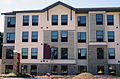 Campus View 3


Campus Map
[edit]JC Central Campus
[edit]
References
[edit]- ^ "JCC Foundation endowment sees 20 percent return on investment". Jackson College. Archived from the original on 2012-12-11. Retrieved October 17, 2012.
- ^ P. Barulin (2021-04-30). "95th Anniversary of the Steamship and the Man". International Affairs. 67 (002): 249–250. doi:10.21557/iaf.67456413. ISSN 0130-9641.
- ^ "Jackson Community College officials will consider removing the word 'community' from the school's name". The Citizen Patriot. Mlive. May 13, 2013. Retrieved June 20, 2013.
- ^ "Jackson Community College is no more as trustees approve name change to Jackson College". The Citizen Patriot. Mlive. June 11, 2013. Retrieved June 20, 2013.
- ^ "Central Campus". Jackson College. Retrieved 2023-12-07.
- ^ "Hillsdale Campus". Jackson College. Retrieved 2023-12-07.
- ^ "William Maher Obituary (2011) - Jackson, MI - Jackson Citizen Patriot". Legacy.com. Retrieved 2023-12-07.
- ^ Miller, Chloe (2023-06-23). "Jackson College sells closed Maher Campus to growing Jackson-based business". mlive. Retrieved 2023-12-07.
- ^ Ross, McKenna (2020-08-06). "Flight school program discontinued at Jackson College". mlive. Retrieved 2023-12-07.
- ^ Bragenzer, Adam (2020-09-21). "Jackson College Eliminates Aviation Program, Flight Center". JTV Jackson. Retrieved 2023-12-07.
- ^ Miller, Chloe (2023-09-06). "A new flight school is helping students reach new career heights in Jackson". mlive. Retrieved 2023-12-07.
External links
[edit]
42°09′52″N 84°24′13″W / 42.16442°N 84.40350°W
| International | |
|---|---|
| Geographic | |

Jackson College
View on GrokipediaHistory
Founding and early years
Jackson Junior College was established on February 16, 1928, by the Jackson Board of Education as part of the Union School District in Jackson, Michigan, marking the beginning of higher education offerings in the community.[5] The institution opened its doors in September 1928, with initial classes held in the old E.O. Marsh home on Wildwood Avenue, sharing facilities such as laboratories and libraries with Jackson High School.[3] This setup allowed the junior college to operate efficiently under the district's oversight, providing accessible post-secondary education to local residents.[5] The inaugural year saw an enrollment of 113 students, exceeding the expectations of school officials, and was supported by a dedicated staff of 10 faculty members, all holding graduate degrees from the University of Michigan.[3] This highly qualified faculty laid a strong academic foundation, emphasizing rigorous instruction aligned with university standards.[5] Enrollment grew steadily in the following years, reaching 327 students by 1939, reflecting increasing demand for junior college education in the region.[5] The early curriculum was designed to prepare students for transfer to four-year institutions or direct entry into the workforce, with a focus on liberal arts and vocational training modeled after the University of Michigan's programs.[5] Following a 1929 inspection, the University of Michigan formally accepted Jackson Junior College credits, affirming the quality of its offerings.[5] By the late 1930s, the curriculum evolved to include specialized two-year programs, such as a terminal secretarial course introduced in 1935, and in 1938, the college formalized divisions in Arts and Sciences for transfer students and General Studies for vocational paths, establishing key foundational academic departments.[5] Key early milestones included the first graduating class in 1930, consisting of 34 students who received associate degrees, celebrating the institution's successful launch.[5] This graduation highlighted the college's role in bridging high school and higher education, with subsequent reunions, such as the 10th-anniversary event in 1940, underscoring community support and alumni engagement.[5] These developments set the stage for further growth in the mid-20th century.Expansion and name changes
In 1962, Jackson County voters approved a proposal to establish an independent Jackson County Community College District, separating the institution from the local public school district and enabling broader countywide operations.[5] This independence facilitated significant physical and programmatic growth, beginning with the construction of the college's first dedicated campus in 1966 on a site in Blackman Township, with the Justin R. Whiting Vocational-Technical Building completed in 1968.[5] In 1965, the institution underwent its first major name change, from Jackson Junior College to Jackson Community College, to better reflect its expanding community-focused mission.[5] The 1970s marked a period of robust expansion in facilities and offerings, highlighted by the completion of the Justin R. Whiting Vocational-Technical Building in 1968, which supported the introduction and growth of vocational programs.[5] Enrollment in these programs surged, including innovative pilots like prison education initiatives that grew from 211 students in 1969–1970 to 450 by 1973, underscoring the college's commitment to accessible workforce development.[5] By the 1980s, the college extended its reach through off-site centers, opening the Lenawee Center in 1989 to serve surrounding counties and the Hillsdale Center in 1991 for further regional access.[5] Technological advancements also began integrating into the curriculum, with the establishment of computer labs in 1986 paving the way for broader digital adoption in the 1990s and 2000s, including online learning platforms and facility renovations such as McDivitt Hall in 2005.[5] In 2013, the board of trustees approved another name change to Jackson College, the third in its history, to emphasize its evolution into a comprehensive institution offering associate degrees, certificates, and even bachelor's programs in select fields.[5][8] This rebranding aligned with ongoing reaffirmations of its accreditation by the Higher Learning Commission, which it has held continuously since 1933, ensuring sustained quality amid these developments.[5] In March 2025, the college suspended its diversity, equity, and inclusion (DEI) programs in response to federal directives to protect federal funding.[9]Administration and organization
Governance
Jackson College operates as a public community college district serving primarily Jackson County, Michigan, with funding derived from local property taxes levied at a millage rate, state appropriations, and tuition and fees.[10][11] In 1962, Jackson County voters approved its reorganization as an independent community college district, and the institution operates under the Michigan Community College Act of 1966 (Act 331, P.A. 1966, as amended), which provides the legal framework for its operations.[11][12] The governance of Jackson College is overseen by a seven-member Board of Trustees, elected at large by residents of the district for staggered six-year terms as prescribed by Michigan law.[13][14] The board is responsible for setting institutional policies, approving the annual budget, and hiring the college president, while delegating day-to-day operations to the executive leadership under a Policy Governance model.[15][16] Jackson College maintains compliance with the Michigan Community College Act through its district structure and is accredited by the Higher Learning Commission under the Open Pathway, ensuring ongoing quality assurance in a 10-year cycle.[17][12] Key governance policies include adherence to open meetings requirements, with all board meetings held publicly and provisions for citizen comments via a structured process limited to five minutes per speaker.[18] The board also engages in strategic planning by defining "ENDS" policies that outline desired outcomes for the institution, linking them to broader mission fulfillment and external community needs.[16]Leadership
The leadership of Jackson College is headed by the president and CEO, who provides strategic direction and oversees operations in collaboration with an executive council and the Board of Trustees. The president is selected through a process managed by the Board of Trustees, which evaluates candidates based on their qualifications to advance the institution's mission of student success and community engagement.[19] Dr. Daniel J. Phelan has served as president and CEO since April 2001, bringing over two decades of experience in higher education administration. Holding a Ph.D. in Higher Education from the University of Missouri-Columbia, Phelan has emphasized continuous innovation and intentional student success initiatives, including enhanced support for veterans, family housing options, and advocacy for state and federal funding for community colleges. Under his leadership, the college launched the Jackson County Early College program to provide dual-enrollment pathways for high school students, and in 2025, he was elected to the board of directors of the American Association of Community Colleges (AACC), representing Michigan's community colleges nationally.[20][21][22][23] Preceding presidents have shaped the institution's growth since its founding in 1928 as Jackson Junior College. The following table lists key leaders and their tenures, along with notable contributions sourced from college records:| President | Tenure | Key Contributions |
|---|---|---|
| Edward O. Marsh | 1928–1930 | Founded Jackson Junior College with an initial enrollment of 113 students.[3] |
| Harold Steele | 1930–1942 | Expanded enrollment to 327 students by 1939, navigating challenges during the Great Depression.[3] |
| George L. Greenwalt | 1942–1952 | Served as superintendent and president while contributing to U.S. technical assistance programs abroad during World War II.[3] |
| William Atkinson | 1952–1969 | As the first full-time president starting in 1952, led significant campus infrastructure development in the 1960s.[3] |
| Harold D. McAninch | 1969–1971 | Transitioned from vice president of instruction to president, focusing on academic program stabilization during early independence from the public schools.[3] |
| Harold V. Sheffer | 1972–1981 | Oversaw the development of off-campus centers and facilities; the Music Hall Auditorium is named in his honor.[3] |
| Clyde E. LeTarte | 1981–1993 | Expanded access to Lenawee and Hillsdale Counties through new centers, one of which bears his name.[3] |
| E. Lee Howser | 1993–2001 | Promoted the "Learning College" concept to emphasize student-centered education; supported the CARE program for at-risk students and opened a child care center in 1997; served the college for a total of 32 years in various roles prior to and including the presidency.[3][5] |