Hubbry Logo
JamboJamboMain
Open search
Jambo
Community hub
Jambo
logo
8 pages, 0 posts
0 subscribers
Be the first to start a discussion here.
Jambo
Jambo
from Wikipedia

Jambo
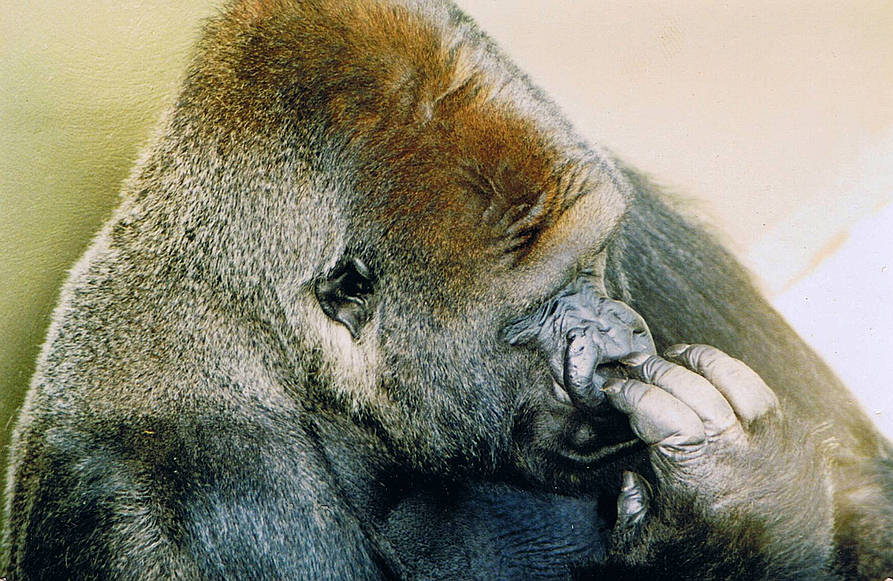
Jambo c. 1986
SpeciesWestern gorilla
SexMale
Born17 April 1961
Zoo Basel, Basel, Switzerland
Died16 September 1992(1992-09-16) (aged 31)
Jersey Zoo
Known forProtecting a child that had fallen in his enclosure

Jambo (17 April 1961 – 16 September 1992) was a gorilla housed at Durrell Wildlife Park in Jersey, Channel Islands. He was involved in an incident in which he was seen to be protective of a child who fell into his enclosure.

Early life

[edit]

Jambo means "hello" in Swahili. The gorilla was born on 17 April 1961, in Zoo Basel, Basel, Switzerland, to mother Achilla and father Stephi. Stephi was acquired from the Columbus Zoo in Ohio. Stephi was captured in 1950 by Columbus resident and gorilla hunter Bill Said, with two other baby gorillas, in French Equatorial Africa. The three were sold to the Columbus Zoo for $10,000. The two which the Columbus Zoo kept, Baron Macombo and Millie Christina, became the parents of Colo, the first gorilla born in a zoo, in Columbus on 22 December 1956. She was the first gorilla born in captivity as well as the first gorilla in captivity to be raised by her own mother.

Jambo's older sister Goma, born on 23 September 1959 in Basel, was the first gorilla born in Europe and lived in the Zoo Basel until her death in 2018.[1] Before Jambo was transferred to Jersey Zoo, Jambo and Goma had a son named Tamtam, who was born at Zoo Basel on 2 May 1971, and died at Wuppertal Zoo on 23 July 2009. Jambo also fathered a daughter while still at Zoo Basel by an unrelated female. Jambo had seven siblings and 20 offspring by five different mates, including three stillbirths. He was moved to Jersey Zoo on 27 April 1972.

Rescue of Levan Merritt

[edit]

On 31 August 1986, five-year-old Levan Merritt fell into the gorilla enclosure and lost consciousness. Jambo stood guard over the boy when he was unconscious, placing himself between the boy and other gorillas in what ethologists analyze as a protective gesture. He later stroked the unconscious boy's back. When the boy regained consciousness and started to cry, Jambo and the other gorillas retreated in panic, and the silverback led them into a small hut in the corner of their pen. A paramedic and two keepers rescued the boy. Most of the incident was recorded on home video and extensively photographed by zoo visitors. The publicity on major news channels and newspapers helped ease public fears about the potentially violent nature of gorillas.

Death and legacy

[edit]
Statue of Jambo by Ralph Brown at Durrell Wildlife Park

Jambo was found dead by his keeper in the gorilla enclosure on 16 September 1992. The cause of death was the spontaneous rupture of a major artery, resulting in a hemorrhage in his chest. A biography of Jambo, written and illustrated by his keeper, was published following his death. A documentary has also been released primarily based on the home video footage of the Levan Merritt incident.

Jersey Zoo has erected a bronze statue of Jambo inside the zoo grounds as a tribute to the gorilla who helped change public perception about the species.

See also

[edit]

References

[edit]
[edit]
Revisions and contributorsEdit on WikipediaRead on Wikipedia
from Grokipedia
Jambo (17 April 1961 – 16 September 1992) was a who resided at (formerly ) in the , renowned for his gentle temperament and significant contributions to gorilla conservation through breeding. Born at in , Jambo was the first male gorilla successfully born and mother-reared in captivity, marking a milestone in husbandry. He arrived at in 1972 as the park's first , where he quickly became a central figure in the institution's efforts to breed western lowland gorillas, a critically endangered . On 31 August 1986, Jambo gained international fame when five-year-old Levan Merritt fell approximately 12 feet (3.7 meters) into the enclosure at , sustaining a fractured and losing consciousness. Displaying protective behavior, Jambo stood guard over the unconscious boy, positioning himself between Merritt and the other gorillas in the troop to prevent any approach, until zoo staff could safely rescue the child. This incident, captured on video and widely publicized, challenged public perceptions of gorillas as aggressive animals and highlighted Jambo's calm demeanor, earning him the nickname "The ." Throughout his life at , Jambo sired 15 offspring with his mates, including notable individuals like Hlala Kahilli (born 1988), contributing to a breeding legacy that includes over 170 descendants as of 2017 and played a crucial role in the conservation of western lowland gorillas. He passed away at the age of 31 from a ruptured , after which honored his memory with a bronze in the grounds. In 2012, Jersey Post issued a set of commemorative stamps featuring Jambo, with proceeds supporting Durrell's conservation work, further cementing his status as an icon of wildlife preservation.

Early Years

Birth and Origins

Jambo, a male (Gorilla gorilla gorilla), was born on April 17, 1961, at in , , marking him as the second gorilla born in a European zoo and the first male gorilla successfully parent-reared in captivity. His parents were the silverback Stephi (also known as Christopher), born wild in 1949 and acquired by in 1954 after time at the Columbus Zoo, and the female Achilla, born wild in 1947. Both parents originated from , representing early imports that supported 's pioneering efforts in gorilla breeding during the late and . Jambo was one of eight offspring from Achilla and Stephi, including seven siblings: his older sister (born ), Migger, Quarta, Ucima (a half-sibling), Wimbi, Donga, and one aborted fetus. Several siblings, such as , remained at for much of their lives, contributing to the institution's multi-generational group. As a young , Jambo was raised by his mother in a family unit, an achievement that advanced captive rearing techniques at the time. During his early years, Jambo inhabited a section of Zoo Basel's bird house, adapted for primates, which served as the initial enclosure for the zoo's troop before the dedicated ape house opened in the late . This breeding program, established after negotiations with the government for the parental pair, emphasized natural social dynamics and was instrumental in producing Europe's first zoo-born , fostering Jambo's development within a troop environment. The , Jambo's , is characterized by its robust build—adult males reaching up to 1.7 meters in height and 200 kilograms—with troops typically comprising 5 to 30 individuals led by a dominant silverback who protects the group. Native to the dense rainforests of western and , this exhibits complex social structures centered on family bonds and behaviors. Jambo's lineage, stemming from wild-caught parents, underscored the ' critically endangered status even in the 1960s, driven by habitat loss and , and highlighted the role of early programs in conservation awareness.

Transfer to Jersey Zoo

In 1972, at the age of 11, Jambo was transferred from in to (now Durrell Wildlife Park) in the as part of international conservation initiatives aimed at bolstering breeding programs for the endangered . 's founder, , specifically sought to assemble a viable troop to support species preservation efforts, and Jambo—the first male ever born in captivity—was chosen for his genetic value and potential leadership role in the group. Born at to a father captured in the wild from , Jambo's relocation represented a key step in global zoo collaborations to prevent the decline of populations. The transfer logistics involved coordinated transport from to the , aligning with standard inter-zoo exchanges of the era, though precise routes such as air or sea components are not extensively documented. Upon arrival, Jambo entered a period to safeguard his health and that of the resident animals, before being housed in the park's newly constructed gorilla , completed between 1971 and 1972 and funded by donor Brian Park. This setup provided ample space and environmental enrichments suited to gorilla social structures, facilitating initial acclimation. Jersey Zoo, established by Durrell in 1959, emphasized the and rehabilitation of , with facilities in 1972 reflecting a growing commitment to like western lowland gorillas amid rising conservation concerns. In his first year, Jambo exhibited steady adaptation behaviors, gradually integrating with the existing female gorillas—such as Nandi—through cautious interactions that established his presence without immediate conflict. This phase culminated in successful group cohesion, evidenced by the birth of his first offspring, Assumbo, in 1973, underscoring the transfer's early impact on the troop's dynamics.

Life at Durrell Wildlife Park

Role as Silverback

Jambo assumed the role of silverback and troop leader at Durrell Wildlife Park upon his arrival from Basel Zoo in 1972, at approximately 11 years of age, becoming the park's first male and establishing dominance over the existing group of females. As the dominant male from the mid-1970s until his death in 1992, Jambo exhibited a calm noted by longtime keepers, who described him as a steady presence capable of maintaining composure amid disturbances. His daily behaviors included leading the troop in foraging and movement within the enclosure, while interactions with keepers involved routine feeding and health checks that highlighted his generally non-aggressive disposition, as recounted by staff familiar with his habits over several years. Jambo's leadership ensured troop cohesion through protective vigilance and social rituals such as grooming, preventing internal conflicts and fostering group stability essential for the park's conservation efforts. This stability as silverback supported the breeding program's success by providing a secure environment for the females and young, without which the group's reproductive outcomes would have been compromised.

Family and Offspring

Jambo sired between 17 and 20 offspring over his lifetime, including three stillbirths, through pairings with five female gorillas. His early mates at Zoo included Kati, a captive-born female, with whom he had daughter Souanke in 1970 (who died shortly after birth due to ), and , his full sister and also captive-born, with whom he fathered son Tamtam in 1971 (who survived until 2009 at Zoo). At Durrell Wildlife Park, Jambo's primary mates were N'Pongo, a wild-born female captured in 1957 and acquired by the zoo in 1959, and Nandi, another wild-born female who arrived in 1961. With N'Pongo, he produced eight offspring between 1973 and 1991, including sons Mamfe (1973, transferred to where he later sired offspring before dying in 2006), Tatu (1975, moved to Oklahoma City Zoo and fathered multiple young), N'Gola (1977, relocated to Zurich Zoo where he sired 34 offspring, 17 surviving), and daughter Hlala Kahili (1988, who remains at Durrell and has herself produced four offspring—Mapema, Ya Pili, Indigo, and a stillborn twin—contributing further to the breeding program). Nandi bore five of Jambo's offspring from 1973 to 1975, notably son Assumbo (1973, the first gorilla born at Durrell, hand-reared and transferred to in in 1999, where he continues to live) and daughter Zaire (1974, moved to and died in 2020 after producing one surviving offspring). Jambo's third mate at Durrell was Kishka, a captive-born female from Bekesbourne in 1978 who joined the group in 1984; although she did not produce surviving offspring with him, her integration supported group dynamics during his later breeding years. Jambo's breeding activity spanned from the early to the early , with key births clustered in 1973–1975 (seven across N'Pongo and Nandi) and continuing sporadically thereafter, reflecting the zoo's success in establishing a stable under his leadership as silverback. Of his , approximately 5 males and 1 female survived to breeding age at Durrell, contributing to a high success rate in the park's early captive breeding efforts for western lowland gorillas. Many of Jambo's descendants were transferred to other European zoos to bolster , including Assumbo to , N'Gola to , and Zaire to , where they participated in conservation breeding. Hlala Kahili's lineage, for instance, includes grandson (born 2012 at Durrell), who supports ongoing efforts to maintain a viable captive population. Several offspring, such as and Mamfe, themselves produced progeny, amplifying Jambo's genetic footprint. Jambo's reproductive success had a profound genetic impact on the ex situ population of western lowland gorillas, with his lineage integrated into the European Endangered Species Programme (EEP). As one of the most prolific sires in early captive breeding, he helped establish Durrell as a key center for gorilla conservation, with descendants numbering over 170 across European collections and aiding efforts to prevent extinction amid wild population declines.

The 1986 Rescue Incident

The Event

On August 31, 1986, at the gorilla enclosure of (now Durrell Wildlife Park) in the , five-year-old Levan Merritt, who was on holiday with his family from the , fell into the exhibit after leaning over or being lifted to the barrier. The boy plummeted approximately 12 feet (3.7 meters) onto a strip, sustaining a fractured , broken , and other injuries that left him unconscious and bleeding. Jambo, the troop's dominant silverback known for his protective role among family members, immediately approached the motionless child and positioned himself to stand guard, using his authority to deter the other gorillas from nearing. In a display of apparent concern, Jambo gently stroked Levan's back with his hand while remaining beside him for several minutes. The rest of the gorilla troop, including younger and more inquisitive individuals, displayed toward the intruder but were kept at a distance by Jambo's vigilant presence and displays of dominance. This behavior lasted until Levan began to stir and cry, at which point the gorillas retreated further. The event exposed vulnerabilities in the enclosure's , particularly the barrier's and , which allowed a young child to reach the edge and fall; subsequent zoo safety reviews cited such features as contributing factors to the breach.

Immediate Response and Rescue

Following the fall of five-year-old Levan Merritt into the enclosure on August 31, 1986, visitors at reacted with immediate panic, screaming as the unconscious boy lay vulnerable amid the gorillas. Zoo staff were alerted within seconds, mobilizing keepers to secure the area and assess the situation while coordinating with emergency services. Brian Fox, who happened to be visiting the zoo that day, volunteered to enter the enclosure to provide medical aid, supported by keepers Andy Wood and who positioned themselves to protect him from potential threats by other gorillas. Jambo's protective behavior toward Merritt, in which the silverback stood guard over the boy and deterred the other , created a brief window of opportunity for intervention without the need for aggressive measures like tranquilizer . As Merritt regained and began crying from , Jambo led the troop, including a younger female gorilla, to retreat to the rear of the , allowing the rescuers to approach safely. Fox then entered, treated the boy's immediate injuries on-site, secured both himself and Merritt with a for safety, and, with assistance from the , lifted and hauled the child out of the . The extraction was completed within about 10 minutes of the fall, minimizing further risk to the boy. Merritt sustained a fractured , broken , and multiple bruises from the 12-foot (3.7-meter) fall, rendering him unconscious upon impact. He was airlifted directly to for emergency treatment, including surgery to address the and injuries, and remained there for six weeks under observation. Merritt made a full recovery within that period, with no long-term complications reported from the incident. In the immediate aftermath, zoo director Lee Durrell initiated a thorough safety review of visitor access points and animal enclosures to prevent similar breaches. This led to the installation of prominent warning signs cautioning against placing children on railings overlooking exhibits, along with enhancements to barrier designs for increased durability and visibility. These changes were implemented swiftly to address vulnerabilities exposed by the event. Witnesses described a palpable tension during the ordeal, with the crowd's initial terror giving way to collective relief upon Merritt's safe extraction. Brian Fox later reflected on the high-stakes moment, stating, "The were keeping another gorilla at bay so I could treat the ." Keeper Johnston-Scott recalled the crowd's noise contrasting with Jambo's calm demeanor, observing, "Jambo looked up as if he was saying 'why are you making so much noise.'" Merritt himself, reflecting years later, expressed profound gratitude amid the relief, saying, "I am forever thankful to Jambo as obviously it could have gone one or two ways. It was amazing how he protected me in that way."

Later Life and Death

Health Decline

Following the 1986 rescue incident, which had no direct physical impact on , he resumed his duties as the troop's silverback leader without any reported behavioral changes or signs of stress at Durrell Wildlife Park. Jambo remained an integral part of the gorilla family, continuing to exhibit protective behaviors and contributing to the breeding program by siring Hlala Kahilli with N'Pongo on January 23, 1988. By the late 1980s and early 1990s, Jambo had reached advanced age for a , turning 30 in 1991 and living to 31 years, at a time when captive individuals typically survive 35 to 50 years but often experience reduced vitality in their later decades. Durrell Wildlife Park's on-site veterinary team provided comprehensive care for its , including annual examinations, monitoring for age-related conditions like and mobility limitations common in elderly s, and tailored dietary adjustments to maintain muscle mass and joint —practices that supported Jambo's ongoing activity levels.

Cause and Circumstances of Death

Jambo was discovered deceased on September 16, 1992, by a keeper entering the enclosure at Durrell Park, at the age of 31. A necropsy performed by the zoo's veterinary team determined the to be a ruptured dissecting , resulting in haemopericardium—a massive hemorrhage into the pericardial sac surrounding the heart—with no signs of external trauma or foul play. This sudden cardiovascular failure occurred overnight. Such aortic dissections and aneurysms are a prevalent and often fatal condition in aging male captive gorillas, frequently linked to underlying hypertension or fibrosing cardiomyopathy rather than atherosclerosis. The necropsy findings on Jambo contributed valuable data to ongoing research on gorilla cardiovascular pathology, highlighting the species' susceptibility to these age-related vascular weaknesses. In the immediate aftermath, the zoo promptly informed the public of Jambo's passing, noting the unexpected nature of the event.

Legacy

Memorials and Recognition

Following Jambo's death in 1992, a life-size bronze statue depicting the in a protective stance was erected at the entrance of in , serving as a lasting tribute to his gentle nature during the 1986 rescue incident. The sculpture, created by artist , has been a prominent feature at the park, symbolizing Jambo's role in gorilla conservation. In 1995, Richard Johnstone-Scott, a longtime keeper at Durrell Wildlife Park, published Jambo: A Gorilla's Story, a biography chronicling the gorilla's life from his birth in Basel Zoo in 1961 to his contributions as the founding silverback of the park's breeding program. The book draws on Johnstone-Scott's personal observations to highlight Jambo's behavior and family dynamics, emphasizing his paternal role with 15 offspring. Documentary footage of the 1986 incident, including BBC coverage that captured Jambo guarding the injured boy, has been featured in several films, such as the 2005 production Gerald Durrell: Jambo the Gentle Giant, narrated by and focusing on the gorilla's life at the park. This media recognition underscores Jambo's immediate fame but did not result in specific awards for the event itself. In 2012, to mark the 20th anniversary of Jambo's death, Jersey Post issued a set of four stamps and a miniature sheet featuring images of the gorilla, acknowledging his protective actions and status as a conservation icon. Additionally, Jambo's legacy is honored through his family lineage, with his 15 direct offspring forming the basis of Durrell's breeding program; as of 2017, his descendants numbered 170 individuals across global conservation efforts.

Influence on Conservation and Public Perception

Jambo's protective actions during the 1986 incident significantly shifted public perception of , portraying silverback males as gentle guardians rather than aggressive threats. This event humanized in the public eye, countering long-held stereotypes of them as dangerous beasts akin to fictional monsters like . The global media coverage fostered greater empathy toward great apes, emphasizing their intelligence and familial behaviors. The heightened awareness from the incident bolstered conservation efforts at , where Jambo resided. His story amplified support for the organization's gorilla breeding program, part of the European Endangered Species Programme (EEP) for , an IUCN critically endangered . Jambo himself contributed directly by fathering 15 , aiding in captive populations and supporting reintroduction initiatives in . This publicity helped sustain funding and resources for and protection projects, with Durrell noting the event's role in elevating international interest in gorilla welfare. Jambo's case served as a positive in later gorilla enclosure incidents, such as the 2016 Harambe event at the Cincinnati Zoo, where experts advocated for non-lethal responses inspired by his protective demeanor. Lee Durrell, executive director of the trust, highlighted how Jambo's behavior demonstrated gorillas' capacity for calm intervention, influencing zoo protocols to prioritize over immediate tranquilization or . This approach indirectly prompted reviews of enclosure designs worldwide, emphasizing taller barriers and moat modifications to enhance safety while minimizing stress on animals. Educationally, Jambo's narrative has been integrated into outreach and school programs to cultivate and combat trafficking. Documentaries and media retellings, such as the 2005 film Gerald Durrell: Jambo the Gentle Giant, use his story to illustrate gorilla social structures and the urgency of conservation, reaching audiences through platforms promoting awareness. As recently as 2025, videos continue to reference Jambo to underscore themes of interspecies compassion. Levan Merritt, the boy protected by Jambo, expressed lasting gratitude in 2016 interviews, crediting the with shaping his advocacy for .

References

Add your contribution
Related Hubs
User Avatar
No comments yet.