


Community hub
Recent from talks
Contribute something
Nothing was collected or created yet.
J. Geils
View on Wikipedia
Key Information


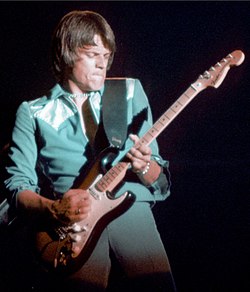
John Warren Geils Jr. (/ɡaɪlz/) (February 20, 1946 – April 11, 2017), was an American guitarist. He was known as the leader of the J. Geils Band.[1]
Growing up in New York City, Geils became interested in jazz and blues. After moving to Massachusetts for his college education, he formed the J. Geils Blues Band while still a student at Worcester Polytechnic Institute. After dropping the word "Blues" from their name, the band released their first album in 1970, performing soul and rhythm and blues-influenced rock music for most of the 1970s before turning to pop music in the 1980s. After the band broke up in 1985, Geils left regular performing to take up restoration and racing of automobiles, with occasional forays into music production. He continued to appear in reunion tours with the rest of his band sporadically during the 2000s and 2010s.
Early life
[edit]John Warren Geils Jr. was born on February 20, 1946, in New York City, and grew up in Morris Plains, New Jersey. He was of German ancestry.[2]
In 1959, his family moved to Old Farm Lane in Bedminster, New Jersey. He attended Bernards High School in nearby Bernardsville. Before he graduated in 1964 he was a member of the math club, the physics club, student council, car club, band club and the marching band. He also was a big fan of motorcycles. His father was an engineer at Bell Labs and a jazz fan.[3] From an early age, he heard his father's albums by Benny Goodman, Duke Ellington, and Count Basie, and was escorted by his father to a Louis Armstrong concert. He learned to play Miles Davis music on the trumpet and drums, and he listened to blues singers Howlin' Wolf and Muddy Waters on the radio.[4] In 1964, he began attending Northeastern University and was a trumpeter in the marching band. When he was drawn to folk musicians in Boston, he left Northeastern for Worcester Polytechnic Institute, where he studied mechanical engineering.[4][3]
Musical career
[edit]Geils began playing jazz trumpet but eventually switched to blues guitar. He formed an acoustic blues trio, 'Snoopy and the Sopwith Camels', with bassist Danny Klein and harmonica player Richard "Magic Dick" Salwitz, while studying mechanical engineering at Worcester Polytechnic Institute in the mid-1960s. In late 1965 their line-up consisted of vocalist/saxophone player Peter Kraemer, guitarists Terry MacNeil and William "Truckaway" Sievers, bassist Martin Beard (born 1947, London), and drummer Norman Mayell. They soon moved to Boston, where they added new drummer Stephen Jo Bladd and lead vocalist Peter Wolf, who was a late-night DJ on WBCN. Geils later formed the 'J. Geils Blues Band' with Klein, Salwitz, Bladd, and Wolf, with Seth Justman becoming the final member before the band released its debut album in 1970.[4]
Renamed "The J. Geils Band", the band released eleven albums between 1970 and 1985. Although they were influenced by soul music and rhythm and blues, their musical style was difficult to categorize. Their success was allegedly limited by being "too white for the black kids and too black for the whites".[citation needed]
The band's sound moved toward pop and rock by the time the breakthrough album Love Stinks (EMI, 1980) came out. Their next album, Freeze Frame, produced the song "Centerfold", which sat at number one for six weeks,[5] and the title track, which was a Billboard Top 10 hit.[6]
Tension and conflict arose among band members, and Wolf left to pursue a solo career. The band broke up in 1985.[7] Geils took a break from music to concentrate on auto racing and restoration.[8]
In 2012 he filed a lawsuit against the other band members when they allegedly planned to tour without him while using the band's trademarked name. This prompted him to quit the group permanently.[9]
Solo career
[edit]Geils recorded two blues albums with Magic Dick during the 1990s, then formed a jazz trio with guitarists Duke Robillard and Gerry Beaudoin. He released his first solo album, Jay Geils Plays Jazz!, in 2005.[4]
In 2015, Geils was named to the Wall of Honor at his alma mater, Bernards High School, in Bernardsville, New Jersey.[10]
KTR Motorsports
[edit]In addition to passing on an interest in jazz, Geils's father took him to auto races in Pennsylvania in the 1950s. Geils became fascinated with Italian sports cars.[3] He drove in five races a year during the early 1980s, at the peak of the J. Geils Band's popularity.[4] He opened KTR Motorsports, an automobile restoration shop in Ayer, Massachusetts to service and repair vintage sports cars such as Ferrari and Maserati. He sold the shop in 1996, though he continued to use the shop and participate in the company.[3]
Personal life and death
[edit]In 1982, Geils moved to Groton, Massachusetts. The town honored him by proclaiming J. Geils Day on December 1, 2009.[11] In September 2016, he was arrested and charged with drunk driving after allegedly rear-ending a car in Concord, Massachusetts.[12]
On April 11, 2017, Groton Police conducted a well-being check on Geils and found him unresponsive at his home. He was pronounced dead from natural causes at age 71.[13][14][15][16][17]
Discography
[edit]As Jay Geils
- Bluestime - with Magic Dick (Rounder, 1994)
- Little Car Blues - with Magic Dick (Rounder, 1996)
- Jay Geils Plays Jazz! (Stony Plain, 2005)
- Jay Geils, Gerry Beaudoin and the Kings of Strings featuring Aaron Weinstein (Arbors, 2006)
- Toe Tappin' Jazz (North Star, 2009)[18]
As New Guitar Summit
- New Guitar Summit - with Duke Robillard, Gerry Beaudoin (Stony Plain, 2004)
- Live at the Stoneham Theatre (Stony Plain, 2004)
- Jazzthing II - with Randy Bachman (Koch, 2007)
- Shivers - with Randy Bachman (Stony Plain, 2008)[18]
References
[edit]- ^ Ware, Susan (October 21, 2004). "Fame still calls J. Geils". The Boston Globe. Archived from the original on January 18, 2013. Retrieved April 12, 2017.
- ^ "Musician J. Geils, dies at Massachusetts home: police". Reuters. April 12, 2017. Archived from the original on April 12, 2017. Retrieved April 12, 2017.
- ^ a b c d Berg, Phil (July 12, 2012). "Rocker Jay Geils' passions for cars, music handed down from his dad: Ferrari, Maserati among his collection". Autoweek. Retrieved January 1, 2017.
- ^ a b c d e Viglione, Joe. "J. Geils". AllMusic. Retrieved January 1, 2017.
- ^ "Top 100 Songs -- The Week of March 13, 1982". Billboard. Retrieved April 12, 2017.
- ^ "Top 100 Songs -- The Week of April 10, 1982". Billboard. Retrieved April 12, 2017.
- ^ Erlewine, Stephen Thomas. "J. Geils Band". AllMusic. Retrieved April 1, 2017.
- ^ Shenton, Zoe (April 12, 2017). "J Geils dead at 71 as The J Geils Band founder and guitarist 'passes away at home'". Mirror Online. Retrieved April 12, 2017.
- ^ Sweeting, Adam (April 12, 2017). "J Geils obituary". The Guardian. Retrieved April 29, 2017.
- ^ Perry, W. Jacob (March 6, 2015). "Rock star among Bernards High's 'Wall of Honor' class". New Jersey Hills. Retrieved April 1, 2017.
- ^ Marotta, Michael (November 29, 2009). "Mass. to celebrate Jay Geils Day". Boston Herald. p. 36.
- ^ "J. Geils Band founder facing drunken driving charge". NY Daily News. September 22, 2016. Retrieved April 12, 2017.
- ^ "Guitarist known as J. Geils found dead in Massachusetts home". Wcvb.com. April 12, 2017. Archived from the original on April 12, 2017. Retrieved April 12, 2017.
- ^ Guerra, C.; Sennott, A. (April 11, 2017). "Guitarist J. Geils found dead in Groton home". The Boston Globe. Retrieved April 11, 2017.
- ^ Jacobo, Julia (April 11, 2017). "Guitarist J. Geils dead at 71, police say". ABC News. Retrieved April 12, 2017.
- ^ "J. Geils Band leader dead at 71". Archived from the original on April 12, 2017. Retrieved April 12, 2017.
- ^ Chokshi, Niraj (April 11, 2017). "J. Geils, Whose Band's Catchy Pop Hits Colored the 1980s, Dies at 71". The New York Times. Archived from the original on April 13, 2017. Retrieved April 13, 2017.
- ^ a b "J. Geils | Credits". AllMusic. Archived from the original on April 12, 2017. Retrieved April 12, 2017.
| International | |
|---|---|
| National | |
| Artists | |

J. Geils
View on GrokipediaEarly Life and Education
Childhood and Family Influences
John Warren Geils Jr. was born on February 20, 1946, in New York City. He spent his early years in Morris Plains, New Jersey, where his family established roots, before relocating to Bedminster in 1959. His father, also named John "J" Geils, worked as an engineer at Bell Labs and played a pivotal role in shaping his son's worldview through shared interests in music and mechanics. The family environment emphasized technical aptitude and cultural appreciation, with Geils later recalling his father's hands-on approach to repairs that instilled a sense of self-reliance. Geils's initial musical exposures came from his parents' shared passion for jazz, particularly through his father's collection of big band records. As a child, he frequently listened to recordings by Benny Goodman and the pioneering electric guitarist Charlie Christian, whose swing-era innovations left a lasting impression and introduced him to the improvisational energy of jazz. These familial influences laid the groundwork for Geils's appreciation of rhythmic complexity, though his listening habits gradually shifted toward blues records he discovered on his own during his pre-teen years, marking an independent pivot from structured big band sounds to more raw, emotive styles. A parallel childhood fascination emerged with automobiles, sparked by his father's enthusiasm for vintage cars and road racing. Geils accompanied his father to events like the Giants Despair hill climb in Pennsylvania as early as 1956, when he was just 10 years old, witnessing high-performance vehicles such as Ferraris and Maseratis in action. This early immersion, combined with his father's mechanical teachings, ignited a lifelong passion for hot rods and sports cars that would complement his musical pursuits.Academic Background and Musical Awakening
John Warren Geils Jr. attended Bernards High School in Bernardsville, New Jersey, where he developed an initial interest in music during his teenage years.[7] Growing up in Far Hills, New Jersey, with a father who worked as an engineer at Bell Labs, Geils was exposed early to jazz through family influences, including attending a Louis Armstrong concert at age 10.[7] At high school, he initially learned trumpet and drums, studying tunes by Miles Davis—whom he later saw in concert at age 13—before switching to guitar.[8][7] In the mid-1960s, Geils enrolled at Northeastern University in Boston, where he played trumpet in the university band.[8] He later transferred to Worcester Polytechnic Institute to study mechanical engineering.[9] Around 1967, Geils decided to leave college and pursue music full-time, prioritizing his growing passion for the instrument over his academic path.[10] Geils was largely self-taught on guitar, acquiring his first instrument during high school and developing his skills through dedicated practice.[7] His early influences included jazz guitarist Charlie Christian as well as blues pioneers such as T-Bone Walker and B.B. King, whose styles shaped his technique of blending fluid phrasing with expressive bends.[7] He emulated jazz guitar approaches, incorporating swing rhythms and sophisticated chord voicings into his routines, while drawing from blues artists like Muddy Waters and John Lee Hooker for raw emotional delivery.[11] These elements fueled his early informal performances in local settings, where he experimented with merging big band swing sensibilities and emerging blues structures.[12]Musical Career with The J. Geils Band
Formation and Early Blues Period
The J. Geils Band originated as an acoustic blues trio formed in 1967 at Worcester Polytechnic Institute in Worcester, Massachusetts, consisting of guitarist John "J." Geils, bassist Danny "Danny K" Klein, and harmonica player Richard "Magic Dick" Salwitz.[13] The group initially performed under names such as Snoopy and the Sopwith Camels, drawing on Geils's developing interest in blues guitar that had taken root during his pre-college years.[13] After the members dropped out of school, they relocated to Boston and expanded the lineup in 1967 by adding vocalist Peter Wolf, who brought influences from his prior work with the R&B group the Hallucinations.[4][14] The band renamed itself the J. Geils Blues Band in 1967, later shortening to the J. Geils Band upon the addition of keyboardist Seth Justman and drummer Stephen Bladd in mid-1968, solidifying a full ensemble dedicated to blues-rock.[4][15] This configuration emphasized a raw, energetic sound rooted in Chicago-style blues, with Salwitz's harmonica evoking masters like Little Walter and Geils's slide guitar channeling South Side Chicago influences alongside soulful phrasing akin to Steve Cropper.[5][16] In their early years, the band honed their craft through gigs at Boston-area clubs, including the Unicorn Coffee House in 1967 and venues like Tammany Hall and the Cambridge Tea Party, where their high-energy performances built a local following.[4][16] These shows featured a gritty, unpolished blues aesthetic that prioritized improvisation and audience interaction, setting the stage for their transition to a more electric presentation.[5] The group's rising profile led to a signing with Atlantic Records in 1970, culminating in the release of their self-titled debut album on November 16 of that year.[17][18] The album showcased a mix of blues covers and originals, such as the driving "Hard Drivin' Man," highlighting the band's electric evolution and Geils's guitar work infused with jazz-like phrasing for added fluidity.[15][16] Their follow-up, The Morning After, arrived in October 1971 and marked a modest commercial step forward with the single "Looking for a Love," a cover of the Valentinos' R&B track that reached number 39 on the Billboard Hot 100.[18] This release further demonstrated the band's shift from acoustic roots to a fuller electric blues sound, blending covers with originals while retaining their Chicago-inspired intensity.[15] Throughout this period, the J. Geils Band's music evolved from the trio's acoustic folk-blues origins to a robust electric format, with Geils's guitar lines incorporating subtle jazz inflections—stemming from his early trumpet experience—for expressive bends and rhythmic nuance in their blues framework.[14][16]Transition to Rock and Commercial Breakthrough
In the early 1970s, the J. Geils Band began shifting from their blues roots toward a more rock-oriented sound infused with R&B and soul elements, drawing inspiration from artists such as Wilson Pickett, Otis Redding, and James Brown. This evolution was evident starting with their 1973 album Bloodshot, which blended gritty blues-rock with rhythmic, horn-driven tracks that highlighted the band's growing emphasis on high-energy grooves and vocal interplay led by Peter Wolf. The album marked a commercial step forward, reaching the Top 10 on the Billboard 200 and earning gold certification for its road-tested blend of covers and originals that captured their bar-band charisma.[5] Their 1972 live album Full House, recorded at Detroit's Cinderella Ballroom, exemplified the band's explosive stage presence during this transitional phase, peaking at No. 54 on the Billboard 200 and showcasing extended jams that fused blues foundations with rock vigor. Tracks like the instrumental "Whammer Jammer" highlighted J. Geils's guitar work, where his slide technique—rooted in Chicago blues and jazz—evolved to incorporate sharper rock edges influenced by figures like Steve Cropper and Jimi Hendrix, while retaining improvisational flair. The album's success underscored their reputation as a formidable live act, helping solidify a dedicated East Coast fanbase, particularly in Boston.[5][19][20] Subsequent releases like Ladies Invited (1973) and Nightmares... and Other Tales from the Vinyl Jungle (1974) furthered this genre expansion with original songs that leaned into R&B-inflected rock, yielding key hits that boosted their visibility. "Give It to Me," from Bloodshot, climbed to No. 30 on the Billboard Hot 100, while "Must of Got Lost" from Nightmares reached No. 12, both tracks featuring Wolf's soulful delivery and the band's tight, horn-augmented rhythm section. Extensive touring as openers for major acts including B.B. King, the Allman Brothers Band, and Johnny Winter during this period built their loyal following through relentless performances across the East Coast and beyond, transforming them from regional favorites into a national touring draw.[5][20][19] By 1978's Sanctuary, the band's sound had tilted further toward pop sensibilities, incorporating diverse elements like synthesizer touches and rockabilly riffs alongside their blues-soul core, resulting in a gold-certified album with tracks such as "One Last Kiss." This release reflected their ongoing maturation, balancing commercial appeal with the raw energy that defined their earlier work, while Geils's solos continued to bridge blues improvisation with rock drive in songs that showcased the group's versatility.[5][21]Peak Popularity and Band Dissolution
The J. Geils Band reached its commercial zenith in the early 1980s with a polished arena rock sound that blended their blues-rock roots with pop sensibilities, marking a shift from the rawer R&B influences of the 1970s. Their 1980 album Love Stinks, released by EMI America, peaked at No. 18 on the Billboard 200 and achieved platinum certification for over one million copies sold in the U.S. The title track single reached No. 38 on the Billboard Hot 100, while "Come Back" hit No. 32, signaling the band's growing radio appeal through Seth Justman's production and Peter Wolf's charismatic vocals. This era saw J. Geils contributing signature guitar riffs and collaborating on horn arrangements that added punchy, Motown-inspired layers to tracks like these, enhancing the band's transition to larger venues.[22] The pinnacle came with the 1981 album Freeze-Frame, which topped the Billboard 200 for four weeks and earned triple-platinum status with over three million U.S. sales. Lead single "Centerfold" became their only No. 1 Hot 100 hit, spending six weeks at the top and driving massive airplay, while the title track reached No. 4. Geils's rhythmic guitar work intertwined with Justman's keyboards and external horn charts by Allen Toussaint, creating infectious hooks that propelled the band to sold-out arena tours, including multiple nights at Madison Square Garden.[22][23] The follow-up Showtime! (1982) also went gold, peaking at No. 5 on the Billboard 200, with hits like "I Do" (No. 11 Hot 100) reinforcing their status as a top concert draw. Internal tensions eroded this success, particularly between Wolf and Justman over songwriting credits and the band's pop direction. Wolf departed in 1983 to pursue solo work, citing creative disagreements that had simmered since the late 1970s.[24] The remaining members, led by Justman on vocals, released their final album You're Gettin' Even While I'm Gettin' Odd in 1984, which peaked at No. 152 on the Billboard 200 and failed to chart singles, reflecting the loss of Wolf's dynamic presence.[25] Ongoing conflicts over musical evolution culminated in the band's dissolution after a 1985 tour, ending their original run amid burnout from relentless touring and shifting industry tastes.[26][27]Solo Work and Later Projects
Jazz and Blues Ventures
Following the dissolution of the J. Geils Band in 1985, J. Geils returned to his blues roots by forming Bluestime in 1992 alongside longtime bandmate Richard "Magic Dick" Salwitz on harmonica.[28] The duo, often accompanied by a rhythm section, emphasized acoustic interpretations of Chicago blues and classic jazz fusion, drawing on Geils's early influences. Bluestime released its self-titled debut album in 1994 on Rounder Records, featuring covers like "I Got to Find My Baby" and "Pontiac Blues," where Geils employed a Charlie Christian-inspired acoustic guitar tone to blend jump blues with swing rhythms.[29] A follow-up, Little Car Blues, arrived in 1996, further showcasing Geils's fluid phrasing and improvisational style on tracks rooted in pre-war blues traditions.[28] Bluestime toured extensively through the late 1990s and early 2000s, performing at major events such as B.B. King's Bluesfest and the BGP & Zenith Blues Music Festival in 1997, where Geils highlighted his guitar techniques influenced by T-Bone Walker and Charlie Christian—emphasizing bent notes, horn-like lines, and rhythmic drive over rock-era distortion.[30] These live shows prioritized spontaneous improvisation and audience interaction, reflecting Geils's preference for authentic blues expression rather than commercial production, with sets often extending classics like "Can't Hold Out Much Longer" into extended jams.[11] In 2005, Geils ventured into pure jazz with his solo album Jay Geils Plays Jazz!, released on Stony Plain Records and recorded live-to-analog at Wellspring Sound Studios in Acton, Massachusetts, without digital processing.[31] The project featured a trio format with tenor saxophonist Scott Hamilton, Hammond organist Al Wilson, and others, interpreting standards such as "Wholly Cats," "Blues Walk," and "I Hear You Talkin' to Me" in a style evoking 1940s big-band swing—echoing Geils's childhood exposure to jazz in New York City.[11] His acoustic archtop guitar work incorporated Western swing elements from Bob Wills alongside Christian's melodic solos, marking a deliberate shift from the band's rock sound to intimate, swing-infused arrangements that underscored his lifelong affinity for improvisation over pop accessibility.[31] Geils continued this jazz direction with a second solo album, Toe Tappin' Jazz, released in 2009 on North Star Records, featuring standards like "Good Queen Bess" and "If I Were a Bell" performed with a similar ensemble emphasizing upbeat, traditional jazz rhythms.[32]Collaborations and Reunions
Following the band's 1985 breakup amid creative tensions, J. Geils largely stepped away from regular performing to focus on automotive pursuits, but he participated in several reunions of the original J. Geils Band lineup during the late 1990s and 2000s. The group's first major comeback was the Great American Houseparty Tour in 1999, a 13-date run across the East Coast and upper Midwest that drew enthusiastic crowds with high-energy sets blending rock anthems like "Centerfold" and blues roots material.[33][34] These efforts continued sporadically, including a one-off jam session by the full original lineup at bassist Danny Klein's 60th birthday party on May 22, 2006, at Scullers Jazz Club in Boston—their first gathering in over two decades.[35] In 2009, the band reunited for multiple shows at Boston's House of Blues, headlining the venue's opening night on February 19 and returning for an additional performance on April 28, recapturing their raw live energy with extended blues-rock jams.[35][36] The following year, on August 14, 2010, they opened for Aerosmith at Fenway Park in a sold-out hometown bill that highlighted their enduring Boston legacy, though minor onstage disputes underscored persistent interpersonal strains.[37] Geils also engaged in blues-oriented collaborations outside full band reunions, including live performances and production work with artists like Bo Diddley, with whom he shared a longtime friendship forged in Detroit's music scene during the early 1970s, and guest contributions to tribute projects honoring blues pioneers. In the 1990s, he supported Klein's blues cover outfit Stone Crazy through production and occasional touring support alongside guitarist Debbie Davies, emphasizing raw electric blues interpretations. Later, Geils contributed to Klein's Full House Review, a group dedicated to reviving J. Geils Band material in live settings, reflecting his commitment to the genre despite reduced personal involvement. Reunions faced ongoing challenges from lineup instability and echoes of the 1985 dissolution, including Geils's 2012 lawsuit against his former bandmates for touring under the J. Geils Band name without him, which alleged breach of partnership agreements and highlighted fractured relationships that limited further full-group activity.[38]Automotive Interests
Passion for Sports Cars
John Warren Geils Jr., known professionally as J. Geils, developed a profound passion for automobiles early in life, heavily influenced by his father's enthusiasm for cars and engineering. His father, an engineer at Bell Labs, taught him basic mechanics and frequently took him to automotive events, including Classic Car Club of America gatherings where he rode in his father's restored 1937 Mercedes-Benz 540K and 1937 Lincoln LeBaron Roadster. This exposure ignited Geils's interest in European classics like Alfas, Bugattis, and Talbot-Lagos. By the late 1950s, at age 10 in 1956, Geils attended the Giants Despair hill-climb road races in Pennsylvania with his father, where the sight of sleek Ferraris and Maseratis racing captivated him and shaped his lifelong affinity for Italian sports cars.[39][40][41] As The J. Geils Band gained prominence in the 1970s, Geils leveraged his rising success to begin acquiring Italian sports cars, marking the start of his personal collection. In the early 1970s, he purchased a 1960 Ferrari 250 GT SII Cabriolet for $5,000, a bargain that reflected the era's accessible market for vintage exotics. Over the next decade, his garage expanded to include multiple Ferraris and Maseratis, with Geils personally restoring several, such as a Maserati Sebring where he installed a modern Tremec gearbox and inlaid custom Maserati logos on the shifter knob. He also began rebuilding Ferrari V-12 engines during this period, blending his mechanical skills with his growing collection of around seven vintage Ferraris and four Alfas accumulated over four decades. These vehicles were housed and displayed at his properties in Massachusetts, serving as a private showcase of his dedication to automotive preservation.[39][40][41] During the band's commercial peak in the early 1980s, Geils actively participated in amateur vintage racing, driving Italian sports cars like Ferraris and Maseratis in several events annually to channel his enthusiasm beyond mere ownership. This hands-on involvement complemented his music career, as he balanced rigorous touring schedules—such as a 1997 stint opening for B.B. King—with time spent tinkering in his garage on restorations and modifications. His collection grew to encompass notable examples like a 1961 Ferrari 250 GTE 2+2, a 1967 Lancia Flaminia 2.8 3C, and a 1967 Fiat Dino Spyder, all meticulously maintained as testaments to his passion. By the mid-1980s, this hobby evolved toward professional pursuits, as Geils's expertise in Italian car restoration prompted him to formalize his mechanical endeavors. Following his death in 2017, his personal collection of Italian cars and motorcycles was auctioned by Mecum at the Monterey Car Week in August 2017.[42][40][41]Founding KTR Motorsports
In the late 1970s, J. Geils founded KTR European Motorsports as a modest garage operation in Carlisle, Massachusetts, initially focused on restoring and servicing vintage Italian sports cars such as Ferraris and Maseratis.[7][40] The business began as an extension of Geils's personal passion for European classics, evolving from a hobbyist setup into a specialized facility that catered to enthusiasts seeking high-performance maintenance and restoration.[43] By the mid-1980s, following the band's 1985 dissolution, KTR had expanded into a full-service performance and restoration shop, attracting a dedicated clientele of enthusiasts. Geils played a hands-on role in the operations, personally overseeing restorations and applying his mechanical expertise to projects involving other European marques, which helped sustain his income during the post-band transition period.[7][40] The shop's reputation grew through its support for vintage racing events, servicing cars like Ferrari 250 GTOs and preparing vehicles for national competitions.[44] In 1996, Geils sold KTR European Motorsports to a group of longtime customers, including vintage-bike racer Bob Gett, who shifted its focus toward trackside services for racers while maintaining the core restoration business.[45] Under new ownership, the facility relocated to a 32,000-square-foot site in Ayer, Massachusetts, incorporating advanced tools like a Dyno Dynamics dynamometer for performance tuning, though Geils remained involved in select projects until his later years.[43][44] This venture not only preserved Geils's automotive interests but also bridged his racing experiences, such as competing in five events annually during the early 1980s, into a commercial enterprise.[46]Personal Life and Death
Private Life
Geils spent much of his later life in a low-profile manner, residing in a rural home on Graniteville Road in Groton, Massachusetts, which provided the seclusion he sought after the band's commercial peak.[47][48] This long-term residence, established around 1982, allowed him to focus on personal interests away from public scrutiny, contrasting sharply with the higher media profile of his former bandmate Peter Wolf, whose marriages and solo career drew tabloid interest.[23] Public details about Geils's personal relationships remain limited, reflecting his deliberate maintenance of privacy following the band's fame. He was married to Kris Geils in a private ceremony in 1971, a union that lasted 28 years until their divorce in 1999.[7] No children from the marriage or otherwise are publicly documented. Geils prioritized close, enduring friendships with his J. Geils Band colleagues, notably harmonica player Magic Dick (Richard Salwitz), with whom he collaborated on the blues project Bluestime starting in 1992.[30] His lifestyle balanced occasional music performances with quieter pursuits, emphasizing a reclusive existence in Massachusetts after relocating there as a young man for college.[7] Geils supported philanthropic causes tied to music education in the region.[49]Death and Legacy
John Warren Geils Jr., known professionally as J. Geils, was discovered unresponsive in his home in Groton, Massachusetts, on April 11, 2017, at the age of 71.[50] The Groton Police Department stated that a preliminary investigation indicated he died of natural causes, with no suspicion of foul play.[51] His funeral was private, attended by family and bandmates, and no public memorial service was held. Geils's legacy endures as a pioneering guitarist who seamlessly bridged blues, jazz, and rock genres, profoundly shaping the vibrant Boston music scene and embodying the high-energy ethos of bar bands in the late 1960s and 1970s.[43] The J. Geils Band received recognition through induction into local institutions like the New England Music Hall of Fame in 2025, yet despite multiple nominations, they have not been enshrined in the Rock & Roll Hall of Fame.[52][53] Following his death, posthumous tributes poured in from fellow musicians, including members of Bruce Springsteen's E Street Band—such as Nils Lofgren, who credited Geils for influencing his early performances while opening for the band, and Steven Van Zandt, who expressed condolences to Geils's family and friends.[54] These remembrances often emphasized Geils's exceptional live energy and masterful guitar craftsmanship. The band's enduring hits, particularly "Centerfold," continue to resonate in popular media, appearing in films, commercials, and television shows, while inspiring covers by contemporary artists that keep their blues-rock fusion alive for new generations.[55]Discography
Albums with The J. Geils Band
The J. Geils Band released eleven studio albums between 1970 and 1984, evolving from raw blues-rock roots to a more polished pop-rock sound in the early 1980s. Their early work, influenced by R&B and blues, emphasized high-energy guitar riffs and harmonica-driven tracks, as heard on their self-titled debut and follow-ups like Bloodshot. By the late 1970s and into the 1980s, albums such as Love Stinks and Freeze-Frame incorporated synthesizers and new wave elements, reflecting a commercial shift toward radio-friendly hits while retaining J. Geils's signature guitar-heavy style. Geils often constructed solos as integral to the melody, using his 1959 Gibson Les Paul through a tweed Gibson GA-40 amp for nearly all recordings, which added a gritty edge to tracks like "Just Can't Wait" on Sanctuary. The band's commercial breakthrough came with Bloodshot in 1973, their first gold-certified album, followed by steady chart gains. Freeze-Frame marked their pinnacle, reaching number one on the Billboard 200 and earning platinum status from the RIAA for over one million units sold. This success underscored their transition to pop, with hits like "Centerfold" embodying cultural shifts in 1980s music. Earlier efforts like The Morning After showcased their live prowess in studio settings, blending covers and originals with bluesy vigor.| Album Title | Release Year | Type | Billboard 200 Peak |
|---|---|---|---|
| The J. Geils Band | 1970 | Studio | 195 |
| The Morning After | 1971 | Studio | 64 |
| "Live" Full House | 1972 | Live | 54 (Gold: RIAA, February 1974)[56] |
| Bloodshot | 1973 | Studio | 10 (Gold: RIAA, September 1973)[57] |
| Ladies Invited | 1973 | Studio | 51 |
| Nightmares...and Other Tales from the Vinyl Jungle | 1974 | Studio | 26 |
| Hotline | 1975 | Studio | 36 |
| Blow Your Face Out | 1976 | Live | 40 |
| Monkey Island | 1977 | Studio | 51 |
| Sanctuary | 1978 | Studio | 49 (Gold: RIAA, February 1979)[58] |
| Love Stinks | 1980 | Studio | 18 (Gold: RIAA, April 1980)[59] |
| Freeze-Frame | 1981 | Studio | 1 (Platinum: RIAA, January 1982)[60] |
| Showtime! | 1982 | Live | 23 (Gold: RIAA, January 1983)[61] |
| You're Gettin' Even While I'm Gettin' Odd | 1984 | Studio | 80 |