



Community hub
Joe Dassin
View on Wikipedia
Key Information


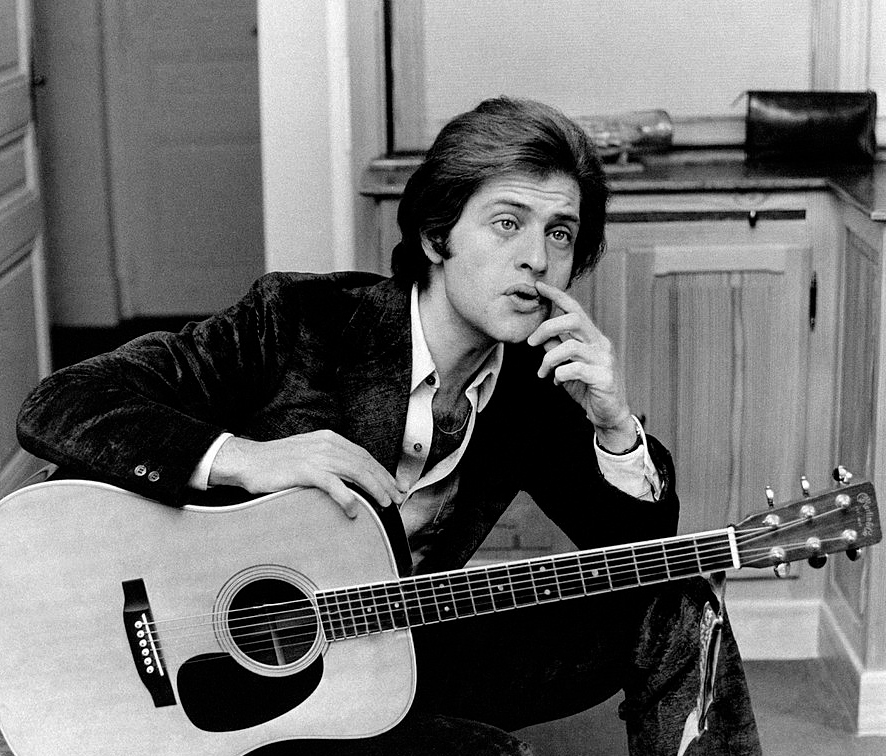
Joseph Ira Dassin[a] (French: [dasɛ̃]; November 5, 1938 – August 20, 1980) was an American–French singer-songwriter. In his career spanning sixteen years (1964–1980), he enjoyed numerous successes in France and the French-speaking world, as well as singing in languages other than French. He had a career in Finland, Greece, and Germany.[1] In total, he sold nearly 25 million records worldwide.[2][3][4] He was the son of film director Jules Dassin.
Early life
[edit]Dassin was born in Brooklyn, New York, to American film director Jules Dassin (1911–2008) and Béatrice Launer (1913–1994),[5] a New York-born violinist, who after graduating from a Hebrew High School in the Bronx studied with the British violinist Harold Berkely at the Juilliard School of Music.[6] Both of his parents were mostly of Ukrainian-Jewish extraction from Kamianets-Podilskyi, Sataniv and Buchach.[7][8][9]
Dassin lived in New York City and Los Angeles until his father fell victim to the Hollywood blacklist in 1950, at which time his family moved to Europe. Between the ages of ten and fifteen Dassin changed schools eleven times.[10] He studied at, among other places, the International School of Geneva and the Institut Le Rosey in Switzerland, and finished his secondary education in Grenoble. Dassin moved back to the United States, where he attended the University of Michigan in Ann Arbor, Michigan from 1957 to 1963, winning an undergraduate Hopwood Award for fiction in 1958 and earning a Bachelor of Arts in 1961 and a Master of Arts in 1963, both in Anthropology.[11] He became a stepson of Greek actress, activist and Minister of Culture Melina Mercouri following his father's second marriage in 1966.
Career
[edit] |

Moving to France, Dassin worked as a technician for his father and appeared as an actor in supporting roles, among others in three movies directed by his father, including Topkapi (1964) in which he played the role of Josef. He met his future wife Maryse Massiéra in Paris in 1963.
On December 26, 1964, Dassin signed with CBS Records, making him the first French-language singer to be signed with an American record label.
By the early 1970s, Dassin's songs were at the top of the charts in France, and he became immensely popular there. He recorded songs in German, Spanish, Italian, and Greek, as well as French and English. Amongst his most popular songs are "Les Champs-Élysées" (Originally "Waterloo Road") (1969), "Salut les amoureux" (originally "City of New Orleans") (1973), "L'Été indien" (1975), "Et si tu n'existais pas" (1975), and "À toi" (1976).
Cinema
[edit]Joe Dassin appeared in the following films:
- 1957: Benos in He Who Must Die, by Jules Dassin
- 1958: Nico in The Law, by Jules Dassin
- 1964: Joseph in Topkapi, by Jules Dassin
- 1965: A police inspector in Lady L, by Peter Ustinov
- 1965: Janos Adler in Nick Carter and Red Club, by Jean-Paul Savignac
Personal life
[edit] |

Dassin married Maryse Massiéra in Paris on January 18, 1966. Their son Joshua was born two and a half months early on September 12, 1973, and died five days later. Overcome by grief, Joe became deeply depressed. Despite all their efforts, their marriage did not survive. In 1977, one year after their move to their newly built home in Feucherolles, just outside Paris, they divorced.
On January 14, 1978, Dassin married Christine Delvaux in Cotignac. Their first son, Jonathan, was born on 14 September 1978; and their second son, Julien, arrived on March 22, 1980. Christine died in December 1995.
Death
[edit]Dassin died from a heart attack during a vacation to Tahiti on August 20, 1980, aged 41.[12] He was eating lunch with family and friends at the restaurant Chez Michel et Éliane in Papeete when he suddenly slumped in his chair, unconscious. A doctor who was also eating at the restaurant performed CPR on him, but Dassin died at the restaurant. The only ambulance in Papeete was unavailable at the time and took 40 minutes to arrive.[13] His body was returned to the United States and is interred in the Beth Olam section of Hollywood Forever Cemetery in Hollywood, California.[14]

Tributes
[edit]In 2020, many established artists paid tribute to Dassin songs in a covers / tribute album À toi, Joe Dassin. The album peaked at No. 44 in the French SNEP Albums chart. It also charted in Belgium peaking at No. 26 in the country's Ultratop albums francophone chart and also peaking at No. 4 in the Swiss Hitparade (Albums Chart).[15]
Artists interpreting Joe Dassin songs on the album included Ycare, Axelle Red, Les Frangines, Trois Cafés Gourmands, Patrick Fiori, Kids United Nouvelle Génération, Madame Monsieur, and Camélia Jordana.[citation needed]
Discography
[edit]Notes
[edit]- ^ The middle name, Ira, was chosen by his mother as a tribute to Ira Gershwin, whom she particularly liked.[citation needed]
References
[edit]- ^ According to one of his interviews, rebroadcast on France 2 in the program Vivement dimanche on 27 June 2010, his sales of songs in languages other than French accounted for two-thirds of his income.
- ^ "'Joe Dassin, le roman de sa vie' : retour sur le destin singulier de l'icône de la chanson française - RTBF Actus". Rtbf.be. Retrieved 23 September 2025.
- ^ "Joe Dassin : le roman de sa vie - Documentaire en replay Joe Dassin : le roman de sa vie". France.tv. Retrieved 23 September 2025.
- ^ Ghyselings, Marise. "Joe Dassin au centre d'un excellent documentaire". Moustique.be. Retrieved 23 September 2025.
- ^ Béatrice Dassin. Genealogy Bank. Retrieved on 26 July 2015.
- ^ The Juilliard School of Music, "The Baton", Web.archive.org, p. 12
- ^ Interview with Béatrice Launer. Joedassin.info. April 2004.
- ^ Michael Sibir. Reference to the State Archives of Khmelnytskyi region. Facebook.com, 31 September 2017.
- ^ Joe Dassin. Geneo - International Genealogical Forum. 4 March 2016. Forum.genoua.name
- ^ "Joe Dassin, Jules Dassin et Mélina Mercouri : les relations entre père et fils" (Video). L'Institut national de l'audiovisuel (in French). 14 June 1970. Retrieved 14 October 2022.
- ^ University of Michigan, List of Hopwood Award Winners Archived 2 April 2015 at the Wayback Machine.
- ^ "Joe Dassin, le roman de sa vie (France 3) – Le destin singulier d'une l'icône de la chanson française". Programme-television.org. 29 July 2022.
- ^ "Joe Dassin : le récit des dernières heures avant sa mort [Phot... – Télé Star". Telestar.fr (in French). 21 August 2015. Retrieved 27 May 2020.
- ^ "LOS ANGELES : Hollywood Forever – Cimetières de France et d'ailleurs". Landrucimetieres.fr.
- ^ Various Artists: À toi, Joe Dassin, Lescharts.com. Accessed 3 July 2023.
External links
[edit]

Joe Dassin
View on GrokipediaEarly life
Family background
Joseph Ira Dassin was born on November 5, 1938, in New York City, New York, to American film director Jules Dassin and Béatrice Launer, a New York-born Jewish-American concert violinist.[11][12][13] Jules Dassin, known for directing influential films such as the heist thriller Rififi (1955) and the romantic comedy Never on Sunday (1960), had established himself in Hollywood by the 1940s, immersing the family in the industry's creative milieu.[14][15] The couple married on September 10, 1933, in Kings County, New York, beginning a family life centered in the United States that would later face upheaval. The couple had three children, including Joe and his two younger sisters, Julie and Richelle.[16][17] Jules Dassin's career was abruptly disrupted in 1949 when he was blacklisted during the McCarthy era for alleged communist sympathies, forcing the family into financial instability and eventual exile abroad, which strained their domestic circumstances.[12][18] This paternal legacy in filmmaking subtly influenced young Joe's early exposure to artistic environments.[12]Childhood and relocation
Joe Dassin was born Joseph Ira Dassin on November 5, 1938, in New York City to film director Jules Dassin and violinist Béatrice Launer. The family relocated to Los Angeles in 1940 when Jules Dassin signed a contract with Metro-Goldwyn-Mayer to pursue his directing career.[19] There, young Joe grew up in a culturally rich environment, exposed to music through his mother's profession as a violinist, which sparked his early interest in playing the violin and piano himself.[19] In 1950, when Joe was 12 years old, the family fled the United States due to Jules Dassin's placement on the Hollywood blacklist following accusations of communist affiliations during the McCarthy era.[20] They first settled in London, England, before moving to Paris, France, as part of the broader exile experienced by blacklisted Hollywood figures seeking work in Europe. The relocations continued with brief stays in other European locations, including Italy and Switzerland, amid Jules Dassin's efforts to restart his career directing films abroad. These frequent moves immersed Joe in diverse cultural and linguistic environments, particularly English and French, fostering his bilingual abilities and adaptability from a young age. Accompanying his father to European film sets during this period further exposed him to the world of entertainment, laying subtle groundwork for his later pursuits while navigating the instability of exile.[19]Education and early interests
Dassin completed his secondary education at prestigious institutions, including the International School of Geneva and the Institut Le Rosey in Switzerland, before earning his baccalauréat in Grenoble in 1956 with honors.[21] These years abroad, prompted by his family's relocations across Europe and the United States due to his father's film career, provided early exposure to diverse cultures and languages.[22] Returning to the United States, Dassin enrolled at the University of Michigan, initially studying medicine before shifting to ethnology, a field that aligned with his growing fascination for cultural anthropology; he earned a master's degree in ethnology in 1963, with a thesis focusing on Native American tribes such as the Hopi.[22][23][24] To support himself during his studies, he took on various odd jobs, including as a cook, garbage collector, and plumber, and in 1958 secured a position as a disc jockey at WCX radio in Detroit, where he honed his broadcasting skills and deepened his appreciation for popular music.[22] The frequent travels of his youth cultivated Dassin's polyglot abilities, enabling him to speak fluent English, French, Spanish, German, Italian, and Greek, which later facilitated his international musical career.[25] In his spare time, he pursued personal interests in music, teaching himself to play the guitar and immersing in American folk and country genres, influences that would shape his songwriting style.[26]Career
Entry into music
After completing his studies in anthropology at the University of Michigan in the early 1960s, Joe Dassin returned to France to pursue a career in music full-time.[5] His academic background, including a Hopwood Award for poetry, reflected an early interest in creative expression that influenced his transition to songwriting and performance.[5] In December 1964, Dassin signed a recording contract with CBS Records, becoming the first French-language artist to join the American label.[27] This deal marked his entry into the professional music industry. His debut single, "Bip Bip," was released in 1965 as an adaptation of John D. Loudermilk's "Road Hog," with French lyrics by Jean Michel Rivat and Frank Thomas.[28] Dassin's first album, Joe Dassin à New York, followed in 1966, recorded in New York and featuring folk and pop influences.[29] Despite these initial releases, his early work faced commercial challenges, with singles and the debut album achieving only modest sales and limited recognition.[30] Early efforts included collaborations with lyricists like Rivat and Thomas, laying the groundwork for future partnerships with composers such as Pierre Delanoë.[31] To build momentum, Dassin performed in small Parisian venues and appeared on local radio programs, gradually gaining a niche audience in France.[30]Breakthrough and hits
Joe Dassin's breakthrough in the French music scene occurred in 1968 with the release of "Le Petit Pain au chocolat," an adaptation of the Italian song "Luglio" by Riccardo Del Turco. The track, with lyrics by Pierre Delanoë, captured a whimsical tale of unrequited love at a bakery and quickly became his first major commercial success. Its upbeat rhythm and relatable storytelling resonated widely, propelling Dassin to national prominence as a fresh voice in popular music. Building on this momentum, Dassin released "Les Champs-Élysées" in 1969, a French-language adaptation of the British band Jason Crest's "Waterloo Road." The song evoked the bustling romance of Paris's iconic avenue, becoming a massive seller and one of his signature tunes, topping popularity polls like those conducted by IFOP and entering charts across Europe. This hit exemplified Dassin's talent for transforming English-language originals into accessible French pop anthems, further cementing his stardom. Dassin's music blended the narrative depth of traditional French chanson with the melodic simplicity of American folk and pop, drawing from his New York roots to create a distinctive, cross-cultural sound. This fusion was prominently featured on his 1969 album Joe Dassin, which included "Les Champs-Élysées" alongside other tracks like "Siffler sur la colline," and his 1970 follow-up Joe Dassin (also titled La Fleur aux dents after its lead single), showcasing songs such as "Cécilia" and "L'Amérique." These early releases and hits collectively surpassed 1 million copies sold, positioning Dassin as a leading figure in French entertainment during the late 1960s.International recordings
Joe Dassin sought to broaden his appeal beyond French-speaking audiences by recording in multiple languages, leveraging his fluency as a polyglot to create versions of his songs for international markets, including German, Spanish, Italian, and English. This approach not only facilitated cultural adaptation but also highlighted his versatility in bridging musical traditions across borders.[32] In German, he released adaptations of his popular tracks, notably "Die Champs-Elysées," the 1970 German version of his breakthrough single "Les Champs-Élysées," which charted in the German hit parade and marked his entry into that market.[33] Similarly, he produced Spanish-language recordings, such as the 1978 compilation album Grandes Éxitos en Castellano y Francés, which featured bilingual tracks blending his French hits with Spanish renditions to target Latin American listeners. His Italian and English efforts included full versions of songs like "A Toi" in Spanish as "A Ti" and explorations of English folk and jazz standards.[34] A prime example of his international success was the 1975 hit "L'Été Indien," originally an adaptation of the Italian song "Africa" by the group Albatros; Dassin recorded multilingual variants, including the English "Indian Summer," Spanish "El Verano Indio," German "Indischer Sommer," and Italian "L'Estate Indiana," which propelled the track to popularity in over 25 countries.[35] This polyglot release exemplified how he transformed foreign compositions into global anthems while re-exporting them in original tongues. Dassin's international phase also involved adapting non-French songs into French to suit his style, such as "Les Champs-Élysées" derived from the British band Jason Crest's "Waterloo Road" and "Cécilia" from Simon & Garfunkel's English original, underscoring his role in cross-cultural exchange.[36] He supported these efforts with tours across Europe, Latin America, and the United States, where his music resonated strongly, contributing to worldwide sales exceeding 50 million records.[37]Later career developments
In the later years of his career, Joe Dassin shifted toward more introspective songwriting, incorporating themes of personal reflection and emotional depth, as exemplified by the ballad "Et si tu n'existais pas," which contemplates the essential role of a loved one in one's existence.[38] This evolution was facilitated by the creative freedom afforded by his established international success. A notable project in this period was the 1979 album Blue Country, where Dassin returned to his country music roots by adapting American country standards into French, including tracks like "Blue Country (Home Made Ice Cream)" and "Faut Pas Faire De La Peine A John (You Don't Mess Around With Jim)."[39] The album highlighted his early influences while showcasing a mature interpretation of the genre.[40] Health challenges in the late 1970s affected Dassin's touring schedule and contributed to a reduced pace of new releases, limiting his live performances and studio work toward the end of the decade.[33] His final single, "Le Jardin du Luxembourg," captured a nostalgic, garden-inspired narrative and marked the close of his active recording period in 1980.[41] Over the course of his career, Dassin released 13 studio albums and recorded approximately 250 songs, cementing his legacy in French popular music.[42]Acting and other pursuits
Film appearances
Joe Dassin made a handful of film appearances in the late 1950s and 1960s, primarily in supporting roles that showcased his early involvement in cinema before his rise as a singer.[7] His debut came in 1957 in the French drama He Who Must Die (original title: Celui qui doit mourir), directed by his father Jules Dassin, where he played the character Benos, a young villager in a story adapted from Nikos Kazantzakis's novel Christ Recrucified (also published as The Greek Passion). This role marked his entry into acting amid the family's European exile following Jules Dassin's Hollywood blacklist.[43] In 1958, Dassin appeared as Nico in another Jules Dassin-directed film, The Law (original title: La Loi), a tense drama set in a Provençal village exploring themes of power and corruption, based on Roger Vailland's novel.[44] His performance as a local youth contributed to the ensemble cast's portrayal of rural intrigue, with critics noting the film's evocative atmosphere shot on location in southern France.[45] The following year, he took on the role of Joseph in the 1964 international heist comedy Topkapi, again under his father's direction; here, he portrayed a sideshow operator assisting in a plot to steal a dagger from an Istanbul museum, blending lighthearted suspense with a star-studded cast including Melina Mercouri and Peter Ustinov.[46] This English-language production highlighted Dassin's versatility in a minor but memorable supporting part. Dassin's final two film credits came in 1965. He played Janos Adler in the French spy thriller Nick Carter and the Red Club (original title: Nick Carter et le trèfle rouge), a low-budget adventure featuring Eddie Constantine as the titular detective.[47] Later that year, he appeared as "Un Inspecteur de Police" in the romantic comedy Lady L, directed by Peter Ustinov and starring Sophia Loren and Paul Newman, where his brief appearance added to the film's whimsical narrative of an elderly woman's scandalous past.[48] These roles, totaling five cinema credits, were characterized by his natural charisma and screen presence, though Dassin did not pursue acting as a primary vocation, shifting focus to his burgeoning music career by the late 1960s.[7] Reviews of his work, particularly in family-directed projects, praised his effortless integration into dramatic ensembles without overshadowing leads.[45]Television and media roles
Joe Dassin began his media career with radio hosting duties in the mid-1960s, animating a series of emissions titled Western Story on Radio Luxembourg, where he explored country music themes.[33] This early role showcased his affinity for American folk and Western genres, drawing on his U.S. roots to engage French audiences through storytelling and music segments.[49] Throughout the late 1960s and 1970s, Dassin made frequent guest appearances on French television variety shows, performing hits and participating in musical segments that amplified his visibility. Notable examples include performances on Dim Dam Dom in 1967, where he mimed tracks like "Hey Joe," and Samedi soir in 1971, featuring songs such as "La Ligne de Vie" and "Bye Bye, Louis."[50] He also appeared on revived editions of Âge tendre et tête de bois in 1978, alongside artists like Petula Clark and Jeane Manson, performing upbeat numbers that highlighted his charismatic stage presence.[51] These TV spots, often broadcast on ORTF channels, emphasized his blend of French chanson and Anglo-American influences, contributing to his widespread appeal. Dassin extended his media presence internationally through guest spots on programs in German-speaking countries, including Austrian television in 1972, where he performed tracks like "La Fleur aux dents."[52] Similarly, his recordings in Spanish led to appearances on Spanish TV outlets, promoting adapted hits to broader European audiences. Promotional efforts for key singles, such as "Les Champs-Élysées" in 1969, included dedicated TV clips and live renditions aired on French networks like Télévision Française 1, capturing the song's lively Parisian vibe.[53] His extensive television and radio engagements, spanning over a decade, solidified Dassin's status as a pop culture icon in France and francophone regions, with regular broadcasts fostering a devoted following and enduring media legacy.[50]Non-entertainment work
Before embarking on his music career, Joe Dassin explored academic and literary pursuits shaped by his multidisciplinary education. He studied economics at the University of Paris and earned a doctorate in ethnology from the University of Michigan, where he also served as a professor of anthropology, focusing on cultural studies that reflected his interest in human societies beyond the performing arts. His ethnology doctorate focused on the Hopi people of Arizona. While at university, he won the Hopwood Award for one of his short stories.[42] Influenced by the legacy of his father, filmmaker Jules Dassin, and his mother, violinist Béatrice Launer, Joe Dassin harbored ambitions as a writer in his early twenties. At age twenty, he confided in his father about his desire to pursue writing professionally, leading him to compose four unpublished short stories during this period. These works, written in English and drawing from his American roots, remained private but highlighted his literary aspirations amid his transition to music.[54]Personal life
Marriages and children
Joe Dassin married his first wife, Maryse Massiéra (also known as Maryse Grimaldi), on January 18, 1966, in Paris. The couple welcomed a son, Joshua, born prematurely on September 12, 1973, who tragically died just days after birth. Their marriage ended in divorce in 1977, amid personal challenges including Dassin's reported depression. In 1978, Dassin married actress Christine Delvaux on January 14 in Cotignac, in the Var region of France. They had two sons: Jonathan, born on September 14, 1978, and Julien, born on March 22, 1980. The couple divorced in 1980, the same year Dassin died, though Delvaux remained involved in raising their children until her own death from an asthma attack in December 1995 at age 46.[55] Dassin's marriages and fatherhood shaped his public image as a devoted family man, often depicted in media as balancing his celebrity with private joys like time with his young sons. His frequent international tours and career pressures occasionally strained these relationships, contributing to the end of his first marriage. Jonathan Dassin pursued a career in music as a singer-songwriter, releasing his debut album À contre-courant in 2013 and performing original works alongside covers of his father's songs.[56] Julien Dassin, the younger son, became an actor and singer, debuting on stage in 2010 with the tribute show 100% Dassin at Théâtre Daunou in Paris, where he performs his father's hits; in 2025, he embarked on a North American tour titled "Salut! Julien Dassin Sings Joe Dassin" to honor his father's legacy.[57][58] Dassin had no other children.Friendships and lifestyle
Joe Dassin maintained close ties with key figures in the French music scene, particularly Johnny Hallyday, whom he introduced to the island of Saint-Barthélemy during the 1970s and who later described him as a dear friend in public tributes.[59] He shared the era's spotlight with contemporaries like Claude François, though accounts from their sons indicate the relationship was largely professional, marked by mutual respect amid competitive dynamics rather than deep personal friendship.[60] Dassin's lifestyle reflected his success and transatlantic roots, characterized by luxury and a love for travel. He owned multiple properties, including apartments in central Paris such as on Boulevard Raspail and Rue d'Assas during his early career, and later a home in the suburbs of Feucherolles outside the city.[33] In addition, he acquired land on the island of Taha'a in French Polynesia, where a beach is still known as Plage Joe Dassin in recognition of his affinity for the region.[61] His personal interests drew heavily from American culture, evident in his incorporation of folk and pop elements into his work, as well as his enjoyment of Western traditions like cowboy music and road trips, which he discussed in interviews as sources of inspiration.[62] Dassin was also passionate about sports, including tennis and horse riding, activities that complemented his energetic and outdoorsy demeanor.[19] Publicly, Dassin projected an approachable and humorous image as an entertainer, often charming audiences with his affable wit and self-deprecating stories about his American-in-France experiences, earning him a reputation as a relatable star in the often glamorous world of French variety.[62] Beyond his career, Dassin engaged in philanthropic efforts, participating in charitable benefits and social initiatives, such as events supporting vulnerable communities, though he kept much of this work low-profile.[63] These activities underscored his generous side, occasionally intersecting with his family life during public engagements.Health challenges
Joe Dassin suffered from a congenital heart condition, specifically a heart murmur, diagnosed during his youth while he was a university student. This issue led to his exemption from military service by U.S. authorities in the early 1960s, marking the beginning of lifelong cardiac concerns that he largely kept private.[64] As his career peaked in the 1970s, Dassin's heart problems progressed, exacerbated by lifestyle factors such as heavy alcohol consumption, which a 2022 France 3 documentary detailed as contributing to his overall decline. In late 1973, he underwent major heart surgery at Cedars of Lebanon Hospital (now Cedars-Sinai Medical Center) in Los Angeles, an procedure complicated by postoperative issues that affected his recovery and long-term health. These challenges imposed strict lifestyle restrictions, including limits on physical exertion, though Dassin continued performing despite the risks.[65] By the late 1970s, increasing fatigue from his cardiac history forced significant career interruptions. Following his final concert at the Olympia in Paris in 1979, Dassin experienced a severe heart alert in December of that year, accompanied by surgery for a related stomach ulcer, which sidelined him from public appearances. This led to the cancellation of multiple tours, including a planned Olympia show in 1979 and his entire summer tour in 1980, as his condition made rigorous schedules unsustainable.[22][66][67]Death and legacy
Circumstances of death
Joe Dassin died on August 20, 1980, at the age of 41, from a heart attack while vacationing in Papeete, Tahiti.[68] He had chosen Tahiti as a favored retreat for relaxation with his family, a place he visited to escape the demands of his career.[69] At around 12:30 p.m., Dassin was having lunch with his wife, young children, and friends, including singer Carlos, at the restaurant Chez Michel et Éliane in Papeete when he suddenly complained of chest pains and collapsed.[69] A doctor present at the restaurant attempted to resuscitate him on the spot, but efforts failed, and he was rushed to the nearby hospital where he was pronounced dead on arrival.[68] The cause was confirmed as a cardiac arrest due to a heart attack, with no indications of foul play or external factors; it was a purely health-related incident exacerbated by Dassin's prior history of heart problems, including a heart attack in 1969 and another in July 1980.[23][70][71]Immediate aftermath
Following Joe Dassin's sudden death from a heart attack on August 20, 1980, in Papeete, Tahiti, French media outlets quickly reported the news, with Le Monde publishing an obituary the next day that highlighted the abrupt nature of his passing during a family vacation (though it erroneously stated his age as 42).[23] The announcement triggered immediate public mourning in France, where Dassin had sold millions of records and become a household name; television broadcasts, such as Antenne 2's evening news on August 21, dedicated segments to his life and career, underscoring the shock given his relatively young age and prior health issues with heart problems.[72] Coverage in the United States was more limited, focusing on his American roots as the son of director Jules Dassin, but fans in both countries expressed grief through informal tributes, including radio dedications. Dassin's body was repatriated from Tahiti to the United States, reflecting his American heritage despite his prominence in French culture. He was buried in a private ceremony at Hollywood Forever Cemetery in Los Angeles, in the Beth Olam Mausoleum, a decision later criticized by some French fans who felt it distanced him from the nation where he achieved stardom.[73][74] His wife, Christine Delvaux, whom he had married in 1978, made no immediate public statements amid the grief, but photographs from October 10, 1980, show her reuniting with their young sons, Jonathan (aged 2) and Julien (aged 6 months), in Palm Springs, California, as the family sought privacy during this period. The family prioritized shielding the children from media attention, avoiding interviews and public appearances to allow them a protected upbringing away from the spotlight of their father's fame. Dassin's record label, CBS, temporarily paused new promotions following the death, though posthumous compilations like a 1980 vinyl release of his hits appeared later that year, capitalizing on ongoing fan interest while respecting the immediate mourning period.[75]Posthumous tributes and influence
Following his death in 1980, Joe Dassin's music continued to resonate in French popular culture, inspiring a wave of tributes that highlighted his enduring appeal. In 2020, to mark the 40th anniversary of his passing, the tribute album À toi, Joe Dassin was released, featuring contemporary French artists reinterpreting his classics. Contributors included Les Frangines on "Les Champs-Élysées," Trois Cafés Gourmands on "Salut les amoureux," and Ycare with Axelle Red on "À toi," among others such as Patrick Fiori and Lola Dubini. The compilation peaked at No. 44 on the French Albums Chart and remained in the top 150 for at least nine weeks, demonstrating renewed interest in his catalog.[76][77] Dassin's influence on French pop remains evident through ongoing covers by modern performers, blending his folk-infused chanson style with contemporary sounds. His son, Julien Dassin, contributed to this legacy in 2016 by recording a new version of "Les Champs-Élysées" for a Sony Music tribute project, which achieved double gold certification in France. Julien's efforts extend to live performances, including the 2025 North American tour "Salut! Julien Dassin Sings Joe Dassin," where he performs his father's hits like "Et si tu n'existais pas" and "A toi" with a full band, drawing crowds to venues in New York, Chicago, Los Angeles, and beyond. These events, presented by organizations like the Cherry Orchard Festival, celebrate Dassin's cross-cultural impact as an American-born artist who became a French icon. In October 2025, Julien revealed that his father had suffered from a congenital heart condition with multiple prior alerts, emphasizing the health challenges that contributed to his early death and dispelling unsubstantiated rumors.[78][58][79] The sustained popularity has fueled a sales resurgence, with Dassin's overall discography reportedly exceeding 50 million records sold worldwide, including significant posthumous releases and compilations that maintain his presence on streaming platforms. Annual fan gatherings and tribute concerts, such as those organized around the anniversary of his death, further preserve his legacy, often featuring discussions of his role in bridging American folk traditions with French variété.[80]Discography
Studio albums
Joe Dassin released thirteen studio albums over the course of his career, from 1966 to 1979, establishing him as a prominent figure in French popular music with a blend of folk, pop, and chanson elements.[42] His discography reflects a progression from lighthearted, folk-influenced tracks drawing on his American heritage to more introspective romantic ballads that resonated deeply with French audiences. Early productions often featured simple arrangements and themes of everyday life and travel, while later works incorporated richer orchestration and emotional depth, often collaborating with lyricist Pierre Delanoë and arrangers like André Popp.[1] Notable best-sellers include L'Été indien (1975), which captured nostalgic summer themes and became one of his commercial peaks, and Joe (1972), certified gold in France for sales exceeding 100,000 copies. Production notes highlight his debut recorded in New York for an authentic folk sound, shifting to Paris-based studios like those of CBS for subsequent releases, emphasizing orchestral arrangements to suit evolving chanson styles.[81] The following table lists his studio albums chronologically, including release years and labels where available:| Title | Release Year | Label |
|---|---|---|
| Joe Dassin à New York | 1966 | CBS |
| Les Deux Mondes de Joe Dassin | 1967 | CBS |
| Joe Dassin (Les Champs-Élysées) | 1969 | CBS |
| Joe Dassin (La Fleur aux dents) | 1970 | CBS |
| Joe Dassin (Elle était… Oh!) | 1971 | CBS |
| Joe | 1972 | CBS |
| 13 chansons nouvelles | 1973 | CBS |
| Joe Dassin (Si tu t'appelles Mélancolie) | 1974 | CBS |
| Joe Dassin (Le Costume blanc) | 1975 | CBS |
| Le Jardin du Luxembourg | 1976 | CBS |
| Les Femmes de ma vie | 1978 | CBS |
| 15 ans déjà... | 1978 | CBS |
| Blue Country | 1979 | CBS |