



Community hub
Recent from talks
Knowledge base stats:
Talk channels stats:
Members stats:
John of Capistrano
John of Capistrano, OFM (Italian: San Giovanni da Capestrano, Hungarian: Kapisztrán János, Polish: Jan Kapistran, Croatian: Ivan Kapistran Serbian: Јован Капистран, Jovan Kapistran; 24 June 1386 – 23 October 1456) was an Italian Franciscan friar and Catholic priest from the town of Capestrano, Abruzzo. Famous as a preacher, theologian, and inquisitor, he earned himself the nickname "the Soldier Saint" when in 1456 at age 70 he led a Crusade against the invading Ottoman Empire at the siege of Belgrade with the Hungarian military commander John Hunyadi.
Elevated to sainthood, he is the patron saint of jurists and military chaplains, as well as the namesake of two Franciscan missions, one in Southern California and the other in San Antonio, Texas.
As was the custom of this time, John is denoted by the village of Capestrano, in the Diocese of Sulmona, in the Abruzzi region, Kingdom of Naples. His father had come to Italy with the Angevin court of Louis I of Anjou, titular King of Naples. He studied law at the University of Perugia.
In 1412, King Ladislaus of Naples appointed him Governor of Perugia, a tumultuous and resentful papal fief held by Ladislas as the pope's champion, in order to effectively establish public order. When war broke out between Perugia and the House of Malatesta in 1416, John was sent as ambassador to broker a peace, but the Malatestas threw him in prison. It was during this imprisonment that he began to study theology. When he was released, he decided to become a Franciscan friar, citing a dream where Saint Francis of Assisi ordered him to enter the Order. He had married before the war, but asserted that the marriage was never consummated and received permission to take holy orders.
Together with James of the Marches, John entered the Order of Friars Minor at Perugia on 4 October 1416. Along with James, he studied theology at Fiesole, near Florence, under Bernardine of Siena. He soon gave himself up to the most rigorous asceticism, vigorously defending the ideal of strict observance and insisting on purity of doctrine, following the example set by Bernardine. From 1420 onwards, he preached with great effect in numerous cities and eventually became well known. He was ordained in 1425.
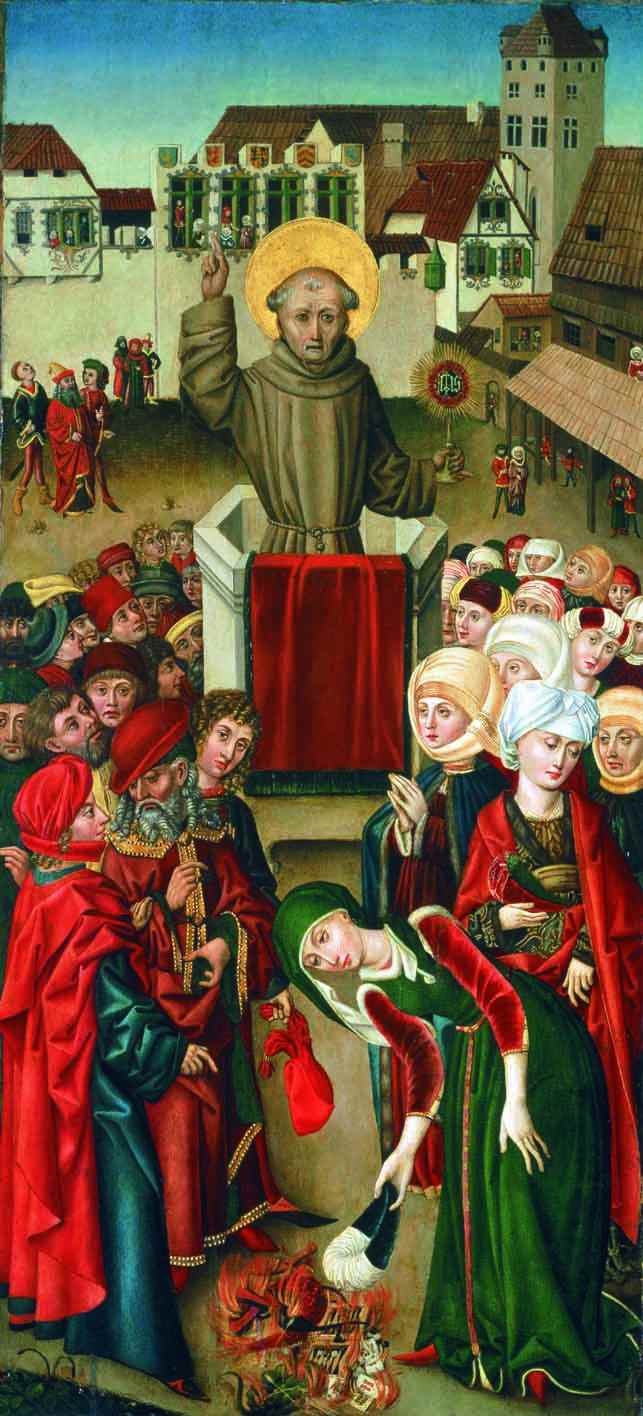
Unlike most Italian preachers of repentance in the 15th century, John was effective in northern and central Europe– in German states of Holy Roman Empire, Bohemia, Moravia, Austria, Hungary, Croatia, and the Kingdom of Poland. Even the largest churches could not hold the crowds that gathered to hear him, so he preached in the public squares; at Brescia in Italy, he preached to a crowd of 126,000.
When he was not preaching, John was writing tracts against heresy of every kind. This facet of his life is covered in great detail by his early biographers, Nicholas of Fara, Christopher of Varese and Girlamo of Udine. While he was thus evangelizing, he was actively engaged in assisting Bernardine of Siena in the reform of the Franciscan Order, largely in the interest of a more rigorous discipline in the Franciscan communities. Like Bernardine, he strongly emphasized devotion to the Holy Name of Jesus, and, together with Bernardine, was accused of heresy on this account. In 1429, these Observant friars were called to Rome to answer charges of heresy, and John was chosen by his companions to speak for them. They were both acquitted by the Commission of Cardinals appointed to judge the accusations.
He was frequently deployed to embassies by Popes Eugene IV and Nicholas V: in 1439, he was sent as legate to Milan and Burgundy, to oppose the claims of the Antipope Felix V; in 1446, he was on a mission to the King of France; in 1451 he went at the request of the emperor as Apostolic Nuncio to Austria. During the period of his nunciature, John visited all parts of the Empire. As legate, or inquisitor, he persecuted the last Fraticelli of Ferrara, the Jesuati of Venice, the Crypto-Jews of Sicily, Moldavia and Poland, and, above all, the Hussites of Germany, Hungary, and Bohemia; his aim in the last case was to make talks impossible between the representatives of Rome and Bohemian "Hussite king" George of Podiebrad, for every attempt at conciliation seemed to him to be conniving at heresy.
Hub AI
John of Capistrano AI simulator
(@John of Capistrano_simulator)
John of Capistrano
John of Capistrano, OFM (Italian: San Giovanni da Capestrano, Hungarian: Kapisztrán János, Polish: Jan Kapistran, Croatian: Ivan Kapistran Serbian: Јован Капистран, Jovan Kapistran; 24 June 1386 – 23 October 1456) was an Italian Franciscan friar and Catholic priest from the town of Capestrano, Abruzzo. Famous as a preacher, theologian, and inquisitor, he earned himself the nickname "the Soldier Saint" when in 1456 at age 70 he led a Crusade against the invading Ottoman Empire at the siege of Belgrade with the Hungarian military commander John Hunyadi.
Elevated to sainthood, he is the patron saint of jurists and military chaplains, as well as the namesake of two Franciscan missions, one in Southern California and the other in San Antonio, Texas.
As was the custom of this time, John is denoted by the village of Capestrano, in the Diocese of Sulmona, in the Abruzzi region, Kingdom of Naples. His father had come to Italy with the Angevin court of Louis I of Anjou, titular King of Naples. He studied law at the University of Perugia.
In 1412, King Ladislaus of Naples appointed him Governor of Perugia, a tumultuous and resentful papal fief held by Ladislas as the pope's champion, in order to effectively establish public order. When war broke out between Perugia and the House of Malatesta in 1416, John was sent as ambassador to broker a peace, but the Malatestas threw him in prison. It was during this imprisonment that he began to study theology. When he was released, he decided to become a Franciscan friar, citing a dream where Saint Francis of Assisi ordered him to enter the Order. He had married before the war, but asserted that the marriage was never consummated and received permission to take holy orders.
Together with James of the Marches, John entered the Order of Friars Minor at Perugia on 4 October 1416. Along with James, he studied theology at Fiesole, near Florence, under Bernardine of Siena. He soon gave himself up to the most rigorous asceticism, vigorously defending the ideal of strict observance and insisting on purity of doctrine, following the example set by Bernardine. From 1420 onwards, he preached with great effect in numerous cities and eventually became well known. He was ordained in 1425.
Unlike most Italian preachers of repentance in the 15th century, John was effective in northern and central Europe– in German states of Holy Roman Empire, Bohemia, Moravia, Austria, Hungary, Croatia, and the Kingdom of Poland. Even the largest churches could not hold the crowds that gathered to hear him, so he preached in the public squares; at Brescia in Italy, he preached to a crowd of 126,000.
When he was not preaching, John was writing tracts against heresy of every kind. This facet of his life is covered in great detail by his early biographers, Nicholas of Fara, Christopher of Varese and Girlamo of Udine. While he was thus evangelizing, he was actively engaged in assisting Bernardine of Siena in the reform of the Franciscan Order, largely in the interest of a more rigorous discipline in the Franciscan communities. Like Bernardine, he strongly emphasized devotion to the Holy Name of Jesus, and, together with Bernardine, was accused of heresy on this account. In 1429, these Observant friars were called to Rome to answer charges of heresy, and John was chosen by his companions to speak for them. They were both acquitted by the Commission of Cardinals appointed to judge the accusations.
He was frequently deployed to embassies by Popes Eugene IV and Nicholas V: in 1439, he was sent as legate to Milan and Burgundy, to oppose the claims of the Antipope Felix V; in 1446, he was on a mission to the King of France; in 1451 he went at the request of the emperor as Apostolic Nuncio to Austria. During the period of his nunciature, John visited all parts of the Empire. As legate, or inquisitor, he persecuted the last Fraticelli of Ferrara, the Jesuati of Venice, the Crypto-Jews of Sicily, Moldavia and Poland, and, above all, the Hussites of Germany, Hungary, and Bohemia; his aim in the last case was to make talks impossible between the representatives of Rome and Bohemian "Hussite king" George of Podiebrad, for every attempt at conciliation seemed to him to be conniving at heresy.