Hubbry Logo
KalpathyKalpathyMain
Open search
Kalpathy
Community hub
Kalpathy
logo
8 pages, 0 posts
0 subscribers
Be the first to start a discussion here.
Kalpathy
Kalpathy
from Wikipedia

Kalpathy or Kalpathi is a residential area in Palakkad city, Kerala, India.[2] It is famous for the Viswanatha Swamy Temple, which is located along the banks of the Kalpathy river, one of the tributaries of the Bharathapuzha. It is also famous for the Kalpathy Radholsavam, which is an annual car festival taking place in the month of Thulam (November).[3][4]

Key Information

Three chariots of Lord Shiva, Ganesha & Kartikeya in the Kalpathy Ratholsavam

Kalpathy is an agraharam, or traditional village. It is the first heritage village in Kerala.[5] This Tamil migrant brahmin village is more popular as the hub of Carnatic music in Kerala rather than for the legacy and tradition passed down through the generations for the past 600 years.

Kalpathy consists of five smaller villages, which are Old Kalpathy, New Kalpathy, Chathapuram, Govindarajapuram and Manthakkara. The similarity of the Viswanatha Swamy Temple to the Varanasi Kashi Viswanatha temple on the banks of Ganges is responsible for the moniker Kasiyil paathi Kalpathy (Half Kashi or Half Benaras) and the term Dakshina Kashi (Southern Kashi) associated with this temple.

The beauty of the architecture here - each brahmin quarter sharing walls and adjoined with the next one forming a linear pattern, the streets that wake up to the Venkatesha Suprabhatham, Vedic mantra recitals and Shiva Sthothram (hymns) - all musical, the rice flour kolam (artful drawing deemed religious and ritualistic) in the front courtyard of each quarter, Idli, Sambar and ghee rich sweets and savouries announcing the glory of Tamil food culture, and the magnificent Ratholsavam (Chariot Festival) celebrated with fervour; All of these constitute the stamp of life in Kalpathy.The rolling of heavily decorated majestic temple chariots through the village streets of Kalpathy is the major attraction of the car festival.

Sree Viswanathaswamy temple is the main centre of the festival while the three satellite temples in the village of new Kalpathy, old Kalpathy and Chathapuram also take part in it.These were all passed on through the generations of lives in the Agraharam without losing the original charm.[6][7][8] Kalpathy and its neighbourhoods have witnessed large settlements of people in colonies and apartments, making it one of the major residential areas of the city.[9]

Kalpathy also has its very own sports event, called the Kalpathy Sports Fest which is conducted annually, it started on October-November 2024.

Aerial view of Kalpathy
Aerial view of a street in Kalpathy
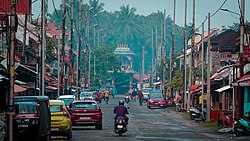
Chathapuram Street of Kalpathy
Manthakkara street of Kalpathy
Govindarajapuram street in Kalpathy

Temples

[edit]
Viswanatha Swamy Temple Entrance
Lakshmi Narayana Perumal temple, Old Kalpathy
Chathapuram Prasanna Mahaganapathy temple
Manthakkara Mahaganapathy temple
Poster of the Manthakkara Mahaganapathy temple
Lakshmi Narayana Perumal alangaram, Old Kalpathy
Muruga temple within the premises of Viswanatha Swamy temple
Viswanatha Swamy temple, New Kalpathy

Location

[edit]

Kalpathy is located about 3 km from the center of the city. City service buses are there to connect Kalpathy with other parts. The nearest major railway station is Palakkad Junction railway station and the nearest airport is Coimbatore International Airport.

History

[edit]

Kalpathy agraharam (the Tamil brahmin settled village next to the temple) was at the centre of a historical controversy in 1924. The famous Kalpathy Radholsavam passed through the main street of the agraharam which was a government funded and maintained road. In early 1920s, the road was not open to the so called lower castes ("awarnas"). The members of the Ezhava community were denied the use of the roads through this Brahmin village and the right to worship in the village temple. To counter this heinous practice, the members of the Ezhava community in Palakkad organized a rebellion by walking thru the public road and towards the temple. Despite the then British Presidency of Madras, under which Palakkad and Kalpathy fell, issuing an order permitting Ezhavas to enter Kalpathy, the conservative Brahmins of the village resisted the attempt. Many an Ezhava was roughed up by the Brahmins for attempting to enter the village.

A group of Ezhavas were "converted" into Arya Samaj. Subsequently, several groups of Ezhavas under various community leaders attempted to walk thru the public road. They were also forcibly denied entry by the residents of the Agraharam. A young man who was severely beaten up later converted to Christianity and took the name John Kittu and went on to become an independent MLA during the first elections to Kerala state assembly.[14]

Recent history

[edit]

In 2019, a sitting Kerala high court judge Justice V Chitambaresh hailing from Kalpathy agraraham, questioned the need for caste based reservation. He called Brahmins as twice-born endowed with good deeds of past births, having "characteristics like clean habits, vegetarian, a lover of Carnatic music and all good qualities rolled into one... is never communal, he is always considerate, he is an ahimsavadi (non-violent person)"[15][16]

References

[edit]
Revisions and contributorsEdit on WikipediaRead on Wikipedia
from Grokipedia

Kalpathy, also spelled Kalpathi, is a historic village in , , , characterized by its linear settlement of traditional homes flanking temple-centric streets along the Kalpathy River, a of the Bharathapuzha. Primarily settled by Tamil Brahmins who migrated from regions like in , the village maintains Dravidian architectural styles and orthodox Hindu customs distinct from surrounding traditions. It serves as a preserved cultural enclave, often likened to a southern due to its cluster of ancient temples and ritual practices.
The focal point is the Sree Viswanatha Swamy Temple, a low quadrangular structure dedicated to Lord Shiva and his consort Visalakshi, dating back over seven centuries and situated riverside. Accompanying temples include those for , Prasanna Mahaganapathy, and others, forming a temple complex that underscores the village's spiritual heritage. Kalpathy's defining event is the Ratholsavam, an eleven-day in November, where massive wooden chariots bearing deities from four principal temples are pulled in procession by devotees, culminating in a convergence that draws regional crowds and exemplifies communal devotion amid preserved Vedic rites. This , among South India's largest, highlights the village's role in sustaining traditions against modern homogenization, though it has historically intersected with local social tensions over caste orthodoxy.

Geography and Location

Physical Setting and Accessibility

Kalpathy is situated on the banks of the Kalpathy River, a of the Bharathapuzha, in , , . The village lies approximately 2 km from town center. The physical setting features flat terrain typical of the riverine alluvial plains in the Bharathapuzha basin, which supports traditional agriculture such as paddy cultivation in the surrounding areas. The village's layout is linear, with traditional settlements aligned parallel to the riverbanks, facilitating access to water and reflecting adaptive settlement patterns to the local . Accessibility to Kalpathy is provided primarily through local roads connecting to National Highway 966, the Palakkad-Coimbatore route that passes nearby. The , a major rail hub, is located about 3 km away, enabling convenient rail access. Proximity to city has led to urban encroachment, with expanding infrastructure and residential developments gradually integrating the village into the urban fabric.

History

Early Settlement and Migration

The settlement of Kalpathy as a Tamil Brahmin agraharam originated from migrations of Iyer families primarily from the Thanjavur and Mayavaram regions of into the of , occurring in waves from the 14th to the 18th centuries via the Palghat Gap. These migrations were driven by factors including periodic invasions and political instability in , such as threats from Muslim rulers, alongside economic opportunities in —particularly exchanging for —and invitations from local rulers seeking scholarly and administrative expertise. Kalpathy emerged as one of the earliest such settlements, with traditions dating its core community establishment to approximately 700 years ago, reflecting a pattern of gradual integration rather than a single mass event. Local patronage systems underpinned these settlements, wherein Kerala rulers, including those of Walluvanad and the Zamorins of Calicut, granted tax-exempt lands to migrants in exchange for Vedic learning, temple rituals, and administration. Agraharams like Kalpathy were designed as linear, self-contained villages with row houses flanking temple-centered streets, fostering communal autonomy while serving royal interests in cultural and economic stabilization. This reciprocal arrangement aligned with broader South Indian practices of to s, though specific inscriptional for Kalpathy remains limited, with historical accounts relying on oral traditions and regional chronicles rather than direct epigraphic records. Empirical patterns indicate these migrations were not uniform; early arrivals integrated through mercantile roles before formal endowments solidified dominance in ritual and scholarly domains, predating later 18th-century influxes tied to Tipu Sultan's campaigns. No verified archaeological artifacts or pre-14th-century inscriptions confirm presence in Palakkad agraharams, underscoring that while general migrations to trace to earlier medieval agrarian expansions, Kalpathy's documented formation aligns with post-1300 CE dynamics of patronage and displacement.

Medieval Foundations and Temple Establishment

The Viswanatha Swamy Temple, a central Shaivite shrine in Kalpathy dedicated to and his consort Visalakshi, was constructed around 1425 CE during the Era 600, as recorded in a Vattezhuthu inscription detailing endowments by Ittikombi Achan, a Palakkad royal family member. These endowments included land grants and resources essential for temple maintenance, establishing a foundation for sustained ritual practices amid the Tamil Brahmin settlement. The temple's Dravidian architectural elements, such as the prominent gopuram, directly stemmed from the builders' Tamil origins, adapting northern Shaivite motifs to the local context while preserving migrant devotional traditions. Parallel developments saw the emergence of associated Shaivite centers, including the Bhadrakali, Manikanteswara, and Sree Gopalakrishna temples, forming a networked religious infrastructure reinforced by similar royal patronage. Inscriptions and historical accounts indicate these sites received endowments that secured their role as foci for community worship, with land allocations enabling perpetual priestly services and festivals. This patronage by local rulers not only financed construction but causally ensured cultural continuity, as fiscal stability allowed the replication of Tamil Nadu's temple-centric Shaivism in Kerala, countering assimilation pressures through institutionalized devotion. The Rathotsavam chariot festival tradition originated in the 14th-15th centuries, tied to the temple foundations and emulating Tamil processional rites to affirm settler identity. Featuring six wooden chariots dedicated to key deities across the temples, its early iterations depended on endowment-funded craftsmanship and logistics, fostering communal participation that linked royal support to enduring cycles. Such mechanisms solidified Kalpathy's medieval religious landscape, where endowments directly enabled the persistence of these practices over generations.

Colonial Era and 19th-Century Stability

Following the British acquisition of Malabar from in 1792, Kalpathy, situated in , fell under direct colonial administration as part of the . The retained significant autonomy as a enclave, with British policies emphasizing revenue extraction through the ryotwari system rather than deep interference in internal community governance or religious practices. This insulation preserved the village's traditional structure, including its linear settlement pattern along the Kalpathy River and temple-centered social organization. In the 19th century, Kalpathy's Brahmin residents, primarily Tamil-speaking Iyers, sustained Vedic learning centers and elaborate temple rituals amid broader colonial economic shifts. Many Palghat Iyers pursued professions in colonial administration, such as clerks and lawyers, channeling earnings back to support scholarly pursuits and ritual maintenance in the agraharam. Temples like the Viswanatha Swamy continued annual observances without recorded colonial disruptions, reflecting the community's economic resilience through these external engagements. While the land revenue assessments introduced fiscal pressures across Malabar—requiring direct payments from cultivators, including landholders—Kalpathy experienced no major upheavals, as endowments from prior princely grants buffered immediate threats to autonomy. Stability persisted until emerging dynamics in the late 19th and early 20th centuries, with the village's insularity limiting broader reformist influences during this era.

20th-Century Social Changes

In the early to mid-20th century, Kalpathy's predominantly population began experiencing out-migration as community members accessed higher education and pursued urban employment opportunities in cities like , , and . This shift accelerated from the onward, driven by expanding professional sectors and educational institutions, transforming the from a near-exclusive settlement to one with increasing demographic diversity as non-Brahmin residents filled vacated homes and lands. Kerala's land reforms, initiated in the 1950s and substantially implemented through the Kerala Land Reforms Act of 1963 up to the 1970s, imposed ceilings on holdings and secured tenancy rights for cultivators, profoundly affecting properties traditionally granted to families. These policies redistributed excess lands and fragmented larger , reducing concentrated ownership while enabling smaller-scale farming by tenants, yet the village retained its spatial and cultural coherence as a heritage settlement. Post-independence, traditional festivals like the Rathotsavam persisted as enduring communal anchors, drawing returned migrants and reinforcing ties amid India's broader Hindu societal consolidation. This continuity underscored adaptation to modern influences without erosion of core practices, with annual events sustaining identity for a dispersed population integrating into national frameworks.

Cultural and Religious Heritage

Major Temples and Architecture

The Sree Viswanatha Swamy Temple, also known as Visalakshi Sametha Sri Viswanatha Swamy Temple, serves as the central religious site in Kalpathy, dedicated to Lord in his Viswanatha form and consort Visalakshi (). Constructed around 1425 AD by Kombi Achan, the Raja of , it represents the oldest surviving temple in the Malabar region, exceeding 700 years in age. The temple's integrates Dravidian elements from Tamil influences with Kerala vernacular features, including an eastern accessed via 18 steps, a 40-foot flagstaff, and intricate carvings on its low quadrangular structure situated along the Kalpathy River banks. Sub-shrines within the complex house deities such as Gnana Nandikeshwarar, Surya Bhagavan, Dakshina Murthy, and Subramanya Swamy with consorts Valli and Devasena, emphasizing Shaivite iconography tied to knowledge, solar worship, and martial aspects. Rituals follow Tamil Brahmin traditions, conducted exclusively by hereditary Iyers, with the temple endowed through historical grants ensuring continuity of daily poojas focused on purity and agrarian prosperity. Access norms historically restricted non-Brahmin entry to outer precincts to maintain ritual sanctity, reflecting the agraharam's caste-based spatial organization. Adjacent temples complement the Shaivite core, including the Lakshmi Narayana Perumal Temple in Old Kalpathy, a Vaishnava exemplifying Kerala-style architecture with its sanctum dedicated to alongside and . Other subsidiary , such as those to , incorporate fierce goddess worship akin to forms, underscoring the eclectic yet Brahmin-centric devotional landscape preserved amid the linear streets. These structures collectively embody Chola-era stylistic echoes through gopurams and deity carvings, adapted to local materials and riverine topography for enduring stability.

Rathotsavam Chariot Festival

The Rathotsavam, or chariot festival, of Kalpathy is an annual Hindu procession dating back over 700 years, originating from traditions brought by Tamil Brahmin settlers and inspired by the Mayavaram car festival in Tamil Nadu. Held to commemorate the installation anniversary of deities in the local temples, it spans 10 days in November, typically aligning with the Tamil month of Aippasi, such as from November 7 to 17 in recent years. The event culminates in the procession of six massive wooden chariots from four temples, pulled by thousands of devotees along predetermined routes through the village's narrow streets, fostering communal participation and reinforcing social bonds within the Brahmin agraharam. The festival's initial days feature intensive Vedic rituals, including recitals of hymns and traditional performances that invoke divine presence and prepare the community spiritually. Over the final three days, the elaborately decorated chariots—each bearing temple deities—are drawn in a synchronized manner, accompanied by rhythmic drums, Vedic chants, and fervent prayers from assembled crowds. These processions, known as Rathasangamam when chariots converge, symbolize the deities' earthly journey and the cosmic order upheld by , with the community traditionally leading the orchestration to maintain purity and hierarchical roles. The event draws thousands of pilgrims annually, peaking during chariot pulls and providing an economic uplift through increased trade and hospitality in the otherwise quiet village. While the chariots' immense size—often exceeding 50 feet in height—and manual propulsion embody enduring devotion, contemporary adaptations for safety, such as route restrictions, have occasionally altered traditional paths, potentially diluting the unbridled communal fervor central to its historical essence. Nonetheless, the persists as a testament to Kalpathy's cultural continuity, with feasts and music performances enhancing the shared experience of transcendence and unity.

Traditional Practices and Agraharam Lifestyle

The agraharams of Kalpathy consist of linear rows of traditional nalukettu houses aligned along temple-flanked streets, forming self-contained settlements that emphasize communal ritual purity and Vedic scholarship. These courtyard-style dwellings, featuring four halls around a central open space, facilitate morning Vedic recitations and daily household rituals, with streets awakening to the chants of mantras that underscore the community's priestly vocation. Residents, adhering to strict , maintain homes centered on Sanskritic learning and temple service, historically sustaining a division of labor where focused on scriptural preservation and ritual expertise, enabling cultural continuity amid regional agrarian economies. Customs in Kalpathy's agraharams reinforce within sub-sects like and Brahacharanam, alongside purity observances such as bathing and avoidance of non-Brahmin contact to uphold ceremonial sanctity, as evidenced by community of self-purification practices. governance occurs through informal sabhas or assemblies that resolve disputes and organize festivals, drawing on oral traditions of that highlight empirical , with households historically depending on land grants for endowments rather than external labor. Daily integrates designs with rice flour at thresholds for auspiciousness and women's roles in preparing sattvic meals, preserving a empirically viable through intergenerational transmission of . In contrast to the surrounding Kerala society dominated by Malayalam-speaking Nairs and Ezhavas, Kalpathy's Tamil Brahmins retain Tamil as the liturgical and domestic language, alongside customs like upanayanam initiations and shraddha ancestor rites, marking a distinct identity forged through migration and selective assimilation. This retention, supported by temple-centric endowments since the 15th century, underscores a causal preservation of North Indian-derived Smarta traditions in a Dravidian context, empirically demonstrated by the unbroken continuity of architecture and rituals despite socio-economic shifts.

Society and Demographics

Brahmin Community Structure

The Brahmin community in Kalpathy comprises primarily Tamil Iyers of the and Brahacharanam sub-sects, reflecting the migratory patterns of these groups from Tamil regions to . Hereditary priests, or archakas, drawn from specific lineages, perform daily rituals and festivals in the local temples, maintaining Vedic through generational transmission. Scholars and Vedic experts constitute an elite cadre, focused on scriptural and pedagogical roles within the settlements. Family organization historically centered on joint families housed in contiguous nalukettu-style dwellings along the Agraharam streets, fostering collective responsibilities for ritual purity and economic sustenance through land grants (brahmadeya). These structures supported roles in temple governance, including oversight of endowments and ceremonies, as well as informal adjudication in community disputes via customary assemblies. Cultural preservation includes Tamil devotional compositions, such as those in the and Divya Prabandham traditions recited in temple contexts, alongside lineages exemplified by figures like Palghat Rama Bhagavatar, whose works emphasize kritis in Telugu and . These outputs, transmitted orally and through performances, underscore the community's role in sustaining South Indian expressions. Historically, Kalpathy served as an exclusive settlement for Tamil-speaking families, known as Palghat Iyers, who comprised nearly the entire resident population prior to the , centered around the villages adjacent to the Kalpathy River. This homogeneity stemmed from medieval migrations sponsored by local rulers, establishing the area as a enclave focused on temple administration, trade, and scholarship. Post-independence, particularly from the 1950s onward, significant out-migration occurred as younger generations pursued higher education and professional opportunities in urban centers like , Bangalore, and , later extending to IT hubs and abroad. Economic pressures, including limited local prospects and the appeal of salaried jobs in government, banking, and technology sectors, drove this exodus, transforming Kalpathy from a self-contained to one with a substantial . The resident has since declined markedly, becoming a minority amid overall locality growth to approximately 5,113 individuals. This demographic shift coincided with inflows of non-Brahmin residents, facilitated by land sales from departing families and the area's integration into expanding urban fringes, where the municipal population rose from 130,955 in 2011 amid broader district urbanization. Proximity to commercial zones encouraged purchases by diverse groups, diluting the original ethnic composition without formal restrictions on transfers post-reforms. Consequently, the aging in-situ demographic has leaned on networks for sustaining communal events, with many heritage homes now occupied by elderly residents or rented to outsiders.

Controversies and Conflicts

Historical Caste Tensions and Agitations

In the early , Kalpathy's , a settlement predominantly inhabited by Tamil-speaking Paradesi , became a focal point for caste-based conflicts rooted in practices that restricted lower castes, particularly , from accessing public roads and temples despite their payment of taxes. These tensions were influenced by broader reform movements, including the 1896 Ezhava Memorial petition seeking civil rights and the contemporaneous (1924–1925), which highlighted similar road access disputes elsewhere in , though Kalpathy's issues remained localized due to the Brahmin community's dominance in maintaining the area's sacred exclusivity. Agitations intensified in 1917 with an initial meeting led by Nadesa Pillai protesting road restrictions, escalating in 1923 through gatherings addressed by reformers like and C. Krishnan, who criticized upper-caste dominance. By September 25, 1924, a order permitted access to public roads and wells, yet enforcement faced resistance. On November 13, 1924, an group led by lawyer M.P. Raghavan attempted entry during the , met with opposition involving stones, logs, and iron rods, resulting in injuries and arrests; a planned December march was canceled amid British oversight. Ezhavas argued for equal rights as taxpayers funding infrastructure, while Brahmins defended exclusions to preserve ritual purity, viewing the as a consecrated space where contact with "polluting" castes could ritually contaminate residents and temples, a stance aligned with orthodox Hindu norms prioritizing community sanctity over egalitarian access. Temple entry remained barred under untouchability customs, with enforcing separation to uphold purity doctrines that deemed lower castes inherently impure for sacred spaces; agitators, supported by figures like and , boycotted events and faced physical confrontations, including roughing up of individuals attempting entry. Police imposed Section 144 restrictions in November 1924 and 1925 to curb violence, while court cases, such as one in 1927 involving assaults, underscored ongoing disputes. counterarguments emphasized causal links between exclusivity and the preservation of traditions, rejecting intrusions as threats to religious integrity rather than mere discrimination. The road access campaign culminated on , 1925, with an edict granting all castes entry to Kalpathy streets, averting further escalation through police and judicial intervention, though sporadic violence persisted, including an October 1925 altercation injuring two Ezhavas and one . Temple restrictions endured longer, mirroring Kerala's phased reforms, without immediate concessions in Kalpathy. These events highlighted clashes between demands for civic equality and defenses of boundaries, with no widespread violence like boycotts but localized enforcement yielding partial gains for agitators.

Reform Movements Within the Community

In the early , internal challenges to orthodox practices emerged within the Kalpathy community, exemplified by figures like Krishna Swami, a scholar who advocated for inter- interactions while upholding Vedic traditions. Born in 1891 in Manjapra village near , Swami arrived in Kalpathy as a youth to study the under local gurus, but his later promotion of misrabhojanam—communal dining across caste lines—and alliances with groups to foster tolerance led to his classification as an "untouchable" by community elders. This stance, influenced by Gandhian principles of coexistence, resulted in his , highlighting tensions between rigid ritual purity and pragmatic social adaptation amid Kerala's evolving socio-political landscape. Post-independence temple entry , including Kerala's integration into unified state administration and subsequent devaswom board reforms, prompted gradual shifts in attitudes toward non- participation in temple peripheries, though hereditary priesthood remained predominantly closed to outsiders due to entrenched tantric and agamic qualifications. Resistance persisted, with conservative factions emphasizing scriptural mandates for exclusivity to preserve efficacy, while pragmatic reformers argued for selective openness to counter declining and sustain institutional relevance against communist-led land reforms and egalitarian policies that eroded traditional networks from the onward. These internal debates reflected a broader : adherence to risked isolation in a secularizing , yet wholesale adaptation threatened cultural dilution, leading to measured concessions like enhanced lay involvement in festivals without altering core priestly roles.

Recent Administrative Disputes

In November 2023, the monitoring committee prohibited the use of to assist in maneuvering during the Kalpathy Rathotsavam, citing concerns amid broader scrutiny of captive elephant handling in festivals. Organizers contested the directive, clarifying that elephants were employed only at sharp turns to aid directional shifts rather than for primary pulling, a practice devotees argued preserved the festival's devotional essence without undue strain, given the event's 700-year history of community-led chariot processions. The decision ignited protests from temple committees and the Devaswom Board, highlighting tensions between administrative interventions and longstanding where no recent major elephant-related incidents at the event were documented, underscoring potential overreach in regulating rare, context-specific usages. Parallel frictions arose from Kalpathy's designation as Kerala's first heritage village in , imposing stringent regulations that restricted residents' ability to renovate or reconstruct aging structures, exacerbating decay and limiting adaptations to modern living needs like expanded space. Local inhabitants, primarily Tamil Brahmins maintaining traditional lifestyles, voiced resentment toward state-level heritage authorities for delays in approvals—sometimes spanning years—contrasting with municipal pressures for urban infrastructure that threatened the village's intact pattern. challenges emerged, including 2019 petitions alleging unauthorized demolitions of protected edifices, pitting community practicality against preservation mandates enforced by the and Heritage Commission. Compromises followed incrementally, such as a state approval for 11 new dwellings after surveys revealed uninhabitable conditions, and phased renovations of around houses by 2018 with ₹1 funding, yet these yielded mixed results, as bureaucratic hurdles persisted in balancing organic evolution of the against top-down conservation that often prioritized static aesthetics over viable habitation. Such disputes illustrated how external regulatory frameworks could inadvertently undermine the self-sustaining dynamics of traditional settlements, fostering local-state divides without addressing root causal factors like population shifts or maintenance incentives.

Preservation and Modern Developments

Heritage Status and Conservation Efforts

Kalpathy was designated as Kerala's inaugural heritage village by the state government, with formal announcements emphasizing its preservation under the Heritage Policy to safeguard the traditional layout, row houses, and associated temples from modern alterations. This status imposes strict regulatory guidelines prohibiting development, redevelopment, construction, additions, or alterations to the over 800 aged structures, aiming to retain the village's historical settlement character dating back centuries, including temples like the Viswanatha Swamy Temple established around 1425. Conservation initiatives include funding from the Kerala Brahmana Sabha for restoration and maintenance of heritage sites, focusing on sustaining the living heritage aspects of the agraharams where residents continue traditional lifestyles. Development regulations are overseen by the Art and Heritage Commission, which coordinates efforts to document and protect architectural elements, though governmental plans have prioritized monumental structures over comprehensive support for vernacular row houses. Diaspora involvement in funding has supplemented state resources, contributing to targeted repairs amid broader challenges in integrating policy with community needs. State interventions have yielded mixed results, with heritage protections often criticized for restricting necessary renovations and repairs to dilapidated mud, brick, and tiled wooden houses, leading to resident resentment and the status becoming a contentious electoral issue. While intended to prevent over-commercialization and preserve authenticity against pressures, these measures have sometimes exacerbated decay by limiting adaptive maintenance, highlighting tensions between rigid preservation mandates and the practical demands of a living village.

Economic and Cultural Impacts

The Kalpathy Ratholsavam, an annual chariot festival, draws over 200,000 devotees and tourists, generating substantial revenue for the local economy through heightened demand for accommodations, food services, and transportation. This influx fosters employment in -related sectors and stimulates new business ventures, with community surveys in reporting high levels of agreement on increased profits for local enterprises (mean score 4.16 on a 5-point scale) and tourism encouragement (mean 4.10). Handicraft sales and see particular gains during the 10-day event in November, underscoring the festival's role in sustaining livelihoods despite broader community out-migration. Brahmin vendors in Kalpathy produce and sell traditional items such as mango pickles, vadams (sun-dried rice crisps), and snacks, which serve as cultural exports and support small-scale economic activity year-round. These products, rooted in Tamil culinary traditions adapted to local markets, provide ongoing income streams, though their scale has diminished with population shifts away from the Agraharams. Culturally, Kalpathy's Tamil Brahmin settlements preserve a syncretic blend of Tamil Vedic practices and customs, exemplified by the Ratholsavam's rituals and performances, which reinforce Palakkad's position as a historical conduit between and identities. This heritage fosters community cohesion and attracts cultural enthusiasts, enhancing regional pride amid demographic declines from migrations since the mid-20th century. However, the area's economic vitality now partly depends on state-supported heritage initiatives, such as the Tourism Department's preservation projects launched around 2021, highlighting underleveraged potential in transforming hubs into modern educational-tourism assets.

Sustainability Initiatives

The Kalpathy Viswanatha Swamy Temple implemented a (DRDO)-designed bio-digester system in its toilet complex in early 2025, achieving complete recycling of wastewater from thousands of daily visitors without any environmental discharge. This replaced an outdated and marked the first such full-scale adoption in a temple, directly mitigating pollution risks to the adjacent Bharathapuzha River amid growing threats from untreated waste in religious sites. The system processes effluents through , producing reusable water and , thereby setting a replicable benchmark for in high-footfall heritage locations. Community-led efforts have complemented temple-specific measures, including periodic riverbank cleanups of the Kalpathy River to remove debris and prevent festival-related litter accumulation. During the 2019 Ratholsavam chariot festival preparations, organizers and local authorities introduced protocols for a "green festival," emphasizing reduced single-use plastics and waste segregation, which contributed to measurable declines in disposable litter compared to prior years. These pragmatic adaptations highlight self-reliant rooted in local needs, such as protecting sacred water bodies from overuse during rituals. However, external regulatory impositions, including the 2023 ban on employing elephants to pull festival chariots—cited for —have drawn criticism for prioritizing narrow interventions over integrated that balances , cultural, and traditional elements without evident gains in broader habitat preservation. Proponents of the ban argue it reduces stress on populations, yet detractors contend it erodes communal practices evolved over centuries, potentially fostering resentment toward mandates perceived as disconnected from holistic village .

References

Add your contribution
Related Hubs
User Avatar
No comments yet.