Hubbry Logo
Kataragama deviyoKataragama deviyoMain
Open search
Kataragama deviyo
Community hub
Kataragama deviyo
logo
8 pages, 0 posts
0 subscribers
Be the first to start a discussion here.
Kataragama deviyo
Kataragama deviyo
from Wikipedia
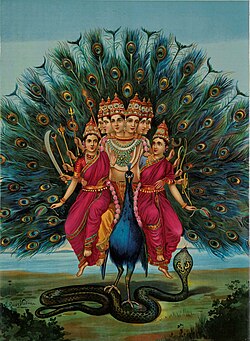
Kataragama deviyo is identified with God Skanda of Hinduism

Kataragama deviyo (also called: Skanda Kumara, Kartikeya, Sinhala: කතරගම දෙවියෝ, Tamil: கதிர்காமம் தேவன்) is a guardian deity of Sri Lanka. A popular deity who is considered to be very powerful, shrines dedicated to Kataragama deviyo are found in many places of the country.[1] Sinhalese Buddhists believe him also as a divine patron of the Buddha Sasana in Sri Lanka.[2] An ancient temple dedicated to God Kataragama, known as Ruhunu Maha Kataragama Devalaya is situated in the South-Eastern town of Kataragama in Monaragala District of Uva Province.

Today Ruhunu Maha Kataragama devalaya has become a temple which attracts and unites people of different religions and faiths.[3] Thousands of devotees from Sri Lanka and other parts of the world visit this temple daily.[4] Kataragama deviyo is identified with God Skanda of Hindu tradition, who is called as Murugan by the Tamil people. There is also an identical guardian deity of Mahayana Buddhism, known as Skanda. Theosophists identify Ruhunu Kataragama devalaya as a shrine which is dedicated to the lord of humanity and the world.[5]

Legends and beliefs

[edit]
Main entrance of the Kataragama temple premises

Kataragama deviyo is native and long-celebrated in Sri Lankan lore and legend. Since ancient times an inseparable connection between Kataragama deviyo and his domain has existed. At some point in the history it is believed that he resided on the top of mountain Wedahitikanda, just outside the Kataragama town. The temple dedicated to Kataragama deviyo in Kataragama has been a place of pilgrimage and religious sanctity for thousands of years.

According to some legends God Kataragama originally lived in the Mount Kailash in Himalayas and had a divine consort by the name of Thevani, before moving to Kataragama in Sri Lanka. After settling down at Kataragama in South Eastern Sri Lanka, he had fallen in love with Valli, a beautiful maiden princess who had been raised by the indigenous Veddahs.[6] Later Valli became the second consort of God Kataragama and transfigured as a deity. Till today the indigenous Veddah people come to venerate Kataragama deviyo at the Kataragama temple complex from their forest abodes. His relationship to the Veddah princess Valli is celebrated during the annual Esala festival.

Balangoda Ananda Maitreya Thero, a scholar Buddhist monk who did research on Kataragama deviyo cult has revealed in his writings that Nilwakke Somananda Thero, who was the chief prelate of Mahabodhi temple in Madras, has managed to obtain Nadi wakya readings regarding God Kataragama. According to those Nadi astrology readings, Kataragama deviyo is a deity known as Subramanya or Subramanium who was sent to Sri Lanka by Gautama Buddha before his visits to the island.[7] During one of his visits to Sri Lanka, Buddha visited Kataragama area and delivered a discourse of Dhamma to the local people. Local residents were also advised to stop animal sacrifices widely practiced by them in that period. Buddha instructed the deity to reside in Sri Lanka and help the people when required, specially in their difficulties.[7] Wedahitikanda, a mountain in the area was selected as the place to stay for the deity. Thereafter the locals in Kataragama built a Buddhalaya (a shrine for Buddha) and a Devalaya (a shrine for Subrahmanya) to pay homage.

Another belief about God Kataragama is that King Mahasen of the Kingdom of Ruhuna later came to be worshiped as a deity. King Mahasen is believed to have built the Kiri Vehera Buddhist Stupa in Kataragama in the 6th century BC, after listening to the discourse of Dhamma delivered by Buddha.[8] In the Sinhalese tradition and culture local kings, rulers and ancestors who did a great service to the country or community were ordained as deities. Some of these deities are called as Bandara Devatha. They are respected and worshiped by certain villages and districts in Sri Lanka. Lot of Bandara Devathas are working under the Kataragama God. [9]

It is believed that the present spiritual residence of Kataragama deviyo lies in the jungles of south eastern Sri Lanka, where he is spending his time in meditation. The area known as Kebiliththa, located in the Yala National Park is one such location where devotees visit, after practicing strict religious rituals such as vegetarianism and abstinence to get the blessings of the god.[10] However, it is believed that Kataragama deviyo visits the Kataragama temple on special occasions, such as Eslala festival days and poya days.[10] Hence a minister of God Kataragama known as Kadawara deviyo, is believed to be the present guardian of the Kataragama temple.[11][12]

Kataragama devalaya

[edit]
Kataragama devalaya with Gana devalaya in the background

According to legends, the Ruhunu Maha Kataragama Devalaya was built by king Dutugemunu around 160 B.C. as a fulfillment of a vow made before undertaking his successful military campaign against the Chola invader king Elara who was occupying the then Sri Lankan capital at Anuradhapura.[6][13] It is said that king Dutugemunu had obtained the blessings and guidance of God Kataragama to undertake his expedition against king Elara. After his victory, king Dutugemunu build the temple and dedicated it to God Kataragama. He also appointed the officials to look after the devalaya.[14]

The building of the Kataragama temple is a simple structure with two apartments and it has not undergone any major structural alterations after its construction.[13] It is a quadrangular building that is set in the middle of the large complex with outer walls of the temple premises have recurring and adorning figures of peacocks and elephants.[6] Next to the main temple are the temples dedicated to God Vishnu and God Ganesha. Another temple which is situated right to the Kataragama devalaya is dedicated to the goddess Thevani, a divine consort of God Kataragama.[15]

The Kiri Vehera, an ancient Buddhist stupa is situated in close proximity to the Kataragama temple. This religious structure probably dates back to the sixth century BC. The Bo tree which is situated behind the Kataragama temple is one of the eight saplings (Ashta Phala Ruhu Bodhi) of Sri Maha Bodhiya in Anuradapura, Sri Lanka. This sacred tree has been planted in the third century BC.[16] The Kiri Vehera Stupa is said to have been built by King Mahasen of the kingdom of Ruhuna, in the exact spot where the king met Buddha on his third and last visit to the island and listened to the sermon delivered by Buddha.[8][17]

Esala festival

[edit]

The main event that is held to pay homage to Kataragama deviyo is the annual Esala Festival held at Kataragama in July or August. The traditional rituals of the annual Kataragama Esala festival starts with traditional Kap Sitaweema ceremony that take place at an auspicious time after the conclusion of Poson Poya day. Kap situweema is the installation of a sanctified log known as kapa at the premises of the temple. Devotees after having a bath in Menik Ganga (a river flowing near to the Kataragama temple) dressed in clean white clothes, walk across to the temple bearing offerings of flowers and fruit to the god, expect to obtain blessings to begin the Esala festival.[17]

A group of dancers participating in the Kataragama Esala Festival

Kataragama Esala Perehera is the most spectacular event of the annual Esala festival, which is held in the nights of festive season. A procession (perehera) with traditional dancers, kawadi dancers, drummers, fire walkers, elephants and many other religious rituals, it is known as one of the most elegant historical cultural pageants in Sri Lanka.[18] The fire-walking ceremonies for which the Kataragama festival is famous, take place in the main temple yard after the procession. The area is prepared with wood being burned beforehand and the devotees who take part in fire-walking, after having cleansed themselves and visited the main temple (maha devale) for divine blessings, tread the red-hot embers floored on the ground to show their great reverence to the god.[6]

The water-cutting ceremony that brings the festival to an official end is held in the Menik Ganga, the morning after the final procession take place on the full moon night. The final rite is the Diya Kapeema, where Kapurala (official of the temple) cut water of the river with a sword to ceremonially end the annual festival. Thereafter the devotees plunges into the shallow waters of Manik Ganga for purification, before departing to their everyday lives.[6]

See also

[edit]

References

[edit]
[edit]
Revisions and contributorsEdit on WikipediaRead on Wikipedia
from Grokipedia
Kataragama deviyo, also known as Skanda, Murugan, or Kantakumara, is a syncretic guardian deity central to Sri Lankan religious traditions, revered by Buddhists and as a protector of the island nation and the Buddhist Sāsana (doctrine). In , he is the god of war and second son of , while in Sinhala Buddhist lore, he is often identified with deified kings such as Mahasena or Dutugemunu, embodying martial valor and benevolence. As one of the four principal guardian deities (Satara Varan Devi) in Sinhala Buddhism, Kataragama deviyo safeguards against calamities and ensures prosperity for devotees, with his cult reflecting a unique blend of Buddhist, Brahmanical Hindu, and indigenous elements. The primary shrine, Kataragama Devalaya, located in southeastern near the Menik Ganga river and , traces its origins to pre-Christian times and is traditionally linked to King Dutugemunu's construction around the 2nd century BCE following his victory in unifying the island. This ancient site, which includes the adjacent Kiri Vehera , serves as a major pilgrimage center attracting diverse worshippers, including , and exemplifies multi-faith harmony in . The deity's veneration gained prominence by the 15th century, as evidenced in temple inscriptions and Tamil hymns like those of Arunakirinatar, underscoring his role in regional devotional practices. Worship at Kataragama emphasizes bhakti (devotional) rituals, with daily offerings and an annual Esala Festival during the July-August full moon poya, featuring processions, water-cutting ceremonies, and the fire-walking rite symbolizing Skanda's mythic triumph over demons. These practices, adapted uniquely in Buddhist Sri Lanka, distinguish the cult from its South Indian counterparts and highlight themes of romance, protection, and communal unity. The site's enduring significance lies in its promotion of interreligious tolerance and its integration of non-Buddhist deities into the Theravada framework, making Kataragama deviyo a symbol of Sri Lanka's pluralistic spiritual heritage.

Identity and Syncretism

Role in Sri Lankan Buddhism

In Sri Lankan , particularly within Sinhalese traditions, Kataragama deviyo is revered as a bodhisattva-like who safeguards the Buddha's sasana (dispensation) and the from threats, both spiritual and temporal. Devotees invoke him for protection in battles, personal safety, and victory over adversities, viewing him as a compassionate yet formidable protector who intervenes in worldly (laukika) affairs to preserve Buddhist teachings and national well-being. This role aligns with his syncretic origins linked to the Hindu Skanda, adapted into a distinctly Buddhist framework. Kataragama deviyo's martial attributes underscore his warrior identity: he is depicted as wielding a symbolizing conquest over evil forces, mounted on a peacock representing vigilance and the subjugation of ego, and associated with the color , evoking , passion, and planetary influence from Mars. As a aiding the Buddha's sasana, he is believed to subdue malevolent entities like yakkas (demons) and ensure , , and order through rituals such as invocations. These qualities position him as an active, passionate intercessor, contrasting with more reserved guardians, and emphasize his function in supporting individual devotees against illness, calamity, and misfortune. His elevation within the Buddhist pantheon occurred prominently during the Kandyan Kingdom in the under Nayakkar rulers, when he was formalized as one of the principal guardian deities, often included among the Satara Varan Devi alongside figures such as , Saman, Natha, , and , depending on the tradition—tasked with protecting the island's Buddhist realms. This integration blended indigenous and South Indian influences, legitimizing kingship and reinforcing Sinhalese identity amid colonial pressures. Earlier roots trace to the Gampola period (), but Kandyan rituals, such as processions and offerings, cemented his status as a national protector. Buddhist iconography of Kataragama deviyo in devalayas (deity shrines) uniquely portrays him in Sinhalese royal attire—often with a crown, flowing robes, and localized motifs—distinguishing him from South Indian depictions and emphasizing his assimilation as a Theravada-aligned figure. These images, found in temple art and processional tableaux, highlight his benevolent yet authoritative presence, often shown enthroned or in dynamic poses to evoke his protective efficacy.

Equivalents in Hinduism and Indigenous Traditions

Kataragama deviyo is widely identified with the Hindu god Skanda, also known as or Murugan, the deity of war and victory who is the son of and . This equivalence is evident in shared iconographic elements, such as the vel (spear) as a primary symbol of divine power and the peacock as the (mount), which appear prominently in both Hindu and Sri Lankan depictions of the god. Historical texts from the 15th century, including Arunagirināthar’s hymns in the , refer to the deity at as the "Perumal of Katirkamam," underscoring the direct linkage to the South Indian Murugan cult. In indigenous Vedda traditions, Kataragama deviyo is connected through legends portraying him as an original forest deity who romanced , a princess from the Vedda community. Valli, depicted as the daughter of a Vedda chieftain, represents the deity's deep ties to Sri Lanka's aboriginal inhabitants, with myths emphasizing his courtship in forested realms and eventual union, symbolizing the integration of local animistic beliefs. This narrative positions the god as a protector of , with Vedda ritual performers, known as Alatti Ammas, continuing to participate in shrine activities, preserving elements of pre-Hindu worship practices. The syncretic evolution of Kataragama deviyo arose from the medieval merger of Tamil Hindu influences from with local Sinhala and beliefs, particularly during the Kandyan kingdom period (15th–19th centuries). Tamil Saivite traditions, carried by pilgrims and traders, adapted the Skanda cult to Sri Lanka's landscape, blending it with indigenous forest deities and Sinhala guardian figures to form a unified tradition. This process is reflected in the site's architecture, which incorporates Hindu devales alongside local shrines, and in routes like the Kataragama Pāda Yātrā, which trace sacred from ancient territories to Hindu cosmologies. Regional variations highlight this : in Tamil communities, the deity is revered as Subrahmanya, emphasizing elaborate Hindu rituals, blood offerings, and recitations from texts like the Kandapuranam during festivals such as Skanda Shashti. In contrast, Sinhalese contexts honor him primarily as Kataragama deviyo through aniconic worship via a in a sacred casket, integrated into Buddhist processions like the Perahera, with royal patronage dating back to King Dutugemunu in the 2nd century BCE. These distinctions underscore the deity's role as a bridge across ethnic lines, fostering shared devotion at the site.

Legends and Origins

Core Mythological Narratives

In the core mythological narratives of Kataragama deviyo, identified syncretically with the Hindu god Skanda or Murugan, the deity's origin traces to a divine birth orchestrated by the gods to counter the demon Surapadma's tyranny over the universe. According to traditional accounts, six sparks emanated from Shiva's , were carried by the fire god to the , and transformed into six infants in the lake, who were then nursed by the six Krittika nymphs before merging into the single form of Skanda upon Parvati's embrace. In Sri Lankan adaptations, this birth story emphasizes Skanda's destined arrival in , where the demon's dominion extended, positioning the island as a pivotal battleground in the cosmic conflict. Central to the deity's lore is the romance and marriage narrative, symbolizing unity across divine, human, and indigenous realms. Skanda, after his birth, marries , the celestial daughter of , in a union arranged by the gods to honor his valor. Complementing this, the Sri Lankan version highlights his earthly marriage to Amman, a huntress from the jungle tribes, whom he woos during a hunt in the southern forests; disguised as a hunter, Skanda wins her affection through trials, including overcoming her father's tests and rival suitors, culminating in their wedded life at . This dual marriage underscores themes of harmony between the divine warrior, heavenly consorts, and the island's aboriginal peoples, with Valli embodying the untamed spirit of Lanka's wilderness. The battle narratives form the epic core of these myths, depicting Skanda's triumphant campaigns against demonic forces in Lanka's southern regions. As commander of the celestial armies, Skanda leads the gods to Ruhuna's dense forests, where he engages Surapadma in fierce combat, ultimately slaying the demon after the latter assumes various monstrous forms; in mercy, Skanda transforms Surapadma's remnants into his sacred cock emblem and peacock mount. These victories sanctify as Skanda's eternal abode, a forested where the resides invisibly, guarding the land from chaos. Miraculous elements permeate the legends, portraying Kataragama deviyo as an unseen protector who intervenes on behalf of devotees in peril. Tales describe the god's ethereal presence guiding warriors through impenetrable Ruhuna thickets during demonic assaults, manifesting as subtle signs like rustling leaves or sudden clearings to ensure victory. Similarly, pilgrims in the myths receive divine aid, such as the deity's invisible escort across treacherous terrains or revelations in dreams, affirming his role as a compassionate guardian beyond mortal sight.

Historical and Cultural Evolution

The worship of deviyo traces its roots to ancient pre-Buddhist animist practices in the Ruhuna region of southern , where local deities were venerated through indigenous rituals tied to the natural landscape. Archaeological evidence from the Kirivehera dagoba near Kataragama includes two inscriptions dating to the 2nd century CE, indicating early monumental construction and possibly linking to animist guardian spirits that predated formalized Buddhist influences. These inscriptions suggest the site's role as a sacred center in the Ruhuna kingdom, founded around the BCE by Mahanaga. A Bo tree at the site is traditionally held to be one of the ancient saplings from the Sri Maha Bodhi in , planted in the BCE, blending animist reverence for local powers with emerging Buddhist elements. The deity's identification with Skanda-Murugan likely evolved from these animist foundations, as noted in epigraphic analyses, though direct 2nd-century BCE records remain scarce, highlighting gaps in early textual documentation. During the medieval period, the cult of Kataragama deviyo gained prominence through royal by Sinhalese kings, integrating it into state rituals that reinforced Buddhist hegemony while accommodating syncretic elements. During the reign of King Dappula I (r. 659–662 CE), the site received royal through offerings, elevating it as a defensive and spiritual stronghold against invasions, such as those by Chola forces in the . By the 15th century, King Parakramabahu VI (r. 1412–1467) extended to Kataragama worship, constructing a devale in the Kotte kingdom's near the royal , which facilitated its incorporation into broader Buddhist state ceremonies and underscored the deity's role as a protector of the realm. This era marked a consolidation of the deity's status, with endowments and inscriptions reflecting a deliberate fusion of indigenous, Buddhist, and Hindu traditions to unify diverse subjects under Sinhalese rule, though primary records of specific rituals remain limited. Colonial encounters profoundly shaped the evolution of deviyo's worship, beginning with suppression under rule in the , when native religious sites across southern faced destruction and forced conversions as part of broader efforts to eradicate non-Christian practices. campaigns targeted Buddhist and Hindu shrines in controlled territories, including Ruhuna, leading to the decline of open pilgrimages and the underground persistence of deviyo veneration amid general religious repression from 1505 to 1658. Under British rule in the , worship revived as colonial policies shifted toward administrative tolerance, with government agents documenting multicultural pilgrimages to that drew Sinhalese Buddhists, , and indigenous groups, often imposing controls like ticket systems for festivals to manage crowds. British accounts, such as those from the , noted the site's enduring appeal despite logistical challenges, signaling a resurgence that preserved syncretic practices while adapting to colonial oversight. 20th-century anthropological studies illuminated the syncretic blending of indigenous Vedda rituals with Hindu-Buddhist elements at , revealing how colonial disruptions accelerated among Vedda communities. Scholars like Gananath Obeyesekere, in his 1978 analysis of fire-walking rituals, described as a nexus of religiosity where Vedda-derived animist invocations merged with Skanda worship, fostering ecstatic practices that transcended ethnic boundaries. Earlier works, including those by C.G. Seligmann (1911) and N.D. Wijesekera (1964), documented Vedda participation in deviyo rites as a survival of pre-colonial , with rituals like Na Yakku invoking spirits alongside Buddhist almsgiving, though resettlement policies eroded traditional forms. These studies highlight gaps in historical records, emphasizing how Vedda —evident in shared myths of demon battles—sustained the deity's multicultural allure despite modernization pressures.

Temple and Worship Practices

Kataragama Devalaya Complex

The Kataragama Devalaya Complex is situated in the town of Kataragama, within the Monaragala District of southern Sri Lanka, approximately 228 km southeast of Colombo. This expansive site serves as a major pilgrimage center and embodies religious syncretism, incorporating a Buddhist stupa known as Kiri Vehera, a Hindu kovil dedicated to Skanda (Murugan) and his consort Thevani Amman, and the central devalaya shrine to Kataragama deviyo. The Kiri Vehera, a white-domed stupa standing 95 feet tall with a circumference of 280 feet, is located about 800 meters north of the main devalaya and dates back to the 3rd century BCE, making it one of Sri Lanka's 16 sacred Solosmasthana sites. It is said to house relics including a hair of the Buddha, a golden seat, and Prince Siddhartha's sword. The complex's layout reflects its multi-faith appeal, with additional structures like a mosque nearby, attracting Buddhists, Hindus, Muslims, and indigenous Vedda communities. Architecturally, the central devalaya follows traditional Kandyan-style Sinhalese design, characterized by its relatively plain and unadorned structure compared to more ornate viharas. The inner sanctum, akin to a garbha griha, houses a small golden statue of the deity, approximately 2 cm high, or a mystical diagram, kept hidden from public view behind a painted depicting Kataragama deviyo mounted on a peacock with his consorts. Surrounding this sanctum are outer halls used for devotee gatherings and offerings, enclosed by walls that underwent significant renovations in the to enhance durability and accessibility. The overall simplicity of the architecture emphasizes spiritual focus over decoration, with elements like perpetual oil lamps illuminating the premises and pathways designed to accommodate processions involving decorated elephants, highlighting the site's role as a unified sacred space for diverse worshippers. Historically, legends link the establishment of the shrine to King Dutugemunu (161–137 BCE), who vowed devotion to the deity before his campaign against the Chola king Elara and built it in fulfillment of that vow. The complex saw major expansions between the 17th and 19th centuries under the Kandyan kings, who regarded Kataragama deviyo as a guardian and patronized the site with endowments and structural enhancements to solidify its prominence in the kingdom's religious landscape. These royal interventions transformed the modest early shrine into a sprawling complex, underscoring its evolution as a cornerstone of Sri Lankan spiritual heritage.

Rituals and Offerings

The daily rituals at the Devalaya are conducted by kapuralas, the lay priests responsible for mediating between devotees and the . These pujas, performed three times daily—morning, noon, and evening—involve the presentation of offerings such as (joss sticks or resins like sambrani burned on ), fresh flowers arranged on altars, and milk-rice (kiri bath, prepared with ) to invoke s for health, prosperity, and protection. Kapuralas recite yatikava (panegyrics in praise of the ) during these ceremonies, accompanied by drumming (tevava), and apply (saffron or paste) on devotees' foreheads as a mark of . The morning puja often begins around 4:30 a.m. with the opening of the inner sanctum, followed by noon and evening sessions that conclude by nightfall. Devotees commonly make vows (bara) at the devalaya, promising offerings in exchange for the deity's intervention in matters like healing or fulfilling personal wishes. Upon success, they present items, such as silver lances, tridents, or spears symbolizing the deity's attributes, often used in acts of like piercing the cheeks, tongue, or body to demonstrate faith. These votive practices extend to simpler gestures, including breaking coconuts on sacred stones to release prayers and tying sacred threads (kalava or mauli) on the wrist after puja for ongoing protection. Kapuralas serve as intermediaries, receiving these offerings, presenting them to the deity's statue, and distributing portions back as prasad (sacramental remnants) for devotees to consume or take home. Fire-walking, though most prominent during festivals, is occasionally performed individually as a non-festive fulfillment of personal vows, where devotees traverse hot coals after purification to prove spiritual attunement and seek or . In such acts, participants prepare through and rituals led by kapuralas, who ensure the rite aligns with the deity's benevolent nature. Kapuralas also function as oracles in limited capacities, interpreting the deity's will through ritual signs or direct counsel during pujas, guiding devotees on vows and resolutions. This role underscores their position as guardians of the camphor light, a symbolic offering central to invoking divine presence. Gender-specific customs reflect the deity's mythological marital legends with his consorts Valli and Teyvannai, emphasizing themes of devotion and vigilance. Women, particularly the Alatti Ammas (Ladies of the Lamp), perform the alatti puja twice daily, waving lit lamps before the deity to honor Valli's protective role and ensure familial harmony; this rite, rooted in ancient tribal traditions, allows female leadership in worship. During approaches to the shrine, women often proceed on their knees or all fours, touching their foreheads to the ground, while men may roll from the riverbank, symbolizing humility and gender-complementary penance. Both genders participate equally in piercing and other vows, fostering inclusive devotion.

Festivals and Pilgrimages

Esala Festival

The Esala Festival at , dedicated to the deity (also known as Skanda or Murugan), occurs annually during the Esala month of the Buddhist , typically spanning or in the depending on the dates. Lasting 10 to 16 days, it commences with a flag-hoisting ceremony and culminates in a final procession, drawing thousands of pilgrims from Buddhist, Hindu, Muslim, and indigenous communities across and beyond. Central to the festival is the Perahera procession, a grand nightly that builds in scale over the days. The deity's sacred palanquin, symbolizing Deviyo's presence, is carried by kapuralas (hereditary priests) atop a decorated , accompanied by relic-bearing , rhythmic drummers on traditional instruments like the dawula and bere, and fire performers executing daring acts with flaming torches. These processions reenact elements of the deity's legends, including a symbolic representation of his divine to the indigenous maiden , emphasizing themes of union and harmony. The festival's symbolic climax is the water-cutting ceremony (Diya Kepima) at the Menik Ganga river on the final morning, following the last Randoli procession. In this ritual, the kapurala dips a golden vessel into the river to "cut" the water, signifying purification, the warding off of evil influences, and the deity's legendary victory over demons after which he rested at . Pilgrims then bathe in the consecrated waters, believed to cleanse sins and invoke prosperity, including rains for the harvest. The event is jointly organized by the Kataragama Devalaya's Buddhist and Hindu committees, with kapuralas overseeing the core rituals to ensure syncretic traditions are upheld across faiths. Security and logistics are coordinated with local authorities to manage the massive crowds, highlighting the festival's role as a beacon of interreligious unity.

Annual and Personal Devotional Journeys

The annual padayatra, or foot pilgrimage, to Kataragama deviyo represents a profound act of devotion, drawing thousands of pilgrims each year from across Sri Lanka to fulfill personal vows. This tradition, primarily undertaken in June and July, involves arduous walks spanning over 300 kilometers, often starting from the Jaffna Peninsula or Okanda in the east, as a means to seek blessings for health, prosperity, and spiritual merit. Devotees from distant locations like Colombo—approximately 283 kilometers away—also join, either completing full segments on foot or integrating shorter treks into their journeys, viewing the pilgrimage as a sacred vow (nercha) to the deity for resolving personal hardships or achieving well-being. Beyond these collective annual marches, personal devotional journeys form the core of individual worship at , where devotees visit the temple independently to honor vows tied to life events or crises. Many undertake such trips following divine intervention in matters like recovery from illness or family prosperity, with rituals including offerings and of the ; these visits often coincide with post-marriage thanksgivings or resolutions of personal distress, reflecting the deity's role as a protector in everyday challenges. To accommodate these pilgrims, especially those traveling by bus or train from afar, dedicated rest houses near the temple provide overnight stays, such as the National Holiday Resort managed by the Tourism Development Authority, offering 43 double rooms and halls for 15 to 30 persons at subsidized rates. The pilgrimage routes emphasize spiritual discipline and communal solidarity, particularly along the iconic path through Yala and Kumana National Parks for the final 100 to 108 kilometers. Pilgrims prepare by carrying essential provisions like dry rations and water, enduring the jungle terrain at a pace of 8 to 10 kilometers per day while halting at roadside shrines for prayers and (dana), which strengthens bonds among diverse participants through shared chants, storytelling, and mutual support. This segment, entered via the Kumana gate around late June, underscores as a form of devotion, with groups under the stars to foster a sense of unity and detachment from worldly comforts. Since the 2000s, these devotional journeys have adapted to growing influences, with participation surging to over 30,000 annually, including non-traditional visitors such as eco-tourists and researchers drawn to the route's natural beauty. To address environmental strains like waste accumulation and disruption in the national parks, authorities have introduced eco-friendly guidelines, including bans on single-use plastics, drone usage, and unauthorized vehicles, alongside self-regulated stations (dansals) that promote minimal impact while preserving the pilgrimage's spiritual essence. These measures balance the influx of modern pilgrims with conservation efforts, ensuring the tradition's amid rising visitor numbers.

Cultural and Social Impact

Multicultural Significance

Kataragama deviyo, revered as Skanda or Murugan in Hindu traditions and as a guardian in Sinhalese Buddhist lore, holds profound interfaith appeal across Sri Lanka's diverse ethnic and religious landscape. The is worshipped by Sinhalese Buddhists, who view it as a protective figure integrated into ; , for whom it embodies the war god ; , who honor it as a (al-Khidr) within Sufi-influenced practices; and the indigenous people, who trace the deity's origins to their ancient hunter-warrior myths. This shared veneration positions Kataragama as a rare site of religious convergence, symbolizing national unity in a country marked by ethnic pluralism. The temple complex serves vital social functions, acting as a neutral ground for inter-community interactions, particularly in the aftermath of the civil war. The annual has facilitated social bonds through collective rituals, with pilgrims reporting strengthened relationships across ethnic lines. These interactions often transcend ethnic barriers during the journey, where diverse groups collaborate on processions and offerings, fostering a sense of shared humanity amid historical divisions. Symbolically, Kataragama deviyo embodies tolerance in Sri Lanka's multi-ethnic society, with festivals like the Esala Perahera drawing participants from all major groups to partake in unified rituals, such as joint chants and processions that blend Buddhist pirith recitations with Hindu pujas and Muslim prayers. This syncretic participation underscores the deity's role as a bridge across faiths, promoting communal without requiring doctrinal assimilation. The site's mythology, including tales of the god's union with a local princess, further reinforces themes of integration and . Anthropological studies highlight how the bridges and ethnic divides through unique Sri Lankan , where liminal experiences—drawing on concepts like Victor Turner's —temporarily dissolve social hierarchies. Research shows that while everyday ethnic mistrust persists, the Kataragama cult creates spaces for egalitarian interaction, particularly among lower s and indigenous groups, distinguishing it as a model of polyethnic religious adaptation. This , evolving from pre-colonial roots, continues to offer insights into fostering social cohesion in divided societies.

Modern Observance and Influence

Following Sri Lanka's independence in 1948, the Kataragama temple complex experienced significant development and increased popularity as a site, with the government declaring it a holy place in the and subsequent political leaders contributing to its expansion and maintenance. This post-independence surge transformed the site from a primarily Hindu-focused destination—dominated by Tamil devotees undertaking arduous foot journeys until the 1940s—into a broader , attracting growing numbers of Sinhalese Buddhists and fostering annual s that now draw over 10,000 participants. Government promotion emphasized its multi-religious significance, aligning it with national heritage efforts and boosting visitor numbers through improved infrastructure. In contemporary media and , Kataragama deviyo features prominently in Sri Lankan cinema, , and music, reflecting its enduring cultural resonance. For instance, the 2003 film Kadira Divyaraja, directed by Sunil Ariyaratne, dramatizes the deity's mythological love story with Valli Amman, blending Hindu lore with Sinhalese narratives to appeal to diverse audiences. Similarly, devotional music albums like Sri Lanka: Musique Sacrée à Kandy, Colombo, Kataragama (2001) capture ritual chants and processional sounds associated with the site's festivals, preserving and disseminating Kataragama's sonic traditions globally. These portrayals often highlight themes of unity and divine protection, influencing public perceptions and encouraging . The site's influence extends to modern , where visits to are frequently combined with safaris in the adjacent , creating hybrid itineraries that merge spiritual devotion with eco-adventure. Tour operators promote packages starting from Kataragama, offering 3- to 12-hour safaris to spot leopards and elephants, which have drawn increasing international visitors and positioned the area as a key southeast Sri Lankan destination. This integration has amplified economic impacts but also raised concerns over resource strain in the region. Contemporary observance faces several challenges, including environmental degradation from overcrowding during peak seasons, where thousands of pilgrims and tourists strain local ecosystems around the Menik Ganga river and Yala buffer zones. For example, the 2024 Esala Festival generated nearly 1,500 tons of solid waste. Commercialization has further altered traditional practices, with vendors and motorized transport eroding the eco-friendly ethos of historical foot pilgrimages. The COVID-19 pandemic prompted adaptations, such as banning public participation in the 2020 Esala festival processions due to health concerns. Post-pandemic, the 2025 Esala Festival proceeded with regulations including traffic controls and waste management guidelines to address ongoing environmental issues. In response, youth-led initiatives have emerged to promote sustainable practices, including training programs in environmental stewardship that educate young villagers on river conservation and organic resource use tied to Kataragama's sacred landscape.

References

Add your contribution
Related Hubs
User Avatar
No comments yet.