Hubbry Logo
Kaykhusraw IIKaykhusraw IIMain
Open search
Kaykhusraw II
Community hub
Kaykhusraw II
logo
8 pages, 0 posts
0 subscribers
Be the first to start a discussion here.
Kaykhusraw II
Kaykhusraw II
from Wikipedia

Ghiyath al-Din Kaykhusraw ibn Kayqubād or Kaykhusraw II (Persian: غياث الدين كيخسرو بن كيقباد) was the sultan of the Seljuqs of Rûm from 1237[2] until his death in 1246. He ruled at the time of the Babai uprising and the Mongol invasion of Anatolia. He led the Seljuq army with its Christian allies at the Battle of Köse Dağ in 1243. He was the last of the Seljuq sultans to wield any significant power and died as a vassal of the Mongols.

Key Information

Succession

[edit]

Kaykhusraw was the son of Kayqubad I and his wife Mahpari Khatun, who was Byzantine Greek by origin,[3] Christian Byzantine Greek women being the dominant origin of the slave-concubines and wives of the Seljuk harem.[4]

Although 'Kaykhusraw was the eldest, the sultan had chosen as heir the younger ‘Izz al-Din, one of his two sons by the Ayyubid princess Adila Khatun, daughter of al Adil I, sultan of Cairo and the Jazira[5][6] In 1226, Kayqubad assigned the newly annexed Erzincan to Kaykhusraw. With the general Kamyar, the young prince participated in the conquest of Erzurum and later Ahlat. Kaykhusraw himself married Ghazia Khatun, the daughter of the emir of Aleppo, Al-Aziz Muhammad.[7]

In 1236–37, raiding Mongols assisted by the Georgians devastated the Anatolian countryside as far as the walls of Sivas and Malatya. In response, Kayqubad moved to punish the Georgians. As the Seljuq army approached, Queen Russudan of Georgia sued for peace, offering her daughter Tamar in marriage to Kaykhusraw.[a] This marriage took place in 1238.[9]

Likely depiction of Gurju Khatun, Kırkdamaltı Kilisesi.[9]

Upon the death of Kayqubad in 1237, Kaykhusraw seized the throne with the support of the great emirs of Anatolia. The architect of his early reign was a certain Sa'd al-Din Köpek, master of the hunt and minister of works under Kayqubad. Köpek excelled at political murder and sought to protect his newfound influence at the court with a series of executions.[10] He captured Diyarbekir from Ayyubids in 1241.

The Baba Ishak Rebellion

[edit]

While the Mongols threatened the Seljuq state from the outside, a new danger appeared from within: a charismatic preacher, Baba Ishak, was fomenting rebellion among the Turkmen of Anatolia. This revolt is known as the Babai revolt.

Nomadic Turkmen had begun moving into Anatolia a few years prior to the Battle of Manzikert. After 1071, Turkic migration into the region went largely unchecked. Both their number and the persuasive power of their religious leaders, nominally Islamized shamans known as babas or dedes,[11] played a large part in the conversion of formerly Christian Anatolia. The Persianized Seljuq military class expended considerable effort keeping these nomads from invading areas inhabited by farmers and from harassing neighboring Christian states. The Turkmen were pushed into marginal lands, mostly mountainous and frontier districts.

Baba Ishak was one such religious leader. Unlike his predecessors, whose influence was limited to smaller tribal groups, Baba Ishak's authority extended over a vast population of Anatolian Turkmen. It is not known what he preached, but his appropriation of the title rasul, normally applied to Muhammad, suggests something beyond mainstream Islam.

The revolt began ca. 1240 in the remote borderland of Kafarsud in the eastern Taurus Mountains and quickly spread north to the region of Amasya. Seljuq armies at Malatya and Amasya were destroyed. Soon the very heart of Seljuq Anatolia, the regions around Kayseri, Sivas, and Tokat, were under the control of Baba Ishak's supporters. Baba Ishak himself was killed, but the Turkmen continued their rebellion against the central Seljuq authority. The rebels were finally cornered and defeated near Kırşehir, probably in 1242 or early 1243. Simon of Saint-Quentin credits the victory to a large number of Frankish mercenaries employed by the sultan.[12]

Battle of Köse Dağ

[edit]

In the winter of 1242–43, the Mongols under Bayju attacked Erzurum; the city fell without a siege. The Mongols prepared to invade Rum in the spring. To meet the threat, Kaykhusraw assembled soldiers from his allies and vassals. Simon of Saint-Quentin, an envoy of Pope Innocent IV on his way to the Great Khan, offers an account of the sultan's preparations. He reports that the king of Armenia was required to produce 1400 lances and the Greek Emperor of Nicaea 400 lances. Both rulers met the sultan in Kayseri to negotiate details. The Grand Komnenos of Trebizond contributed 200, while the young Ayyubid prince of Aleppo supplied 1000 horsemen.[13] In addition to these, Kaykhusraw commanded the Seljuq army and irregular Turkmen cavalry, though both had been weakened by the Baba Ishak rebellion.

The army, except for the Armenians who were then considering an alliance with (or submission to) the Mongols, assembled at Sivas. Kaykhusraw and his allies set out to the east along the trunk road towards Erzurum. On 26 June 1243, they met the Mongols at the pass at Köse Dağ, between Erzincan and Gümüşhane.[14][15] Kaykhusraw built a large army to confront the invasion, but his 80,000-strong force lacked the discipline and cohesion of the Mongols. A feigned retreat by the Mongol horsemen disorganized the Seljuqs, and Kaykhusraw's army was routed. The sultan collected his treasury and harem at Tokat and fled to Ankara. The Mongols seized Sivas, sacked Kayseri, but failed to move on Konya, the capital of the sultanate.

In the months following the battle, Muhadhdhab al-Din, the sultan's vizier, sought out the victorious Mongol leader. Since the sultan had fled, the embassy seems to have been the vizier's own initiative. The vizier succeeded in forestalling further Mongol devastation in Anatolia and saved Kaykhusraw's throne. Under conditions of vassalage and a substantial annual tribute, Kaykhusraw, his power much diminished, returned to Konya.

Identity

[edit]

According to Rustam Shukurov, it is likely that Kaykhusraw II, who was born from a Greek mother, and was yet another Seljuk Sultan with a great interest in Greek women, "bore a dual confessional and ethnic identity".[16]

Legacy

[edit]

Kaykhusraw died leaving three sons: 'Izz al-Din Kaykaus, aged 11, son of the daughter of a Greek priest; 9-year-old Rukn al-Din Kilij Arslan, son of a Turkish woman of Konya; and 'Ala al-Din Kayqubad, son of the Georgian princess Tamar and at age 7 youngest of the three boys.[17]

Kaykhusraw had named his youngest child Kayqubad as his successor, but because he was a weakly child, the new vizier Shams al-Din Isfahani placed Kayqubad's two underage brothers Kaykaus II and Kilij Arslan IV on the throne as well, as co-rulers. This was an attempt to maintain Seljuq control of Anatolia in the face of the Mongol threat.

Although weakened, Seljuq power remained largely intact at the time of Kaykhusraw's death in 1246. The Mongols failed to capture either the sultan's treasury or his capital when they had the chance, and his Anatolian lands escaped the worst of the invaders’ depredations. The real blow to the dynasty was Kaykhusrev's inability to name a competent successor. With the choice of the three young brothers, Seljuq power in Anatolia no longer lay with Seljuq princes but instead devolved into the hands of Seljuq court administrators.

Coinage

[edit]

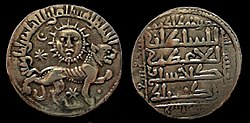
Between 1240 and 1243 (638 and 641 A.H.) a series of remarkable silver dirhams were struck in Kaykhusraw's name at Sivas and Konya depicting a lion and sun.[18] While coins with images are not unknown in Islamic lands, particularly in the centuries following the Crusades, some Islamic traditions forbid representations of living things.

Several explanations of the lion and sun have been offered. One suggests that the images represent the constellation Leo, the astrological sign of Kaykhusraw's beloved Georgian wife Tamar.[19] Another says that the lion represents Kaykhusraw and the sun Tamar.[19]

[edit]

In the Turkish television series Diriliş: Ertuğrul, Kaykhusraw II is portrayed by Turkish actor Burak Dakak.[20]

Notes

[edit]

References

[edit]

Sources

[edit]
  • Blessing, Patricia; Goshgarian, Rachel (2017). Architecture and Landscape in Medieval Anatolia, 1100-1500. Edinburgh University Press. p. 233. ISBN 978-1-4744-1130-1. Following Mahperi, Kayqubad's second marriage was to an Ayyubid princess, the daughter of al Adil I, sultan of Cairo and the Jazira
  • Cahen, Claude (2001). The Formation of Turkey: The Seljukid Sultanate of Rum: Eleventh to Fourteenth Century. Translated by Holt, P.M. Routledge. ISBN 978-1-317-87626-7.
  • Claude Cahen, “Keyhusrev II" Encyclopaedia of Islam, ed. by P. Bearman, et al. (Brill 2007).
  • Cahen, Claude (1968). Pre-Ottoman Turkey: a general survey of the material and spiritual culture and history c. 1071-1330. Translated by Jones-Williams, J. Taplinger.
  • Canby, Sheila R.; Beyazit, Deniz; Rugiadi, Martina; Peacock, A.C.S., eds. (2016). Court and Cosmos: The Great Age of the Seljuqs. The Metropolitan Museum of Art.
  • Crane, H. (1993). "Notes on Saldjūq Architectural Patronage in Thirteenth Century Anatolia". Journal of the Economic and Social History of the Orient. 36 (1): 1–57. doi:10.1163/156852093X00010.
  • Hillenbrand, Carole (2007). "Sa'd al-Dīn Köpek b. Muhammad". In Bearman, P. (ed.). Encyclopaedia of Islam. Brill.
  • Humphreys, R. S. (1977). From Saladin to the Mongols: The Ayyubids of Damascus 1193-1260. SUNY Press. p. 389
  • Peacock, A.C.S.; Yildiz, Sara Nur, eds. (2013). The Seljuks of Anatolia: Court and Society in the Medieval Middle East. I.B.Tauris. ISBN 978-0857733467.
  • Vryonis, Speros (1971). The Decline of Medieval Hellenism in Asia Minor and the Process of Islamization from the Eleventh through the Fifteenth Century. University of California Press.
  • Dr. Antony Eastmond, Courtauld Institute of Art (25–28 June 2007). "Intermarriage and its impact on art in Anatolia in the 13th century". International Sevgi Gönül Byzantine Studies Symposium, Istanbul. Archived from the original on 31 July 2009. Retrieved 22 July 2020.
[edit]
Revisions and contributorsEdit on WikipediaRead on Wikipedia
from Grokipedia
Ghiyāth al-Dīn Kaykhusraw ibn Kayqubād, commonly known as Kaykhusraw II, was the Seljuk of Rûm who reigned from 1237 until his death in 1246. The son of Sultan Kayqubād I and a Greek wife, he seized power following his father's assassination, supported by Anatolian emirs amid rival claims from half-brothers. His rule featured initial military successes, such as capturing from the Ayyubids and suppressing the Babai uprising led by Baba Ishāq, often with Christian aid, reflecting alliances with Byzantine and Latin forces. However, the Mongol invasion under Baijū culminated in the Seljuq defeat at the in 1243, forcing tribute and vassalage that eroded central authority and presaged the sultanate's fragmentation. Kaykhusraw married multiple times, including to Georgian princess Tamar (Gurji Khatun), producing successors like ʿIzz al-Dīn Kaykāwūs II and Rukn al-Dīn Kılıç Arslan IV, amid a court blending Turkic, Persian, and Christian influences. His era marked the Seljuqs of Rûm's peak and precipitous decline under external pressures.

Origins and Ascension

Family Background and Early Life

Ghiyāth al-Dīn Kaykhusraw ibn Kayqubādh, known as , was born in the early as the eldest son of ʿAlāʾ al-Dīn Kayqubādh I, ruler of the Seljuqs of Rūm from 1220 to 1237. His mother was Mahperī Khātūn, a consort of Greek origin, identified as the daughter of Kir Fārīd, the lord of Kalonoros (modern ), which his father had conquered in 1227. This union reflected the diverse alliances and captures common in Seljuk court dynamics, where non-Turkic women from conquered territories often entered the sultanic household. Despite his , Kayqubādh I reportedly favored his younger son, ʿIzz al-Dīn Kaykāʾūs, for the succession, possibly due to political considerations or maternal influences from other consorts. In 1226, Kaykhusraw received his first major appointment as governor of the newly annexed province of , a strategic eastern territory that bolstered Seljuk control over trade routes. He gained early military experience by accompanying the commander Kamyār in the 1230 campaign that captured from the Khwarazmians, demonstrating competence in frontier warfare amid threats from nomadic incursions and rival powers. These formative years under his father's expansive reign, marked by territorial gains and diplomatic maneuvering with neighbors like the Ayyubids and Nicaean Empire, positioned Kaykhusraw amid the internal court factions that would shape his later ascension. His Greek maternal heritage may have facilitated ties with Byzantine entities, though primary accounts emphasize his role in consolidating paternal conquests rather than personal diplomacy at this stage.

Succession to the Throne in 1237

Upon the sudden death of his father, ʿAlāʾ al-Dīn Kayqubād I, on 31 May 1237, Ghiyāth al-Dīn Kaykhusraw II ascended the throne of the Seljuq Sultanate of Rūm. Kayqubād's demise occurred during a feast in honoring foreign ambassadors, with contemporary accounts attributing it to , though the perpetrators remain unconfirmed amid rumors implicating court figures. As the son of Kayqubād's Greek consort, the daughter of the lord of Kalonoros, Kaykhusraw—then approximately 16 or 17 years old—benefited from the backing of Anatolia's influential emirs to claim the sultanate. The succession bypassed Kayqubād's designated heir, his younger son ʿIzz al-Dīn Qilij Arslān, in favor of Kaykhusraw, a decision orchestrated by the emirs under the leadership of the ambitious amir Saʿd al-Dīn Köpek. Köpek, who had risen rapidly in Kayqubād's administration, positioned himself as the young sultan's chief advisor, leveraging the power vacuum to consolidate control. To eliminate potential rivals, Köpek ordered the strangulation of Kaykhusraw's two half-brothers—sons of Kayqubād's Ayyubid wife—along with their mother, while also purging numerous military commanders and officials suspected of disloyalty. This campaign of executions, spanning 1237 to 1238, secured Kaykhusraw's position but destabilized the court, fostering resentment among the nobility. Köpek's dominance proved short-lived; by mid-1238, Kaykhusraw, perceiving him as a threat, authorized his execution alongside other purged figures' avengers, restoring a measure of stability to the early reign. The succession thus marked a turbulent transition from Kayqubād's prosperous era, highlighting factional emir influence over royal designation and setting the stage for internal vulnerabilities exploited later by external threats.

Military and Expansion Efforts

Initial Conquests in Eastern

Upon ascending the throne in 1237 following the death of his father, ʿAlāʾ al-Dīn Kayqubād I, Kaykhusraw II directed military efforts toward consolidating and expanding Seljuk authority in the eastern frontiers of , where Ayyubid influence persisted amid fragmented local powers. These campaigns targeted key strongholds to secure trade routes linking central to and the . In 1240, Seljuk forces under Kaykhusraw II's command captured the fortified city of Amid (modern ), wresting it from Ayyubid control after a siege that exploited divisions among the ruling Artuqid and Ayyubid factions in the region. The conquest incorporated Amid's strategic position on the River, enhancing Seljuk oversight of eastern trade corridors and providing a buffer against Ayyubid incursions from and northern . Kaykhusraw II promptly asserted sovereignty by minting dirhams in his name at the city's mint, a practice that symbolized direct administrative integration into the Sultanate of Rūm. This victory temporarily extended Seljuk reach into southeastern , incorporating diverse populations including and under Rum's aegis, though sustained control was challenged by subsequent internal revolts and external pressures. The campaign's success relied on the sultan's mobilized forces and alliances with local emirs, reflecting Kaykhusraw II's initial strategy of offensive consolidation before the Baba Ishāq uprising disrupted further eastern advances.

Suppression of Internal Threats: The Baba Ishak Rebellion

The Baba Ishak Rebellion, spanning 1240 to 1241, represented a significant internal challenge to Sultan Kaykhusraw II's authority in the Seljuk Sultanate of Rum, primarily involving discontented Turkmen nomads in eastern Anatolia. Triggered by economic pressures such as resource scarcity from rapid population influxes of Turkmen migrants, the privatization of state lands through the iqta system, and resentment toward forced sedentarization policies that clashed with nomadic lifestyles, the uprising also drew on heterodox religious sentiments opposing strict Sunni orthodoxy enforced by the central administration. Vizier Sa'd al-Din Köpek's mismanagement and the sultan's perceived neglect exacerbated grievances, framing the revolt as a socio-religious protest against elite corruption and foreign influences, including Christian and Khwarezmian mercenaries in Seljuk service. The revolt coalesced around Baba Ishak, a dervish who mobilized followers after the death of his mentor Baba Ilyas Horasani in early 1240 near , where Seljuk forces had crushed an initial gathering of up to 20,000 Turkmen. Baba Ishak's forces, blending with antinomian advocating egalitarian , advanced westward from regions like and Kafarsud in the , capturing towns and threatening the capital at by mid-1240. Their numbers swelled to tens of thousands, fueled by messianic claims and opposition to taxation, but lacked unified command and heavy armament, relying on guerrilla tactics against Seljuk garrisons. Kaykhusraw II's regular army proved inadequate to quell the insurgents promptly, prompting the to augment his troops with approximately 300 Frankish (Latin) mercenaries, likely drawn from recent alliances with Crusader elements or the . These auxiliaries, under Seljuk command, surprised the rebels in a decisive engagement near or environs in late 1240 or early 1241, exploiting the insurgents' disarray to shatter their momentum. Baba Ishak was captured during the rout and publicly executed by hanging in 1241, effectively dismantling the revolt's leadership and scattering remaining bands. Though suppressed, the rebellion's two-year duration exposed fissures in Seljuk cohesion, depleting military resources and eroding loyalty among Turkmen levies at a critical juncture before the Mongol incursions of 1243, while fostering enduring heterodox traditions that influenced later Anatolian sects.

Mongol Confrontation and Defeat

Prelude to the Mongol Invasion

Following the death of his father, Sultan Alaeddin Kayqubad I, in 1237, Kaykhusraw II inherited a sultanate that had maintained nominal vassalage to the through tribute payments established after the Mongol destruction of the in the 1220s. However, the sultanate's stability eroded rapidly due to the Baba Ishaq rebellion of 1240, a widespread uprising of Turkmen pastoralists and dervishes that devastated central , killed thousands, and depleted military resources, leaving Kaykhusraw's forces disorganized and finances strained. By 1241, , the Mongol general overseeing operations in the and eastern after subjugating Georgia and , demanded that Kaykhusraw reaffirm vassalage through renewed oaths, tribute, and possibly hostages or a personal submission to the Mongol court, amid reports of Seljuk encroachments on Mongol-allied territories. Kaykhusraw rejected these overtures, influenced by advisors optimistic about alliances and underestimating Mongol resolve, and instead authorized raids against Mongol vassals such as Georgian forces, provoking retaliatory incursions into Seljuk borderlands. In response, Baiju's forces besieged , a key eastern fortress, in late 1241 or early 1242; the city fell after months of resistance, with its garrison massacred and population subjected to Mongol reprisals, marking the onset of open invasion. Faced with this escalation, Kaykhusraw mobilized an estimated 80,000 troops, including contingents from allies such as the Empire of Trebizond, the Byzantine Empire of Nicaea, and limited support from Ayyubid Syria, while dispatching envoys seeking further aid from Cilician Armenia—itself a reluctant Mongol vassal. Internal divisions hampered preparations: Kaykhusraw ignored counsel from experienced commanders like Qazwini, who urged submission to avoid catastrophe, and the coalition's forces suffered from poor coordination and low morale amid rumors of Mongol feints. Baiju, commanding a disciplined force of around 20,000-30,000 Mongol and auxiliary cavalry, advanced methodically through eastern Anatolia in spring 1243, exploiting Seljuk disarray to position for decisive confrontation.

Battle of Köse Dağ in 1243

The Battle of Köse Dağ was fought on June 26, 1243, at a mountain pass approximately 80 kilometers northwest of in eastern , pitting the forces of the under Sultan Kaykhusraw II against a Mongol army commanded by the general . The Mongol incursion had begun earlier, with Baiju's troops sacking in late 1242 and advancing into Seljuk territory, prompting Kaykhusraw to mobilize a coalition army that included Turkish, Georgian, and other allied contingents, though internal disunity hampered coordination. Historical estimates of forces vary, with Mongol strength reckoned at around 40,000 troops organized in four tümen (divisions), largely comprising mobile Turkish auxiliaries such as Uighurs and Qarluqs, while Seljuk numbers are gauged at 60,000 to 80,000, bolstered by diverse ethnic units but plagued by poor leadership and premature engagements. Kaykhusraw, rejecting counsel for a defensive posture, dispatched an advance guard of about 20,000 to probe the , which Baiju's forces promptly engaged using classic tactics of to lure the Seljuks into a vulnerable valley position, followed by enveloping maneuvers and devastating arrow volleys that inflicted heavy casualties, estimated at 3,000 killed in the initial clash. As panic spread to the main Seljuk army upon witnessing the , many units deserted or fled without committing to battle, allowing the to achieve a decisive victory through superior discipline and mobility rather than numerical superiority. Kaykhusraw himself escaped westward to and eventually sought refuge in Byzantine territory, abandoning the field. The immediate aftermath saw Mongol forces under Baiju occupy key Seljuk cities including , , , and with minimal resistance, culminating in the imposition of vassalage terms on the , including annual tribute of 1.2 million silver dirhams, 500 bolts of silk, 4,500 sheep, and 500 camels, enforced through resident Mongol overseers. These terms, drawn from contemporary accounts like those of Ibn Bībī and Juwaynī, marked the effective subjugation of to Mongol overlordship under the broader structure, though real administrative control remained fragmented until later consolidations.

Consequences of Vassalage

Following the Mongol victory at the on June 26, 1243, Kaykhusraw II submitted to the demands of the Mongol general , transforming the into a under Ilkhanid overlordship. The terms of submission required Kaykhusraw to send royal hostages to the Mongol court, pay a heavy annual tribute in coinage, goods, and other resources, and furnish auxiliary troops for Mongol campaigns as needed. To enforce compliance, the Mongols appointed a darughachi—an overseer or resident commissioner—in the Seljuk capital, initially based in Sivas and later extending influence to Konya, granting them authority to supervise tribute collection and intervene in administrative matters. This arrangement diminished Kaykhusraw's effective control over eastern Anatolia, where Mongol garrisons occupied key cities like Kayseri and Sivas, extracting direct levies and curtailing Seljuk military presence. The economic burden of tribute payments exacerbated fiscal pressures on the Sultanate, converting Rum into a economic dependency that funneled agricultural surpluses, artisanal products, and monetary output northward to Mongol treasuries, thereby limiting investments in and military recovery. Militarily, the obligation to provide contingents for Mongol operations depleted Seljuk reserves, preventing Kaykhusraw from mounting independent offensives and forcing reliance on fragile alliances with neighbors like the Ayyubids and Nicaean Empire to offset the power imbalance. Overall, these impositions eroded central authority, fostering discontent among and setting the stage for decentralized power structures even as Kaykhusraw retained nominal rule until 1246.

Personal and Cultural Dimensions

Family, Marriages, and Heirs

Kaykhusraw II was the son of Sultan and a Greek woman, the of Kir Farid, lord of Kalonoros. As , Kaykhusraw II practiced , contracting marriages with women from diverse ethnic and religious backgrounds to forge political alliances, a common strategy among Seljuk rulers. His first wife was Prodoulia (also called Bardoulia), of a Greek ; she outlived him, dying after 1264. By her, he had two children: Izz al-Din Kaykaus (born 1234 or 1235, died 1279 or 1280), who later became , and an unnamed . His second wife was a Turkish woman from , who bore him Rukn al-Din Kilij Arslan (born between 1236 and 1247, died 1265), also a future . In 1237, shortly after ascending the throne, Kaykhusraw II married Thamar (known as Gurju Khatun or Tamar), a Georgian princess and daughter of Mughith ud-Din Turkan Shah and Queen Rusudan I of Georgia; this union followed his father's campaigns against Georgia and strengthened ties with the Bagratid dynasty. Thamar, his favored consort, gave birth to Ala al-Din Kayqubad (born 1239 or 1240, died 1257), who briefly held the sultanate, and Gurji Khatun, who later married Mu'in ud-Din Suleyman. Upon Kaykhusraw II's death in 1246, his underage sons—Kaykaus (aged about 11), Kilij Arslan (aged about 9), and Kayqubad (aged about 6)—emerged as heirs, sparking a protracted succession struggle marked by Mongol interference and fraternal rivalry; Kayqubad died young, while his half-brothers alternately or jointly ruled until the sultanate's fragmentation.

Religious Identity and Byzantine Influences

Kaykhusraw II, as sultan of the , adhered to , consistent with the Turco-Persian religious framework of his dynasty, which emphasized orthodox Islamic governance amid a diverse Anatolian population. His rule reflected pragmatic engagement with the region's Christian communities, shaped by the sultanate's origins in former Byzantine territories and intermarriages that introduced Byzantine Greek elements into the royal . His mother, Mahpari Khatun (originally a Byzantine Greek named Prodoule), originated from Christian stock and converted to Islam upon her marriage to Kayqubad I around 1214, yet her background contributed to cultural osmosis in the court, where Seljuk princes often encountered Greek language and customs through maternal influences. This exposure did not alter Kaykhusraw II's personal Islamic devotion but fostered a milieu of religious accommodation; for instance, his Georgian wife Gurju Khatun (Tamar), married in 1237 or 1238 following the death of her first husband Muhammad II of Khwarezm, retained her Orthodox Christian faith and bore him the future sultan Kayqubad II around 1238–1239. Such unions, common in Seljuk diplomacy, underscored a policy of tolerance rather than assimilation, allowing Christian consorts limited public practice of their religion as seen in contemporary accounts of harem dynamics. Byzantine influences manifested in Kaykhusraw II's strategic alliances and military collaborations with Christian powers, including Armenian and Georgian forces during the 1243 against the , where Christian contingents bolstered the Seljuk army. This ecumenical approach extended to permitting overt Christian observance, such as in 1243 when he sanctioned a Latin princess's public faith practice, exemplifying religious amid existential threats. Culturally, the court's —evident in Greek linguistic proficiency among elites and architectural motifs blending Islamic and Byzantine styles—reflected Anatolia's transitional identity, though Kaykhusraw II prioritized Islamic in coinage and administration to affirm sultanic legitimacy. These dynamics did not indicate in his core identity but a calculated realism to maintain cohesion in a multi-confessional facing Mongol incursions.

Death and Transition

Circumstances of Death in 1246

Kaykhusraw II, sultan of the Seljuk , died in 1246 during a in the Alaiye region (modern ), a key Mediterranean port under Seljuk control. This occurred approximately three years after the decisive defeat at the in 1243, amid ongoing Mongol overlordship and efforts to stabilize vassal territories. Contemporary historical accounts do not specify the precise , leaving the circumstances ambiguous; possibilities such as illness, battle , or are unconfirmed by primary sources. Some later summaries suggest the event took place near , aligning with the Alaiye campaign's coastal focus, but without corroboration from chronicles like those of Ibn Bibi or al-Aqsarayi detailing a clear mechanism. The lack of detail may reflect the era's fragmented record-keeping under Mongol pressure, where sultanic deaths often prompted immediate succession crises rather than exhaustive documentation. His passing marked the end of a reign characterized by external subjugation and internal revolts, with no evidence of foul play or extraordinary events recorded in surviving Seljuk historiography. The sultan's body was likely returned to Konya for burial, though exact funerary arrangements remain unverified.

Power Struggle Among Successors

Following the death of Kaykhusraw II in 1246, the Sultanate of Rum fragmented among his three underage sons, initiating a protracted power struggle influenced by Mongol overlords and local factions. The eldest, ʿIzz al-Dīn Kaykāwūs II (born circa 1234–1235), initially dominated the western territories, leveraging alliances with Byzantine lords and Turkmen tribes for support. His brothers, Rukn al-Dīn Kīlīč Arslān IV (born circa 1236–1247) and the youngest ʿAlāʾ al-Dīn Kayqubād II (born circa 1239–1240), held sway in the east under Mongol patronage, reflecting the Ilkhanate's strategy to weaken central authority through division. Mongol intervention formalized this partition around 1257, confirming joint rule that favored Kīlīč Arslān IV's eastern base while marginalizing Kayqubād II, who was effectively displaced and died shortly thereafter in 1257. Kaykāwūs II and Kīlīč Arslān IV's rivalry escalated into open civil war by 1256, with the former's forces ultimately defeated amid shifting Mongol endorsements. In 1262, Kaykāwūs II fled to Byzantine territory for refuge, marking his effective exile and ceding dominance to Kīlīč Arslān IV until the latter's death in 1265. This fraternal conflict, rooted in post-Mongol vassalage vulnerabilities, accelerated the sultanate's decentralization and reliance on regents like Muʿīn al-Dīn Parvāna.

Material and Symbolic Legacy

Numismatic Evidence

Silver dirhams constituted the principal coinage minted during the reign of Kaykhusraw II (AH 634–644 / AD 1237–1246), produced at key mints including Konya and Sivas to facilitate trade and administration across the Sultanate of Rum. These coins bore standard Islamic inscriptions in Arabic, featuring the sultan's laqab Ghiyath al-Din Kaykhusraw ibn Kayqubad alongside invocations of the Abbasid caliph, such as al-Mustansir, affirming nominal ties to the caliphate. Dated examples from AH 639 (AD 1241/2) and AH 641 (AD 1243) demonstrate continuity in minting operations amid regional conflicts. A notable series of dirhams struck between AH 638–641 (ca. AD 1240–1243) at and introduced a figural lion-and-sun motif, depicting a advancing right beneath a radiant sun face with accompanying stars, diverging from prevailing aniconic conventions in Islamic . This , referenced in Album 1218, symbolized solar and leonine power, potentially drawing from pre-Islamic Persian traditions or contemporary alliances with Byzantine and Frankish entities, and underscored Kaykhusraw's assertive sovereignty prior to the . Such designs, rare for the period, highlight a brief phase of cultural experimentation or , as Islamic generally proscribed zoomorphic representations on currency to avoid . Bronze coins, struck in lesser denominations at mints like Anqara, supplemented the silver dirhams, evidencing a stratified supporting campaigns and urban centers. The absence of overt Mongol symbols, such as tamgas, on coins through AH 643 (AD 1245/6) suggests that, despite vassalage post-1243, Kaykhusraw maintained internal fiscal autonomy until his death. Numismatic records thus attest to robust mint output reflecting territorial control and economic resilience in Anatolia's final independent Seljuk phase.

Architectural and Cultural Patronage

During the reign of Kaykhusraw II (1237–1246), architectural patronage in the persisted amid political instability, primarily driven by court officials, tutors, and royal kin rather than the sultan himself. Notable projects included the Sırçalı Madrasa (also known as the Tile Madrasa) in , constructed in 1242 AH (circa 1242–1243 CE) by Badr al-Din Muşlih, the sultan's (tutor), featuring intricate tilework characteristic of Anatolian Seljuk design. Similarly, the Kırkgöz Han , built between 1237 and 1246 CE along trade routes, was commissioned by Zayn al-Din Hızır, the (guardian) of the young sultan, exemplifying the era's emphasis on infrastructure for commerce and military mobility despite Mongol pressures. Family members also contributed significantly. Māhbarī Khātūn, mother of Kaykhusraw II and widow of previous rulers, sponsored a complex in comprising a , , , and bathhouse ruins, constructed during his rule to support religious and educational functions. Ferruh , serving under Kaykhusraw II, is attested as a patron through inscriptions on architectural elements, underscoring the role of administrative elites in sustaining Seljuk building traditions influenced by Persian, Byzantine, and local Anatolian styles. Cultural patronage under Kaykhusraw II appears more subdued, with limited direct evidence of initiatives like manuscript illumination or literary courts, likely constrained by events such as the Babai Revolt (1240) and the Mongol victory at Köse Dağ (1243). However, the sultan's ties to Byzantine elites, including marriages to Greek Orthodox princesses, facilitated cultural exchanges evident in hybrid artistic motifs in contemporary structures, though these were not explicitly commissioned by him. Overall, these efforts maintained continuity from the prosperous era of his father, , but on a reduced scale reflective of vassalage to the post-1243.

Historical Assessment

Achievements and Strategic Decisions

Kaykhusraw II achieved territorial expansion in southeastern by annexing Amida (modern ) from the Ayyubids in 1241, thereby pushing the boundaries of the eastward and securing control over strategic urban centers previously outside direct Seljuk influence. This conquest demonstrated effective military coordination against rival Muslim powers, temporarily bolstering the sultanate's regional position amid growing internal and external pressures. Domestically, Kaykhusraw II decisively suppressed the Babai revolt (1240–1241), a major Turkmen uprising led by the preacher Baba Ishak that threatened the sultanate's cohesion in central and southeastern . Employing Frankish mercenaries alongside Seljuk forces, he restored order after the rebellion had exploited socioeconomic grievances among nomadic groups, preventing further fragmentation despite the heavy toll on military resources. In foreign policy, Kaykhusraw II strategically married Gurju Khatun, a Georgian princess, around 1237–1238, forging diplomatic ties with the Kingdom of Georgia to counterbalance threats from the and Byzantines; this union not only stabilized northern frontiers but also integrated Georgian support into Seljuk campaigns. Facing the Mongol advance, he opted to mobilize a coalition army including Christian allies from the and sought aid from Ayyubid and contacts, rejecting advisors' counsel to adopt a defensive posture and instead launching an offensive that culminated in the on June 26, 1243— a decision that, while bold, resulted in defeat and vassalage but initially preserved core territories through subsequent negotiations.

Criticisms and Failures

Kaykhusraw II's youth upon ascending the throne in 1237, estimated at around 16 years old, rendered him vulnerable to manipulation by his , who exploited this to unleash a lasting until Köpek's execution in 1238. This period involved the systematic purge of influential Khwarazmian military commanders and other rivals, eroding the Seljuk army's leadership and operational cohesion at a time when external threats loomed. Kaykhusraw II personally sanctioned executions, including orders for the deaths of imprisoned royal princes, which further destabilized the court and highlighted his initial governance lapses in curbing unchecked vizierial power. Administrative frailties persisted, as evidenced by the state's reliance on Mongol and diverse ethnic forces to quell Türkmen revolts during his , underscoring an inability to maintain internal order through indigenous means alone. These uprisings reflected broader discontent with heavy taxation and perceived favoritism toward Persian bureaucrats over Turkic elements, exposing structural weaknesses in fiscal and social policies that Kaykhusraw II failed to address effectively. The most consequential failure occurred at the on 26 June 1243, where Kaykhusraw II disregarded warnings from seasoned generals to avoid direct engagement and instead led an 80,000-strong army into a trap involving Mongol feigned retreats, resulting in a rout that forced the into vassalage under Mongol . This defeat, attributed to his rash decision-making and the army's lack of discipline, marked the effective end of Seljuk independence and invited repeated Mongol incursions, with cities like and sacked in its aftermath.

Long-Term Impact on the Sultanate of Rum

The Mongol victory at the on June 26, 1243, during Kaykhusraw II's reign, imposed lasting vassalage on the , requiring annual tribute payments of 12 million silver coins, 500 silk bolts, 4,500 sheep, and 500 camels, alongside the installation of Mongol overseers (daruyachi) to monitor administration. This subjugation, which Kaykhusraw II accepted to preserve nominal , eroded the sultanate's and military capacity, setting a precedent for dominance that outlasted his death in 1246. The economic strain from these exactions diverted resources from and defense, fostering fiscal dependency and administrative corruption under Mongol-supervised viziers. Kaykhusraw II's demise amid a coalition campaign against the and Crusaders intensified succession disputes among his sons—, , and —resulting in a fragmented rule from 1246 to 1265, further diluted by Mongol . This internal division empowered opportunistic elites, such as the vizier family of the Pervane, who aligned with Ilkhanid interests, sidelining sultans like (r. 1265–1284) and accelerating central authority's decay. By the late , recurrent Mongol interventions, including punitive raids for shortfalls, compounded by revolts like the Baba Işak uprising (1240–1241), undermined cohesive governance. Over the subsequent decades, the sultanate's progressive disintegration manifested in the autonomy of frontier Turkmen beyliks, such as Karaman and precursors to the Ottomans, which capitalized on weakened oversight to expand amid Ilkhanate decline after 1335. The final collapse occurred in 1308 following the murder of Mesud II, with Konya reduced to a powerless rump amid rival principalities, effectively ending Seljuk rule in Anatolia and facilitating the region's transition to post-Mongol polities. This trajectory, initiated under Kaykhusraw II's reactive diplomacy toward the Mongols, precluded any restoration of pre-1243 prosperity, prioritizing survival over strategic consolidation.

References

Add your contribution
Related Hubs
User Avatar
No comments yet.