


Community hub
Recent from talks
Contribute something
Nothing was collected or created yet.
Kharkovchanka
View on Wikipedia
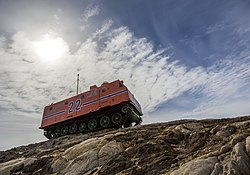
Kharkovchanka (Russian: Харьковчанка) or Kharkivyanka (Ukrainian: Харків'янка, "Woman of Kharkiv"), code name: Manufacture 404S, is a model of Antarctic off-road vehicle made circa 1957–1958 in the Soviet Union, designed and built by the Kharkov Transport Engineering Plant, Ukraine[1]: 8:14–15:46 and later manufactured in Kharkiv by the Malyshev Factory.[2] Based on the AT-T tractor platform (itself based on the T-54 tank). In December 1959 two of them ("21" and "23") were delivered to Antarctica and reached the South Pole.[3] The massive off-road snow vehicle had a small galley, toilet, oven, and a total of eight beds.[1]
By the 39th Russian Antarctic expedition, Vityaz DT-30Ps replaced the Kharkovchankas.[1]: 30:20 Those were themselves later replaced by PistenBully 300 Polar vehicles.[1]
History
[edit]
Three Kharkovchankas were built in 1958, and shipped to Antarctica. They traversed from the ocean coast to the existing Soviet Vostok Station in February 1959. Two of these, and a third AT-T tractor, left Vostok station for the geographic South Pole in early December 1959, arriving at the pole on 26 December 1959, and surprising the US crew that had been airlifted into the Amundsen–Scott Station the previous summer.[1] Dozens of more exploratory missions into Antarctica were made with Kharkovchankas in subsequent years.[1]: 20:15
In 1974–1975, a second generation Kharkovchanka was designed and built for Antarctic service. The largest design difference was the movement of the cab and engine back out in front of the main massive rectangular body structure, as well as the addition of auxiliary power generation for electricity and heat when the main engine was not operating. Three second generation Karkovchankas came off the production line in the fall of 1975.[1]: 22:45–24:55
A potential third generation based on the MT-T tractor was considered in the 1980s, but was put on permanent hold for budgetary reasons, and following the Dissolution of the Soviet Union, left the Kharkovchankas as the main transportation system for Antarctic cargo into the early 2010s as part of the Russian Antarctic operation.[1]: 25:35–26:30
Description
[edit]First generation
[edit]Like the Antarctic Snow Cruiser, the engine was inside the 20 m2 (220 sq ft) living space to allow maintenance without being exposed to the elements.[4] However, this meant that the noise of the engine prevented any sleep and that everything was covered by soot from the exhaust fumes.[4]
Technical characteristics
[edit]First generation
[edit]- Assembly: Kharkiv (Kharkov Transport Engineering Plant), Ukrainian SSR[1]
- Manufacturer: Malyshev Factory
- Length: 8.5 m (27 ft 11 in)
- Width: 3.5 m (11 ft 6 in)
- Height: 4 m (13 ft 1 in)[1]
- Wheels: 7 each side with drive sprocket and idler
- Track width: 1 m (3 ft 3 in)[5]
- Suspension: torsion bar
- Engine: 995 hp (742 kW) V-12 diesel
- Cruise speed: 30 km/h (19 mph)[1]
- Max. speed: 56 km/h (35 mph)[1]
- Max. grade: 30 degrees slope[1]
- Weight: 35,000 kg (34 long tons)
- Tow load: 60 tonnes[1]
See also
[edit]- Antarctic Snow Cruiser, US vehicle, circa 1940, unsuccessful.
References
[edit]- ^ a b c d e f g h i j k l m n Gillies, Calum (27 June 2020). "Kharkovchanka" - The Colossal Soviet Antarctic Cruisers (video). Retrieved 20 July 2020 – via YouTube.
- ^ "Antarctic Off-road Vehicles: USA vs. USSR"
- ^ Russian South Pole Traverse
- ^ a b "Science and exploration in the high interior of East Antarctica in the twentieth century - 中国知网". www.cnki.net. doi:10.13679/j.advps.2016.2.00065. Retrieved 2021-01-13.
- ^ New Scientist. Reed Business Information. 1959-12-17. p. 1254.
External links
[edit]Kharkovchanka
View on GrokipediaDevelopment
Origins and Initial Design
The Soviet Union's Antarctic program gained momentum during the International Geophysical Year (IGY) of 1957–1958, as part of a broader international effort to conduct geophysical research in extreme polar environments. Motivated by the need to establish and supply inland stations such as Vostok in East Antarctica, Soviet scientists and engineers sought advanced over-snow transport solutions capable of navigating vast ice expanses and sub-zero temperatures far beyond the capabilities of existing vehicles like the AT-T heavy artillery tractor. These traverses, spanning thousands of kilometers from coastal bases like Mirny, required vehicles that could operate autonomously in isolation, prompting the initiation of specialized vehicle development to support the USSR's scientific ambitions and geopolitical presence in the region.[3] To leverage proven technology, the Kharkovchanka was based on the AT-T platform, a robust artillery tractor derived from the T-54 tank chassis known for its reliability in Arctic conditions, with a base towing capacity of around 20 tons on snow. The project, code-named "Product 404" or "Manufacture 404S," was undertaken by the Kharkov Transport Engineering Plant (KhTZ) in collaboration with the Malyshev Factory, both located in Kharkov (now Kharkiv), Ukraine, under commission from the Institute of Geography of the USSR Academy of Sciences. This choice of facilities capitalized on their expertise in heavy machinery production, enabling rapid adaptation of military-grade components for polar exploration.[7][3] Central to the initial design were goals of creating a self-contained mobile habitat to sustain a crew during extended missions, including integrated living quarters for up to eight personnel with facilities for rest, cooking, and maintenance. The vehicle was engineered to tow sledges laden with fuel, equipment, and provisions, while incorporating redundant fuel storage and navigation systems to ensure operational independence over long distances without reliance on external support. These features addressed the logistical challenges of Antarctic interiors, where resupply was impractical and environmental hazards like blizzards demanded enclosed, insulated structures.[3][8] Initial prototypes underwent rigorous testing in 1957–1958 in Arctic regions to validate performance in simulated Antarctic conditions, including deep snow and extreme cold, prior to final adaptations for southern deployment. These trials focused on refining the integration of living modules with the AT-T chassis, ensuring structural integrity and crew habitability under prolonged vibration and isolation.[3]First Generation Production
The first-generation Kharkovchanka vehicles were designed and built circa 1957–1958 at the Kharkiv Tractor Factory (KhTZ) and Malyshev Factory in Kharkov, Ukraine, with final assembly completed by early 1959 in preparation for shipment to Antarctica.[9][10] These efforts aligned with the Soviet Union's participation in the International Geophysical Year (IGY) of 1957–1958, aimed at advancing polar scientific traverses.[11] A total of five units were produced, marking the initial output of this specialized off-road vehicle series.[3][4] Production presented significant engineering challenges, particularly in integrating the insulated living modules onto the base AT-T artillery tractor chassis to form a self-contained habitat-transport hybrid.[12] Engineers focused on reinforcing the structure for durability against extreme conditions, including temperatures down to -50°C that could freeze diesel fuel solid and gale-force winds exceeding 100 km/h capable of shifting snow drifts and stressing joints.[13][14] The entire development from initial drawings to fabrication occurred within approximately three months, demanding rapid prototyping and testing to balance habitability with mobility on unprepared terrain.[14][12] Prior to deployment, each vehicle underwent targeted modifications to optimize performance in deep snow, including the installation of wider tracks measuring 1 meter each for improved flotation and the tuning of the torsion bar suspension system to handle uneven icy surfaces.[12] The chassis was also extended by adding two additional road wheels per side to enhance stability and load distribution.[12] Following completion, the five vehicles were loaded aboard the Soviet research vessel Ob in late 1958 for transport across the Southern Ocean to the Antarctic coast, arriving in early 1959 to support inland operations.[4][9] This logistical phase ensured the units were preserved from maritime hazards while en route to their operational environment.[11]Second Generation Upgrades
Feedback from Antarctic expeditions conducted between 1959 and the 1970s revealed significant limitations in the first-generation Kharkovchanka, particularly the rear-mounted engine's contribution to excessive noise, soot infiltration into living spaces, and cab overheating, which compromised crew comfort and operational efficiency.[15] To address these issues, engineers at the Kharkov Transport Engineering Plant redesigned the vehicle in 1974–1975, relocating the engine and driver's cab to the front for improved weight distribution, better isolation of the living module from heat and exhaust, and easier access for maintenance.[15][16] This shift also incorporated enhanced thermal insulation layers to maintain stable internal temperatures.[15] Furthermore, an auxiliary power unit was added to generate independent electricity and heating without relying on the main engine, allowing sustained support for crew activities during stationary periods.[17] The second-generation models, designated as Product 404C, were produced in 1975 on an updated long-wheelbase AT-T chassis variant, with three to five units constructed to meet the demands of ongoing Soviet polar operations.[18][19][15] One additional unit was built in 1984 to replace an aging vehicle, ensuring continuity in the fleet.[20] These upgrades occurred during a period of intensified Soviet Antarctic scientific endeavors in the 1970s, reflecting the state's commitment to technological self-reliance in extreme environments.[15] However, subsequent plans for a third-generation Kharkovchanka in the 1980s, which would have utilized the MT-T heavy tractor platform for further enhancements, were ultimately canceled amid funding reductions and the dissolution of the Soviet Union in 1991.[21]Design and Features
Chassis and Propulsion System
The Kharkovchanka's chassis formed the robust foundation for its polar operations, derived from an elongated AT-T heavy artillery tractor frame, which itself originated from the T-54 tank's drive and structural components. This base was extended by adding two additional track rollers per side, resulting in seven rollers overall for improved stability and load distribution across uneven, snow-covered terrain. Reinforced with high-strength steel plating, the chassis supported the vehicle's mass of approximately 35 tonnes, enabling reliable traversal of Antarctica's vast ice fields while towing sleds up to 70 tonnes.[3][12] The propulsion system centered on a supercharged V-12 diesel engine with a base output of 520 horsepower, boosted to up to 990 horsepower, coupled with a multi-speed transmission to power the tracked drivetrain.[1] Wide tracks, measuring 1 meter in width, were optimized for flotation in deep snow and ice, allowing the vehicle to navigate challenging polar environments with a ground pressure low enough to avoid excessive sinking. The torsion bar suspension absorbed shocks from rough surfaces, while steering was achieved through differential braking of the tracks, providing precise control during maneuvers. A multi-tank fuel arrangement offered an operational range of up to about 1,500 km, essential for extended expeditions without frequent refueling.[14] Although capable of fording water up to 1.3 meters deep—a feature inherited from the AT-T platform—this was seldom required in Antarctic conditions.[22][12][14] Adaptations for extreme cold included insulation and heating systems integrated into the chassis to maintain operational integrity at temperatures as low as -70°C, preventing mechanical failures in frozen conditions. The tracks and undercarriage benefited from engine heat circulation to mitigate ice buildup, enhancing reliability in sub-zero environments. In the second-generation models introduced in 1975, the engine was relocated to the front of the chassis, which improved weight distribution for better front-end traction and reduced the tendency for the rear to dig into soft snow during ascents or turns. This modification addressed limitations observed in the first generation, where the rear-mounted engine contributed to occasional stability issues on inclines.[3][12]Crew Accommodations and Support Equipment
The Kharkovchanka's crew accommodations centered on a self-contained, enclosed cabin designed for habitability during prolonged Antarctic traverses, supporting 8 personnel while allowing space for scientific instruments.[12] The internal layout featured eight specialized compartments, including a driving cab, workroom, galley with cooking facilities, service areas, chemical toilet, drying room, and lobby, enabling the crew to live and work in isolation without exposure to external extremes. Storage provisions accommodated supplies for extended missions, up to 20 days, encompassing food, fuel, and equipment essentials.[1][2] Climate control systems were critical to counter the harsh polar environment, with the cabin insulated for temperature differentials of up to 180°F (100°C) and operational viability down to -94°F (-70°C). Double-layered walls incorporated felt and multiple insulation layers, supplemented by diesel heaters for warmth and ventilation to manage condensation and air quality in sub-zero conditions. These features maintained a livable interior despite ambient temperatures as low as -50°C.[1][15] Support equipment emphasized reliability in remote operations, including a shortwave radio station for communication and navigation aids such as gyrocompasses, magnetic compasses, astronomical tools, and radio compasses for route guidance. A basic medical kit provided essential care for injuries or illnesses during isolation. The first generation integrated the engine within the living space for in-cabin maintenance, but this placement introduced ergonomic challenges, including high noise levels that disrupted sleep and exhaust fumes infiltrating the crew area. The second generation mitigated these by compartmentalizing the engine and cab, while adding independent diesel generators to power lighting, ventilation, and auxiliary systems independently of the main propulsion.[2][1]Technical Specifications
First Generation Details
The first-generation Kharkovchanka, produced in 1958 at the Malyshev Factory in Kharkiv, Ukrainian SSR, featured a robust set of technical parameters optimized for extreme polar conditions, building on the base AT-T heavy artillery tractor as a comparative baseline for its tracked chassis design.[14] These specifications emphasized durability, flotation on snow, and self-sufficiency for Antarctic traverses, with the vehicle measuring 8.5 meters in length, 3.5 meters in width, and 4 meters in height to accommodate its enclosed living quarters and cargo space.[23] The powertrain consisted of a supercharged V-12 diesel engine producing up to 1000 horsepower (from a base of 520 horsepower), derived from the AT-T tractor's powerplant and adapted for heavy towing, enabling a maximum speed of 56 km/h and a cruising speed of 30 km/h on firm surfaces.[14][1] At an empty weight of 35,000 kg, it had a towing capacity of 70 tonnes and a fuel range of 1,500 km, supported by multiple fuel tanks for extended operations without refueling.[23][3] The suspension employed a torsion bar system, paired with 14 tracks (seven per side, each 1 meter wide), achieving a ground pressure of approximately 0.28 kg/cm² (4 psi) to ensure flotation on deep snow.[1] Additional metrics included the ability to climb slopes up to 30 degrees and operate in temperatures ranging from -50°C to +40°C, making it suitable for the harsh Antarctic environment.[14]| Parameter | Specification |
|---|---|
| Dimensions | Length: 8.5 m; Width: 3.5 m; Height: 4 m |
| Powertrain | Supercharged 1000 hp V-12 diesel engine (520 hp base); Max speed: 56 km/h; Cruise speed: 30 km/h |
| Capacity | Weight: 35,000 kg; Towing load: 70 tonnes; Fuel range: 1,500 km |
| Suspension and Tracks | Torsion bar; 14 tracks (7 per side, 1 m wide); Ground pressure: ~0.28 kg/cm² (4 psi) |
| Other Metrics | Max slope: 30 degrees; Operational temperature: -50°C to +40°C |