


Community hub
Recent from talks
Contribute something
Nothing was collected or created yet.
The Kinks
View on Wikipedia
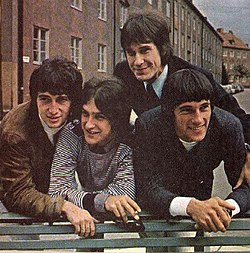
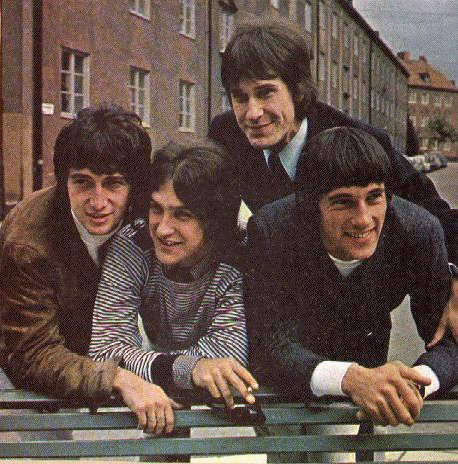
The Kinks were an English rock band formed in London in 1962 by brothers Ray and Dave Davies, and Pete Quaife. The band emerged during the height of British rhythm and blues and Merseybeat, and were briefly part of the British Invasion of the United States until their touring ban in 1965. Their third single, the Ray Davies-penned "You Really Got Me",[3][4] became an international hit, topping the charts in the United Kingdom and reaching the Top 10 in the United States.[5]
Key Information


The Kinks' music drew from a wide range of influences, including American R&B and rock and roll initially, and later adopting British music hall, folk, and country. The band gained a reputation for reflecting English culture and lifestyle, fuelled by Ray Davies' observational and satirical lyricism,[6][3][4][7] and made apparent in albums such as Face to Face (1966), Something Else (1967), The Village Green Preservation Society (1968), Arthur (1969), Lola Versus Powerman (1970), and Muswell Hillbillies (1971), along with their accompanying singles including the transatlantic hit "Lola" (1970). After a fallow period in the mid-1970s, the band experienced a revival with their albums Sleepwalker (1977), Misfits (1978), Low Budget (1979), Give the People What They Want (1981) and State of Confusion (1983), the last of which produced one of the band's most successful US hits, "Come Dancing".
The band's original line-up comprised Ray (lead vocals, rhythm guitar), Dave (lead guitar, vocals), Quaife (bass) and Mick Avory (drums, percussion). The Davies brothers remained with the band throughout its history. Quaife briefly left the band in 1966 and was replaced by John Dalton, though Quaife returned by the end of that year before leaving permanently in 1969, once again being replaced by Dalton. Keyboardist John Gosling joined in 1970 (prior to this, session keyboardist Nicky Hopkins played on many of their recordings). After Dalton's 1976 departure, Andy Pyle briefly served as the band's bassist before being replaced by Argent bassist Jim Rodford in 1978. Gosling quit in 1978 and was first replaced by ex-Pretty Things member Gordon John Edwards, then more permanently by Ian Gibbons in 1979. Avory left the group in 1984 and was replaced by another Argent member, Bob Henrit. The band gave its last public performance in 1996 and broke up in 1997 as a result of creative tension between the Davies brothers.[8]
The Kinks are regarded as one of the most influential rock bands of the 1960s.[6][3] They have had seventeen Top 20 singles and five Top 10 albums in the UK,[9] and five of their singles reached the Top 10 on the US Billboard Hot 100 chart. Additionally, nine of their albums charted in the Top 40 of the US Billboard 200.[10] Four Kinks albums have been certified Gold by the Recording Industry Association of America (RIAA), and the band has sold over 50 million records worldwide. Among numerous honours, they received the Ivor Novello Award for "Outstanding Service to British Music".[11] In 1990, the original four members of the Kinks were inducted into the Rock and Roll Hall of Fame,[3][4] as well as the UK Music Hall of Fame in 2005. In addition, groups such as Van Halen, the Jam, the Knack, the Pretenders and the Romantics covered their songs, helping to boost the Kinks' record sales. In the 1990s, Britpop acts such as Blur and Oasis cited the band as a major influence.[6]
History
[edit]Formation (1962–1963)
[edit]
The Davies brothers, Ray and Dave, were born in suburban North London on Huntingdon Road, East Finchley, the youngest and the only boys among their family's eight children.[12] Their parents, Frederick and Annie Davies, moved the family to 6 Denmark Terrace, Fortis Green, in the neighbouring suburb of Muswell Hill.[13] At home, the brothers were immersed in a world of varied musical styles, from the music hall of their parents' generation to the jazz and early rock and roll their older sisters enjoyed.[13] Both Ray and his brother Dave, younger by almost three years, learned to play guitar, and they played skiffle and rock and roll together.[12]
The brothers attended William Grimshaw Secondary Modern School (later merged with Tollington Grammar School to become Fortismere School), where they formed a band, the Ray Davies Quartet, with Ray's friend and classmate Pete Quaife and Quaife's friend John Start (although they would also be known as the Pete Quaife Quartet if the bass player landed a gig for them instead). Their debut at a school dance was well received, which encouraged the group to play at local pubs and bars. The band went through a series of lead vocalists, including Rod Stewart,[14] another student at William Grimshaw,[15] who performed with the group at least once in early 1962.[14] He then formed his own group, Rod Stewart and the Moonrakers, who became a local rival to the Ray Davies Quartet.[14]
In late 1962, Ray Davies left home to study at Hornsey College of Art. He pursued interests in subjects such as film, sketching, theatre, and music, including jazz and blues.[16] When Alexis Korner's Blues Incorporated played at the college in December, he asked advice from Alexis Korner, who recommended Giorgio Gomelsky, the former Yardbirds manager, who put Davies in touch with the Soho-based Dave Hunt Band, a professional group of musicians who played jazz and R&B.[17] A few days after the Ray Davies Quartet supported Cyril Stapleton at the Lyceum Ballroom on New Year's Eve, Davies, while still remaining in the Quartet, joined the Dave Hunt Band which briefly included Charlie Watts on drums.[18] In February 1963, Davies left Dave Hunt to join the Hamilton King Band (also known as the Blues Messengers), which had Peter Bardens as a pianist.[18] At the end of the spring term, he left Hornsey College with a view to studying film at the Central School of Art and Design. Around this time the Quartet changed their name to the Ramrods.[19] Davies has referred to a show the fledgling Kinks played (again as the Ray Davies Quartet) at Hornsey Town Hall on Valentine's Day 1963 as their first important gig. In June, the Hamilton King Band broke up.[19] However, the Ramrods kept going, performing under several other names, including the Pete Quaife Band and the Bo-Weevils, before (temporarily) settling on the Ravens.[4][20] The fledgling group hired two managers, Grenville Collins and Robert Wace. In late 1963 former pop singer Larry Page became their third manager. American record producer Shel Talmy began working with the band, and the Beatles' promoter, Arthur Howes, was retained to schedule the Ravens' live shows.[21] The group unsuccessfully auditioned for various record labels until early 1964, when Talmy secured them a contract with Pye Records. During this period they had acquired a new drummer, Mickey Willet; however, Willet left the band shortly before they signed to Pye.[20] The Ravens invited Mick Avory to replace him after seeing an advertisement Avory had placed in Melody Maker.[22] Avory had a background in jazz drumming and had played one gig with the fledgling Rolling Stones.[22]
Around this period, the Ravens decided on a new, permanent name: the Kinks. Numerous explanations of the name's genesis have been offered. In Jon Savage's analysis, they "needed a gimmick, some edge to get them attention. Here it was: 'Kinkiness'—something newsy, naughty but just on the borderline of acceptability. In adopting the 'Kinks' as their name at that time, they were participating in a time-honoured pop ritual—fame through outrage."[23] Manager Robert Wace related his side of the story: "I had a friend ... He thought the group was rather fun. If my memory is correct, he came up with the name just as an idea, as a good way of getting publicity ... When we went to [the band members] with the name, they were ... absolutely horrified. They said, 'We're not going to be called kinky!'"[23] Ray Davies' account conflicts with Wace's—he recalled that the name was coined by Larry Page, and referenced their "kinky" fashion sense. Davies quoted him as saying, "The way you look, and the clothes you wear, you ought to be called the Kinks."[23] "I've never really liked the name", Ray stated.[23]
Early years (1964–1965)
[edit]
The Kinks' first single was a cover of the Little Richard song "Long Tall Sally". A friend of the band, Bobby Graham,[24] was recruited to play the drums on the recording. Graham would continue to occasionally substitute for Avory in the studio and he played on several of the Kinks' early singles, including the hits "You Really Got Me", "All Day and All of the Night" and "Tired of Waiting for You".[25] Released in February 1964, "Long Tall Sally" was almost completely ignored, despite the publicity efforts of the band's managers. When the second single "You Still Want Me" failed to chart,[26] Pye Records threatened to annul the group's contract unless their third single was a success.[citation needed]

The Ray Davies song "You Really Got Me", influenced by American blues and the Kingsmen's version of "Louie Louie",[27][28] was recorded on 15 June 1964 at Pye Studios with a slower and more produced feel than the final single.[29][30] Davies, who "hated" the recording, feeling that the guitar was too buried and the echo too prominent, wanted to rerecord the song, but Pye refused to fund another session; Davies was adamant, so Collins and Wace broke the stalemate by underwriting the session themselves.[31] The band used an independent recording studio, IBC, and completed the recording in two takes on 15 July.[29] The single was released in August 1964; supported by a performance on the television show Ready Steady Go! and extensive pirate radio coverage, it entered the UK charts on 15 August, reaching number one on 19 September.[32][33] Hastily imported by the American label Reprise Records, where the band was signed by legendary executive Mo Ostin,[34] "You Really Got Me" also made the Top 10 in the United States.[5] The loud, distorted guitar riff and solo—played by Dave Davies and achieved by a slice he made in the speaker cone of his Elpico amplifier (referred to by the band as the "little green amp")—helped with the song's signature, gritty guitar sound.[35] "You Really Got Me" has been described as "a blueprint song in the hard rock and heavy metal arsenal",[35] and as an influence on the approach of some American garage rock bands.[36] After its release, the Kinks recorded most of the tracks for their debut LP, simply titled Kinks. Consisting largely of covers and revamped traditional songs, it was released on 2 October 1964, reaching number four on the UK chart.[37] "All Day and All of the Night", another Ray Davies hard rock tune, was released three weeks later as the group's fourth single, reaching number two in the UK and number seven in the US.[5][35][38] The next three singles, "Tired of Waiting for You", "Ev'rybody's Gonna Be Happy" and "Set Me Free", were also commercially successful, with the first of the three topping the UK singles chart.[10][38]
The group opened 1965 with their first tour of Australia and New Zealand, with Manfred Mann and the Honeycombs.[39] An intensive performing schedule saw them headline other package tours throughout the year with acts such as the Yardbirds and Mickey Finn.[40] Tensions began to emerge within the band, expressed in incidents such as the on-stage fight between Avory and Dave Davies at the Capitol Theatre in Cardiff, Wales, on 19 May.[40][41] After finishing the first song, "You Really Got Me", Davies insulted Avory and kicked over his drum set.[40][41] Avory responded by hitting Davies with his hi-hat stand, rendering him unconscious, before fleeing from the scene, fearing that he had killed his bandmate. Davies was taken to Cardiff Royal Infirmary, where he received 16 stitches to his head.[40][41] To placate the police, Avory later claimed that it was part of a new act in which the band members would hurl their instruments at one another.[40][41]
Following a mid-year tour of the US, the American Federation of Musicians refused permits for the group to appear in concerts there for the next four years, effectively cutting them off from the main market for rock music at the height of the British Invasion.[6][42] Although neither the Kinks nor the union revealed a specific reason for the ban, at the time it was widely attributed to their rowdy on-stage behaviour.[42] It has been reported that the ban was sparked by an incident that happened when the band were taping Dick Clark's TV show Where the Action Is in 1965. Ray Davies recalls in his autobiography, "Some guy who said he worked for the TV company walked up and accused us of being late. Then he started making anti-British comments, such as, 'Just because the Beatles did it, every mop-topped, spotty-faced limey juvenile thinks he can come over here and make a career for himself.'"; subsequently, a punch was thrown, and the AFM banned them.[43]

A stopover in Bombay, India, during the band's Australian and Asian tour led to Davies writing the song "See My Friends", which was released as a single in July 1965.[44] This was an early example of crossover music and one of the first pop songs of the period to display the direct influence of traditional music from the Indian subcontinent.[44] Davies had written the song with a raga feel after hearing the early morning chants of local fishermen.[45] Music historian Jonathan Bellman argues that the song was "extremely influential" on Ray Davies' musical peers: "And while much has been made of the Beatles' 'Norwegian Wood' because it was the first pop record to use a sitar, it was recorded well after the Kinks' clearly Indian 'See My Friends' was released."[44] Pete Townshend of the Who was particularly affected by the song: "'See My Friends' was the next time I pricked up my ears and thought, 'God, he's done it again. He's invented something new.' That was the first reasonable use of the drone—far, far better than anything The Beatles did and far, far earlier. It was a European sound rather than an Eastern sound but with a strong, legitimate Eastern influence which had its roots in European folk music."[46] In a widely quoted[44][46][47] statement by Barry Fantoni, himself a 1960s celebrity and friend of the Kinks, the Beatles and the Who, he recalled that it was also an influence on the Beatles: "I remember it vividly and still think it's a remarkable pop song. I was with the Beatles the evening that they actually sat around listening to it on a gramophone, saying 'You know this guitar thing sounds like a sitar. We must get one of those.'"[46] The song's radical departure from popular music conventions proved unpopular with the band's American following—it hit number 10 in the UK but stalled at number 111 in the US.[48]
There were only a few bands that had this sorta really rough-sounding, what we used to call "R&B" style in the Sixties. There were the Yardbirds, there was us, there was the Pretty Things, as well.[49]
The day after the band's return from the Asian tour, recording began promptly on their next project, Kinda Kinks. The LP was completed and released within two weeks, even though 10 of its 12 songs were originals.[50][51][52] According to Ray Davies, the band was not completely satisfied with the final cuts,[51][52] but pressure from the record company meant that no time was available to correct flaws in the mix. Davies later expressed his dissatisfaction with the production, saying, "A bit more care should have been taken with it. I think [producer] Shel Talmy went too far in trying to keep in the rough edges. Some of the double tracking on that is appalling. It had better songs on it than the first album, but it wasn't executed in the right way. It was just far too rushed."[52]
A significant stylistic shift in the Kinks' music became evident in late 1965, with the appearance of singles like "A Well Respected Man" and "Dedicated Follower of Fashion", as well as the band's third album The Kink Kontroversy,[3] on which Nicky Hopkins made his first appearance as a session musician with the group on keyboards.[53] These recordings exemplified the development of Davies' songwriting style, from hard-driving rock numbers toward songs rich in social commentary, observation and idiosyncratic character study, all with a uniquely English flavour.[3][7]
Critical success (1966–1972)
[edit]
The satirical single "Sunny Afternoon" was the biggest UK hit of summer 1966, topping the charts and displacing the Beatles' "Paperback Writer".[54] Before the release of The Kink Kontroversy, Ray Davies suffered a nervous and physical breakdown, caused by the pressures of touring, writing and ongoing legal squabbles.[55] During his months of recuperation, he wrote several new songs and pondered the band's direction.[55] In June 1966, Quaife was involved in an automobile accident,[55] and after his recovery he decided to leave the band. Bassist John Dalton, who was initially hired to fill in for the injured Quaife, subsequently became his official replacement.[56] However, Quaife soon had a change of heart and rejoined the band in November 1966, with Dalton returning to his previous job as a coalman.[57]
"Sunny Afternoon" was a dry run for the band's next album Face to Face, which displayed Davies' growing ability to craft musically gentle yet lyrically cutting narrative songs about everyday life and people.[6] Hopkins returned for the sessions to play various keyboard instruments, including piano and harpsichord. He played on the band's next two studio albums as well and was involved in a number of their live BBC recordings before joining the Jeff Beck Group in 1968.[55] Face to Face was released in October 1966 in the UK, where it was well received and peaked at number 8.[58] When it was released in the US in December, the album was tipped as a potential "chart winner" by Billboard magazine.[59] Despite this, it managed only a meagre chart peak of 135—a sign of the band's flagging popularity in the American market.[60]
Released in November 1966, the Kinks' next single was a social commentary piece entitled "Dead End Street".[59] It became another UK Top 10 hit,[61] but reached only number 73 in the US.[5] Bob Dawbarn from Melody Maker praised Ray Davies' ability to create a song with "some fabulous lyrics and a marvellous melody ... combined with a great production",[58] and music scholar Johnny Rogan described it as "a kitchen sink drama without the drama—a static vision of working-class stoicism".[61] One of the group's first promotional music videos was produced for the song. It was filmed on Little Green Street, a small 18th-century lane in north London, located off Highgate Road in Kentish Town.[62] Both "Dead End Street" and its B-side "Big Black Smoke" were recorded with John Dalton on bass, though Quaife had returned by the time the single was released, and appeared in the promotional music video.[citation needed]
The Kinks' next single, "Waterloo Sunset", was released in May 1967. The lyrics describe two lovers passing over a bridge, with a melancholic observer reflecting on the couple, the Thames, and Waterloo station.[65][66] The song was rumoured to have been inspired by the romance between actors Terence Stamp and Julie Christie, two British celebrities of the time.[67][68][69] Ray Davies denied this in his autobiography, and claimed in a 2008 interview, "It was a fantasy about my sister going off with her boyfriend to a new world and they were going to emigrate and go to another country."[66][70] Despite its complex arrangement, the sessions for "Waterloo Sunset" lasted a mere ten hours.[63] Dave Davies later commented on the recording: "We spent a lot of time trying to get a different guitar sound, to get a more unique feel for the record. In the end, we used a tape-delay echo, but it sounded new because nobody had done it since the 1950s. I remember Steve Marriott of the Small Faces came up and asked me how we'd got that sound. We were almost trendy for a while."[64] The single was one of the Kinks' biggest UK successes, hitting number two on Melody Maker's chart,[67] and became one of their most popular and best-known songs. Critic Robert Christgau called it "the most beautiful song in the English language",[71] and AllMusic senior editor Stephen Thomas Erlewine cited it as "possibly the most beautiful song of the rock and roll era".[72] Ray Davies was chosen to perform "Waterloo Sunset" at the closing of the 2012 London Olympic Games, 45 years after the song's release.[73][74]

The songs on the 1967 album, Something Else by the Kinks, developed the musical progressions of Face to Face, adding English music hall influences to the band's sound.[76] Dave Davies scored a major UK chart success with the album's "Death of a Clown". While co-written by Ray Davies and recorded by the Kinks, the song was also released as a Dave Davies solo single.[5][76] Overall, the album's commercial performance was disappointing, prompting the Kinks to rush out a new single, "Autumn Almanac", in early October. Backed with "Mister Pleasant", the single became another top-5 success for the group. At this point, in a string of 13 singles, 12 of them reached the top 10 in the UK chart.[77] Andy Miller suggests that, despite its success, the single marks a turning point in the band's career—it would be their last entry into the UK top ten for three years: "In retrospect, 'Autumn Almanac' marked the first hint of trouble for the Kinks. This glorious single, one of the greatest achievements of British 60s pop, was widely criticised at the time for being too similar to previous [Ray] Davies efforts."[78] Nick Jones of Melody Maker asked, "Is it time that Ray stopped writing about grey suburbanites going about their fairly unemotional daily business? ... Ray works to a formula, not a feeling, and it's becoming rather boring."[78] Disc jockey Mike Ahern called the song "a load of old rubbish".[78] Dave's second solo single "Susannah's Still Alive" was released in the UK on 24 November. It sold 59,000 copies, failing to reach the top 10. Miller states that "by the end of the year, the Kinks were rapidly sliding out of fashion".[79]
Everyone was panicking because "Wonderboy" wasn't sounding like a hit record. Among the management and the agent, Danny Detesh, there was definitely a sense that the band wouldn't go on for much longer ... Danny came backstage when the record flopped and said, "Well, you've had a good run. You've enjoyed it." As if it was all over for us.[80]
Beginning early in 1968, the group largely retired from touring, instead focusing on studio work. As the band was not available to promote their material, subsequent releases met with little success.[81] The Kinks' next single, "Wonderboy", released in the spring of 1968, stalled at number 36 and became the band's first single not to make the UK top twenty since their early covers.[82] In the face of the band's declining popularity, Davies continued to pursue his personal song-writing style while rebelling against the heavy demands placed on him to keep producing commercial hits, and the group continued to devote time to the studio, centring on a slowly developing project of Ray's called Village Green.[6] In an attempt to revive the group's commercial standing, the Kinks' management booked them on a month-long package tour for April, drawing the group away from the studio. The venues were largely cabarets and clubs; headlining was Peter Frampton's group the Herd. "In general, the teenyboppers were not there to see the boring old Kinks, who occasionally had to endure chants of 'We Want The Herd!' during their brief appearances",[83] commented Andy Miller. The tour proved taxing and stressful—Pete Quaife recalled, "It was a chore, very dull, boring and straightforward ... We only did twenty minutes, but it used to drive me absolutely frantic, standing on stage and playing three notes over and over again."[83] At the end of June, the Kinks released the single "Days", which provided a minor, but only momentary, comeback for the group. "I remember playing it when I was at Fortis Green the first time I had a tape of it", Ray said. "I played it to Brian, who used to be our roadie, and his wife and two daughters. They were crying at the end of it. Really wonderful—like going to Waterloo and seeing the sunset. ... It's like saying goodbye to somebody, then afterwards feeling the fear that you actually are alone."[80] "Days" reached number 12 in the UK and was a top-20 hit in several other countries, but it did not chart in the US.[84]
Village Green eventually morphed into their next album, The Kinks Are the Village Green Preservation Society, released in late 1968 in the UK. A collection of thematic vignettes of English town and hamlet life, it was assembled from songs written and recorded over the previous two years.[85] It was greeted with almost unanimously positive reviews from both UK and US rock critics, yet failed to attract strong sales.[86] One factor in the album's initial commercial failure was the lack of a popular single;[87] it did not include the moderately successful "Days", and the album track "Starstruck" was released as a single in North America and continental Europe, but was unsuccessful.[88][89] Although a commercial disappointment, Village Green (the project's original name was adopted as a shorthand for the long album title) was embraced by the new underground rock press when it was released in January 1969 in the US, where the Kinks began to acquire a reputation as a cult band.[90] In The Village Voice, a newly hired Robert Christgau called it "the best album of the year so far".[90] The underground Boston paper Fusion published a review stating, "the Kinks continue, despite the odds, the bad press and their demonstrated lot, to come across. ... Their persistence is dignified; their virtues are stoic. The Kinks are forever, only for now in modern dress."[90] The record did not escape criticism, however. In the student paper California Tech, one writer commented that it was "schmaltz rock ... without imagination, poorly arranged and a poor copy of The Beatles".[90] Although Davies later estimated that it had sold only around 100,000 copies worldwide on its initial release,[91] Village Green has since become the Kinks' best-selling original record.[86] The album remains popular; in 2004, it was re-released in a 3CD "Deluxe" edition, and the track "Picture Book" was featured in a popular Hewlett-Packard television commercial, helping considerably to boost the album's popularity.[92]
In early 1969, Quaife again announced that he was leaving the band.[93] The other members did not take his statement seriously until an article appeared in New Musical Express on 4 April featuring Quaife's new band, Maple Oak, which he had formed without telling the rest of the Kinks.[93][94][95] Ray Davies pleaded with him to return for the sessions for their upcoming album, but Quaife refused.[96] His last recording with the Kinks was the non-album single "Plastic Man" and its B-side "King Kong", released in March 1969. Immediately after Quaife had confirmed he was not returning, Ray Davies called up John Dalton, who had replaced Quaife three years prior, and asked him to rejoin. Dalton remained with the group until the recording of the album Sleepwalker in 1976.[96]
Ray Davies travelled to Los Angeles in April 1969 to help negotiate an end to the American Federation of Musicians' ban on the group, opening up an opportunity for them to return to touring in the US.[97] The group's management quickly made plans for a North American tour to help restore their standing in the US pop music scene.[98] Before their return to the US, the Kinks recorded another album, Arthur (Or the Decline and Fall of the British Empire).[99] As with the previous two albums, Arthur was grounded in characteristically English lyrical and musical hooks.[99] A modest commercial success, it was well received by American music critics.[5][99] Conceived as the score for a proposed but unrealised television drama, much of the album revolved around themes from the Davies brothers' childhood; their sister Rosie, who had migrated to Australia in the early 1960s with her husband Arthur Anning, the album's namesake; and life growing up during the Second World War.[99][100] The Kinks embarked on their tour of the US in October 1969.[98] The tour was generally unsuccessful, as the group struggled to find cooperative promoters and interested audiences; many of the scheduled concert dates were cancelled. The band did, however, manage to play a few major venues such as the Fillmore East and Whisky a Go Go.[101]
The band added keyboardist John Gosling to their line-up in early 1970;[103] before which, Nicky Hopkins and Ray Davies had done most of the session work on keyboards. In May 1970, Gosling debuted with the Kinks on "Lola", an account of a confused romantic encounter with a transvestite, which became both a UK and a US top-10 hit, helping return the Kinks to the public eye.[103][104] The lyrics originally contained the word "Coca-Cola", and the BBC refused to broadcast the song, considering it to be in violation of their policy against product placement.[103] Part of the song was hastily rerecorded by Ray Davies, with the offending line changed to the generic "cherry cola", although in concert the Kinks still used "Coca-Cola".[103] Recordings of both versions of "Lola" exist. Released in November 1970, the accompanying album Lola Versus Powerman and the Moneygoround, Part One was a critical and commercial success, charting in the top 40 in the US, making it their most successful album since the mid-1960s.[105][106] After the success of "Lola", the band released Percy in 1971, a soundtrack album to a film of the same name about a penis transplant.[107] The album, which consisted largely of instrumentals, did not receive positive reviews.[107] The band's US label, Reprise, declined to release it in the US, precipitating a major dispute that contributed to the band's departure from the label.[107] Directly after the release of the album, the band's contracts with Pye and Reprise expired.[6][107]

Before the end of 1971, the Kinks signed a five-album deal with RCA Records and received a million-dollar advance, which helped fund the construction of their own recording studio, Konk.[6][108] Their debut for RCA, Muswell Hillbillies, was replete with the influence of music hall and traditional American musical styles, including country and bluegrass. Though not as successful as its predecessors, it is often hailed as their last great record.[108] It was named after Muswell Hill where Ray and Dave grew up and contained songs focusing on working-class life and, again, the Davies brothers' childhood.[108] Despite positive reviews and high expectations, Muswell Hillbillies peaked at number 48 on the Record World chart and number 100 on the Billboard chart.[5][108] It was followed in 1972 by a double album, Everybody's in Show-Biz, consisting of both studio tracks and live numbers recorded during a two-night stand at Carnegie Hall.[109] The record featured the ballad "Celluloid Heroes" and the Caribbean-themed "Supersonic Rocket Ship", their last UK top-20 hit for more than a decade.[109] "Celluloid Heroes" is a bittersweet rumination on dead and fading Hollywood stars (Mickey Rooney was still alive), in which the narrator declares that he wishes his life were like a movie "because celluloid heroes never feel any pain ... and celluloid heroes never really die."[109][110] The album was moderately successful in the US, peaking at number 47 in Record World and number 70 in Billboard.[5][109] It marks the transition between the band's early 1970s rock material and the theatrical incarnation in which they immersed themselves for the next four years.[109]
Theatrical incarnation (1973–1976)
[edit]In 1973, Ray Davies dived headlong into the theatrical style, beginning with the rock opera Preservation, a sprawling chronicle of social revolution, and a more ambitious outgrowth of the earlier Village Green Preservation Society ethos.[111][112] In conjunction with the Preservation project, the Kinks' line-up was expanded to include a horn section and female backup singers, essentially reconfiguring the group as a theatrical troupe.[6][111]
Ray Davies' marital problems during this period began to affect the band adversely,[112] particularly after his wife, Rasa, took their children and left him in June 1973.[113] Davies became depressed; during a July gig at White City Stadium, he told the audience he was "fucking sick of the whole thing" and was retiring.[114][115][116] He subsequently collapsed after a drug overdose and was taken to hospital.[114][117] With Ray Davies in a seemingly critical condition, plans were discussed for Dave to continue as frontman in a worst-case scenario.[118] Ray recovered from his illness as well as his depression, but throughout the remainder of the Kinks' theatrical incarnation the band's output remained uneven, and their already fading popularity declined even more.[117] John Dalton later commented that when Davies "decided to work again ... I don't think he was totally better, and he's been a different person ever since."[118]

Preservation Act 1 (1973) and Preservation Act 2 (1974) received generally poor reviews.[111][119][120] The story on the albums involved an anti-hero called Mr Flash, and his rival and enemy Mr Black (played by Dave Davies during live shows), an ultra-purist and corporatist.[121] Preservation Act 2 was the first album recorded at Konk Studio; from this point forward, virtually every Kinks studio recording was produced by Ray Davies at Konk.[112][122] The band embarked on an ambitious US tour throughout late 1974, adapting the Preservation story for the stage. Author Robert Polito: "[Ray] Davies expanded the Kinks into a road troupe of perhaps a dozen costumed actors, singers and horn players. ... Smoother and tighter than on record, Preservation live proved funnier as well."[123]
Davies began another project for Granada Television, a musical called Starmaker.[125] After a broadcast with Ray Davies in the starring role and the Kinks as both back-up band and ancillary characters, the project eventually morphed into the concept album The Kinks Present a Soap Opera, released in May 1975, in which Ray Davies fantasised about what would happen if a rock star traded places with a "normal Norman" and took a 9–5 job.[125][126] In August 1975, the Kinks recorded their final theatrical work, Schoolboys in Disgrace, a backstory biography of Preservation's Mr Flash.[127] The record was a modest success, peaking at number 45 on the Billboard charts.[5][127]
Return to commercial success (1977–1985)
[edit]Following the termination of their contract with RCA, the Kinks signed with Arista Records in 1976. With the encouragement of Arista's management, they stripped back down to a five-man core group and were reborn as an arena rock band.[6] John Dalton left the band before finishing the sessions for the debut Arista album. Andy Pyle was brought in to complete the sessions and to play on the subsequent tour.[6] Sleepwalker, released in 1977, marked a return to success for the group as it peaked at number 21 on the Billboard chart.[5][128] After its release and the recording of the follow-up, Misfits, Andy Pyle and keyboardist John Gosling left the group to work together on a separate project.[129] In May 1978, Misfits, the Kinks' second Arista album, was released. It included the US top-40 hit "A Rock 'n' Roll Fantasy",[130] which helped make the record another success for the band. The non-album single "Father Christmas" has remained a popular track. Driven by session drummer Henry Spinetti's drumming and Dave Davies' heavy guitar, the song "Father Christmas" has become a classic seasonal favourite on mainstream radio.[131] For the following tour, the band recruited ex-Argent bassist Jim Rodford and ex-Pretty Things keyboardist Gordon John Edwards.[130] Edwards was soon fired from the Kinks for failing to show up to recording sessions, and the band recorded 1979's Low Budget as a quartet, with Ray Davies handling keyboard duties. Keyboardist Ian Gibbons was recruited for the subsequent tour and became a permanent member of the group. Despite the personnel changes, the popularity of the band's records and live shows continued to grow.[citation needed]
Beginning in the late 1970s, bands such as the Jam ("David Watts"), the Pretenders ("Stop Your Sobbing", "I Go to Sleep"), the Romantics ("She's Got Everything"), and the Knack ("The Hard Way") recorded covers of Kinks songs, which helped bring attention to the group's new releases.[6][3] In 1978, Van Halen covered "You Really Got Me" for their debut single, a top-40 US hit, helping boost the band's commercial resurgence (Van Halen later covered "Where Have All the Good Times Gone", another early Kinks song which had been covered by David Bowie on his 1973 album Pin Ups). The hard rock sound of Low Budget, released in 1979, helped make it the Kinks' second gold album and highest charting original album in the US, where it peaked at number 11.[6][3][5] The live album One for the Road was produced in 1980, along with a video of the same title, bringing the group's concert-drawing power to a peak that would last into 1983.[6][3] Dave Davies also took advantage of the group's improved commercial standing to fulfil his decade-long ambitions to release albums of his solo work. The first was the eponymous Dave Davies in 1980. It was also known by its catalogue number "AFL1-3603" because of its cover art, which depicted Dave Davies as a leather-jacketed piece of price-scanning barcode. He produced another, less successful, solo album in 1981, Glamour.[132][133]
The next Kinks album, Give the People What They Want, was released in late 1981 and reached number 15 in the US.[134] The record attained gold status and featured the UK hit single "Better Things" as well as "Destroyer", a major Mainstream Rock hit for the group.[5][134] To promote the album, the Kinks spent the end of 1981 and most of 1982 touring relentlessly,[3] and played multiple sell-out concerts throughout Australia, Japan, England and the US.[135] The tour culminated with a performance at the US Festival in San Bernardino, California, for a crowd of 205,000.[136] In spring 1983, the song "Come Dancing" became their biggest American hit since "Tired of Waiting for You", peaking at number six.[5] It also became the group's first top-20 hit in the UK since 1972, peaking at number 12.[137] The accompanying album, State of Confusion, was another commercial success, reaching number 12 in the US, but, like all the group's albums since 1967, it failed to chart in the UK.[138] Another single released from the record, "Don't Forget to Dance", became a US top-30 hit and minor UK chart entry.[5]
.jpg)
The Kinks' second wave of popularity remained at a peak with State of Confusion, but that success began to fade, a trend that also affected their British rock contemporaries the Rolling Stones and the Who.[137][139][140] During the second half of 1983, Ray Davies started work on an ambitious solo film project, Return to Waterloo, about a London commuter who daydreams that he is a serial murderer.[141][142] The film gave actor Tim Roth a significant early role.[142] Davies' commitment to writing, directing and scoring the new work caused tension in his relationship with his brother.[143] Another problem was the stormy end of the relationship between Ray Davies and Chrissie Hynde.[144] The old feud between Dave Davies and drummer Mick Avory also re-ignited. Davies eventually refused to work with Avory,[144] and called for him to be replaced by Bob Henrit, former drummer of Argent (of which Jim Rodford had also been a member).[144] Avory left the band, and Henrit was brought in to take his place. Ray Davies, who was still on amiable terms with Avory, invited him to manage Konk Studios. Avory accepted and continued to serve as a producer and occasional contributor on later Kinks albums.[144]
Between the completion of Return to Waterloo and Avory's departure, the band had begun work on Word of Mouth, their final Arista album, released in November 1984. As a result, it includes Avory on three tracks,[144] with Henrit and a drum machine on the rest.[145] Many of the songs also appeared as solo recordings on Ray Davies' Return to Waterloo soundtrack album.[141] Word of Mouth's lead track, "Do It Again", was released as a single in April 1985. It reached number 41 in the US, the band's last entry into the Billboard Hot 100.[145] Coinciding with the album's release, the first three books on the Kinks were published: The Kinks: The Official Biography, by Jon Savage;[146] The Kinks Kronikles, by rock critic John Mendelsohn, who had overseen the 1972 The Kink Kronikles compilation album; and The Kinks – The Sound and the Fury (The Kinks – A Mental Institution in the US), by Johnny Rogan.[147]
Decline in popularity and split (1986–1997)
[edit]In early 1986, the Kinks signed with MCA Records in the US and London Records in the UK.[10][145] Their first album for the new labels, Think Visual, was released later that year with moderate success, peaking at number 81 on the Billboard albums chart.[5][10][148] Songs like the ballad "Lost and Found" and "Working at the Factory" concerned blue-collar life on an assembly line, while the title track was an attack on the very MTV video culture from which the band had profited earlier in the decade.[149] Think Visual was followed in 1987 with the live album The Road, which was a mediocre commercial and critical performer.[5] In 1989, the Kinks released UK Jive, a commercial failure that made only a momentary entry into the US album chart at number 122.[5] MCA Records ultimately dropped them, leaving the Kinks without a label deal for the first time in over a quarter of a century. Longtime keyboardist Ian Gibbons left the group and was replaced by Mark Haley.[150]
The Kinks were inducted into the Rock and Roll Hall of Fame in 1990, their first year of eligibility.[3] Mick Avory and Pete Quaife were present for the award.[3][150] The induction did not lead to a revival of the group's stalled career. A compilation from the MCA Records period, Lost & Found (1986–1989), was released in 1991 to fulfil contractual obligations, marking the official end of the group's relationship with the label.[10]
The Kinks then signed with Columbia Records and released the five-song EP Did Ya in 1991, the title track of which charted number 48 on the US Mainstream Rock chart.[5][10][151] The Kinks reverted to a four-piece band for the recording of their first Columbia album, Phobia, in 1993.[150][152] After a sellout performance at the Royal Albert Hall in London, Mark Haley departed the band and Gibbons rejoined them for a US tour.[150] Phobia managed only one week in the US Billboard chart at number 166;[5][150] as had by then become usual for the band, it made no impression in the UK.[152] The single "Only a Dream" narrowly failed to reach the British chart. The album's final candidate for release as a single, "Scattered", was announced and followed up with TV and radio promotion. However, the record was unavailable in stores—several months later, a small number appeared on the collector market.[152] The group was dropped by Columbia in 1994.[152]
The band continued without the support of the major record label and released the first version of the album To the Bone on their own Konk label in the UK in 1994. This live acoustic album was partly recorded on the highly successful UK tours of 1993 and 1994 and partly in the Konk studio in front of a small, invited audience.[153] Two years later, the band released a new, improved, live double-CD set in the US, which retained the same name and contained two new studio tracks, "Animal" and "To the Bone". The CD set also featured new treatments of many old Kinks hits.[153] The record drew respectable press but failed to chart in either the US or the UK.[5][153]
The band's profile rose considerably in the mid-1990s, primarily as a result of the "Britpop" boom.[6][153] Several of the most prominent bands of the decade cited the Kinks as a major influence. Despite this recognition, the group's commercial viability continued to decline.[6] They gradually became less active, leading Ray and Dave Davies to pursue their own interests. Each released an autobiography; Ray's X-Ray was published in early 1995, and Dave responded with his memoir Kink, published a year later.[154] The Kinks gave their last public performance in mid-1996,[155] and the group assembled for what turned out to be their last time together at a party for Dave's 50th birthday. Kinks chronicler and historian Doug Hinman stated, "The symbolism of the event was impossible to overlook. The party was held at the site of the brothers' very first musical endeavour, the Clissold Arms pub, across the street from their childhood home on Fortis Green in North London."[156]
Solo work and recognition (1998–present)
[edit]
The band members subsequently focused on solo projects, and the Davies brothers both released their own studio albums.[154] Talk of a Kinks reunion circulated (including an aborted studio reunion of the original band members in 1999), but neither Ray nor Dave Davies showed much interest in playing together again.[152] Meanwhile, former members John Gosling, John Dalton and Mick Avory had regrouped in 1994 and started performing on the oldies circuit along with guitar-player/singer Dave Clarke as the Kast Off Kinks.[157]
In 1998, Ray Davies released the solo album Storyteller as a companion piece to his book X-Ray. Originally written two years earlier as a cabaret-style show, the album celebrated his old band and estranged brother.[158] Seeing the programming potential of his music/dialogue/reminiscence format, the American music television network VH1 launched a series of similar projects featuring established rock artists titled VH1 Storytellers.[158] Dave Davies spoke favourably of a Kinks reunion in early 2003. As the 40th anniversary of the group's breakthrough neared, both the Davies brothers expressed interest in working together again.[159] However, hopes for a reunion were dashed in June 2004 when Dave suffered a stroke that temporarily impaired his ability to speak and play guitar.[70] Following his recovery, the Kinks were inducted into the UK Music Hall of Fame in November 2005, with all four of the original band members in attendance. The induction helped fuel sales for the group; in August 2007, a re-entry of The Ultimate Collection, a compilation of material spanning the band's career, reached number 32 on the UK Top 100 album chart and number one on the UK Indie album chart.[160] Quaife, who had been receiving kidney dialysis for more than ten years, died on 23 June 2010, aged 66.[161] In 2018, long-time bassist Jim Rodford died at the age of 76.[162] Keyboardist Ian Gibbons died of cancer in 2019.[163] Gosling died on 4 August 2023, at the age of 75.[164]
In June 2018, the Davies brothers said they were working on a new Kinks studio album with Avory.[165] In July 2019, the band again said they were working on new music.[166] However, in a December 2020 interview with The New York Times, Ray Davies gave no indication that much, or indeed any, work had been done, saying "I'd like to work with Dave again—if he'll work with me."[167] When asked about a reunion in an interview published in January 2021, Dave Davies said "We've been talking about it. I mean there's a lot of material and, you know, it could still happen."[168]
In March 2023, Avory laid to rest rumours of a reunion, citing differences between the Davies brothers: "I don't think it's possible now – one thing, health-wise. And I don't think we could ever work it out because Dave wanted to do it one way, and Ray wanted to do it the other – which was quite normal thinking for them. [...] Ray thought [of] doing it as an 'evolution tour' – you have different people who came into the band and what songs they recorded on and what songs affected them. I thought that would be more interesting. But I think Dave just wanted 'a band' – not particularly with me in it. Just reform something like they had when I left – just a band with him and Ray in it, really."[169]
Live performances
[edit]The first live performance of the Ray Davies Quartet, the band that would become the Kinks, was at a dance for their school, William Grimshaw, in 1962. The band performed under several names between 1962 and 1963—the Pete Quaife Band, the Bo-Weevils, the Ramrods, and the Ravens—before settling on the Kinks in early 1964.[4][20] Ray has stated that a performance at Hornsey Town Hall on Valentine's Day 1963 was when the band were truly born.[citation needed]
The Kinks made their first tour of Australia and New Zealand in January 1965 as part of a "package" bill that included Manfred Mann and the Honeycombs.[39] They performed and toured relentlessly, headlining package tours throughout 1965 with performers such as the Yardbirds and Mickey Finn.[40] Tensions began to emerge within the band, expressed in incidents such as the on-stage fight between drummer Mick Avory and Dave Davies at The Capitol Theatre, Cardiff, Wales on 19 May.[40][41] After finishing the first song, "You Really Got Me", Davies insulted Avory and kicked over his drum set.[40][41] Avory responded by hitting Davies with his hi-hat stand, rendering him unconscious, before fleeing from the scene, fearing that he had killed his bandmate. Davies was taken to Cardiff Royal Infirmary, where he received 16 stitches to his head.[40][41] To placate police, Avory later claimed that it was part of a new act in which the band members would hurl their instruments at each other.[40][41] Following their summer 1965 American tour, the American Federation of Musicians refused permits for the group to appear in concerts in the US for the next four years,[6][42] possibly due to their rowdy on-stage behaviour.[170]
In April 1969, Davies helped negotiate an end to the American Federation of Musicians ban on the group,[97] which allowed plans for a North American tour. However, over the next few years, Davies went into a state of depression, not helped by his collapsing marriage, culminating in his onstage announcement that he was "sick of it all" at a gig in White City Stadium, London, in 1973.[113] A review of the concert published in Melody Maker stated: "Davies swore on stage. He stood at The White City and swore that he was 'F...... [sic] sick of the whole thing' ... He was 'Sick up to here with it' ... and those that heard shook their heads. Mick just ventured a disbelieving smile, and drummer [sic] on through 'Waterloo Sunset.'"[115] Davies proceeded to try to announce that the Kinks were breaking up as the band were leaving the stage, but this attempt was foiled by the group's publicity management, who pulled the plug on the microphone system.[113][115]
Musical style
[edit]According to Jeff Mezydlo of Yardbarker, the Kinks combined the "pop-rock feel of the British invasion with a bluesy tint".[171] The band started out playing the then popular R&B and blues styles; then, under the influence of the Kingsmen's "Louie Louie" recording, developed louder rock and hard rock sounds. Due to their pioneering contribution to the field, they have often been labelled as "the original punks".[172][173] Dave Davies was "really bored with this guitar sound—or lack of an interesting sound" so he purchased "a little green amplifier ... an Elpico" from a radio spares shop in Muswell Hill,[174] and "twiddled around with it", including "taking the wires going to the speaker and putting a jack plug on there and plugging it straight into my AC30" (a larger amplifier), but didn't get the sound he wanted until he got frustrated and "got a single-sided Gillette razorblade and cut round the cone [from the centre to the edge] ... so it was all shredded but still on there, still intact. I played and I thought it was amazing."[175] The jagged sound of the amplifier was replicated in the studio; the Elpico was plugged into the Vox AC30, and the resulting effect became a mainstay in the Kinks' early recordings—most notably on "You Really Got Me" and "All Day and All of the Night".[6]
From 1966 onwards,[6] the Kinks came to be known for their adherence to traditions of English music and culture, during a period when many other British bands dismissed their heritage in favour of American blues, R&B and pop styles.[6] Ray Davies recalled that at a distinct moment in 1965, he decided to break away from the American scene and write more introspective and intelligent songs. "I decided I was going to use words more, and say things. I wrote 'A Well Respected Man'. That was the first real word-oriented song I wrote ... [I also] abandoned any attempt to Americanise my accent."[176] The Kinks' allegiance to English styles was strengthened by the ban placed on them by the American Federation of Musicians. The ban cut them off from the American record-buying public, the world's largest musical market,[6] forcing them to focus on Britain and mainland Europe. The Kinks expanded on their English sound throughout the remainder of the 1960s, incorporating elements of music hall, folk, and baroque music through use of harpsichord, acoustic guitar, Mellotron, and horns, in albums such as Face to Face, Something Else by the Kinks, The Kinks Are the Village Green Preservation Society, and Arthur (Or the Decline and Fall of the British Empire), creating some of the most influential and important music of the period.[6]
Beginning with Everybody's in Show-biz (1972), Ray Davies began exploring theatrical concepts on the group's albums; these themes became manifest on the 1973 album Preservation Act 1 and continued through Schoolboys in Disgrace (1976).[6] The Kinks were less commercially successful with these conceptual works and were dropped by RCA, which had signed them in 1971. In 1977, they moved to Arista Records, which insisted on a more traditional rock format. Sleepwalker (1977), which heralded their return to commercial success, featured a mainstream, relatively slick production style that would become their norm.[128] The band returned to hard rock for Low Budget (1979), and continued to record within the genre throughout the remainder of their career,[6] combining this with pop music in the 1980s with albums such as Give the People What They Want and songs such as "Better Things".[177]
Legacy
[edit]The Kinks are regarded as one of the most influential rock acts of the 1960s and early 1970s.[6][3] Stephen Thomas Erlewine called them "one of the most influential bands of the British Invasion".[6] They were ranked 65th on Rolling Stone magazine's "100 Greatest Artists of All Time" list.[178]
Artists influenced by the Kinks include punk rock groups such as the Ramones,[179] the Clash,[180] Blondie,[181] and the Jam,[182] heavy metal acts including Van Halen and Britpop groups such as Oasis and Blur.[6] Craig Nicholls, singer and guitarist of the Vines, described the Kinks as "great songwriters, so underrated".[183] Pete Townshend, guitarist with the Kinks' contemporaries the Who, credited Ray Davies with inventing "a new kind of poetry and a new kind of language for pop writing that influenced me from the very, very, very beginning."[184] Jon Savage wrote that the Kinks were an influence on late 1960s American psychedelic rock groups "like the Doors, Love and Jefferson Airplane".[64] Music writers and other musicians have acknowledged the influence of the Kinks on the development of hard rock and heavy metal. Musicologist Joe Harrington stated: "'You Really Got Me', 'All Day and All of the Night' and 'I Need You' were predecessors of the whole three-chord genre ... [T]he Kinks did a lot to help turn rock 'n' roll (Jerry Lee Lewis) into rock."[179] Queen guitarist Brian May credited the band with planting "the seed which grew into riff-based music."[185]
They have two albums, The Kinks Are the Village Green Preservation Society (No. 384)[186] and Something Else by the Kinks (No. 478),[187] on Rolling Stone magazine's 2020 500 Greatest Albums of All Time list. They have three songs on the same magazine's 500 Greatest Songs of All Time list as updated in September 2021: "Waterloo Sunset" (No. 14),[188] "You Really Got Me" (No. 176),[189] and "Lola" (No. 386).[190] A musical, Sunny Afternoon, based on the early life of Ray Davies and the formation of the Kinks, opened at the Hampstead Theatre in April 2014.[191][192] The musical's name came from the band's 1966 hit single "Sunny Afternoon"[193] and features songs from the band's back catalogue.[194]
In 2015, it was reported that Julien Temple would direct a biographical film of the Kinks titled You Really Got Me, but as of 2021, nothing had come of the project.[195] Temple previously released a documentary about Ray Davies titled Imaginary Man.[196]
Members
[edit]Past members
- Ray Davies – lead and backing vocals, rhythm guitar, keyboards, harmonica (1963–1997)
- Dave Davies – lead guitar, backing and lead vocals, occasional keyboards (1963–1997)
- Mick Avory – drums, percussion (1963–1984)
- Pete Quaife – bass, backing vocals (1963–1966,[197][56] 1966–1969; died 2010)
- John Dalton – bass, backing vocals (1966, 1969–1976)[198]
- John Gosling – keyboards, piano, backing vocals (1970–1978; died 2023)
- Andy Pyle – bass (1976–1978)
- Jim Rodford – bass, backing vocals (1978–1997; died 2018)
- Gordon John Edwards – keyboards, piano, backing vocals (1978–1979; died 2003)[1]
- Ian Gibbons – keyboards, piano, backing vocals (1979–1989, 1993–1997; died 2019)
- Bob Henrit – drums, percussion (1984–1997)
- Mark Haley – keyboards, piano, backing vocals (1989–1993)[2]
Major album contributors
- Rasa Davies – backing vocals from Kinks (1964) to The Kinks Are the Village Green Preservation Society (1968)
- Bobby Graham – drums, percussion on select tracks from Kinks (1964) and Kinda Kinks (1965; died 2009)
- Nicky Hopkins – keyboards, piano from The Kink Kontroversy (1965) to The Kinks Are the Village Green Preservation Society (1968) (died 1994)
- Clem Cattini – drums, percussion on select tracks from The Kink Kontroversy (1965) and drum overdubs on Misfits (1978)
- Alan Holmes – saxophone, clarinet from Muswell Hillbillies (1971) to Schoolboys in Disgrace (1975) and on "Come Dancing" from State of Confusion (1983) (died 2022)
Discography
[edit]The Kinks were active for more than three decades, between 1963 and 1996, releasing twenty-four studio albums and four live albums.[199] The first two albums were released in different formats in the UK and US, partly because of the contrast in popularity of the extended play format—the UK market liked EPs, the US market did not, so US albums had the EP releases bundled onto them—and also because the US albums included the hit singles, while the UK albums did not; after The Kink Kontroversy in 1965, the UK/US album releases were the same.[200] There have been somewhere between 100 and 200 compilation albums released worldwide.[201][202][203] The hit singles included three UK number ones, starting in 1964 with "You Really Got Me"; plus eighteen top 40 singles in the 1960s alone, and additional top 40 hits in the 1970s and 1980s.[citation needed]
The Kinks had five top 10 singles on the US Billboard chart and nine top 40 albums.[10] In the UK, the group had seventeen top 20 singles and five top 10 albums.[9] The RIAA has certified four of the Kinks' albums as gold records. Released in 1965, The Kinks Greatest Hits! was certified gold for sales of 1,000,000 on 28 November 1968—this was six days after the release of The Kinks Are the Village Green Preservation Society, which failed to chart worldwide.[87] The group did not receive another gold record award until 1979's Low Budget. The 1980 live album One for the Road was certified gold on 8 December 1980. Give the People What They Want, released in 1981, received its certification on 25 January 1982 for sales of 500,000 copies.[204] Despite not selling at the time of its release,Village Green was awarded a gold disc in the UK in 2018 for selling more than 100,000 copies.[205] For the hit single "Come Dancing", the performing rights organisation ASCAP presented the Kinks with an award for "One of the Most Played Songs of 1983".[146]
Studio albums
- Kinks (1964)
- Kinda Kinks (1965)
- The Kink Kontroversy (1965)
- Face to Face (1966)
- Something Else by the Kinks (1967)
- The Kinks Are the Village Green Preservation Society (1968)
- Arthur (Or the Decline and Fall of the British Empire) (1969)
- Lola Versus Powerman and the Moneygoround, Part One (1970)
- Percy (1971)
- Muswell Hillbillies (1971)
- Everybody's in Show-Biz (1972)
- Preservation Act 1 (1973)
- Preservation Act 2 (1974)
- Soap Opera (1975)
- Schoolboys in Disgrace (1975)
- Sleepwalker (1977)
- Misfits (1978)
- Low Budget (1979)
- Give the People What They Want (1981)
- State of Confusion (1983)
- Word of Mouth (1984)
- Think Visual (1986)
- UK Jive (1989)
- Phobia (1993)
Live albums
- Live at Kelvin Hall (1967)
- One for the Road (1980)
- Live: The Road (1988)
- To the Bone (1994)
- BBC Sessions: 1964–1977 (2001)
See also
[edit]- Do It Again, 2009 documentary film
- Freakbeat
- Swinging London
References
[edit]Citations
[edit]- ^ a b Hinman 2004, p. 219.
- ^ a b Hinman 2004, p. 298.
- ^ a b c d e f g h i j k l m "The Kinks". Rock and Roll Hall of Fame. 2007. Archived from the original on 27 June 2018. Retrieved 20 November 2009.
- ^ a b c d e "The Kinks". Blender.com. Archived from the original on 13 July 2010. Retrieved 8 December 2009.
- ^ a b c d e f g h i j k l m n o p q r s t "Charts And Awards". Allmusic. Archived from the original on 4 June 2011. Retrieved 20 November 2009.
- ^ a b c d e f g h i j k l m n o p q r s t u v w x y z aa Erlewine, Stephen. "The Kinks Biography on All Music.com". AllMusic. Archived from the original on 28 July 2024. Retrieved 20 November 2009.
- ^ a b "The Kinks Biography". Rolling Stone. Archived from the original on 21 June 2008. Retrieved 20 November 2009.
- ^ Hinman 2004, pp. 340–342.
- ^ a b Rogan, Johnny (2004). passim ("Chart Positions" data)
- ^ a b c d e f g "Discography". Allmusic. Archived from the original on 4 June 2011. Retrieved 25 November 2009.
- ^ Hinman 2004, p. 303.
- ^ a b Hinman 2004, p. 6.
- ^ a b Kitts 2008, pp. 1–3.
- ^ a b c Hinman 2004, pp. 8–9.
- ^ Ewbank, Tim; Hildred, Stafford (2005). Rod Stewart: The New Biography. Portrait. p. 7. ISBN 978-0-74995027-9.
- ^ Kitts 2008, p. 23.
- ^ Kitts 2008, pp. 28–29.
- ^ a b Kitts 2008, p. 29.
- ^ a b Kitts 2008, p. 30.
- ^ a b c Hinman 2004, pp. 9–20.
- ^ Savage 1984, pp. 15–19.
- ^ a b Hinman 2004, pp. 17–20.
- ^ a b c d Savage 1984, p. 17.
- ^ Hinman 2004, p. 20.
- ^ Hinman 2004, pp. 20–46.
- ^ Hinman 2004, pp. 18–22.
- ^ McCormick, Neil (4 August 2014). "Was heavy rock born 50 years ago?". The Daily Telegraph. Archived from the original on 11 January 2022.
- ^ Ellis, Iain (2012). Brit Wits: A History of British Rock Humor. Intellect Books. p. 39. ISBN 978-1-84150565-7. Archived from the original on 14 June 2020. Retrieved 16 September 2017.
- ^ a b Buskin, Richard (September 2009). "The Kinks "You Really Got Me": Classic Tracks". soundonsound.com. Archived from the original on 24 September 2015. Retrieved 23 October 2015.
- ^ Hinman 2004, p. 28.
- ^ Jovanovic, Rob (2013). God save the Kinks : a biography. Aurum Press. pp. 65–66. ISBN 9781781311646.
- ^ Rogan 2015, pp. 151–152.
- ^ Kitts 2008, p. 40.
- ^ Hilburn, Robert (11 December 1994). "Quotations From Chairman Mo : Mo Ostin let his artists do the talking for him his whole career. Now the record-biz legend steps out of the shadows and takes us on a tour from Ol' Blue Eyes to Red Hot Chili Peppers". Los Angeles Times. Archived from the original on 10 May 2021. Retrieved 29 October 2020.
- ^ a b c Sullivan, Denise. "You Really Got Me". Allmusic. Archived from the original on 13 September 2022. Retrieved 25 November 2009.
- ^ Kitts 2008, p. 43.
- ^ Hinman 2004, pp. 30–40.
- ^ a b Rogan 1998, p. 10.
- ^ a b Hinman 2004, p. 47.
- ^ a b c d e f g h i j Kitts 2008, p. 58.
- ^ a b c d e f g h Hinman 2004, p. 55.
- ^ a b c Alterman, Loraine (18 December 1969). "Who Let the Kinks In?". Rolling Stone. Archived from the original on 20 December 2016. Retrieved 9 December 2016.
- ^ Savage, Mark (23 April 2017). "To Ray Davies, America is a 'beautiful but dangerous' place". BBC News. Archived from the original on 23 April 2017. Retrieved 23 April 2017.
- ^ a b c d Bellman 1998, p. 294.
- ^ Kitts 2008, p. 241.
- ^ a b c Savage 1984, p. 58.
- ^ Bellman 1998, p. 363.
- ^ Hinman 2004, p. 62.
- ^ Stegall, Tim. "The Li'l Green Aggravation Society". Austin Chronicle. Archived from the original on 5 June 2011. Retrieved 6 February 2010.
- ^ Hinman 2004, p. 48.
- ^ a b "Kinda Kinks". Allmusic. Archived from the original on 28 July 2024. Retrieved 27 November 2009.
- ^ a b c Doggett, Peter. Kinda Kinks CD liner notes, Sanctuary Records (2004)
- ^ Hinman 2004, p. 68.
- ^ Rogan 1998, p. 16.
- ^ a b c d Hinman 2004, p. 77.
- ^ a b Hinman 2004, p. 89.
- ^ Hinman 2004, p. 91.
- ^ a b Hinman 2004, p. 92.
- ^ a b Hinman 2004, p. 93.
- ^ Hinman 2004, pp. 91–93.
- ^ a b Rogan 1998, p. 17.
- ^ "Dave Davies Returns to Little Green Street and talks about Dead End Street". DetuneTv. 7 September 2007. Archived from the original on 14 November 2021. Retrieved on 27 November 2009
- ^ a b Kitts 2008, pp. 86–87.
- ^ a b c Savage 1984, p. 87.
- ^ Maginnis, Tom. "Waterloo Sunset". Allmusic. Archived from the original on 28 July 2024. Retrieved 27 November 2009.
- ^ a b Baltin, Steve (27 March 2008). "The Kinks' Ray Davies Serves Up Songs at the 'Working Man's Cafe'". spinner.com. Archived from the original on 6 March 2012. Retrieved 8 December 2009.
- ^ a b Rogan 1998, p. 18.
- ^ "Biography of Julie Christie". Variety. Archived from the original on 22 April 2009. Retrieved 27 November 2009.
- ^ Jenkins, David (3 February 2008). "Julie Christie: Still Our Darling". Sunday Telegraph. London. Archived from the original on 11 January 2022. Retrieved 27 November 2009.
- ^ a b McNair, James (23 September 2008). "Ray Davies' well-respected legacy". The Independent. London. Archived from the original on 13 February 2010. Retrieved 27 November 2009.
- ^ Christgau, Robert. "Consumer Guide: The Kinks". Village Voice, Robertchristgau.com. Archived from the original on 19 September 2020. Retrieved 18 February 2010.
- ^ Erlewine, Stephen. "To the Bone". Allmusic. Archived from the original on 3 January 2011. Retrieved 27 November 2009.
- ^ Moreton, Cole (22 July 2012). "London 2012 Olympics: The perfect stage for Ray Davies's Waterloo Sunset". The Telegraph. Archived from the original on 3 July 2018. Retrieved 13 December 2020.
- ^ "Davies: Closing ceremony was 'intimate'". Irish Examiner. 16 August 2012. Archived from the original on 28 February 2022. Retrieved 13 December 2020.
- ^ Forte, Dan (September 1977). "Dave Davies – Of The Kinks". Guitar Player.
- ^ a b Erlewine, Stephen. "Something Else By The Kinks". Allmusic. Archived from the original on 4 April 2011. Retrieved 27 November 2009.
- ^ "Kinks UK Chart History". Official Charts. Archived from the original on 24 November 2020. Retrieved 21 January 2022.
- ^ a b c Miller 2003, p. 15.
- ^ Miller 2003, p. 16.
- ^ a b Savage 1984, pp. 97–100.
- ^ Miller 2003, pp. 4–10.
- ^ Rogan, Johnny (2004). p. 20
- ^ a b Miller 2003, p. 27.
- ^ Rogan 1998, p. 20.
- ^ Erlewine, Stephen. "The Village Green Preservation Society". Allmusic. Archived from the original on 4 April 2011. Retrieved 27 November 2009.
- ^ a b Miller 2003, p. 138.
- ^ a b Hinman 2004, p. 121.
- ^ Miller 2003, p. 85.
- ^ Kitts 2008, p. 121.
- ^ a b c d Hinman 2004, p. 125.
- ^ Rogan 2015, p. 365.
- ^ Mason, Stewart. "Picture Book". Allmusic. Archived from the original on 4 June 2011. Retrieved 27 November 2009.
- ^ a b Hinman 2004, p. 123.
- ^ Hinman 2004, p. 124.
- ^ Hinman 2004, p. 127.
- ^ a b Hinman 2004, p. 126.
- ^ a b Hinman 2004, pp. 128–129.
- ^ a b Hinman 2004, p. 137.
- ^ a b c d Erlewine, Stephen. "Arthur (Or the Decline and Fall of the British Empire)". Allmusic. Archived from the original on 24 July 2011. Retrieved 27 November 2009.
- ^ Kitts 2008, p. 131.
- ^ Hinman 2004, pp. 133–137.
- ^ Hinman 2004, p. 140.
- ^ a b c d Hinman 2004, p. 141.
- ^ Rogan 1998, pp. 22–23, 76.
- ^ Rogan 1998, pp. 75–80.
- ^ Erlewine, Stephen. "Lola Versus Powerman and the Moneygoround, Part One". Allmusic. Archived from the original on 28 July 2024. Retrieved 27 November 2009.
- ^ a b c d Erlewine, Stephen. "Percy". Allmusic. Archived from the original on 28 July 2024. Retrieved 8 December 2009.
- ^ a b c d Erlewine, Stephen. "Muswell Hillbillies". Allmusic. Archived from the original on 18 March 2011. Retrieved 8 December 2009.
- ^ a b c d e Erlewine, Stephen. "Everybody's in Show-Biz". Allmusic. Archived from the original on 21 April 2025. Retrieved 8 December 2009.
- ^ Davies, Ray. "Celluloid Heroes" lyrics. Davray Music Ltd. (1972)
- ^ a b c Erlewine, Stephen. "Preservation Act 1". Allmusic. Archived from the original on 4 April 2011. Retrieved 13 February 2010.
- ^ a b c Hinman 2004, p. 169.
- ^ a b c Hinman 2004, p. 173.
- ^ a b Hinman 2004, p. 174.
- ^ a b c Hollingsworth, Roy (21 July 1973). "Thank you for the days, Ray". Melody Maker.
- ^ Gilbert, Jerry (21 July 1973). "Ray Quits Kinks". Sounds.
- ^ a b George, Chris (27 August 1994). "The Kitchen Sink Kink". The Independent. Archived from the original on 31 December 2015. Retrieved 16 October 2015.
- ^ a b Marten & Hudson 2007, pp. 128–129.
- ^ Hinman 2004, pp. 177–179.
- ^ Erlewine, Stephen. "Preservation: Act 2". Allmusic. Archived from the original on 25 December 2010. Retrieved 18 February 2010.
- ^ Weisbard 2004, pp. 135–140.
- ^ Hinman 2004, p. 178.
- ^ Weisbard 2004, p. 139.
- ^ Hinman 2004, p. 181.
- ^ a b Erlewine, Stephen. "The Kinks Present a Soap Opera". Allmusic. Archived from the original on 4 April 2011. Retrieved 27 November 2009.
- ^ Hickey, Dave. "Soap Opera: Rock Theater That Works". Village Voice, 19 May 1975
- ^ a b Erlewine, Stephen. "The Kinks Present Schoolboys In Disgrace". Allmusic. Archived from the original on 28 July 2024. Retrieved 27 November 2009.
- ^ a b Erlewine, Stephen. "Sleepwalker". Allmusic. Archived from the original on 4 April 2011. Retrieved 13 February 2010.
- ^ Hinman 2004, p. 218.
- ^ a b Hinman 2004, pp. 218–219.
- ^ "The Kinks, "Father Christmas" "American Songwriter". American Songwriter. 21 December 2015. Archived from the original on 21 January 2016. Retrieved 7 January 2016.
- ^ Unterberger, Richie. "Dave Davies". Allmusic. Archived from the original on 4 April 2011. Retrieved 27 November 2009.
- ^ Chrispell, James. "AFL1-3603". Allmusic. Archived from the original on 22 April 2025. Retrieved 27 November 2009.
- ^ a b Erlewine, Stephen. "Give the People What They Want". Allmusic. Archived from the original on 4 April 2011. Retrieved 27 November 2009.
- ^ Hinman 2004, pp. 250–270.
- ^ Hinman 2004, p. 260.
- ^ a b Rogan, Johnny (2004). p. 138
- ^ Hinman 2004, p. 266.
- ^ Erlewine, Stephen. "The Rolling Stones". Allmusic. Archived from the original on 16 October 2010. Retrieved 27 November 2009.
- ^ Erlewine, Stephen. "The Who". Allmusic. Archived from the original on 18 January 2011. Retrieved 27 November 2009.
- ^ a b Ruhlmann, William. "Return To Waterloo". Allmusic. Archived from the original on 28 July 2024. Retrieved 27 November 2009.
- ^ a b Deming, Mark. "Return To Waterloo". Allmovie. Archived from the original on 28 January 2010. Retrieved 27 November 2009.
- ^ Hinman 2004, p. 270.
- ^ a b c d e Hinman 2004, pp. 275–300.
- ^ a b c Rogan, Johnny (2004). p. 142
- ^ a b Hinman 2004, p. 272.
- ^ Hinman 2004, p. 352.
- ^ Rogan, Johnny (2004). pp. 142–154
- ^ Erlewine, Stephen. "Think Visual". Allmusic. Archived from the original on 4 April 2011. Retrieved 27 November 2009.
- ^ a b c d e Hinman 2004, pp. 300–320.
- ^ "The Kinks - Mainstream Rock Airplay". billboard.com. Retrieved 8 July 2025.
- ^ a b c d e Hinman 2004, p. 325.
- ^ a b c d Hinman 2004, p. 340.
- ^ a b Hinman 2004, p. 333.
- ^ Hinman 2004, pp. 325–350.
- ^ Hinman 2004, p. 337.
- ^ Eder, Bruce. "Mick Avory". Allmusic. Archived from the original on 4 April 2011. Retrieved 27 November 2009.
- ^ a b Ruhlman, William; Erlewine, Stephen. "Ray Davies". Allmusic. Archived from the original on 30 January 2011. Retrieved 27 November 2009.
- ^ Hinman 2004, p. 342.
- ^ Strong 2006, p. 608.
- ^ Greene, Andy (24 June 2010). "Original Kinks Bassist Pete Quaife Dead at 66". Rolling Stone. Archived from the original on 26 June 2010. Retrieved 24 June 2010.
- ^ "Zombies bassist and former Kinks member Jim Rodford dies at 76". The Guardian. 20 January 2018. Archived from the original on 27 October 2018. Retrieved 26 October 2018.
- ^ "The Kinks keyboardist Ian Gibbons has died". NME. 2 August 2019. Archived from the original on 15 November 2019. Retrieved 14 November 2019.
- ^ Rapp, Allison (4 August 2023). "Ex-Kinks Keyboard Player John Gosling Dead at 75". Ultimate Classic Rock. Archived from the original on 5 August 2023. Retrieved 5 August 2023.
- ^ Vincent, Alice (26 June 2018). "Ray Davies: The Kinks are officially getting back together". The Telegraph. Archived from the original on 11 January 2022. Retrieved 9 October 2018.
- ^ "The Kinks Are Recording New Music, According to Ray and Dave Davies". SPIN. 17 July 2019. Archived from the original on 23 December 2019. Retrieved 2 December 2019.
- ^ Farber, Jim (1 December 2020). "Ray Davies on 50 Years of 'Lola'". The New York Times. Archived from the original on 27 January 2021. Retrieved 1 December 2020.
- ^ Edgers, Geoff (31 January 2021). "Q&A with Dave Davies: Whether the Kinks will reunite, the magic of 'Lola' and the little green amp". The Washington Post. Archived from the original on 31 January 2021. Retrieved 31 January 2021.
- ^ Prato, Greg (28 March 2023). "The Kinks' Mick Avory Talks New Anthology, 'You Really Got Me,' and If A Reunion Is Possible". AllMusic. Archived from the original on 25 October 2023. Retrieved 31 March 2023.
- ^ Crouse, Timothy. The British Scourge. Show Guide Magazine, 1969.
- ^ "The 25 most legendary bands to hail from England". Yardbarker. 28 January 2025. Archived from the original on 26 January 2025. Retrieved 10 February 2025.
- ^ Hinman 2004, p. 1.
- ^ Ganz, Caryn (30 October 2009). "Hall of Fame Anniversary Rocks on With Second All-Star Night". Rolling Stone. Archived from the original on 9 March 2011. Retrieved 8 February 2010.
- ^ Davies, Dave. "Elpico Amp (The 'Green Amp') – 1962". davedavies.com. Archived from the original on 25 April 2016.
- ^ Hunter, Dave (January 1999). "Voxes, Vees And Razorblades". The Guitar Magazine. Archived from the original on 12 July 2015.
- ^ Hinman 2004, p. 61.
- ^ Carino, Paula (2011). "The 30-Day Song Selection Spectacular: number 4, Favorite Breakup Song". American Songwriter. Archived from the original on 6 August 2017. Retrieved 16 June 2020.
- ^ Buck, Peter. "100 Greatest Artists". Rolling Stone. Archived from the original on 20 September 2017. Retrieved 16 September 2017.
- ^ a b Harrington, Joe S. Sonic Cool: The Life & Death of Rock 'n' Roll (2002), p. 165
- ^ Gracyk, Theodore. I Wanna Be Me: Rock Music and the Politics of Identity (2001), p. 75
- ^ Porter, Dick; Needs, Kris (13 February 2017). Blondie: Parallel Lines. Omnibus Press. ISBN 9780857127808. Archived from the original on 9 October 2021. Retrieved 2 October 2020.
- ^ Perone, James E. (2009). Mods, Rockers, and the Music of the British Invasion. ABC-CLIO. p. 116. ISBN 978-0-275-99860-8.
- ^ DiPerna, Alan Guitar Player Magazine (2004), p. 106
- ^ The History of Rock 'n' Roll (Television). Warner Bros. Domestic Television Distribution. 1995.
- ^ Vinnicombe, Chris (24 November 2009). "VIDEO: Queen's Brian May picks his favourite riffs". MusicRadar. Archived from the original on 4 March 2016. Retrieved 8 July 2016.
- ^ "Village Green ranked 384th by Rolling Stone". Rolling Stone. 22 September 2020. Archived from the original on 22 January 2021. Retrieved 17 January 2021.
- ^ "Something Else ranked 478th by Rolling Stone". Rolling Stone. 22 September 2020. Archived from the original on 10 December 2020. Retrieved 17 January 2021.
- ^ "Waterloo Sunset ranked 14th by Rolling Stone". Rolling Stone. 15 September 2021. Archived from the original on 21 September 2021. Retrieved 28 September 2021.
- ^ "You Really Got Me ranked 176th by Rolling Stone". Rolling Stone. 15 September 2021. Archived from the original on 28 September 2021. Retrieved 28 September 2021.
- ^ "Lola ranked 386th by Rolling Stone". Rolling Stone. 15 September 2021. Archived from the original on 25 September 2021. Retrieved 28 September 2021.
- ^ "'Sunny Afternoon' uses band's hits to tell Ray Davies' life story". Rolling Stone. 13 December 2013. Archived from the original on 17 December 2014. Retrieved 21 November 2014.
- ^ "London's Hampstead Theatre to Offer World Premiere of Sunny Afternoon, Early Life Story of Singer-Songwriter Ray Davies". playbill.com. Playbill. 16 December 2013. Archived from the original on 3 March 2016. Retrieved 21 November 2014.
- ^ "The Kinks: Musical to tell Ray Davies' early life story". BBC News. 13 December 2013. Archived from the original on 6 February 2014. Retrieved 21 November 2014.
- ^ "Ray Davies musical to premiere at Hampstead Theatre". The Stage. 13 December 2013. Archived from the original on 29 November 2014. Retrieved 21 November 2014.
- ^ Child, Ben (18 May 2015). "Julien Temple to direct Kinks biopic You Really Got Me". The Guardian. Archived from the original on 22 January 2018. Retrieved 21 January 2018.
- ^ "'Imaginary Man': Julian Temple's superb documentary on Ray Davies". Dangerous Minds. 5 February 2013. Archived from the original on 14 August 2021. Retrieved 14 August 2021.
- ^ Laing, Dave (27 June 2010). "Pete Quaife obituary". The Guardian. ISSN 0261-3077. Archived from the original on 13 June 2020. Retrieved 9 August 2023.
- ^ Hinman 2004, pp. 89, 217–219.
- ^ Fox, Hank (4 March 1967). "Disk Firms Swing to Less-Groove Policy". Billboard. pp. 1 & 10. Archived from the original on 22 February 2017. Retrieved 16 September 2017.
- ^ Hinman, Doug (1994). You Really Got Me : An Illustrated World Discography of the Kinks, 1964–1993. Douglas E Hinman. Archived from the original on 17 March 2015. Retrieved 13 November 2015.
- ^ Hinman, Doug (1994). You Really Got Me : An Illustrated World Discography of the Kinks, 1964–1993. Douglas E Hinman. Archived from the original on 17 November 2015. Retrieved 13 November 2015.
- ^ "The Kinks Discography: Compilations". discogs.com. Archived from the original on 10 September 2017. Retrieved 13 November 2015.
- ^ "The Kinks: Discography: Compilations". allmusic.com. Archived from the original on 13 June 2020. Retrieved 20 April 2020.
- ^ Hinman 2004, p. 256.
- ^ "The Kinks awarded gold disc for classic Village Green Preservation Society album". ITV News. 13 November 2018. Archived from the original on 3 February 2023. Retrieved 15 January 2020.
Sources
[edit]- Bellman, Jonathan, ed. (1998). The Exotic in Western Music. Lebanon, NH: University Press of New England. ISBN 978-1-55553-319-9.
- Davies, Ray (1995). X-Ray. New York: Overlook Press. ISBN 978-0-87951-611-6.
- Davies, Dave (1996). Kink. London: Boxtree Limited. ISBN 978-0-7868-6149-1.
- Hinman, Doug (2004). The Kinks: All Day and All of the Night. London: Backbeat Books. ISBN 978-0-87930-765-3.
- Kitts, Thomas M. (2008). Ray Davies: Not Like Everybody Else. New York: Routledge. ISBN 978-0-415-97768-5.
- Marten, Neville; Hudson, Jeff (2007). The Kinks (2nd ed.). London: Sanctuary Publishing. ISBN 978-1-86074-387-0.
- Miller, Andy (2003). The Kinks Are the Village Green Preservation Society. London: Continuum International Publishing Group. ISBN 978-0-8264-1498-4.
- Rogan, Johnny (1998). The Complete Guide to the Music of The Kinks. London: Omnibus Press. ISBN 978-0-7119-6314-6.
- Rogan, Johnny (2015). Ray Davies: A Complicated Life. London: The Bodley Head. ISBN 978-1-84792-317-2.
- Savage, Jon (1984). The Kinks: The Official Biography. London: Faber and Faber. ISBN 978-0-571-13379-6.
- Strong, Martin C. (2006). The Essential Rock Discography. Edinburgh: Canongate Books. ISBN 978-1-84195-860-6.
- Weisbard, Eric, ed. (2004). This Is Pop. Cambridge, MA: Harvard University Press. ISBN 978-0-674-01321-6.
External links
[edit]

- Official website

- The Kinks discography at Discogs
- The Kinks at IMDb


The Kinks
View on GrokipediaEarly History
Formation and Initial Breakthrough (1962–1964)
The Kinks originated in Muswell Hill, North London, where brothers Ray Davies (born June 21, 1944) and Dave Davies (born February 21, 1947) began performing together in the early 1960s, initially influenced by skiffle, jazz, and American rhythm and blues.[5] Ray formed a skiffle group called the Ray Davies Quartet in 1962, which evolved after he met bassist Pete Quaife at art college, leading to the short-lived band The Ravens that played covers of American blues and rock standards.[3] Drummer Mick Avory joined in early 1963, solidifying the core lineup of Ray (lead vocals and rhythm guitar), Dave (lead guitar and vocals), Quaife (bass), and Avory (drums); the group adopted the name The Kinks around this time, drawing from the slang term for eccentric behavior.[6] The band honed their sound through gigs in London pubs and rhythm and blues clubs, emulating contemporaries like the Rolling Stones while covering tracks by artists such as Little Richard and Chuck Berry.[3] Producer Shel Talmy signed them to Pye Records in January 1964 after a demo tape impressed him, marking their professional entry into the recording industry.[7] Their debut single, a cover of "Long Tall Sally" backed with original "I Took My Baby Home," released on February 7, 1964, failed to chart despite publicity efforts, prompting a shift toward original material composed primarily by Ray Davies.[8] Breakthrough arrived with "You Really Got Me," released on August 4, 1964, which featured Dave Davies' innovative guitar riff achieved by slashing the speaker cone of his amplifier with a razor blade to produce a raw, distorted tone previously unheard in mainstream pop records.[9] [10] The track, Ray's composition capturing youthful frustration, topped the UK Singles Chart for two weeks starting September 16, 1964, establishing The Kinks as a leading British Invasion act and signaling their transition to songwriting-driven rock.[11]Early Success and Internal Foundations (1965)
Following the breakthrough of "You Really Got Me" in September 1964, the Kinks achieved further commercial momentum with their follow-up single "All Day and All of the Night," released on October 23, 1964, which reached number 2 on the UK Singles Chart and peaked at number 7 on the US Billboard Hot 100 in early 1965.[12][13] Their self-titled debut album, issued on October 2, 1964, climbed to number 4 on the UK Albums Chart, featuring raw rhythm-and-blues covers alongside originals that captured the band's aggressive live energy and solidified their presence amid the British Invasion.[14] The band's management structure took shape under Robert Wace and Grenville Collins, affluent London businessmen who assumed control in late 1963 after encountering the group at a gig; by August 1964, they were handling promotions and contracts, though their inexperience in rock music foreshadowed conflicts over artistic direction and finances.[15] Early royalty issues surfaced as publishing advances outpaced earnings, with frozen payments tied to disputes between managers and labels, straining the band's nascent business foundations.[16] Internal frictions, particularly between brothers Ray and Dave Davies, emerged from familial rivalries and Ray's growing insistence on songwriting and performance control, as Dave chafed at reduced creative input despite his pivotal guitar innovations; these dynamics, compounded by alcohol-fueled clashes, hinted at the volatility that would define the group's operations.[17] Onstage incidents, such as Dave stumbling into drummer Mick Avory's kit during a May 25, 1965, London performance—leading to a physical altercation where Dave was knocked unconscious—underscored escalating tempers within the lineup.[18] Initial forays into the US market in 1965 revealed patterns of disruptive conduct, including equipment damage and audience confrontations during promotional tours, attributed by band members to exhaustion, poor oversight, and youthful aggression rather than deliberate sabotage.[19] These episodes, while not yet culminating in formal repercussions, exposed the Kinks' challenges in adapting to international demands and adapting their raucous style to structured bookings.[20]Mid-Career Challenges and Developments
The American Touring Ban and Its Causes (1965–1969)
In June 1965, during their inaugural U.S. tour, The Kinks encountered escalating conflicts stemming from payment disputes and union requirements. At a Reno performance on June 25, the band delivered a shortened set amid disagreements with promoter Betty Kaye over compensation, followed by a refusal to play a full show in Sacramento on June 26 due to her inability to provide immediate cash payment from slow ticket sales.[21][22] These incidents reflected poor tour planning by early management, including inadequate advance guarantees and reliance on undercapitalized local promoters, which exacerbated logistical strains on a young band unaccustomed to American operational norms.[23] Tensions peaked with direct confrontations involving union officials from the American Federation of Musicians (AFM). Ray Davies, the band's leader, physically assaulted an AFM representative in San Francisco after the official repeatedly implied that the British Invasion acts, including The Kinks, were part of a communist infiltration of U.S. entertainment—a claim Davies perceived as a personal and national slight.[21][24] This altercation, compounded by the band's refusal to adhere to AFM contracts requiring payment of local musician dues and hiring of union sidemen—despite performing as a self-contained unit—prompted the AFM to revoke their work permits.[25][26] The ban, imposed in mid-1965, prohibited U.S. performances for four years, until October 1969, attributing the decision primarily to the group's "delisted" status for non-compliance rather than isolated brawls alone.[19][27] The prohibition's immediate effects were severe, halting live revenue from the lucrative American market just as singles like "Tired of Waiting for You"—which reached number 6 on the Billboard Hot 100 in March 1965—signaled potential breakthrough momentum.[21] Financially, the band lost an estimated primary income stream, with manager Larry Page's high commission structure (up to 50%) and lack of contingency planning leaving them vulnerable to such disruptions.[23] Internally, alcohol consumption and interpersonal volatility among members, including Davies brothers' frequent arguments, fueled petulant responses to perceived slights, prioritizing short-term defiance over strategic restraint.[28][29] These self-inflicted behaviors, rather than external conspiracies, formed the causal core of the ban, as evidenced by contemporaneous AFM records citing repeated contractual breaches over vague misconduct allegations.[26][30]Artistic Shifts Amid Strife (1970–1976)
The Kinks issued Lola Versus Powerman and the Moneygoround, Part One in November 1970, a concept album satirizing the music business through tracks targeting publishers, managers, and Denmark Street's role in songwriting exploitation.[31] The title track "Lola" achieved commercial success as a single, reaching number 2 in the UK and number 9 in the US, but the album overall marked a shift toward narrative-driven works amid waning hit singles.[12] In 1971, the band released Percy, a soundtrack for the British comedy film of the same name, featuring orchestral arrangements and songs like "God's Children" that blended rock with cinematic elements.[32] That November, Muswell Hillbillies followed, drawing on Ray Davies' North London roots with nostalgic depictions of working-class life, infused with American country and folk influences. Ray Davies expanded into theatrical rock concepts, releasing Preservation Act 1 in October 1973 and Act 2 in May 1974, albums decrying modernization's erosion of traditional British values through allegorical storytelling about societal preservation. These works toured as stage productions in 1973–1974, incorporating narrative performance elements. Soap Opera arrived in May 1975, another concept exploring a rock star's exchange with an ordinary man's life, emphasizing themes of authenticity versus fame, though it received mixed reception for its ambitious but uneven execution.[33] This period's output reflected Davies' growing preoccupation with British identity and social commentary, diverging from earlier pop hits toward complex, album-oriented compositions. Internal dysfunction intensified, with longstanding frictions exacerbated by Ray Davies' autocratic songwriting and production control, fueling brotherly clashes between Ray and Dave Davies over creative direction.[34] Bassist Pete Quaife's permanent exit in 1969, following years of band tensions including prior physical confrontations like the 1965 onstage altercation between Dave Davies and drummer Mick Avory, led to John Dalton's full-time role by 1970.[35] These strains coincided with commercially modest results, as subsequent albums after Lola faltered in sales despite artistic innovation, underscoring a lean era defined by personal turmoil and experimental ambition.[33]Later Career and Dissolution
Commercial Resurgence and Peak (1977–1983)
The Kinks experienced a commercial revival beginning with their 1977 album Sleepwalker, released on February 12 by Arista Records, which marked their shift from Reprise and signaled a return to straightforward rock arrangements after years of concept-driven works.[36] The album peaked at number 21 on the Billboard 200, their strongest U.S. chart performance in over a decade, driven by singles like the title track "Sleepwalker" and "Juke Box Music," which emphasized urban alienation and rock nostalgia over prior experimentalism.[37] This success facilitated renewed U.S. touring opportunities, contrasting the band's earlier ban and internal disruptions with more stable lineup contributions from Ray Davies on vocals and guitar, Dave Davies on lead guitar, Andy Pyle on bass, and John Gosling on keyboards.[38] The follow-up Misfits, released on May 17 in the U.S., continued this momentum with polished production at Konk Studios, yielding tracks such as "A Rock 'n' Roll Fantasy" that celebrated escapist anthems and entered the Billboard Hot 100.[39] Despite lineup changes including Pyle and Gosling's departures amid tensions, the album sustained U.S. visibility, building on Sleepwalker's foundation without reverting to the chaos of 1970s village-green narratives.[40] Ray Davies' promotional efforts, including solo acoustic sets like his 1977 Fort Worth performance previewing Sleepwalker material, integrated personal expression without halting the band's collective output.[41] By 1982, Come Dancing—a single evoking Davies' childhood memories of family dance halls in post-war London—reached number 6 on the Billboard Hot 100 and number 12 in the UK, their highest U.S. single placement since 1965.[42] Featured on the June 1983 album State of Confusion, which debuted at number 12 on the Billboard 200 and achieved gold certification in Canada, the track's buoyant calypso rhythm and nostalgic lyrics broadened appeal amid arena-scale tours.[43] Performances escalated to larger venues like the Cow Palace in San Francisco on April 26, 1983, with refined staging and sound that amplified rock anthems, reflecting operational stability under Arista despite Davies brothers' frictions.[44] This period's focus on radio-friendly hooks and live spectacle distinguished it from earlier introspective phases, culminating in sustained chart presence through 1983.[45]Decline, Split, and Aftermath (1984–1997)
Following the commercial peak of State of Confusion in 1983, The Kinks experienced a marked decline in popularity during the mid-1980s, as their rock-oriented sound struggled against the rising dominance of synth-pop and later alternative genres. Their 1986 album Think Visual, released on RCA Records, failed to achieve significant chart success, peaking outside the top 100 in major markets like the US and Australia. This underperformance reflected broader challenges in adapting to shifting musical tastes, with no major hit singles emerging from the record despite Ray Davies' thematic focus on media and technology. Similarly, Phobia in 1993, issued on Columbia Records after a label switch, debuted at number 166 on the Billboard 200 but quickly faded, hampered by minimal promotion and the band's inability to secure radio play amid the grunge explosion led by acts like Nirvana.[46] Internal strife, particularly between brothers Ray and Dave Davies, exacerbated the band's woes, with longstanding sibling rivalry manifesting in frequent public feuds and creative disruptions throughout the 1980s and 1990s. Dave Davies' frustrations with Ray's dominant songwriting and leadership led to incidents like his role in ousting longtime drummer Mick Avory in 1984 amid escalating band tensions, further destabilizing the lineup. Recording sessions often devolved into boycotts and arguments, as Dave publicly criticized Ray's control, stemming from childhood conflicts that persisted into professional disputes over artistic direction and personal boundaries. These clashes, described by Dave as rooted in their "different animals" dynamic, prevented cohesive output and fueled exhaustion, with Ray later attributing the era's stagnation to unresolved family animosities.[47][48][34][49] Business challenges compounded the creative fatigue, including disputes with record labels that dated back decades but intensified in the 1980s with RCA's perceived mishandling of promotion for Think Visual, prompting lyrical jabs at industry executives on the album itself. Frequent label changes—from Arista to RCA to Columbia—yielded little stability, as former imprints like MCA continued issuing compilations without resolving royalty backlogs or advancing new material effectively. By the mid-1990s, lack of fresh recordings and mounting financial strains from these issues left the band in limbo, unable to mount a sustained comeback. The Kinks' final performance occurred on June 15, 1996, at the Norwegian Wood Festival in Oslo, Norway, marking the end of live activity without fanfare or indication of permanence. The official split came in 1997, driven primarily by the Davies brothers' irreconcilable tensions and creative burnout, with no viable path forward for new albums amid stalled negotiations and personal rifts. This dissolution closed a chapter defined by unyielding internal pressures rather than external triumphs, leaving unresolved disputes over the band's legacy and finances.[50][49][51][52]Solo Careers and Recent Recognition (1998–present)
Ray Davies advanced his solo endeavors, including the development of the jukebox musical Sunny Afternoon, which premiered at the Hampstead Theatre on 11 March 2014 before transferring to London's West End and receiving critical acclaim for its portrayal of the band's formative years.[53] The production, featuring Davies' songs and a book by Joe Penhall, ran internationally and contributed to renewed interest in the Kinks' catalog without involving a band reunion. On 16 March 2017, Davies was knighted by Prince Charles at Buckingham Palace for services to music, recognizing his songwriting and cultural impact.[54] [55] Dave Davies, having dealt with health setbacks including a stroke in 2013 that limited his performing, shifted toward archival curation and occasional solo output. In 2025, he contributed to The Journey – Part 3, a compilation album released on 11 July covering the Kinks' 1977–1984 period, as the final installment in the band's 60th anniversary anthology series initiated in 2023.[56] [57] This release, featuring remastered tracks and live recordings, emphasized the band's commercial resurgence era but highlighted ongoing frictions precluding collaborative live efforts. Mick Avory, the band's original drummer, maintained involvement in Kinks-related preservation through interviews and fan events but voiced strong doubts about a reunion. In an August 2025 interview, Avory stated that prospects were dim due to irreconcilable differences among core members, quipping that a "resurrection" appeared more feasible than reconciliation.[58] The Kinks' 60th anniversary from 2023 to 2025 yielded multiple releases, including The Journey – Part 1 on 24 March 2023 (focusing on 1964–1975), a sampler compilation, and the concluding Part 3, sustaining legacy without new group material or tours.[59] [60] As of October 2025, no full band reunion had materialized, with individual paths and historical tensions cited as barriers by surviving members.[58]Musical Style and Technical Innovations
Core Elements and Songwriting Approach
The Kinks' core sound derived from British Invasion-era rhythm and blues, characterized by driving rhythms and raw guitar work that emphasized power chords for rhythmic propulsion and aggression.[61][62] Guitarist Dave Davies pioneered a signature distortion effect by slashing the speaker cone of his amplifier with a razor blade, creating a fuzzy, overdriven tone that amplified the intensity of simple chord structures without relying on effects pedals.[63][10] This technique, applied to high-volume playback through a combo amp, produced a proto-fuzz sound that contrasted clean and distorted channels for dynamic loudness.[64][65] Ray Davies' songwriting centered on observational storytelling, drawing from vignettes of working-class English life to craft character-driven narratives infused with irony and social commentary.[66][67] His lyrics often employed satire to juxtapose traditional values against encroaching modernity, highlighting tensions in class structures and cultural shifts through witty, precise depictions rather than overt preaching.[68] This approach privileged everyday absurdities and personal foibles, maintaining a consistent thread of thematic detachment that underscored human folly without moralizing.[69] Arrangements incorporated eclectic instrumentation, blending garage-rock simplicity with influences from vaudeville and music hall traditions, such as theatrical flourishes and exaggerated melodic phrasing.[70] Over time, this evolved toward more orchestral elements, including baroque-style strings and sound effects, yet preserved a core ironic detachment in execution.[71] The band's technical foundation thus balanced raw energy with structured sophistication, prioritizing narrative clarity and sonic punch.[72]Influence from and on Genres
The Kinks drew heavily from American rock 'n' roll pioneers such as Chuck Berry, whose guitar-driven riffs and rhythmic structures informed their early sound, with the band explicitly admitting to emulating Berry's style on tracks like "You Really Got Me" released in August 1964.[73] This influence extended to raw, aggressive energy akin to early blues-rock figures like John Lee Hooker and Little Richard, blending into their British Invasion-era output.[74] Elements of skiffle and folk revivalism, via British interpreters like Lonnie Donegan, also shaped their formative years, providing a hybrid base that prioritized narrative songcraft over abstraction.[75] In turn, The Kinks exerted causal influence on harder rock subgenres, particularly through the distorted guitar tone on "You Really Got Me," achieved by Dave Davies slashing his amplifier speaker in 1964, which predated similar innovations by Led Zeppelin and marked an early template for hard rock aggression.[76] This proto-hard rock edge, characterized by riff-centric propulsion, inspired heavy metal precursors and acts like Van Halen, who covered the track as their debut single in 1978, adapting its raw power into arena-scale bombast while acknowledging the original's foundational role.[77] Similarly, Oasis songwriter Noel Gallagher cited Kinks-like riff structures in tracks such as "The Swamp Song – Excerpt 1" from 1998, reflecting a debt to their concise, hook-driven Britpop revivalism.[78] The band's unyielding focus on British working-class themes and music hall traditions positioned them as a counterforce to the dominant psychedelic trends of the late 1960s, fostering proto-punk sensibilities through lyrical bite and sonic terseness rather than extended improvisation.[79] This aggression directly shaped punk bands including the Ramones, whose drummer Marky Ramone identified The Kinks' sound as proto-punk in a 2022 interview, and The Clash, who drew from their rebellious stance and economical riffs in forming mid-1970s punk's blueprint.[80] Despite these impacts, The Kinks' influence was historically underrecognized in the U.S. due to their 1965–1969 touring ban, stemming from onstage altercations that clashed with industry norms, and a non-conformist image that eschewed countercultural alignment, prioritizing satirical realism over hippie escapism.[19][81]Live Performances and Stage Dynamics
Touring Style and Audience Interaction
The Kinks' early live performances drew heavily from rhythm and blues influences, delivering high-energy sets characterized by raw guitar riffs and aggressive rhythms in intimate UK venues such as pubs and clubs.[82] Their December 1963 debut at the Chaos pub in north London exemplified this style, where close-quarters proximity to audiences cultivated a boisterous, participatory atmosphere with fans often responding with enthusiastic, unrestrained energy.[83] This pub rock foundation fostered loyal, rowdy crowds accustomed to the band's unpolished vigor, contrasting with the more restrained expectations of larger international audiences later encountered.[84] By the 1970s, the band's touring aesthetic evolved into elaborate theatrical spectacles, particularly during tours supporting concept albums like Preservation Act 1 (1973) and Preservation Act 2 (1974), incorporating costume changes, character portrayals, horn sections, and backup singers to enhance narrative depth.[85] Ray Davies anchored these shows with a charismatic, storyteller's presence, weaving songs into cohesive dramatic arcs that engaged audiences through observational lyrics and dynamic vocal delivery, often strumming acoustic guitar while directing the ensemble.[86] Complementing this, Dave Davies provided explosive guitar heroics, featuring extended solos—such as the searing leads in "Celluloid Heroes"—that injected improvisational fire and amplified crowd excitement amid the structured pageantry.[87] Following their 1969 return to international touring, the Kinks adapted to larger arenas and theaters by refining setlists into tighter, more rehearsed configurations that preserved core energy while accommodating expansive staging and amplified sound systems.[88] This shift enabled sustained audience interaction through call-and-response elements and encores of hits like "You Really Got Me," balancing the chaotic intimacy of UK roots with professional polish suited to venues like the Fillmore East.[89]Challenges and Notable Incidents
Following the resolution of their US touring ban on October 17, 1969, the Kinks resumed performances in the country later that year, but encountered initial resistance from promoters and audiences wary of their prior reputation for disruptive conduct.[30] This skepticism persisted into early tours, though by the mid-1970s, consistent appearances helped foster gradual acceptance among American rock enthusiasts, coinciding with renewed album interest.[19] Tours in the early 1970s were plagued by the band's heavy alcohol use and physical exhaustion from relentless schedules, often yielding unpredictable shows marked by sloppiness and mid-set lapses in cohesion. A late-night performance on November 11, 1972, at Boston's Orpheum Theater exemplified this, with the group exhibiting loose, drunken execution amid audience complaints of disarray.[90] Such incidents stemmed from compounded fatigue and substance reliance, occasionally prompting abrupt ejections of members or early terminations, though specific ejections remained anecdotal rather than systemic.[91] Logistical hurdles included recurrent equipment breakdowns from the Kinks' vigorous stage dynamics, with Dave Davies' forceful guitar assault—rooted in techniques like speaker slashing—exacerbating amplifier failures under live strain.[63] Union disputes also recurred sporadically beyond the US, complicating venue access and local hires in Europe and elsewhere, while inherited financial strains from earlier mismanagement and revenue gaps limited tour scales to more viable regional circuits.[92] These factors collectively strained operational reliability, prioritizing survival over expansion.Band Composition
Principal Members and Contributions
Ray Davies, born June 21, 1944, co-founded The Kinks in 1963 and served as the band's primary songwriter, lead vocalist, and rhythm guitarist throughout its history.[93] [94] His contributions centered on crafting keen observational lyrics and distinctive melodies that captured British working-class life and social commentary, forming the core of the band's identity.[95] [96] Davies also directed arrangements, blending music hall influences with rock structures to create the group's signature sound.[93] Dave Davies, Ray's younger brother and co-founder, handled lead guitar duties and provided backing vocals from 1963 onward.[93] His most pivotal innovation occurred in 1964 when he slashed the speaker cone of his amplifier with a razor blade to produce the raw, distorted tone on "You Really Got Me," a technique that birthed fuzz guitar and influenced hard rock, punk, and heavy metal.[97] [98] [99] This aggressive riffing and power chord approach, combined with his raw energy, provided the causal backbone for the band's harder-edged tracks and early breakthrough hits.[100] [101] Pete Quaife, another founding member, played bass from 1963 to 1970, delivering self-taught, driving lines that anchored the rhythm section and infused the early repertoire with R&B propulsion.[102] [103] His solid foundation supported the band's dynamic shifts and contributed to the cohesive feel of albums like The Kinks (1964) and Kinda Kinks (1965).[104] [105] Mick Avory joined as drummer in early 1964 and provided rhythmic stability through 1984, shaping the band's sound with precise, understated playing that elevated tracks across genres.[106] [107] His contributions emphasized groove and texture, complementing the Davies brothers' creativity while maintaining the ensemble's drive on hits from "All Day and All of the Night" to later works.[108][109]Line-up Changes and Departures
Bassist Pete Quaife left the Kinks in April 1969 amid growing frustrations with the band's internal pressures, marking the end of the original lineup configuration.[104] He was promptly replaced by John Dalton, who had previously substituted during Quaife's recovery from a 1966 car accident that sidelined him temporarily.[102] This shift contributed to a reconfiguration that introduced keyboardist John Gosling in 1970, expanding the ensemble to five members and altering the rhythm section's dynamic, though it preserved the core songwriting drive led by the Davies brothers.[103] Throughout the 1970s, the band experienced flux in supporting roles, particularly with keyboardists and bassists, as Gosling departed in 1978 and Dalton was succeeded by Jim Rodford that same year.[110] These transient changes, often driven by touring fatigue and personal burnout rather than musical shortcomings, tested group cohesion but maintained operational continuity under Ray Davies' direction. The Davies brothers' steadfast presence amid these adjustments underscored the band's resilience, enabling sustained output despite eroded original synergies. Drummer Mick Avory exited in July 1984 following cumulative strains from prolonged collaboration, particularly with guitarist Dave Davies, which had frayed interpersonal rhythms over two decades.[107] Bob Henrit, formerly of Argent, assumed the role thereafter, stabilizing the percussion until the band's 1996 cessation of performances.[111] Avory's departure highlighted how endurance-related exhaustion, not deficits in skill, precipitated key exits, ultimately narrowing the lineup but allowing the group to navigate its later phases without full dissolution until familial and creative impasses peaked.Discography and Commercial Metrics
Key Albums and Singles
The Kinks' debut album, Kinks, released on 2 October 1964 in the United Kingdom, consisted of 12 tracks largely comprising covers and original songs recorded during early sessions.[112] It incorporated their breakthrough single "You Really Got Me," issued on 4 August 1964, which originated from a distorted guitar riff developed by Dave Davies.[113] Follow-up singles from the mid-1960s era included "All Day and All of the Night" in late 1964 and "Tired of Waiting for You" in January 1965, both drawn from subsequent releases like Kinda Kinks (February 1965).[12] Among their conceptual albums, The Kinks Are the Village Green Preservation Society, released on 22 November 1968, presented 24 short tracks themed around nostalgic English rural life, recorded amid label disputes that delayed its issuance.[114] The 1970 release Lola Versus Powerman and the Moneygoround, Part One featured the single "Lola," released on 12 June 1970 in the UK, narrating a narrative of industry critique intertwined with personal encounters.[115] Later conceptual efforts included Low Budget, issued on 10 July 1979, which explored economic themes through 12 original compositions.[116] Over their career spanning 1964 to 1993, the band issued 24 studio albums, each with distinct tracklists emphasizing Ray Davies' songwriting.[117] In commemoration of their 60th anniversary, the Kinks curated and released The Journey anthology series through BMG: Part 1 on 24 March 2023 covering early Pye Records material, Part 2 on 17 November 2023 focusing on Reprise years, and Part 3 on 11 July 2025 encompassing the Arista period from 1977 to 1984.[59][118]Chart Performance and Sales Data
The Kinks achieved three number-one singles on the UK Singles Chart: "You Really Got Me" in September 1964, "Sunny Afternoon" in July 1966, and a third unspecified peak per official records.[12] They amassed 17 top-20 singles in the UK, with additional top-10 entries including "All Day and All of the Night" (number 2, 1964) and "Tired of Waiting for You" (number 1, 1965).[12] In the US, the band secured five top-10 singles on the Billboard Hot 100, hampered by a 1965 touring ban that curtailed promotion: "You Really Got Me" peaked at number 7 in 1964, "All Day and All of the Night" at number 7 in 1965, and "Tired of Waiting for You" at number 6 in 1965.[119] Later US peaks included "Lola" at number 9 in 1970 and "Come Dancing" at number 29 in 1983, marking their final top-40 entry amid declining chart presence post-1983.[119]| Single | UK Peak (Year) | US Peak (Year) |
|---|---|---|
| You Really Got Me | 1 (1964) | 7 (1964) |
| All Day and All of the Night | 2 (1964) | 7 (1965) |
| Tired of Waiting for You | 1 (1965) | 6 (1965) |
| Lola | 2 (1970) | 9 (1970) |
| Come Dancing | 5 (1982) | 29 (1983) |