Hubbry Logo
Kitchen KabaretKitchen KabaretMain
Open search
Kitchen Kabaret
Community hub
Kitchen Kabaret
logo
8 pages, 0 posts
0 subscribers
Be the first to start a discussion here.
Kitchen Kabaret
Kitchen Kabaret
from Wikipedia
Kitchen Kabaret
The Kitchen Krackpots
Epcot
AreaFuture World
(The Land Pavilion)
Coordinates28°22′25″N 81°33′08″W / 28.37361°N 81.55222°W / 28.37361; -81.55222
StatusRemoved
Opening dateOctober 1, 1982 (1982-10-01)
Closing dateJanuary 3, 1994 (1994-01-03)
Replaced byFood Rocks
Ride statistics
Attraction typeAudio-Animatronic variety show
DesignerWalt Disney Imagineering
ThemeNutrition
HostBonnie Appetite (voiced by Jeanine Brown)
SponsorKraft Foods (October 1, 1982–September 26, 1993)
Disabled access Wheelchair accessible

Kitchen Kabaret was a 13-minute audio-animatronic show at the Epcot park at Walt Disney World in Bay Lake, Florida, United States. Located in The Land pavilion, Kitchen Kabaret was present on EPCOT's opening day, October 1, 1982.[1]

The hostess, Bonnie Appetite, introduced the acts in a musical revue and comedy format that advocated healthy eating and provided a primer on the four food groups: meat, dairy, grains, and fruits/vegetables.

The show was replaced in 1994 by Food Rocks.

Show description

[edit]

Introduction

[edit]

"Meal Time Blues" by Bonnie Appetite
Bonnie sings this at the start of the show. Looking exhausted, she has cookbooks and her hair wrapped in a bun. She explains that it is time for her to prepare a meal, and she isn't too excited about it. The lights turn off, and the next performance begins.

Act 1

[edit]

"Chase Those (Meal Time) Blues Away" by Bonnie Appetite and the Kitchen Krackpots
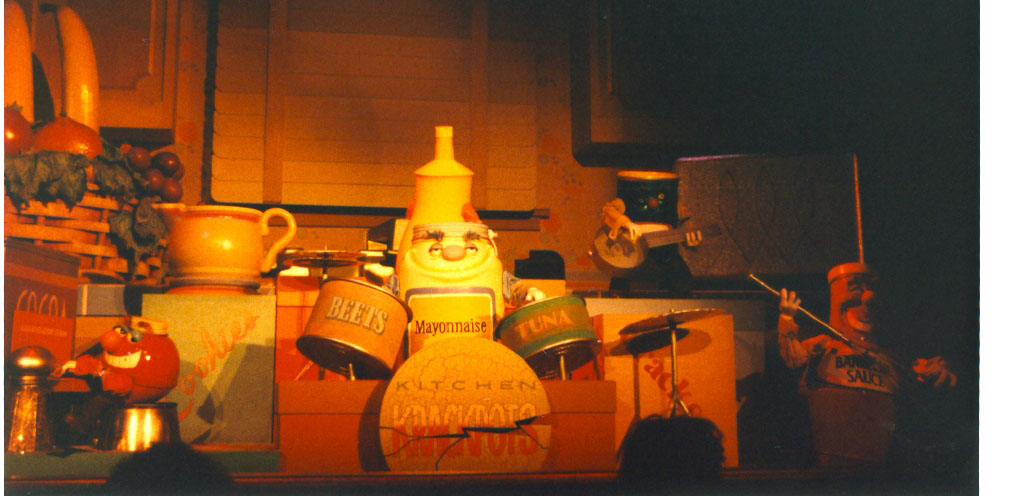
The Kitchen Krackpots band (containers of mayonnaise, Parmesan cheese, a spinning bottle of mustard, etc.) plays a boisterous ragtime intro, as Bonnie reappears, now in showbiz attire, to "Thank you all for coming to (her) kitchen."

Act 2

[edit]

"The Stars of the Milky Way" by Dairy Goods and his Stars of the Milky Way
Mr. Dairy Goods is a singing milk carton who emerges from a refrigerator holding an old-fashioned radio-style floor microphone, crooning introductions to three dairy products: Miss Cheese, Miss Yogurt, and Miss Ice Cream - in the style of 1930s costume extravaganzas. Each of the dairy products performs a brief cameo in a stylized manner (e.g., Miss Cheese sings like Mae West, Miss Yogurt sings like a European sex kitten, and Miss Ice Cream sings like Eartha Kitt). Every time they emerge, ice cold fog pours out of the freezer.

Act 3

[edit]

"Boogie Woogie Bakery Boy" by The Cereal Sisters
The Cereal Sisters—Mairzy Oats, Rennie Rice, and Connie Corn—sing a parody of Boogie Woogie Bugle Boy in the style of The Andrews Sisters, accompanied by a bugle-blowing bread slice.

Act 4

[edit]

"Meat Ditties" by Hamm & Eggz
Hamm & Eggz give a vaudeville-style comic rendition of The Meat Group Can Help You Keep Strong, in which Mr. Hamm and Mr. Eggz tell jokes and sing a few short ditties. At the end, Mr. Hamm gets angry because of Mr. Eggz's corny jokes, and decides to split from the duo to join another protein group.

  • Mr. Hamm: "There's plenty of good protein acts for me to work with!"
  • Mr. Eggz: "Oh yeah? Like who?"
  • Mr. Hamm: "Cheese, cheese is a great source of protein!"
  • Mr. Eggz: "Oh, I cheddar to think about it."
  • Mr. Hamm: "Beans, now there's good..."
  • Mr. Eggz: "Beans! Oh nuts to you, hammy!"
  • Mr. Hamm: "That's right, nuts to me! Another excellent source of protein".

Act 5

[edit]

"Veggie Veggie Fruit Fruit" by the Colander Combo and the Fiesta Fruit
Night sounds, Latin percussion, and low lighting set the mood for this number, as the produce (broccoli, tomatoes, bananas, etc.) begin to chant "Veggie-Veggie-Fruit-Fruit! Veggie-Veggie-Fruit-Fruit!" Bonnie Appetite, now in a Carmen Miranda-style carnival outfit, and perched upon a crescent moon that descends from the ceiling, sings "I simply have to tell you that my friends who are singing are...delectable!"

Finale

[edit]

"Kabaret Finale" by Bonnie Appetite and cast

Bonnie Appetite and the cast sing a medley of each of their songs. All of the cast returns, and Bonnie says good bye, before the curtains with the Kraft logo covers the stage.

Other appearances

[edit]

Disney created merchandise with the Kitchen Kabaret characters, including coloring books, audio tapes / CDs, musical books, postcards and pins of the Veggie Veggie Fruit Fruit group.[2] Even after closing, the Colander Combo and Fiesta Fruit reappeared as characters in the annual Epcot International Food and Wine Festival.[3]

The Astuter Computer Revue and Backstage Magic in CommuniCore featured a guest appearance by Mr. Eggz highlighting how computers controlled audio-animatronic characters.[4] An educational animated short, "Harold and his Amazing Green Plants" used slightly redesigned versions of the Colander Combo to explain how plants grow.

On August 17, 2007, Walt Disney World released a commemorative pin honoring this attraction as part of its White Glove Remember When series. Another White Glove (a part of the Retro Epcot) pin was released on July 1, 2008.

The song Veggie Veggie Fruit Fruit appeared in the spectacular Epcot Forever.

At the 2021 Destination D23 (Disney) event, the characters of Kitchen Kabaret were featured in a panel on the park specific characters at Walt Disney World. The Kitchen Kabaret was then pitted against Food Rocks in the first ever Battle of the Food Bands. In a shocking upset, Food Rocks emerged victorious.[citation needed] A line of exclusive merchandise featuring the Battle of the Food Bands was released at the event, including a shirt, poster, and pin.

See also

[edit]

References

[edit]
[edit]

See also

[edit]
Revisions and contributorsEdit on WikipediaRead on Wikipedia
from Grokipedia
Kitchen Kabaret was a 13-minute audio-animatronic musical show located in The Land pavilion at , a theme park within the [Walt Disney World](/page/Walt Disney World) Resort in , that ran from October 1, 1982, to January 3, 1994. Sponsored by , the attraction used 28 animatronic figures representing food items and utensils to educate visitors on through upbeat songs and performances centered on the four basic food groups—fruits and vegetables, meats, grains and breads, and milk—as recommended by the USDA at the time. Hosted by the elegant animatronic figure Bonnie Appetite, the show opened with her introducing a series of acts that humorously depicted balanced meals, including the condiment band Kitchen Krackpots (featuring , mustard, and ) performing "Chase Those Mealtime Blues Away," the dairy-themed Stars of the (Miss Cheese, Miss Yogurt, and Miss ), and the grain representatives Cereal Sisters (Mairzy Oats, Rennie Rice, and Connie Corn) performing "Boogie Bakery Boy." Other notable segments featured the and dairy duo Hamm n' Eggz, the vegetable group Colander Combo, and the vibrant Fiesta Fruits singing "Veggie Veggie Fruit Fruit," all culminating in a finale emphasizing the importance of a varied diet. As one of Epcot's original opening-day attractions, Kitchen Kabaret blended entertainment with subtle educational messaging in a lighthearted, format that appealed to guests during the park's early years. Its closure in 1994 was prompted by the end of Kraft's sponsorship in 1993 and updates to nutritional guidelines, leading to its replacement by the similar but rock-music-themed show, sponsored by , which itself closed in 2004. Today, the attraction is remembered fondly by Disney enthusiasts for its catchy tunes, clever puns, and role in promoting healthy eating amid Epcot's futuristic focus on innovation and human progress.

History and Development

Conception and Design

Kitchen Kabaret was conceived by in the late 1970s as one of the original attractions for the opening of Center in 1982, specifically within The Land pavilion to align with the park's emphasis on innovative environmental and agricultural themes. The project's core goal was to promote healthy eating habits among visitors, particularly families and children, by blending nutritional with entertaining humor and musical , drawing on the USDA's guidelines at the time. Imagineer Scott Hennesy played a pivotal role in developing the overall concept and scripting the show, including writing the original lyrics for its songs, while composer provided the musical score to create a lively, revue-style format. Central to the design were the anthropomorphic food characters, crafted by Imagineer Steve Kirk, who specialized in whimsical, expressive figures such as singing condiments, dancing products, and animated grains to make abstract nutritional concepts relatable and fun. Kirk's designs emphasized personality and movement, transforming everyday food items into performers that could interact dynamically on stage. The initial scripting structured the show as a of classic musical revues, with segments dedicated to the four basic food groups—, grains, proteins, and fruits/vegetables—to deliver educational messages without feeling didactic. A key innovation in the conception phase was the advancement of technology tailored to food-themed figures, featuring 28 custom-built with specialized moving parts like articulated limbs for dancing, facial expressions for comedic timing, and synchronized lip movements for singing. These technical enhancements allowed the characters to perform fluid, human-like actions, setting Kitchen Kabaret apart as a showcase for Imagineering's evolving capabilities in thematic entertainment that combined education with spectacle.

Sponsorship and Opening

Kitchen Kabaret was sponsored by from its inception, with the company committing to a $35 million, 10-year in 1978 to back the Pavilion at , later known as The Land. This sponsorship integrated Kraft products directly into the show's characters, such as the Kitchen Krackpots band, whose members were designed to resemble condiments like , mustard, and , alongside elements like cheese and in other acts. The arrangement aligned with The Land pavilion's focus on agricultural and nutritional , promoting the four basic food groups through entertaining musical performances. The attraction officially premiered on October 1, 1982, coinciding with Epcot's , as one of the pavilion's flagship shows. Each lasted 13 minutes and featured in a theater setting, drawing crowds with its lighthearted approach to healthy eating. Kraft's involvement continued without significant alterations to the show's format until the sponsorship concluded on September 26, 1993. Upon opening, Kitchen Kabaret was well-received as a family-oriented educational experience, using humor and music to teach in an engaging manner suitable for all ages. It operated daily as a key component of The Land, complementing the pavilion's exhibits on production and .

Operation and Technical Aspects

Kitchen Kabaret employed advanced technology, featuring 28 figures capable of synchronized lip-syncing, expressive facial movements, and coordinated choreography to perform musical routines across the theater's multi-segmented stage setup. These figures, including anthropomorphic items like the trumpet-playing slice of and the bowtie-wiggling , were programmed to interact dynamically during the 13-minute show, enhancing the revue's comedic and educational elements. The technical infrastructure centered on a dedicated theater in the lower level of The Land pavilion, where guests entered a 250-seat for performances. Stage transitions between acts relied on theatrical effects to illuminate different sections, creating the illusion of a lively kitchen , while a high-fidelity sound system delivered the original musical scores and , ensuring clear audio for the synchronized performances. The were controlled via Epcot's centralized computer systems, allowing precise timing for movements and audio cues across the ensemble. Over its 12-year run from to , maintenance involved regular servicing of the animatronic mechanisms and costumes to address wear from continuous operation. The show's content became outdated following the USDA's introduction of the Food Guide Pyramid in 1992, influencing the decision to end operations. The show operated free with admission and included wheelchair-accessible viewing areas in the theater.

Show Format and Elements

Premise and Structure

Kitchen Kabaret was conceived as a revue in which anthropomorphic items and kitchen utensils performed in a cabaret-style setting within a simulated kitchen, promoting the concept of balanced nutrition through entertaining songs and skits. The show's premise centered on these characters collaborating to demonstrate how different food elements contribute to a healthy meal, using humor and performance to engage audiences without direct instruction. The structure of the 13-minute presentation followed a format divided into an introduction, five acts, and a finale, with each act highlighting a specific to progressively build a of constructing a complete, nutritious . This progression began with foundational elements like grains and , moved to proteins, and culminated in fruits and , culminating in a group medley that reinforced the meal's harmony. The hostess, Bonnie Appétit, briefly tied the acts together with welcoming commentary. At its core, Kitchen Kabaret served as an educational primer on the Department of Agriculture's (USDA) four basic food groups— and , and protein, cereals and grains, and fruits and vegetables—introduced in 1956 and prevalent during the show's run from 1982 to 1994. These concepts were conveyed subtly through the revue's songs and comedic routines, encouraging viewers to appreciate dietary balance in an approachable, non-lecturing manner that aligned with the era's nutritional guidelines. The revue drew from and musical theater traditions, employing a lively, variety-show pace with seamless transitions between performances to maintain energy and focus on the thematic message. This format, powered by technology, allowed for dynamic staging that emphasized the interplay among food groups, fostering a sense of performance in the kitchen cabaret environment.

Host and Characters

The central host of Kitchen Kabaret was Bonnie Appetite, an animatronic figure designed as a cheerful woman perched atop a stack of cookbooks titled Food for Thought, dressed in a Broadway-style outfit that evolved into a vibrant Carmen Miranda-inspired ensemble during the performance; she was voiced by Jeannine Brown and served as the perky emcee who introduced each act while reinforcing the show's nutritional messages about balanced meals. The ensemble featured over 20 animatronic figures representing food groups through anthropomorphic designs with exaggerated personalities to make engaging and memorable, with some figures repurposed across acts for . The Kitchen Krackpots were a trio of sassy condiment jars—including , mustard, and a Parmesan-style cheese shaker—outfitted as a Dixieland band using kitchen utensils as instruments, portraying eccentric, wisecracking performers who kicked off the with high energy. Mr. Dairy Goods, a suave milk carton emerging from an upright refrigerator, led the dairy segment with a charismatic, crooning demeanor reminiscent of classic lounge singers, emphasizing the cool, refreshing qualities of products. The Cereal Sisters—Mairzy Oats, Rennie Rice, and Connie Corn—were depicted as harmonious, Andrews Sisters-inspired grain figures perched on a cupboard shelf, exuding poppy, upbeat energy to highlight and . Complementing them was the Boogie Woogie Bakery Boy, an energetic slice of that popped from a to play with rising-star flair. The protein duo Hamm & Eggz consisted of a straight-laced in a smoking pan paired with a playful, bow-tied egg whose tie wiggled during laughs, delivering comedic banter with exasperated and jokester dynamics, respectively; Hamm was voiced by . The Colander Combo featured vegetable figures like a sunglass-wearing , designed as lively band members in colanders to promote veggies with rhythmic enthusiasm. The Fiesta Fruit group included animated bananas, oranges, and grapes as colorful, samba-dancing performers with joyful, harmonious personalities that celebrated fruit's vibrant appeal.

Songs and Musical Style

The soundtrack of Kitchen Kabaret consisted of original songs composed to promote nutritional through entertaining musical numbers. Key tracks included "Chase Those Mealtime Away," performed as an upbeat opener to encourage balanced eating; "Stars of the ," a highlighting dairy products' benefits; "Boogie Woogie Bakery Boy," a lively grain-themed tune; "Meat Ditties," focusing on proteins; "Veggie Veggie Fruit Fruit," a calypso-style piece emphasizing fruits and ; and a finale medley uniting all themes. The music blended styles such as Dixieland, , , , and calypso, often parodying classic hits to create a revue-like atmosphere with upbeat tempos designed to engage audiences of all ages. For instance, "Boogie Woogie Bakery Boy" parodied ' "" to underscore the energy from grains, while the overall 1930s-1940s pastiche evoked a nostalgic, theatrical vibe. The score was composed by Disney veteran , with lyrics by Imagineer Scott Hennessy, and recorded for the attraction's performances as well as the 1982 album The Official Album of [Walt Disney World](/page/Walt Disney World) Epcot Center, utilizing orchestral arrangements to enhance the lively orchestration. Each song reinforced the show's nutritional themes by tying musical elements to the four USDA food groups—dairy for calcium and strength in "Stars of the ," grains for sustained energy in "Boogie Woogie Bakery Boy," proteins for vitality in "Meat Ditties," and fruits/vegetables for vitamins in "Veggie Veggie Fruit Fruit"—promoting the idea of chasing away "mealtime blues" through wholesome choices.

Detailed Acts

Act 1: Introduction and Kitchen Krackpots

The opening act of Kitchen Kabaret begins with hostess Bonnie Appetite appearing on a small side , seated atop stacks of cookbooks titled Food for Thought, where she performs the introductory song "Meal Time Blues." In this number, Bonnie expresses the frustrations of mealtime preparation and the need for nutritious variety, setting the revue's premise as a lively musical promotion of balanced eating from the four basic food groups. This leads seamlessly into the Kitchen Krackpots' performance of "Chase Those Mealtime Blues Away," as Bonnie calls out, "OK Krackpots, let's get cooking!" The three condiment jars—representing , mustard, and —emerge as an anthropomorphic swinging band on a kitchen counter stage, playing instruments made from kitchen utensils like cans for drums and an egg beater for . Sponsored by Kraft products, the band delivers a boisterous tune that humorously emphasizes how condiments enhance flavors without overpowering a , educating audiences on in to support overall nutritional balance. The act's stage mechanics feature a surprise reveal, with the Kitchen Krackpots rising on a platform from a cabinet at the front of the main stage, energizing the audience and transitioning the show's tone from bluesy lament to upbeat enthusiasm. rejoins in a glamorous Broadway-style outfit, quipping, "Thanks gang. That was a real spicy number. Aw, they're such seasoned performers," underscoring the pun-filled humor that ties flavor enhancement to healthy habits.

Act 2: Dairy Group Performance

In Act 2 of Kitchen Kabaret, the Dairy Group Performance commenced with Mr. Dairy Goods, an anthropomorphic singing carton, emerging from a giant door that opened amid a burst of cold, frosty mist. He held a styled like an old-fashioned radio and introduced his backup singers, the Stars of the : Miss Cheese (modeled after ), Miss Yogurt (with a French accent emphasizing her "cultured" nature), and Miss (in the style of ). These characters represented key products and positioned dairy as an essential foundation for balanced meals within the show's educational framework on the four basic food groups. The group then performed the song "The Stars of the ," a harmonious musical number where served as the lead conductor, guiding the trio in their backup vocals and brief solo cameos. The lyrics praised the appeal and nutritional qualities of dairy foods, specifically underscoring the benefits of calcium and protein for building strong bones and teeth, while encouraging audiences to incorporate them into daily diets for overall health. This segment transitioned smoothly from the prior act via a brief cue from hostess Bonnie Appetite, maintaining the show's rhythmic flow. The performance concluded with the refrigerator door closing after the song, symbolizing the "cool" storage of dairy essentials and reinforcing the act's message on proper through engaging, anthropomorphic .

Act 3: Grain Group Routine

The Grain Group routine in Kitchen Kabaret featured the Cereal Sisters—Mairzy Oats, Rennie Rice, and Connie Corn—as animatronic performers representing key grains in a high-energy, bakery-themed musical number. These characters, styled after , delivered "Boogie Woogie Bakery Boy," a parody of the 1941 hit "," with upbeat vocals and synchronized movements to promote the nutritional benefits of grains. The act highlighted grains' contributions to daily energy and through its boogie-woogie rhythm and thematic lyrics, such as references to "rising to a star" after starting as a humble lump, symbolizing transformation and vitality. Accompanying animations depicted and the rising process, with flour-dusted adding to the atmosphere and engaging audiences in the educational message about balanced nutrition. Central to the performance was the giant bread slice character, the Boogie Woogie Bakery Boy, who emerged from a toaster-like stage element playing a trumpet solo and dancing with floppy, exaggerated movements that injected humor into the routine. The Cereal Sisters sang from an elevated cupboard shelf on the kitchen-themed , where cabinet doors opened to frame their entrance, culminating in the bread character sliding back into the toaster as the number ended with comedic flair. This segment followed the Dairy Group's performance, advancing the show's progression through the four basic food groups.

Act 4: Protein Duo Act

The Protein Duo Act, also known as the "Meat Ditties" segment, featured the anthropomorphic characters , a slice of ham, and , a fried egg, as a vaudeville-style pair representing the protein-rich group in the show's nutritional theme. These Audio-Animatronic figures emerged in sizzling pans atop a kitchen oven, engaging in banter and song to highlight protein's role in building strength, aligning with the USDA's four basic food groups promoted throughout the revue. The act opened with Mr. Eggz attempting a humorous rendition of "," only for Mr. Hamm to redirect them to their rehearsed material, setting a tone of playful . They then performed the song "Meat Ditties," with lyrics emphasizing their protein content: Mr. Hamm sang, "As members of the meat group, we would like to sing this song," followed by Mr. Eggz adding, "And cook you up some ditties, as we're singing right along," and both concluding, "The meat group can help you keep strong!" Interspersed were corny jokes, such as Mr. Eggz's pun on Chicken Little's family mishaps or a tale of a fox at the henhouse, prompting Mr. Hamm's exasperated warnings like, "One more joke like that and we'll get ." The routine escalated into comedic conflict when Mr. Eggz quipped, "One more crack out of me and the yolk's on you," leading Mr. Hamm to declare, "That does it, we're through!" before they descended into the oven amid theatrical smoke, symbolizing a "hot" exit. Accompanied by a projected near the kitchen window illustrating protein sources, the segment underscored the duo's message that meats, eggs, and related foods provide essential nutrients for vitality, without delving into specific caloric . This lighthearted portrayal, composed by musicians Scott Hennesy and Norman "Buddy" Baker, contributed to the show's overall 13-minute runtime by blending humor with .

Act 5: Vegetable and Fruit Segments

Act 5 of Kitchen Kabaret shifted the show's focus to the vegetable and fruit groups, presenting them through energetic performances that highlighted their role in a balanced diet. The segment opened with the Colander Combo, a trio of anthropomorphic vegetables including a prominent broccoli character, appearing as a lively band amid tropical percussion and Latin rhythms. This group performed in a style evoking a musical ensemble, contributing to the act's upbeat tone with exclamations like "Cha-cha-cha!" to emphasize the fun and vitality of vegetables. Following the Colander Combo's introduction, the Fiesta Fruit joined in, representing anthropomorphic fruits in a collaborative number titled "Veggie, Veggie, , ." The , performed under low lighting with night sounds and Latin percussion, featured the two groups singing about the irreplaceable nutritional benefits of produce, including vitamins A and C for health and energy. Host Bonnie Appetite participated, dressed in a vibrant, carnival-inspired outfit reminiscent of , adding verses that portrayed and as exciting and essential elements of meals, akin to a festive gathering. Visual effects, such as fiberoptic visible through a kitchen window, enhanced the celebratory mood, underscoring the freshness and appeal of these food groups. The performance served an educational purpose by promoting the inclusion of vegetables and fruits to complete the four basic food groups, stressing variety and balance for optimal without substitutes. Through its rhythmic, dance-infused style, the act reinforced the idea that these nutrient-rich items provide essential vitamins and contribute to healthy, enjoyable eating habits.

Finale: Full Cast Medley

The finale of Kitchen Kabaret, known as the "Kabaret Finale," brought together the entire cast of characters for an ensemble medley that recapped the show's key musical numbers and reinforced its nutritional themes. Led by hostess Bonnie Appetite, who descended onto the in a sparkling gown on a crescent moon before reappearing in her cooking apron, the performance featured all representatives performing in unison on the main stage. The high-energy sequence included reprises of prominent songs such as "Chase Those Mealtime Blues Away" from the Kitchen Krackpots, "Stars of the " from the dairy group, " Bakery Boy" for grains, "Meat Ditties" from the proteins, and "Veggie Veggie " for vegetables and , with each character contributing lines in their distinctive styles to highlight balanced eating. accompanied the number, including smoking pans for the protein characters Hamm and Eggz, and visible through a , symbolizing the vibrant culmination of a complete, healthy . As the medley progressed, the emphasized variety across the four food groups, singing lyrics like "The proper foods each time you dine, can keep you fit and feeling fine" to deliver the show's core message on maintaining through nutritious choices. The approximately 2-3 minute segment built to a climactic close with Bonnie's farewell, urging audiences to adopt good eating habits to "chase those away," followed by cues and fading lights as the curtains drew, transitioning guests out of the theater.

Closure and Legacy

Replacement by Food Rocks

The final performance of Kitchen Kabaret occurred on January 3, 1994, marking the end of its 12-year run since the opening of Epcot's The Land pavilion. The closure stemmed primarily from the termination of ' sponsorship in 1993, and the show's increasingly outdated content, including its reliance on the four basic food groups model that had been replaced by the USDA's food pyramid in 1992. Nestlé, which assumed sponsorship of The Land pavilion starting January 1, 1993, initiated a comprehensive refurbishment to modernize the attraction. Kitchen Kabaret was replaced by , a new audio-animatronic that debuted on March 26, 1994, shifting the educational focus on nutrition to parodies of rock and pop songs while preserving the pavilion's overall theme. The transition involved retaining select , such as the milk carton figure Mr. Dairy Goods, who was repurposed in the new show. Stage modifications included redesigning the set for a vibrant, abstract aesthetic with large lighting fixtures evoking an concert vibe to support the rock-themed performances, alongside the removal of characters like the condiment duo ( and mustard) from the original Protein act. The immediate aftermath saw expressions of from longtime fans, who cherished the show's whimsical, educational charm as a hallmark of 's inaugural era.

Merchandise and Collectibles

During its run from 1982 to 1994, Kitchen Kabaret inspired a range of official merchandise produced by and sponsor Kraft, including audio cassette tapes featuring the show's songs as part of broader compilations. The 1990 cassette release of The Official Album of Disneyland and included a "Kitchen Kabaret Medley" track with selections like "Boogie Woogie Bakery Boy" and "Veggie Veggie Fruit Fruit," capturing the musical performances of animatronic characters such as the Kitchen Krackpots. These tapes were distributed through parks and retail outlets, providing visitors a way to relive the nutritional at home. Plush toys of select characters, such as Mr. Pineapple from the fruit segment, were also available as official souvenirs in the 1980s, often sold at 's gift shops within The Land pavilion. These 8-inch stuffed figures, produced by Productions, depicted the anthropomorphic produce with fabric details mimicking the show's colorful designs. Collectible pins commemorating the show emerged in later years, with releasing limited-edition items through its pin trading program. In 2007, the White Glove Series "Remember When" collection offered a limited edition of 750 pins featuring the Kitchen Kabaret logo and The Land pavilion imagery, sold exclusively at . The following year, 2008 pins highlighted individual acts, including Mr. Orange from the vegetable routine and a design, packaged on cards as part of the Food Rocks/Kitchen Kabaret series and available at merchandise locations. In the post-closure era, Disney has continued to offer nostalgic items evoking the show, such as the Vinylmation Park 7 set—a limited edition of 2,000 featuring six 3-inch vinyl figures inspired by characters like the Dairy Goods and Combo. More recently, a limited-edition series included Kitchen Kabaret artwork alongside other attractions, available through ShopDisney. A matted art print reproducing the show's promotional imagery was sold at the for $39.99, limited to 10 per customer. On resale markets like , rare Kitchen Kabaret items have appreciated in value; for instance, vintage plush toys and official cassette albums from compilations often list for $50 or more, driven by collector demand for extinct attraction memorabilia.

Reappearances and Cultural Impact

Following its closure in 1994, select elements from Kitchen Kabaret found new uses within attractions and related media productions. Mr. Eggz made guest appearances in the Astuter Computer Revue (1982–1984) and its successor, Backstage Magic (1984–1993), both presented in East, where he demonstrated how centralized computers programmed and controlled audio-animatronic figures. In the mid-1980s, slightly redesigned versions of the Combo appeared in the educational animated short Harold and His Amazing Green Plants (1984), produced for Educational Media to teach children about , , and plant growth through a story of a botanist and his "pet seed." Kitchen Kabaret's innovative use of to deliver nutritional education in a musical format directly influenced its successor show, (1994–2004), which retained the core concept of food-themed characters promoting healthy eating but updated it with rock, pop, and rap styles aligned to the 1992 Food Guide Pyramid. The attraction's legacy endures through nostalgia in Disney history retrospectives, where it is celebrated as a quintessential example of Center's original blend of entertainment and edutainment, often highlighted in fan discussions and anniversary features for its catchy songs and whimsical characters.

References

Add your contribution
Related Hubs
User Avatar
No comments yet.