Hubbry Logo
La CastellaneLa CastellaneMain
Open search
La Castellane
Community hub
La Castellane
logo
8 pages, 0 posts
0 subscribers
Be the first to start a discussion here.
La Castellane
La Castellane
from Wikipedia

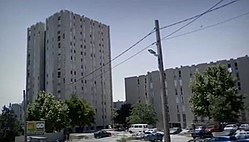
La Castellane is a neighbourhood in the 16th arrondissement of Marseille, France. Built as a Modernist council estate in the 1960s for French refugees of the Algerian War of 1954–1962, it is now home to about 7,000 residents, many of whom are second-generation French citizens. The neighbourhood is plagued by unemployment, drug trafficking, prostitution, and arms smuggling. It is also known for being the neighbourhood where the footballer Zinedine Zidane grew up.[1]

Key Information

Location

[edit]

La Castellane is located in the Verduron district in the northwestern edge of Marseille,[2] the second largest city in France after its capital Paris.[3] It is just off the A55 autoroute.[4]

History

[edit]

The neighbourhood was built on the grounds of the ancient marquisate of Foresta.[2] The idea of building tall, modern buildings was first broached in 1955.[2] They were designed by architect Pierre Meillassoux, who was inspired by master architect Xavier Arsène-Henry and, to a certain extent, Oscar Niemeyer.[2] The housing complex, completed in the 1960s, consists of eleven buildings containing 1,249 apartments.[2] As of 2015, the buildings are said to be run-down.[5]

The neighbourhood first served as a council estate for refugees of the Algerian War of 1954–1962, as a result of the loss of French Algeria during the presidency of General Charles de Gaulle.[2] Shortly after, immigrants from Morocco moved to La Castellane, followed by others from Sub-Saharan Africa and the Caribbeans.[2] It is now home to about 7,000 residents, many of whom are second-generation French citizens.[3][6][5] For example, it is the hometown of football player Zinedine Zidane, whose parents were born in Algeria.[6][5] Lamine Gassama, another football player who grew up in La Castellane, was born to parents from Senegal.[7] As in many other underserved French banlieues, young people from La Castellane are "condemned to excellence" to achieve success and recognition in mainstream society, often through football.[8]

In the first round of the 2017 presidential election, the 15th arrondissement voted 27% for Marine Le Pen, the Front National candidate.[9] This support for far right political organizations in the neighborhoods nearby La Castellane reflects the tensions between ethnically European and immigrant populations living in Marseille and throughout France.[10] Part of a national phenomenon, the lack of integration of immigrants into mainstream French society has led to many living in La Castellane to not identify themselves as French.[6] The social divisions between banlieues like La Castellane and mainstream France are also clear from anti-immigrant rhetoric in local and national politics, which purports that people from the banlieues are not truly French.[11]

The neighbourhood is plagued by unemployment, drug trafficking, prostitution and arms smuggling.[3][12] There are three drug-trafficking networks: "place du Mérou", "Tour K", and "La Jougardelle".[13] French newspapers have suggested the neighbourhood is known as a "supermarket" for illegal drugs.[13]

In June 2013, French police took down a drug-trafficking syndicate, including 1.3 million euros in cash split between several smugglers, weapons and drugs.[5] In December 2014, a state school was burnt down in La Castellane.[14] A month later, in January 2015, a young man was gunned down, as was another young man in 2011.[5]

On 9 February 2015, shortly after gunfire at a police car during the 2015 Marseille shooting,[15] the National Gendarmerie Intervention Group seized seven Kalashnikov rifles, two .357 Magnum revolvers and around 20 kilograms of drugs;[3][5][16] however, the gunmen were not aiming at the police; instead, it was the result of a turf war between two gangs,[17] selling primarily cannabis and cocaine.[12] Drug-traffickers as a whole in La Castellane were reported in 2015 to make between 50,000 and 60,000 euros a day.[5] Shortly after the February incident, French Prime Minister Manuel Valls, who was visiting Marseille, called it an example of "apartheid", whereby French citizens who live in such neighbourhoods feel excluded from society.[3]

On June 15, 2015, French police arrested 33 suspected drug traffickers, including Socialist Senator Samia Ghali's chauffeur, as well as weapons and several kilograms of cannabis.[13] Bernard Cazeneuve, the French Interior Minister, suggested drug-trafficking was used to fund terrorism on French soil, and reiterated his commitment to restore order.[13]

In April 2016, some buildings were scheduled to be demolished in an effort to put an end to drug-trafficking.[18]

References

[edit]
Revisions and contributorsEdit on WikipediaRead on Wikipedia
from Grokipedia

La Castellane is a large-scale social constructed between 1969 and 1971 on the northern hillsides of , , spanning the 15th and 16th arrondissements. Designed as a modernist complex to accommodate post-colonial repatriates and growing urban populations, it consists of high-rise towers and barres amid a compact 33-hectare area, offering panoramic views of the city and bay. Home to approximately 6,500 residents as of recent estimates, the neighborhood exhibits stark socioeconomic disparities, with a rate of 61 percent, an rate of 20.1 percent, and over half the adult population lacking any diploma. Immigrants comprise 30.2 percent of inhabitants, alongside 19.2 percent foreigners, reflecting concentrations of North African-origin families amid broader integration failures. Designated a quartier prioritaire under 's urban policy framework, La Castellane exemplifies dysfunctions, including entrenched trafficking operations that generate substantial illicit revenues through controlled street-level sales points and armed lookouts. Ongoing initiatives, such as tower reductions and infrastructure upgrades, aim to mitigate decay but face persistent challenges from gang violence and .

Geography and Layout

Location and Urban Design

La Castellane occupies the northwestern outskirts of , positioned astride the boundary between the 15th and 16th arrondissements. This location situates the neighborhood roughly 9 kilometers northwest of the city center's Vieux-Port district, proximate to industrial facilities and key transport arteries including the A7 autoroute. The terrain features a mix of built-up residential zones and peripheral undeveloped land, underscoring its peripheral status relative to 's denser core. As a classic French grand ensemble development, La Castellane's urban form consists of clustered tower blocks and linear bar buildings designed for high-density habitation. These structures, emblematic of mid-20th-century modernist planning, enclose a series of internal courtyards and pathways that prioritize vehicular access over pedestrian connectivity. The site's compact scale, encompassing over 50 hectares, supports a concentrated population while limiting expansive open areas, a hallmark of such projects intended to rapidly address shortages. The design's emphasis on has inadvertently amplified social and spatial isolation. Minimal integration with adjacent districts stems from sparse green buffers, restricted inter-neighborhood links, and historically inadequate public transit , with reliance on infrequent bus lines rather than until forthcoming extensions. This configuration fosters a semi-autarkic cité environment, where internal circulation dominates and external engagement is constrained by physical barriers like highways and topographical divides. Such features, rooted in functionalist principles, have perpetuated a sense of detachment from 's broader urban fabric.

Physical Infrastructure

La Castellane includes essential community facilities such as multiple schools, a , sports infrastructure comprising a , gymnasium, and , as well as a commercial center for shopping needs. These amenities support daily resident activities but are hampered by persistent maintenance challenges reflecting long-term underinvestment. A notable example of decay is observed at École La Castellane, where corridors flood into makeshift showers during rainstorms due to faulty , and entrance gates warp to the point of inoperability. Such issues extend to broader problems like unreliable electrical systems and inadequate , as addressed in initiatives under the Nouveau Programme National de Renouvellement Urbain (NPNRU), which targeted La Castellane as a priority neighborhood since its designation in 2014. Access to modern services remains constrained, with limited high-speed coverage contributing to higher isolation indices in French priority urban areas like La Castellane, per national studies on digital divides. Healthcare facilities are similarly scarce locally, exacerbating reliance on distant services and underscoring the neighborhood's infrastructural isolation relative to central .

Historical Development

Origins and Construction

La Castellane was developed as a grand ensemble, or large-scale project, between 1969 and 1971 in Marseille's 16th , responding to acute housing shortages exacerbated by postwar and the repatriation of approximately one million French citizens from following its in 1962. The initiative aligned with France's national policy of grands ensembles, which sought to construct affordable, high-volume accommodations rapidly to house urban migrants and returning colonists, known as pieds-noirs, amid broader pressures. Architecturally, the neighborhood featured prefabricated concrete towers and low-rise slabs adhering to modernist tenets of functionalism and , planned for around 7,000 inhabitants on peripheral land to maximize while minimizing costs. This design emphasized vertical expansion and standardized units over pedestrian-oriented layouts or shared amenities, reflecting state priorities for quantitative output in the face of a housing backlog estimated at over 300,000 units nationwide by the late . Early occupancy drew primarily from French internal migrants from rural regions and Algerian repatriates, filling the voids left by wartime destruction and demographic surges. The construction's causal structure—isolated megastructures with limited green spaces or mixed-use integration—prompted initial observations of social fragmentation, as residents experienced diminished compared to traditional urban fabrics, a pattern documented in contemporaneous evaluations of similar projects. These features, driven by bureaucratic imperatives for speed and scale rather than organic community evolution, laid foundational conditions for the neighborhood's subsequent challenges, though initial like schools and basic services was provisioned to support the influx.

Post-Colonial Settlement Patterns

Following the 1962 Évian Accords that concluded the Algerian War of Independence on March 18, 1962, migration from Algeria to France persisted despite the return of approximately 900,000 European settlers (pieds-noirs), as the accords initially enabled free circulation between the two countries. This framework, later regulated by the December 27, 1968, Franco-Algerian agreement, permitted Algerians to enter France for work and extended stays, addressing labor shortages in industries like construction and manufacturing. Similar bilateral arrangements with Morocco facilitated Moroccan worker inflows, with both nationalities responding to France's economic demands post-World War II. La Castellane, developed as a modernist social housing estate between 1969 and 1971 in Marseille's 16th , became a primary destination for these migrants due to its location and availability of affordable units in the city's expanding northern periphery. From the 1970s onward, provisions—allowing established workers to sponsor dependents—drove a marked increase in Algerian and Moroccan family arrivals, particularly from rural areas like in , amplifying settlement through kinship ties and economic opportunities in Marseille's port-related sectors. Chain migration further entrenched these patterns, as initial pioneers facilitated the arrival of extended networks, prioritizing familial and regional affiliations over assimilation into broader French society. By the 1990s, these dynamics had solidified La Castellane as an , with North African-origin residents comprising the predominant demographic, consistent with INSEE observations of high immigrant concentrations (over 40% foreign-born in overall, elevated in northern districts) from and . This settlement model, rooted in post-colonial labor policies rather than random dispersion, fostered self-sustaining communities reliant on internal social structures, as evidenced by the sustained growth of Maghrebi populations amid national trends that saw Algerian numbers in rise to over 600,000 by 1975.

Demographics and Social Composition

Population Statistics

La Castellane La Bricarde, the core quartier prioritaire encompassing the neighborhood, recorded a municipal population of 6,535 inhabitants based on 2020 hexagon and 2021 overseas estimates. This figure reflects a compact urban spanning 33 s, resulting in a of approximately 198 inhabitants per hectare. The demographic profile features a pronounced youth skew, with 25.4% of residents aged 0-14 and 19.1% aged 15-24, totaling over 44% under 25 years old. This structure contributes to elevated dependency ratios—roughly twice the French national average of around 60%—due to the high proportion of non-working-age relative to the 39.4% in the 25-59 working-age bracket and limited elderly population (16.2% aged 60 and over). Population trends indicate stagnation or modest decline since the early , as evidenced by broader quartier prioritaire data showing a drop from 10,040 residents in 2013 to 9,109 in 2018 across the extended La Castellane La Bricarde Plan D'Aou Saint Antoine zone. This shift accompanies a significant immigrant component, with 30.2% of the population classified as immigrants (born abroad) and 19.2% as foreign nationals, per 2021 breakdowns.

Ethnic and Cultural Makeup

La Castellane's ethnic composition is dominated by residents of Maghrebi origin, primarily Algerian (including Kabyle subgroups) and Moroccan, who became the majority following large-scale from the 1970s onward. Ethnographic studies document an initial mix of European immigrants (Italian, Spanish, ) in the late 1960s, supplanted by North African arrivals that reshaped the demographic profile into a predominantly Maghrebi one. Smaller communities include Comorians, evidenced by dedicated local associations like the Association de l'Unité des Comoriens Résidants à la Castellane, alongside groups from , , , and , resulting in a reported diversity of 21 nationalities. Cultural life centers on Islamic practices, with mosques such as the Mosquée de La Castellane providing spaces for prayer, study, and language education for children and adults. structures tied to ethnic networks foster community cohesion, often aligned with ancestral villages or regions, as seen in Kabyle or Comorian groupings. Home environments commonly feature or Berber dialects alongside French, reflecting persistent linguistic ties to countries of origin. Spatial ethnic clustering—such as Comorians along certain boulevards or Kabyles on specific streets—signals parallel social structures, with limited intermingling beyond schooling. While youth report some mixing through , ethnographic observations highlight segregated life events (e.g., marriages, funerals) that reinforce ethnic boundaries, contributing to indicators of incomplete assimilation in government-recognized priority neighborhoods.

Socioeconomic Profile

La Castellane faces entrenched socioeconomic deprivation, characterized by unemployment rates nearing 40% overall, far exceeding the municipal average of 14% for individuals aged 15-64 as recorded in 2022 by INSEE-derived data. exacerbates this, reaching approximately 54% among those under 25 as of 2015 assessments, reflecting persistent barriers to labor market entry despite national trends of stabilization. Female employment rates lag further at around 24%, compared to 52% citywide, underscoring gender disparities in access to stable work. Welfare dependency remains acute, with over 50% of households reliant on social prestations including the , driven by low activity rates and precarious job conditions where one-third of positions are part-time. Nearly all residences consist of social housing, with occupancy rates approaching 100% in these collective units built predominantly in the 1970s, limiting through concentrated public resource allocation. Educational outcomes contribute to this cycle, with roughly two-thirds of residents aged 15 and older lacking a qualification, a figure markedly higher than Marseille's baseline and linked to elevated school dropout risks in the area. Only about 12% of women hold diplomas at BAC+2 level or above, per recent quartier prioritaire diagnostics, hindering qualification for skilled employment and perpetuating intergenerational low attainment. These indicators point to structural underinvestment in rather than transient factors, as evidenced by sustained gaps relative to regional benchmarks.

Notable Residents and Achievements

Zinedine Zidane's Upbringing

Zinedine Zidane was born on June 23, 1972, in Marseille to Algerian Kabyle immigrants Smaïl and Malika Zidane, who had settled in France during the 1960s. The family resided in La Castellane, a housing project characterized by high unemployment, crime, and modest living conditions typical of post-colonial immigrant communities in France's southern suburbs. From age five, Zidane developed his football skills through informal street games in the neighborhood, honing dribbling and control amid limited formal resources. At age 14, Zidane was spotted by scouts during a training camp, leading to his integration into the club's youth system. He signed his first professional contract with Cannes and made his senior debut on May 20, 1989, at age 16, in a Division 1 match against . Zidane has attributed his discipline and ascent to familial emphasis on perseverance, noting his father's lesson that immigrants must "work twice as hard as anybody else" and never give up, rather than relying on communal structures. Zidane's trajectory exemplifies individual agency overcoming environmental hurdles, as he emerged from a setting where aspirations for were common but realizations rare; football programs yield disproportionate elite talents for yet filter severely, with Zidane as an outlier amid thousands of peers. Post-retirement, he has supported local initiatives like funding the Association des Jeunes de la Nouvelle Vague football club in La Castellane to nurture skills, though such interventions underscore the exceptional nature of his own path.

Other Figures and Local Success Stories

Rapper Graya, born in 1994 in La Castellane, has built a career documenting neighborhood life through releases like the track "La Castellane 6" (2025), featuring collaborations with fellow local artists So La Zone and La Crapule. Similarly, So La Zone, originating from the same quartier, debuted his first album La Rue en Personne on January 19, 2024, emphasizing authentic street narratives from Marseille's northern suburbs. Emerging emcee also hails from La Castellane, contributing to the area's rap output with independent tracks since around 2020. These musical successes underscore rare upward trajectories in a context of limited mobility; in , only 9.7% of children from the bottom income quintile reach the top quintile, with persistence rates around 50% and even lower outcomes in Mediterranean coastal regions like 's segregated banlieues. Northern exhibits near 40%, double the national average, constraining broader exits via or traditional employment. Community sports programs continue to yield minor league football talents from La Castellane, fostering skills amid high local poverty rates exceeding 30% in tax households. However, scalability remains constrained, with most participants not advancing professionally, per reports on persistent structural barriers in such cités. Nearby influences, like footballer Samir Nasri's rise from adjacent Marseille suburbs such as Septèmes-les-Vallons, illustrate potential regional pathways through youth academies.

Crime and Security Challenges

Drug Trafficking Operations

Drug trafficking operations in La Castellane have centered on networks controlling fixed points of sale, known locally as points de deal, primarily for and , with local high-rise towers serving as fortified distribution hubs. These operations rely on narcotics imported through the nearby port, Europe's third-largest container facility, where shipments from and are offloaded and routed inland via compartmentalized logistics involving local couriers and storage in residential blocks. Judicial investigations have documented the use of Tower K and similar structures for packaging and retail distribution, with armed lookouts enforcing territorial control over sales territories. A prominent example emerged from a 2015 trial in , where 28 individuals were convicted for running a trafficking ring based in La Castellane's Tower K, generating an estimated €80,000 in daily revenue through organized sales points. The network, led by figures like Achouri, imported bulk via maritime routes and distributed it across the neighborhood, with convictions ranging from 12 months to eight years based on roles in and . Prosecutors highlighted the operation's scale, involving systematic resale from tower bases to street-level dealers, underscoring the mechanics of from import to retail. Since the mid-2010s, networks such as the have dominated La Castellane's trade, expanding from to importation and sales, with operations leveraging the port's volume of over 80 million tons annually for concealment in legitimate cargo. French judicial probes into activities describe a structured enterprise handling multi-ton shipments, processed in neighborhood facilities before dispersal through points de deal yielding high-volume, low-margin retail. While exact annual turnovers vary by probe, intercepted operations reveal multimillion-euro flows, with the group's model emphasizing rapid turnover and local monopoly over sales points.

Violence and Gang Dynamics

La Castellane has been a focal point for inter-gang rivalries in Marseille, primarily involving the DZ Mafia clan, which originated in the neighborhood, against competing groups such as the gang operating in adjacent northern cités like La Busserine and Les Trois Cités. These conflicts, driven by territorial control over drug distribution points, escalated in the and continued into the , contributing to over 20 homicides linked to such disputes according to prosecutorial assessments of drug-related violence in the area. loyalties, rooted in networks often tracing to North African or Comorian origins, prioritize obligations over ideological motivations, fostering recruitment cycles that perpetuate violence through retaliatory cycles. Recruitment into these gangs predominantly targets youth aged 15-25, leveraging familial ties to embed members within clan structures from an early age, with hitmen often minors radicalized through proximity to dealing operations rather than formal indoctrination. This dynamic sustains gang resilience amid arrests, as family-based allegiance ensures operational continuity. Arms procurement exacerbates lethality, with weapons including AK rifles and grenades smuggled via routes from the Western Balkans into France, as documented in Europol-coordinated operations dismantling trafficking networks supplying urban gangs. Prior to intensified policing in the early 2020s, La Castellane functioned as a no-go zone for , where police patrols were infrequent and reactive due to ambush risks, enabling unchecked dominance. Resident perceptions of insecurity were markedly elevated, with local accounts reflecting fear levels substantially exceeding Marseille's urban average, compounded by weak state authority that allowed arbitration to supplant formal . This environment of diminished state presence causally reinforced clan-centric power structures, as gangs filled governance voids through intimidation and localized control.

Police Interventions and Operations

Police have conducted multiple large-scale raids in La Castellane targeting drug networks, often involving significant seizures of cash and narcotics. In 2013, a raid uncovered over €1.3 million in cash linked to a major drug operation on the estate. In June 2015, authorities arrested more than 20 individuals during a coordinated operation against drug gangs in the neighborhood. Similarly, a 2018 raid resulted in eight arrests and the dismantling of a key ring operating from the Castellane housing estate. These interventions have frequently deployed elite units, such as the national intervention group, alongside local forces to secure high-risk areas and apprehend suspects. A notable controversy arose in 2025 from a failed by the Anti-Narcotics Office targeting Mohamed Djeha, known as "Mimo," a prominent trafficker associated with La Castellane networks. Officers attempted to entrap him using 360 kilograms of , but the plan collapsed amid procedural errors and loss of accountability for the drugs, valued at around €10 million. Internal reviews implicated at least five officers, highlighting operational lapses in handling evidence during the attempted buy-bust. Allegations of have undermined trust in local policing efforts, with probes uncovering bribe-taking tied to traffickers. In 2012, twelve members of Marseille's anti-crime squad (BAC) were arrested on charges including and , with of favors exchanged for overlooking activities in high-trafficking zones like those near La Castellane. Prosecutors described the unit as "deeply ," leading to its temporary closure and broader internal affairs investigations into systemic vulnerabilities exploited by . These cases illustrate challenges in maintaining integrity amid intense pressure from entrenched trafficking operations.

Government Policies and Interventions

Urban Renewal Efforts

In the 2000s and 2010s, La Castellane participated in France's National Urban Renewal Program (PNRU) and its successor, the New National Urban Renewal Program (NPNRU), which allocated over €1 billion across Marseille's northern priority neighborhoods for upgrades, rehabilitation, and public facility enhancements, including community centers and green spaces. These initiatives aimed to deconcentrate and improve living conditions through targeted renovations, such as residential densification and better urban connectivity. Despite these investments, outcome metrics reveal constrained effectiveness; unemployment in the La Castellane-La Bricarde quarter stood at 20.1% as of , far exceeding the national rate of approximately 7.4%, indicating that physical improvements did not substantially alleviate structural joblessness. Vocational training efforts, facilitated by entities like Pôle Emploi and local partnerships, have supplemented these programs but yielded limited long-term insertion, as evidenced by sustained high idleness rates amid broader evaluations of urban renewal's socioeconomic shortcomings in similar banlieues. A key component involved demolishing select towers to reduce vertical segregation, exemplified by the 2019 deconstruction of Tour K—a 91-unit structure symbolizing entrenched issues—which required relocating about 70 families via individualized housing placements. While relocation processes emphasized resident accompaniment, persistent neighborhood challenges suggest incomplete resolution of underlying integration barriers.

Recent Anti-Crime Initiatives

In March 2024, French President initiated an "unprecedented" nationwide anti-drug operation with a focal deployment of around 4,000 police officers in , targeting high-trafficking neighborhoods including La Castellane during his unannounced visit there. The effort yielded initial arrests exceeding 100 suspects in Marseille's early phases, alongside drug seizures contributing to broader French totals of over 1,300 detentions and 22 kilograms of narcotics within days. The intensified policing in La Castellane produced short-term disruptions to local trafficking, with residents reporting a temporary sense of amid the heavy officer presence that persisted into April 2024, though many expressed over its due to potential resident fatigue from constant scrutiny and risks of rapid once forces scaled back. By 2025, operations extended amid ongoing trafficking challenges, exemplified by the January extradition from of Félix Bingui, alleged leader of the gang tied to networks, and a May anti-narcotics sting attempt involving 360 kilograms of targeting a major trafficker, despite operational setbacks. These actions underscored persistent enforcement but highlighted empirical limits, as violence and dealer resilience persisted without verified long-term declines in La Castellane-specific metrics.

Broader Impacts and Debates

Cultural Representations

La Castellane features prominently in international documentaries portraying its association with drug trafficking and gang activity, such as the 2012 episode of : Extreme World focused on , where the presenter entered the neighborhood against police advice to document its dangers and youth involvement in narcotics. Subsequent segments in the series examined local drug operations and police raids in the area, emphasizing its isolation and control by criminal networks. These depictions often highlight the "no-go" status for outsiders, balancing raw footage of daily risks with interviews revealing community resilience amid economic hardship. French films inspired by northern Marseille cités, including La Castellane, depict heightened crime and law enforcement struggles, as in The Stronghold (2020), which follows a police unit navigating in these districts where offense rates exceed national averages. Such narratives underscore the of the cité as a microcosm of urban marginalization, exporting images of fortified estates and intra-gang conflicts to broader audiences, though they risk simplifying complex social dynamics into thriller tropes. Marseille's rap scene, rooted in banlieues like La Castellane, frequently represents "hustle" culture through lyrics on street , survival, and defiance, with artists like Jul blending gangsterism references with ironic or everyday vignettes from local life. This music has shaped French urban narratives by popularizing the cité as a site of raw authenticity and multi-ethnic vitality, influencing soundtracks and cultural discourse on immigrant-descended youth. However, while glorifying individual agency in illicit economies, it often juxtaposes bravado with critiques of exclusion, countering pure romanticization by alluding to entrapment in cycles of poverty and rivalry. Biographies and documentaries of , who grew up in La Castellane, romanticize the neighborhood's streets as the origin of his football prowess, portraying impromptu games amid adversity as key to his ascent from cité kid to global icon. Works like his official emphasize this rags-to-riches arc, crediting the area's toughness for instilling discipline and skill, yet such accounts may idealize limited opportunities while downplaying contemporaneous prevalence. Local media coverage, including reports on the 2015 trial of a major drug network tied to La Castellane, has periodically intensified focus on routine existence and judicial proceedings, offering grounded perspectives on community tensions without the dramatization of formats. These spikes, often during high-profile cases, reveal media's role in amplifying the cité's visibility while prompting debates on whether portrayals perpetuate stigma or foster understanding of structural factors.

Integration and Policy Critiques

Critiques of integration policies in La Castellane highlight persistent socio-economic isolation despite substantial public investments exceeding 40 billion euros in French initiatives since the 1980s, with annual state expenditures reaching around 10 billion euros by 2020, yielding limited assimilation outcomes. Analysts attribute this to policy emphases on over cultural and linguistic assimilation, fostering enclaves where over 50% of households rely heavily on social benefits, correlating with rates of 20.1% as of 2021—more than double the national average. Left-leaning perspectives often frame these challenges as stemming from systemic and inadequate anti-poverty measures, arguing that exclusionary labor markets perpetuate dependency. In contrast, right-leaning critiques emphasize failed , pointing to cultural manifested in community withdrawal and parallel dispute resolutions influenced by tribal or communal norms, which undermine republican unity. Evidence includes low proficiency among immigrants, with national data showing 29% arriving with no comprehension skills, exacerbating employability gaps in linguistically demanding sectors. Think-tank analyses, such as those from Institut Montaigne, link these barriers to unselective policies and lax enforcement of assimilation requirements, arguing that welfare incentives—sustaining over half of local allocataires—erode and entrench parallel societies rather than promoting . Despite billions allocated, outcomes reveal causal persistence of ethnic enclaves, with Marseille's northern districts like La Castellane exemplifying fragmentation where socio-spatial segregation hinders broader societal integration. Reforms advocated include stricter language mandates and reduced benefit traps to prioritize causal drivers of assimilation over symptomatic spending.

References

Add your contribution
Related Hubs
User Avatar
No comments yet.