


Community hub
Recent from talks
Contribute something
Nothing was collected or created yet.
Charter of 1814
View on Wikipedia | This article includes a list of general references, but it lacks sufficient corresponding inline citations. (June 2022) |
| Charter of 1814 | |
|---|---|
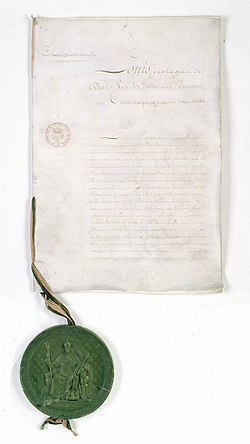
 Charter of 1814. | |
| Original title | (in French) Charte constitutionnelle du 4 juin 1814 |
The French Charter of 1814 was a constitutional text granted by King Louis XVIII shortly after the Bourbon Restoration, in the form of a royal charter. The Congress of Vienna demanded that Louis bring in a constitution of some form before he was restored. After refusing the proposed constitution, the Constitution sénatoriale, set forth on 6 April 1814 by the provisional government and the Sénat conservateur ("Conservative Senate"), Louis Stanislas Xavier, count of Provence, bestowed a different constitutional Charter, on 4 June 1814. With the Congress of Vienna's demands met, the count of Provence was officially named Louis XVIII, and the monarchy was restored.
The Charter presents itself as a text of compromise, possibly of forgiveness, preserving the numerous acquisitions from the French Revolution and the Empire, whilst restoring the dynasty of the Bourbons. Its title as ‘constitutional Charter’ acts as evidence of compromise, the term ‘charter’ as reference to the Ancien Régime (“old rule”) and ‘constitutional’ indicates revolutionary intent. However, the Charter establishes a limited monarchy, as opposed to a constitutional monarchy, implementing a regime dominated by the King himself, declaring him as Head of State.
Nature of the charter
[edit]
A charter is a document defining the responsibilities of actors of the French state (the king and the two chambers).
In his Souvenirs de 1814, Louis-Philippe claimed that Louis XVIII did not conceive the charter as a new fundamental law of the French Kingdom – for those were still in place and could not be changed – but rather as a document stating the replacement of the Estates General and Parliaments by two Chambers, and defining the new responsibilities of these two Chambers.
Drafting committee
[edit]On 18 May 1814, Louis XVIII created a drafting committee, nominating its twenty- two members. Wary of Talleyrand he decided not to include him, even though the latter played a key role during the constitution of 6 April.
In this commission, chaired by the chancellor Dambray, there were:
- Three royal commissioners: Montesquiou, Ferrand and Beugnot;
- Nine senators: Barbé-Marbois, Barthélemy, Boissy d’Anglas, Fontanes, Garnier, Pastoret, Huguet de Sémonville, Sérurier and Vimar;
- Nine members of the "Corps législatif": Blanquart de Bailleul, Chauvin de Bois-Savary, Chabaud-Latour, Clausel de Coussergues, Duchesnes de Gillevoisin, Faget de Baure, Faulcon, Lainé and Perrée-Duhamel.
On 22 May, the commission held its first meeting at Dambray's which lasted for six days. On 26 May, the commission offered its draft to the private counsel which approved it.
Public law of the French
[edit]The opening twelve articles of the Charter are analogous to a "Bill of Rights". They contained such measures as a declaration of equality before the law, due process rights, religious toleration, freedom of the press, protection of private property, and abolition of conscription. These principles, together with the retention of the Napoleonic Code, represent some of the permanent gains of the French Revolution.
Nevertheless, the concept of the judicial review of the constitutionality of legislation was undeveloped, and it was the responsibility of the legislature, not the courts, to defend these rights.[1][page needed] Freedom of the press, in particular, was subsequently restricted by harsh press censorship laws, which were deemed to violate the spirit of the charter.[2][page needed]
Moreover, religious toleration was limited by the special provision made for the Catholic Church as the official state religion.
Contents of the Charter
[edit],_G.34279.jpg)
- Guarantee of individual rights, property rights, freedom of the press and freedom of expression, religious freedom (i.e. Catholicism is declared the state religion)
- Conscription is abolished
- The sale of national goods is not challenged, only remaining goods are handed over to former emigrants
- The King has executive power (right to peace and war, alliances, appointment to professional posts). Article 14 gives the King the right to legislate by ordinance ‘for the execution of laws and the security of the State’. He is the head of the armies. Louis XVIII, ‘sovereign by the grace of God’, initiates laws and promulgates them. He appoints the ministers, who are accountable to him alone, but can be indicted before the Chamber of Deputies. Ministers may be chosen from among the members of two chambers
- Legislative power is divided between the King, who alone initiates laws, and two chambers. The Chamber of Peers, made up of nobles, is appointed by the King (for life and on a hereditary basis) and the Chamber of Deputies is elected by selective suffrage (deputies pay more than 1,000 francs in direct taxes, voters more than 300), renewable by one-fifth each year. The Chamber of Deputies may be dissolved by the King. The Chambers progressively obtain the right of address and the capacity to put questions to the government and thus put it in difficulty, without this necessarily leading to its resignation
- Judicial power is given to judges appointed by the King and is irremovable; the institution of the jury is confirmed. All the codes remain in force. The King retains significant judicial power
- The former pre-revolutionary nobility is restored in its titles, but the imperial nobility retains its titles. The nobility confers "no exemption from the duties and obligations of society"
- The right to suffrage is granted to men of at least 30 years of age and tax (300 French francs of direct contributions) is imposed on them because there was no question at the time of establishing universal suffrage, the electorate being considered as a social function.[3] At the request of the liberals, selective suffrage is adopted. This is granted to men of at least 40 years of age, who are charged 1,000 French francs of direct tax. Given these conditions, the politically active citizens amount to 100,000 voters and 15,000 eligibles [4]
- The administrative structures put in place by the Revolution and the Empire are massively preserved within the framework of a strict policy of centralisation of powers (mayors, general councillors and district councillors are appointed by the government or the State representatives)
The King and his Ministers
[edit]The King occupied a central position under the Charter of 1814.
The Charter declared that the king was Head of State and chief executive: the King appointed public officials, issued the ordinances and regulations necessary "for the execution of the laws and the security of the state", commanded the army and navy, declared war, and made "treaties of peace, alliance and commerce" (Articles 13 and 14).
In addition, the King had great influence over the legislative power, since he possessed the sole right to present draft laws to Parliament (Article 16), and the right to grant or withhold assent to laws passed by the Parliament (Article 20). The King summoned and prorogued Parliament and had the right to dissolve the Chamber of Deputies and call new elections (Article 50). The King also appointed the members of the House of Peers (Article 27).

In the judicial field, the King appointed judges (Article 57) and had the power of pardon (Article 67).
The Chambers
[edit]In imitation of the British model, the Charter of 1814 established a bicameral legislature, consisting of a Chamber of Deputies and a Chamber of Peers.
The Chamber of Deputies was elected, but with a high tax qualification. The election took place in two stages, with voters choosing members of Electoral Colleges, who in turn elected Deputies. Members of Electoral Colleges had to pay 300 francs a year in direct taxes (Article 40), while Deputies themselves had to pay a direct tax of 1000 Francs a year. As taxes were mainly levied on landed wealth, this restricted the Chamber of Deputies to a very small percentage of the richest landowners. The representative basis of the French parliament under the Charter was thus much narrower than that which had been used to elect the Estates-General under the Ancien Régime.[5][page needed] Moreover, the Presidents of the Electoral Colleges were appointed by the King, giving the government the ability to influence the outcome of elections.[5]
The Chamber of Peers was appointed by the King, and could consist of both hereditary aristocrats and life peers ennobled in recognition of public service (Article 27). The number of peers was unlimited, meaning that the King could, at any time, add to their number. In addition to its legislative and deliberative role, the Chamber of Peers also acted as a special court for the trial of impeachments (Article 55) and for cases of "high treason and attacks against the security of the state" (Article 33). During the Napoleonic Hundred Days period, the Charter was suspended, only to come back into force after Napoleon's abdication in 1815. All 29 peers appointed in 1814 were removed from power following Napoleon's abdication for allying with him. New peers were appointed in August of the same year, with most of the previously removed getting reinstated in the following years, albeit at a lower rank.[6]
The members of the two Chambers enjoyed certain parliamentary privileges, including immunity from arrest (Articles 34 and 52). The President (Speaker) of the Chamber of Deputies was appointed by the King from a list of five members presented by the Chamber (Article 43), while the Chamber of Peers was presided over by the Chancellor of France, an official appointed by the King (Article 29).
The consent of both Chambers was necessary for the passage of a law. There was no provision for joint sessions or other constitutional means of resolving differences between the Chambers. Proposed laws (bills) could be initiated by the King in either Chamber, except for laws concerning taxes, which had to be initiated in the Chamber of Deputies (Article 17).
A constitutional, but not parliamentary, monarchy
[edit]The King's powers were for the most part exercised by his Ministers. The Ministers were chosen by the King. Article 13 stated open-endedly that "Ministers are responsible", but the nature of this responsibility was ambiguous and its extent limited. Articles 55 and 56 restricted this responsibility to "acts of treason and peculation". Moreover, responsibility could only be enforced by impeachment—arraignment by the Chamber of Deputies and trial by the Chamber of Peers. Thus, the Charter gave no recognition to the principle of modern parliamentary government, namely that the Ministers are not just legally, but also politically, responsible to Parliament, and that Parliament can remove Ministers by a simple vote of no-confidence, without having to bring impeachment proceedings.
In this respect, the Charter was not dissimilar to other constitutional documents of its time (even in Britain, where the responsibility of Ministers to Parliament had been established in the eighteenth century, it remained on a purely conventional basis). Therefore, the challenge for the liberal elements of French politics during the Restoration era was to develop a convention of parliamentary government according to which: (i) the King would act only on the advice of his Ministers, and (ii) the Ministers, although formally appointed by the King, would be drawn from amongst the leaders of the majority in Parliament, and would be required to resign if they lost the confidence of Parliament. Owing to the narrow franchise, the dominance of the reactionary Ultra party, and the personal intervention of the King, these conventions did not develop during the 1814–1830 period. Thus, although monarchy under the charter was constitutional, it never evolved into a truly parliamentary system of government.[2]
Status and amendment
[edit]The Charter was presented as a gift from the King to the people, not as a constituent act of the people. It ended with the words "Given at Paris, in the year of grace 1814, and of our reign the nineteenth"; this commitment to the principles of "legitimism" would put the reign of Louis XVIII beginning in June 1795, after the death of Louis XVII, the youngest son of Louis XVIII's brother Louis XVI. The King and his successors were bound to swear an oath (Article 74) to maintain the Charter. The Charter contained no provision for future amendment. According to one reading, this made the Charter a truly fundamental law, binding on the King, the Chambers, and the people alike. However, the 1830 revolution established the principle that the Charter, which was then reissued in amended form, could be changed, in the same way as an ordinary law, by the joint act of the King and the Chambers.
References
[edit]- ^ Thornhill, Christopher J. (2011). A Sociology of Constitutions: Constitutions and State Legitimacy in Socio-Historical Perspective. Cambridge: Cambridge University Press. ISBN 9780521116213.
- ^ a b Cobban, Alfred (1961). A History of Modern France. Vol. 2. 1799-1945. Pelican Books.
- ^ Troper, Michel and Francis Hamon (2008). Droit constitutionnel. L.G.D.J.
- ^ Caron, Jean-Claude (2002). La France de 1815 à 1848. Armand Colin. p. 9.
- ^ a b Campbell, Peter (1958). French Electoral Systems and Elections since 1789. London: Faber & Faber. ISBN 0566056968.
{{cite book}}: ISBN / Date incompatibility (help) - ^ "Peers Removed from the Chamber on 24 July 1815 by King Louis XVIII". www.napoleon-series.org. Retrieved 18 February 2021.
External links
[edit]
Charter of 1814
View on GrokipediaHistorical Background
The Fall of Napoleon and Return of the Bourbons
The War of the Sixth Coalition culminated in the Allied invasion of France in January 1814, with Austrian, Prussian, Russian, and other German forces crossing the Rhine and advancing despite Napoleon's defensive efforts, including victories in the Six Days' Campaign from February 10 to 15.[4] By late March, Allied troops under Tsar Alexander I, King Frederick William III of Prussia, and Austrian forces captured Paris on March 31 after the defection of Marshals Auguste Marmont and Nicolas Oudinot, rendering further resistance untenable for Napoleon's depleted army of approximately 70,000 men against over 300,000 invaders.[5] On April 1, 1814, the French Senate, led by figures including Charles Maurice de Talleyrand, established a provisional government and deposed Napoleon on April 2, prompting his unconditional abdication on April 6 at Fontainebleau, formalized by the Treaty of Fontainebleau on April 11, which exiled him to Elba while preserving sovereignty for his son in initial offers rejected by the Allies.[5][6] The Senate then issued overtures to Louis XVIII, the brother of the executed Louis XVI, inviting him from exile in England to assume the throne as a means to restore monarchical continuity amid the power vacuum.[7] Louis XVIII landed at Calais on April 24, 1814, and entered Paris on May 3 amid public jubilation from war-exhausted citizens seeking stability after 23 years of upheaval since 1791.[8] This Bourbon return was pragmatic, driven by Allied insistence on legitimacy over alternatives like a regency or republic, which risked renewed instability, thus necessitating a constitutional document to balance royal authority with post-revolutionary expectations of limited government and property rights to prevent backlash from liberal and military factions.[9]Revolutionary Legacies and Restoration Imperatives
The absolute monarchy of pre-1789 France exhibited structural weaknesses, including chronic financial crises exacerbated by wars and inefficient taxation systems that disproportionately burdened the Third Estate, contributing to widespread discontent and the Revolution's outbreak.[10][11] The Revolution's excesses, such as the Reign of Terror from September 1793 to July 1794, which resulted in approximately 16,000 executions by the Revolutionary Tribunal, alongside subsequent political instability marked by frequent regime changes and civil strife, demonstrated the perils of unchecked radicalism and underscored the need for a balanced restoration to avoid renewed chaos. These historical lessons informed the imperative for a moderated monarchical framework in 1814, one that rejected both absolutism's rigidity and revolutionary volatility. Key revolutionary gains retained in the Charter included civil equality before the law and the inviolability of property rights, principles enshrined to maintain social stability and prevent backlash from those who had benefited from the abolition of feudal privileges.[2] Administrative efficiencies from the Napoleonic era, particularly the Civil Code of 1804, were preserved, ensuring continuity in legal uniformity and secular governance that had replaced the ancien régime's fragmented customary laws, thereby averting administrative collapse.[12] This hybrid approach reflected a pragmatic recognition that full reversion to pre-Revolutionary absolutism would alienate the propertied classes and military elites acclimated to merit-based systems. France's exhaustion after over two decades of warfare, with estimates of 600,000 to 1.3 million French military deaths between 1792 and 1815 primarily from combat, disease, and campaigns like the Russian invasion, created urgent imperatives for the Charter to signal internal reconciliation and external peace to the Allied powers, who conditioned Bourbon restoration on constitutional safeguards against absolutist revival.[13] By incorporating these legacies, the document aimed to legitimize the monarchy causally through demonstrated adaptation to irreversible societal shifts, fostering legitimacy amid a populace weary of upheaval and economic ruin.[2][14]Drafting and Adoption
Formation of the Drafting Committee
On 18 May 1814, King Louis XVIII appointed a drafting commission comprising 22 members to prepare the text of a constitutional charter. The group included three royal commissioners tasked with overseeing the work, alongside representatives drawn from the Senate and the Corps législatif of the Napoleonic regime, reflecting a deliberate selection of figures who balanced monarchical loyalty with familiarity in legislative matters. This assembly convened for its first general meeting on 22 May at the residence of the Keeper of the Seals, Chancelier Dambray, underscoring the king's direct oversight in initiating the process.[15] The commission's mandate emphasized producing a document framed as a royal concession rather than a popular constitution, aligning with Louis XVIII's view of sovereignty as inhering in the crown by divine right, albeit pragmatically adjusted to postwar exigencies and Allied pressures for stability. Members operated under instructions to incorporate select revolutionary gains—such as equality before the law—while prioritizing monarchical prerogatives, ensuring the charter would serve as an instrument of royal authority rather than a contract subordinating the king to legislative will. This approach maintained the Bourbons' control over the Restoration's foundational terms, avoiding any semblance of negotiation that might legitimize revolutionary precedents.[15][16] Pressured by the king and international demands for prompt governance, the commission finalized its draft on 31 May 1814, submitting it for royal review. Louis XVIII personally examined and modified the text before granting final approval on 4 June, after which it was promulgated as the Charte constitutionnelle, affirming the document's status as an octroi emanating unilaterally from the throne.[15]Key Influences and Compromises in Redaction
The redaction of the Charter of 1814 drew primarily from the British model of constitutional monarchy, which emphasized a balance of powers through bicameral legislature and limited royal authority, as advocated by figures invoking Montesquieu's theories during the Bourbon return.[17] This influence aimed to temper absolute rule without transferring sovereignty fully to popular assemblies, a rejection rooted in the observed instability of revolutionary France, where unchecked legislative dominance had led to repeated upheavals and executive weakness. Elements of Napoleonic governance were retained for administrative continuity, such as centralized equality before the law and civil liberties, to avoid disrupting the post-imperial bureaucracy amid France's war exhaustion, thereby prioritizing causal stability over radical reinvention.[18] Political compromises shaped the text amid tensions between liberal doctrinaires seeking broader representation and ultra-royalists demanding restoration of pre-revolutionary privileges. Liberals, including influences like Benjamin Constant's submissions on May 2, 1814, pushed for bicameralism and enumerated rights to secure revolutionary gains, which were incorporated to legitimize the regime and appease urban elites wary of absolutism.[19] Conversely, to counter ultra pressures for unchecked royal power, Louis XVIII entrenched monarchical prerogatives such as absolute veto over legislation and unilateral appointment of peers, ensuring the upper chamber remained a bulwark against lower-house radicalism without conceding to full hereditary nobility revival.[20] This arbitration preserved executive dominance, reflecting pragmatic realism that pure absolutism risked alienating the Napoleonic-era middle classes essential for fiscal and social order. The drafting process underscored haste driven by post-war imperatives, with the committee—formed around late April 1814—completing the text by early June to preempt Allied demands for constitutional guarantees and domestic unrest.[21] Spanning roughly five to six weeks from initial deliberations to promulgation on June 4, 1814, the redaction favored empirical stabilization over exhaustive debate, as evidenced by the king's direct oversight to forestall prolonged negotiations that could invite factional paralysis or foreign intervention.[22] Such expediency aligned with causal priorities: rapid institutionalization to harness Bourbon legitimacy while integrating liberal concessions, thereby mitigating risks of Weimar-esque deadlock in a society scarred by decades of regime flux.Legal Character
Nature as a Royal Charter
The Charter of 1814 was promulgated on June 4, 1814, by Louis XVIII as a unilateral royal act known as an octroi, or concession, rather than a constitution derived from popular sovereignty or a constituent assembly.[1] In its preamble, the king attributed his restoration to divine providence after a long exile, presenting the document as a voluntary exercise of royal authority to address the kingdom's exigencies: "Une Charte constitutionnelle était sollicitée par l'état actuel du royaume, nous l'avons promise, et nous la publions."[1] This framing emphasized a paternal grant—"Nous avons volontairement... ACCORDÉ ET ACCORDONS... FAIT CONCESSION ET OCTROI à nos sujets"—positioning the Charter as a monarchical initiative, not a social contract negotiated with the populace.[1] Unlike the revolutionary constitutions of 1791, 1793, and 1795, which originated from elected assemblies invoking national sovereignty, the Charter affirmed sovereignty's residence in the king alone, who modified its exercise to incorporate post-revolutionary reforms without delegating constitutive power.[23] Drafted by a royal committee but ultimately issued by Louis XVIII's decree, it rejected the model of bottom-up constitutionalism that had fueled factionalism and instability during the Revolution.[2] This octroyée structure enabled rapid promulgation—mere weeks after the king's entry into Paris on May 3, 1814—averting the protracted debates and deadlocks of prior assemblies, thus prioritizing monarchical agency for expeditious stabilization amid post-Napoleonic chaos.[2] By bestowing the Charter as a reconciling measure between ancien régime principles and modern liberties, Louis XVIII asserted the crown's enduring role in defining the polity's framework.Integration with French Public Law
The Charter of 1814 established itself as the loi fondamentale of the French state, serving as the supreme norm that subordinated and selectively integrated prior legal frameworks without wholesale endorsement of their ideological underpinnings. Issued on June 4, 1814, by Louis XVIII, it abrogated only those laws explicitly incompatible with its provisions, thereby preserving the Napoleonic Civil Code of 1804 as the basis for private law due to its demonstrated administrative efficiency in standardizing legal relations across a fragmented society.[24] This retention acknowledged the Code's causal role in reducing pre-revolutionary feudal disparities through clear, centralized rules on property, contracts, and family matters, which had empirically stabilized civil transactions despite originating under the Empire. In public law, the Charter affirmed the Napoleonic administrative divisions—departments, prefects, and centralized bureaucracy—while placing them under monarchical oversight to prevent the executive autonomy seen in prior regimes. Article 71 guaranteed continuity for public debts, treaties, and contracts predating the Restoration, ensuring fiscal and international stability without retroactive nullification that could have invited economic disruption.[1] This selective supersession extended to maintaining laws on public instruction, military service, and the Concordat of 1801, subordinating them to royal prerogative as outlined in Titles I and II, which vested legislative initiative and sanction in the king.[16] The Charter's status as binding fundamental law extended to successors on the throne, with amendments permissible only through royal proposal to the peerage and chamber of deputies, reflecting a hierarchical structure where monarchical consent remained indispensable for constitutional change.[3] By eschewing a comprehensive codification of all public law norms, it retained space for customary practices and ordinances, prioritizing empirical continuity over the revolutionary impulse for total rupture, which historical evidence showed had repeatedly undermined institutional legitimacy and social order in France since 1789.[25]Principal Provisions
Preamble and Declaratory Principles
The preamble to the Charter of 1814, drafted personally by Louis XVIII, opens with an invocation of Divine Providence for restoring the Bourbon monarch to the throne after a prolonged exile during the revolutionary and Napoleonic eras, framing this return as a divine mandate imposing duties toward the French people.[2][26] It declares that peace, restored through the king's efforts post-Napoleon's abdication on April 6, 1814, was the primary need of the subjects, followed by securing national happiness via the voluntary concession of the charter from the sovereign's inherent authority, without implying popular sovereignty as the origin of power.[2][12] This rhetorical structure asserts monarchical legitimacy as corrective to the upheavals since 1789, portraying the charter not as a revolutionary pact but as a paternal gift to unify a fractured realm under restored Bourbon rule.[2] The ensuing declaratory principles, comprising the charter's initial articles, lay out axiomatic commitments blending select revolutionary gains with traditional anchors to promote social cohesion. Article 1 establishes equality of all Frenchmen before the law, irrespective of titles or ranks, while Article 2 limits hereditary privileges to the peerage alone, eschewing broader feudal estates.[2][16] Article 9 declares all property inviolable, explicitly including former national lands seized during the Revolution, thereby safeguarding possessions acquired under prior regimes against retrospective claims.[2][27] On religion, Articles 5 and 6 guarantee freedom to profess any faith with equal protection, yet designate the Catholic, apostolic, and Roman religion as that of the state, with the king obliged to remunerate its clergy—pragmatically accommodating Protestant and other minorities while reaffirming Catholicism's preeminent role to anchor national identity.[2][28] These provisions prioritized restorative stability and hierarchical continuity over radical egalitarian abstractions, countering the atomizing individualism of revolutionary ideology by embedding rights within a framework of monarchical oversight and organic societal bonds, as evidenced by the charter's rejection of unlimited popular sovereignty in favor of royal initiative.[2][29] The emphasis on indivisibility of the French nation, echoed from the king's earlier Declaration at Saint-Ouen on May 2, 1814, underscores this unity under the crown, warding against federalist or separatist tendencies amid post-imperial fragmentation.[30]Executive Powers: Monarchy and Ministry
The Charter vested exclusive executive authority in the king, declaring that "to the king alone belongs the executive power."[1] Article 13 further affirmed the king's person as inviolable and sacred, while stipulating ministerial responsibility, thereby insulating the monarch from direct accountability and channeling potential liability through appointed officials.[2] This structure preserved monarchical supremacy amid constitutional limits, retaining centralized administrative mechanisms inherited from the Napoleonic era to ensure efficient governance and avert the decentralized inefficiencies of pre-revolutionary feudalism.[16] As supreme head of state under Article 12, the king commanded the land and sea forces, declared war, negotiated treaties of peace, alliance, or commerce, and appointed ministers and public officials.[2] Additional prerogatives included the absolute veto over legislation, as the monarch alone sanctioned laws proposed by the Chambers, with no provision for overriding royal refusal, and the authority to dissolve the Chamber of Deputies at will.[1] These powers underscored the king's dominant role in foreign and military affairs, as well as domestic execution, without subjection to parliamentary confidence mechanisms that might foster factional instability.[31] Ministers served as extensions of royal will, selected solely by the king and bound by personal loyalty to the crown rather than legislative majorities.[16] Lacking any formal vote of no confidence or requirement for parliamentary approval, their tenure and policy execution aligned with monarchical directives, reinforcing executive cohesion against the partisan disruptions observed in revolutionary assemblies.[32] This arrangement prioritized stable administration over responsive accountability to elected bodies, reflecting a deliberate rejection of unchecked parliamentary influence in favor of hierarchical command.[3]Legislative Framework: The Chambers
The Charter of 1814 established a bicameral legislature comprising the Chamber of Deputies and the Chamber of Peers, with legislative power exercised collectively by the king, the peers, and the deputies.[1] This structure was intended to mitigate the risks of radical popular impulses by interposing royal influence at multiple points: through the king's exclusive right to propose laws, his power to dissolve the elected chamber, and his authority to appoint members of the upper house.[1] [16] The Chamber of Deputies, the lower house, consisted of representatives elected for five-year terms, with one-fifth renewed annually to ensure continuity while allowing periodic refreshment. Eligibility to stand for election required candidates to be at least 40 years old and pay at least 1,000 francs in direct taxes annually, while electors needed to be 30 years old and pay a minimum of 300 francs in direct taxes, implementing a censitary suffrage that restricted participation to a narrow property-owning elite.[1] The king held the prerogative to prorogue, adjourn, or dissolve this chamber at will, requiring new elections and convocation within three months, thereby enabling him to check perceived excesses in popular representation. In contrast, the Chamber of Peers served as an appointed upper house designed to infuse aristocratic and monarchical wisdom into the legislative process, acting as a bulwark against hasty or demagogic measures from the deputies.[33] Peers were nominated exclusively by the king in unlimited numbers, either for life or hereditarily, with members eligible to sit from age 25 but deliberative voice only from age 30, ensuring a body aligned with royal interests rather than electoral pressures. Laws required discussion and majority approval in each chamber separately before royal sanction and promulgation by the king alone, fostering deliberation without granting the chambers initiative powers. On fiscal matters, the chambers provided consent for new taxes—land taxes annually and indirect taxes for set periods—but the king regulated state expenditures unilaterally, preserving monarchical sovereignty over budgeting and preventing parliamentary dominance over royal priorities. [16]Guaranteed Rights and Liberties
The Charter of 1814 outlined civil protections in Articles 1 through 10 under the "Droits publics des Français," presenting them as inviolable guarantees conceded by the restored monarchy to reconcile with societal expectations shaped by prior constitutional experiments, while prioritizing stability over expansive individualism.[1][2] Article 1 declared Frenchmen equal before the law irrespective of titles or ranks, eliminating birth-based privileges except those deemed necessary for public utility and ensuring equal eligibility for civil and military offices based on capacity and merit.[2] Article 4 safeguarded personal liberty by prohibiting prosecutions or arrests except in cases and forms explicitly defined by law, with no authorization for arbitrary detention.[2] Property rights received strong affirmation in Articles 9 and 10: all properties, including those termed "national," were deemed inviolable with no legal distinctions among them, though the state could demand sacrifices for verified public interest only upon prior indemnity.[2] Religious liberty was granted equal protection for all professions under Article 5, with state safeguards extended uniformly to cults, yet Article 6 subordinated this to Catholicism's status as the state religion of the majority, reflecting a pragmatic toleration that preserved confessional primacy amid post-revolutionary sectarian tensions.[1] Press freedom appeared in Article 8, affirming the right of Frenchmen to publish and print opinions while requiring conformity to laws repressing abuses, thereby permitting regulatory measures like prior deposits or censorship to forestall the inflammatory disorders observed during the 1789-1794 period.[2] Judicial safeguards included irremovability for royal appointees (judiciary Article 2), retention of the jury system with changes allowable only by legislation (judiciary Article 9), prohibition of extraordinary tribunals except in specified military contexts (Article 63), mandates for public criminal debates unless deemed threats to order or morals (Article 64), and permanent abolition of property confiscation as punishment (Article 66).[2] These measures balanced procedural fairness with monarchical oversight, including royal pardon authority, to mitigate risks of judicial overreach or egalitarian absolutism untempered by hierarchy.[1] Collectively, these liberties eschewed universal political enfranchisement—such as broad suffrage—and incorporated qualifiers to constrain potential for mass agitation, embodying concessions calibrated to empirical lessons from revolutionary anarchy rather than unqualified endorsements of popular sovereignty.[2]Governmental Framework
Constitutional Monarchy in Practice
The operational model of the constitutional monarchy established by the Charter of 1814 centered on a tripartite structure of executive, legislative, and judicial powers, with the king positioned as the unifying apex to maintain sovereignty and stability. Executive authority resided exclusively with the king, who commanded the armed forces, declared war, negotiated treaties, and appointed all public officials, including prefects in the preserved centralized administrative system inherited from the Napoleonic era. This retention of administrative efficiency from revolutionary reforms allowed for effective rule without fragmenting authority into local autonomies that had previously fueled instability. The king's inviolability ensured decisive action, with ministers executing his will and bearing formal responsibility, thereby anchoring legitimacy in monarchical continuity rather than shifting parliamentary majorities prone to factional deadlock.[2] Legislative power was exercised collectively by the king, the appointed Chamber of Peers, and the elected Chamber of Deputies, designed to balance representation with safeguards against demagoguery. The king initiated all legislation, proposing bills to the chambers, which deliberated and voted by majority; final sanction rested with the royal prerogative, effectively granting an absolute veto to prevent unwise or radical measures. The bicameral system positioned the Peers—composed of royal appointees serving for life or hereditarily—as a stabilizing buffer, embodying historical continuity and elite counsel to temper the more volatile, popularly elected Deputies, whose five-year terms and direct taxation could otherwise amplify transient public pressures. This configuration averted the factionalism observed in pure republics by vesting ultimate causal efficacy in the crown's oversight, fostering governance oriented toward long-term order over short-term populism.[2] Judicial independence was nominally upheld, with courts applying laws uniformly, yet the king's appointment of judges and oversight of high courts reinforced executive predominance, integrating legal functions into the monarchical framework without ceding control. Dissolution powers allowed the king to prorogue the Deputies and convene new elections within three months, providing a mechanism to realign legislative alignment with royal policy amid discord. Overall, this model privileged the crown's directive role to synthesize revolutionary administrative gains—such as uniform prefectural oversight—with hereditary legitimacy, ensuring operational efficacy through hierarchical balance rather than egalitarian diffusion of authority.[2]Non-Parliamentary Elements and Power Balances
The Charter of 1814 vested ministerial responsibility with the king rather than the chambers, as articulated in Article 12, which stated that the king's ministers were responsible while affirming his exclusive executive authority.[2] Unlike parliamentary systems reliant on legislative confidence, ministers could not be dismissed via votes of no confidence; instead, accountability flowed upward to the monarch, with impeachment as the sole parliamentary recourse under Article 59, requiring trial by peers.[2] [34] This structure insulated governance from electoral volatility, avoiding the paralysis of "government by assembly" observed in France's revolutionary era, where unchecked legislative dominance contributed to rapid regime collapses between 1789 and 1799.[34] Royal ordinances further reinforced executive prerogative, with Article 13 granting the king sole power to issue them for law execution and public order maintenance, subject to countersignature but independent of prior legislative approval in operational matters.[2] The unlimited appointment of peers under Article 23 empowered the monarch to compose the upper chamber as a bulwark against lower-house majorities, enabling adjustments in dignities, lifetime terms, or hereditary status to align with stability needs.[2] These mechanisms checked legislative overreach without fusing powers, as the king retained dissolution rights over the Chamber of Deputies per Article 47, though not concurrently with the peers.[2] In practice, these non-parliamentary balances empirically tempered extremes during the Restoration. Louis XVIII invoked dissolution on 5 September 1816 to disband the ultra-royalist Chambre introuvable, elected amid post-Napoleonic backlash, thereby curbing vengeful policies that risked broader unrest following the White Terror.[35] [36] Peer appointments similarly moderated liberal surges in later sessions, fostering pragmatic governance over ideological purity.[37] Such provisions reflected a causal realism drawn from France's pre-1814 convulsions, where parliamentary sovereignty illusions yielded instability, prioritizing monarchical arbitration to sustain order amid polarized elites.[34]Reception and Contemporary Debates
Elite and Public Responses
Moderate royalists, known as the Doctrinaires, including figures like Pierre Paul Royer-Collard and François Guizot, praised the Charter for its balanced hybrid system that reconciled monarchical authority with representative institutions, viewing it as a pragmatic foundation for stable governance post-Napoleon.[38] In contrast, ultra-royalists criticized the document for excessive concessions to revolutionary principles, such as retaining civil equality and limiting royal absolutism, which they saw as perpetuating revolutionary gains rather than fully restoring pre-1789 order.[39] [40] Liberals, exemplified by Benjamin Constant, deemed the Charter insufficiently democratic, arguing it preserved undue executive dominance over the legislature and failed to ensure true ministerial responsibility to elected bodies, thus limiting popular sovereignty.[41] Public reception initially favored acceptance, facilitated by Louis XVIII's portrayal of the Charter as a royal gift that restored order without widespread retribution against former revolutionaries or Bonapartists, emphasizing reconciliation and legal continuity.[42] However, underlying divisions surfaced in the August 1815 elections for the Chamber of Deputies, where ultra-royalists secured a commanding majority—approximately five-to-one over moderates—resulting in the ultra-dominated Chambre introuvable, signaling electoral preference for reversing perceived Charter leniencies amid fears of revolutionary resurgence post-Hundred Days.[43] [44] This outcome highlighted tensions, as the Charter's octroi nature—imposed unilaterally by the king rather than negotiated—fostered doubts about its legitimacy among those expecting a more consultative process, though immediate protests against its restricted suffrage to about 1% of the population were minimal.[27] [45]Controversies Over Sovereignty and Legitimacy
The Charter of 1814 elicited fundamental disputes regarding its juridical status, pitting interpretations of it as a revocable royal ordinance against views of it as an irrevocable constitutional limitation on sovereignty. Louis XVIII explicitly framed the document in its preamble as a unilateral grant rooted in divine providence and the Bourbon dynasty's hereditary legitimacy, affirming the king's preeminent sovereignty while conceding specified liberties and institutional forms to avert revolutionary recurrence.[46] This royalist perspective emphasized the Charter's origin as an octroi, or bestowed act, amenable to revision under exigencies of state security, as per Article 14, thereby preserving monarchical causality as the regime's foundational principle rather than subordinating it to popular will.[15] Liberal constitutionalists, exemplified by Pierre Paul Royer-Collard, countered by portraying the Charter as a historical synthesis elevating it to irrevocable fundamental law, wherein royal power self-limited through balanced cooperation among the crown, Chamber of Peers, and Chamber of Deputies, effectively diluting absolute sovereignty into directed influence guided by reason and public opinion.[47] Such contractualist readings invoked the Charter's integration of post-revolutionary equalities and electoral mechanisms to argue against unilateral royal alterations, positing it as a pact embedding national rights beyond mere concession; yet this overlooked the empirical primacy of dynastic legitimacy in restoring order, as evidenced by the regime's initial stability absent broad popular ratification. Ultra-royalists, in turn, decried these accommodations as concessions to revolutionary ideology, advocating in the 1815 Chambre introuvable—an assembly overwhelmingly comprising returned émigrés—for revisions to reinforce aristocratic privileges and curtail electoral liberalism, though Louis XVIII's dissolution of the chamber on 5 September 1816 upheld the Charter to forestall factional overreach.[48] These sovereignty contentions manifested in pragmatic adherence rather than doctrinal purity, with legislative sessions from 1814 onward operating under the Charter's bicameral structure and the king's veto intact, yielding measurable compliance: over 300 laws enacted by 1819 without systemic breach, attributable to monarchical arbitration resolving inter-chamber deadlocks.[15] Claims of inherent popular sovereignty, advanced by some doctrinaires, faltered against this evidence of cohesion deriving from royal initiative—such as the king's sanction of budgets and treaties—rather than delegate assemblies, underscoring causal realism in the Charter's endurance as a delegated framework under undivided crown authority until external disruptions.[47]Implementation, Amendments, and Termination
Application During the Bourbon Restoration
The Charter of 1814 functioned as the operative constitutional framework throughout the Bourbon Restoration from its promulgation on June 4, 1814, until the July Revolution of 1830, with King Louis XVIII demonstrating consistent adherence to its provisions during his reign until 1824.[2] Louis XVIII utilized the Charter's grant of royal prerogatives, including the power to dissolve the Chamber of Deputies and appoint peers, to manage parliamentary compositions and prevent imbalances that could undermine governance stability.[49] For instance, following the return from exile after Napoleon's Hundred Days, the king exercised dissolution authority against the ultra-royalist-dominated chambre introuvable elected in August 1815, which advocated punitive measures against former revolutionaries, thereby averting potential excesses in retaliation policies.[42] Under Louis XVIII's rule, parliaments operated with relative stability, as the king balanced factional pressures through strategic peer creations in the upper chamber and electoral adjustments, fostering a functional constitutional monarchy without recourse to extralegal overrides. The ministry led by Joseph de Villèle from 1821 onward exemplified this royal dominance, achieving fiscal reforms such as the payment of indemnities to émigrés and maintaining budgetary equilibrium amid post-war recovery, while navigating ultra-royalist influences without precipitating systemic crises.[50][51] Despite the ultras' initial post-1815 ascendancy pushing for absolutist restorations, Louis XVIII's interventions ensured the Charter's mechanisms preserved equilibrium, countering radical shifts through dissolutions and appointments that realigned legislative majorities toward moderation.[42] Challenges emerged from persistent liberal oppositions, particularly after electoral law modifications in 1820 that restricted suffrage to higher taxpayers, yet these did not erode the Charter's core operations until compounded by broader economic difficulties in the late 1820s. The system's resilience was evident in the absence of parliamentary paralysis or royal abdication of constitutional bounds under Louis XVIII, affirming the Charter's design for accommodating monarchical authority with limited representative input. Peer appointments further stabilized proceedings by diluting extremist blocs in the Chamber of Peers, allowing deliberative continuity on key legislation like financial bills and administrative reforms.[52] Overall, the period highlighted the Charter's practical efficacy in sustaining governance amid ideological strains, with royal tools enabling adaptive responses rather than rigid confrontations.Amendments and the Charter's End in 1830
The Constitutional Charter of 1814 underwent no formal textual amendments during the Bourbon Restoration, as its structure as a royal grant precluded easy revision without monarchical consent and parliamentary involvement under Articles 59–60, which required royal initiative for any alterations.[2] Modifications instead occurred via ordinances and statutes adjusting its application, notably in electoral laws to manage political factions. In July 1815, post-Waterloo, a royal ordinance lowered voter eligibility from the Charter's 300 francs annual direct tax to 200 francs and deputy candidacy from 1,000 to 500 francs, aiming to expand the electorate while incorporating loyalty oaths to exclude Hundred Days participants, thus producing the royalist-dominated Chamber Introuvable.[53] Subsequent tweaks included the 1817 electoral law under the Richelieu ministry, which restored the original 300-franc threshold but introduced departmental colleges to dilute urban liberal influence, and 1822 restrictions tightening candidate scrutiny amid Ultra-royalist efforts to curb opposition.[53] These pragmatic adjustments, enacted without Charter revision, highlighted its flexibility in execution but rigidity in core principles like royal sovereignty, preventing broader reforms responsive to emerging liberal and economic pressures. The Charter's end arrived with the July Revolution, triggered on July 26, 1830, by Charles X's Four Ordinances, which dissolved the Chamber of Deputies nine months early, censored the press, and scheduled elections under a suffrage restricting voters to the top 25 percent of prior electors—decrees justified via Article 14's executive powers but exceeding it by enacting legislative changes unilaterally, contravening the Charter's intent for shared lawmaking.[54] Parisian barricade fighting from July 27–29, involving 4,000 troops and 800 deaths, compelled Charles X's abdication on July 31 at Rambouillet, shifting power to Louis-Philippe d'Orléans.[55] The Orléanist regime replaced the Charter on August 14, 1830, with a revised version maintaining bicameralism and liberties but altering sovereignty phrasing to "the French people govern themselves via their king and representatives," reducing voter tax to 200 francs (adding 165,000 electors), and limiting peerage heredity while annulling Charles X's creations.[56] This abrogation reflected not the Charter's inherent instability—evident in its endurance through 1815 upheavals and 1820s indemnities—but monarchical refusal to adapt formally amid causal stressors like harvest failures, workshop unemployment, and liberal-journalistic mobilization, pressures that revolutionary constitutions had failed to withstand even briefly.[56]Enduring Impact and Evaluation
Influence on Subsequent French Constitutions
The Charter of 1830, enacted on 14 August 1830 after the July Revolution ousted Charles X, functioned as a direct revision of the 1814 Charter rather than a wholesale replacement. It maintained the bicameral legislature with an elected Chamber of Deputies and an upper Chamber of Peers, alongside protections for civil liberties such as equality under the law, inviolability of domicile, and freedom of instruction. These elements provided institutional continuity, adapting the 1814 framework to reinforce parliamentary influence while preserving monarchical executive powers like command of the armed forces and treaty-making authority.[57][58] Modifications to the 1814 text shifted sovereignty from the king's divine right to the French nation, eliminated the royal absolute veto over legislation, and introduced partial budget voting by the Chambers, though censitary suffrage remained restricted to property owners numbering roughly 200,000 voters. This evolution demonstrated the original charter's viability as a template for hybrid constitutional monarchy, enabling power-sharing that mitigated absolutist tendencies without fully parliamentary dominance. The revised charter governed until the 1848 Revolution, illustrating empirical persistence in averting radical breaks in governance structure.[59][32] Elements of the 1814 model, particularly circumscribed bicameralism and executive primacy, resurfaced in the Second Empire's constitution of 14 January 1852, which featured a Senate and Legislative Body with limited initiative powers under Napoleon III's control. While more centralized than its predecessors, this arrangement echoed the charter's pragmatic conservatism by balancing representation against monarchical—or imperial—authority to promote stability. However, the enduring narrow electoral base, akin to the 1814 suffrage threshold of 300 francs in direct taxes, underscored a key limitation: exclusion of broader popular participation, which contributed to later regime instabilities.[60][61]Historical Assessments of Stability and Efficacy
Historians regard the Charter of 1814 as having achieved a measure of stability in post-Napoleonic France, establishing the Bourbon Restoration as the first sustained constitutional regime following the upheavals of revolution and empire, lasting from 1815 to 1830 despite initial modest popular support and events like Napoleon's Hundred Days return.[62] [63] This stability stemmed from its integration of revolutionary gains—such as civil equality, property protections, and individual liberties—into a monarchical framework, which helped reconcile divided elites and prevent immediate relapse into absolutism or radicalism.[61] Under Louis XVIII (r. 1814–1824), the Charter's bicameral legislature and separation of powers facilitated pragmatic governance, enabling economic recovery and administrative continuity from the Napoleonic era, with the king exercising prerogatives like dissolution of the Chamber of Deputies judiciously to maintain balance.[15] Its efficacy, however, was constrained by the document's non-parliamentary design, where the king retained initiative in legislation, appointment of peers, and veto power, limiting ministerial accountability to parliament and fostering tensions between royal authority and emerging liberal demands.[61] [15] Contemporary observers like François Guizot described it as a "treaty of peace" reconciling monarchy with post-revolutionary society, while Pierre Lanjuinais praised it in 1819 as among Europe's most liberal constitutions for mandating cooperation among separated powers.[61] Yet, assessments highlight causal weaknesses in its archaic royalism, which clashed with France's transformed political culture; under Charles X (r. 1824–1830), ultra-royalist dominance and policies like indemnifying émigrés exacerbated divisions, culminating in the 1830 ordinances that suspended electoral freedoms and press liberty, triggering the July Revolution.[15] Later scholarly analysis attributes the Charter's termination less to structural defects—such as its octroi by royal fiat without popular ratification—than to exogenous pressures including economic downturns, generational shifts toward liberalism, and failure to evolve toward full parliamentary sovereignty, as evidenced by the 1820s election of increasingly oppositional deputies.[64] Figures like Joseph de Villèle critiqued it for embedding "germs of revolutions" through ambiguous power-sharing, a view echoed in evaluations noting its inability to fully suppress Bonapartist or republican undercurrents amid France's polarized society.[15] Overall, while effective in averting short-term chaos and influencing European constitutional models, its stability proved fragile against causal dynamics of ideological polarization and monarchical intransigence, paving the way for the more parliamentary Charter of 1830.[61]References
- https://en.wikisource.org/wiki/July_Ordinances