Recent from talks
Nothing was collected or created yet.
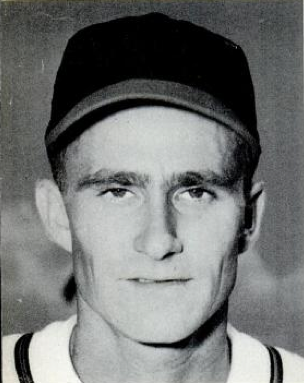
Lew Burdette
View on Wikipedia
Selva Lewis Burdette, Jr. (November 22, 1926 – February 6, 2007) was an American right-handed starting pitcher in Major League Baseball who played primarily for the Boston / Milwaukee Braves.[1] The team's top right-hander during its years in Milwaukee, he was the Most Valuable Player of the 1957 World Series, leading the franchise to its first championship in 43 years, and the only title in Milwaukee history.[2] An outstanding control pitcher, his career average of 1.84 walks per nine innings pitched places him behind only Robin Roberts (1.73), Greg Maddux (1.80), Carl Hubbell, (1.82) and Juan Marichal (1.82) among pitchers with at least 3,000 innings since 1920.
Key Information
Major League career
[edit]Born in Nitro, West Virginia, Burdette was signed by the New York Yankees in 1947, and after making two relief appearances for the team in September 1950, he was traded to the Braves in August 1951 for four-time 20-game winner Johnny Sain.[3] Along with left-hander Warren Spahn and right-hander Bob Buhl, he gave the Braves one of the best starting rotations in the majors during the 1950s, winning 15 or more games eight times between 1953 and 1961. Burdette led National League pitchers in earned run average in 1956.[4] When Milwaukee won the 1957 World Series against the Yankees, Burdette became the first pitcher in 37 years to win three complete games in a series, and the first since Christy Mathewson in 1905 to pitch two shutouts (Games 5 and 7), starting Game 7 after Games 1 and 4 starter Warren Spahn was stricken by the flu.[5][6] In the 1958 Series, however, the Yankees defeated Burdette twice in three starts. The final setback came in Game 7, which he again started on only two days' rest, a decision for which manager Fred Haney was widely criticized.[7] In addition to winning 20 games in 1958 and tying Spahn for the National League lead with 21 victories in 1959, Burdette won 19 in 1956 and 1960, 18 in 1961, and 17 in 1957.[1][8]
Burdette was the winning pitcher on May 26, 1959 when the Pittsburgh Pirates' Harvey Haddix pitched a perfect game against the Braves for 12 innings, only to lose in the 13th.[9] Burdette threw a 1–0 shutout, scattering 12 hits. In the ensuing offseason, he joked, "I'm the greatest pitcher that ever lived. The greatest game that was ever pitched in baseball wasn't good enough to beat me, so I've got to be the greatest!"
On August 18 of the following year, facing the minimum 27 batters, Burdette no-hit the Philadelphia Phillies 1–0 at Milwaukee County Stadium.[10] Tony González, the only opposing batter to reach base after being hit by a pitch in the fifth inning, was retired on a double play. Burdette helped himself by scoring the only run of the game; after doubling to lead off the eighth inning, he scored on Bill Bruton's double one batter later. Following up his no-hitter, five days later he pitched his third shutout in a row.[11]
In 1963 Burdette was traded to the St. Louis Cardinals (1963–64), and was later sent to the Chicago Cubs (1964–65) and Phillies (1965).[3] Signing with the California Angels, he pitched exclusively in relief for the team in 1966 and 1967 before retiring.
Career statistics
[edit]In an 18-year career, Burdette posted a 203–144 record with 1,074 strikeouts and a 3.66 ERA in 3,067.1 innings, compiling 158 complete games and 33 shutouts.[1] In two All-Star games, he allowed only one run in seven innings pitched,[12][13] and in 1956 he topped National League pitchers with a 2.70 earned run average.[1] He was twice a 20-game winner and twice led the National League in shutouts.[1] He also led the National League in wins, earned run average, innings and complete games once each.[1] His totals of wins, games and innings with the Braves ranked behind only Spahn and Kid Nichols in franchise history. He won his only NL Player of the Month award in August 1958 (7–1, 1.89 ERA, 38 SO); teammate pitcher Joey Jay had won the award the month previous. As a hitter, he compiled a .183 batting average (185-for-1,011) with 75 RBI and 12 home runs;[1] his first two home runs came in the same 1957 game, and he later had two more two-homer games.[14][15] He also hit a home run in Game 2 of the 1958 World Series, being the first pitcher to do so since Bucky Walters in 1940.
Pitching style
[edit]Burdette was a very fidgety pitcher, constantly scratching himself and fussing with his uniform before pitches. Former manager Fred Haney once said, "Burdette would make coffee nervous."[5] Frequently repeated motions such as bringing his fingers to his lips and wiping sweat from his forehead lead to rumors of throwing spitballs.[6][16] After the second game of the 1957 season, Birdie Tebbetts, manager of the Cincinnati Reds, called Burdette a "cheating spitballer," prompting Redlegs' GM Gabe Paul to lodge an official protest with the National League.[17] NL President Warren Giles responded with a statement clarifying that it was okay for a pitcher to moisten his hands as long as he did not transfer the moisture to the baseball and said, "Until someone—the umpires or someone—presents evidence that Burdette is using the spitter, I'll do nothing about it."[17][18] Burdette himself said, "It's the best pitch I've got—and I don't throw it."[17] The rumors persisted, though: Don Hoak said, "Only once did I ever see water fly off a spitball, and the man who threw me that pitch was Burdette."[18] The Sporting News wrote in 1967, "Perhaps no pitcher has engendered more controversy about the spitter than Lou Burdette."[18] New York Times sportswriter Red Smith wrote, "There should be 3 pitching statistics for Burdette: Wins, Losses, and Relative Humidity." Burdette himself referenced this reputation, saying he retired because "they were starting to hit the dry side of the ball."[19]
Personal life
[edit]Burdette was inducted into the Florida Sports Hall of Fame in 1998 [20] and the West Virginia Sports Hall of Fame in 1974. He died of lung cancer at age 80 in Winter Garden, Florida.[5]
In 1958, a reference to Burdette appeared in an episode of Leave It to Beaver. The text "Lew Burdette just hit a home run and Milwaukee leads seven to one in the series," appears briefly in a few frames showing a letter from the principal to Beaver's parents.[21] Burdette also released a single in 1958 with two Rockabilly songs "Three Strikes and You're Out" on the A side, and "Mary Lou" on the B side.[22]
Burdette's grandson, Nolan Fontana, is a retired former professional baseball player.[23]
Highlights
[edit]- Two-time All-Star (1957, 1959)
- Third in Cy Young Award voting (1958)
- Led league in wins (1959)
- Led league in games started (1959)
- Led league in complete games (1960)
- Twice led league in shutouts (1956, 1959)
- 5 times in top 4 in wins (1956–58, 1960–61)
- World Series MVP (1957)
- Player of the Month for August 1958
See also
[edit]References
[edit]- ^ a b c d e f g "Lew Burdette Stats". Baseball-Reference.com. Retrieved January 7, 2025.
- ^ "1957 World Series - Milwaukee Braves over New York Yankees (4-3)". Baseball-Reference.com. Retrieved January 7, 2025.
- ^ a b "Lew Burdette Trades and Transactions". Baseball Almanac. Retrieved January 7, 2025.
- ^ "1956 National League Pitching Leaders". Baseball-Reference.com. Retrieved January 7, 2025.
- ^ a b c Goldstein, Richard (February 7, 2007). "Lew Burdette, Masterful Pitcher, Dies at 80". New York Times. Archived from the original on June 5, 2011. Retrieved January 7, 2025.
- ^ a b Chapman, Lou (October 1991). "Lew Burdette: His Moment of Glory Came in '57 Series". Baseball Digest. Vol. 50, no. 10. ISSN 0005-609X.
- ^ "1958 World Series - New York Yankees over Milwaukee Braves (4-3)". Baseball-Reference.com. Retrieved January 7, 2025.
- ^ "1959 National League Pitching Leaders". Baseball-Reference.com. Retrieved January 7, 2025.
- ^ "Pittsburgh Pirates at Milwaukee Braves Box Score, May 26, 1959". Baseball-Reference.com. May 26, 1959. Retrieved January 7, 2025.
- ^ "Philadelphia Phillies at Milwaukee Braves Box Score, August 18, 1960". Baseball-Reference.com. August 18, 1960. Retrieved January 7, 2025.
- ^ "Milwaukee Braves at Los Angeles Dodgers Box Score, August 23, 1960". Baseball-Reference.com. August 23, 1960. Retrieved January 7, 2025.
- ^ "1957 All-Star Game Box Score, July 9". Baseball-Reference.com. Retrieved January 7, 2025.
- ^ "1959 All-Star Game Box Score, July 7". Baseball-Reference.com. Retrieved January 7, 2025.
- ^ "Milwaukee Braves at Cincinnati Redlegs Box Score, August 13, 1957". Baseball-Reference.com. August 13, 1957. Retrieved January 7, 2025.
- ^ "Milwaukee Braves at Los Angeles Dodgers Box Score, July 10, 1958". Baseball-Reference.com. July 10, 1958. Retrieved January 7, 2025.
- ^ "The Case of the Suspected Spitter". LIFE Magazine. Vol. 41, no. 11. September 10, 1956. p. 67. ISSN 0024-3019. Retrieved January 7, 2025.
- ^ a b c Wilks, Ed (April 19, 1957). "Birdie Says Burdette Is 'Cheating Spitballer'; Warren Giles Demands Proof Before Any Action". Times Daily. p. Two-5. Retrieved January 22, 2020.
- ^ a b c "The Infamous Spitter". Sports Illustrated. July 31, 1967. Retrieved January 22, 2020.
- ^ Baehler, James R. (November 18, 2014). Unbreakable: The 25 Most Unapproachable Records in Baseball.
- ^ "Lew Burdette". Florida Sports Hall of Fame. Retrieved January 7, 2025.
- ^ "All of this is nonsense". Letters of Note. Archived from the original on September 27, 2009. Retrieved October 13, 2009.
- ^ "Lew Burdette - Three Strikes and You're Out / Mary Lou". Discogs. 1958. Retrieved January 7, 2025.
- ^ Fowler, Jeremy (May 20, 2010). "Gators star Nolan Fontana paying tribute to his late grandfather, former pitcher Lew Burdette". Orlando Sentinel. Retrieved October 31, 2013.
External links
[edit]- Career statistics from MLB · ESPN · Baseball Reference · Fangraphs · Baseball Reference (Minors) · Retrosheet · Baseball Almanac
- Lew Burdette at the SABR Baseball Biography Project
- Lew Burdette at Baseball Almanac
- Lew Burdette Archived 2020-01-23 at the Wayback Machine at The Deadball Era
- Cooperstown's Loss
Lew Burdette
View on GrokipediaEarly Life
Youth and Education
Selva Lewis Burdette Jr. was born on November 22, 1926, in Nitro, West Virginia, to Selva Lewis Burdette Sr., a foreman at the local American Viscose Rayon plant, and his wife Agnes Burnett.[2] The Burdette family resided in this industrial community, originally established as a World War I boom town for explosives manufacturing along the Kanawha River, where many residents, including Burdette's siblings, were employed in factory work, reflecting the area's working-class character.[2][4] Growing up in Nitro, Burdette developed an early interest in sports through informal sandlot baseball games with local children, which served as his primary introduction to the game amid limited organized opportunities.[2] At Nitro High School, where no baseball team existed, he first gained athletic recognition as a standout on the football team, honing his competitive drive in a small-town environment that emphasized community and manual labor.[2][5] Following his graduation from high school, Burdette pitched in semi-organized play, posting a 12-2 record for the Viscose plant's team in the local Industrial League during the summer of 1944, which showcased his emerging talent and drew initial attention from baseball enthusiasts.[2] Burdette graduated from Nitro High School in 1944 at the age of 17, marking the end of his formal secondary education in a region shaped by industrial growth and economic challenges.[2] Following a pivotal delay due to military service during World War II, he enrolled at the University of Richmond in 1946, where he joined the baseball team as a pitcher for the Spiders under legendary coach Mac Pitt.[2] That season, Burdette earned All-Virginia Big Six honors for his performances on the mound, further solidifying his skills and attracting scouting interest from Major League Baseball teams, including the New York Yankees, who recognized his potential shortly after high school.[6][2]Military Service
Following his graduation from Nitro High School in 1944, Lew Burdette enlisted in the U.S. Army Air Corps Reserve on April 14, 1945, at Camp Atterbury in Columbus, Indiana.[2][7] Assigned to a welding outfit due to the full ranks of active pilots and crew, Burdette did not serve overseas or engage in combat roles, reflecting the non-combat nature of his brief wartime contribution.[2] Burdette's military service lasted approximately seven months, from enlistment through the final stages of World War II until his honorable discharge on November 9, 1945.[2][7] This interruption occurred just as Burdette was beginning to pursue semiprofessional baseball opportunities in West Virginia, delaying his athletic development amid the broader wartime disruptions affecting many young athletes.[2][8] The short duration of his service, however, allowed for a swift transition back to civilian life without long-term setbacks. Upon discharge, Burdette returned to baseball in 1946 by enrolling at the University of Richmond, where he pitched for the Spiders baseball team and quickly impressed scouts with his potential.[2][8] This post-service resumption at the collegiate level proved pivotal, as his performances there facilitated his signing with the New York Yankees organization in 1947, marking the start of his professional career.[2][9] Thus, while the military briefly halted his progress, it ultimately positioned him to leverage his skills in a competitive environment that accelerated his path to the major leagues.Professional Career
Minor Leagues and Early Major League Years
Following his discharge from military service, Lew Burdette signed with the New York Yankees organization as an amateur free agent in 1947 for a salary of $200 per month.[2] Initially assigned to the Class B Norfolk Tides in the Piedmont League, he appeared in just six games before transferring to the Class C Amsterdam Atoms of the Canadian-American League, where he posted a 9-10 record with a 2.82 ERA over 150 innings pitched.[2][10] Burdette's minor league development showed early promise but included setbacks as he advanced levels. In 1948 with the Class B Quincy Gems of the Three-I League, he excelled with a 16-11 mark, a 2.02 ERA, and 185 strikeouts in 214 innings, demonstrating improved control and stamina.[10] Promoted to Triple-A Kansas City Blues of the American Association the following year, he struggled against stiffer competition, finishing 6-7 with a 5.26 ERA in 118 innings and shifting primarily to relief duties; he roomed there with future Yankees teammate Whitey Ford.[2][10] Repeating at Kansas City in 1950, Burdette went 7-7 with a 4.79 ERA over 139 innings and 77 strikeouts, refining his sinking slider under the guidance of pitching coach Burleigh Grimes while building a reputation for psychological tactics on the mound.[2][10] Burdette made his major league debut with the Yankees on September 26, 1950, against the Washington Senators, entering in relief during the fifth inning and inducing a groundout to end the threat; he appeared in two games total that September, allowing two earned runs in 1.1 innings for a 6.75 ERA without a decision.[2][11] On August 29, 1951, the Yankees traded him to the Boston Braves along with $50,000 cash in exchange for veteran pitcher Johnny Sain, a move that provided the Braves with a promising young arm as part of the deal.[12][2] With the Braves, Burdette made three relief appearances in 1951, posting a 6.23 ERA over 4.1 innings.[11] In 1952, he transitioned to a more prominent role, appearing in 45 games mostly from the bullpen and starting 9, but endured early major league struggles with a 6-11 record and 3.61 ERA in 137 innings, though his durability in high-leverage situations hinted at untapped potential.[2][11] When the Braves relocated to Milwaukee for the 1953 season, Burdette seized the opportunity amid injuries to other starters, emerging as a key rotation member with a breakout 15-5 record, 3.24 ERA, and six complete games in 46 appearances over 175 innings.[2][11]Milwaukee Braves Era
Following the Boston Braves' relocation to Milwaukee in 1953, Lew Burdette transitioned to a full-time role in the starting rotation, marking the start of his most productive period in the major leagues.[2] In his debut season with the team in Milwaukee, he posted a 15-5 record with a 3.24 ERA over 175 innings, one shutout, and six complete games as the Braves finished fourth in the National League.[11] The following year in 1954, he recorded a 15-14 mark with a 2.76 ERA over 238 innings, ranking second in the National League in ERA and contributing four shutouts as the Braves finished second in the league.[11] This performance established him as a reliable workhorse, contrasting sharply with his brief and ineffective stint as a rookie with the New York Yankees in 1950, where he appeared in just two games without a decision.[2] Burdette's standout seasons highlighted his rise to stardom within the Braves' rotation, anchored by fellow Hall of Famer Warren Spahn. In 1956, he led the National League with a 2.70 ERA and six shutouts, finishing 19-10 over 256.1 innings to help the Braves mount a strong pennant challenge, though they fell one game short of the title. The following year, 1957, Burdette went 17-9 with a 3.72 ERA in 256.2 innings, earning his first All-Star selection and forming a formidable trio with Spahn and Bob Buhl that combined for 56 wins to secure the Braves' first National League pennant in nine years.[2] He won 20 games (20-10, 2.91 ERA) in 1958 while placing third in Cy Young voting, contributing to the team's repeat pennant with three shutouts and 275.1 innings pitched.[11] Burdette continued his excellence into the early 1960s, tying for the National League lead in wins with 21 (21-15 record, 4.07 ERA) and shutouts (four) in 1959, while appearing in both All-Star Games despite the Braves' third-place finish amid a competitive race.[13] His signature regular-season moment came on August 18, 1960, when he pitched a no-hitter against the Philadelphia Phillies, winning 1-0 by facing the minimum 27 batters through exceptional control.[2] That year, he recorded 19 wins (19-13, 3.36 ERA) over 275.2 innings with four shutouts, solidifying his status as a cornerstone of the rotation during the Braves' consistent contention from 1953 to 1960.[11] Amid growing trade speculation in the early 1960s, including discussions with the Baltimore Orioles, Burdette remained loyal to the Braves until his departure in midseason 1963, when he was traded to the St. Louis Cardinals on June 15 after a 6-5 start (3.64 ERA in 84 innings).[14] Over his nine full seasons in Milwaukee (1954-1962), he amassed 152 wins, a testament to his enduring impact on the franchise's success.[11]Later Major League Teams
On June 15, 1963, Burdette was traded from the Milwaukee Braves to the St. Louis Cardinals in exchange for catcher Gene Oliver and pitcher Bob Sadowski, marking the end of his tenure with the team where he had achieved his greatest success.[12] With the Cardinals that year, he posted a 3-8 record over 98 innings, primarily in relief roles, contributing to a combined 9-13 mark for the season across both teams.[11] His performance showed early signs of inconsistency compared to his peak years in Milwaukee, where he had routinely won 15 or more games annually.[2] Burdette remained with the Cardinals into the 1964 season but appeared in only eight relief outings, going 1-0 with a 1.80 ERA before being traded to the Chicago Cubs on June 2 in exchange for pitcher Glen Hobbie.[11][12] In Chicago, he transitioned to a starting role, finishing the year 9-9 with a 4.88 ERA over 131 innings, reflecting a further dip in effectiveness as he approached age 38.[11] The move highlighted his diminishing status as a frontline starter, with the Cubs utilizing him in a mixed rotation amid their rebuilding efforts.[2] His time with the Cubs extended into 1965, where he struggled in limited action, going 0-2 with a 5.31 ERA in just 20.1 innings before being sold to the Philadelphia Phillies on May 30.[11][12] With Philadelphia, Burdette made nine starts, recording a 3-3 mark and a 5.48 ERA, often relying on his veteran savvy in short outings but unable to reclaim his earlier command.[11] This brief stint, totaling just 91 innings for the season, underscored the challenges of maintaining velocity and consistency in his late 30s.[2] Burdette signed as a free agent with the California Angels prior to the 1966 season, shifting primarily to relief duties where he found some late-career stability.[2] He appeared in 54 games, posting a 7-2 record with a 3.39 ERA and five saves, including his 200th career victory on July 22 against the New York Yankees.[11] The following year, at age 40, his role diminished further to 19 relief outings, yielding a 1-0 record and 4.91 ERA over 18.1 innings, with his final major league appearance coming on July 16 against the Minnesota Twins, where he pitched a scoreless inning.[11][2] Burdette's late-career decline was largely attributed to advancing age, which eroded his stamina and reduced his starting opportunities, leading to ERAs above his career mark from 1964 onward except for a resurgent 3.39 in 1966.[11] While no major injuries were reported in these years, the cumulative wear from two decades of professional pitching contributed to his transition to the bullpen and eventual retirement after a brief minor-league assignment with the California Angels' AAA affiliate in Seattle in 1967.[2]Postseason Achievements
1957 World Series
The Milwaukee Braves defeated the New York Yankees 4 games to 3 in the 1957 World Series, securing their only championship in the city and snapping the Yankees' streak of five consecutive titles.[15] Lew Burdette emerged as the series' standout performer, earning the World Series MVP award for his three complete-game victories in Games 2, 5, and 7, a rare feat last achieved by Stan Coveleski in 1920 and later matched by Bob Gibson in 1967 and Mickey Lolich in 1968.[2] His dominance included two shutouts and a career-best postseason ERA of 0.67 over 27 innings pitched, allowing just two runs—all in Game 2—while issuing four walks.[2] This performance marked Burdette as the first World Series MVP from a team that had posted a worse regular-season record than its opponent, with the Braves finishing 95-59 compared to the Yankees' 98-56.[16] In Game 2 on October 3 at Yankee Stadium, Burdette outdueled Bobby Shantz with nine innings of two-run ball, scattering seven hits and three walks to secure a 4-2 victory that evened the series at 1-1; the Braves' offense was paced by Eddie Mathews' two-run homer in the fourth.[17] Three days later, with the series tied 2-2, Burdette started Game 5 at County Stadium on October 7 against Whitey Ford, delivering a masterful one-run shutout on seven hits and no walks, as Milwaukee's lone run came on a seventh-inning sacrifice fly by Johnny Logan; this 1-0 win gave the Braves a 3-2 lead and forced a decisive Game 7.[18] Working on just two days' rest after Warren Spahn fell ill, Burdette closed out the series in Game 7 on October 10, hurling another complete-game shutout—this time a 5-0 blanking of Don Larsen—on seven hits with one walk, as the Braves erupted for four runs in the third inning highlighted by Del Crandall's two-run double.[19] Burdette's heroics carried added personal significance, as he had begun his professional career in the Yankees' organization, signing with them in 1947 and making two relief appearances in 1950 before being traded to the Braves in 1952.[2] His regular-season form in 1957, where he posted a 17-13 record with a 3.05 ERA over 298 innings, had prepared him for this postseason spotlight, solidifying his reputation as a clutch performer.[11] The MVP award not only cemented Burdette's legacy as the architect of Milwaukee's triumph but also highlighted his mastery of the Yankees' lineup, including stars like Mickey Mantle and Yogi Berra, in a series remembered for its underdog drama.[16]1959 National League Tie-Breaker Series
The 1959 Milwaukee Braves finished the regular season tied with the Los Angeles Dodgers at 86 wins, necessitating a best-of-three tie-breaker series to determine the National League pennant. Burdette started Game 2 on September 29 at the Los Angeles Memorial Coliseum against Don Drysdale. He pitched 8⅔ innings, allowing 10 hits and 5 runs (4 earned), with 2 walks and 5 strikeouts, in a no-decision as the Braves led 5-4 before the Dodgers rallied for two runs in the ninth off reliever Don McMahon to win 6-5 in 12 innings.[20] The Braves lost the series 2-0, with Game 1 also a Dodgers victory, ending Milwaukee's bid for a third consecutive pennant.1958 and 1964 World Series
In the 1958 World Series, Burdette started Games 2, 5, and 7 for the Milwaukee Braves against the New York Yankees, posting a 1-2 record with a 5.64 ERA over 22.1 innings pitched.[21] He earned a complete-game victory in Game 2, a 13-5 rout where he allowed five runs on 10 hits while contributing a three-run home run in the first inning to ignite the Braves' offense.[22] However, his performance faltered in subsequent starts, yielding seven runs in six innings during a 7-0 loss in Game 5 and three runs in seven innings of a 6-2 defeat in Game 7, contributing to the Braves' 4-3 series loss despite his strong regular-season form of 20 wins.[23] This outing contrasted sharply with his dominant 1957 World Series MVP performance, where he went 3-0 with a 0.67 ERA, highlighting the challenges of sustaining peak effectiveness against a resilient Yankees lineup.[2] Combined with his 1957 efforts, Burdette's 1957-58 World Series record stood at 4-2 with a 2.93 ERA across 49.1 innings, establishing him as a key postseason performer for the Braves during their consecutive National League pennants.[11] His career World Series mark finished at 4-2 with a 2.92 ERA in six appearances, all starts, underscoring his historical impact despite the 1958 setbacks.[24] By 1964, at age 37, Burdette had transitioned to a relief role with the St. Louis Cardinals early in the season, appearing in eight games with a 1-0 record and 1.80 ERA before being traded to the Chicago Cubs on June 3.[2] This move occurred well before the Cardinals' World Series appearance against the Yankees, which they won 4-3, leaving Burdette without a postseason opportunity that year and reflecting the physical toll of aging on his once-enduring starting career amid shifting team dynamics in the National League.[25] His limited regular-season contributions with St. Louis exemplified a late-career adaptation to bullpen duties, a far cry from his 1957 pinnacle, as injuries and roster changes curtailed his influence on championship contention.[1]On-Field Analysis
Pitching Style
Lew Burdette was renowned as a finesse pitcher who emphasized control and precision over raw velocity, lacking an overpowering fastball but excelling through meticulous command of the strike zone.[2][8] His career average of 1.84 walks per nine innings pitched underscored this approach, placing him among the most controlled hurlers of his era and allowing him to induce weak contact rather than overpowering hitters with speed.[26] This style contributed to his effectiveness in pitching complete games, a hallmark of his 18-year major league tenure where he logged 158 such outings by relying on location and movement to navigate lineups efficiently.[26] Burdette's delivery was deliberately fidgety and methodical, designed to unsettle batters through a series of pauses, mannerisms, and adjustments that disrupted their timing and focus.[2] He frequently fussed with his uniform, wiped his brow, adjusted his cap, and even muttered to himself on the mound, creating an aura of unease that former Braves manager Fred Haney described as enough to "make coffee nervous."[2][27] These antics, far from signs of nerves, were a calculated psychological tactic to throw off opponents' rhythm before unleashing his pitches.[8] Throughout his career, Burdette faced persistent rumors of employing illegal pitches, particularly the spitball, which had been banned in Major League Baseball since 1920, though he was never suspended for such activity.[8] Opposing managers and players, including Cincinnati Reds skipper Birdie Tebbetts, accused him of violating rules by spitting on the ball, glove, or hands, but Burdette and his teammates consistently denied the claims, with umpires finding no evidence during inspections.[2][28] He shrewdly cultivated the suspicion as a mental edge, once quipping, "My best pitch is one I do not throw," which amplified the intimidation factor without confirming any wrongdoing.[2] Anecdotes from contemporaries, such as Yankees outfielder Harry Simpson noting that Burdette's sinker alone was deceptive enough without needing illicit aid, highlighted how the rumors enhanced his reputation as a crafty operator.[29] Burdette's arsenal centered on a mix of off-speed and movement pitches that complemented his control: a sharp sinker (often called a sinking fastball) to generate ground balls, a reliable curveball delivered from a sidearm slot for deception, and a changeup to further vary speeds and keep hitters off-balance.[2][8][30] He also incorporated a slider and occasional screwball variations, but his success stemmed from seamlessly locating these offerings within the strike zone rather than overwhelming batters with power.[8][31] This repertoire proved particularly potent in high-stakes situations, as evidenced by his three complete-game victories in the 1957 World Series.[2]Career Statistics
Lew Burdette compiled a distinguished 18-year Major League Baseball career from 1950 to 1967, amassing 203 wins against 144 losses while posting a 3.66 earned run average over 3,067.1 innings pitched in 626 appearances, including 373 starts. He struck out 1,074 batters, completed 158 games, and recorded 33 shutouts, showcasing durability and effectiveness as a workhorse starter in an era dominated by complete games and high pitch counts.[11] Burdette earned All-Star selections in 1957 and 1959, representing the National League in both games that year.[11] His peak performance came during the late 1950s with the Milwaukee Braves, where he frequently anchored the rotation alongside Warren Spahn. Burdette led the National League in earned run average with a 2.70 mark in 1956, tied for the wins lead with 21 in 1959, paced the circuit in shutouts with six in 1956, and shared the complete games lead with 18 in 1960.[32][13][33] These accomplishments highlighted his command on the mound, as evidenced by a career-low 1.07 walks per nine innings that stemmed from his meticulous control-oriented pitching style.[34] In postseason play, Burdette appeared in two World Series, posting a 4-2 record with a 2.78 ERA across 49.1 innings in six starts; his standout contribution came in the 1957 World Series, where he went 3-0 with a 0.67 ERA over 27 innings, including two shutouts.[11] The following table summarizes Burdette's annual wins and ERA during his MLB career:| Year | Team | Wins | ERA |
|---|---|---|---|
| 1950 | NYY | 0 | 6.75 |
| 1951 | BSN | 0 | 6.23 |
| 1952 | BSN | 6 | 3.61 |
| 1953 | MLN | 15 | 3.24 |
| 1954 | MLN | 15 | 2.76 |
| 1955 | MLN | 13 | 4.03 |
| 1956 | MLN | 19 | 2.70 |
| 1957 | MLN | 17 | 3.72 |
| 1958 | MLN | 20 | 2.91 |
| 1959 | MLN | 21 | 4.07 |
| 1960 | MLN | 19 | 3.36 |
| 1961 | MLN | 18 | 4.00 |
| 1962 | MLN | 10 | 4.89 |
| 1963 | MLN/STL | 9 | 3.71 |
| 1964 | STL/CHC | 10 | 4.66 |
| 1965 | CHC/PHI | 3 | 5.44 |
| 1966 | CAL | 7 | 3.39 |
| 1967 | CAL | 1 | 4.91 |
| Career | - | 203 | 3.66 |
| Statistic | Lew Burdette | Warren Spahn |
|---|---|---|
| Wins-Losses | 203-144 | 363-245 |
| ERA | 3.66 | 3.09 |
| Innings Pitched | 3,067.1 | 5,243.2 |
| Strikeouts | 1,074 | 2,583 |
| Complete Games | 158 | 382 |
| Shutouts | 33 | 63 |
