Hubbry Logo
Level setLevel setMain
Open search
Level set
Community hub
Level set
logo
8 pages, 0 posts
0 subscribers
Be the first to start a discussion here.
Level set
Level set
from Wikipedia

Points at constant slices of x2 = f (x1).
Lines at constant slices of x3 = f (x1, x2).
Planes at constant slices of x4 = f (x1, x2, x3).
(n − 1)-dimensional level sets for functions of the form f (x1, x2, …, xn) = a1x1 + a2x2 + ⋯ + anxn where a1, a2, …, an are constants, in (n + 1)-dimensional Euclidean space, for n = 1, 2, 3.
Points at constant slices of x2 = f (x1).
Contour curves at constant slices of x3 = f (x1, x2).
Curved surfaces at constant slices of x4 = f (x1, x2, x3).
(n − 1)-dimensional level sets of non-linear functions f (x1, x2, …, xn) in (n + 1)-dimensional Euclidean space, for n = 1, 2, 3.

In mathematics, a level set of a real-valued function f of n real variables is a set where the function takes on a given constant value c, that is:

When the number of independent variables is two, a level set is called a level curve, also known as contour line or isoline; so a level curve is the set of all real-valued solutions of an equation in two variables x1 and x2. When n = 3, a level set is called a level surface (or isosurface); so a level surface is the set of all real-valued roots of an equation in three variables x1, x2 and x3. For higher values of n, the level set is a level hypersurface, the set of all real-valued roots of an equation in n > 3 variables (a higher-dimensional hypersurface).

A level set is a special case of a fiber.

Alternative names

[edit]
Intersections of a co-ordinate function's level surfaces with a trefoil knot. Red curves are closest to the viewer, while yellow curves are farthest.

Level sets show up in many applications, often under different names. For example, an implicit curve is a level curve, which is considered independently of its neighbor curves, emphasizing that such a curve is defined by an implicit equation. Analogously, a level surface is sometimes called an implicit surface or an isosurface.

The name isocontour is also used, which means a contour of equal height. In various application areas, isocontours have received specific names, which indicate often the nature of the values of the considered function, such as isobar, isotherm, isogon, isochrone, isoquant and indifference curve.

Examples

[edit]

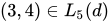
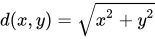
Consider the 2-dimensional Euclidean distance: A level set of this function consists of those points that lie at a distance of from the origin, that make a circle. For example, , because . Geometrically, this means that the point lies on the circle of radius 5 centered at the origin. More generally, a sphere in a metric space with radius centered at can be defined as the level set .
A second example is the plot of Himmelblau's function shown in the figure to the right. Each curve shown is a level curve of the function, and they are spaced logarithmically: if a curve represents , the curve directly "within" represents , and the curve directly "outside" represents .

Log-spaced level curve plot of Himmelblau's function[1]

Level sets versus the gradient

[edit]
Consider a function f whose graph looks like a hill. The blue curves are the level sets; the red curves follow the direction of the gradient. The cautious hiker follows the blue paths; the bold hiker follows the red paths. Note that blue and red paths always cross at right angles.
Theorem: If the function f is differentiable, the gradient of f at a point is either zero, or perpendicular to the level set of f at that point.

To understand what this means, imagine that two hikers are at the same location on a mountain. One of them is bold, and decides to go in the direction where the slope is steepest. The other one is more cautious and does not want to either climb or descend, choosing a path which stays at the same height. In our analogy, the above theorem says that the two hikers will depart in directions perpendicular to each other.

A consequence of this theorem (and its proof) is that if f is differentiable, a level set is a hypersurface and a manifold outside the critical points of f. At a critical point, a level set may be reduced to a point (for example at a local extremum of f ) or may have a singularity such as a self-intersection point or a cusp.

Sublevel and superlevel sets

[edit]

A set of the form

is called a sublevel set of f (or, alternatively, a lower level set or trench of f). A strict sublevel set of f is

Similarly

is called a superlevel set of f (or, alternatively, an upper level set of f). And a strict superlevel set of f is

Sublevel sets are important in minimization theory. By Weierstrass's theorem, the boundness of some non-empty sublevel set and the lower-semicontinuity of the function implies that a function attains its minimum. The convexity of all the sublevel sets characterizes quasiconvex functions.[2]

See also

[edit]

References

[edit]
Revisions and contributorsEdit on WikipediaRead on Wikipedia
from Grokipedia
In , a level set of a real-valued function f:RnRf: \mathbb{R}^n \to \mathbb{R} is defined as the set of all points in its domain where the function attains a specific constant value cc, formally expressed as {xRnf(x)=c}\{ \mathbf{x} \in \mathbb{R}^n \mid f(\mathbf{x}) = c \}. These sets provide a way to visualize and analyze the behavior of multivariable functions by slicing them at constant outputs, analogous to contour lines on a for two-dimensional functions or isosurfaces in three dimensions. The of the function is to its level sets, which is crucial for understanding directions of steepest ascent and applications in optimization and . Level sets appear throughout , including —where they help study manifolds and hypersurfaces—and , where they relate to concepts like . In , level sets of polynomial functions define algebraic varieties, connecting to broader structures in . Their geometric interpretation facilitates proofs in analysis, such as the , which guarantees that level sets near regular points resemble smooth submanifolds. In computational mathematics and scientific computing, level sets form the basis of the level set method, a numerical technique introduced by Stanley Osher and James A. Sethian in 1988 for tracking the evolution of interfaces and fronts under complex motions, such as those driven by curvature or velocity fields. By embedding the interface as the zero level set of a higher-dimensional signed distance function ϕ(x,t)\phi(\mathbf{x}, t), the method naturally handles topological changes like merging or splitting without explicit parameterization. This approach has been extended with efficient algorithms, including narrow-band and fast marching variants, to reduce computational cost. The has broad applications across disciplines, including for simulating multiphase flows, image processing for segmentation and denoising, for modeling phase transitions, and for dynamic . In biomedical , it enables accurate tracking of organ boundaries in MRI scans, while in , it models propagation. These applications leverage the method's robustness to irregular geometries and its ability to incorporate partial differential equations for realistic simulations.

Definition and Notation

Formal Definition

In mathematics, the level set of a real-valued function f:XRf: X \to \mathbb{R} at a level cRc \in \mathbb{R} is defined as the preimage Lc(f)={xXf(x)=c}L_c(f) = \{x \in X \mid f(x) = c\}, where XX is the domain of ff. This construction captures the locus of points in the domain where the function attains the constant value cc. The domain XX is most commonly taken to be a subset of Euclidean space Rn\mathbb{R}^n, but the definition generalizes to scalar-valued functions defined on smooth manifolds or more abstract topological spaces, where level sets serve as fundamental objects in studying the geometry and topology of the function's behavior. For Lc(f)L_c(f) to be nonempty, cc must belong to the image (range) of ff; if cc lies outside this range, the level set is the . If ff is , then each level set Lc(f)L_c(f) is a closed of XX, as it arises as the preimage of the closed singleton set {c}R\{c\} \subset \mathbb{R} under a continuous function. To obtain well-behaved level sets with additional structure, such as smooth hypersurfaces away from critical points, regularity assumptions are typically required; for instance, ff is often assumed to be continuously differentiable (C1C^1) and cc a regular value where the f\nabla f is nowhere zero on Lc(f)L_c(f).

Common Notations

The level set of a real-valued function f:RnRf: \mathbb{R}^n \to \mathbb{R} at a constant value cc is most commonly denoted using the preimage notation f1(c)f^{-1}(c), which emphasizes the set-theoretic inverse under ff. An equivalent and frequently used symbolic convention is Lc(f)={(x1,,xn)Rnf(x1,,xn)=c}L_c(f) = \{ (x_1, \dots, x_n) \in \mathbb{R}^n \mid f(x_1, \dots, x_n) = c \}, where the subscript cc specifies the level and the clearly delineates the points satisfying the equality. Alternative notations include the more compact set-builder form {xf(x)=c}\{ \mathbf{x} \mid f(\mathbf{x}) = c \}, which prioritizes brevity in general mathematical discourse. In contexts involving partial differential equations (PDEs), particularly those modeling interfaces or fronts, level sets are often symbolized as Σc\Sigma_c for hypersurfaces where f=cf = c, or Γc\Gamma_c to denote boundaries or codimension-one manifolds at that level. The notation for level sets traces its origins to contour lines in 19th-century cartography, where lines of equal elevation were first systematically drawn by in his 1774 survey of mountain in , marking an early visual representation of constant-value sets on functions of two variables. This practical convention evolved into abstract mathematical notation in the , influenced by developments in and analysis, where level sets formalized the generalization of contours to higher dimensions. Field-specific conventions further adapt these notations for clarity and application; for instance, in and numerical simulations via level set methods, the zero level set representing an evolving interface is standardly denoted ϕ1(0)\phi^{-1}(0), with ϕ\phi serving as the to the surface. Multivariable calculus textbooks emphasize consistent use of f(x)=cf(\mathbf{x}) = c for level curves and surfaces to build intuitive understanding, avoiding overloaded symbols to maintain precision across pedagogical contexts.

Geometric and Topological Properties

Relation to the Gradient

The gradient vector f\nabla f of a smooth function f:RnRf: \mathbb{R}^n \to \mathbb{R} at a point pp in the level set Lc(f)={xRnf(x)=c}L_c(f) = \{ x \in \mathbb{R}^n \mid f(x) = c \} is orthogonal to the tangent space TpLc(f)T_p L_c(f) provided that f(p)0\nabla f(p) \neq 0. This orthogonality arises because the directional derivative of ff along any tangent vector tTpLc(f)t \in T_p L_c(f) vanishes, satisfying f(p)t=0\nabla f(p) \cdot t = 0. Consequently, f(p)\nabla f(p) serves as a normal vector to the level set at such points, pointing in the direction of steepest ascent of ff. Points where f(p)0\nabla f(p) \neq 0 are termed regular points of the level set, and near these points, Lc(f)L_c(f) forms a smooth (n1)(n-1)-dimensional manifold. In contrast, critical points occur where f(p)=0\nabla f(p) = 0, leading to potential singularities in the level set, such as cusps or isolated points, where the manifold structure may fail. The absence of the precludes a well-defined , disrupting the local smoothness guaranteed by the at regular points. This orthogonality has significant implications for the flow along the . , which are the curves of the vector field f\nabla f, intersect the level sets perpendicularly at every regular point, as their direction aligns solely with the normal to TpLc(f)T_p L_c(f). These curves trace paths of steepest ascent or descent, transversely crossing successive level sets without tangential components.

Implicit Surfaces and Manifolds

Level sets provide a fundamental way to define implicit surfaces and submanifolds in Euclidean space. The zero level set of a smooth function f:RnRf: \mathbb{R}^n \to \mathbb{R}, denoted L0(f)={xRnf(x)=0}L_0(f) = \{ x \in \mathbb{R}^n \mid f(x) = 0 \}, constitutes a hypersurface, which is a codimension-one subset embedded in Rn\mathbb{R}^n. More generally, for any constant cRc \in \mathbb{R}, the level set Lc(f)={xRnf(x)=c}L_c(f) = \{ x \in \mathbb{R}^n \mid f(x) = c \} can be viewed as the zero level set of the translated function fcf - c, effectively shifting the hypersurface in the function's range space. Under suitable regularity conditions, these level sets inherit a smooth manifold structure. Specifically, if cc is a regular value of ff, meaning the f(x)0\nabla f(x) \neq 0 for all xLc(f)x \in L_c(f), then Lc(f)L_c(f) is a smooth of Rn\mathbb{R}^n with n1n-1. This result follows from the regular value theorem (or submersion theorem for the case where ff is a submersion onto its image), which leverages the to locally parametrize the level set as a graph over hyperplanes transverse to f\nabla f. The non-vanishing ensures that the differential dfxdf_x is surjective at each point, guaranteeing the local embedding properties required for a . Topological properties of level sets, such as and connectedness, are closely tied to the asymptotic behavior of ff at . A smooth function ff is said to be coercive if f(x)|f(x)| \to \infty as x\|x\| \to \infty; under this condition, every level set Lc(f)L_c(f) is , as it is closed (by continuity of ff) and bounded (since unbounded sequences on Lc(f)L_c(f) would contradict the coercivity). For connectedness, the global of Lc(f)L_c(f) depends on the connectivity of sublevel sets {fc}\{f \leq c\} and the distribution of critical points, influenced by how ff approaches its limiting values at ; for instance, if sublevel sets remain connected due to a connected set of weakly isolated minima extending to , the corresponding level sets inherit connectedness. In contrast to parametric representations, where a submanifold is described explicitly via a map r:URn1Rn\mathbf{r}: U \subseteq \mathbb{R}^{n-1} \to \mathbb{R}^n with coordinate parameters, implicit definitions via level sets use a single equation f(x)=cf(x) = c without requiring such a parametrization. This implicit approach offers advantages in dimensionality reduction, as it embeds the (n1)(n-1)-dimensional object using an nn-variable function of codimension one, facilitating the representation of complex topologies that may be challenging to parametrize globally.

Examples and Visualizations

Simple Geometric Examples

In one dimension, consider the function f(x)=x2f(x) = x^2 defined on R\mathbb{R}. The level set for a constant c>0c > 0 consists of the two points {±c}\{ \pm \sqrt{c} \}
Add your contribution
Related Hubs
User Avatar
No comments yet.