Hubbry Logo
Looping StarshipLooping StarshipMain
Open search
Looping Starship
Community hub
Looping Starship
logo
8 pages, 0 posts
0 subscribers
Be the first to start a discussion here.
Looping Starship
Looping Starship
from Wikipedia
Looping Starship
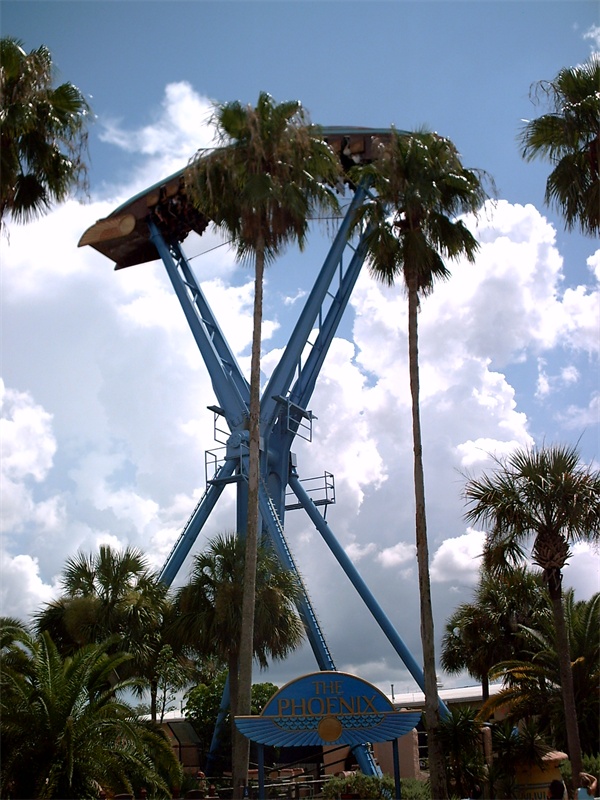
Phoenix at Busch Gardens Tampa Bay, a custom Looping Starship ride
StatusDiscontinued
First manufactured1984
No. of installations14
ManufacturerIntamin
Height14.6 m (48 ft)
Capacity650 riders per hour
Durationapproximately 3 minutes and 33 seconds ride time

The Looping Starship is an amusement ride manufactured by Intamin of Switzerland. The ride is a swinging ship that can spin a complete 360-degree revolution. The ride has been modified with custom theming to resemble a number of different vehicles, including a Space Shuttle, a fighter jet, an Egyptian cargo ship, and a Looney Tunes ACME Rocket.

The Looping Starship is manufactured either as a traveling model or a park model. Most parks require riders to be at least 48 inches (1.2 m) tall.

Locations

[edit]

Existing Looping Starships

[edit]
Name Park Year opened Notes
Looping Starship Yomiuriland 1992 (Themed after a space shuttle)
Pirate's Revenge Sunway Lagoon 2005 This ride was the former Bounty's Revenge at Wonderland Sydney,[1] which operated from 1985 to 2004.
Space Shuttle Nagashima Spa Land 1992 (Themed after a space shuttle)


Removed

[edit]
Name Park Year opened Year closed Notes
Power Dive Six Flags Great America[1] 1987 2001 (Themed after a fighter jet. Removed due to maintenance issues)
Looping Starship Six Flags Over Georgia[1] 1989 2005 (Removed to make way for Goliath)
Z-Force Six Flags Magic Mountain 1987 1993 (Removed to make way for Batman: The Ride)
Space Shuttle Six Flags AstroWorld 1986 2005 (Removed due to park's closure, and relocated to Six Flags Over Texas)
Space Shuttle Six Flags Great Adventure[1] 1985 2007 (Removed as a result of cost-cutting, and currently[as of?] in storage)
Aerovarvet Liseberg 1989 2002 (Was rebuilt in the winter between 2001-2002 to a swinging ship ride)
Perilous Pendulum Galaxyland[1] 1985 2003 (The first indoor Looping Starship, but removed for replacement by the Solar Flare ride)
Jet Scream Canada's Wonderland 1990 2010 Removed for WindSeeker. As of August 2011, put up for sale[2]
Bounty Walibi Belgium 1992 2002 (The former "Bateau Ivre" at fr:Zygofolis in France,[1] which operated from 1987 to 1991)
ACME Rock n' Rocket Six Flags Over Texas 2006 2014 (Most of the ride's parts are from the Six Flags Astroworld Looping Starship, which operated from 1986 to 2005. An entirely new chassis was built for its installation, and themed after a Looney Tunes ACME rocket for Justice League: Battle for Metropolis.)
Looping Starship Tokyo Summerland[1] 1986 2007 (Themed as a Space Shuttle)
Looping Starship Seibuen Yuenchi 1988 2011 (Themed as a Space Shuttle)
Looping

Starship

Expo 86, Vancouver BC[1] 1986 1986 (It was themed as a Space Shuttle, in place during the summer run of the world's fair in 1986, and presumably[why?] sold when the fair closed.)
H.M.B. Endeavor California's Great America 1987 2017 (Themed after a pirate ship, formerly called The Revolution, and removed mid-off-season[vague] due to maintenance issues, low ridership and South Bay Shores.)[citation needed]
Looping Starship Takarazuka Family Land 1991 2003
Looping Starship Parque Grano de Oro 2012 2017 (Themed as a Space Shuttle, formerly Jet Scream at Canada's Wonderland -- which operated from 1990 to 2010)
Phoenix Busch Gardens Tampa Bay[1] 1984 2018 (Themed after an Egyptian[vague] cargo vessel) Demolished in December 2022.
Looping Starship Valleyfair[1] 1985 2019 (Themed after a pirate ship.)
Southern Star Carowinds[1] 1986 2022 (Themed after a viking ship, formerly called Frenzoid)
Berserker Kings Dominion[1] 1984 2025 (Themed after a Viking ship)

References

[edit]
[edit]
Revisions and contributorsEdit on WikipediaRead on Wikipedia
from Grokipedia
The Looping Starship is a thrill amusement ride manufactured by , a Liechtenstein-based company specializing in innovative park attractions, featuring a pendulum-style that swings like a pirate ship but builds momentum through a massive and to perform complete 360-degree inversions, subjecting riders to intense forces and brief . Debuting in 1984 with initial installations at Tampa and , the ride represented an evolution of earlier swinging ship concepts by incorporating full-looping capabilities, which made it a standout flat ride during the thrill boom. It accommodated 40 to 50 riders per cycle, depending on the model, in a boat-shaped vehicle with over-the-shoulder restraints, often customized with space or nautical themes to enhance its immersive appeal at parks worldwide. The Looping Starship gained widespread popularity, appearing at numerous major venues including multiple properties, but faced declining operations from the 2000s onward due to high maintenance demands and competition from advanced coaster technologies. By early 2025, the last North American example—known as at —had been retired after four decades of service, leaving only three units operational globally as of November 2025, primarily in .

History

Development and manufacturing

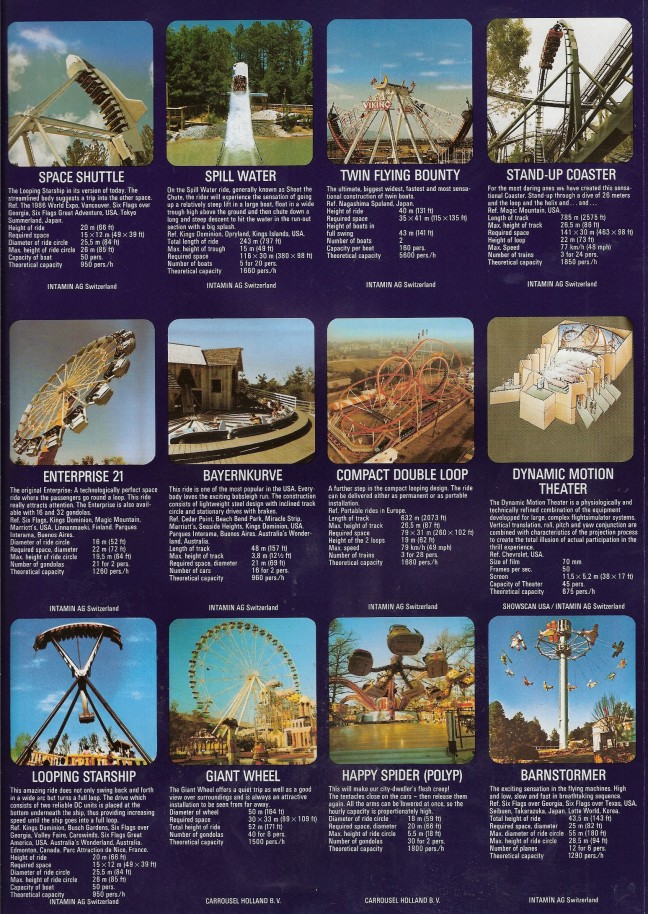
The Looping Starship was developed by in 1984 as an advanced variant of their existing swinging ship rides, evolving the concept of the Bounty pirate ship to incorporate full 360-degree inversions for enhanced thrill. This innovation built on the pendulum motion of earlier models by adding a massive and to enable controlled upside-down loops, powered by drive tires similar to those used in the Super Bounty for precise propulsion and braking. The design prioritized safety during inversions with dual shoulder restraint bars and careful cycle programming to maintain rider positioning. Key engineering features included a with 10 rows of five seats facing inward, accommodating up to 50 riders per cycle, and an overall height of 66 feet (20 meters) to facilitate the vertical loop. The ride's compact footprint measured 49 feet by 39 feet (15 by 12 meters), allowing installation in various park layouts while achieving an hourly throughput of approximately 950 passengers. These specifications represented a significant advancement in flat ride technology during the looping trend, distinguishing it from non-inverting pirate ships. Manufacturing occurred primarily in Switzerland, where Giovanola fabricated the structures for Intamin from 1984 until 1992, resulting in a total of 21 units produced worldwide. Following Intamin's discontinuation of the model, the design influenced subsequent Ranger Ship attractions by other manufacturers, though Intamin's originals remained distinct in their engineering. Initially marketed under the name Looping Starship, the ride was also offered as the Space Shuttle with a 1980s space-themed aesthetic to capitalize on contemporary interests. Early installations appeared in 1984 at parks such as Tampa and , with several locations adopting the model shortly thereafter.

Introduction and early installations

The Looping Starship debuted in in 1984 with installations at Busch Gardens Tampa, where it operated as Phoenix and opened on June 5, and at as . These were followed by additional early adopters, including a unit at in , , and various parks starting in 1985, such as . The ride's initial rollout capitalized on the thrill ride boom, with themed variants like pirate ships and space shuttles enhancing its appeal.

Popularity peak and subsequent decline

The Looping Starship attained its peak popularity during the late 1980s and early , as amusement parks expanded their thrill offerings with this innovative flat ride capable of full inversions. A total of 21 units were manufactured by between 1984 and 1992, with notable installations occurring in Asia, including at Yomiuriland and in in 1992. The ride's space shuttle theming aligned with contemporary public fascination with , enhancing its appeal amid NASA's Shuttle program activities. Its success stemmed from being a relatively affordable attraction that delivered coaster-like thrills through inversions on a compact footprint, attracting both families and adrenaline enthusiasts without the extensive space requirements of full roller coasters. This made it a staple in major park expansions, including multiple properties during the mid- to late 1980s, such as the 1986 debut at . By the mid-1990s, however, the ride's popularity began to wane as operational challenges and evolving industry trends took hold. High maintenance demands, particularly related to the hydraulic systems enabling the inversions, contributed to frequent downtime and escalating costs for operators. Simultaneously, amusement parks shifted focus toward larger-scale roller coasters to draw bigger crowds, leading to the removal of several Looping Starships to accommodate these investments; for instance, the unit at was dismantled in 2005 to clear space for the , which opened the following year. This decline culminated in recent years with the closure of remaining units. The final operating Looping Starship in the United States, known as at , was retired and dismantled in early 2025 after four decades of service since its 1984 opening, effectively ending the ride's presence across .

Design and operation

Mechanical components

The gondola of the Looping Starship is an enclosed, spaceship- or boat-themed cabin designed to accommodate 50 riders seated in two inward-facing rows across 10 benches of five seats each. Riders are secured by automatic over-the-shoulder restraints, supplemented by lap bars and seatbelts for redundancy, ensuring safety during inversions. The drive system employs four large friction tire drives positioned at the base of the central structure, which propel the through its swinging motion. A substantial , constructed from and and mounted at the rear of the , balances the vehicle to enable powered swings reaching full 360-degree loops and inversions up to three times per cycle. The ride's framework forms a central tower supporting the 's pivot , with an overall of 67 feet (20.5 ) and a measuring approximately 49 by 39 feet (15 by 12 ). During operation, the swings to support a throughput of approximately 950 to 1,200 riders per hour. Component variations across installations primarily involve theming of the —such as motifs in U.S. parks or nautical designs elsewhere—while core mechanical elements remained consistent from the ride's 1985 debut, with post-installation modifications like added protective netting around the perimeter for enhanced safety. Early units, introduced in 1985, featured the standard enclosed design without significant structural divergences reported in later models.

Ride cycle and controls

The ride cycle of a Looping Starship begins with manual loading of up to 50 passengers into the , followed by operator checks of restraints including lap bars, over-the-shoulder harnesses, and seat belts to ensure secure positioning. Once cleared, the cycle initiates, typically lasting approximately 2 minutes and enabling an hourly throughput of around 1,200 riders. The operational sequence starts with pendulum-like swings driven by four large tire mechanisms at the ride's base, which gradually build momentum through slow back-and-forth oscillations. A on the opposite end of the assists in balancing the motion, allowing the swings to intensify until sufficient energy is achieved for full inversions. Upon reaching adequate speed, the executes 2 to 3 complete 360-degree loops, generating up to 3 G-forces during the rotations and incorporating extended hangtime—often 10 seconds or more—while inverted. The cycle concludes with decelerating swings, returning the to the loading platform for unloading, with the entire motion powered through the tire drives to maintain controlled progression. Operator controls consist of a central console that manages cycle , monitoring hydraulic pressure via gauges and providing an emergency stop button for immediate halt if needed. Most installations operate in a standard automatic mode for consistency, though some feature selectable programming for forward or backward swing patterns to optimize momentum buildup before inversions; includes safeguards to prevent loop attempts if power is insufficient, defaulting to reverse swings. Variations in cycle programming exist across installations, with some configured for higher-speed revolutions without prolonged hangtime, while others emphasize slower loops for extended inverted pauses, but the fixed standard cycle prioritizes reliable 2-3 inversions following 4-5 initial swings.

Safety and rider requirements

The Looping Starship employs individual over-the-shoulder restraint bars with dual locking mechanisms to secure passengers during the ride's inversions, ensuring riders remain contained even when the cabin rotates fully upside down. These restraints are manually lowered and locked by operators, who perform a pre-ride test on each one to verify engagement and redundancy before dispatch. In response to early operational issues with loose articles, protective mesh screens were installed over the passenger compartment starting in the season across multiple installations, effectively containing items and preventing them from falling into queue areas below during loops. Rider eligibility standards for the Looping Starship align with amusement ride norms for inversion-capable attractions, requiring a minimum height of 48 inches (122 cm) to ride unaccompanied in order to fit securely within the restraint system and seat contours. Children between 42 inches (107 cm) and 48 inches (122 cm) may ride when accompanied by a supervising adult meeting the height requirement, though this varies by park policy. Per-rider weight limits are established at a maximum of 300 pounds (136 kg) to accommodate the design load capacities of the restraints and , with operational guidelines prohibiting riders exceeding 250 pounds (113 kg) in some cases to maintain optimal . Policies strictly enforce the removal of loose clothing, jewelry, glasses, or other unsecured items, often requiring storage in provided lockers or pouches to mitigate risks during high-G maneuvers. Safety protocols emphasize rigorous maintenance and compliance with industry standards, including daily visual and functional inspections of the hydraulic drive system, restraint assemblies, and structural integrity to detect wear or anomalies. Rides are limited to operational cycles that prevent excessive on components, with immediate shutdowns mandated following any irregularity or reported discomfort. The design adheres to ASTM F2291 guidelines for amusement rides, particularly Class 5 redundant locking restraints and acceleration limits under 1.5 G for sustained forces, ensuring patron containment during inversions. Incidents have been limited to minor cases of unsecured objects detaching and falling, prompting enhanced netting and policy enforcement, with no fatalities documented across installations.

Installations

Operating Looping Starships

As of 2025, only three Looping Starship installations remain operational worldwide, all located in Asia and manufactured by Intamin, with the most recent addition dating back to 2005. At Yomiuriland in Inagi, Tokyo, Japan, the ride operates under its original name, Looping Starship, and features a space shuttle theme. It opened in March 1992 and accommodates up to 50 riders per cycle with an hourly capacity of approximately 950 passengers. The attraction contributes to the park's winter illumination events, where it rotates amid light displays. Sunway Lagoon in Petaling Jaya, Selangor, Malaysia, houses the pirate-themed variant known as Pirate's Revenge, which opened in 2005 after refurbishment from a previous installation. This 360-degree rotating galleon-style ride is situated within the park's Amusement Park zone, part of an integrated multi-park complex that includes a water park area. The park operates Wednesday through Monday from 10:00 a.m. to 11:00 p.m. Nagashima Spa Land in Kuwana, Mie, Japan, features the ride as Space Shuttle, which debuted in 1992 and retains its original space-themed design. The attraction benefits from the park's high visitor volume, which exceeded 4.2 million in 2022, ranking it among Japan's top amusement parks and supporting consistent ridership.

Defunct Looping Starships

Several Looping Starship installations have been removed from amusement parks worldwide, often due to high maintenance costs, space constraints for new attractions, or park closures. Approximately 20% of the ride units were relocated between parks during their operational history, such as the transfer of a unit from Six Flags Over Georgia to Six Flags AstroWorld in 1986. At in Jackson, , the Looping Starship—later renamed —operated from 1985 until its closure at the end of the 2007 season. The ride was dismantled during the 2007-2008 off-season to accommodate park expansion and space for new developments, with the unit ultimately scrapped. It was notable for early operational challenges, including frequent incidents where riders' loose articles fell during the inverted cycle, prompting the addition of a safety net in 1987. Kings Dominion in Doswell, Virginia, hosted the longest-running Looping Starship in the United States under the name Berserker, which debuted in 1984 and operated for 40 years until its permanent closure on January 4, 2025. As the final example of the ride type in the U.S., it was removed ahead of the 2025 season to make way for future park enhancements, with the fate of its parts remaining unknown and likely scrapped. Six Flags Over Georgia in Austell, Georgia, featured two separate Looping Starship units over its history. The first operated briefly in 1985 before relocation to , where it ran from 1986 until the park's closure in 2005; that unit was then moved to as ACME Rock-n-Rocket, operating from 2006 until its closure on August 24, 2014. A second unit arrived in 1989 and operated until 2005, when it was closed and scrapped to clear space for the , which opened in 2006. Other notable defunct installations include the Looping Starship at in , which ran from 1985 to 2019 before closure for park modernization, with the unit scrapped due to escalating maintenance expenses. At in , , the ride operated as Jet Scream from 1990 to 2010, after which it was relocated to Parque Grano de Oro in . In , several parks decommissioned their Looping Starships in the 2000s owing to similar maintenance challenges.

Variants and similar rides

Themed versions

The Looping Starship ride was initially introduced with a theme, featuring a designed to mimic NASA's spacecraft, complete with futuristic sounds and visual elements evoking space travel. This aesthetic was standard for early models produced between 1984 and 1986, aligning with the era's fascination with the space program. However, following the on January 28, 1986, which claimed seven lives, parks phased out direct references to the shuttle name; for instance, removed the "Challenger" labeling from its 1985 installation during the off-season and rebranded it simply as Looping Starship to show respect for the tragedy. Pirate-themed adaptations transformed the into a galleon-style ship, incorporating immersive details like and crossbone motifs, fire audio effects, and nautical decorations to create a swashbuckling atmosphere. A prominent example is Pirate's Revenge at in , which debuted in 2005 after relocation from (where it operated as Bounty's Revenge from 1985 to 2004) and emphasizes the 360-degree rotation as a stormy sea battle. Park-specific theming often drew from cultural or historical motifs to fit the venue's identity, such as the Viking warrior design on at in , USA. Installed in 1984 and operating until 2025, this version featured a gondola with Nordic , shields, and soundscapes to simulate a fierce raid on the high seas. Similarly, the Looping Starship at Yomiuriland in , opened in March 1992, features a theme with a sleek spaceship exterior and cosmic elements. Other themed variants include nautical boat designs, such as Southern Star at , which adopted a maritime theme. As of November 2025, operational examples like Yomiuriland's Looping Starship and Sunway Lagoon's Pirate's Revenge continue to thrill riders, contributing to the three remaining units worldwide, primarily in Asia. Over time, theming for Looping Starship installations shifted from the predominant space shuttle motif in the mid-1980s to more customized, park-integrated designs that leveraged local lore or generic adventure tropes, while preserving the ride's fundamental structure. This allowed operators to refresh the attraction without altering its mechanics, as seen in transitions from space-oriented originals to maritime or historical variants in later decades. The Ranger Ship, produced by during the 1970s and 1980s, functioned as a non-looping predecessor to the Looping Starship, featuring a single vertical steel structure that swung riders to a maximum of 180 degrees without any power assistance. This design emphasized pendulum motion on a compact footprint, serving as a foundational model for 's swinging ship attractions before the introduction of powered elements. In contrast, the Looping Starship evolved this concept by incorporating hydraulic assistance, enabling full 360-degree revolutions and upside-down positioning, which marked a significant advancement in Intamin's flat ride portfolio starting in 1985. This powered system built directly on the Ranger's swinging mechanics while adding the intensity of inversions, transforming a traditional into a hybrid thrill experience. Enterprise-style rides, such as the 1977 (manufactured by Schwarzkopf and distributed by ), introduced rotational inversions through a large with suspended gondolas that tilted riders upside down during cycles, differing from the Looping Starship's linear swinging but sharing an emphasis on controlled inversion sensations. Unlike the pendulum-based motion of , these rides relied on continuous rotation to achieve multiple inversions per cycle, highlighting early experimentation with vertical orientation in flat rides. The Shuttle Loop, an Intamin-designed steel coaster debuted in the mid-1970s and manufactured by , featured a launched vertical loop on a compact track, providing a coaster-like inversion experience that paralleled the Starship's hybrid flat-ride inversions without the swinging element. This ride's focus on high-speed, 360-degree inversions in a shuttle format influenced broader trends in Intamin's attractions toward combining motion types for enhanced thrill. The Looping Starship's integration of hydraulic propulsion for full ship loops distinguished it from these predecessors, paving the way for subsequent inversion-focused flat rides while maintaining its unique pendulum-loop hybrid.

References

Add your contribution
Related Hubs
User Avatar
No comments yet.