Hubbry Logo
Loren LemanLoren LemanMain
Open search
Loren Leman
Community hub
Loren Leman
logo
8 pages, 0 posts
0 subscribers
Be the first to start a discussion here.
Loren Leman
Loren Leman
from Wikipedia

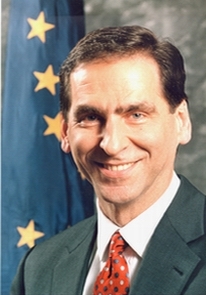
Loren Dwight Leman (Russian: Лорен Дуайт Леман; born December 2, 1950) is an American politician who served as the eighth lieutenant governor of Alaska, from 2002 to 2006. Before that, he served in both houses of the state legislature, and was elected as the Senate Majority Leader by the end of his term.[1] He served in office in electoral politics from 1989 to 2006. When Leman was elected as lieutenant governor in 2002, he was the first person of Alaska Native ancestry to be elected to statewide office in Alaska. He also has Russian-Polish ancestry.

Key Information

Early life and family

[edit]

Leman was born in Pomona, California, and grew up in Ninilchik, Alaska, in a Russian-speaking family of Alutiiq, Russian Creole, and Polish ancestry. They were commercial fishermen. He watched his father operate a fish trap during Territorial days, before this fishing method was outlawed by referendum in 1959.[citation needed]

He subsequently has worked the family salmon setnet operation on Cook Inlet near Ninilchik. He longlined for halibut in Cook Inlet and harvested herring roe on kelp in Prince William Sound. Leman traces his long family history in Alaska to the marriage in Kodiak in 1798 between a Russian shipbuilder and an Alutiiq woman from Afognak.

He graduated from Ninilchik High School in 1968. He received his bachelor's degree in civil engineering from Oregon State University in 1972 and master's degree in civil/environmental engineering from Stanford University in 1973.[2]

He and his wife Carolyn raised three children; Rachel, Joseph, and Nicole.[3] Their younger daughter, Nicole, died in a hiking accident in New Zealand in December 2015.[4][5]

Political career

[edit]

Leman joined the Republican Party in Alaska and became politically active. He was elected in 1988 to the Alaska state house, representing west Anchorage and serving until 1993. He was known as a social conservative, pro-development, pro-business, environmentally-conscious, a supporter of Alaska's military and taxpayer-friendly.

In 1992 he was elected to represent northwest Anchorage in the State Senate, serving from January 1993 to December 2002. In addition to other assignments, he chaired the Senate State Affairs, Labor & Commerce and Resources committees, and served on its Finance Committee. In his last term, he was elected as Senate Majority Leader.

Lieutenant governor

[edit]

In November 2002, Leman became the first person of Alaska Native ancestry to be elected to statewide office when he won the position of Alaska's eighth lieutenant governor. In the fall of 2002 Leman had campaigned to win the Republican nomination for lieutenant governor. His opponents were Gail Phillips, State Representative from Homer; Robin Taylor, State Senator from Wrangell; and Sarah Palin, who had been a mayor of Wasilla. Leman won. Palin was a close second, within 2,000 votes.[citation needed] She later ran for vice president on a ticket with Senator John McCain for president.

As lieutenant governor, Leman continued his interests in budget discipline, education accountability, promoting wise use of Alaska's natural resources, and supporting the right to life. Leman was an advocate for fiscal responsibility through adopting and following a five-year plan to reduce State spending by $250 million. A social conservative, he led efforts to require parental notification for girls seeking to have abortions and was a prime sponsor of a 1998 Alaska constitutional amendment that defined marriage as between one man and one woman.

He was active on the multi-state Energy Council, Pacific States Marine Fisheries Commission, and Pacific States Legislative Task Force. He taught the Alaska constitution and legislative process to Boys and Girls State delegates, "Winning Women" seminars, and has been a guest lecturer to high school and University of Alaska students.

During his four years as lieutenant governor, Leman led Alaska's Faith-Based & Community Initiatives, to develop synergies between government and Alaska's faith communities. After the initiative had been underway for a year, the White House recognized Alaska as a "role model State" for its FBCI achievements. Lieutenant Governor Leman spoke on the role of people of faith in politics and community service.

He represented the State as one of seven commissioners on the Denali Commission, a unique State-federal cooperative effort to improve health care, energy, transportation, economic opportunities and workforce development, primarily in rural Alaska. [citation needed]

There was speculation Leman might run for governor in 2006, either challenging Frank Murkowski in the primary or running for an open seat if Murkowski retired. Leman planned an announcement in February 2006, but postponed the news to talk more with his family about the decision. In late May 2006, Murkowski announced his plans to run for reelection. A few days later, Leman declined a run for the office (saying Murkowski's decision was only one of many factors) and also opted out of a second term as lieutenant governor.[6] Republican Sean Parnell succeeded Leman.

Leman spoke at a pro-life event at the Alaska Capitol in 2018,[7] stating "more and more people recognize that abortion is not a good solution. It doesn’t lead to happiness and fulfillment," and "we have lost 60 million people who could have made a difference in our world."[8]

Transportation improvements

[edit]

Loren Leman has long maintained an avid interest in transportation improvements in Alaska. He has managed projects to improve airports, was an early supporter of the Alaska Aerospace Development Corporation's launch facilities on Kodiak, served on the board of directors of the Challenger Learning Center in Kenai, and as the national chairman of the Aerospace States Association, an organization of lieutenant governors and governor-appointed delegates from space ports and academia who advise Congress on aviation and space issues. He was a sponsor of legislation to enable the Alaska Railroad to complete a track realignment and improvement project from Ship Creek to Wasilla. He has championed road, port and harbor, and building improvements and served on the Legislature's Deferred Maintenance Task Force in the mid-1990s, identifying more than $1.4 billion in infrastructure improvement needs.

His other work history includes consulting civil/environmental engineering and fishing. A registered civil engineer in Alaska, Leman has had engineering work during the past 43 years that has spanned the entire State, from Ketchikan to Kotzebue, Unalaska to Wasilla to Yakutat.

Legacy and honors

[edit]
  • In 1999 then-Senator Leman won the national Civil Government award from the American Society of Civil Engineers (ASCE), the world's premier civil engineering society, for his work in improving education, developing resources and improving transportation in Alaska.[9]

See also

[edit]

References

[edit]
[edit]
Revisions and contributorsEdit on WikipediaRead on Wikipedia
from Grokipedia
Loren Dwight Leman (born December 2, 1950) is an American civil engineer, commercial fisherman, and Republican politician who served as the eighth lieutenant governor of Alaska from 2002 to 2006 under Governor Frank Murkowski. Born in Pomona, California, Leman moved to Alaska as a child and was raised in Ninilchik on the Kenai Peninsula, where he developed interests in engineering and fishing while tracing his family roots to early Russian settlers in Kodiak dating back to the late 18th century. Prior to his executive role, Leman represented Anchorage in the from 1989 to 1993 and the Alaska State Senate from 1993 to 2002, serving as chair of the Senate Resources Committee and the Senate Labor and Commerce Committee, with a focus on resource development, , and opposition to new es such as a . During his tenure as , he presided over the state senate and handled administrative duties amid the Murkowski administration's challenges, including federal investigations into oil procurement contracts that implicated other officials but did not directly involve Leman. Post-office, Leman has engaged in civic education, teaching on the Constitution and legislative processes, and serving on nonprofit boards while maintaining his engineering and fishing professions.

Early Life and Education

Upbringing and Family Heritage

Loren Leman was born on December 2, 1950, in . He spent his formative years in Ninilchik, a small coastal community on the along in southcentral Alaska, where he was raised amid extended family. Leman grew up in a multi-generational family, assisting in the family setnet operation on and observing his father manage a fish trap during Alaska's Territorial period before statehood in 1959. This upbringing instilled a deep connection to Alaska's maritime traditions, with harvesting sustaining the family's livelihood for generations. His family heritage traces to early Russian settlement in Alaska, including a recorded marriage around 1802 in Kodiak between a Russian shipbuilder and an Alutiiq woman from Afognak Island, linking to broader ancestry among gold miners, fishermen, missionaries, and . The lineage reflects intermarriages between Russian fur traders and explorers and indigenous and Aleut peoples of Kodiak, Afognak, and other coastal areas.

Formal Education

Leman graduated from Ninilchik High School in 1968. He then pursued higher education in engineering, earning a degree in from in 1972. Following this, he obtained a degree in civil/environmental engineering from in 1973. Leman later attended the in 1976 for studies in Arctic engineering, though no additional degree was conferred from this institution.

Pre-Political Career

Engineering Profession

Leman earned a in from in 1972 and a in Civil/ from in 1973. He obtained registration as a Professional Engineer (CE 4332) in in 1977. Upon completing his graduate studies, Leman began his professional career at CH2M HILL in July 1973, serving as a and later advancing to vice president until October 1987. In this role, he managed projects involving water and wastewater systems, environmental compliance, transportation studies and designs, and business development, primarily serving clients in . In October 1987, Leman founded his independent consulting firm, Loren Leman, P.E., which he operated alongside his subsequent political service from 1989 to 2002 and resumed full-time in February 2017. Through the firm, he delivered civil and services statewide, specializing in water and sewer infrastructure, environmental investigations, permitting compliance, and transportation-related work for utilities, governmental agencies, Native organizations, and industrial clients. Leman's engineering practice accumulated over five decades of experience by the 2020s, encompassing projects that addressed needs across Alaska's diverse regions.

Fishing and Community Involvement

Leman was raised in Ninilchik, a small coastal community on the along , where has long sustained local families. Born in 1950, he grew up in a multigenerational fishing household, observing his father operate a during Alaska's territorial era before the practice was banned by voter in 1959. He subsequently participated in the family operation, working their setnet site on the Ninilchik River to harvest , a tradition continued across several generations tied to the area's indigenous and Aleut heritage in coastal regions like Kodiak and Afognak. As a self-employed commercial fisherman from to 2000, Leman contributed to Alaska's seafood industry, focusing on setnet amid the state's variable seasonal yields and regulatory changes, such as the shift away from fish traps toward more sustainable methods. This hands-on involvement reflected the economic realities of rural Alaskan communities, where provided primary and fostered self-reliance in remote areas with limited alternative employment. In Ninilchik's tight-knit setting, Leman's fishing activities intertwined with broader community life, as family-based operations like setnet sites supported local traditions of resource stewardship and mutual aid among coastal residents. His early experiences underscored the challenges of commercial fishing, including dependence on natural salmon runs and adaptation to state management policies, which shaped his later perspectives on resource utilization without formal pre-political organizational roles documented in available records.

Legislative Career

Alaska House of Representatives (1989–1993)

Loren Leman, a Republican, was elected to the in November 1988 and took office in January 1989, serving through 1992. He represented District G, covering portions of west Anchorage. During his House tenure, Leman participated in the House Liability Insurance Task Force, addressing concerns over insurance availability and costs in . He also chaired the Pacific Fisheries Legislative Task Force, which examined management and policy issues affecting 's commercial fishing industry, a key economic sector. These roles aligned with his professional experience as a and involvement in fishing communities. Specific bills sponsored by Leman in the House are not prominently documented in legislative records from this period, though his committee work contributed to broader discussions on resource development and fiscal responsibility.

Alaska State Senate (1993–2002)

Loren Leman, a Republican, was elected to the Alaska State Senate in the November 3, 1992, general election, representing District G after serving three terms in the Alaska House of Representatives from 1989 to 1992. District G encompassed west Anchorage neighborhoods including Turnagain, Spenard, and Bootleggers Cove, as well as . He was reelected in 1996 and again in the November 7, 2000, general election, securing 6,380 votes or 52.61% against Democratic challenger Therese Wilson. Leman's Senate tenure spanned the 18th through 22nd Legislatures, focusing on issues aligned with his engineering background and regional priorities such as and . During his service, Leman held committee assignments including Senate State Affairs, Corrections, (formerly Law), and the . He also served on the Committee, Labor and Committee, and Health, Education and Social Services Committee. As a , Leman sponsored measures to foster a business-friendly environment, including legislation aiding compliance with environmental regulations grounded in empirical science rather than unsubstantiated assumptions. His efforts emphasized fiscal restraint and resource-based , reflecting Alaska's reliance on oil, fisheries, and transportation . By the conclusion of his Senate term in 2002, Leman had risen to Majority Leader, a position earned through leadership in bipartisan negotiations and advocacy for practical policy reforms. His tenure contributed to legislative advancements in areas like railroad improvements, though specific bill sponsorships were often collaborative amid Alaska's resource-driven fiscal debates. Leman did not seek reelection in 2002, transitioning to his appointment as later that year.

Lieutenant Governorship

Appointment and Responsibilities (2002–2006)

Loren Leman was elected of in the November 5, 2002, , defeating Democratic nominee Fran Ulmer after securing the Republican nomination in a competitive primary on August 27, 2002, where he narrowly led with 28.9% of the vote to her 28.5%. He was sworn into office on December 2, 2002, marking the first time an individual of Alaska Native ancestry held statewide elected office in the state. Leman's term concluded on December 4, 2006, after he chose not to seek re-election. In this role, Leman administered Alaska's election laws through oversight of the Division of Elections, ensuring uniform implementation of voting procedures, , and ballot certification across the state. Statutory duties included appointing notaries public, adopting administrative regulations, and maintaining custody of the of the State of Alaska. As , he presided over legislative sessions and cast tie-breaking votes as required, while also serving as a commissioner on the Denali Commission to advance rural and initiatives. Leman's responsibilities extended to chairing the Alaska Historical Commission and participating on the Alaska Workforce Investment Board, focusing on preservation efforts and workforce development. During his tenure, he prioritized budget oversight, policy development, and election integrity, drawing from his and legislative background to promote fiscal discipline and efficient state operations.

Key Decisions and Administrative Role

As Lieutenant Governor of from December 2002 to December 2006, Loren Leman held primary administrative responsibility for overseeing the Division of Elections, including the of ballot initiatives, processes, and compliance with federal election laws such as the Help America Vote Act of 2002. This role required him to review initiative applications for compliance with Statutes, particularly AS 15.45, which mandates rejection if petitions seek unconstitutional objectives or fail statutory criteria. A notable decision involved the 2003 review of a reform initiative , where Leman received a Department of opinion assessing its substantive provisions against constitutional standards before determining eligibility. In 2005, Leman, alongside Gregg Renkes, delayed of the "Trust the People" initiative—aimed at establishing legislative term limits—after the Alaska Legislature passed similar legislation, arguing it rendered the moot; the overturned this delay, ruling that the lieutenant governor must certify qualifying applications regardless of contemporaneous legislative action, provided they are not identical to enacted laws. Such rulings underscored Leman's adherence to legal thresholds in administrative gatekeeping, though subject to judicial oversight to protect voter initiative rights under the . Beyond elections, Leman represented as one of seven commissioners and state co-chair on the Denali Commission, a federal-state partnership established by in 1998 to fund , , , , and projects in rural Alaskan communities, particularly Alaska Native villages. In this capacity, he contributed to policy oversight and budget allocations prioritizing transportation and utilities in underserved areas, aligning with the commission's mandate to leverage $15 million annual federal appropriations matched by state and local funds for . His background informed emphases on practical, needs-based projects, though specific project approvals during his tenure emphasized collaborative federal-state decision-making over unilateral actions. Leman's administrative duties also encompassed traditional lieutenant gubernatorial functions, such as advising on state policy and budgets, though his influence was constrained by appointment rather than and the Murkowski administration's hierarchical structure. These roles positioned him as a key executor of and rural advocacy, with decisions grounded in and intergovernmental cooperation rather than partisan policymaking.

Policy Contributions

Transportation and Infrastructure Advocacy

Leman's engineering background, spanning over five decades including transportation projects during his time at firms like CH2M HILL from 1973 to 1987, informed his policy focus on practical infrastructure solutions tailored to Alaska's geography. In the Alaska State Senate from 1993 to 2002, he chaired committees addressing transportation issues and contributed to legislative efforts for resource access and economic development through enhanced connectivity. These efforts earned him the 1999 ASCE Civil Government Award for advancing transportation improvements alongside education and resource policies. As from 2002 to 2006, Leman represented on the Denali Commission, one of seven commissioners tasked with prioritizing transportation upgrades in rural areas to support , , and economic opportunities. He emphasized multi-modal systems—encompassing roads, airports, marine highways, harbors, and railroads—to address the state's unique challenges, including only 13,628 miles of roadways despite comprising one-fifth of U.S. land area and 90% of communities relying on for access. In testimony before a U.S. field hearing on April 14, 2003, in , Leman advocated for full funding of the under the Transportation Equity Act reauthorization to enable predictable five-year project timelines and a fair allocation formula benefiting low-population, high-need states like . He highlighted specific priorities such as the Knik Arm Crossing to alleviate congestion between Anchorage and the Mat-Su Borough, upgrades to Lucille and Mack Drive for traffic relief and , and a new road on the for community connectivity. Leman stressed that such investments would reduce living costs, enhance medevac reliability in remote areas, and spur amid 73.6% increases in regions like the Mat-Su Valley over the prior decade, where all Anchorage-to-Fairbanks traffic funneled through Wasilla. He also underscored the role of the Alaska Marine Highway System in serving coastal communities, noting its integration into broader infrastructure for security and resource extraction.

Resource Development and Fiscal Positions

During his tenure in the Alaska State Senate from 1993 to , Loren Leman advocated for the responsible development of the state's natural , including oil, gas, and minerals, as a means to sustain jobs and in a -dependent . As a member of the , he supported policies promoting in extraction while emphasizing environmental protections grounded in rather than regulatory overreach. Leman's pro-development agenda aligned with Alaska's reliance on industries, where he sponsored to foster a business-friendly climate that encouraged exploration and supporting extraction activities. Leman participated in discussions on oil and gas policy, including testimony related to Bill 150 in 1993, which addressed incentives for marginal oil fields to bolster production in established areas like the North Slope. His involvement with the Oil and Gas Committee reflected a commitment to expanding energy development without compromising fiscal prudence, viewing resource revenues as critical to avoiding dependency on new taxes. On fiscal matters, Leman consistently prioritized spending restraint, voting for state budgets that cut general fund expenditures by more than $250 million over five years during the late and early . He opposed reinstating a personal income tax, arguing instead for smaller and reliance on resource-generated revenues to fund operations. Notably, Leman backed depositing $3 billion into special accounts for the , designating these funds as inaccessible to legislative spending to safeguard long-term fiscal stability amid volatile oil prices. This approach underscored his belief that fiscal health required curbing expenditures rather than expanding revenue sources through taxation or over-exploitation of savings.

Political Challenges and Criticisms

Association with Murkowski Administration

Loren Leman served as of from December 2, 2002, to December 4, 2006, under Governor , having been elected on the Republican ticket in November 2002. The administration encountered widespread public disapproval, stemming from Murkowski's December 2002 appointment of his daughter, , to the U.S. Senate seat vacated by his ascension to the governorship, a move decried as that alienated voters and fueled perceptions of entitlement. This decision, made without a special election, contributed to early erosion of support for the administration, with approval ratings for Murkowski dropping below 30% by mid-term. A pivotal arose in 2005 when Murkowski pursued the acquisition of a Westwind II jet for state use, initially through a $2.7 million outright purchase and later via lease-back arrangements totaling around $26 million over time, despite legislative opposition and amid state budget constraints. Critics, including lawmakers and media outlets, portrayed the jet as emblematic of administrative extravagance and detachment from Alaska's resource-dependent electorate, amplifying calls for accountability and intensifying scrutiny on the entire executive team, including Leman. Separate probes into administration aides, such as a 2008 plea by former aide tied to oil services dealings, further tarnished the government's image, though no direct charges implicated Leman. Leman's proximity to these issues manifested in political repercussions during the August 22, 2006, Republican primary for and , where the Murkowski-Leman ticket garnered only 19.4% of the vote against and Sean Parnell's 48.9%, marking a rejection attributed in large part to voter fatigue with the administration's perceived arrogance and missteps. Opponents, including Palin, campaigned explicitly against the "status quo" of the Murkowski era, linking Leman's tenure to stalled reforms on and fiscal oversight. As chief elections officer, Leman also drew challenges for disqualifying citizen initiatives when the legislature enacted parallel measures, such as in the 2003 denial of Proposition 03 USSENV (related to vacancy procedures) and the 2005 State v. Trust the People case, where sponsors contested his application of Constitution Article XI, Section 6, alleging it shielded administration priorities from direct voter input. The upheld aspects of such processes but highlighted interpretive tensions, fueling claims—primarily from initiative proponents and reform advocates—that Leman's rulings exhibited partisan favoritism toward Murkowski's agenda. These episodes underscored Leman's entanglement in the administration's defensive posture against populist pressures, ultimately diminishing his viability for future office.

2006 Primary Defeat and Aftermath

In the August 22, 2006, Republican primary for and , and were defeated by former Wasilla Mayor and her running mate, . Palin secured 51,443 votes (50.59 percent) in the gubernatorial contest, while Murkowski received approximately 19 percent, finishing third behind Palin and businessman John Binkley. As gubernatorial and lieutenant gubernatorial candidates run as a joint ticket under election law, Leman's campaign was effectively tied to Murkowski's, resulting in his primary loss without separate vote tallies reported for the race. The defeat stemmed primarily from widespread dissatisfaction with the Murkowski administration's handling of fiscal and ethical issues, including a controversial $2.4 million purchase of a luxury jet that exceeded budget projections and drew accusations of extravagance amid state budget constraints. Critics, including Palin, highlighted perceived cronyism, failure to advance a natural gas pipeline project, and increases in administrative perks, which eroded support among Republican voters seeking reform. Pre-election analyses noted growing discontent with Murkowski's leadership style, positioning Alaska as vulnerable for an incumbent loss despite its Republican leanings. Leman, who had narrowly defeated Palin in the 2002 lieutenant gubernatorial primary, faced additional scrutiny for his association with these administrative shortcomings, though specific criticisms targeted the gubernatorial ticket as a whole. Murkowski conceded the primary shortly after polls closed, pledging support for Palin as the Republican nominee, a stance Leman echoed by facilitating a smooth transition without public acrimony. Leman's term ended on December 4, 2006, when Palin and Parnell were sworn in following Palin's victory. In the immediate aftermath, Leman withdrew from elective politics, returning to private and consulting work in , where he leveraged his background as a professional and commercial . He avoided further campaigns in 2006 or 2007, focusing instead on non-political professional engagements amid the Republican Party's shift toward Palin's reform agenda.

Later Career and Legacy

Post-2006 Professional Roles

Following his tenure as Lieutenant Governor, Loren Leman resumed his professional career in civil and . From January 2007 to January 2017, he worked as a project manager, key employee, and vice president at CH2M HILL (later acquired by Jacobs Engineering) and MLFA, focusing on and systems, environmental compliance, transportation projects, and . In February 2017, he established his own firm, Loren Leman, P.E., in Anchorage, where he serves as owner and principal engineer, specializing in civil and services related to , , and . Leman has maintained his professional engineering license in (CE4332) since 1977. In addition to engineering, Leman continued his activities as a commercial fisherman, a role he held alongside public service throughout his career. Post-2006, he has held multiple appointments on advisory boards and commissions, contributing to education, community preservation, and resource management in Alaska. These include service on the University of Alaska Anchorage (UAA) College of Engineering Advisory Board and UAA School of Nursing Community Advisory Board for the last 15 years as of 2024; the Anchorage Historic Preservation Commission; the Alaska Christian College Board of Trustees; the LeTourneau University Board of Trustees; the Salvation Army Community Advisory Board; the Cook Inlet Aquaculture Association Board; the Anchorage Local Emergency Planning Committee; the Challenger Learning Center Board; and the Building Codes Task Force. Leman's civic engagements extend to mentorship and advisory roles, such as mentoring at Alaska Boys & Girls State, advising the Alaska Military Youth Academy Advisory Council and Dimond High School Engineering Academy, and judging speech contests and scholarship events. In 2022, Anchorage Mayor appointed him to the Anchorage Municipal , where he participated amid discussions on election integrity and leadership. He has also delivered presentations on Alaska's history and constitution to universities, legislatures, and community groups.

Honors, Recognitions, and Enduring Impact

Leman was awarded the 1999 Civil Government Award by the , nominated by the Section and selected nationally for his legislative efforts advancing education accountability, resource development, and transportation improvements in the state. In 2002, he became the first person of Aleut descent elected to statewide office in upon winning the lieutenant governorship. Following his tenure as , Leman continued contributions to public service through appointments to advisory roles, including the of Engineering Advisory Board, where he served for 15 years influencing and workforce development, and the Anchorage Historic Preservation Commission. He also joined the board of trustees for Christian , supporting higher education initiatives in rural . Leman's enduring impact stems from his 14 years in the Alaska Legislature (1989–2002), where he chaired committees on resources, transportation, and labor, shaping policies that prioritized infrastructure upgrades and in remote areas, as evidenced by his role on the Denali Commission advancing rural health care, energy, and transportation projects. Post-public office, his engineering practice focused on , , and environmental compliance projects, contributing to Alaska's utility infrastructure resilience over five decades. His advocacy for fiscal responsibility and pro-development stances during the Murkowski administration influenced ongoing debates on and state budgeting.

References

Add your contribution
Related Hubs
User Avatar
No comments yet.