


Community hub
Recent from talks
Contribute something
Nothing was collected or created yet.
Loricata
View on Wikipedia
| Loricata Temporal range: Olenekian - Recent,
| |
|---|---|

| |
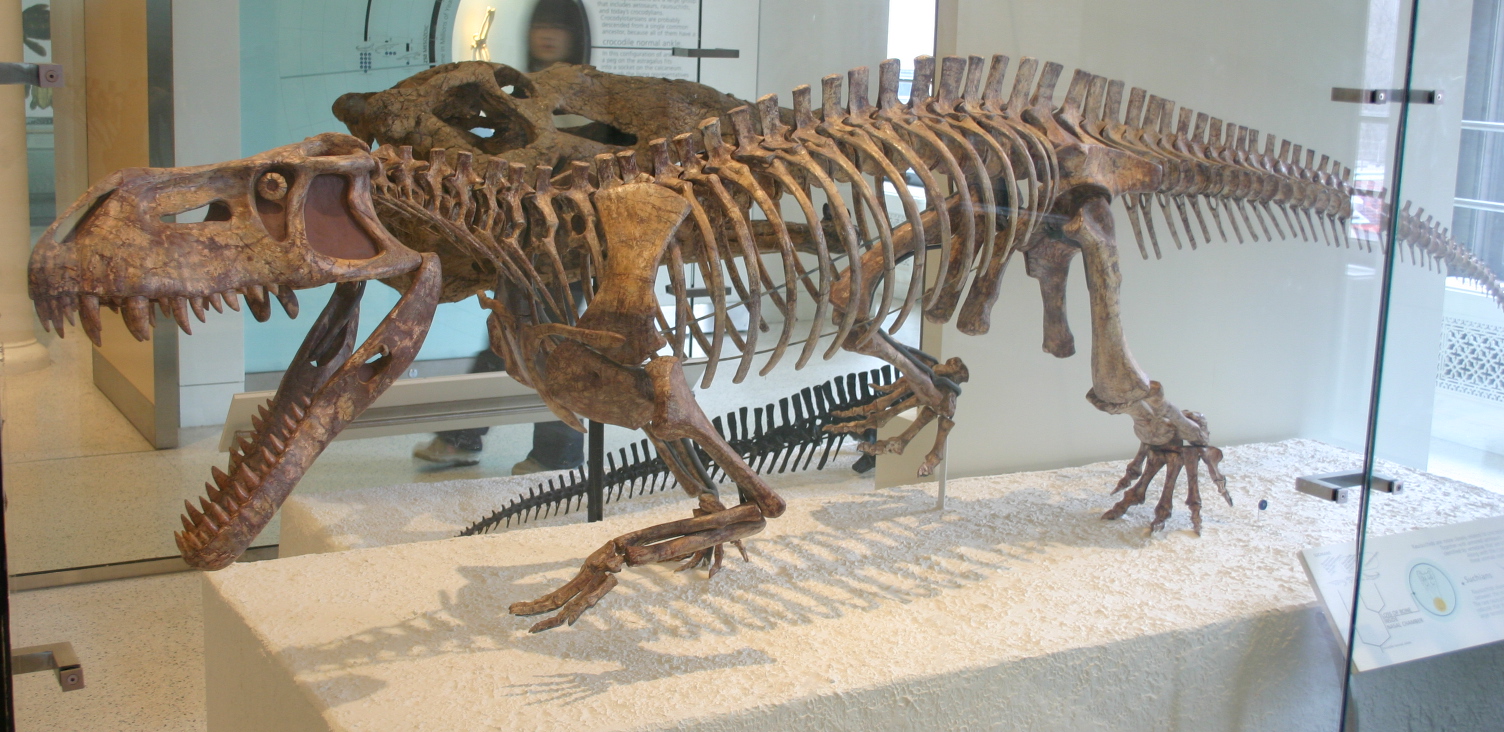
| Skeleton of Prestosuchus chiniquensis, an early loricatan. | |
Scientific classification 
| |
| Kingdom: | Animalia |
| Phylum: | Chordata |
| Class: | Reptilia |
| Clade: | Archosauria |
| Clade: | Pseudosuchia |
| Clade: | Paracrocodylomorpha |
| Clade: | Loricata Merrem, 1820 |
| Subtaxa | |
Loricata is a clade of archosaur reptiles that includes crocodilians and some of their Triassic relatives, such as Postosuchus and Prestosuchus. More specifically, Loricata includes Crocodylomorpha (the persistent archosaur subset which crocodilians belong to) and most "rauisuchians", a paraphyletic grade of large terrestrial pseudosuchians which were alive in the Triassic period and ancestral to crocodylomorphs.[1]
Loricata is one branch of the group Paracrocodylomorpha; the other branch is the clade Poposauroidea, an unusual collection of strange "rauisuchians" including bipedal, herbivorous, and sail-backed forms. The vast majority of typical "rauisuchians", which were usually quadrupedal predators, occupy basal (early-branching) rungs of Loricata leading up to crocodylomorphs.[1]
History and Classification
[edit]Loricata was initially named in a completely different context by German naturalist Blasius Merrem in his 1820 Versuch eines Systems der Amphibien. Merrem considered it to be one of three groups of Pholidota (reptiles), the other two being Testudinata (turtles) and Squamata (lizards and snakes).[2] Loricata was an early name for the order that includes crocodiles, alligators, and gharials. That order is now referred to as Crocodilia (or Crocodylia), the crocodilians.
The name Loricata gained a new phylogenetic definition in 2011. In his study of early archosaur phylogeny, paleontologist Sterling J. Nesbitt defined it as the most inclusive clade containing Crocodylus niloticus (the Nile crocodile), but not Poposaurus gracilis, Ornithosuchus longidens, or Aetosaurus ferox, all of which were extinct species of Triassic archosaurs closer to crocodilians than to dinosaurs.[1]
Nesbitt considered the following features to be synapomorphies (distinguishing features) of Loricata:
- Four teeth in the premaxilla (the toothed bone at the tip of the snout).
- A ridge on the surface of the lower branch of the squamosal (the multi-pronged bone forming the upper rear corner of the skull).
- A projection on the squamosal which encroaches the infratemporal fenestra (the boxy hole on the side of the skull behind the eye socket)
- A tall, narrow orbit (eye socket).
- A ridge for the attachment of the iliofibularis muscle positioned halfway down the length of the fibula (outer shin bone).
- A distinct gap on the calcaneum (heel bone) between the articulation for the fourth distal tarsal bone and the tip of the calcaneal tuber.
- A projection at the base of the fifth metatarsal of the foot which is separated from the end of the bone by a concave gap.
Nesbitt's phylogenetic analysis placed Crocodylomorpha and an array of "rauisuchians" within Loricata. Rauisuchidae was found to be a small clade, forming the sister taxon of Crocodylomorpha. Prestosuchidae, on the other hand, was reconfigured into a paraphyletic grade, forming a series of more basal loricatans. Loricata is the sister taxon of Poposauroidea, a group of unusual Triassic rauisuchians. Below is a cladogram of Loricata from Nesbitt (2011):[1]
| Paracrocodylomorpha |
| ||||||
França, Langer and Ferigolo (2011) found that, when added to Nesbitt's analysis (2011), Decuriasuchus was recovered as the basalmost loricatan. Its addition influenced the phylogenetic placement of Ticinosuchus as well; in Nesbitt's original analysis it was recovered outside Loricata, but when Decuriasuchus was included in the analysis, Ticinosuchus was recovered as a basal member of Loricata.[3]
Prior to 2011, poposauroids were sometimes viewed as closer relatives of crocodylomorphs than rauisuchids and "prestosuchids" were. The clade Paracrocodylomorpha was named in 1993 to include poposaurids and crocodylomorphs. Although Paracrocodylomorpha was originally designated to exclude rauisuchids and "prestosuchids", Nesbitt (2011) found that most members of those groups are closer to crocodylomorphs than poposauroids are. Thus, Paracrocodylomorpha was redefined into a two-pronged group, one prong containing poposauroids and the other (i.e., Loricata) including crocodylomorphs, rauisuchids, and "prestosuchids". Loricata is considered to be a subgroup of Paracrocodylomorpha according to this redefinition.[1]
A clade called Paracrocodyliformes was erected in 2007 in which rauisuchids and prestosuchids were more closely related to Crocodylomorpha, and poposauroids were the most basal group.[4] This usage is similar to Loricata.
References
[edit]- ^ a b c d e Nesbitt, S.J. (2011). "The early evolution of archosaurs: relationships and the origin of major clades". Bulletin of the American Museum of Natural History. 352: 1–292. doi:10.1206/352.1. hdl:2246/6112.
- ^ Merrem, B. (1820). Versuch eines Systems der Amphibien. Krieger. p. 191.
- ^ Marco Aurélio G. França; Max C. Langer; Jorge Ferigolo (2011). "Incorporating Decuriasuchus quartacolonia (Pseudosuchia) into the archosaur phylogeny". Ameghiniana. 48 (Supplement to 4): R63. Archived from the original on 2014-11-29. Retrieved 2012-12-31.
- ^ Weinbaum, J.C.; Hungerbühler, A. (2007). "A revision of Poposaurus gracilis (Archosauria: Suchia) based on two new specimens from the Late Triassic of the southwestern U.S.A.". Paläontologische Zeitschrift. 81 (2): 131–145. Bibcode:2007PalZ...81..131W. doi:10.1007/BF02988388. S2CID 84822632.
| |||||||||||||||||||||||||||||||
| |||||||||||||||||||||||||||||||
| |||||||||||||||||||||||||||||||


Loricata
View on GrokipediaTaxonomy
History of classification
The name Loricata was proposed in 1817 by Christian Friedrich Schumacher as a class within Mollusca, referring to the armored shell structure of chitons resembling a lorica (Latin for "armor" or "coat of mail").[5] This designation emphasized the distinctive eight-plated dorsal shell and was part of early 19th-century efforts to classify marine invertebrates based on shell morphology. In 1821, George Robert Gray established the class Polyplacophora, which quickly became the preferred name, rendering Loricata a synonym.[6] Early classifications grouped chitons with other mollusks like aplacophorans under Amphineura, but by the late 19th century, Polyplacophora was recognized as a distinct class due to unique features such as the serial gills and radula structure.[7] Fossil discoveries from the Late Cambrian onward confirmed their ancient origins, influencing revisions that separated extinct forms into Palaeoloricata. Modern taxonomy, informed by molecular phylogenetics, places Polyplacophora as a basal aculiferan clade sister to other mollusks.[7]Definition and diagnosis
Loricata, synonymous with Polyplacophora, is defined as the class of mollusks characterized by a dorsal shell composed of eight transverse, overlapping calcareous plates (valves) articulated by a girdle of muscular and calcareous tissue.[6] This class encompasses approximately 1,000 extant species and over 430 fossil species, primarily marine but with rare freshwater records.[7] Diagnostic features include a dorsoventrally flattened body with a broad ventral foot for adhesion and locomotion; a chitinous radula for grazing; and gills arranged in series along the mantle cavity for respiration.[7] The shell plates bear sensory aesthetes for light and chemical detection, and the girdle often features spines or scales for protection. These traits distinguish Polyplacophora from other mollusks, such as gastropods (which have a single coiled shell) or bivalves (with two valves). Early fossils like those from the Late Cambrian exhibit these features, confirming the clade's antiquity.[6]Included groups
Polyplacophora is divided into two main subclasses: the extant Neoloricata, which includes all living species (~940 as of 2023), and the extinct Palaeoloricata, known only from fossils dating from the Late Cambrian to the Late Cretaceous.[6] Neoloricata further comprises three orders: Lepidopleurida (deep-sea forms with smooth valves), Chitonida (shallow-water species with diverse ornamentation), and Callochitonida (intermediate forms).[8] Palaeoloricata lacks sutural laminae on the valves and represents primitive chitons, with genera like Matthevia from the Cambrian illustrating early diversification. The total known diversity includes about 20 families, predominantly in Neoloricata, reflecting adaptation to rocky substrates across global marine environments.[7]Description
Cranial features
The skulls of non-crocodylomorph loricatans exhibit an elongate rostrum adapted for a predatory lifestyle, featuring ziphodont teeth that are labiolingually compressed, recurved, and finely serrated along their mesial and distal carinae. In Postosuchus kirkpatricki, the premaxilla is subrectangular and slightly longer than deep, housing four such teeth, while the maxilla bears 13 alveoli with similar dentition, including approximately three serrations per millimeter on the posterior teeth, facilitating slashing and tearing of prey.[9] Prestosuchus chiniquensis displays comparable morphology, with four premaxillary teeth serrated at four denticles per millimeter and 13 maxillary teeth at three to four denticles per millimeter, emphasizing the hypercarnivorous adaptations shared across the group.[10] Cranial fenestration in loricatans supports robust jaw mechanics, with the antorbital fenestra typically wedge-shaped and present but variably proportioned relative to skull length, bordered by the maxilla, nasal, and lacrimal. The supratemporal fenestra is notably large and ovate, bordered by the parietal, postorbital, and squamosal, providing expansive attachment areas for the jaw adductor muscles such as the m. adductor mandibulae externus.[9][10] The quadrate bone is oriented anterodorsally to posteroventrally, with distinct medial and lateral condyles and a quadrate foramen, enabling a wide gape essential for ambushing large prey; palatal teeth on the pterygoids, when present, further aid in grasping by forming a secondary tooth row along the palate.[10][11] Variations in cranial morphology reflect evolutionary progression within Loricata. Basal forms like Decuriasuchus quartacolonia retain a more primitive, shorter rostrum with a subtriangular antorbital fenestra and 17 maxillary teeth, indicating less specialized elongation compared to derived taxa.[12] Advanced rauisuchids, such as Saurosuchus galilei, feature deeper skulls with rectangular lateral profiles and convex ventral margins, enhancing structural support despite relatively modest bite forces estimated at 1015–1885 N, suited for defleshing rather than bone-crushing.[13] Sensory adaptations include large, keyhole-shaped orbits in Postosuchus, bordered by the prefrontal, postfrontal, postorbital, and jugal, suggesting enhanced visual acuity; the forward-facing orientation of these orbits, combined with the infratemporal fenestra, likely permitted some degree of binocular vision for prey localization.[9]Postcranial skeleton
The postcranial skeleton of Loricata exhibits a robust axial column adapted for supporting large body sizes and facilitating movement. The vertebral column typically includes 7–9 cervical vertebrae in basal forms like Decuriasuchus and Prestosuchus, though some rauisuchids such as Postosuchus possess up to 10–12 elongated cervicals that enhance neck flexibility for prey manipulation.[14] Dorsal vertebrae number around 13–15, with pronounced ventral keels on cervicals and amphicoelous centra; presacral counts reach 25 in Prestosuchus.[15] Gastralia form a series of overlapping rods providing abdominal support and rigidity, as seen in Postosuchus specimens.[16] Limb morphology in Loricata varies but emphasizes powerful hindlimbs for propulsion. In large rauisuchids like Postosuchus, hindlimbs are pillar-like with straight femora and robust tibiae, supporting body weights up to several tons and enabling rapid terrestrial locomotion; forelimbs are notably reduced, with humeri shorter than femora, indicating facultative bipedality in some taxa.[17] Basal loricatans such as Decuriasuchus retain more equal fore- and hindlimb proportions, suggesting quadrupedality.[18] The pelvic girdle in basal Loricata features a crocodile-like, imperforate acetabulum formed by the ilium, ischium, and pubis, providing a stable articulation for the femur.[19] The ilium bears a prominent supra-acetabular crest for muscle attachment, while the pubis and ischium often show slight distal expansions; sacral vertebrae incorporate 2–3 elements, varying across the clade, to bolster pelvic stability.[14] In crocodylomorphs, the acetabulum evolves toward a more open configuration, enhancing hip mobility.[20] The tail in Loricata is long and muscular, comprising numerous caudals that aid in balance and propulsion. Caudal vertebrae elongate distally, with haemal arches (chevrons) beginning from the third vertebra; these Y-shaped chevrons, as in Prestosuchus, feature separated proximal facets and enhance tail flexibility while supporting lateral undulation.[14][16] Body sizes in Loricata span a wide range, from small basal taxa around 1–2 meters in length, such as certain Middle Triassic forms, to giants exceeding 7 meters like Fasolasuchus, reflecting diverse ecological roles within Pseudosuchia.[21][22]Phylogeny
Position within Mollusca
Polyplacophora, synonymous with Loricata, is a class of mollusks positioned within the phylum Mollusca as part of the Aculifera clade, which also includes the aplacophoran classes Solenogastres and Caudofoveata.[23] Aculifera forms one of the two major lineages of Mollusca, sister to the Conchifera (which encompasses gastropods, bivalves, cephalopods, and others), a topology supported by genomic, mitogenomic, and morphological data.[23][7] This placement highlights Polyplacophora's basal position among mollusks, with fossil evidence indicating an origin in the Late Cambrian, around 500 million years ago, predating the diversification of Conchifera.[23] The monophyly of Polyplacophora is well-established, characterized by synapomorphies such as the eight-plated dorsal shell (valves) and a creeping foot with a girdle.[24] Within Aculifera, Polyplacophora diverged early, with molecular clock estimates suggesting a split from other aculiferans around 440 million years ago during the Silurian.[23] Recent phylogenomic analyses, incorporating whole-genome data from species like Acanthochitona discrepans and Boreochiton ruber, confirm this deep divergence and reveal high rates of chromosomal rearrangements despite conserved morphology.[23] Polyplacophora's ancient lineage underscores its role as a key group for understanding early molluscan evolution, bridging fossil records with modern biodiversity of approximately 1,000 extant species.[24]Interrelationships
Internally, Polyplacophora is divided into two subclasses: the extinct Palaeoloricata, known from Cambrian to Jurassic fossils with more primitive shell structures, and the Neoloricata, which includes all extant species and features more derived valve articulation.[6] Within Neoloricata, phylogenomic and mitogenomic studies resolve three main orders: Lepidopleurida (basal, including families like Leptochitonidae), Callochitonida, and Chitonida.[24][7] Chitonida, the most diverse order, further splits into suborders Chitonina (encompassing Chitonoidea and Schizochitonoidea) and Acanthochitonina (including Mopalioidea and Cryptoplacoidea).[24] Callochitonidae is positioned as sister to the rest of Chitonida, while Lepidopleurida forms the basal grade.[7] These relationships are corroborated by analyses of 13 mitochondrial genomes and transcriptomic data, identifying gene rearrangements like tRNA inversions as synapomorphies for certain clades.[7] A simplified cladogram of Polyplacophora, based on recent phylogenomic datasets, illustrates these relationships as follows:Polyplacophora
├── Palaeoloricata (extinct)
└── Neoloricata
├── Lepidopleurida
├── Callochitonida
└── Chitonida
├── Chitonina
│ ├── Chitonoidea
│ └── Schizochitonoidea
└── Acanthochitonina
├── Mopalioidea
└── Cryptoplacoidea
Polyplacophora
├── Palaeoloricata (extinct)
└── Neoloricata
    ├── Lepidopleurida
    ├── Callochitonida
    └── Chitonida
        ├── Chitonina
        │   ├── Chitonoidea
        │   └── Schizochitonoidea
        └── Acanthochitonina
            ├── Mopalioidea
            └── Cryptoplacoidea
Evolutionary history
Origins and diversification
Loricata likely originated in the Early Triassic, during the Olenekian stage, evolving from basal pseudosuchians shortly after the Permian-Triassic mass extinction event that eliminated much of the late Paleozoic terrestrial vertebrate fauna. This emergence positioned Loricata as part of the broader archosaur radiation, with phylogenetic analyses indicating a ghost lineage extending back to the Induan from more complete Middle Triassic records. The earliest definitive fossil records of loricatans appear in Induan-Anisian deposits across Gondwana, including localities in present-day Argentina, Brazil, and South Africa, where fragmentary remains suggest an initial Gondwanan distribution. In the wake of the extinction, Loricata rapidly diversified into hypercarnivorous roles, exploiting unoccupied apex predator niches amid the slow recovery of continental ecosystems, as evidenced by increased archosauromorph disparity and evolutionary rates in the Olenekian.[25] A pronounced diversification pulse occurred in the Middle Triassic (Anisian-Ladinian), marking an "explosion" of basal loricatans that adapted to diverse terrestrial habitats, exemplified by Decuriasuchus quartacolonia from the Santa Maria Formation in southern Brazil, a quadrupedal carnivore reaching approximately 2.5 meters in length. This radiation was driven by post-extinction environmental stabilization, the expansive connectivity of the supercontinent Pangaea facilitating dispersal, and incipient ecological pressures from contemporaneous theropod dinosaurs. However, the fossil record reveals significant gaps, particularly sparse Induan material, which implies that loricatan origins may be rooted in undersampled regions of Gondwana, such as interior Africa, where Early Triassic sediments remain poorly explored.Decline and extinction of non-crocodylomorphs
During the Carnian and Norian stages of the Late Triassic, non-crocodylomorph loricatans, often referred to as rauisuchians, achieved their peak diversity and ecological dominance as apex predators across both Laurasia and Gondwana, coexisting with the early radiation of dinosaurs (avemetatarsalians).[26] Iconic giants such as Postosuchus kirkpatricki in North American Laurasian assemblages and Prestosuchus chiniquensis in South American Gondwanan formations exemplified this era, reaching body lengths of 4–6 meters and filling top carnivore niches in continental ecosystems.[27][28] These predators contributed to a broader pseudosuchian dominance, with rauisuchians comprising a significant portion of large-bodied terrestrial faunas before the close of the Norian. The decline of non-crocodylomorph loricatans accelerated toward the end of the Late Triassic, culminating in their extinction during the end-Triassic mass extinction event approximately 201.4 million years ago.[29] This event, triggered by massive volcanic eruptions from the Central Atlantic Magmatic Province (CAMP), released pulses of greenhouse gases and toxins, leading to rapid climate warming, acid rain, and environmental stress that disproportionately affected large, terrestrial hypercarnivores.[30] Concurrently, increasing competition from diversifying avemetatarsalians, which exhibited greater morphological disparity in the Late Triassic despite lower species richness, likely intensified ecological pressures on rauisuchians sharing similar predatory niches.[31] Non-crocodylomorph loricatans vanished from the fossil record by the Rhaetian stage, with no definitive remains documented beyond the early Late Norian, marking a selective extinction that spared only the Crocodylomorpha within Loricata.[32] Early crocodylomorphs survived through reductions in body size (often under 2 meters) and shifts to semi-aquatic habitats, which buffered them against the terrestrial disruptions of the extinction.[33] In contrast, the larger, more endothermic non-crocodylomorphs, adapted to high-metabolism terrestrial lifestyles, succumbed to the physiological stresses of the event.[33] Following the extinction, Crocodylomorpha underwent a rapid adaptive radiation in the Early Jurassic, diversifying into a wide array of forms and eventually evolving specialized aquatic adaptations that characterize modern crocodylians.[34] This post-extinction legacy highlights a survivor bias within Loricata, where the crocodylomorph lineage represents the sole persistent branch to the present day, embodying less than 1% of the original Triassic diversity of the clade.[34]Paleobiology
Locomotion and adaptations
Members of Loricata exhibited diverse locomotor strategies shaped by their skeletal morphology, ranging from terrestrial pursuits to semi-aquatic lifestyles. In non-crocodylomorph loricatans such as rauisuchids, locomotion was primarily quadrupedal with semi-erect hindlimbs, enabling a parasagittal gait that supported efficient terrestrial movement. For instance, Postosuchus kirkpatricki possessed a crurotarsal ankle and elongated hindlimbs relative to forelimbs, facilitating an upright posture during locomotion, though debates persist on whether it was strictly quadrupedal or capable of facultative bipedality.[35][36] This semi-erect configuration, inferred from femoral curvature and trochanter positioning, allowed for bursts of speed suited to ambush predation rather than sustained pursuit, with biomechanical models estimating walking speeds of approximately 10-15 km/h and short sprints up to 20 km/h based on limb proportions and trackway analyses.[37][36] Within crocodylomorphs, the clade's stem members transitioned from terrestrial to semi-aquatic habits during the Early Jurassic, evolving sprawling gaits that contrasted with the more erect postures of their loricatan relatives. This shift supported proal (forward-directed) limb motion on land, minimizing lateral undulation for energy-efficient travel, while facilitating adaptation to aquatic environments.[38] Early forms like sphenosuchians retained relatively erect limbs for versatile terrestrial-aquatic movement, but later neosuchians and thalattosuchians developed reduced, paddle-like limbs that enhanced steering during swimming, prioritizing ambush strategies in riparian and coastal habitats over agile terrestrial pursuit.[39][38] Key adaptations across Loricata included a muscular, elongated tail for propulsion, particularly evident in semi-aquatic crocodylomorphs where undulatory tail motion generated thrust during swimming, outperforming limb-based locomotion in water.[38] Limb robusticity varied with habitat and predation ecology; robust femora in larger terrestrial rauisuchids like Postosuchus supported weight-bearing in open terrains, correlating with strategies for overpowering large prey, whereas slenderer limbs in basal crocodylomorphs aligned with agile maneuvers in vegetated or riparian zones.[36] Osteoderms, while providing armor, permitted segmental flexibility in the axial skeleton, aiding tail oscillation and body undulation essential for both terrestrial stability and aquatic efficiency, though their presence constrained extreme spinal bending compared to non-armored taxa.[40] Speed estimates for basal loricatans suggest walking paces of 10-15 km/h, with advanced terrestrial forms achieving burst speeds of 25 km/h via optimized hindlimb ratios, underscoring adaptations for predatory efficiency across diverse environments.[36]Diet and predatory role
Loricatans were predominantly hypercarnivorous, with their diet consisting primarily of vertebrate flesh, as evidenced by the ziphodont dentition characteristic of most members of the clade. These teeth, labiolingually compressed, recurved, and serrated along their margins, were adapted for slicing and tearing soft tissues from prey, minimizing direct contact with bone to avoid damage.[35] Some basal members exhibit more conical or needle-like teeth, suggesting piscivorous specializations targeting fish and other aquatic vertebrates.[35] Bite marks on aetosaur osteoderms from the Chinle Formation, featuring parallel grooves consistent with ziphodont tooth profiles of large pseudosuchians including loricatans such as Postosuchus, support predation or scavenging on armored herbivores.[41] Predatory strategies varied with habitat and body plan, reflecting the clade's ecological versatility. Semi-aquatic rauisuchids, such as those inferred from robust builds and environmental associations, likely employed ambush tactics to capture prey near water margins, using powerful initial bites to subdue victims before defleshing.[13] Terrestrial forms like Postosuchus, equipped with elongated limbs for cursorial movement, pursued larger herbivores including prosauropods and dicynodonts across open terrains, targeting juveniles or subadults to overcome size disparities.[35] Finite element modeling of skulls, such as that of Saurosuchus galilei, reveals relatively weak posterior bite forces (around 1885 N), suited for puncturing and pulling flesh rather than crushing bone, aligning with a strategy focused on evisceration over osteophagy.[13] Within Triassic food webs, loricatans occupied apex or mesopredator trophic levels, exerting top-down control on ecosystems recovering from the Permian-Triassic extinction. As the largest carnivores in many Middle to Late Triassic assemblages, they filled vacant predatory niches, preying on dominant herbivores like rhynchosaurs and aetosaurs while suppressing smaller carnivores through competition and interference.[4] Their role as keystone species is inferred from biomechanical evidence suggesting inefficient carcass utilization, which would have generated carrion for scavengers and regulated herbivore populations before the rise of large theropod dinosaurs.[13] In South American and North American faunas, loricatans like Prestosuchus and Postosuchus dominated as the primary large-bodied predators, maintaining ecosystem stability amid high faunal diversity.[42] Dietary variations emerged across loricatan lineages, particularly in crocodylomorph ancestors. While core rauisuchians remained strictly carnivorous, early crocodylomorphs exhibited shifts toward durophagy in some branches, with robust, blunt teeth enabling the crushing of armored prey like turtles or shelled invertebrates, as seen in later forms like Acynodon adriaticus.[43] This adaptation likely arose as a niche specialization in response to prey availability, contrasting the flesh-tearing focus of basal loricatans. Stable isotope analyses of North American Triassic fossils, including δ¹³C and δ¹⁵N signatures from bone collagen, indicate reliance on terrestrial protein sources with elevated trophic positions, supporting a diet dominated by C₃-plant-fed herbivores rather than aquatic resources.[44]References
- https://en.wikisource.org/wiki/Natural_History%2C_Reptiles/Loricata