Hubbry Logo
LoriiniLoriiniMain
Open search
Loriini
Community hub
Loriini
logo
8 pages, 0 posts
0 subscribers
Be the first to start a discussion here.
Loriini
Loriini
from Wikipedia
Loriini
Collared lory (Vini solitaria), 1876
Scientific classification Edit this classification
Kingdom: Animalia
Phylum: Chordata
Class: Aves
Order: Psittaciformes
Family: Psittaculidae
Subfamily: Loriinae
Tribe: Loriini
Selby, 1836
Genera

Oreopsittacus
Charminetta
Hypocharmosyna
Charmosynopsis
Charmosyna
Vini
Neopsittacus
Lorius
Psitteuteles
Parvipsitta
Chalcopsitta
Glossoptilus
Trichoglossus

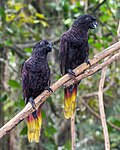
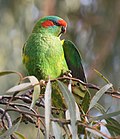
Loriini is a tribe of small to medium-sized arboreal parrots characterized by their specialized brush-tipped tongues for feeding on nectar of various blossoms and soft fruits, preferably berries.[1] The species form a monophyletic group within the parrot family Psittaculidae. The group consists of the lories and lorikeets. Traditionally, they were considered a separate subfamily (Loriinae) from the other subfamily (Psittacinae) based on the specialized characteristics, but recent molecular and morphological studies show that the group is positioned in the middle of various other groups. They are widely distributed throughout the Australasian region, including south-eastern Asia, Polynesia, Papua New Guinea, Timor Leste and Australia, and the majority have very brightly coloured plumage.

Etymology

[edit]

The word "lory" comes from the Malay lūri, a name used for a number of species of colourful parrots.[2] The name was used by the Dutch writer Johan Nieuhof in 1682 in a book describing his travels in the East Indies.[3] The spelling "laurey" was used by English naturalist Eleazar Albin in 1731 for a species of parrot from Brazil,[4] and then in 1751 the English naturalist George Edwards used the spelling "lory" when introducing names for five species of parrot from the East Indies in the fourth volume of his A Natural History of Uncommon Birds. Edwards credited Nieuhof for the name.[5]

The choice of the terms "lory" and "lorikeet" is subjective, like the use of "parrot" and "parakeet". Species with longer tapering tails are generally referred to as "lorikeets", while species with short blunt tails are generally referred to as "lories".[6]

Taxonomy

[edit]

Traditionally, lories and lorikeets have either been classified as the subfamily, Loriinae, or as a family on their own, Loriidae,[7] but they are currently classified as a tribe. Neither traditional view is confirmed by molecular studies. Those studies show that the lories and lorikeets form a single group, closely related to the budgerigar and the fig parrots (Cyclopsitta and Psittaculirostris).[8][9][10][11][12]

A comprehensive molecular phylogenetic study of the Loriini published in 2020 led to major changes in the generic boundaries. The reorganisation involved the resurrection of four genera: Charminetta, Hypocharmosyna, Charmosynopsis and Glossoptilus, as well as the erection of three entirely new genera: Synorhacma, Charmosynoides and Saudareos. One genus disappeared, as the collared lory, which had previously been placed in the monotypic genus Phigys, was found to be embedded in the genus Vini. The extinct New Caledonian lorikeet, although not sampled, was assumed to be a member of the genus Vini on plumage and biogeographic grounds. The tribe Loriini now contains 61 species divided into 13 genera.[13][14][15]

Loriini

Oreopsittacus – Plum-faced lorikeet

Charminetta – Pygmy lorikeet

Hypocharmosyna – 2 species

Charmosynopsis – 2 species

Charmosyna – 4 species

Vini – 12 species

Neopsittacus – 2 species

Lorius – 6 species

Psitteuteles – Varied lorikeet

Parvipsitta – 2 species

Chalcopsitta – 5 species

Glossoptilus – Goldie's lorikeet

Trichoglossus – 22 species

Phylogeny of the Loriini based on a genetic study published in 2020.[13][14][15]

Genera

[edit]
Image Genus Living species
Oreopsittacus Salvadori, 1877
Charminetta Iredale, 1956
Hypocharmosyna Salvadori, 1891
Charmosynopsis Salvadori, 1877
Charmosyna Wagler, 1832
Vini Lesson, R, 1833
Neopsittacus Salvadori, 1875
Lorius Vigors, 1825
Psitteuteles Bonaparte, 1854
Parvipsitta Mathews, 1916
Chalcopsitta Bonaparte, 1850
Glossoptilus Rothschild and Hartert, 1896
Trichoglossus Stephens, 1826

Morphology

[edit]
Tongue of a lory

Lories and lorikeets have specialized brush-tipped tongues for feeding on nectar and soft fruits. They can feed from the flowers of about 5,000 species of plants and use their specialized tongues to take the nectar. The tip of their tongues have tufts of papillae (extremely fine hairs), which collect nectar and pollen.

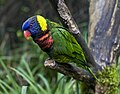
The multi-coloured rainbow lorikeet was one of the species of parrots appearing in the first edition of The Parrots of the World and also in John Gould's lithographs of the Birds of Australia.

Diet

[edit]

In the wild, rainbow lorikeets feed mainly on pollen and nectar, and possess a tongue adapted especially for their particular diet. Many fruit orchard owners consider them a pest, as they often fly in groups and strip trees containing fresh fruit. They are also frequent visitors at bird feeders that supply lorikeet-friendly treats, such as store-bought nectar, sunflower seeds, and fruits such as apples, grapes and pears.[16] Occasionally they have been observed feeding on meat.[17]

Conservation

[edit]
Rainbow lorikeet drinking

The ultramarine lorikeet is endangered. It is now one of the 50 rarest birds in the world. The blue lorikeet is classified as vulnerable. The introduction of European rats to the small island habitats of these birds is a major cause of their endangerment.[18] Various conservation efforts have been made to relocate some of these birds to locations free of predation and habitat destruction.

In literature

[edit]

A "Lory" famously appears in Chapter III of Lewis Carroll's Alice's Adventures in Wonderland. Alice argues with the Lory about its age.

[edit]

References

[edit]
[edit]
Revisions and contributorsEdit on WikipediaRead on Wikipedia
from Grokipedia
Loriini is a tribe of small to medium-sized, arboreal parrots in the subfamily Loriinae of the family Psittacidae, renowned for their specialized brush-tipped tongues that enable efficient feeding on nectar, pollen, and soft fruits from blossoms. These nectarivorous birds display extraordinary plumage diversity, with colors including vivid greens, reds, blues, and yellows, often serving as a key identifying feature despite historical challenges in taxonomic classification due to this variability. Comprising 58 species across 15 genera, Loriini are endemic to the Indo-West Pacific region, spanning from the Philippines and Sulawesi through New Guinea and Australia to Polynesia and other Pacific islands. The of Loriini has undergone significant revision in recent decades, informed by phylogenomic analyses integrating ultraconserved elements and , which confirm their monophyletic status within Loriinae—a that also encompasses the fig parrots (Cyclopsittini) and budgerigars (Melopsittacini). Key genera include , Charmosyna, Lorius, and , with updates as of introducing new genera such as Saudareos and Charmosynoides and further refinements in 2024 to better reflect evolutionary relationships. Molecular studies suggest an origin in , followed by rapid diversification and dispersal across the , driven by a mosaic of processes including and ecological adaptation. Loriini species are primarily canopy-dwelling, often forming noisy flocks in rainforests, mangroves, and flowering woodlands, where their acrobatic feeding behaviors and vocalizations contribute to their ecological as pollinators. While many are classified as Least Concern by the IUCN, several face threats from , , and illegal pet trade, with Critically Endangered taxa like the ultramarine lorikeet (Vini ultramarina) highlighting conservation priorities through and habitat protection efforts. Their popularity in underscores both their charismatic appeal and the need for sustainable practices to mitigate wild population declines.

Taxonomy and Classification

Etymology

The term "lory" originates from the Malay word lūri (a variant of nuri), referring to various colorful parrots, and first entered European literature in 1682 through Dutch traveler Johan Nieuhof's account of his journeys in the East Indies. This name was adopted into English in the mid-18th century, notably by naturalist George Edwards in his 1751 work A Natural History of Uncommon Birds, where he applied "lory" specifically to short-tailed species of these parrots. During the , a distinction arose in common between "lory," denoting with short, blunt tails, and "lorikeet," for those with longer, tapering tails; the latter term emerged as a of "lory," patterned after "." This subjective differentiation, akin to the broader parrot- divide, reflects early observations of morphological variations among these birds but lacks strict taxonomic basis. The scientific tribe name Loriini was formally established in 1836 by British ornithologist Prideaux John Selby within the family , encompassing the lories and lorikeets as a distinct group in his contribution to The Naturalist's Library: Ornithology—Parrots.

Phylogenetic Relationships

The tribe Loriini, comprising the lories and lorikeets, is classified within the subfamily Loriinae of the family Psittacidae, based on molecular phylogenetic analyses that have refined parrot taxonomy since the early 2000s. Earlier classifications often treated Loriini as a distinct subfamily (Loriinae) or even a separate family (Loriidae), but comprehensive genetic studies from 2015 onward have integrated it into the broader Psittacidae structure while maintaining its tribal status due to shared morphological and genetic traits with other Old World parrots. These revisions emphasize Loriini's monophyly, supported by analyses of mitochondrial DNA (e.g., cytochrome b) and multiple nuclear genes (e.g., RAG-1, osteocalcin, and myoglobin intron 2), which consistently place the tribe as a cohesive clade. Phylogenetic evidence indicates that Loriini originated in during the mid-Miocene, approximately 14.2 million years ago, with subsequent diversification across the region through repeated founder-event speciation and island hopping. This pattern is inferred from time-calibrated trees derived from multilocus datasets, revealing rapid radiations linked to ecological opportunities in nectar-rich habitats. Loriini forms a monophyletic group closely related to the fig parrots of tribe Cyclopsittini, with their common ancestor diverging around 19.3 million years ago, as shown in recent phylogenomic reconstructions using ultraconserved elements (UCEs) that sampled nearly all Loriini species. A major taxonomic revision in incorporated genomic data from over 3,700 UCE loci, leading to significant genus-level reorganizations within Loriini and the recognition of 17 genera to better reflect evolutionary relationships and resolve paraphyletic assemblages. This update, building on the 2015 multilocus framework, introduced new genera such as Saudareos and Charmosynoides while reinstating others like Glossopsitta, ensuring the classification aligns with phylogenetic history rather than outdated morphological groupings.

Genera and Species Diversity

The tribe Loriini encompasses 59 species distributed across 17 genera, reflecting a taxonomic revision that refined the classification based on phylogenetic analyses of genetic and morphological data. This diversity highlights the group's evolutionary radiation within the region, with genera varying in size from monotypic to multispecies assemblages adapted to diverse island and mainland habitats. Key genera within Loriini include the monotypic Oreopsittacus, represented by the plum-faced lorikeet; Neopsittacus with two species; the resurrected Charminetta containing two species such as the Duchess lorikeet; the resurrected Hypocharmosyna with three species; the resurrected Charmosynopsis with one species; the resurrected Glossoptilus with one species; the newly established Synorhacma with one species; the new Charmosynoides with two species; the new Saudareos with three species including the collared lory; Vini comprising nine species of Pacific lorikeets; Eos with six species known as red lories; Trichoglossus encompassing nine species of rainbow lorikeets; Psitteuteles with two species; Lorius with five species such as the purple-naped lory; Chalcopsitta with four species including the black lory; Glossopsitta with three species such as the musk lorikeet; and Pseudeos with two species. These groupings emphasize the tribe's morphological and ecological specialization, particularly in nectarivory.
GenusSpecies CountRepresentative Examples
Oreopsittacus1Plum-faced lorikeet
Neopsittacus2Yellow-billed lorikeet, orange-billed lorikeet
Charminetta2Duchess lorikeet
Hypocharmosyna3Meek lorikeet, racket-tailed lorikeet
Charmosynopsis1Yellow-throated lorikeet
Glossoptilus1Ross's lorikeet?
Synorhacma1Finsch's lorikeet?
Charmosynoides2New Caledonian lorikeet, lorikeet?
Saudareos3Collared lory
Vini9 lorikeet
6
9
Psitteuteles2Olive lorikeet
Lorius5Purple-naped lory
Chalcopsitta4Black lory
Glossopsitta3
Pseudeos2Duchess of Burgundy lory
Recent taxonomic developments stem from a comprehensive phylogenetic study that identified non-monophyly in larger genera, leading to the of four genera (Charminetta, Hypocharmosyna, Charmosynopsis, Glossoptilus) and the of three new ones (Synorhacma, Charmosynoides, Saudareos), largely through splits from the polyphyletic former Charmosyna. These adjustments, implemented in major checklists, enhance the alignment of with evolutionary history. As of 2025 checklists like the IOC World Bird List (v15.1) and eBird , no significant alterations to Loriini diversity have occurred since the revision, indicating taxonomic stability.

Physical Characteristics

General Morphology

Loriini, commonly known as lories and lorikeets, encompass a diverse group of small to medium-sized parrots within the family , with body lengths ranging from approximately 13 cm in the pygmy lorikeet (Charminetta wilhelminae) to 31 cm in species like the (Lorius lory), and weights typically between 20 g and 280 g, though most species measure under 25 cm and weigh less than 150 g. These dimensions reflect their to arboreal lifestyles in forested environments, where compact forms facilitate agile movement among branches and foliage. The body shape of Loriini is characteristic of arboreal parrots, featuring a streamlined with a rounded head, robust zygodactylous feet suited for perching and grasping, and a strong, curved bill that enables cracking open fruits and seeds. This morphology varies from stocky builds in genera like Lorius to more slender profiles in Charmosyna, but all share a conserved psittaciform plan optimized for climbing and short-distance flight. The bill is generally short and hooked, with a down-curved upper and an upturned lower one, aiding in manipulation of food sources beyond . Plumage in Loriini is renowned for its vibrant and iridescent hues, predominantly featuring greens accented by reds, blues, yellows, and purples, which provide both in leafy canopies and visual signals for intraspecific communication. These colors arise from structural pigments like psittacofulvins and feather microstructures, resulting in a spectrum from ultraviolet-reflecting blues to deep crimsons across species such as and . is minimal in most Loriini, with males and females exhibiting nearly identical coloration; however, subtle differences, such as variations in eye-ring size or minor markings, occur in select species like certain Charmosyna lorikeets. Tail morphology distinguishes lories from lorikeets within the : lories typically possess short, blunt or rounded tails, while lorikeets have longer, pointed tails that enhance aerial maneuverability during rapid flights. This variation supports their dynamic lifestyles, with elongated tails in genera like Saudareos and Vini aiding balance and agility in dense vegetation. A defining trait shared across Loriini is the brush-tipped , specialized for extraction, though detailed adaptations are addressed elsewhere.

Specialized Adaptations

Loriini parrots exhibit a distinctive brush-tipped tongue adapted for efficient nectarivory and pollen collection. The tongue's apex features numerous fine, hair-like papillae that form a brush-like structure, enabling the birds to lap up nectar and trap pollen particles as they feed on blossoms. In some species, such as certain lories, the tongue tip is bifurcated, enhancing its ability to probe deep into flowers, while underlying erectile tissue allows for controlled extension during foraging. These papillae provide a moist, sponge-like surface that maximizes contact with floral rewards. The bill of Loriini is specialized for probing floral structures, featuring a slender, elongated upper that facilitates access to hidden within corollas. This morphology contrasts with the robust, crushing bills of granivorous parrots, reflecting a reduced capacity for seed processing in favor of and soft diets. The overall bill shape supports precise insertion into blooms without damaging delicate petals, a key innovation linked to the tribe's nectarivorous radiation. Adaptations in the digestive system accommodate the high-volume, low-nutrient demands of a nectar- and pollen-based diet. The gut is notably shortened compared to other parrots of similar size, promoting rapid transit times for liquid ingesta and efficient absorption of sugars and proteins from pollen. A well-developed serves as a storage reservoir for , allowing temporary holding before processing, while the is less muscular, minimizing expenditure on grinding tough foods. These features support a higher metabolic rate suited to the energy-intensive lifestyle of frequent flights between feeding sites. Additional traits enhance suitability for arboreal nectarivory, including tetrachromatic vision with sensitivity that aids in detecting floral patterns and guides invisible to humans. The lightweight skeleton, characterized by and fused elements, promotes agility in maneuvering through canopy foliage and quick flights between dispersed blooms.

Distribution and Habitat

Geographic Range

The Loriini tribe, comprising lories and lorikeets, is primarily distributed across the , extending from the in , , eastward through southeastern Asia (including the and ), , northern and eastern , and Pacific islands up to and in . This range encompasses a diverse array of islands and continental margins, with the core diversity centered in the region. Species-specific distributions within Loriini reflect varied patterns, including widespread mainland forms such as the rainbow lorikeet (Trichoglossus moluccanus), which occurs across northern and eastern , as well as and adjacent islands, and island endemics like those in the Vini, confined to remote Pacific archipelagos such as the , Tuamotu Archipelago, , , and . These patterns highlight a from continental to oceanic distributions, with over 100 taxa documented across the region. Introduced populations have expanded the tribe's range beyond its native limits, primarily through escapes from the pet trade; notable examples include reported introduced populations of the rainbow lorikeet in and introduced but not established feral groups in (in the 1990s in areas like , with ongoing eradication efforts as of 2025), as well as various urban centers worldwide. Biogeographically, Loriini originated in approximately 10 million years ago, following regional orogenic events, with subsequent diversification driven by dispersal from this hub and founder-event leading to radiations on surrounding islands. This evolutionary history underscores the tribe's to island , enabling its broad occupancy.

Habitat Preferences

Loriini species predominantly occupy tropical rainforests, forests, and mangroves across their Australasian range, favoring the upper canopy layers of flowering trees that provide abundant and resources essential to their specialized diet. These arboreal parrots are strictly tree-dwelling, often forming large flocks in the emergent and canopy strata where they can access blooming vegetation year-round. groves and coastal woodlands also serve as key habitats for several species, particularly in , supporting their preference for diverse, flowering woodland environments. The tribe exhibits a broad altitudinal distribution, from sea-level lowlands to montane forests reaching up to 3,000 m in . While many remain in lowland tropical zones, others, such as Stella's lorikeet (Charmosyna papou), inhabit highland forests and disturbed montane areas in , tolerating cooler temperatures at these altitudes. This vertical range allows Loriini to exploit varied flowering cycles across elevational gradients, enhancing their adaptability within forested ecosystems. Some Loriini have successfully adapted to anthropogenic landscapes, with the rainbow lorikeet ( moluccanus) exemplifying urban tolerance by proliferating in cities and suburban gardens rich in nectar-bearing plants like eucalypts and introduced flowers. These birds utilize feeders, parks, and street trees as substitutes for natural canopy resources, enabling range expansions into modified environments. Unlike strict forest dwellers, urban-adapted species demonstrate flexibility in exploiting human-altered habitats without requiring extensive native vegetation. Loriini movements are typically nomadic rather than migratory, driven by seasonal flowering booms of key food trees across their habitats. Flocks shift locally or regionally to follow availability, such as rainbow lorikeets tracking eucalypt blooms along coastal , ensuring consistent resource access without fixed breeding migrations. This opportunistic ranging reinforces their reliance on dynamic, flowering-rich microhabitats over static territories.

Ecology and Behavior

Diet and Foraging

Loriini, the encompassing lories and lorikeets, derive the majority of their nutrition from and sourced from native flowering trees such as eucalypts in and coconut palms in parts of , with providing essential carbohydrates (15-35% sugars by weight) and serving as the primary protein source (16-30% protein by ). These components often comprise over 90% of their observations in natural habitats, as seen in rainbow lorikeets (Trichoglossus moluccanus) where alone accounts for up to 94% of feeding activity in tropical woodlands. Supplementary foods include soft fruits like native figs and berries, along with occasional seeds and invertebrates, which contribute minor but nutritionally diverse elements such as fats and additional proteins. Foraging strategies involve probing flowers with their specialized brush-tipped tongues to extract and , typically while perched upright on branches or hanging inverted from canopies, with clinging to substrates facilitating access to blooms; hovering is rare but occasionally observed. Species like the utilize up to 43 plant species opportunistically, traveling significant distances to exploit seasonal flowering resources. Daily intake equates to 10-15% of body weight in dry matter, including approximately 5-6 grams of for a 150-gram , supporting their high-energy lifestyle. Ecologically, Loriini play a vital role as pollinators by transferring on their feathers and bills while feeding, aiding the reproduction of key native plants like eucalypts. However, their consumption of fruits and nectar from orchards renders them agricultural pests in regions such as and the Pacific, where they cause damage to crops like stone fruits and foul areas with droppings.

Reproduction and Breeding

Breeding in Loriini is largely opportunistic and closely tied to the abundance of floral resources, such as and from eucalypts and other trees, which provide essential nutrition for reproduction. In tropical regions, including parts of and , breeding can occur year-round due to consistent food availability, allowing multiple clutches annually. In contrast, populations in temperate areas like southeastern exhibit a more defined seasonal pattern, typically from spring through summer (August to January), aligning with peak flowering events. This flexibility enables Loriini to capitalize on transient resource booms, though environmental disruptions like habitat loss can desynchronize breeding cycles and reduce success rates. Mating systems in Loriini are predominantly monogamous, with pairs forming strong, long-term bonds that often last for life, facilitating coordinated . Courtship displays are elaborate and multimodal, featuring aerial acrobatics such as chases and synchronized flights, combined with vocalizations including whistles, chatters, and contact calls to attract and reinforce pair bonds. Males may also perform ground-based behaviors like bobbing, bowing, and mutual to females, with copulation following successful displays. These rituals not only secure mates but also help defend nesting territories against intruders. Nesting occurs in secure cavities, primarily natural tree hollows in eucalypts or other mature trees, though some species, such as the red-flanked lorikeet (Charmosyna placentis), utilize arboreal mounds for added protection against predators. Pairs select sites with small entrances (typically 3-4 cm in diameter) that they maintain by chewing surrounding bark, often reusing the same hollow across multiple seasons or generations. Clutch sizes are small, usually comprising 2-3 white, rounded eggs laid at intervals of 1-2 days, with incubation lasting 23-26 days and performed almost exclusively by the female while the male provides food. Eggs are altricial, hatching into naked, helpless chicks dependent on regurgitated and for sustenance. Chick development is protracted, with nestlings remaining in the cavity for 7-10 weeks, during which both parents share brooding and feeding duties to support rapid growth. Fledging marks independence from the nest, but juveniles often stay with parents for an additional 2-3 weeks, learning skills amid high . In undisturbed habitats, fledging success rates are generally high, underscoring the importance of intact ecosystems for Loriini reproduction; disturbances like can significantly reduce these rates by destroying nest sites and sources.

Social Structure

Loriini species, such as the rainbow lorikeet (Trichoglossus moluccanus), typically live in loose, fission-fusion societies characterized by dynamic group formations that split and merge based on resource availability and activity. flocks commonly consist of 10 to 100 or more individuals, with mean sizes around 10 to 50 birds observed in native Australian populations, allowing for flexible social associations without rigid hierarchies. These structures facilitate coordinated movement across landscapes, particularly during nomadic travels in search of flowering trees. Communication among Loriini is primarily vocal, featuring loud screeches and chatters that serve to maintain group cohesion, signal location, and coordinate activities during flight or roosting. Contact calls, often high-pitched and repetitive, help sustain social bonds within flocks. Visual signals complement these vocalizations, including displays like rapid head-bobbing and posture changes to assert dominance or resolve intra-group conflicts. Territorial behavior in Loriini is most pronounced during breeding, when pairs actively defend nesting sites in tree hollows through aggressive patrols, vocal threats, and physical chases to exclude intruders. Outside the breeding season, remains minimal, with individuals tolerating close proximity in communal roosts or areas. Interspecies interactions often involve mixed flocks with other parrots and nectarivores, enhancing foraging efficiency in shared habitats. Occasional hybridization occurs within the tribe, particularly in introduced ranges; for example, rainbow lorikeets hybridize with musk lorikeets (Trichoglossus concinnus) in southeastern , leading to small hybrid populations that integrate into local flocks.

Conservation Status

Major Threats

The primary anthropogenic threat to Loriini populations is habitat loss driven by , particularly in and the Pacific islands, where and agricultural expansion have reduced the availability of flowering trees essential for their nectar-based diet. This pressure affects over 20 across the tribe, leading to population declines in forest-dependent taxa such as the Iris lorikeet (Trichoglossus iris) and the Flores lorikeet (Trichoglossus weberi). In regions like and the , conversion of lowland rainforests to plantations and smallholder farms has fragmented habitats, exacerbating vulnerability for island-endemic . Invasive species pose a severe , especially on isolated Pacific islands, where introduced predators like ship rats (Rattus rattus) and feral cats (Felis catus) prey on eggs, chicks, and adults, decimating populations of Vini lorikeets. Rats, transported via human cargo, have caused extinctions or near-extinctions on multiple atolls, threatening species such as the ultramarine lorikeet (Vini ultramarina), which survives only on predator-free refuges like Ua Huka. Feral cats further compound this by targeting ground-nesting or low-branch sites, contributing to the critical endangerment of at least five Vini species. Illegal wildlife trade significantly impacts Loriini through capture for the pet market, affecting at least 10 with documented historical declines in the and . Trapping targets vibrant like the Mindanao lorikeet (Saudareos johnstoniae), whose populations have plummeted due to routes linking , the , and international markets. In , demand for feathers and live birds has driven unsustainable harvesting of lorikeets, with enforcement challenges allowing trade networks to persist despite protections. Climate change disrupts Loriini by altering flowering cycles of nectar-producing trees, potentially desynchronizing food availability with breeding seasons and migration patterns. For nectar-dependent species like the red-throated lorikeet (Charmosyna amabilis), shifts in could reduce in already fragmented habitats. Additionally, the invasive spread of adaptable species such as the rainbow lorikeet (Trichoglossus moluccanus) into new ranges, facilitated by warming temperatures, intensifies competition for resources with native Loriini congeners in and New Zealand.

Conservation Initiatives

Conservation initiatives for Loriini species focus on protecting threatened taxa through legal protections, habitat management, and population recovery programs, particularly for island-endemic Vini lorikeets in the Pacific. According to the , the majority of the 61 Loriini species are classified as Least Concern, reflecting their adaptability and wide distributions in , , and surrounding islands; however, a small number face elevated risks, including the Critically Endangered ultramarine lorikeet (Vini ultramarina), Endangered Kuhl's lorikeet (Vini kuhlii), and such as the (Vini peruviana). The 2025 IUCN assessments included updates for Loriini, downlisting the palm lorikeet (Charmosyna palmarum) to Least Concern while uplisting the yellow and green lorikeet ( flavoviridis) to Near Threatened. These statuses drive targeted actions, with international trade regulated under , where most Loriini are listed in Appendix II to monitor and control exports, and critically threatened species like the ultramarine lorikeet placed in Appendix I for stricter prohibitions on commercial trade. Key efforts include eradications on Pacific islands to safeguard Vini lorikeets from predation by introduced rats, which have decimated populations on former strongholds. For instance, the World Parrot Trust's South Pacific Lorikeet Recovery Program supports rat detection and prevention measures, including ship inspections and detector dogs, to maintain predator-free s on lorikeet-inhabited in ; successful eradications, such as on Tetiaroa Atoll in 2022, have led to rapid rebounds in native bird populations, benefiting like the . In , restoration initiatives emphasize planting native eucalypts and protecting old-growth forests critical for nectar-feeding lorikeets, with programs like those by BirdLife Australia aiding such as the ( chlorolepidotus) through corridor creation and weed control in fragmented woodlands. Captive breeding programs play a vital role in bolstering wild populations of endangered Loriini, with zoos and aviaries contributing to reintroduction efforts. For the Endangered scarlet-breasted lorikeet ( forsteni), including its critically low mitchellii with fewer than 50 individuals remaining in the wild, the World Parrot Trust funds breeding at facilities like the Begawan Foundation in and Paradise Park in the UK, providing artificial nest boxes and monitoring post-release survival to support and supplementation; in 2025, 40 captive-bred Mitchell's lorikeets were reintroduced to to aid recovery. Ongoing monitoring utilizes platforms like eBird for tracking abundance trends across ranges, supplemented by camera traps in remote habitats to assess breeding ; IUCN reassessments from 2020 to 2025 indicate stable or improving populations for about 80% of Loriini species, attributed to these combined interventions.

Human Interactions

Role in Aviculture

Loriini, commonly known as lories and lorikeets, have long been favored in for their vibrant plumage and engaging behaviors, with species like the rainbow lorikeet (Trichoglossus moluccanus) and (Eos bornea) standing out as particularly popular pets due to their colorful appearances and ability to mimic sounds. Historically, the international pet trade in these birds was substantial prior to stricter regulations, with psittacines including lories comprising a significant portion of the over 200,000 birds exported annually in the mid-1980s. In captivity, loriini require specialized care to thrive, primarily centered on their nectar-based diet, which must be replicated using commercial formulas high in carbohydrates and low in protein to mimic wild on flowers and fruits. should include large aviaries allowing for flight, as these active s need ample space to exercise, and they benefit from social pairing or daily human interaction to avoid stress and behavioral issues like . Challenges in keeping loriini include their high susceptibility to diseases such as (PBFD), a that causes feather loss, beak deformities, and immune suppression, often requiring vigilant veterinary monitoring and protocols in captive settings. In the wild, lifespans typically average 7-10 years due to predation and environmental hazards, while in optimal captivity they can exceed 20 years; however, under suboptimal conditions such as dietary errors or inadequate enrichment, captive lifespans may average only 10-15 years. Following the implementation of regulations in the 1970s and 1980s, which listed most loriini species under Appendix II to control international trade, has shifted toward ethical practices emphasizing sustainable programs to reduce pressure on wild populations. Bans on wild imports in regions like the via the 1992 Wild Bird Conservation Act have further promoted hobbyist and commercial breeding, ensuring birds are sourced from verified captive lineages.

Cultural Significance

In Lewis Carroll's Alice's Adventures in Wonderland (1865), the Lory appears as a minor character in chapters 2 and 3, participating in the "Pool of Tears" scene and the subsequent "Caucus-Race and a Long Tale," where it engages in a with Alice about drying off after falling into the pool, portraying the bird as opinionated and authoritative. In Australian Aboriginal Dreamtime stories, such as those involving the Rainbow Serpent, rainbow lorikeets are linked to rain, floods, and the acquisition of vibrant colors symbolizing renewal and life's cycles. In , lorikeets contribute to indigenous cultural practices through their feathers, which are valued for adornments symbolizing prestige and attraction in rituals, though birds of paradise dominate such traditions. Lorikeets feature in modern conservation media, such as the short film Guardians of Ua Huka (2020), which documents efforts to protect the critically endangered ultramarine lorikeet on its remote Pacific island habitat, highlighting community involvement in habitat restoration. The lorikeet holds national significance as the official state bird of in the , designated by the "State Bird Act" to promote conservation and cultural pride. In Polynesian art, birds like lorikeets are depicted in traditional tattoos as symbols of voyages, freedom, and divine messages, their colorful forms empowering wearers with spiritual authority and connections to the gods. Similarly, in Indonesian crafts such as and wood carvings, parrot-like birds represent vibrancy and tropical vitality, embodying themes of life and in motifs drawn from island ecosystems.

References

Add your contribution
Related Hubs
User Avatar
No comments yet.