Hubbry Logo
BudgerigarBudgerigarMain
Open search
Budgerigar
Community hub
Budgerigar
logo
8 pages, 0 posts
0 subscribers
Be the first to start a discussion here.
Budgerigar
Budgerigar
from Wikipedia

Budgerigar
Temporal range: Pliocene–Holocene [1]
Blue cere indicates male
Flaking brown cere indicates female in breeding condition
Scientific classification Edit this classification
Kingdom: Animalia
Phylum: Chordata
Class: Aves
Order: Psittaciformes
Family: Psittaculidae
Subfamily: Loriinae
Tribe: Melopsittacini
Genus: Melopsittacus
Gould, 1840
Species:
M. undulatus
Binomial name
Melopsittacus undulatus
(Shaw, 1805)
The range of the Budgerigar
Native range: green
Introduced range: light green

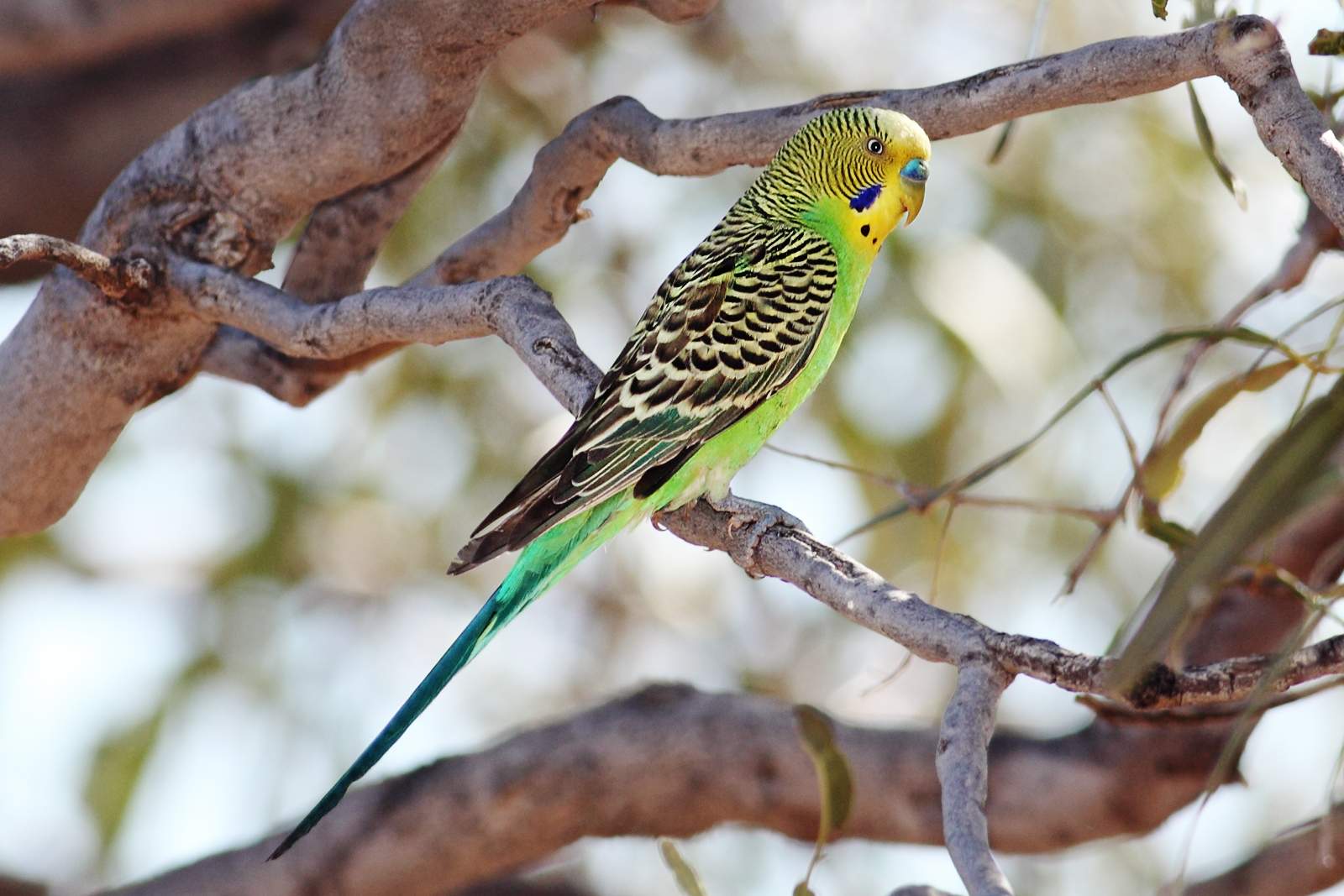
The budgerigar (/ˈbʌərɪɡɑːr, -ər-/ BUJ-ər-ih-gar, -⁠ə-ree-;[3] Melopsittacus undulatus), also known as the common parakeet, shell parakeet or budgie (/ˈbʌi/ BUJ-ee),[3][4] is a small, long-tailed, seed-eating parrot native to Australia. Naturally, the species is green and yellow with black, scalloped markings on the nape, back, and wings.[5] Budgies are bred in captivity with colouring of blues, whites, yellows, greys, and even with small crests.[5][6] Juveniles and chicks are monomorphic (the sexes are visually indistinguishable), while adults are told apart by their cere colouring and their behaviour.

The species is monotypic, meaning it is the only member of the genus Melopsittacus, which is the only genus in the tribe Melopsittacini. The budgerigar is closely related to lories and the fig parrots.[7][8][9][10]

The origin of the budgerigar's name is unclear. First recorded in 1805, budgerigars are popular pets around the world due to their small size, low cost, and ability to mimic human speech. They are likely the third most popular pet in the world, after the domesticated dog and cat.[11] Budgies are nomadic flock parakeets that have been bred in captivity since the 19th century. In both the wild and in captivity, budgerigars breed opportunistically and in pairs.

They are found wild throughout the drier parts of Australia, where they have survived harsh inland conditions for over five million years. Their success can be attributed to a nomadic lifestyle and their ability to breed while on the move.[12]

Etymology

[edit]

Several possible origins for the name budgerigar have been proposed. One origin could be that budgerigar may be a mispronunciation or alteration of the Gamilaraay word gidjirrigaa (Aboriginal pronunciation: [ɡ̊iɟiriɡaː])[13][14] or gijirragaa from the Yuwaalaraay.[15] Another possible origin is that budgerigar might be a modified form of budgery or boojery (Australian English slang for "good") and gar ("cockatoo").[16] While many references mention "good" as part of the meaning, and a few specify "good bird", it is quite possible that reports by those local to the region are more accurate in specifying the direct translation as "good food".[17]

Alternative spellings include budgerygah and betcherrygah,[18] the latter used by Indigenous people of the Liverpool Plains in New South Wales.[19]

Alternative names for the budgerigar include the shell parrot or shell parakeet, the warbling grass parakeet, the canary parrot, the zebra parrot, the flight bird, and the scallop parrot. Although more often used as a common name for small parrots in the genus Agapornis, the name "lovebird" has been used for budgerigars, because of their habit of close perching, mutual preening, and their long term pair-bonds.[18]

The genus name Melopsittacus is coined from Ancient Greek, meaning "melodious parrot".[20] The species name undulatus is Latin for "undulated" or "wave-patterned".[21]

Taxonomy

[edit]
Evolutionary history
parrots

... other parrots

Phylogenetic chart[7][8][9][10]

The budgerigar was first described by George Shaw in 1805, and given its current binomial name by John Gould in 1840. The budgerigar was once proposed to be a link between the genera Neophema and Pezoporus, based on the barred plumage.[22] However, recent phylogenetic studies using DNA sequences place the budgerigar very close to the lories (tribe Loriini) and the fig parrots (tribe Cyclopsittini).[7][8][9][10]

Description

[edit]
Anatomy of a male budgerigar

Wild budgerigars average 18 cm (7 in) long,[6] weigh 30–40 grams (1.1–1.4 oz), 30 cm (12 in) in wingspan, and display a light green body colour, while their mantles display pitch-black mantle markings (blackish in fledglings and immatures) edged in clear yellow undulations. The forehead and face is yellow in adults.

Prior to their adult plumage, young individuals have blackish stripes down to the cere in young individuals until around 3–4 months of age. They display small, iridescent blue-violet cheek patches and a series of three black spots across each side of their throat. The two outermost throat spots are situated at the base of each cheek patch. The tail is cobalt, and outside tail feathers display central yellow flashes. Their wings have greenish-black flight feathers and black coverts with yellow fringes along with central yellow flashes, which only become visible in flight or when the wings are outstretched. Bills are olive grey and legs blueish-grey, with zygodactyl toes.[22]

In their natural Australian habitat, budgerigars are noticeably smaller than those in captivity.[23] This particular parrot species has been bred in many other colours and shades in captivity (e.g. blue, grey, grey-green, pieds, violet, white, yellow-blue). Pet store individuals will commonly be blue, green, or yellow. Like most parrot species, budgerigar plumage fluoresces under ultraviolet light – a phenomenon possibly related to courtship and mate selection.[24][25]

The colour of the cere (the area containing the nostrils) differs between the sexes, being a lavender/baby blue in males, pale brownish/white (non breeding) to brown (breeding) in females, and pink in immature birds of both sexes (usually of a more even purplish-pink colour in young males).[5] Some female budgerigars develop brown cere only during breeding time, which later returns to the normal colour.[5] Young females can often be identified by a subtle, chalky whiteness that starts around the nostrils. Males that are either albino, lutino, dark-eyed clear or recessive pied (Danish pied or harlequin) retain the immature purplish-pink cere colour for their entire lives.[22][26]

A flock of wild budgerigars in flight at Mount Hope, New South Wales, Australia

Mature males usually have a cere of light to dark blue, but in some particular colour mutations it can be periwinkle, lavender, purplish or pink – including dark-eyed clears, Danish pieds (recessive pieds) and inos, which usually display much rounder heads. Female budgerigars display more dominant behaviour compared to males of the species and may act aggressively towards them.[27]

Budgerigars have tetrachromatic colour vision, although all four classes of cone cells will not operate simultaneously unless under sunlight or a UV lamp.[28] The ultraviolet spectrum brightens their feathers to attract mates. The throat spots in budgerigars reflect UV and can be used to distinguish individual birds.[25] While ultraviolet light is essential to the good health of caged and pet birds, inadequate darkness or rest results in overstimulation.[29]

Colour mutations

[edit]

All captive budgerigars are divided into two basic series of colours; namely, white-based (blue, grey and white) and yellow-based (green, grey-green and yellow).[5] Presently, at least 32 primary mutations (including violet) occur, enabling hundreds of possible secondary mutations (stable combined primary mutations) and colour varieties (unstable combined mutations).[5]

Ecology

[edit]
Distribution map of budgerigar in Australia
Distribution area
 Frequent occurrence
 Occasional occurrence

Budgerigars are nomadic and flocks move on from sites as environmental conditions change.[11][30][6] Budgerigars are found in open habitats, primarily in scrublands, open woodlands, and grasslands of Australia.[11] The birds are normally found in small flocks, but can form very large flocks under favourable conditions.[11] The nomadic movement of the flocks is tied to the availability of food and water.[22] Budgerigars have two distinct flight speeds which they are capable of switching between depending on the circumstance.[31] Budgerigars sometimes swarm together in groups containing thousands of individuals.[32]

Drought can drive flocks into more wooded habitat or coastal areas. They feed on the seeds of spinifex and grass, and sometimes ripening wheat.[22][33][5][6] Budgerigars feed primarily on grass seeds.[30][5] The species also opportunistically depredates growing cereal crops and lawn grass seeds.[34] Due to the low water content of the seeds they rely on the availability of fresh water.[5]

Outside of Australia, a population of naturalised feral budgerigars was present near St. Petersburg, Florida for over 50 years.[22] Increased competition for nesting sites from European starlings and house sparrows is thought to be a primary cause of the Florida population declining from the 1980s,[30] and this population died out in 2014.[35]

Behaviour

[edit]

Breeding

[edit]

Breeding in the wild generally takes place between June and September in northern Australia and between August and January in the south, although budgerigars are opportunistic breeders and respond to rains when grass seeds become most abundant.[6][5][22] Budgerigars are monogamous and breed in large colonies throughout their range.[36] They show signs of affection to their flockmates by preening or feeding one another. Budgerigars feed one another by eating the seeds themselves, and then regurgitating it into their flockmate's mouth. Populations in some areas have increased as a result of increased water availability at farms. Nests are made in holes in trees, fence posts or logs lying on the ground; the four to six eggs are incubated for 18–21 days, with the young fledging about 30 days after hatching.[22][33][6][11] In the wild, virtually all parrot species require a hollow tree or a hollow log as a nest site.[5] Budgerigars will typically breed in captivity when provided with a nest box.[37]

The eggs are typically one to two centimetres long and are pearl white without any colouration if fertile. Female budgerigars can lay eggs without a male partner, but these unfertilised eggs will not hatch. Females normally have a whitish tan cere; however, when the female is laying eggs, her cere turns a crusty brown colour. Certain female budgies may always keep a whitish tan cere or always keep a crusty brown cere regardless of breeding condition. A female budgerigar will lay her eggs on alternating days.[38] After the first one, there is usually a two-day gap until the next. She will usually lay between four and eight eggs, which she will incubate (usually starting after laying her second or third) for about 21 days each.[38] Females only leave their nests for very quick defecations, stretches and quick meals once they have begun incubating and are by then almost exclusively fed by their mate (usually at the nest's entrance). Females will not allow a male to enter the nest, unless he forces his way inside.[38] Clutch size ranges from 6 to 8 chicks.[6]

There is evidence of same-sex sexual behaviour amongst male budgerigars.[24] It was originally hypothesised that they did this as a form of "courtship practice" so they were better breeding partners for females; however, an inverse relationship exists between participation in same-sex behaviour and pairing success.[24]

Chick health

[edit]
The chicks and eggs of budgerigar in nest box

Breeding difficulties arise for various reasons. Some chicks may die from diseases and attacks from adults. Other budgerigars (virtually always females) may fight over the nest box, attacking each other or a brood. Another problem may be the birds' beaks being under-lapped, where the lower mandible is above the upper mandible.[39]

Most health issues and physical abnormalities in budgerigars are genetic. Care should be taken that birds used for breeding are active, healthy and unrelated. Budgerigars that are related or have fatty tumours or other potential genetic health problems should not be allowed to breed. Parasites (lice, mites, worms) and pathogens (bacteria, fungi and viruses), are contagious and thus transmitted between individuals through either direct or indirect contact.[citation needed]

In some cases, chicks will experience splay leg. This medical condition may be congenital or acquired through malnutrition. Chicks can be treated with splints although this method is not always successful in curing the affected bird. Preventative measures include using proper nesting box materials such as pine shavings[40] and cleaning the nest box between uses.[41]

Development

[edit]
A three-week-old chick beginning to develop feathers and adult coloration.

Eggs take about 18–20 days before they start hatching.[citation needed] The hatchlings are altricial – blind, naked, unable to lift their head and totally helpless,[5][6] and their mother feeds them and keeps them warm constantly. Around 10 days of age, the chicks' eyes will open, and they will start to develop feather down. The appearance of down occurs at the age for closed banding of the chicks.

They develop feathers around three weeks of age. (One can often easily note the colour mutation of the individual birds at this point.) At this stage of the chicks' development, the male usually has begun to enter the nest to help his female in caring and feeding the chicks. Some budgerigar females, however, totally forbid the male from entering the nest and thus take the full responsibility of rearing the chicks until they fledge.[citation needed]

Depending on the size of the clutch and most particularly in the case of single mothers, it may then be wise to transfer a portion of the hatchlings (or best of the fertile eggs) to another pair. The foster pair must already be in breeding mode and thus either at the laying or incubating stages, or already rearing hatchlings.[citation needed]

As the chicks develop and grow feathers, they are able to be left on their own for longer periods of time. By the fifth week, the chicks are strong enough that both parents will be comfortable in staying out of the nest more. The youngsters will stretch their wings to gain strength before they attempt to fly. They will also help defend the box from enemies, mostly with their loud screeching. Young budgerigars typically fledge (leave the nest) around their fifth week of age and are usually completely weaned between six and eight weeks old. However, the age for fledging, as well as weaning, can vary slightly depending on the age and the number of surviving chicks. Generally speaking, the oldest chick is the first to be weaned. Although it is logically the last one to be weaned, the youngest chick is often weaned at a younger age than its older sibling(s). This can be a result of mimicking the actions of older siblings. Lone surviving chicks are often weaned at the youngest possible age as a result of having their parents' full attention and care.[citation needed]

Hand-reared budgies may take slightly longer to wean than parent-raised chicks. Hand feeding is not routinely done with budgerigars, due to their small size and because young parent raised birds can be readily tamed.[citation needed]

Domestication and relationship with humans

[edit]

According to some sources, budgies are the most popular species of pet birds in the world.[42] In the U.S., budgies started becoming increasingly popular as a pet during the 1950s, at a time when previously canaries had been the most popular bird pet.[43] Today budgies are considered to be the third most popular pet in the U.S. after dogs and cats.[44] Cockatiels have in recent times become as popular as budgies.[45]

Aviculture

[edit]
Exhibition style "budgie" (left), as compared to pet-type budgerigars

The budgerigar has been bred in captivity since the 1850s. Breeders have worked to produce a variety of colour, pattern and feather mutations, including albino, blue, cinnamon-ino (lacewing), clearwing, crested, dark, greywing, opaline, pieds, spangled, dilute (suffused) and violet.[5]

"English budgerigars", more correctly called "show" or "exhibition budgerigars", are about twice as large as their wild counterparts and have puffier head feathers, giving them a boldly exaggerated look. The eyes and beak can be almost totally obscured by these fluffy head feathers. English budgerigars are typically more expensive than wild-type birds, and have a shorter life span of about seven to nine years. Breeders of English budgerigars show their birds at animal shows. Most captive budgerigars in the pet trade are more similar in size and body conformation to wild budgerigars.[46]

Budgerigars are social animals and require stimulation in the shape of toys and interaction with humans or with other budgerigars. Budgerigars, and especially females, will chew material such as wood. When a budgerigar feels threatened, it will try to perch as high as possible and to bring its feathers close against its body in order to appear thinner.[citation needed]

Tame budgerigars can be taught to speak, whistle and play with humans. Both males and females sing and can learn to mimic sounds and words and do simple tricks, but singing and mimicry are more pronounced and better perfected in males. Females rarely learn to mimic more than a dozen words. Males can easily acquire vocabularies ranging from a few dozen to a hundred words. Pet males, especially those kept alone, are generally the best speakers.[47]

Budgerigars will chew on anything they can find to keep their beaks trimmed. Mineral blocks (ideally enriched with iodine), cuttlebone and soft wooden pieces are suitable for this activity. Cuttlebones also supply calcium, essential for the proper forming of eggs and bone solidity. In captivity, budgerigars live an average of five to eight years, but life spans of 15–20 years have been reported.[48] The life span depends on breed, lineage, and health, being highly influenced by exercise and diet. Budgerigars have been known to cause "bird fancier's lung" in sensitive people, a type of hypersensitivity pneumonitis.[49] Apart from a handful of illnesses, diseases of the species are not transmittable to humans.[50]

Mimicry

[edit]

Budgerigars, like many other species of parrot, are able to mimic human speech.[51] Puck, a male budgerigar owned by American Camille Jordan, holds the world record for the largest vocabulary of any bird, at 1,728 words. Puck died in 1994, with the record first appearing in the 1995 edition of Guinness World Records.[52][53] The budgerigar "Disco" became Internet famous in 2013.[54] Some of Disco's most repeated phrases included, "I am not a crook" and "Nobody puts baby bird in a corner!".[55]

[edit]

Small bathing suits for men, commonly referred to as togs or "Speedos", are informally called "budgie smugglers" in Australia. The phrase is humorously based on the appearance of the tight-fitting cloth around the male's genitals looking like a small budgie. The phrase was added to the Oxford English Dictionary in 2016.[56]

[edit]

See also

[edit]

References

[edit]

Bibliography

[edit]

Further reading

[edit]
Revisions and contributorsEdit on WikipediaRead on Wikipedia
from Grokipedia
The budgerigar (Melopsittacus undulatus), commonly known as the budgie or common , is a small, long-tailed native to the arid and semi-arid interior regions of . Measuring 18–20 cm in length and weighing 22–32 g, it features a streamlined body with green upperparts, yellow underparts, a yellow head marked by black scalloping, purple-black cheek patches, and a tail in its wild form; slight is evident in the cere color, with males displaying and females brown. This species is highly social and nomadic, forming large flocks that undertake seasonal migrations in response to food and water availability, and it is renowned worldwide as the most popular pet bird, with millions kept in captivity. Budgerigars inhabit open woodlands, shrublands, grasslands, and savannas across approximately 7,160,000 km² of , preferring areas with spinifex grass, trees, and proximity to water sources, though they avoid dense coastal forests. They are diurnal ground-foragers, primarily consuming seeds from grasses and crops, and can drink up to 5.5% of their body weight daily at water holes, often traveling in flocks of hundreds or thousands for protection from predators. Their behavior includes undulating flight patterns, chattering vocalizations, and , with females exhibiting more aggressive tendencies during breeding. Introduced populations exist in , , but remain small and localized compared to the abundant native range. Breeding occurs opportunistically year-round in response to rainfall and seed abundance, with monogamous pairs nesting in colonies within tree hollows or shrubs, where females lay 4–8 eggs per clutch and incubate them for about 18 days while males provide food. In captivity, budgerigars are valued for their , abilities, and varied color mutations, though wild populations face periodic die-offs during droughts despite benefiting from human-modified landscapes like farmland. The species is classified as Least Concern by the IUCN, with an increasing global population trend due to its adaptability and lack of major threats.

Nomenclature

Etymology

The name "budgerigar" derives from the Australian Aboriginal (also known as Kamilaroi) language, where it appears as "betcherrygah" or a similar form, meaning "good " or "good ," reflecting the bird's status as a valued food source for . The budgerigar was first scientifically described by George Shaw in 1805 as undulatus. John assigned the current binomial Melopsittacus undulatus and illustrated it in his 1840 publication The Birds of Australia, drawing on specimens from Australian expeditions in the 1830s. Gould's work popularized the species among Western audiences, leading to its widespread adoption. Common alternative names include "budgie," a form of "budgerigar" that emerged in the late as the became a popular . Other designations, such as "shell parakeet" and "undulated parakeet," stem from descriptive features: the former alludes to the scalloped, shell-like patterns on the bird's cheeks and back, while the latter references the undulating black markings on wild specimens, derived from the Latin undulatus meaning "wavy" or "undulated." The term "" itself originates from the perroquet or paroquet, a form possibly linked to the name (Peter) used as a pet name for parrots, evolving through Italian parrocchetto and Spanish periquito to denote small parrots in English by the 16th century. The scientific binomial Melopsittacus undulatus, assigned by Gould, combines Greek roots for "melodious " with the Latin descriptor for its patterned .

Taxonomy

The budgerigar (Melopsittacus undulatus) belongs to the order Psittaciformes and the family , where it forms its own monotypic as the sole , with no recognized . Phylogenetic analyses position the budgerigar as an early-diverging lineage within , originating in approximately 5–10 million years ago during the Miocene-Pliocene radiation of in the region. Its closest relatives are the lories and lorikeets (subfamily Loriinae) and fig parrots (tribe Cyclopsittini), based on whole-genome sequencing that resolves deep branches in parrot phylogeny. Genetic studies, including high-coverage genome sequencing, have revealed the budgerigar's structure features extensive reshuffling, such as fusions and fissions, relative to other avian lineages, contributing to . These structural differences limit successful hybridization with other parrots, as interspecific crosses often result in infertile offspring or fail due to chromosomal incompatibilities, despite occasional reports of hybrids with closely related species like cockatiels. The fossil record supports the budgerigar's long-standing presence in , with bones from Pliocene deposits at Riversleigh, northwestern , dating to at least 5 million years ago and indistinguishable from modern specimens.

Physical Characteristics

Morphology

The budgerigar (Melopsittacus undulatus) is a small, streamlined parrot averaging 18–20 cm in length and 30–40 g in weight, with a wingspan of approximately 30 cm. Its body features a short tail and rounded wings, which enable agile, maneuverable flight suited to its nomadic existence in open Australian grasslands, where rapid evasion of predators and coordination in large flocks are essential. The skeletal structure is lightweight, with hollow bones and a pronounced keel on the sternum that anchors powerful flight muscles, such as the pectoralis, allowing for sustained flapping during long-distance foraging movements across arid habitats. This contrasts with larger parrots, which often exhibit more robust skeletons adapted for powerful but less agile propulsion over shorter bursts. Key anatomical features include zygodactyl feet, with two toes facing forward and two backward, facilitating secure perching on branches and climbing within tree cavities while also aiding ground foraging by providing stability on uneven surfaces. The strong, curved , with the upper overhanging the lower, is specialized for cracking and dehulling hard seeds, a primary dietary component that requires precise force application without teeth. Above the lies the cere, a fleshy structure used for differentiation: it is typically in males and brown in females, reflecting hormonal influences on pigmentation. In the wild, budgerigars have a lifespan of 5–8 years, shorter than many larger parrots due to their small size, high metabolic rate, and exposure to environmental stressors like predation and resource scarcity, though basic physiological traits such as efficient oxygen uptake in flight muscles are shared across psittacines. variations can serve as indicators of health, with dull or patchy feathers signaling nutritional deficiencies or .

Plumage Variations

The wild-type budgerigar exhibits predominantly plumage on the body and back, with a bright face and forehead, complemented by scalloped markings—known as undulations—on the wings and , and subtle white edging along the wing feathers for enhanced contrast. These coloration patterns provide effective in the arid eucalyptus grasslands of inland , where the hues blend with sparse and the spots mimic shadows or bark textures to evade predators. The facial mask and cheek patches, accented by a small blue spot near the eye, further integrate with sunlit grass and floral elements in their native . Since the late , in captivity has produced over 30 recognized color s, transforming the wild green into a of hues and patterns prized by aviculturists in and . The first major , a dilute variant, appeared in European aviaries around 1870, followed by the establishment of blue strains in by the early 1900s. Notably, the inaugural blue budgerigars—lacking the yellow for a sky-blue body—were exhibited in in 1910, marking a pivotal moment in development that spread to Australian breeders via imports in the and . Subsequent innovations, such as pied and spangle varieties in the mid-20th century, arose from targeted pairings in both regions, yielding combinations like the (albino) and (lutino) forms that eliminate dark markings entirely. These mutations stem from alterations in pigment production and distribution, governed by recessive and dominant alleles at specific genetic loci. The blue mutation, for instance, is recessive and eliminates yellow psittacofulvin pigments, resulting in a white base color overlaid with structural blue from melanin; when combined with green, it produces the sky-blue variety. In contrast, the lutino mutation is sex-linked recessive, targeting the ino gene on the Z chromosome to suppress melanin synthesis, yielding bright yellow feathers with red eyes and no black spots—effects that manifest differently in males and females due to hemizygosity. Pied mutations disrupt melanin deposition in patches, creating irregular white or yellow areas, while spangle variants lighten wing markings to golden edges through diluted melanin expression. Post-2020 genetic studies have advanced understanding of these traits, identifying key loci beyond traditional markers; for example, variations in the SLC45A2 gene contribute to loss in yellow phenotypes across parrots, including budgerigars, by impairing function in barbs. Although —encoding tyrosinase-related protein 1, crucial for eumelanin production—has been linked to reduced in other parrots like lovebirds, its role in budgerigar mutations remains under exploration, with expression analyses showing elevated levels in dark-feathered regions to support undulation patterns. These findings highlight how mutations alter not just visible color but underlying biochemical pathways for deposition. Certain carry health implications, particularly those reducing , such as albinos (blue-series inos), which exhibit increased vulnerability to (UV) radiation due to diminished protective pigments in and eyes. This lack of heightens risks of UV-induced cellular damage and lesions in outdoor or high-light environments, compounded by vision impairments like and from underdeveloped retinal pigmentation. Lutinos face similar issues, with reduced leading to potential chronic and higher susceptibility to inflammatory conditions, though overall lifespan varies by breeding quality rather than mutation alone.

Natural History

Habitat and Distribution

The budgerigar (Melopsittacus undulatus) is native exclusively to , inhabiting much of the continent's interior but absent from the tropical far north (including parts of and the ), the extreme southwest, and . Its range spans approximately 7.16 million km², encompassing diverse arid and semi-arid zones where it has persisted for millions of years. In these arid and semi-arid environments, budgerigars are adapted to variable temperatures, including cold nights that can drop to a few degrees below freezing in mid-winter, demonstrating resilience to such dry cold conditions while preferring milder temperatures between 18 and 25°C. Although classified as non-migratory, budgerigars display highly nomadic behavior, traversing vast distances in response to rainfall events that trigger seed availability and breeding opportunities. This mobility allows them to exploit ephemeral resources across arid and semi-arid regions, often resulting in the formation of massive flocks numbering in the tens of thousands during favorable wet periods. In terms of habitat preferences, budgerigars favor open landscapes such as grasslands, savannas, and lightly wooded areas, particularly those featuring and trees for roosting and nesting cavities. They actively avoid dense rainforests and heavily forested regions. The species' wild population remains abundant and stable, exceeding several million individuals, with no significant threats leading to its IUCN Least Concern status. Small, localized introduced populations occur in regions such as (), , and parts of , but do not significantly expand the species' overall range.

Ecology

Budgerigars are primarily granivorous, feeding mainly on seeds from native Australian grasses such as spinifex (Triodia spp.) and tussock grasses, which they dehull before consumption to access energy-rich nutrients. Their diet is supplemented by fruits, berries, and occasionally , providing additional variety and protein during periods of abundance. In response to droughts, when seed availability declines, they shift seasonally to consuming green vegetation and herbaceous plants, which offer moisture and sustenance in arid conditions. occurs primarily on the ground in open grasslands, with birds feeding actively after sunrise and before sunset, while resting motionless in shade during midday heat to conserve energy. Predators of budgerigars include such as falcons (e.g., , Falco longipennis, and , Falco peregrinus), hawks, and ravens, as well as introduced mammals like feral cats and foxes, and reptiles including goannas and snakes. To counter these threats, budgerigars employ anti-predator strategies such as heightened ground vigilance while foraging. Their erratic, swift flight in groups further confuses pursuing predators. In their , budgerigars play a key role in , as undigested pass through their digestive system and are deposited across grasslands, promoting plant regeneration and in arid zones. They also compete with other granivores, including cockatoos and , for resources, potentially influencing dynamics in shared habitats. Budgerigars often form flocks to navigate and exploit patchy habitats efficiently. Regarding energetics, recent physiological studies highlight their adaptations for arid survival, including control over insensible evaporative water loss for and a relatively low that minimizes energy and water demands in hot, dry environments.

Behavior

Social and Foraging Behavior

Budgerigars (Melopsittacus undulatus) are highly social birds that aggregate into large, nomadic flocks in , typically comprising 20 to over 1,000 individuals, though numbers can swell to tens of thousands following rainfall that boosts availability. These flocks exhibit a fluid structure without a rigid , allowing flexible associations among members, while strong, long-term monogamous pair bonds form within groups. Females often display greater than males, influencing interactions during group activities. Communication among flock members relies on a combination of vocalizations, , and visual displays to maintain cohesion and coordinate movements. Vocal signals include warbling "chirrup" contact calls for general flock communication and sharp "zit" calls to alert others to threats. Both sexes produce individually distinctive contact calls, which are learned and aid in recognizing companions over distances, while males additionally perform complex warble songs. features head bobbing and wing flapping to convey excitement or affiliation, often reinforced by tactile interactions like mutual , which strengthens pair and group bonds. At , flocks synchronize through loud calling and high-speed aerial maneuvers to reconvene before roosting. Foraging occurs in synchronized group efforts, primarily on the ground where budgerigars harvest from native grasses and by stems and biting off seed heads. These activities are most intense in the morning, with flocks departing roosts shortly after sunrise to feed, avoiding midday heat by seeking shade. Daily routines tie closely to light cycles, beginning with and vocalizing before dawn flights to sites and ending with returns to communal roosts in trees or shrubs. Recent observations in wild flocks highlight playful behaviors, such as aerial chases, which may represent precursors to more advanced manipulative skills seen in other parrot species. These interactions, often occurring during non-foraging periods, contribute to social learning and flock dynamics without direct ties to survival tasks.

Reproduction and Development

Budgerigars exhibit opportunistic breeding in the wild, with primarily triggered by rainfall that stimulates vegetation growth and seed production in their arid Australian habitats, allowing pairs to at any time of year when conditions are favorable. Monogamous pairs form strong bonds that facilitate nesting in pre-existing cavities such as tree hollows in or other trees. A typical clutch consists of 4-8 white eggs, laid one every 1-2 days, with the female commencing incubation after the first or second egg is laid to ensure asynchronous hatching. The lasts 18-21 days, during which the female primarily tends the eggs while the male forages and regurgitates food to provision her. Both parents share parental responsibilities, with the female handling most incubation duties and the male providing food to the sitting female; after hatching, both sexes feed the chicks through regurgitation of partially digested seed and crop milk, a nutrient-rich secretion produced in their crops. Chicks hatch altricial, blind, featherless, and helpless, relying entirely on parental care for warmth and nutrition. Eyes open around 10 days post-hatching, with downy feathers emerging shortly thereafter and full plumage developing by 3-4 weeks; the cere, the fleshy area above the beak, begins to show sexual dimorphism at this stage, turning blue in males and brown in females for sex determination. Fledging occurs at 4-5 weeks, when chicks leave the nest for short flights but continue to be fed by parents until achieving independence at 8-10 weeks, at which point they join larger flocks. Social pair bonding enhances by strengthening coordination in nest defense and provisioning during this vulnerable period.

Domestication

History of Domestication

The budgerigar (Melopsittacus undulatus) was first brought into captivity in when naturalist imported live specimens from to in 1840, following his expeditions and documentation in The Birds of Australia. These initial imports sparked interest among aviculturists, and by the , the species had gained rapid popularity as a household pet in due to its adaptability, sociable nature, and relative ease of , with the first successful reproductions recorded around that decade. By the late , commercial demand had led to massive exports from , with dealers shipping hundreds of thousands of pairs annually to , raising concerns over depletion of wild flocks. In response, the Australian imposed a ban on budgerigar exports in 1894 to safeguard native populations, which effectively ended wild captures and shifted reliance to captive propagation. This accelerated the development of independent breeding programs worldwide, establishing stable strains in , , and beyond, and preventing potential pressures on the wild species. Selective breeding advanced significantly during the late 19th and early 20th centuries, marked by the emergence of color mutations that diversified captive lines beyond the wild green form. The lutino mutation, which first appeared but vanished, was re-established in Europe between 1931 and 1933, creating excitement among breeders and leading to further variations like the black-eyed yellow by the 1880s. The skyblue mutation first appeared in 1878 in Belgium, alongside developments in dark green and cobalt varieties, which expanded aesthetic options and fueled hobbyist interest. Early aviculture societies, emerging in the 1910s and formalizing with groups like the Budgerigar Club in 1925, promoted standardized breeding practices, while established trade networks had already disseminated birds to the Americas shortly after 1840 and to Asia, including significant imports to Japan by the 1920s despite local restrictions. In the post-2000 period, and research communities have emphasized genetic conservation in captive budgerigar lines to preserve wild-type traits and mitigate risks, drawing on foundational studies of depression effects and advocating for routine in breeding programs. These efforts, often coordinated through international societies, aim to sustain and diversity amid ongoing selective pressures from breeding.

Aviculture

Budgerigars in require spacious housing to accommodate their active nature and promote physical and mental . For a pair, the minimum recommended is 36 inches wide by 24 inches deep by 24 inches high (approximately 91 x 61 x 61 cm), with bar spacing no wider than 1/2 inch to prevent escapes or injuries. Larger enclosures or flight s, such as 32 inches by 21 inches, allow for essential exercise and flight space, supplemented by perches of varying diameters and textures to exercise feet and prevent pododermatitis, as well as toys like ladders and bells for enrichment. Environmental conditions should mimic natural cycles, including 10-12 hours of light exposure daily using full-spectrum lamps to support synthesis and hormonal balance, with the placed away from drafts, , and household fumes. Temperatures should be maintained between 18-25°C (64-77°F), with a minimum of 15°C (59°F) to prevent stress or chilling. A balanced diet in is crucial to prevent and nutritional deficiencies common in seed-only fed birds. Formulated pellets should form the majority of the diet, providing complete , while mixes (such as millet, canary , and oats) are limited to 20-30% as treats to avoid excessive fat intake. Daily offerings of fresh vegetables like leafy greens, , carrots, and bell peppers, along with occasional fruits such as berries or in moderation, supply essential vitamins and fiber; calcium supplementation via or liquid gluconate, paired with from lighting, is necessary to support bone health and prevent , particularly in breeding females. Breeding budgerigars in aviculture involves providing nest boxes that replicate natural tree hollows, typically wooden with a concave floor and dimensions around 12 x 8 x 8 inches, filled with soft bedding like pine shavings for comfort and hygiene. Pairs should be at least 10-12 months old, with 12 hours of light daily to stimulate egg-laying; incubation occurs over 18-21 days at 99-100°F, often aided by external brooders if needed for infertile eggs or weak chicks. Common challenges include egg binding, caused by nutritional imbalances, dehydration, or oversized eggs, which requires immediate veterinary intervention such as calcium injections, fluid therapy, warmth, and possible manual egg removal under anesthesia to avoid fatal complications like oviduct rupture. Selective breeding has emphasized color mutations, but prioritizes health to sustain viable lineages. Health management in captive budgerigars focuses on preventing infectious diseases and monitoring for age-related issues, with proper care enabling lifespans up to 15 years. Behavioral signs such as persistent puffed up feathers may indicate the bird is cold, ill, relaxing, or preening; if persistent, monitor for signs of illness and consult a veterinarian. Avian bornavirus, causing proventricular dilatation disease (PDD), presents with chronic weight loss, undigested seeds in droppings, and neurological signs like ; diagnosis via PCR testing of is confirmed, with treatment limited to supportive care including anti-inflammatories like and dietary adjustments, as no cure exists. (PBFD), a infection, leads to feather dystrophy, beak deformities, and , transmitted via , , or direct contact; while no commercial is available as of 2025 despite ongoing research into mRNA and subunit candidates, prevention relies on , testing, and isolation of infected birds, with supportive care extending life in chronic cases.

Human Interaction

Mimicry and Cognition

Budgerigars are renowned for their vocal mimicry abilities, particularly in captive settings where they can imitate human speech sounds, words, and phrases. A survey of companion parrots found that male budgerigars tend to have larger repertoires of mimicked words and phrases than females, though differences vary and are not always significant. Exceptional individuals, such as Puck, have demonstrated vocabularies exceeding 1,700 words. A famous example is Puck, a male budgerigar owned by Camille Jordan in Petaluma, California, USA, who held the Guinness World Record for the largest bird vocabulary with 1,728 words before his death in 1994. Evidence of budgerigar cognition includes problem-solving skills demonstrated in tasks, such as detour reaching to access rewards, where birds show varying performance influenced by and . In mirror self-recognition tests, budgerigars interact with reflections in ways correlated with pair-bond strength, increasing mirror use as social bonds deepen, though this does not conclusively indicate self-recognition. studies have also explored tool use, with budgerigars learning to manipulate objects through , as shown in two-object/two-action paradigms that test imitative versus non-imitative social learning. Social learning from flock facilitates vocal and behavioral acquisition, with their flocking tendencies enhancing observational of calls and actions. The budgerigar's brain features an enlarged nidopallium, a telencephalic region containing specialized vocal learning nuclei analogous to those in songbirds, which supports open-ended vocal production and throughout adulthood. Key nuclei, such as the magnocellular nucleus of the medial (MMSt), express genes like and FoxP1 at higher levels, enabling complex vocal sequencing and learning. Training for relies on positive techniques, where rewards like treats or praise encourage repetition of sounds. A 2025 study found that budgerigar neurons encode vocal acoustic features in a manner similar to the , underscoring parallels in vocal processing between the species. Recent research from 2022 to 2023 has utilized computational analysis to examine budgerigar vocal dialects, revealing higher-order variations in warble syntax across regions and convergence upon social contact between groups. These studies highlight regional differences in call sequences, suggesting cultural transmission similar to dialects, analyzed through advanced sequence modeling methods.

Cultural Significance

Budgerigars have featured prominently in literature and , underscoring their appeal as vibrant and engaging subjects. British illustrator , known for her children's books, created detailed watercolour drawings of a green budgerigar alongside a canary, reflecting her personal ownership of the birds and her broader fascination with avian life. The 2021 book Flight of the Budgerigar by ornithologist Penny Olsen chronicles the ' cultural history, detailing its role as Australia's first mass-exported bird and its associations with royalty, film stars, spies, and world leaders across centuries. A 1976 British documentary short, The World of Budgerigars, narrated by actors including Sidney James, highlighted the bird's and global popularity, contributing to early public fascination with the . In Australian Indigenous cultures, budgerigars carry deep symbolic meanings tied to survival and spirituality. Within Aboriginal narratives, the birds serve as guides for locating and in arid environments, symbolizing and resourcefulness amid environmental challenges. They are woven into traditional paintings, songs, stories, and ceremonies, often representing the pursuit of wisdom and harmony with the land. Beyond , budgerigars embody themes of freedom and companionship in broader Australian cultural contexts, evoking the vastness of the and the joy of social bonds. The interactive and cheerful disposition of budgerigars has led to their use in therapeutic settings, particularly for addressing among the elderly. A seminal 1975 study by Mugford and McComisky provided pet budgerigars to non-institutionalized older adults aged 75–81 living alone, finding significant reductions in self-reported scores compared to a control group receiving only . This research established budgerigars as valuable companions in age-related care, leveraging their sociability to foster emotional well-being. Budgerigars also play a role in conservation advocacy, aiding efforts to raise awareness about 's avian . Organizations like BirdLife incorporate the species into initiatives, such as the annual Aussie Bird Count, where public sightings contribute to monitoring population trends and educating participants on native . These programs, active since the , highlight budgerigars' adaptability to highlight broader threats like degradation affecting Australian parrots.

References

Add your contribution
Related Hubs
User Avatar
No comments yet.