


Community hub
Recent from talks
Contribute something
Nothing was collected or created yet.
Lothian Buses
View on Wikipedia
 | |
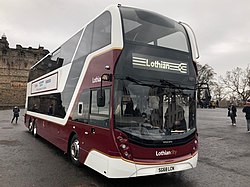
_on_route_11.jpg) Alexander Dennis Enviro400 XLB bodied Volvo B8L in March 2019 | |
| Parent | Transport for Edinburgh (91%) Midlothian Council (5%) East Lothian Council (3%) West Lothian Council (1%) |
|---|---|
| Founded | 1 July 1919 |
| Headquarters | Edinburgh, Scotland |
| Service area | Edinburgh East Lothian Midlothian West Lothian |
| Service type | Bus services Open top bus tours Executive Tours |
| Alliance | Edinburgh Trams |
| Routes | 63 daytime, 19 night buses |
| Stops | 2,900 |
| Depots | Longstone (LS) Central (CE) Marine (MA) Musselburgh (MU) North Berwick (NB) Seafield (SF) Newbridge (NE) Livingston (LV) Dunbar (Eve Coaches) |
| Fleet | 730 (January 2025) |
| Annual ridership | 110 million (2023)[1] |
| Chief executive | George Lowder |
| Website | www https://lothianmotorcoaches.com https://www.eveinfo.co.uk |

Lothian Buses is a major bus operator based in Edinburgh, Scotland.[2] It is the largest municipal bus company in the United Kingdom:[3] the City of Edinburgh Council (through Transport for Edinburgh) owns 91%, Midlothian Council 5%, East Lothian Council 3% and West Lothian Council 1%.[4][5]
Lothian operates the majority of bus services in Edinburgh, and is a significant operator in East Lothian, Midlothian and most recently West Lothian.[6] It operates a comprehensive night bus network, three routes to Edinburgh Airport, and owns the subsidiary companies Lothian Country, East Coast Buses, Edinburgh Bus Tours, Lothian Motorcoaches and Eve Coaches.
History
[edit]The company can trace its history back to the Edinburgh Street Tramways Company of 1871, also involving at various times the tramway companies of Leith, Musselburgh and Edinburgh North. The City Council (Edinburgh Corporation Tramways Department) took over operation of the tramways in 1919, at which time most of the system was cable operated. Electrification of the tram network was completed in 1923,[7] but the first motor buses had arrived in 1919.[8]
The city's trams ceased operation between 1950 and 1956, after which the operation became the Edinburgh Corporation Transport Department.[9] In 1965, it purchased its first rear-engined double-decker bus, a Leyland Atlantean PDR1/1 (registration ESF 801C). This bus is currently preserved at the Scottish Vintage Bus Museum. Almost 600 buses were added to the fleet over the next 17 years.
Following local government reorganisation, Edinburgh Corporation Transport was renamed Lothian Region Transport on 16 May 1975. In January 2000, it was again renamed as Lothian Buses.[10][11]
Awards
[edit]Lothian Buses have won several bus awards for their services to the Lothian region including Bus Operator of the Year in the 2007 UK Bus Awards,[12][13] and has subsequently been voted Public Transport Operator of the Year (Bus) at the 2008 National Transport Awards, at which the company was cited for its substantial route development, 32% growth in passenger numbers since 1998 and £100 million investment in low-floor buses since 2000.[14]
Lothian Buses was voted Best UK Bus Company in 2002 and 2003.[by whom?][15] Vehicles previously carried the wording Voted Scotland's Best Bus Company 2006 in a laurel wreath type logo near the fleetname.
In November 2011, the company won the Top City Operator of the Year award at the UK Bus Awards.[16]
In June 2023, Lothian Buses received the Excellence in Transport Accessibility award and the Excellence in Innovation and Technology award at the Scottish Transport Awards.[17] In 2024, the company was named Bus Operator of the Year at the National Transport Awards. Lothian Buses was also awarded the Gold Employer Recognition Scheme Award from the Ministry of Defence and the silver award in the Employer of the Year category at the Scottish Veteran Awards.[18] In 2025, its Lothian Country Service 43 received the Excellence in Transport Best Bus Service award.[19]
Fares
[edit]Lothian Buses have operated a flat-fare system since March 2006.[20] Adult and child singles and day tickets, pre-paid multiple singles and 'Ridacards' are also available, with senior citizens travelling on free travel passes in line with the rest of Scotland. As of April 2025[update], an adult single fare is £2.20 and a child fare costs £1.10. An adult day ticket costs £5.50 and a child day ticket £2.75.[21]
Cash fares are paid into a hopper, which automatically dumps the money into a vault to which the driver has no access; change is not given.[22]
The Lothian 'Ridacard' bus pass is a pre-paid plastic smartcard giving unlimited travel on regular daytime and night bus services, as well as Edinburgh Trams services.[23] It is purchased initially from a Transport for Edinburgh Travelshop, where the owner's picture is incorporated on the card to prevent misuse. Once purchased, the card can be placed onto an on-board reader, which reads the contactless chip in the smartcard. Cards can be credited for a weekly, 4 weekly or annual period. A warning is displayed on the last five days of validity. The card can then be topped up at Transport for Edinburgh Travelshops or PayPoint equipped retailers.[24]
Lothian Buses launched contactless payment on their day network in 2019.[25] Passengers can pay their fare by tapping their contactless debit or credit card when boarding the bus. Daily and weekly capping apply. Passengers who make just one or two journeys in a day are charged the normal single fares; a daily cap is applied when three or more journeys are made. Weekly capping works on the same principle. Passengers who pay with a debit or credit card can view their journey history for the previous seven days on the Lothian website.[26]
Regular Lothian Bus services running within Edinburgh and the west of East Lothian operate a flat fare, but from Longniddry, Macmerry and Ormiston there is a zonal system with East Coast Buses having six zones.
Network, brands and subsidiaries
[edit]Lothian-branded network
[edit]
Lothian-branded services are the core of the Lothian Buses group. There are some core services in the Lothian network that have followed more or less the same route since they were operated by trams in the 1950s, like services 3, 4, 5, 10, 11 and 16.[27] However, the routes and timetables of most services are frequently modified in minor ways. For example, in recent years several confusing details such as letter suffixed routes and clockwise/anticlockwise circular services have been removed from the map. In the last ten years, there have been many temporary and permanent diversions in the New Town, including the closure at various times of Princes Street for tram works, George Street for pedestrianisation[28] and Leith Street for the reconstruction of the St James Centre.
The majority of current routes pass through the city centre from opposing termini, either crossing or following Princes Street in full or in part. This means that there are some arteries in and out of the New Town that are served by as many as a dozen different routes, such as Nicolson Street and Leith Walk. Some of these services, like services 3, 26 and 37, extend into outlying towns in East Lothian and Midlothian. There are also some more orbital routes, such as service 38.
Liveries
[edit]Traditionally, Edinburgh Corporation, LRT and Lothian Buses had been generally painted in a madder (a dark red) and cream (or white) livery. When low floor disabled access vehicles were introduced in the late 1990s, they were given their own distinguishing "harlequin" livery, moquette covered seating and brightly coloured floors and walls. The last high step bus was removed from service by Lothian in the late 2000s, making the distinction irrelevant.
Lothian began to phase out the harlequin livery in May 2010, replacing it with a version of the traditional madder and white colour scheme. This had sweeping curved lines, having been updated to suit the body shapes of more modern buses. The last harlequin bus was repainted in 2016.[29]
In late 2016 a new livery, known as the fleet of the future livery, was unveiled on a batch of new Wright Gemini 3 Streetdeck style buses, for route 22. The angular shape and style of this livery was a complete departure from anything Lothian had designed before, and as of 2021 is the standard livery for all new vehicles. The livery underwent a minor adjustment when a fleet of new Alexander Dennis Enviro400 XLBs were put into service in 2019, with smoother curves and a lack of a smaller 'cheatline' on the bus's lower sides. While the Enviro400 XLBs carried the coat of arms of the city of Edinburgh on each side, every batch of vehicles bought thereafter have not had the same coat of arms added.
Airlink and other airport routes
[edit].jpg)
Lothian operates three services to and from Edinburgh Airport: Airlink 100, and Lothian City services 17 and 18. The airport is in a separate fare zone from the rest of the Lothian network, which means that fares to and from the airport are higher than the fares charged elsewhere on the network. However, this only applies to Airlink 100. On routes 17 and 18, the airport is treated as being in the same zone as the rest of the city.
Current airport routes
[edit]Airlink 100 runs to Waverley Bridge. Since 30 July 2017, Airlink has accepted contactless card payments as well as cash and ridacard fares.
Former airport routes
[edit]Lothian also used to have a separate network of bus routes that ran to the Airport from places outside the city centre named Skylink. These routes were withdrawn from service and replaced with conventional city services on 6 April 2025.[30]
Skylink 200 commenced on 23 April 2017, running from the airport to the north of Edinburgh, terminating at Ocean Terminal.[31][32] It was initially operated by single decker buses, but double deckers have been used since 1 October 2017. This route was withdrawn in April 2025 and renumbered as service 17.[30]
Skylink 300 commenced on 1 October 2017, as an upgrade and renumbering of the old service 35, which ran from the airport to the Ocean Terminal via Slateford, Longstone and South Gyle.[33][34] The 35 had been a way of getting to the airport while only paying the standard Lothian fare, and usually used repainted ex-Airlink vehicles with extra luggage racks. The route was amended on 29 July 2018, shortening the route considerably and introducing a new terminal at Cameron Toll. At the same time, a modified 35 was reintroduced, but this service terminated at Heriot-Watt University rather than the airport. Skylink 300 was withdrawn from the timetable change on 11 September 2022 due to low passenger demand.[35]
Skylink 400 commenced on 29 July 2018 operating to Fort Kinnaird via Gracemount, Fairmilehead, Oxgangs and Colinton.[36][37][38] This route was withdrawn in April 2025 and has been renumbered as the 18, bringing back the old route and 'city' fares for the service pre-2018.[30]
Between June 2021 and March 2022, Skylink services 200, 300, and 400 were adjusted to call at the Royal Highland Centre, which was in use as a vaccination centre during the COVID-19 pandemic.[39] These services were reverted to their original routings when the centre closed in March 2022.[40]
Liveries and vehicles
[edit]Airlink 100 was originally branded as "Airline", and has used many different liveries and logos, though all have been primarily blue. Airlink buses are always new when they start on the service, and are cascaded to other services after a few years. Over the years, the service has used the Leyland Olympian, Scania Omnicity, Wright Eclipse Gemini 2 and the Wright Eclipse Gemini 3.[41] Between June 2017 and August 2019 the Airlink service used a light blue and grey version of the standard angular livery. These vehicles have since moved onto Skylink, still with the light blue livery. other Skylink services use a medium blue and white version of the angular livery. From August 2019, Enviro400 XLBs have been introduced on the Airlink Service, with a dark blue plain livery with a large gold Airlink logo on both sides.
East Coast Buses
[edit].jpg)
In summer 2012, First Scotland East withdrew route 44B from Edinburgh to Pencaitland. This prompted Lothian Buses to expand into East Lothian much further than they had for years; far past the Tranent terminus of the service 26. Operations were initially branded as East Lothian Buses, and service 113 launched on 12 June 2012.[42][43] A second service was added in September 2014 (the 104 to Haddington).[44] The brand name was changed to Lothian Country Buses. One reason for launching as a separate brand was to make it easier to introduce a zonal fare system, rather than the flat fare of Lothian Buses.
First Scotland East announced in June 2016 that they would be withdrawing entirely from East Lothian by 14 August, believing the county to be unprofitable.[45] Lothian later announced the creation of a wholly owned subsidiary company, East Coast Buses, to again fill the gap left by First. The new company also took over the former First depots at North Berwick and Musselburgh, and took on many former First staff.[46][47] From 23 April 2017, the two Lothian Country Buses routes were integrated into East Coast Buses.[48]
Liveries and vehicles
[edit]East Lothian Buses services were initially operated by existing Lothian vehicles. The service was later operated by five Wright Eclipse bodied Volvo B7RLEs and two Plaxton President bodied Dennis Trident 2s. The East Lothian Buses/Lothian Country Buses livery was a version of the standard Lothian design featuring sweeping curved lines in bright green and cream, similar to the livery of the former Scottish Motor Traction/Eastern Scottish buses.[49] East Coast Buses then used a version of the fleet of the future livery, the angular Lothian design, in green and grey (though the ECB green is slightly bluer than that formerly used by LCB).
In November 2021, Lothian Buses announced a new joint livery for subsidiaries Lothian Country and East Coast Buses. They were similar liveries with the only differences being the vinyls (logos) being put on the buses to signify which company was operating the service. As of November 2023, the repainting process has been completed.
Lothian Country
[edit]
In June 2017, a new subsidiary named Lothian Country commenced operating route 43 to South Queensferry after the previous operator Stagecoach East Scotland deemed the service not economically viable.[50][51][52] This new operation re-used the then-recently defunct Lothian Country Buses brand, for unrelated services travelling the opposite direction out of the city.
On 19 August 2018, three new Lothian Country services to West Lothian commenced, creating new links between Edinburgh and Bathgate, and Edinburgh Park station and Whitburn.[6]
On 17 November 2019 service X38 was launched connecting Edinburgh to Linlithgow (now withdrawn), rivalling First Scotland East's service with the same number. This was followed by the X18 on 2 December 2018, serving Edinburgh and Armadale via Broxburn and Bathgate, and night service N28, replicating the existing X27 route as far as Deans South.
In May 2023 a new N18 night service was introduced, with one journey per night between Edinburgh and Bathgate via Broxburn, and with an additional journey per night on weekends.[53]
Edinburgh Bus Tours
[edit]History of tour operations
[edit]_Routemaster_CUV_241C_Mac_Tours_livery,_29_August_2010.jpg)
Lothian Buses have operated city tours using white liveried coaches. Later, Leyland Atlanteans were employed in this same livery, with blinds for City Tour. These wore an updated version of the white livery with blue detailing after a short period. An Edinburgh Classic Tour was set up in 1989 using open top Leyland Atlanteans, and later Leyland Olympians, which competed with Guide Friday.[54] This was as a result of Guide Friday introducing competition on the city centre to Airport route. The buses wore a blue and white livery, each carrying a name e.g. Scottish Star, Lothian Star and Highland Star. Lothian Buses also operated open top tours in Oxford (in conjunction with local operator Tappins) and Cambridge under the Classic Tour identity.[citation needed]
From 2002 to 2016, a sightseeing operation named MacTours operated across Edinburgh between March and October, using a fleet of 12 AEC Routemaster buses painted in a dark red and cream livery. These were withdrawn in November 2016 due to changing environmental standards and disabled access requirements.[55][56]
On 2 April 2022, Edinburgh Bus Tours launched Cobbles' Tour, named after the Edinburgh Tour's Scottish Terrier mascot 'Cobbles'.[57] The service, which operates using five Volvo B5TL Wright Gemini 3s cascaded from the other open-top operations, serves the Grassmarket, Edinburgh Castle and the Royal Mile at a fifteen-minute frequency.[58][59] This tour did not return in 2023, with buses being moved onto City Sightseeing and Edinburgh Tour tours allowing for summer frequency increases.
Current operations
[edit]_223_-_SJ16_CSU.jpg)
Today's open-top services are operated by Edinburgh Bus Tours under three distinct brands: City Sightseeing, the Edinburgh Tour and the Regal Tour. The City Sightseeing tour is operated as a franchise of the City Sightseeing brand.[60]
City Sightseeing and the Edinburgh Tour visit the Old Town, New Town, Calton Hill, Holyrood Palace and Edinburgh Castle, albeit on slightly differing routes. The Regal Tour operates a long loop from Holyrood and New Town, via the Royal Botanic Garden, to the coast at Ocean Terminal, the site of the former Royal Yacht Britannia.
All sightseeing services are operated with 30 purpose-built Wright Gemini 3 bodied Volvo B5TL open top buses, which replaced Plaxton President bodied Dennis Tridents in 2016. For the City Sightseeing tours, the livery is red, for Edinburgh Tours the livery green, and Regal Tours use blue coloured vehicles.[61]
Between 4 and 26 August 2018, Edinburgh Bus Tours operated the '20 Days Of Summer' bus tour, serving destinations around Edinburgh such as the Braid Hills, Colinton, Fettes College, the Ocean Terminal and Portobello using a fleet of refurbished former Mac Tours AEC Routemasters.[62]
Lothian Motorcoaches
[edit]
In June 2018, Lothian returned to the coach charter market after a 19-year absence through a new subsidiary named Lothian Motorcoaches that commenced with five Plaxton Panther bodied Volvo B11Rs and three-second-hand Van Hool bodied Volvo B12MTs.[63][64][65] A new depot is being built for Lothian Country and Lothian Motorcoaches in the Newbridge area.[needs update] The design of the livery used by Lothian Motorcoaches is not related to the other brands of the group, being entirely dark grey with silver lettering.
Eve Coaches
[edit]In February 2024, Lothian announced that it had purchased East Lothian coach operator, Eve Coaches. The company said that it intended to continue operating the existing services under the Eve Coaches brand, these including local bus services, private hire services and school work. Lothian also said that it would expand its own coach and tours offering in East Lothian.[66]
Night buses
[edit]Lothian Buses also operates a nightbus network. Ridership increased when the routes were re-numbered and re-routed to match daytime routes and increased in frequency. The operation of night buses provides a continuous 24-hour bus service to some areas of the city.[67] This ticket allows for unlimited travel all night on any night bus.[68] From 5 November 2016, East Coast Buses introduced its own nightbus service under the NightHawk brand, to North Berwick and Dunbar.[69][70] In December 2018, Lothian Country introduced the Nightbus N28 to Livingston.
Infrastructure and operation
[edit]The previous company headquarters and engineering works in Shrub Hill, off Leith Walk, were sold in 1999 subject to planning permission, after being occupied by the company since 1871.[71] After repeated delays, controversies and a public inquiry,[72][73] in 2004, the site was sold to BL Developments for £12 million so that the site could be developed flats and houses.[74][75]
The company as a whole operates three travel shops,[76] and nine depots.
Lothian Buses serve five park & ride sites, located at Hermiston, Ingliston, Sheriffhall, Straiton (in Midlothian) and Wallyford (in East Lothian).[77]
Lothian's double decker buses were unique in Scotland in displaying the destination at both the front and rear. In early mornings and late evenings, some services are curtailed to the city centre or to early termini, in the transition to the night bus service. In such cases, 'Part Route' is displayed in the intermediate display. Certain routes have all day short working termini, and minor diversions which are often indicated through the use of internal or external 'tram boards'. Since 2006, double-deck deliveries feature a "Route Diverted" intermediate display, used when road closures cause a service to be diverted from its normal route.[citation needed]
Trams
[edit]
Lothian Buses' services have been integrated with Edinburgh Trams, since the trams commenced operation in 2014 – both are managed by Transport for Edinburgh, with Lothian Buses serving interchange with the trams at various locations. The now closed guided busway element of Fastlink formed part of phase 1a of the tram permanent way.[78]
Fleet
[edit]As of January 2025, the Lothian Buses fleet, incorporating East Coast Buses, Lothian Country, the Edinburgh Bus Tours, Lothian Motorcoaches and Eve Coaches, consists of approximately 730 buses and coaches.[79]
Recent purchases
[edit]Lothian first introduced low emissions vehicles in the form of hybrid buses into service in 2011 with the purchase of 15 Alexander Dennis Enviro400Hs;[80][81] these were subsequently retrofitted with diesel engines in 2018 due to issues with the hybrid batteries.[82] These were supplemented with the arrival of the first ten Volvo 7900Hs in April 2013, initially allocated to route 1 from Clermiston to Easter Road.[83] 20 more of the type were delivered in July 2014, followed by the delivery of another repeat order for 20 at the end of the year.[84]
In 2017, Lothian Buses introduced six Wright StreetAir battery electric buses for route 1, replacing the Volvo 7900Hs.[85][86] Another five were planned to be purchased in 2018 to fully electrify the route, but the order did not materialise. These were later complemented by four BYD Alexander Dennis Enviro400EVs in March 2021, purchased with funding by Scottish Power and the first battery electric double-decker buses to be purchased for Edinburgh.[87][88] Following a period in 2023 in which single and double-deck demonstrator models were trialled, 50 double-deck Volvo BZLs are to be delivered to Lothian across two batches in 2024.[89]
Historically Lothian has purchased new buses for its regular services across Edinburgh, however in 2018, the company purchased 50 Wright Eclipse Gemini 2 bodied Volvo B9TLs from Tower Transit and Metroline, which were heavily refurbished before the first of the batch entered service in April.[90]
In November 2018, the company announced the purchase of 42 13.4m Alexander Dennis Enviro400 XLB bodied Volvo B8L tri-axle buses, the first batch being delivered in early 2019, in time to celebrate the 100th anniversary of the founding of the company. The vehicles have 100 seats, with front and centre doors.[91] Another batch of these buses, branded in a dark blue and gold livery for the 'Airlink' 100 express service, were delivered and put into service later in the summer, featuring luggage racks and audio-visual announcements. These tri-axle vehicles have been criticised for lacking space to fit pushchairs,[92] as well as their length causing near collisions with motorists, pedestrians and cyclists.[93]
Route branding
[edit]
Route branding been used by Lothian since the introduction of low floor vehicles, although many liveries have now been phased out in favour of more uniform branding.
In 2010, the Harlequin livery used to identify low floor buses began to be phased out due to the company achieving full low-floor operation, with the company returning to their traditional madder and white livery.[94][95]
In July 2011, Lothian Buses introduced 60 new double deck buses. These buses continued with the same madder red and white pattern on the outside of the bus but Lothian Buses changed the seats to a matching madder red colour.[94] They also changed the entrance to the bus to a more wooden effect. Routes 4, 5, 19, 23 and 27 were the first buses to receive this branding.


These brands were:
- Penicuik City Link (37, 47 and X47) between Edinburgh and Penicuik. This was superseded by a new branding, "The Pen-Y-Cog".
- Playing cards theme
- Club Class – across the City and Midlothian (3/3A) with yellow uppers and roofline and a black club symbol. This was later superseded by "3-Connect" branding.
- East to West Through the Heart of the City (26)[96]
- Ace of spades – cutting across the city and Midlothian (31) with orange uppers and roofline and a black spade symbol.[97]
- Service with a Sparkle (44) with black uppers and roofline and a yellow diamond symbol. This was superseded by a new branding, "The Mill Race".[98]
- The Best Deal (29), later The Stock Brig
- Leader of the Pack (49), later The Queen of Scots
- Connect branding[99]
- 26 Connect: Clerwood, City Centre, Seton Sands / Tranent (This supersedes the earlier playing card theme.)
- 22 Connect: Gyle + Edinburgh Park, Stenhouse, City Centre, Granton Harbour
- 3 Connect (later replaced by The Lady Victoria branding)
- Morningside Maisie (5) with cream uppers and roofline and Maisie the Cat on both sides and at the rear.
- Zoom to the Zoo advertising (Route 26)[100]
Five variations exist, on two vehicles each:
- Glide to the Antarctic – Penguins
- Trek to China – Pandas
- Hop to the Amazon – Frogs
- Cha Cha to Chile – Flamingos
- Swing into Africa – Chimpanzees
In 2017, Lothian Buses' partnership with the Edinburgh Zoo was renewed, which saw 30 new buses receive livery designs featuring animals from the zoo including otters, penguins, koalas, red pandas and tigers. Colloquially known as "zoo buses", some of the animal designs appearing on these buses were decided by vote.[101][102] A giraffe print design was added to the fleet in 2021 following the opening of the zoo's giraffe house.[103]
Preserved vehicles
[edit]Many vehicles previously used by Lothian Buses and its predecessors have been preserved (or are awaiting preservation) by various groups and societies. Several of the vehicles regularly appear at events, rallies and running days around Scotland and the rest of the United Kingdom.[104][105]
Vehicle tracking
[edit]Lothian Buses are active members of the Bustracker system and are responsible for the funding of it as well as being partly responsible for the operation of it.[106] It operates by tracking the movements of buses; computers then relay this information to the designated bus tracker signs throughout the city giving real-time and more up-to-date information on when buses are due to the passengers.[107]
In December 2009, it was announced that following the success of Bustracker, an application had been developed for the iPhone that is similar to the way Bustracker works. It allows people to download an application to their iPhone that enables them to see where their nearest bus stop is and when the bus is due. Although not developed by Lothian Buses or The City of Edinburgh Council, the application has now won the backing of both organisations.[108] My Bus Edinburgh is an application developed for the Android platform which is similar in functionality to the iPhone application. Like the iPhone application, this application is developed by an independent developer, backed by Lothian Buses and The City of Edinburgh Council, and is available free of charge.[109]
In August 2010, the company introduced an early running alarm system for drivers, which is linked into the automatic vehicle tracking system, and sounds an alarm and displays warning messages if the bus is running early.[110] This was as a result of the company being fined £10,500 by the Traffic Commissioner for Scotland, having been found to be running buses early. After a customer complaint, Vehicle and Operator Services Agency monitored services 4, 16, 27 and 45 in February 2010, and found that of 303 instances, 44 buses were running early, despite starting the route on time, while 20 were running late. The company's defence was that they had built in some running time to cope with the delays due to tram works, but in some places, these works had ended early. The Commissioner accepted this defence, and chose not to take action against the company's operating licence (which authorises a maximum of 700 vehicles). Instead the Commissioner imposed a fine set much lower than the legal maximum (calculated as £550 * 700 vehicles = £385,000)[111]
The company also supplies data to the Transport for Edinburgh open data service,[112] which supplies vehicle location data to sites such as bustimes.org.[113]
In media
[edit]Lothian Buses' Marine depot was used as a location for the CBeebies children's programme Me Too! under the name of Riversea Buses. The company's staff also feature in the programme, aired between 2006 and 2008. Of Lothian Buses' participation in the series, the company's then chief executive officer Neil Renilson said "It's a good opportunity to keep public transport in the eye of the next generation of customers."[114]
References
[edit]- ^ Peat, Chris (7 February 2024). "Lothian patronage increases 17% in 2023". Bus & Coach Buyer. Retrieved 7 February 2024.
- ^ "LOTHIAN BUSES LIMITED". Companies House. Retrieved 9 January 2023.
- ^ "Lothian Buses Challenges Youth Unemployment" (PDF). Lothian Buses. 9 May 2012. Archived from the original (PDF) on 26 January 2013.
- ^ "Consolidated Financial Statements for the year ended 31 December 2016" (PDF). Archived from the original (PDF) on 4 August 2017.
- ^ "Governance and Responsibility review relating to the events and Council involvement into management difficulties at Lothian Buses" (PDF). 21 May 2015. Archived from the original on 23 September 2015.
- ^ a b "Lothian Country expands to West Lothian". Coach & Bus Week. No. 1350. Peterborough. 10 July 2018. p. 9. Retrieved 7 February 2024.
- ^ "Edinburgh Trams". Scottish Transport. Archived from the original on 8 February 2013. Retrieved 28 December 2012.
- ^ "Edinburgh's Buses Successful 11th November 1932 The Commercial Motor Archive". Archive.commercialmotor.com. 11 November 1932. Retrieved 28 December 2012.
- ^ "Transition from multimodal to unimodal public transit". Xweb.geos.ed.ac.uk. Retrieved 28 December 2012.
- ^ "Lothian Timeline". Lothian Buses. Archived from the original on 23 December 2012. Retrieved 2 January 2013.
- ^ Companion to Road Passenger Transport History. Walsall: Roads & Road Transport History Association. 2013. p. 339. ISBN 978-0-9552876-3-3.
- ^ "UK Bus Awards Results 2007". Ukbusawards.org.uk. Retrieved 27 December 2012.
- ^ "Official Report Debate Contributions – Parliamentary Business : Scottish Parliament". Scottish.parliament.uk. 24 May 2011. Retrieved 28 December 2012.
- ^ "The UK Bus Awards, organised by The Bus Industry Awards Limited". Ukbusawards.org.uk. Retrieved 1 January 2013.
- ^ "Stuck on Scotland Lothian Buses article". Stuckonscotland.co.uk. Archived from the original on 6 February 2006. Retrieved 15 April 2010.
- ^ Gordon, Rebecca (30 November 2011). "Lothian Buses top of UK's city services | Edinburgh News | STV Local". Scottish Television. Archived from the original on 2 December 2011. Retrieved 1 December 2011.
- ^ Keith, Karen (26 June 2023). "Lothian wins at Scottish Transport Awards 2023". Lothian Buses. Retrieved 17 November 2024.
- ^ Taylor, Sarah (29 October 2024). "Lothian named National Bus Operator of the Year". Lothian Buses. Retrieved 17 November 2024.
- ^ Stephen, Phyllis (20 June 2025). "Scottish Transport Awards - Edinburgh's newest active travel link declared a winner". The Edinburgh Reporter. Retrieved 23 June 2025.
- ^ McCall, Chris (30 October 2015). "Should Scotland's bus services be regulated?". The Scotsman.
- ^ "Fares revision on Lothian network". Lothian Buses. 3 March 2025. Retrieved 10 April 2025.
- ^ "Lothian Buses". Edinburgh Notes. Archived from the original on 10 May 2013. Retrieved 28 December 2012.
- ^ "Fares and Tickets". Lothianbuses.com. Archived from the original on 19 October 2013. Retrieved 28 October 2013.
- ^ "Ridacard". Lothianbuses.com. Archived from the original on 26 December 2012. Retrieved 28 December 2012.
- ^ Lothian Buses announce contactless payment on all services stv.tv 2019
- ^ Everything you need to know about our capped contactless system lothianbuses.com 2019
- ^ King, David. "Granton History: Edinburgh tram routes 1950". www.grantonhistory.org. Retrieved 18 December 2017.
- ^ "routes". Lothianbuses.com. Archived from the original on 25 December 2012. Retrieved 29 December 2012.
- ^ Lothian phases out harlequin livery Coach & Bus Week 1 February 2016
- ^ a b c "Service change from Sunday 6 April". Lothian Buses. 3 March 2025. Retrieved 14 April 2025.
- ^ Lothian Buses to create 55 new jobs BBC News 21 March 2017
- ^ Skylink buses unveiled Lothian Buses 19 April 2017
- ^ Lothian Buses scraps cheapest airport bus link Edinburgh Evening News 19 September 2017
- ^ Introducing Skylink 300, Service 35 relaunch from 1 October 2017 Lothian Buses 26 September 2017
- ^ "Service change from 11 September 2022". 19 August 2022.
- ^ Introducing Skylink 400 Lothian Buses 30 July 2018
- ^ New cross city links for airport travellers Route One 1 August 2018
- ^ "Lothian launches new cross-city Edinburgh airport service" Coach & Bus Week issue 1354 7 August 2018 page 8
- ^ Fairnie, Robert (19 February 2021). "Lothian Buses change services so they can take residents to vaccine appointments". edinburghlive. Retrieved 17 June 2021.
- ^ "Vaccination travel". Lothian Buses. Retrieved 25 June 2022.
- ^ Summer upgrade for Airlink service Coach & Bus Week 22 June 2015
- ^ City bus service expands network to East Lothian Archived 21 September 2013 at the Wayback Machine STV News 11 June 2012
- ^ Companies House extract company no SC208702 Lothian Country Buses Limited
- ^ A new bus service from East Lothian to Edinburgh has been launched East Lothian News 4 September 2014
- ^ "First to Withdraw from East Lothian". www.focustransport.org. Retrieved 16 October 2018.
- ^ Lothian Buses deal to save East Lothian services and jobs Edinburgh Evening News 3 July 2016
- ^ Lothian Buses subsidiary to take on First's East Lothian services Archived 4 August 2017 at the Wayback Machine Bus & Coach Professional 8 July 2016
- ^ Timetables & Fares from 23 April 2017 Archived 3 August 2017 at the Wayback Machine East Coast Buses
- ^ Greener Buses for East Lothian eurotransport 28 October 2012
- ^ Snead, Florence (12 May 2017). "Lothian Buses launches new South Queensferry service". Edinburgh Evening News. Retrieved 4 June 2017.
- ^ "Timetable and fares information announced for forthcoming Lothian Country services". Bus & Coach Professional. 19 May 2017. Archived from the original on 9 August 2018. Retrieved 9 August 2018.
- ^ "Lothian Buses subsidiary announces new timetables and fares". Coach & Bus Week. No. 1292. Peterborough. 23 May 2017. p. 11. Retrieved 7 February 2024.
- ^ Stephen, Phyllis (2 May 2023). "Lothian to make changes to bus services later this month". The Edinburgh Reporter. Retrieved 19 June 2023.
- ^ "Edinburgh's Guide Friday Bus Tour". Stuckonscotland.co.uk. Archived from the original on 9 March 2014. Retrieved 28 December 2012.
- ^ "The last days of our MacTours and Routemasters". Edinburgh Bus Tours. 27 October 2016. Archived from the original on 3 August 2017. Retrieved 3 August 2017.
- ^ "End of the road for Edinburgh's vintage sightseeing buses". Edinburgh Evening News. 7 November 2016. Retrieved 3 August 2017.
- ^ Stephen, Phyllis (8 July 2021). "Cobbles is top dog on the bus tours". The Edinburgh Reporter. Retrieved 25 June 2022.
- ^ Walter, Richard (20 April 2022). "Exploring Edinburgh with Cobbles the Dog". Coach & Bus Week. Peterborough. Retrieved 25 June 2022.(subscription required)
- ^ "Cobbles' Tour". Edinburgh Bus Tours. Retrieved 25 June 2022.
- ^ "Edinburgh Bus Tours – official hop-on-hop-off guided tours". Edinburgh Bus Tours. Retrieved 27 December 2012.
- ^ Cole, David (23 August 2016). "Fresher air on top". Bus & Coach Buyer. Retrieved 25 June 2022.
- ^ Stephen, Phyllis (25 July 2018). "Edinburgh Bus Tours – 20 Days of Summer Tour". The Edinburgh Reporter. Retrieved 25 June 2022.
- ^ Lothian Motor Coaches revealed Coach & Bus Week 1 May 2018
- ^ "Lothian returns to coaching in style with five Plaxton Volvos" Route One issue 738 2 May 2018 page 14
- ^ "Lothian returns to coaches" Buses issue 759 June 2018 page 10
- ^ Swanson, Ian (13 February 2024). "Lothian Buses takes over well-known East Lothian coach operator Eve Coaches". Evening News. Edinburgh. Retrieved 27 May 2024.
- ^ "Nightbuses". Lothianbuses.com. Archived from the original on 22 December 2012. Retrieved 27 December 2012.
- ^ "Nightbus Fares". Lothianbuses.com. Archived from the original on 5 March 2013. Retrieved 13 March 2013.
- ^ Nighthawk Archived 6 November 2016 at the Wayback Machine East Coast Buses
- ^ Introducing NightHawk East Coast Buses 13 October 2016
- ^ "Planners back 'high-rise' urban village". The Scotsman. Edinburgh. 5 February 2002. Archived from the original on 21 October 2012. Retrieved 15 April 2010.
- ^ "Masons hit roof over lead theft". The Scotsman. Edinburgh. 1 May 2003. Archived from the original on 21 October 2012. Retrieved 15 April 2010.
- ^ "Shrub Place : Development". Edinburgh Architecture. Retrieved 15 April 2010.
- ^ "Lothian Buses drives in the fast lane with £16.3m profit". The Scotsman. Edinburgh. 3 August 2006. Archived from the original on 28 April 2016. Retrieved 15 April 2010.
- ^ "Shrubhill". BL Developments. Archived from the original on 21 March 2011. Retrieved 23 September 2010.
- ^ "TravelHub". Lothian Buses. Retrieved 25 June 2022.
- ^ "Park & Ride". Lothian Buses. Retrieved 25 June 2022.
- ^ "Action plan 2008 section 4.4" (PDF). Retrieved 4 January 2013.[permanent dead link]
- ^ Halford, Paul (14 January 2025). "Lothian rolls out Freeway Fleet Systems technology". routeone. Retrieved 21 March 2025.
- ^ "Lothian Buses Launches hybrid fleet". Coach & Bus Week. Peterborough. 13 September 2011. Retrieved 25 June 2022.
- ^ Henderson, Damien (8 September 2011). "Cleaner air for Edinburgh as 15 hybrid buses take to the streets". The Herald. Glasgow. Retrieved 25 June 2022.
- ^ "Lothian Buses ditch eco-friendly fleet after 'battery issues'". Edinburgh Evening News. 11 September 2018. Retrieved 25 June 2022.
- ^ "Ten new Volvo 7900s for Lothian Buses". Coach & Bus Week. Peterborough. 16 April 2013. Retrieved 25 June 2022.
- ^ "Lothian receives 20 new Volvo 7900Hs". Coach & Bus Week. Peterborough. 31 July 2014. Retrieved 25 June 2022.
- ^ "First fully electric public buses in Edinburgh unveiled ahead of launch". Peeblesshire News. 29 September 2017. Archived from the original on 4 October 2017. Retrieved 9 August 2018.
- ^ "Lothian is first to put Wrightbus StreetAir buses on the road". Routeone. 3 October 2017. Retrieved 4 October 2017.
- ^ Walker, Peter A. (11 March 2021). "Edinburgh's first fleet of electric double decker buses launches". Scottish Business Insider. Retrieved 25 June 2022.
- ^ "Lothian launches electric double-deckers". Coach & Bus Week. Peterborough. 29 June 2021. Retrieved 25 June 2022.
- ^ Deakin, Tim (20 September 2023). "Lothian Buses orders 50 Volvo BZL double-deckers". routeone. Retrieved 20 September 2023.
- ^ "Lothian puts refurbed ex-London Geminis into service". Buses. Stamford: Key Publishing. 19 April 2018. Retrieved 25 June 2022.(subscription required)
- ^ "100 Seats for Lothian in New Three-Axle ADL Enviro400XLB on Volvo Chassis". 9 November 2018.
- ^ "Lothian Buses bosses 'could be questioned' in buggy row". BBC News. 13 May 2019. Retrieved 3 September 2020.
- ^ Matchett, Connor; McKenzie, Jamie (16 September 2019). "Watch as Edinburgh 'super buses' nearly hit cyclist and pedestrians on pavement while turning on tiny roundabout". Edinburgh Evening News. Retrieved 3 September 2020.
- ^ a b "Accessibility FAQs" (PDF). Lothian Buses. Archived from the original (PDF) on 26 January 2013. Retrieved 28 December 2012.
- ^ "Madder and white in pink as buses return to classic livery". The Scotsman. Edinburgh. 23 March 2010. Retrieved 17 March 2022.
- ^ "Route 26". Archived from the original on 23 December 2012. Retrieved 2 January 2013.
- ^ "Route 31". Archived from the original on 23 December 2012. Retrieved 2 January 2013.
- ^ "Route 44". Archived from the original on 15 January 2013. Retrieved 2 January 2013.
- ^ "Edinburgh's Transport – Lothian Buses – Bus Liveries". Edinphoto.org.uk. Retrieved 28 December 2012.
- ^ "Edinburgh Zoo catches the bus – News – The Drum – Advertising, Design, Media, Marketing, Digital, PR – News, Information & Jobs". The Drum. 5 June 2009. Retrieved 15 April 2010.
- ^ Smith, Mike (5 November 2017). "Otters Win Public Vote for New Bus Design". The Edinburgh Reporter. Retrieved 17 March 2022.
- ^ "Public to choose new wild animal theme for Lothian bus fleet". Edinburgh Evening News. 12 February 2018. Retrieved 17 March 2022.
- ^ Stephen, Phyllis (11 July 2021). "Lothian buses – new design with high impact". The Edinburgh Reporter. Retrieved 17 March 2022.
- ^ Pooran, Neil (28 September 2019). "Here's when you can see vintage Lothian Buses vehicles in Edinburgh this weekend". Edinburgh Live. Retrieved 6 January 2021.
- ^ "Lothian Easter Vintage Running Day 2019". Lothian Buses. 3 April 2019. Retrieved 6 January 2021.
- ^ "My Bustracker partners". United Kingdom. Retrieved 31 August 2011.
- ^ "Bus Tracker Goes Live This November". Scotland: The City of Edinburgh Council. 1 November 2004. Archived from the original on 18 April 2012. Retrieved 3 December 2009.
- ^ Marshall, Chris; Fraser, Gemma (2 December 2009). "Software innovator touches on new way to keep track of Capital's buses". Edinburgh Evening News. Scotland. Retrieved 3 December 2009.
- ^ "My Bus Edinburgh – Official – Android Apps on Google Play". Retrieved 28 December 2012.
- ^ "Drivers Get the Beep!". Lothian Buses. 26 August 2010. Archived from the original on 29 August 2010. Retrieved 17 September 2010.
- ^ Office of the Traffic Commissioner (Scotland) (30 July 2010). "Lothian Buses fined £10,500 by Traffic Commissioner". Central Office of Information. Archived from the original on 8 March 2012. Retrieved 17 September 2010.
- ^ "Live vehicle locations · TFE Open Data API". TFE Open Data API. Retrieved 8 May 2022.
- ^ "Data sources – bustimes.org". bustimes.org. Retrieved 8 May 2022.
- ^ Vallely, Joanna (14 February 2006). "What's the story? Balamory makers hop on bus to Capital". Edinburgh Evening News. Archived from the original on 3 June 2016. Retrieved 3 September 2020.
External links
[edit]
|    | ||||||||||
|
| |||||||||||
| |||||||||||


Lothian Buses
View on GrokipediaLothian Buses is the principal public bus operator in Edinburgh and the surrounding Lothian region of Scotland, functioning as the United Kingdom's largest municipally owned bus company.[1] Wholly owned by the City of Edinburgh Council alongside the councils of East Lothian, Midlothian, and West Lothian, it maintains a fleet exceeding 700 vehicles that deliver extensive day and night services across more than 70 routes from eight depots.[1] Originating in 1919 as Edinburgh Corporation Transport, the company has endured through events such as World War II and evolved via regional reorganization in the 1970s to its present form under Lothian Buses, consistently serving as a vital link for local communities and visitors.[2][1] Its operations emphasize accessibility with a modern, easy-access fleet incorporating zero-emission electric buses, integrated ticketing with Edinburgh Trams, and technological advancements, while employing over 2,500 staff, including 1,700 drivers, as one of the region's major employers.[1] Recognized as an award-winning provider, Lothian Buses prioritizes reliable connectivity, including airport links, underscoring its role in sustainable urban mobility without notable operational disruptions highlighted in official records.[1]
History
Origins as a municipal operator
The City of Edinburgh Corporation established municipal control over public transport by acquiring the Edinburgh and District Tramways Company on 1 July 1919, thereby forming the Edinburgh Corporation Tramways Department to manage the existing cable and horse-drawn tram network.[3] This takeover followed the expiration of the private operator's lease and reflected a broader post-World War I trend toward public ownership of urban transport to ensure reliability and integration with city planning needs.[4] Motor buses were introduced under this municipal framework in 1919, initially as supplements to trams on less dense routes and to address wartime disruptions in tram operations.[2] These early buses, often single-deckers, operated from central depots and expanded the network's reach into suburban areas, with services running continuously despite challenges like fuel shortages during the interwar period.[2] By the late 1920s, the growing prominence of buses—driven by their flexibility over fixed tram tracks—prompted a reorganization, renaming the entity the Edinburgh Corporation Transport Department in 1928 to formally integrate bus and tram operations under unified municipal oversight.[4] This department maintained a fleet that grew to over 500 vehicles by the 1930s, emphasizing standardized liveries and routes coordinated with Edinburgh's expanding urban footprint.[4]Expansion and challenges under deregulation
Following the implementation of the Transport Act 1985, bus services outside London were deregulated effective 26 October 1986, prompting the transformation of Edinburgh's municipally operated bus system into Lothian Region Transport (LRT) plc, a commercial entity fully owned by Lothian Regional Council.[5] This shift allowed LRT to register services without prior licensing restrictions, enabling rapid network growth beyond Edinburgh's boundaries into adjacent areas such as East Lothian and West Lothian. Under managing director Charles Evans, LRT pursued aggressive expansion, introducing new routes to underserved rural and suburban locales while modernizing its fleet to compete effectively, despite Evans's public criticism of deregulation's potential to destabilize services.[6] LRT capitalized on deregulation's opportunities by registering over 50 additional services in the immediate post-1986 period, focusing on high-demand corridors linking Edinburgh to surrounding towns like Livingston and Haddington, which boosted vehicle kilometers operated by approximately 20% within the first two years. This expansion maintained LRT's market dominance, with the operator retaining over 90% share in core Edinburgh routes, supported by public ownership that facilitated cross-subsidization of less profitable extensions from urban revenues.[7] However, night services, deemed non-commercial, continued to receive local authority subsidies, preserving coverage that private entrants often avoided.[5] Challenges emerged from increased entry by independent operators targeting LRT's lucrative inner-city and airport feeder routes, sparking initial price wars and frequency battles that eroded margins on contested services by up to 15% in the late 1980s. While overall Scottish bus mileage rose post-deregulation, patronage in deregulated areas like Lothian's periphery stagnated or declined due to overlapping services and unreliable scheduling, prompting LRT to rationalize routes and invest in better information systems to retain riders.[7] These skirmishes persisted intermittently through the 1990s, culminating in more structured competition from larger rivals like FirstGroup in the early 2000s, though LRT's integrated approach and council backing ensured operational stability absent in fully privatized English counterparts.[6][7]Integration of subsidiaries and modern restructuring
In the years following bus deregulation, Lothian Buses restructured its operations through a group of subsidiaries to address competitive challenges and expand service coverage beyond core urban routes. East Coast Buses, established as a wholly owned subsidiary, acquired the East Lothian network from First Scotland East on 14 August 2016, including the Musselburgh and North Berwick depots, associated vehicles, and routes such as the X5 and local services, which faced imminent withdrawal and job losses.[8][9][10] This move preserved approximately 50 jobs and maintained vital links to coastal communities, with the Competition and Markets Authority clearing the transaction in January 2017 after review for potential anti-competitive effects.[11] Further consolidation occurred with the February 2024 acquisition of Eve Coaches, a Dunbar-based operator specializing in school contracts and tours, integrating its fleet and expertise to bolster Lothian's regional coach capabilities without disclosed financial terms.[12][13] The Lothian group now encompasses subsidiaries including East Coast Buses, Lothian Country for West Lothian services, and Lothian Motorcoaches for charters, reflecting a strategy to unify branding and operations under the parent company while adapting to local demand.[1] Contemporary restructuring has prioritized multi-modal coordination, notably integrating Edinburgh Trams into the Lothian framework. In July 2020, City of Edinburgh Council endorsed operational alignment between Lothian Buses and Edinburgh Trams to eliminate redundant competition, streamline ticketing, and enhance interchange efficiency, with trams designated as a subsidiary under Lothian from 2021 to support this as a unified public operator.[14][15] By September 2025, Sarah Boyd's appointment as chief executive formalized oversight of bus-tram convergence, including shared platforms for journey planning and real-time data to improve system reliability amid rising passenger volumes.[16] These efforts underscore a shift toward integrated public ownership models, contrasting with privatized operators' fragmentation, though ongoing service adjustments continue to address post-pandemic recovery and electrification costs.[17]Recent service expansions and electrification initiatives
In September 2023, Lothian Buses launched its "Driving towards Net Zero" strategy, committing to a zero tailpipe emission fleet by 2035 through phased investments in electric vehicles and supporting infrastructure, with the initial phase targeting fleet upgrades by the end of 2025.[18] As part of this, the company ordered 50 Volvo BZL electric double-deck buses to expand its zero-emission capabilities.[19] In October 2023, Lothian partnered with Kleanbus to repower and upcycle 18 existing open-top diesel buses to electric, marking a pilot for sustainable fleet renewal without full vehicle replacement.[20] The first of these Volvo BZL electric double-deckers entered service on September 7, 2024, initially operating on routes 8 and 9, providing quieter rides and enhanced passenger comfort while contributing to reduced emissions in Edinburgh.[21] This deployment builds on earlier electric introductions, such as single-deckers on service 1, and aligns with broader infrastructure developments to support charging needs.[22] On the service expansion front, Lothian introduced a new route in December 2024 connecting Winchburgh to Edinburgh via Kirkliston and Newbridge, with frequencies up to every 30 minutes daily, improving access for growing suburban areas.[23] In May 2023, a new service launched between Musselburgh and Rosewell via key interchanges like Fort Kinnaird and Dalkeith, enhancing connectivity in East Lothian.[24] Further adjustments in April 2025 saw subsidiary East Coast Buses assume operations of supported services 120, 121, and 123, previously handled by a private contractor, expanding in-house network control.[25] These changes, including September 2025 extensions to routes like 73 toward Bathgate, reflect ongoing efforts to boost reliability and coverage amid urban growth.[26]Ownership and Governance
Public ownership model and council control
Lothian Buses functions as a municipal bus operator under full public ownership by regional councils, a model preserved amid the UK's widespread bus privatization following the Transport Act 1985. The company is structured as a limited company, Lothian Buses Limited, with shares held exclusively by local authorities: the City of Edinburgh Council possesses 91% via its arm's-length entity Transport for Edinburgh Limited, Midlothian Council holds 5%, East Lothian Council 3%, and West Lothian Council 1%.[27][28][1] This ownership framework enables direct council influence over operations, contrasting with privatized competitors reliant on shareholder profit motives. Councils appoint directors to the board and enforce strategic alignment through shareholder agreements, which mandate consultation on key decisions such as route planning, fleet investments, and financial policies to prioritize public service over commercial gain.[29] For instance, the City of Edinburgh Council, as majority shareholder, retains veto rights on major capital expenditures and service changes affecting residents.[30] Council control extends to subsidy allocation and performance monitoring, with annual reports submitted to shareholders for approval; this has facilitated integrated transport initiatives, such as coordination with Edinburgh Trams, without the fragmentation seen in deregulated markets.[31] However, minority shareholders like East Lothian Council have occasionally contested dividend distributions, highlighting tensions in resource sharing across jurisdictions.[27] The model emphasizes long-term regional mobility over short-term profitability, supported by council-backed loans and grants rather than market-driven revenues alone.[28]Board structure and executive remuneration
Lothian Buses Limited operates under a board structure that includes a chair, executive directors responsible for day-to-day operations, and non-executive directors providing independent oversight, including an employee representative elected by staff.[32][33] The board totals around 11 members, with statutory directors registered at Companies House encompassing both executive and non-executive roles.[33] Susan Deacon serves as chair, having been appointed in August 2024 following approval by the City of Edinburgh Council's Transport and Environment Committee; she is a former MSP with experience in public policy.[34] Executive directors include Sarah Boyd as chief executive (appointed September 2025, previously managing director since 2022), Willie Hamilton as operations director (appointed December 2022), Robert Benns as finance director (appointed June 2025), Gaynor Marshall as communications director, and Dylan Dastey as engineering director.[32][35][33] Non-executive directors comprise Tony Rose as senior independent director (appointed July 2015), Iain Reid (appointed August 2018), Mark Yexley (appointed July 2015), Loraine Strachan (appointed November 2024), Stéphanie Rivet (appointed November 2024), and Fraser Wallace as employee director (appointed December 2020).[32][33] Executive remuneration is determined by the board and approved by the owning councils, with policies aligned across related entities like Edinburgh Trams to ensure consistency in the public transport group.[30] In December 2022, the managing director's annual salary was approved at £180,000, excluding pension and benefits, a figure higher than the UK Prime Minister's base pay at the time but below some prior packages that included bonuses.[36][37] For the 2023/24 financial year, Sarah Boyd's remuneration included a base salary of £192,150 plus pension contributions of approximately £25,000, placing her among Edinburgh Council's highest-paid executives with a total package exceeding £200,000.[38] Historical adjustments, such as 2016 reductions to curb bonus culture, reflect efforts to align pay with public sector norms amid scrutiny over levels deemed excessive relative to performance and taxpayer funding.[39] Specific figures for non-executive directors remain undisclosed in public sources, though benchmarking exercises inform their compensation to attract independent expertise.[40]Financial performance metrics and dividend policies
Lothian Buses Limited maintains financial performance metrics indicative of recovery from pandemic-era disruptions, with revenue driven primarily by passenger fares, concessionary reimbursements, and subsidiary operations. In recent years, the operator has reported revenue of approximately £183 million, yielding a gross profit margin of 9.1%, reflecting efficient cost management amid public service requirements and fleet investments. Passenger volumes reached 110 million in 2023, a 17% increase from 2022, supporting operational rebound and revenue growth. Pre-COVID figures showed steady expansion, with turnover rising from £152.9 million in 2017 to £160.6 million in 2018, alongside net profits around £6-8 million annually in the mid-2010s. Dividend policies prioritize returns to local authority shareholders—primarily the City of Edinburgh Council (80% ownership via parent entities)—when profits permit, balancing reinvestment needs with fiscal contributions to public budgets. Over the decade to 2023, cumulative dividends exceeded £36 million, including regular pre-pandemic payments of around £6 million annually to the City of Edinburgh Council alone. Payments were halted from 2020 through 2022 due to COVID-19 losses and subsidy dependencies, resuming with £3.2 million distributed in March 2024 from 2023 profits—the first since 2019. No dividend was declared for the 2024 financial year, redirected toward electric vehicle acquisitions and route sustainability, underscoring a pragmatic approach over rigid payout formulas. This shareholder-focused model contrasts with privatized operators, enabling flexibility for long-term capital expenditures without external investor pressures.Economic and Operational Efficiency
Subsidy dependence and profitability analysis
Lothian Buses, as Scotland's sole publicly owned major bus operator, has demonstrated consistent profitability in its core operations, generating a gross profit of £16.7 million on £183.51 million in revenue for the year ended 31 December 2023, equating to a 9.1% gross profit margin.[41] This performance enabled a £3.2 million dividend payment to its local authority shareholders in 2024, marking the first such distribution since 2019 and contributing to £36 million in total dividends over the preceding decade.[42][41] Passenger journeys exceeded 110 million in 2023, reflecting a 17% increase and supporting revenue growth to approximately £176.6 million amid post-pandemic recovery.[42] Despite this underlying profitability, the operator receives targeted public funding for socially necessary but unprofitable routes. In March 2025, the City of Edinburgh Council approved a £646,817 subsidy for services 38 and 400 to offset operational losses incurred since July 2023, ensuring continuity for vulnerable communities in western Edinburgh suburbs.[43] Additionally, Lothian Buses accessed £6.924 million in Scottish Government Network Support Grants via Transport Scotland during 2023, aiding network stability during economic pressures.[30] Dividends were suspended from 2020 to 2022 to prioritize reinvestments, including £4.1 million allocated in 2023 toward less viable services, highlighting a strategy of internal cross-subsidization from profitable urban routes.[41] In comparison to Scotland's privatized operators, which derived 58% of their £757 million total revenue from government subsidies in 2023-24, Lothian Buses exhibits lower systemic dependence, relying primarily on fare income and commercial efficiency for its Edinburgh-centric network.[41] This public ownership model facilitates surplus retention for service enhancements and electrification, yielding higher gross margins (9.1%) than the industry average of 6% for private firms in the same period, though targeted grants remain essential for peripheral route viability.[41] Such dynamics underscore a hybrid financial structure where profitability sustains core viability, supplemented by public support to fulfill broader regional obligations without the route cherry-picking prevalent among profit-extracting private entities.[41]Comparisons with privatized bus operators
Lothian Buses, as one of the few remaining municipally owned operators in the UK following the 1985 Transport Act deregulation, contrasts with privatized firms such as Stagecoach and FirstGroup, which prioritize commercial viability on profitable routes while relying on public subsidies for others.[44][41] Privatized operators in Scotland derived 58% of their 2023-24 revenue (£439 million) from subsidies, including concessionary fares and local contracts, enabling gross profits of £45 million (6% margin) despite a 16% reduction in bus kilometers since 2018-19.[41] In comparison, Lothian Buses achieved a 9.1% gross profit margin in 2023 (£16.7 million), reinvesting surpluses—such as £4.1 million that year—into unprofitable routes rather than shareholder dividends, supporting sustained service levels amid declining national patronage.[41] Fares under public ownership like Lothian's are structurally lower, with single tickets at £1.80 compared to £2.50 on privatized First Glasgow services, reflecting cross-subsidization from integrated operations rather than revenue maximization.[45] Passenger surveys indicate Lothian provides superior value for money across Scotland, attributed to consistent coverage and reliability, while privatized networks exhibit fragmentation, with operators withdrawing from low-density areas to protect margins.[46] This pattern aligns with broader UK trends post-deregulation, where private operators' operating costs averaged £2.46 per kilometer in Scotland, often offset by service cuts, contrasting Lothian's fleet modernization (e.g., full ultra-low emission by 2022) funded internally without equivalent subsidy dependence.[41] Efficiency comparisons reveal trade-offs: privatized firms demonstrate variable productivity gains from competition, with Stagecoach reporting adjusted operating profits of £51.1 million on £773.2 million revenue in its latest half-year (up from prior periods), yet facing losses in subsidized segments like London (£8.4 million).[47][48] Lothian, exempt from full deregulation via local resistance, maintains comprehensive urban-suburban networks, yielding 21% passenger growth to 119.3 million journeys (combined with trams) in 2023-24, outperforming privatized peers' ridership stagnation outside high-demand corridors.[49] Empirical analyses of British bus productivity (1994-2016) post-privatization show overall gains but uneven distribution, with public models like Lothian's enabling better social coverage at potentially higher unit costs, as private incentives favor profitable "cherry-picking" over universal access.[50][51]| Metric (2023-24, Scotland unless noted) | Lothian Buses (Public) | Privatized Operators |
|---|---|---|
| Subsidy as % of Revenue | Reinvests surpluses; lower direct reliance | 58% (£439m total) |
| Gross Profit Margin | 9.1% | 6% (£45m total) |
| Single Fare Example | £1.80 | £2.50 (e.g., First) |
| Service Km Change (since 2018-19) | Maintained/expanded | -16% |
| Operating Cost per Km | N/A (internal funding) | £2.46 |
Impacts of public ownership on fares and service coverage
Public ownership of Lothian Buses, primarily by the City of Edinburgh Council and surrounding local authorities, enables cross-subsidization of less profitable routes using revenues from higher-density urban services, thereby sustaining broader service coverage than might occur under purely commercial operations. In 2023, the company reinvested £4.1 million to support underutilized routes, preventing cuts that private operators in deregulated markets often implement to prioritize profitability.[41] This model has maintained operations on suburban and inter-urban extensions, including subsidized services like routes 38 and 400, which received approximately £650,000 in council funding in 2025 to avoid withdrawal despite operating at a loss.[53] On fares, public control has facilitated relatively stable and lower pricing compared to many privatized operators elsewhere in Scotland and the UK, with integrated flat-fare structures and concessions supported by local subsidies rather than solely fare revenue. Adult single fares in Edinburgh remained at £1.80 as of early 2023, below averages in deregulated areas where private firms like First Bus have imposed sharper hikes, while Lothian benefits from the Scottish Government's £2 fare cap (extended to £3 nationally in late 2024).[54][55] However, fares have risen periodically to offset costs, with adult singles increasing from £2 to £2.20 in April 2025—a 10% adjustment after a three-year freeze—and historical data showing a 150% rise in minimum fares from 2002 to 2012, outpacing UK inflation of approximately 50% over that period.[56][57][58] This approach contrasts with privatized systems, where operators in England and non-municipal Scottish regions often reduce coverage on low-demand routes and raise fares to maximize returns, leading to patronage declines without public intervention. Lothian's public model, while subsidy-dependent for marginal services (e.g., via the Bus Service Operators' Grant and local tenders), has supported consistent network expansion and reliability, including rural extensions, though it relies on taxpayer funding that averaged millions annually for viability.[44][59] Empirical outcomes include higher customer satisfaction and reinvestment in fleet modernization over profit extraction, as evidenced by dividend payments to shareholder councils alongside service continuity.[60][61]Network and Services
Core urban and suburban routes
Lothian Buses maintains an extensive network of over 50 day routes focused on urban and suburban connectivity within Edinburgh, linking outer residential areas to the city center and key destinations such as hospitals and shopping centers.[62] These services form the essential backbone for daily commuting, with routes designed to converge on central hubs including St Andrew Square and Waverley Bridge for efficient transfers.[63] Core routes typically operate along radial corridors, serving suburbs to the north, south, east, and west of the city center, while avoiding longer inter-urban extensions handled by subsidiary operations.[64] For instance, route 1 connects Clermiston in the northwest to Seafield in the east, passing through central Edinburgh.[62] Route 2 links Hermiston Gait retail park to The Jewel shopping center via the city center and Edinburgh Royal Infirmary.[62] Similarly, route 3 runs from Clovenstone to Mayfield, providing southwesterly suburban access.[62]
| Route | Termini | Primary Function |
|---|---|---|
| 1 | Clermiston – Seafield | Cross-city east-west suburban link |
| 2 | Hermiston Gait – The Jewel | Southwestern suburbs to eastern retail and hospital |
| 3 | Clovenstone – Mayfield | Northwest to southeast residential |
| 5 | City Centre – Oxgangs | Southern suburban corridor |
| 22 | City Centre – Muirhouse | Northern coastal and housing estates |
| 26 | City Centre – Clerwood | Western suburbs including Parkhead |
Subsidiary brands and specialized operations
Lothian Buses maintains a group structure encompassing several subsidiary brands that extend operations beyond core urban routes, focusing on regional connectivity, tourism, and specialized transport needs. These include East Coast Buses, which delivers express and local services across East Lothian, linking towns such as Tranent, North Berwick, Haddington, and Dunbar to Edinburgh via routes like the X4, X5, X6, and X7 express services, alongside local lines including the 106, 107, and 113.[65] It also manages dedicated school routes such as the 125 and 126, with flat fares of £3.20 for adults and £1.60 for children, and integrates ticketing with Lothian Buses through shared day passes (e.g., City DAY at £5.50 adult) and contactless payment options like TapTapCap.[65] Lothian Country operates inter-urban and rural bus services across the wider Lothians, complementing urban networks with connections to outlying areas.[1] Edinburgh Bus Tours, consolidated under Lothian ownership in 2002 following the integration of prior tour operators, specializes in guided sightseeing with three principal hop-on hop-off products: City Sightseeing Edinburgh, The Edinburgh Tour, and The Regal Tour.[66] These utilize a fleet of 30 eco-friendly open-top buses introduced via a £6.5 million investment in 2016, achieving a 40% reduction in carbon emissions and 95-99% cuts in other pollutants compared to predecessors.[66] On 13 February 2024, Lothian acquired Eve Coaches, a family-run operator based in Dunbar, East Lothian, with over 40 years of service history, to expand capabilities in local bus routes, school contracts, and private hires; services continue under the Eve brand without immediate disruption.[67] Lothian Motorcoaches provides contract and private hire services for events, groups, and visitor attractions, supporting large-scale transport demands.[1] These subsidiaries enhance operational flexibility while maintaining public ownership alignment, with integrated maintenance and fleet standards across the group.[1]Airport links, tours, and night services
Lothian Buses provides dedicated airport links primarily through the Airlink 100 express route, which connects Edinburgh Airport directly to the city centre via stops at Haymarket and Waverley Bridge, operating 24 hours a day, seven days a week. The service departs every 10 minutes during peak daytime hours (04:00–01:00) and every 15–20 minutes overnight (01:15–03:45), completing the 30-minute journey with features such as free Wi-Fi, USB charging ports, contactless payments, and space for luggage. Single adult fares from the airport to the city centre stand at £7.50, with child fares at half price; shorter segments, such as between Maybury and the airport, remain £3.50 following a fare revision on 27 July 2025 that preserved those rates while adjusting others for inflation. [68] [69] [70] [71] Supplementary airport access is available via regular routes like services 17 and 18, which integrate with the broader network but lack the express priority of Airlink. These links support high passenger volumes, with Airlink handling frequent flights and emphasizing reliability for transfers. [70] Edinburgh Bus Tours, a Lothian Buses operation, delivers open-top, hop-on hop-off sightseeing services across three main routes: City Sightseeing Edinburgh, focusing on landmarks like Edinburgh Castle and the Royal Mile; the Edinburgh Tour, extending to Holyrood Palace and Leith; and the Regal Tour, covering Newhaven and the Royal Yacht Britannia. These tours utilize double-decker buses for elevated views, with multilingual audio guides and flexible 24- or 48-hour tickets starting from £16 for adults, often bundled in the Royal Edinburgh Ticket for combined attraction access. The services have held five-star VisitScotland status since at least 2023, reflecting consistent quality in tourist feedback and operational standards. [72] [73] [74] The NightBus network runs from midnight to 4:30 a.m. daily, offering 14 routes (prefixed 'N') that mirror daytime paths while extending to suburban Lothians areas via Lothian Country and East Coast Buses integrations. Single tickets cost £3.50, with unlimited night options like the £5.50 Evening/Overnight Rider for zones B–H on participating services; these provide essential connectivity for shift workers and late-night travelers, covering most of Edinburgh's urban core. In October 2025, Lothian marked the centenary of night operations, tracing origins to 1925 informal services that evolved through wartime adaptations, deregulation in 1986, and rebranding to NightBus with fare hikes from £1.60 to £2 in the early 2000s for sustainability. [75] [5] [74]Rural and inter-urban extensions
Lothian Buses maintains rural and inter-urban connectivity through dedicated subsidiaries, focusing on West Lothian via Lothian Country and East Lothian via East Coast Buses.[76] These operations extend beyond Edinburgh's urban core, linking satellite towns and villages with express and local services.[77][65] Lothian Country provides inter-urban express routes utilizing motorway corridors for efficient travel between Edinburgh and West Lothian destinations. Key services include the X18 from Edinburgh to Whitburn, operating via the M8 motorway with departures starting as early as 04:23 on weekdays, and the X19 to Winchburgh.[77][78] The X27 connects Edinburgh to Bathgate, supporting commuter flows with regular frequencies.[79] These routes employ specialized vehicles, such as dual-door coaches, to accommodate higher-speed inter-urban demand.[80] In contrast, East Coast Buses emphasizes rural extensions in East Lothian, serving coastal and inland communities with linking services. Route 120 operates between North Berwick and Dunbar, providing weekday timetables with hourly departures from key points like Dunbar's Asda at 06:35 to 20:35.[65][81] Service 121 links North Berwick to Haddington via intermediate stops, while the 123 forms a circular route around Gifford.[62] In March 2025, East Coast Buses secured contracts for these routes, introducing revisions such as an improved Dunbar terminus on the 120 and enhanced timetables across the network.[25] These extensions ensure transport access in sparsely populated areas, with services tailored to local needs including school and seasonal adjustments implemented in September 2025.[26] Overall, they complement core urban operations by bridging regional gaps without relying on privatized competitors in these corridors.[1]Fares and Ticketing
Current fare structures and concessions
Lothian Buses operates a flat fare structure for its core city services within the Edinburgh urban area, charging a uniform single ticket price regardless of distance traveled on day services. As of April 6, 2025, an adult single fare stands at £2.20, while children aged 5-15 pay £1.10; children under 5 travel free with a fare-paying adult.[57][64] Day tickets for unlimited travel in the city zone cost £5.50 for adults and £2.75 for children, with contactless payment options featuring daily capping at these rates via the TapTapCap system.[82][83] Subsidiary operations under Lothian Country and East Coast Buses employ a zonal fare structure, dividing the network into zones A (city center) through H (outer rural areas), with fares escalating based on zones traversed. Single fares start at £2.20 for adults covering one or two zones (including A/B combinations), rising to higher rates for longer zonal spans, such as £3.20 for certain East Coast routes.[57][77] Day tickets reflect this, with a Country Day pass for zones B-H at approximately £8.50 for adults, and combined City & Country options at £10.50, also available via contactless capping. Airport services like Airlink 100 maintain specialized pricing, with adult singles at £7.50 for full city-to-airport journeys (unchanged in recent revisions except for partial segments at £3.50), and child fares at half price.[71][68] Concessions emphasize accessibility through Scotland's national schemes, administered via the National Entitlement Card (NEC). Residents aged 60 and over, or those with qualifying disabilities, receive free off-peak travel across all Lothian services using a standard NEC; under-22s (up to age 21) qualify for free bus travel anytime with a Young Scot NEC variant.[84][85] Children aged 5-15 receive a standard 50% discount on pay-as-you-go fares, while Ridacard season tickets offer further reductions for frequent users, including student discounts (e.g., weekly passes at £21 with valid matriculation) and annual direct debit options tailored to usage patterns.[86] These schemes, funded by Scottish Government subsidies, cover Lothian Buses' day and night networks but exclude certain premium airport extensions unless specified.[87]| Ticket Type | Adult Fare | Child Fare (5-15) |
|---|---|---|
| City Single (flat) | £2.20 | £1.10 |
| City Day (unlimited city zone) | £5.50 | £2.75 |
| Country Single (1-2 zones) | £2.20+ | £1.10+ |
| Country Day (zones B-H) | £8.50 | £4.25 |
| Airlink Single (full) | £7.50 | £3.75 |
Ticketing technology and integration challenges
Lothian Buses employs a mix of smart card, contactless, and mobile ticketing technologies, including the Ridacard for prepaid fares and concessions, which requires physical top-up at TravelHubs due to its offline validation system that stores expiry data on the card itself.[88][89] Contactless payments via TapTapCap, accepting Visa, Mastercard, and digital wallets like Apple Pay and Google Pay, enable account-based ticketing (ABT) with automatic daily capping at £5.00 and weekly capping at £24.50 for bus and tram journeys, launched in phases starting April 2023.[90][91][92] A dedicated Bus & Tram app, introduced in June 2024 in partnership with UrbanThings and Littlepay, integrates journey planning, real-time tracking, and mobile ticket purchases across Lothian services and Edinburgh Trams, supporting secure payments and gifting options with a minimum £4.00 purchase.[93][94] Integration efforts have advanced with Scotland's first multimodal, multi-operator ABT system, rolled out in Edinburgh by May 2025 on a cloud-based platform, allowing seamless fare calculation and capping between Lothian Buses and Edinburgh Trams via shared contactless infrastructure supplied by providers like Flowbird.[95][96] This builds on earlier tram trials of "tap on, tap off" payments in April 2025, mirroring bus contactless methods to reduce fare complexity for users switching modes.[97] However, broader integration with ScotRail remains fragmented, relying on separate add-ons like PlusBus for unlimited Edinburgh bus travel bundled with rail tickets, rather than unified ABT across rail, bus, and tram.[98][99] Challenges persist in transitioning from legacy systems like Ridacard, which faces misuse risks such as hot-listing for unauthorized use or scams involving fake free card offers, prompting warnings from Lothian in July 2025.[100][88] Payment reliability has been tested by global IT outages, as in July 2024, disrupting card processing at TravelHubs and highlighting vulnerabilities in hybrid digital-physical setups.[101] Full multimodal coverage excluding rail limits convenience, with users often navigating multiple apps or tickets for inter-urban or airport-linked trips, despite partial concessions like Spirit of Scotland passes that include some buses but not comprehensive capping.[102] Ongoing pushes toward digital adoption, per Scotland's 2024 smart ticketing strategy, underscore tensions between innovation and equitable access for non-smartphone users or those reliant on subsidized Ridacards.[102]Pricing evolution and passenger affordability
Lothian Buses introduced a flat-fare system in March 2006, replacing zonal pricing with a uniform adult single fare regardless of distance within the core network, aimed at simplifying ticketing and encouraging usage.[103] This structure has persisted, with periodic adjustments to base fares driven by operational costs. Adult single fares rose from £1.30 in April 2011, citing rising fuel prices, to £1.70 by late 2019.[104] Subsequent increases included a 10p rise to £1.80 for adults in January 2020—the first adjustment in two years—followed by further hikes to £2 by April 2023 amid post-pandemic recovery and inflation.[105] [106] In April 2025, fares increased by 10% to £2.20 for adults and £1.10 for children (aged 5-15), reflecting escalated operating pressures such as fuel, labor, and maintenance costs since the prior revision.[57] [56] Day tickets evolved similarly, reaching £5.50 for adults by 2025, offering unlimited travel as a cost-effective option for multiple journeys.[64] These adjustments align with broader Scottish trends, where bus fares rose 6% in real terms over five years to 2023, outpacing the UK average of 3%, though Lothian's public ownership and local subsidies have moderated increases relative to privatized operators.[54] Passenger affordability remains supported by concessions, including free travel for elderly and disabled users under national schemes, and child fares at half the adult rate; however, single-ticket reliance burdens occasional users amid inflation. Ridership growth—up over 17% in 2023 to millions of passengers—suggests sustained accessibility, bolstered by the flat structure's predictability, despite public critiques of cumulative hikes eroding value for low-frequency commuters.[107]Fleet Composition
Vehicle types and current inventory
Lothian Buses operates a fleet primarily composed of double-deck buses suited to the dense urban and suburban routes of Edinburgh, with a smaller complement of single-deck vehicles for niche operations such as airport transfers or lower-demand services. The majority of vehicles are low-floor designs compliant with accessibility standards, featuring automatic transmission and air conditioning in newer models. Chassis are predominantly from Volvo, paired with bodies from Alexander Dennis (Enviro series) or Wrightbus (Gemini series), reflecting a focus on reliability and parts commonality.[108] Double-deck buses form the core of the inventory, enabling higher passenger capacity on key corridors; typical configurations seat 70-100 passengers, with recent models incorporating three-axle designs for enhanced stability and load distribution. Single-deck buses, often midibuses or full-size, are deployed on routes requiring tighter turning radii or where double-deckers are impractical, such as rural extensions or specialized tours. The fleet includes a growing segment of zero-emission vehicles, transitioning from early trials with battery-electric single-deckers to full double-deck electrics, supported by depot charging infrastructure. Hybrids supplement diesel models, though the latter remain dominant for their established range and fueling logistics.[108][21] As of the second quarter of 2025, the active fleet totaled 614 vehicles, excluding preserved or withdrawn units. Approximately 540 were double-deckers, while 74 were single-deck. By powertrain, 551 vehicles were diesel-powered, 16 hybrid, and 47 fully electric. Major models included around 250 Volvo B5TL chassis with Alexander Dennis Enviro400 bodies, 100 Volvo B9TL variants, 70 Volvo B8R/B8L types, and 50 Volvo 7900/7905 series. Electric holdings featured 33 Volvo BZL double-deckers with MCV bodies (deliveries phased from 2024 onward as part of a 50-unit order) and 4 BYD Enviro400EV double-deckers introduced earlier.[108][21]| Category | Approximate Number | Key Models |
|---|---|---|
| Double-deck Diesel | 500+ | Volvo B5TL Enviro400, B9TL Gemini/Enviro400, B8L |
| Double-deck Electric | 37 | Volvo BZL MCV, BYD Enviro400EV |
| Single-deck (various) | 74 | Volvo B5LH hybrids, smaller electrics/diesels |
| Hybrids (mixed) | 16 | Volvo B5LH |