


Community hub
Recent from talks
Contribute something
Nothing was collected or created yet.
Lubny
View on Wikipedia | This article has multiple issues. Please help improve it or discuss these issues on the talk page. (Learn how and when to remove these messages)
|


Lubny (Ukrainian: Лубни, pronounced [lʊbˈnɪ]) is a city in Poltava Oblast, central Ukraine. It serves as the administrative center of Lubny Raion. It also hosts the administration of Lubny urban hromada, one of the hromadas of Ukraine.[2] Population: 44,089 (2022 estimate).[3]
Key Information


History
[edit]Lubny is reputed to be one of the oldest cities in Ukraine, allegedly founded in 988 by knyaz (prince) Vladimir the Great (Volodymyr) of Kyiv. The first written record, however, dates from 1107.
Initially, it was a small wooden fortress above the Sula River. The fortress quickly grew, and in the 15th or 16th century, it was owned by the powerful Wisniowiecki family. The town was ruled by Magdeburg rights and had a coat of arms.
In 1596, Lubny was the site of the last battle of Severyn Nalyvaiko against the Poles. In the 17th century the city was one of the largest in the area. In 1638 it had 2,646 inhabitants.
After Khmelnytsky Uprising, between 1648 and 1781, the town was the headquarters of the Lubny Cossack Regiment.
In 1782 Lubny became an uyezd center of Kiev Viceroyalty, in 1793 the town was included into Malorossiya Governorate, since 1802 - into Poltava Governorate[4]
After a railroad line was constructed through Lubny in 1901, industry grew rapidly and expanded in the city.
During the Revolution of 1905 a self-defence group was formed by Ukrianian activists in Lubny in order to protect the community from the Black Hundreds. Among its active members was Andriy Livytskyi, the future head of the Ukrainian People's Republic in exile. Members of the force, also known as "Lubny Republic", were later persecuted by Tsarist authorities on accusations of separatism.[5]
A local newspaper («Лубенщина») has been circulating in the city since July 1917.[6][7]
During the German occupation in the Second World War, Lubny was the centre of major partisan (resistance) movement. Two Nazi concentration camps were there.[8] On 16 October 1941 over a thousand of the city's Jews, including women and children, were massacred by German Einsatzgruppen on the outskirts of the city. The action, all the way until the execution, was thoroughly documented by photographer Johannes Hähle.[9]
Until 18 July 2020, Lubny was designated as a city of oblast significance and did not belong to Lubny Raion even though it was the center of the raion. As part of the administrative reform of Ukraine, which reduced the number of raions of Poltava Oblast to four, the city was merged into Lubny Raion.[10][11]
Modern Lubny
[edit]
Today, Lubny is a large industrial and cultural centre. Many automotive and farm equipment factories were established during the growth of industry between 1901 and the 1930s. As well, Lubny is a major producer of meat and milk products, furniture and bread. Over 40 types of ice cream are made in the milk factorу, and the Lubny bread is known across Ukraine.
Lubny also has its own soccer team, FC Lubny. Several museums and art galleries are located there, and the Lubny institute district is known for the bookstores that carry a wide variety of technical and non-technical books.
A second local newspaper, Visnyk (Вісник) is published in the city since 1994.
The main landmark of the Lubny District is the Mharsky Monastery, with a large six-pillared Ukrainian Baroque cathedral, built in 1684–92 and renovated after a conflagration in 1754, and a neoclassical bell tower, started in 1784 but not completed until 1844.
Monument
[edit]-
 A school in Lubny
 -
 City stadium
 -
 Khorol descent
 -
 Lubny Economic college
 -
 Veterans' hospital
 -
 Children's clinic in Lubny
 -
 City court
 -
 Old tower in Lubny
 -
 Taras Shevchenko monument
 -
 Lubny Forestry College park
 -
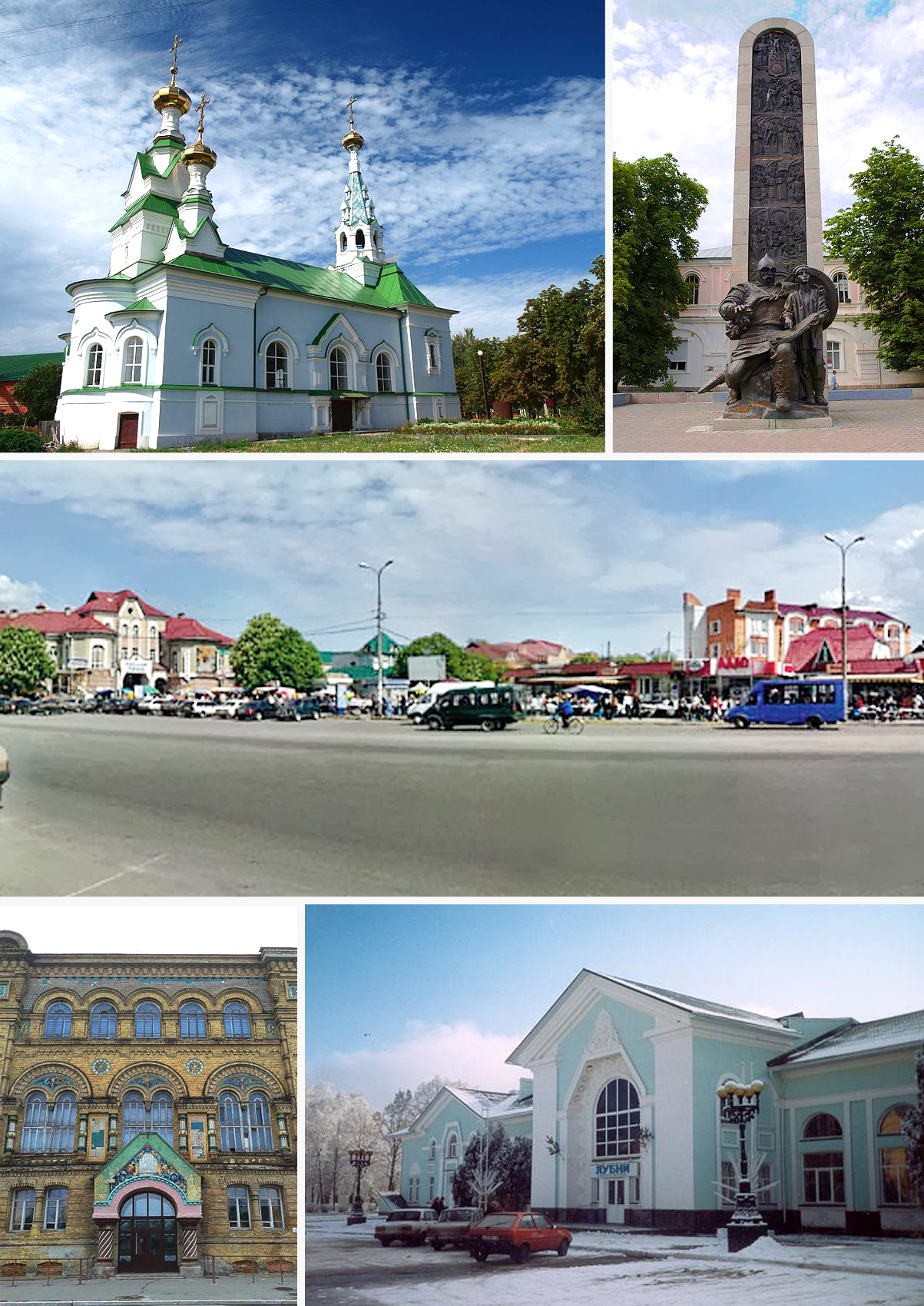
 The monument to 1000-year anniversary of Lubny
 -
 The church of Virgin Mary's Birthday (19th century)
 -
 The Mhar's monastery. The cathedral (17th century)
 -
 The Mhar's monastery. The church
.jpg)


,2.JPG)


Administrative divisions
[edit]Lubny is divided into eight microdistricts, each raion is governed by a specially-appointed secretary, and has its own branch of the police force. The secretaries are responsible for handling issues in their raion.
Population
[edit]Language
[edit]Distribution of the population by native language according to the 2001 census:[12]
| Language | Percentage |
|---|---|
| Ukrainian | 91.06% |
| Russian | 8.61% |
| other/undecided | 0.33% |
Geography
[edit]Climate
[edit]| Climate data for Lubny (1991–2020) | |||||||||||||
|---|---|---|---|---|---|---|---|---|---|---|---|---|---|
| Month | Jan | Feb | Mar | Apr | May | Jun | Jul | Aug | Sep | Oct | Nov | Dec | Year |
| Mean daily maximum °C (°F) | −1.7 (28.9) |
−0.2 (31.6) |
5.7 (42.3) |
14.9 (58.8) |
21.4 (70.5) |
24.9 (76.8) |
26.8 (80.2) |
26.3 (79.3) |
20.1 (68.2) |
12.6 (54.7) |
4.7 (40.5) |
−0.2 (31.6) |
13.0 (55.4) |
| Daily mean °C (°F) | −4.1 (24.6) |
−3.3 (26.1) |
1.8 (35.2) |
9.8 (49.6) |
15.8 (60.4) |
19.5 (67.1) |
21.3 (70.3) |
20.3 (68.5) |
14.7 (58.5) |
8.2 (46.8) |
2.0 (35.6) |
−2.5 (27.5) |
8.6 (47.5) |
| Mean daily minimum °C (°F) | −6.4 (20.5) |
−5.9 (21.4) |
−1.6 (29.1) |
5.1 (41.2) |
10.3 (50.5) |
14.3 (57.7) |
16.2 (61.2) |
15.0 (59.0) |
10.0 (50.0) |
4.4 (39.9) |
−0.3 (31.5) |
−4.6 (23.7) |
4.7 (40.5) |
| Average precipitation mm (inches) | 47 (1.9) |
41 (1.6) |
49 (1.9) |
37 (1.5) |
59 (2.3) |
75 (3.0) |
63 (2.5) |
47 (1.9) |
57 (2.2) |
47 (1.9) |
45 (1.8) |
51 (2.0) |
618 (24.3) |
| Average precipitation days (≥ 1.0 mm) | 10.0 | 8.9 | 9.6 | 6.8 | 9.0 | 8.4 | 8.0 | 5.1 | 6.7 | 6.8 | 7.7 | 9.4 | 96.4 |
| Average relative humidity (%) | 86.3 | 82.6 | 75.5 | 63.2 | 63.4 | 65.7 | 67.2 | 65.4 | 71.3 | 78.7 | 86.1 | 87.8 | 74.4 |
| Source: NOAA[13] | |||||||||||||
Notable people
[edit]_(cropped).jpg)
- Jeremi Wiśniowiecki, Ruthenian and Polish magnate, the father of the future king of Poland Michael I (1612-1651)
- Szymon Syrski, Polish zoologist (1824–1882)
- Kateryna Skarzhynska, Ukrainian philanthropist and collector of folklore (1852-1932)
- Lyudmila Rudenko, Soviet chess world champion (1904–1986)
- Natalya Meklin, Soviet pilot (1922-2005)
- Melkhisedek (Znachko-Yavorsky), 18th-century Ukrainian religious figure
Transport
[edit]Lubny railway station is located in the city.
References
[edit]- ^ Лубны // Советский энциклопедический словарь. редколл., гл. ред. А. М. Прохоров. 4-е изд. М., «Советская энциклопедия», 1986. стр.728
- ^ "Лубенская городская громада" (in Russian). Портал об'єднаних громад України.
- ^ Чисельність наявного населення України на 1 січня 2022 [Number of Present Population of Ukraine, as of January 1, 2022] (PDF) (in Ukrainian and English). Kyiv: State Statistics Service of Ukraine. Archived (PDF) from the original on 4 July 2022.
- ^ Лубны // Большая Советская Энциклопедия. / редколл., гл. ред. Б. А. Введенский. 2-е изд. том 25. М., Государственное научное издательство «Большая Советская энциклопедия», 1954. стр.439
- ^ "Перша тріщина московського імперіалізму: як царський маніфест 120 років тому випустив «українського джина»". 2025-10-17. Retrieved 2025-10-17.
- ^ № 6800 «Красная Лубенщина» («Червона Лубенщина» // Газеты СССР 1917—1960. Библиографический справочник. том 3. М., «Книга», 1978. стр.224
- ^ Газеты дореволюционной России 1703—1917. Каталог. СПб., 2007. стр.91
- ^ Концентрационные лагеря, образованные на территории СССР немецко-фашистскими захватчиками в 1941-1944 гг. Список составлен по материалам Чрезвычайной Государственной Комиссии (ЧГК) // газета "Судьба", июнь 1995. стр.3-6
- ^ United States Holocaust Museum, Einsatzgruppen (Mobile Killing Units) Archived 2009-05-07 at the Wayback Machine
- ^ "Про утворення та ліквідацію районів. Постанова Верховної Ради України № 807-ІХ". Голос України (in Ukrainian). 2020-07-18. Retrieved 2020-10-03.
- ^ "Нові райони: карти + склад". Мінрегіон (in Ukrainian). Міністерство розвитку громад та територій України. 17 July 2020.
- ^ "Рідні мови в об'єднаних територіальних громадах України" [Native languages in the united territorial communities of Ukraine] (in Ukrainian). Archived from the original on 2021-06-14. Retrieved 2025-10-04.
- ^ "World Meteorological Organization Climate Normals for 1991-2020 — Lubny". National Oceanic and Atmospheric Administration. Archived from the original on 22 April 2025. Retrieved 16 June 2024.
External links
[edit]- (in Ukrainian) Lubny News
- (in Ukrainian) Official city administration site
- History of Jewish Community in Lubny
- The murder of the Jews of Lubny during World War II, at Yad Vashem website.

Lubny
View on GrokipediaHistory
Origins and medieval period
Lubny possesses a longstanding reputation as one of Ukraine's ancient urban centers, with evidence of continuous settlement predating 1000 AD along the Sula River, which supported early economic activities through its navigable waters and fertile surroundings.[7] In the medieval era, the locality formed part of the Kievan Rus' polity, particularly within the Pereiaslavl lands, where Slavic communities engaged in agriculture, trade, and defense against nomadic incursions from steppe peoples such as the Pechenegs and Cumans.[8] Primary historical records, including Rus' chronicles, reference Lubny (variously transcribed as Lobyn or Lubin) as a strategic refuge amid inter-princely conflicts and raids, underscoring its role in the fragmented political landscape of 12th-century Rus'. The adoption of Orthodox Christianity across Rus' in 988 influenced local cultural and architectural evolution, though specific monumental remains from this phase remain sparse due to subsequent destructions. The Mongol onslaught of 1237–1240 inflicted severe depopulation and economic regression on the region, curtailing urban growth and shifting patterns of habitation toward more fortified or remote sites until later recoveries.[8]Cossack and early modern era
The Lubny Cossack Regiment was organized in 1648 at the outset of the Khmelnytsky Uprising, incorporating territories in central Ukraine that had previously fallen under Polish administration.[9] Lubny functioned as the regimental headquarters from around 1650 until the close of the 18th century, serving as a key military and administrative center within the Cossack Hetmanate on the Left Bank of the Dnieper.[10] Prior to the uprising, the city had been the seat of Polish magnate Jeremi Wiśniowiecki (1612–1651), who maintained it as the capital of his extensive estates and a stronghold against nascent Cossack resistance in the Polish-Lithuanian Commonwealth.[10] As part of the Hetmanate's regimental structure, the Lubny unit mobilized for imperial campaigns under Russian oversight following the 1654 Treaty of Pereiaslav, including significant deployments during the 1721–1725 Russo-Persian War led by Colonel Yakiv Markovych, whose diary records detailed Cossack musters and logistics from the regiment's base.[11] Regimental leadership transitioned to appointed colonels in the early 18th century, with one serving from 1714 to 1727 amid efforts to integrate Cossack forces into broader Russian military operations, such as fortifications in northern regions.[12] Economically, the regiment secured monopolies on local trade, including licenses for distilling and selling spirits, tobacco, and tar across its jurisdiction, reflecting the semi-autonomous fiscal practices of Hetmanate units. By the late 18th century, as Russian centralization dismantled the Hetmanate's autonomy—culminating in the abolition of regiments around 1781—Lubny shifted from Cossack regimental seat to a district center within Poltava Governorate, retaining its strategic position on the Sula River but under imperial provincial governance.[10] This era marked the gradual erosion of Cossack military privileges, with Lubny's forces increasingly subordinated to regular Russian army structures while local elites adapted to new administrative hierarchies.Imperial Russian and revolutionary times
Following the dissolution of the Lubny Cossack Regiment in 1781, the town was integrated into the Russian Empire's administrative framework, becoming the seat of Lubny uyezd in Poltava Governorate upon its establishment in 1802.[7] As a key regional center, Lubny hosted numerous annual fairs that generated significant revenue for the gubernia, alongside an economy centered on agriculture and trade.[7] By 1897, the Jewish community numbered 3,006 residents, reflecting substantial minority settlement dating back to the 17th century.[1] The 8th Lubny Hussar Regiment, raised before the Patriotic War of 1812, distinguished itself in 19th-century Russian campaigns, including against Napoleon and in later conflicts, maintaining a garrison presence in the town.[13] Educational advancements included the Lubny Men's Gymnasium, operational in the second half of the 19th century, which served as a hub for classical learning and local self-awareness within the imperial system.[14] By 1910, Lubny's population reached 12,786, supported by seven churches and growing urban infrastructure.[4] The 1905 Revolution saw the formation of a Revolutionary Coalition Committee by Ukrainian Social Democrats, briefly establishing self-governance dubbed the Lubny Republic amid broader unrest.[4] In the turmoil of 1917–1921, control shifted rapidly; Bolshevik expeditionary forces advanced through Lubny toward Kyiv in February 1918 during the Ukrainian-Soviet War.[15] Local units, including remnants of the Lubny Hussars, suppressed Bolshevik uprisings in Kyiv and resisted Red forces through winter 1917–1918.[13] The Russian Civil War brought paramilitary violence to Lubny, including an anti-Jewish pogrom in 1919 initiated by irregular forces en route to confront Cheka units, propagated under slogans like "Death to the Yids and Communists."[16] Ukrainian troops intervened to halt pogromist attacks in the town that year, defending Jewish residents against assailants.[17] Such events exemplified the era's ethnic and ideological clashes in the region.[1]Soviet industrialization and collectivization
In the late 1920s, Soviet authorities initiated forced collectivization in the Lubny district of Poltava Oblast as part of the broader Ukrainian campaign to consolidate individual peasant farms into collective enterprises (kolkhozy). This process accelerated after 1929, involving the liquidation of private property, confiscation of mills and other assets—such as the 27 mills seized in Lubny county—and the dekulakization of wealthier peasants labeled as kulaks, who faced deportation, execution, or forced labor.[18] By early 1932, over 70% of farms in Soviet Ukraine, including those in the Poltava region encompassing Lubny, had been collectivized, often under coercion from party activists and with quotas for grain procurement that exceeded actual harvests.[19] These policies precipitated a severe famine, known as the Holodomor, peaking in 1932–1933, which devastated rural areas around Lubny due to excessive grain requisitions, restrictions on peasant mobility, and the export of food to fund industrialization elsewhere in the USSR. Soviet procurement targets in Ukraine reached 7.7 million tons in 1932 despite poor yields, leading to widespread starvation; empirical estimates place excess deaths in Ukraine at 3.9 million from 1932–1934, with Poltava Oblast suffering among the highest rates due to its agricultural centrality and resistance to collectivization.[20] [21] The famine's man-made character stemmed from policy choices prioritizing state control over food security, as harvests were sufficient for basic sustenance but diverted to urban centers and exports.[22] Industrialization in Lubny during the First Five-Year Plan (1928–1932) was limited compared to major urban hubs, focusing on light and agricultural processing rather than heavy industry, with some expansion of farm equipment repair and small-scale manufacturing tied to regional collectivized output. Automotive and machinery workshops emerged or were repurposed in the Poltava area, including near Lubny, to support mechanized farming, though production quotas often outpaced infrastructure, contributing to inefficiencies.[23] By the mid-1930s, these efforts had modestly increased local employment but at the cost of rural depopulation from famine and repression, aligning with Stalin-era priorities of rapid extraction for national heavy industry goals.[24]World War II and Nazi occupation
German forces captured Lubny on September 13, 1941, during the advance following the Battle of Kiev as part of Operation Barbarossa.[25] The city fell under the administration of Reichskommissariat Ukraine, a Nazi civil administration established to exploit occupied Soviet territories for resources and labor while implementing racial policies. During the occupation, which lasted until Soviet liberation, the region experienced economic plunder, forced labor requisitions, and suppression of resistance, typical of Nazi governance in Ukraine.[26] The Jewish community, numbering approximately 2,833 in 1939 and comprising about 10-12% of Lubny's population, faced immediate persecution after the German arrival.[25] Rumors of mass killings in earlier-conquered areas prompted some Jews to attempt flight or hiding, but most remained.[27] On October 16, 1941, German forces, likely including Einsatzgruppen mobile killing units, rounded up the Jews and marched them to an execution site outside the city, where they were shot en masse in a ravine.[28] This "Holocaust by bullets" action, documented in photographs showing victims awaiting death, resulted in the murder of nearly the entire Jewish population of Lubny, with few survivors.[25] No formal ghetto was established prior to the killings, distinguishing it from some other Ukrainian sites.[29] Throughout the occupation, Nazi policies enforced anti-partisan reprisals and resource extraction, though specific incidents in Lubny beyond the initial Jewish massacre are sparsely documented. The Red Army liberated Lubny on September 18, 1943, during the Poltava-Kremenchug Offensive as part of the broader Battle of the Dnieper, ending two years of direct German control.[1] Post-liberation, Soviet authorities documented Nazi atrocities, including the Jewish executions, though commemoration focused more on general anti-fascist narratives than specifically on the Holocaust.[30]Post-war reconstruction and late Soviet period
Lubny was liberated from Nazi occupation on 18 September 1943, after nearly two years of control that included the establishment of a concentration camp for Soviet prisoners of war in 1942 and widespread destruction of infrastructure and industry.[4][1] Post-war reconstruction aligned with Soviet priorities for rapid industrial recovery across Ukraine, emphasizing the repair of war-damaged factories in machine-building and metalworking, sectors central to Lubny's pre-war economy. Efforts focused on restoring plants like those producing grinding machines and tools, contributing to the broader mechanization of agriculture and heavy industry in Poltava Oblast.[31][32] By the late 1940s and 1950s, reconstruction had enabled Lubny's enterprises to resume and expand production, supporting the Soviet Union's fourth and subsequent five-year plans that prioritized heavy industry. The city's machine-tool facilities played a role in supplying equipment for regional agricultural processing and manufacturing, amid Poltava's status as a key grain-producing area. Housing and social infrastructure, including schools and hospitals, were also rebuilt to accommodate returning residents and workers, fostering urban growth tied to industrial output.[33][34] In the late Soviet era, from the 1960s to 1980s, Lubny solidified its position as an industrial hub within the Ukrainian SSR, with ongoing modernization of factories enhancing output in metalworking and related fields. This development reflected centralized planning that integrated local production into national supply chains, though constrained by systemic inefficiencies and resource shortages common to the period. Cultural and commemorative sites, such as war memorials, underscored the narrative of Soviet victory and rebuilding, influencing public memory in the region.[35][31]Independence and post-Soviet developments
Ukraine declared independence from the Soviet Union on August 24, 1991, with the decision affirmed by a nationwide referendum on December 1, 1991, where over 90% of voters supported separation. Lubny, situated in central Poltava Oblast, underwent the broader national transition from a centrally planned economy to market-oriented reforms, including privatization efforts starting in the mid-1990s that affected local state-owned enterprises in food processing and light manufacturing. These changes led to economic contraction, with hyperinflation peaking at over 10,000% in 1993 and industrial output in regions like Poltava declining sharply as Soviet-era supply chains dissolved.[36][37] Demographic trends in Lubny reflected Ukraine's post-Soviet population decline, driven by emigration, low birth rates, and economic hardship. The city's population stood at 52,600 according to the 2001 census but fell to an estimated 44,089 by 2022, marking an average annual decrease of about 0.9% since 2014 amid ongoing challenges. Poltava Oblast as a whole experienced a gradual reduction in residents, with shifts toward urban-rural migration and aging demographics exacerbating labor shortages in traditional sectors.[4][38] By the 2000s, Lubny's economy pivoted toward small-scale private enterprise, trade, and services, supplementing legacy industries like meat processing and engineering with emerging tourism tied to historical sites. Infrastructure improvements, such as road upgrades on the M-03 highway connecting Lubny to Poltava, supported regional connectivity under post-independence development projects. The 2014 Revolution of Dignity and ensuing Russo-Ukrainian conflict prompted local commemorative efforts, including war memorials honoring participants from Poltava Oblast, while the city served as a rear-area hub without direct frontline involvement until escalated Russian strikes on energy and transport infrastructure in the Lubny district beginning in 2022.[4][39][35][40]Geography and environment
Location and physical features
Lubny is situated in central Ukraine within Poltava Oblast, serving as the administrative center of Lubny Raion.[41] The city lies at geographic coordinates 50°00′N 33°01′E.[42] The urban area occupies 31.67 km².[38] Lubny is positioned on the banks of the Sula River, a left-bank tributary of the Dnipro River.[7] The city's elevation averages 153 meters above sea level.[43] The local terrain features gently rolling plains characteristic of the broader Poltava region's landscape in the forest-steppe zone.[44]Climate and weather patterns
Lubny experiences a warm-summer humid continental climate classified as Dfb under the Köppen system, marked by four distinct seasons, significant temperature variation, and moderate precipitation without a pronounced dry period. Winters are long and cold, influenced by Siberian air masses, while summers are warm and occasionally hot due to continental highs; transitional spring and autumn periods feature variable weather with increasing frost risk in fall. Annual average temperatures hover around 8°C, with strong seasonality driving a range from subzero winter lows to mid-20s°C summer highs.[45][46] January, the coldest month, typically sees average highs of -2°C and lows of -8°C, with frequent snow cover lasting 80-100 days per year and occasional blizzards from northerly winds. July, the warmest, averages highs of 27°C and lows of 14°C, with partly cloudy skies and potential for heatwaves; humidity peaks in summer, fostering thunderstorms that contribute to convective precipitation. Precipitation totals approximately 780 mm annually, fairly evenly distributed but with summer maxima from June (around 110 mm) due to cyclonic activity and minimal winter drought, though frozen ground limits infiltration.[46][47] Recorded extremes include a high of 39°C on August 8, 2010, during a regional heatwave, and winter lows occasionally dipping below -20°C, reflecting vulnerability to Arctic outbreaks; such events underscore the climate's continental character, with low pressure systems from the Mediterranean occasionally bringing mild thaws or heavy snow in winter. Wind speeds average 10-15 km/h year-round, strongest in spring transitions, while cloud cover is highest in winter (over 70% monthly average). Long-term data indicate stable patterns, though recent decades show slight warming trends in line with broader Eurasian shifts, without altering core seasonality.[48]| Month | Avg. High (°C) | Avg. Low (°C) | Precip. (mm) |
|---|---|---|---|
| [January | -2](/page/January_2) | -8 | ~40 |
| [April | 15](/page/April_15) | 9 | ~45 |
| [July | 27](/page/July_27) | 14 | ~70 |
| [October | 12](/page/October_12) | 4 | ~40 |