Hubbry Logo
The Lucy ShowThe Lucy ShowMain
Open search
The Lucy Show
Community hub
The Lucy Show
logo
8 pages, 0 posts
0 subscribers
Be the first to start a discussion here.
The Lucy Show
The Lucy Show
from Wikipedia

The Lucy Show
Logo used from season 3
Also known asThe Lucille Ball Show
GenreSitcom
Created by
Based onLife Without George
by Irene Kampen
Directed by
  • Jack Donohue
  • Maury Thompson
Starring
Narrated byRoy Rowan
Theme music composerWilbur Hatch
Composers
  • Wilbur Hatch
  • Julian Davidson
Country of originUnited States
Original languageEnglish
No. of seasons6
No. of episodes156 (list of episodes)
Production
Executive producers
Producers
  • Elliott Lewis (1962)
  • Tommy Thompson
  • Jack Donohue
Camera setupMulti-camera
Running time30 minutes per episode
Production companies
Original release
NetworkCBS
ReleaseOctober 1, 1962 (1962-10-01) –
March 11, 1968 (1968-03-11)
Related
I Love Lucy
Here's Lucy
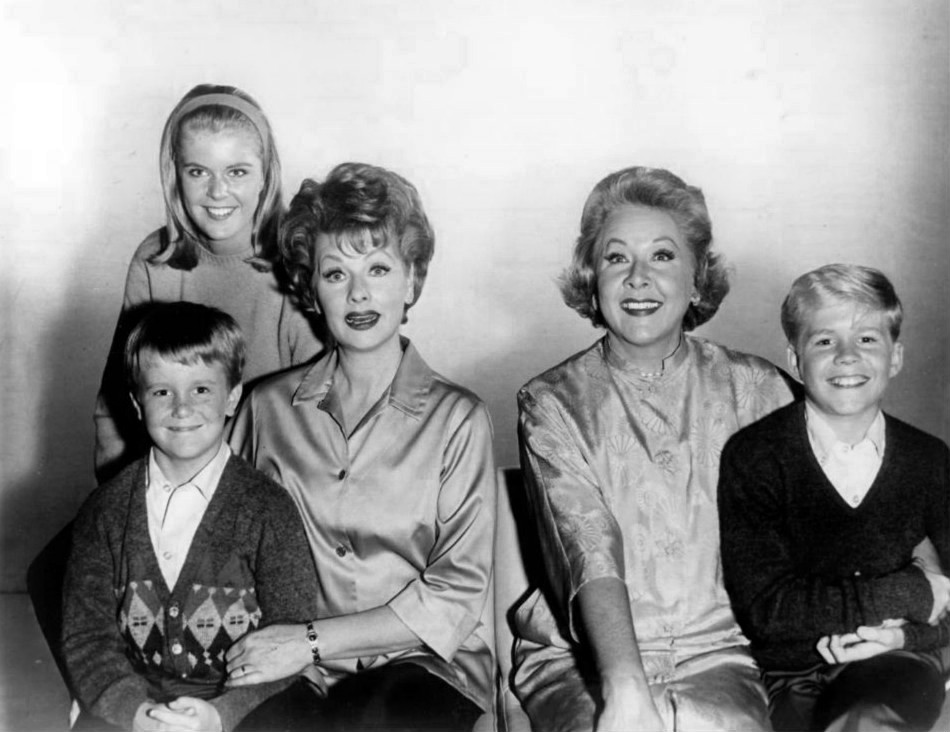
The original cast (l-r): Jimmy Garrett (Jerry Carmichael), Candy Moore (Chris Carmichael), Lucille Ball (Lucy Carmichael), Vivian Vance (Vivian Bagley), Ralph Hart (Sherman Bagley).
From the episode "Kiddie Parties, Inc." (1963)

The Lucy Show is an American sitcom that aired on CBS from 1962 to 1968. It was Lucille Ball's follow-up to I Love Lucy. A significant change in cast and premise for the fourth season (1965–1966) divides the program into two distinct eras; aside from Ball, only Gale Gordon, who joined the program for its second season, remained. For the first three seasons, Vivian Vance was the co-star.

The earliest scripts were titled The Lucille Ball Show; but, when that title was rejected by CBS, producers thought of calling the show This Is Lucy or The New Adventures of Lucy, before deciding on the title The Lucy Show. Ball won consecutive Emmy Awards as Outstanding Lead Actress in a Comedy Series for the series' final two seasons, 1966–67 and 1967–68.

Creation

[edit]

In 1960, Lucille Ball and Desi Arnaz divorced, and the final episode of The Lucy–Desi Comedy Hour aired (using the I Love Lucy format). Later that year, Ball moved to New York to try the Broadway stage in an unsuccessful musical, Wildcat. During the show's run, Ball was plagued by illness and fatigue and in early 1961, the show closed when she collapsed on stage from total exhaustion. Later that year, she married for the second time, to comedian Gary Morton.

Ball returned to television in the spring of 1962, when she teamed with Henry Fonda in The Good Years, a TV special on CBS. She adamantly refused to return to weekly television, as she was convinced she could never top the success of I Love Lucy.

At that time, Desilu Productions was struggling. In the spring of 1961, four of the studio's situation comedies were cancelled: The Ann Sothern Show; Angel, a sitcom starring Marshall Thompson and French actress Annie Farge; Harrigan and Son, starring Pat O'Brien and Roger Perry; and Guestward, Ho!, starring Joanne Dru and Mark Miller. In the spring of 1962, after a two-year run, the comedy series Pete and Gladys (a spin-off of the popular Desilu sitcom December Bride) was canceled. It starred Harry Morgan and Cara Williams in the title roles. At that time, the red-headed Williams, who had been promoted as the next Lucille Ball, had just received an Emmy nomination as Best Actress in a Comedy Series for her role on the show. That left Desilu with only one hit series, The Untouchables.

Arnaz, as president of Desilu, offered Ball an opportunity to return to television in a weekly sitcom. At that time, CBS executives were somewhat dubious as to whether Ball could carry a show without Arnaz, and whether she could follow such a landmark series as I Love Lucy. It was "never intended for this program to go beyond a single season."[1] This arrangement was "meant to be a stop-gap measure for the beleaguered studio" and that through the sale of this series, Desilu was able to "force the CBS network to invest in and air other upcoming Desilu products."[1] It was a strategy that Ball would use in the future to take control of The Lucy Show's renewal from CBS. With Arnaz's encouragement and persuasion, Ball agreed to do the show, provided that it would be shown on Monday nights (the night on which I Love Lucy had aired), and that she would be reunited with Vivian Vance and her writers from I Love Lucy. CBS agreed to a full season of episodes without a pilot, and The Lucy Show premiered on Monday, October 1, 1962, at 8:30 p.m.

Premise

[edit]

The original premise of the series was that widow Lucy Carmichael lives in the fictional town of Danfield, New York with her teenage daughter Chris and younger son Jerry, with her divorced friend Vivian "Viv" Bagley and Bagley's young son Sherman as tenants. Early episodes included their next-door neighbor, Harry Connors. Lucy's late husband left her a substantial trust fund, managed by a local banker (originally recurring character Mr. Barnsdahl, and later regular character Mr. Mooney); Lucy would frequently try to persuade the bank to let her raid the fund for various purchases or harebrained projects. Lucy also took on various jobs to boost her finances. Lucy, Viv, and Chris all dated regularly, yielding additional fodder for plots; in early episodes, Viv had a regular boyfriend, Eddie Collins.

In 1965, the show was extensively retooled for its fourth season. Lucy moves to Los Angeles to be closer to Chris, who was attending college in California (but no longer appeared on the show), and enrolls Jerry in a military boarding school there (facilitating his also being written out). Viv, now remarried as Vivian Bunson, remains in Danfield with Sherman, but visits Lucy a few times; Lucy's new best friend is Mary Jane Lewis. Lucy finds that Mr. Mooney has been transferred to the Los Angeles branch of the bank, and she eventually becomes his employee there. The new setting provided ample opportunity for celebrities to appear as themselves, often becoming entangled in Lucy's zany schemes. References to Lucy's children and her trust fund were eventually dropped, and this remained the show's premise through the sixth and final season.

Production

[edit]

The Lucy Show was one of only two sitcoms at the time to use the multi-camera setup and film with a live studio audience (The Dick Van Dyke Show, which was also filmed by Desilu and aired on CBS, was the other).

The show began with Lucille Ball as Lucy Carmichael, a widow with two children, Chris (Candy Moore) and Jerry (Jimmy Garrett), living in the fictional town of Danfield, New York, sharing her home with divorced friend Vivian Bagley (Vance) and her son, Sherman (Ralph Hart). In order to get Vance to commit to the series, Arnaz acquiesced to her demands for an increase in salary, co-star billing, a more attractive wardrobe - though it remained somewhat dowdy - and, finally, that her character's name be Vivian. After doing I Love Lucy, she was still being referred to as Ethel Mertz by people on the street, much to her annoyance.[2][unreliable source?][better source needed]

Although the book on which the show was based, Irene Kampen's Life Without George, centered on two divorcées living together in the same house raising their children, it was decided early on that the Lucy Carmichael character should instead be a widow.[3] The consensus was that fans would be offended by a Lucy who was divorced, despite the fact that this was a new character and Ball herself was divorced. The character of Vivian Bagley became the first divorced woman on primetime television.[3]

In the show's original format, Lucy had been left with a substantial trust fund by her late husband, which was managed during the first season by local banker Mr. Barnsdahl (Charles Lane). Comedian Dick Martin, working solo from his longtime partner Dan Rowan, was cast in ten episodes as Lucy's next-door neighbor and frequent boyfriend, Harry Connors, during the show's first season. Character actor Don Briggs was also featured in six episodes as Viv's beau, Eddie Collins, and Tom Lowell, a young actor seen on various primetime television shows, appeared in three installments as Chris Carmichael's boyfriend, Alan Harper. The first season of The Lucy Show fully utilized the talents of Bob Carroll Jr., Madelyn Martin, Bob Schiller, and Bob Weiskopf (four of the five original writers of I Love Lucy) in creating its thirty episodes, with Desi Arnaz as executive producer for fifteen of those shows.[4] At the end of its first season, The Lucy Show received highly positive reviews from the critics and ranked #5 in the Nielsen seasonal ratings. Ball was nominated for an Emmy Award as Best Actress in a Series, but lost to Shirley Booth for the NBC comedy hit Hazel. On the strength of its high ratings, the series was renewed for a second year, but a number of significant changes were made.[citation needed]

At the beginning of the 1962–63 season, Desi Arnaz resigned as head of Desilu and as the executive producer of The Lucy Show. Ball took over as president of the studio and Elliott Lewis replaced Arnaz as executive producer of Ball's series. Dick Martin, Don Briggs, Tom Lowell, and Charles Lane left the show. The characters of Harry Connors and Alan Harper were never mentioned again. Briggs would make one more appearance as Eddie Collins in the episode "Lucy Goes Duck Hunting". The Barnsdahl character was replaced by Theodore J. Mooney, played by Gale Gordon, who would remain with the series for the remainder of its run, surviving another format change. In the episode "Lucy Gets Locked in the Vault", Gordon's character is introduced when Lucy discovers that Mr. Barnsdahl has been transferred to another bank and that the management of her trust fund has been taken over by a new banker. The name "Theodore J. Mooney" had been used earlier by the actor George Cisar, who was cast as a police sergeant on thirty-one episodes of Gordon's other CBS sitcom, Dennis the Menace.

Gordon had worked with Ball as far back as 1938 on the CBS radio program The Wonder Show[5] and later worked with her on another radio show, My Favorite Husband. When CBS retooled My Favorite Husband for television as I Love Lucy, Gordon was offered the role of Fred Mertz, but he was already committed to the radio series Our Miss Brooks (which also was about to move to television) so William Frawley was cast in the part. In 1952, Gordon guest starred on the first season of I Love Lucy as Ricky Ricardo's boss at the Tropicana, Alvin Littlefield. Six years later, Gordon became a regular on the short-lived NBC-TV sitcom Sally which starred actress Joan Caulfield (who inherited Lucille Ball's role as Liz Cooper when My Favorite Husband was directly adapted to television in 1953). In the late fall of 1958, Gordon guest-starred as a judge in the hour-long The Lucy–Desi Comedy Hour episode "Lucy Makes Room for Danny". From 1960 to 1962, he had recurring roles on two CBS-TV sitcoms – The Danny Thomas Show and Pete and Gladys. Gordon was to have joined The Lucy Show at its premiere in the fall of 1962, but he was still contractually obligated to Dennis the Menace, in which he had replaced Joseph Kearns, who had unexpectedly died earlier in the year. It was later revealed that Ball had grown unhappy with Charles Lane because of his difficulty remembering his lines in front of the studio audience and was eager to have Gordon join the cast.[6] Lane then became a semi-regular on the CBS-TV sitcom Petticoat Junction as Homer Bedloe.

During the first two seasons, a few guest stars were brought in for some episodes such as Broadway superstar Ethel Merman, actor-comedian Wally Cox, singer Roberta Sherwood, and golf pros Jimmy Demaret and Bo Wininger. Character actor-comedian Hans Conried, who was a semi-regular on The Danny Thomas Show playing Uncle Tonoose, appeared on two episodes of The Lucy Show in 1963 ("Lucy's Barbershop Quartet" and "Lucy Plays Cleopatra") playing Dr. Gitterman, a voice teacher. At this time, Ball also used many other well-known character actors in featured parts such as Carole Cook, Mary Wickes, Roscoe Karns, John McGiver, William Schallert, John Carradine, Robert Alda, Majel Barrett, Karen Norris, Dorothy Konrad, Lou Krugman, Stafford Repp, Ellen Corby, Philip Carey, Carl Benton Reid, Lyle Talbot, Leon Ames, Jackie Coogan, Kathleen Freeman, Keith Andes (who was Ball's leading man in the Broadway musical Wildcat), William Windom, Vito Scotti. Robert Rockwell, Frank Aletter, Reta Shaw, Murvyn Vye, Hazel Pierce, J. Pat O'Malley, Roland Winters, Sandra Gould, Cesare Danova, Bobs Watson, Nancy Kulp, future Academy Award-winning actor Jack Albertson, and the so-called "Queen of the Hollywood Extras" Bess Flowers. In addition, young performers like Don Grady, Tina Cole, Barry Livingston, Eddie Applegate, Stephen Talbot, Lee Aaker, Eddie Hodges, and future Academy Award-nominee Michael J. Pollard and Ball's two children, Lucie Arnaz and Desi Arnaz Jr., made appearances on the program. In the second season, Ball's second husband Gary Morton made his acting debut on The Lucy Show.

At the end of the second season, a disagreement erupted between Ball and head writers Bob Carroll, Jr., and Madelyn Martin regarding a particular script which Ball found to be inferior. As a result, Carroll, Martin, Weiskopf and Schiller left the series.[7]

In early 1964, the show was in threat of getting canceled when Lucille Ball attempted to retire from CBS to spend her time as president of Desilu Productions,[8] but she changed her mind and signed a new three-year agreement with the network.[9]

Lucy gets into the soup with Danny Kaye while trying to meet him, 1964.

In the fall of 1964, though CBS began to broadcast sporting events and cartoons in color, they still refused to broadcast The Lucy Show in color even though the series had been filmed in color since the start of the second season, 1963-1964. Through that year ownership of color TV sets grew, and several other manufacturers began making color equipment and color TV sets.

At the beginning of the 1964–65 season, The Lucy Show went through a significant staff change. Elliott Lewis left the series and was replaced as executive producer by Jack Donohue, who served as producer and director. With the absence of Carroll, Martin, Weiskopf, and Schiller, Ball hired veteran comedy writer Milt Josefsberg, who had written for Jack Benny, as script consultant. Under Josefsberg's supervision there were no permanent writers for the series and different writers were employed each week (among them, Garry Marshall). Ball persuaded Weiskopf and Schiller to return and write four installments.

There were further changes to the series. Vivian Vance reduced the number of episodes in which she appeared in that season to spend more time on the East Coast with her husband, literary editor John Dodds. Ann Sothern, whom Ball considered to be "the best comedian in the business, bar none" and a personal friend,[10] made a number of appearances during 1964 and 1965 as the "Countess Framboise" (née Rosie Harrigan) to fill Vance's absence. The Countess, who had been widowed by the death of her husband, "who left her his noble title and all of his noble debts," was always trying to get money to pay off her debts. She also did battle with Mr. Mooney and, somewhat tongue-in-cheek, she addressed him as "Mr. Money," which he found mildly annoying, even as he gently attempted to correct her. Because it was known that Vance would be leaving the series, Sothern was proposed as the new co-star, but she declined.[11] Sothern reportedly wanted to share top billing with Ball, who flatly refused to consider the notion.[12] Sothern made three more guest appearances during the following (1965–66) season.

The Lucy Show was filmed on Stage 21 at Desilu Studios (now Paramount)

In the spring of 1965, Vance was growing tired of commuting weekly between her home on the East Coast and Los Angeles. To continue appearing on the show, Vance wanted more creative control with the opportunity to produce and direct episodes and to receive better pay. Agents and studio executives misinformed Ball regarding Vance's desires, believing that she wanted to be Ball's equal. It was decided not to meet Vance's requests, leaving both Ball and Vance feeling betrayed by the other. As a result, Vance decided to leave the series. Ball would later regret not giving Vance what she requested. Without Vance on the show, Ball seriously considered ending the series, feeling she could not continue without her.

Even though Candy Moore, Jimmy Garrett, and Ralph Hart were still contracted to the series, they were used minimally during the third year. For example, in the episode "Lucy and the Old Mansion", which was the final Season 3 installment, filmed in January 1965, Moore, Garrett, and Hart appear in the opening scene, have a few lines of dialogue, then exit. It is the last time in which all of the three children are seen, and they were subsequently written out in Season 4. Dropping Candy Moore, in fact, was Ball's decision. Because Moore was popular with teenagers and the subject of dozens of articles in youth-oriented magazines at the time, her departure was originally nixed by CBS but finally accepted when Ball threatened to "retire".

Clint Walker is a construction worker who takes Lucy atop a skyscraper under construction, where they both learn she is afraid of heights.

The third season included such guest stars as Jack Benny, Bob Hope, Danny Kaye, and Arthur Godfrey.

Format, setting, and major cast changes

[edit]

In the first episode of the fourth season, Lucy and Jerry Carmichael and Mr. Mooney moved from Danfield to California, where Lucy began working for Mr. Mooney at the bank. Lucy's daughter Chris was said to have gone away to college and was not mentioned again. It was explained that Vance's character (Vivian Bagley) remarried and that she, along with her son Sherman and her new husband, remained in Danfield, although she returned for a few guest appearances towards the end of the series' run.[13] With Candy Moore and Ralph Hart having already left the show at this point, only Jimmy Garrett was retained, but he would make only two appearances to support the transition before he, too, was phased out of the series.

This procedure was later explained by Oscar Katz, one of Desilu's vice presidents. According to Katz, "If you go into a network with the same series but a radically changed format, the contracts allow for greater financial renegotiation." Candy Moore adds, "By dropping all of us at once, Desilu was able to get a lot more money out of CBS for the continuation of The Lucy Show."

In the fourth season premiere episode, "Lucy at Marineland", Jerry was quickly shipped off to a military academy. He made one final appearance, in a Christmas-themed episode, midway in the 1965–66 season. Sothern made three more guest appearances as the Countess, and Joan Blondell guest-starred in two episodes as Lucy's new friend Joan Brenner. However, Ball felt there was no chemistry between them and so, the idea of Blondell becoming Lucy's new comrade on the series was quickly rejected.

Finally, Lucy gained a new best friend, Mary Jane Lewis (Mary Jane Croft). Croft had prior experience performing with Ball and was the wife of former executive producer Elliott Lewis. In 1954, she made her first appearance on I Love Lucy playing Cynthia Harcourt, a rich friend of Lucy Ricardo in the episode "Lucy Is Envious". In 1956, she returned to the series playing Evelyn Bigsby, a traveler seated next to Lucy on an airplane in the fifth season finale, "Return Home from Europe". In 1957, she made her final appearances on the series as Lucy's neighbor Betty Ramsey in the sixth season. During the 1950s, Croft also had occasional roles on I Married Joan and Our Miss Brooks. She was also the voice of Cleo the basset hound in the sitcom The People's Choice. Croft then portrayed Lucy Carmichael's friend Audrey Simmons during the 1962–64 episodes of The Lucy Show. In the third season, with the departure of Elliott Lewis as executive producer, Croft had also left the series, although her character of Audrey was still referred to in a few episodes but never seen. At this time, Croft had also been a regular for ten years on the long-running ABC-TV sitcom The Adventures of Ozzie and Harriet, which was in its final year of production in 1965. In returning to The Lucy Show in the fall of 1965 as a new character, Croft was replacing Vivian Vance as Lucy's pal and co-conspirator; she did not, however, get co-star billing – like Roy Roberts, who played Mooney's boss at the bank, Mr. Cheever, she received featured billing despite playing a regular character.

By January 1966, all references to Lucy Carmichael's children, her trust fund, and her former life in Danfield were dropped. Lucy Carmichael was firmly established as a single woman living in Los Angeles. Lucy worked in films disguised as stunt man "'Iron Man' Carmichael" for three episodes ("Lucy the Stunt Man", "Lucy and the Return of Iron Man", and "Lucy and Bob Crane"). At the end of the 1965–66 season Lucille Ball was nominated for her second Emmy for The Lucy Show as Best Actress in a Comedy Series, however, Mary Tyler Moore took home the trophy for her role as Laura Petrie for The Dick Van Dyke Show.[citation needed]

The next two seasons featured many stars making guest appearances as themselves conducting business at Lucy's bank. For the last two seasons, Vivian Vance made three guest appearances in her role as Vivian Bagley (except it was now Vivian Bunson, as her character had gotten married again when Lucy Carmichael moved to California). In all three episodes in which Viv visited Lucy, there were passing references to their former life in Danfield as well as Viv's new husband, but no mention was made about any of their children. In the fifth-year episode "Lucy Gets Caught Up in the Draft", Lucy Carmichael receives a letter from her son, who is away in military school. In that installment, he is called Jimmy, not Jerry. During the filming of that particular show, Ball was constantly being corrected by her crew saying that the son's name was Jerry and that Jimmy Garrett had played that part and that was the reason for her being confused. However, Ball refused to listen and so the error stayed in and that was the last reference to Lucy Carmichael's son. For the 1966–67 season, Gale Gordon was nominated for an Emmy Award as Best Supporting Actor in a Comedy Series, but lost to Don Knotts, who won for his guest appearance in the episode "The Return of Barney Fife" on The Andy Griffith Show. Maury Thompson received a nomination for Best Directing in a Comedy Series and is the only Lucy director ever to receive a nomination in the directing category. After eleven years, Ball was finally awarded an Emmy as "Best Actress in a Comedy Series" (she had previously won two, as "Best Comedienne" in 1953 and as "Best Actress in a Continuing Performance" in 1956 for I Love Lucy).[citation needed]

During the 1967–68 season, Ball's second husband, Gary Morton, became executive producer of The Lucy Show. Lucille Ball sold Desilu Productions to Gulf+Western Industries, abandoning ownership of the series. In the spring of 1968, The Lucy Show won Emmy nominations for Best Comedy Series, Milt Josefsberg and Ray Singer for Best Writing in a Comedy Series, Lucille Ball for Best Actress in a Comedy Series, and Best Supporting Actor in a Comedy Series (Gale Gordon). This time, Gordon lost the award to Werner Klemperer of Hogan's Heroes, and the show itself lost the Best Comedy Series Award to the NBC sitcom Get Smart. For the second straight year, Ball was awarded the coveted statuette. At the end of its sixth season, The Lucy Show posted its highest Nielsen rating, ranking at #2.

After six seasons, Ball decided to end the series, feeling that the show had enough episodes for syndication. Ball opted to continue on television under the provision that her two children, Lucie Arnaz and Desi Arnaz Jr., agreed to appear alongside her.[14] Thus, in the fall of 1968, an entirely new series, Here's Lucy, debuted. This series featured her and her children, as well as Gordon. Croft was gradually added as a regular and Vance made several guest appearances. Gordon, as well as both actresses, played new characters which were similar to their characters on the former series. Like I Love Lucy and The Lucy Show, Here's Lucy also ran on CBS for six seasons.

Cast

[edit]
Actor Character Season 1 Season 2 Season 3 Season 4 Season 5 Season 6
1962–63 1963–64 1964–65 1965–66 1966–67 1967–68
Lucille Ball Lucille Carmichael Starring
Vivian Vance Vivian Bagley Starring N/A Guest
Gale Gordon Theodore J. Mooney N/A Regular Starring
Mary Jane Croft Audrey Simmons/
Mary Jane Lewis
Recurring N/A Regular
Candy Moore Chris Carmichael Regular Recurring N/A
Jimmy Garrett Jerry Carmichael Regular Recurring N/A
Ralph Hart Sherman Bagley Regular Recurring N/A
Dick Martin Harry Recurring N/A
Charles Lane Mr. Barnsdahl Recurring N/A

Guest stars

[edit]
Guest star John Wayne on a 1966 episode

From the 1965–66 season onward, with the change in format, a number of celebrities guest starred on The Lucy Show, usually playing themselves under the premise that the Lucy Carmichael character, now living in Hollywood, crossed paths with them, either in her day-to-day life, or through her job at the bank. These included Jack Benny, Mickey Rooney, Carol Burnett, George Burns, Joan Crawford, Tennessee Ernie Ford, Dean Martin, Phil Silvers, Frankie Avalon, Wayne Newton, Robert Stack, Mel Tormé, John Vivyan, Jack Cassidy, Clint Walker, and Milton Berle.

Other CBS shows were sometimes brought in. In the episode "Lucy and John Wayne", a photograph of Bob Crane as Colonel Hogan from Hogan's Heroes can be seen as guest star Wayne is exiting a scene.

The episode featuring Joan Crawford, "Lucy and the Lost Star", caused much celebrity fodder given Ball and Crawford's public feud during the filming. According to Ball, Crawford was often drunk on the set[15] and could not remember her lines.[citation needed] Ball was said to have requested several times to replace Crawford with Gloria Swanson, who was supposed to have filled the role originally but bowed out for health reasons. Crawford was so upset that at one point, she wouldn't leave her dressing room. According to Ball's friend the singer-comedian Kaye Ballard, it was Vanda Barra, a featured actress frequently used on The Lucy Show, who finally persuaded Crawford to continue with the show by giving her a much needed pep talk. As a result, Crawford sailed through the filming with nary a flaw. After the show was filmed, Crawford went out of her way to thank Barra for encouraging and supporting her.

Ball and Vance in a 1967 episode

The February 14, 1966 episode featuring Dean Martin (in which Lucy Carmichael accepts a blind date with Dean Martin's lookalike stunt double "Eddie Feldman," but when he can't make it, the real Dean Martin takes his place on the date with Lucy) was described by Ball as her favorite episode of the series.

Lucie Arnaz, Ball's daughter, appeared in several episodes of the show during its run: she was an extra in the first season's third episode, "Lucy Is a Referee," the teenage best friend of Chris in "Lucy Is a Soda Jerk" and "Lucy Is a Chaperone" (though she was only 12 at the time), and later as one of her mother's friends, Dottie, in the 1967 "Lucy and Robert Goulet" (although she was only 16). She was also seen briefly as a teen walking past Lucy and Mr. Mooney in the episode "Lucy and the Ring a Ding Ring". She was also seen playing a student named Patty in the episode "Lucy Gets Her Diploma".[16]

In addition, Desi Arnaz, Jr. appeared in six episodes on The Lucy Show as Mary Jane Croft's son Billy Simmons ("Lucy Is A Referee", "Lucy Visits the White House", "Lucy and the Little League", and "Lucy and the Scout Trip"). Lucie Arnaz appeared with her brother Desi Arnaz Jr. (Lucille Ball and Desi Arnaz's son) briefly in the first episode of the fourth season, "Lucy at Marineland".

The October 1965 episode, "Lucy and the Countess Have a Horse Guest" reunited Ball and her former I Love Lucy co-star William Frawley, who played a small role as a horse trainer, for the last time. It was his last television appearance, six months before he died. In the episode credits, he's listed as "Our Own Bill Frawley"

Opening credits

[edit]
Season 1 opening credits (1962–1963): animations of Lucille Ball and Vivian Vance. Opening credits were changed throughout the show's run.

A different opening sequence was created for each season:

  • Season 1 (1962–63): animated stick figures of Ball and Vance were used (similar to the ones used in the original opening sequences of I Love Lucy and of the subsequent 13 hour-long specials later syndicated in reruns as The Lucy–Desi Comedy Hour).
  • Season 2 (1963–1964): stills from previous episodes
  • Season 3 (1964–1965): Clips appear from previous episodes
  • Season 4 (1965–1966): Clips from previous episodes appear viewed from a kaleidoscope. The titles were designed by Howard Anderson Jr., who was also responsible for the "heart" opening for I Love Lucy.[17]
  • Season 5 (1966–1967): an additional opening was created at the beginning of the season that featured Lucille Ball as an animated "jack-in-the-box". Ball reportedly hated it, and it was only used in a handful of episodes at the start of the season before being replaced by a slightly revamped version of the kaleidoscope opening. However, because of poor editing, the theme music to this opening was retained while the kaleidoscope opening played for several of the early 1966 fall episodes.
  • Season 6 (1967–1968): the kaleidoscope opening was used once again, but the theme music was reorchestrated. Also the "Glamour Shot" of Ball at the end of the opening is a different clip than season five. For the episodes in which Gale Gordon did not appear, the "Co-Starring: Gale Gordon" voiceover was omitted from the audio track.

During later television airings, including 1970s and 1980s syndicated runs,[citation needed] as well as Nick at Nite's 1990s reruns of the series, the later "kaleidoscope" opening was used in nearly all episodes (with a "costarring Vivian Vance" voiceover edited in for episodes from the first three seasons).

The theme music was composed by Wilbur Hatch, who was the show's musical director, a role he also performed on Ball's previous series I Love Lucy.

Episodes

[edit]
SeasonEpisodesOriginally releasedRankRatingHouseholds
(millions)
First releasedLast released
130October 1, 1962 (1962-10-01)April 29, 1963 (1963-04-29)429.8[a]14.99[18]
228September 30, 1963 (1963-09-30)April 27, 1964 (1964-04-27)628.115.00[19]
326September 21, 1964 (1964-09-21)April 12, 1965 (1965-04-12)826.614.02[20]
426September 13, 1965 (1965-09-13)March 21, 1966 (1966-03-21)327.714.92[21]
522September 12, 1966 (1966-09-12)March 6, 1967 (1967-03-06)426.214.44[22]
624September 11, 1967 (1967-09-11)March 11, 1968 (1968-03-11)227.015.30[23]

Unproduced episodes

[edit]

There were several scripts written that were never filmed. "Lucy & Viv Fight Over Harry" was set to be produced as the 11th episode in the first season, but there were too many "production problems" and the episode was canceled. In an interview with Jimmy Garrett, he said the audience barely laughed at rehearsals, and Desi Arnaz cancelled the episode with Lucille Ball's permission. During season 2, both "Lucy is a Girl Friday" and "Lucy Plays Basketball" were canceled before filming began as well. The details of these "lost" episodes can be found on the official DVD sets for the first two seasons.

Awards

[edit]
Primetime Emmy Awards
Year Season Category Recipient(s) Outcome
1963 1 Outstanding Continued Performance by an Actress in a Series (Lead) Lucille Ball Nominated
1966 4 Outstanding Lead Actress in a Comedy Series Lucille Ball Nominated
1967 5 Outstanding Lead Actress in a Comedy Series Lucille Ball Won
Outstanding Supporting Actor in a Comedy Series Gale Gordon Nominated
Outstanding Directorial Achievement in Comedy Maury Thompson Nominated
1968 6 Outstanding Comedy Series Tommy Thompson Nominated
Outstanding Lead Actress in a Comedy Series Lucille Ball Won
Outstanding Supporting Actor in a Comedy Series Gale Gordon Nominated
Outstanding Writing for a Comedy Series Milt Josefsberg & Ray Singer for "Lucy Gets Jack Benny's Bank Account" Nominated

Filming

[edit]
L-R: Jack Benny, Bob Hope and Lucy - "Lucy and the Plumber" (1964)

Unlike most sitcoms of the era, The Lucy Show was filmed before a live audience; standard practice at the time was to film an episode on a closed set and add a laugh track during post-production. However, a laugh track was still used to fill any gaps in audience reactions or missed punchlines. The live format was used for all I Love Lucy episodes, for all but a few Lucy–Desi Comedy Hour installments and on The Lucy Show. Arnaz felt Ball performed better in front of a live studio audience.[24] Carole Cook, Ball's long-time friend and protégée in a radio show Great Lives based on Lucille Ball said that three cameras were used so to capture everything in one go, and the best angles would be used. While Ball would ad-lib during rehearsals, she followed the script when filming the actual show.

While filming the 1963 episode "Lucy and Viv Put In A Shower", in which the leading ladies attempted to install a shower stall (but become trapped inside, unable to shut the water off), Ball nearly drowned while performing in the tank of water. She was unable to bring herself back to the surface, and it was Vance who realized there was a problem and pulled her co-star to safety; Vance went on to ad lib until Ball could catch her breath to resume speaking her lines (all the while, cameras continued to film). Neither the film crew nor the live studio audience realized there was a problem.[25]

In her autobiography Love, Lucy, Lucy talks of this episode:[26]

...I found I had no room to manoeuvre. I couldn't get back to the surface again. What's more I swallowed a lot of water and was actually drowning right there in front of three hundred people who were splitting their sides laughing. Vivian (Vance), realising in cold terror what had happened, never changed expression. She reached down, pulled me safely to the surface by the roots of my hair and then calmly spoke both sides of our dialogue, putting my lines in the form of questions. Whatta girl! And whatta night.

The two special episodes to feature Ethel Merman ("Lucy Teaches Ethel Merman to Sing" and "Ethel Merman and the Boy Scout Show") were originally just one episode, "Lucy Teaches Ethel Merman to Sing". This installment was a consolation prize to Merman after her Desilu-produced pilot, Maggie Brown, was rejected as a regular series by CBS. The plot was much as it remains today with Lucy and Viv trying to pass off Agnes Schmidlap as Ethel Merman, not knowing that it really is Ethel Merman, and Lucy attempts to teach her how to sing. In the original version, Lucy's voice lesson scene with Merman (which was lifted from the previous season's episode "Lucy's Barbershop Quartet" in which Hans Conried was the instructor and Lucy the pupil) was much shorter than it is today and that episode ended with the Boy Scout show, with Jerry Carmichael hosting, Sherman Bagley dancing, and Lucy joining Ethel for a brand new version of Merman's great hit "Anything You Can Do (I Can Do Better)". But then, Desilu Productions thought that maybe too much had been crammed into one half-hour and since Ball and Vance (who both were great friends of Merman) were having such a marvelous time working with the legendary Broadway belter, they decided to expand it into two episodes, thereby taking advantage of Merman's formidable talents. So, a second filming was scheduled. In Part 1, Ethel was to be the houseguest of Lucy and Viv for a few weeks, and then in Part 2, a full blown episode was created that included scenes of Lucy once again, trying to get into the act. An all new Boy Scout show was filmed also, with Jerry once again hosting, Sherman dancing, and Lucy, Viv, and Ethel, this time joined by Mr. Mooney, singing and dancing through a history of show business.

An episode from the 1966–1967 season called "Lucy Flies to London" served as the basis for a standalone one-hour special called Lucy in London, which featured Ball with guest stars Anthony Newley and the Dave Clark Five. Much of the "Lucy Flies to London" episode, which centered around Lucy's lack of experience in air travel, was based on an unsold pilot shot in 1960 that was written by Bob Carroll, Jr. and Madelyn Pugh Martin Davis. It starred Lucille Ball and Gale Gordon. Desi Arnaz was the director.[27]

Comic book

[edit]

A comic book adaptation, The Lucy Show, was published by Gold Key Comics, running for five issues, from June 1963 to June 1964.[28]

Home media

[edit]

Before July 2009, there were only thirty episodes available on DVD and/or VHS (two episodes from the first season, twenty-one from the fifth season, and seven from the sixth season), all of which are believed to be in the public domain due to copyright oversights. These episodes have been released by unauthorized companies like Vintage Home Entertainment, Mill Creek Entertainment, Alpha Video, Digiview, Front Row Entertainment, Diamond Entertainment, Madacy Entertainment and Echo Bridge Home Entertainment.

CBS DVD (distributed by Paramount Home Entertainment) has released all six seasons of The Lucy Show on DVD in Region 1, as of October 9, 2012.[29] CBS announced that all the episodes have been restored and remastered using the original film negatives, and was presented uncut in its original broadcast form. However, some of the episodes were edited from the original, uncut versions due to expensive costing issues, as well as the original music scores were replaced due to music licensing issues.

The first three official DVD releases allow viewers to view the original openings, closings, and cast commercials directly in the episode, while the fourth, fifth and sixth season DVD releases do not have this function.

The Complete Series was released on November 15, 2016.[30]

In Australia, The Complete Series was released on April 1, 2020, and is distributed by Shock Entertainment.[31]

DVD name Ep # Release date Bonus Features
The Official First Season 30 July 21, 2009
  • Closed-captioned
  • New Interviews with Lucie Arnaz & Jimmy Garrett
  • Clips from "Opening Night" Special
  • Vintage Openings/Closings
  • Cast Commercials
  • Vintage Network Promos
  • Cast Biographies
  • Production Notes
  • Photo Gallery
  • "The Lucy Show": Vintage Merchandise
The Official Second Season 28 July 13, 2010
  • Vintage Openings/Closings
  • The Lucille Ball Comedy Hour (1964) with Bob Hope
  • Newly-Recorded Interview with Carole Cook
  • Newly recorded Interview with Barry Livingston
  • Cast Commercials
  • Clips from Opening Night & CBS: The Stars' Address
  • Production Notes
  • Photo Gallery
The Official Third Season 26 November 30, 2010
  • Featurette-Lucille Ball at the 1964 World's Fair for Lucille Ball Day
  • Clips from The Danny Kaye Show
  • Vintage Openings/Closings
  • Rare International Promos & Film Clips
  • Cast Commercials
  • Production Notes
  • Photo Gallery
The Official Fourth Season 26 April 26, 2011
  • "The Magic of Broadcasting" (Behind-the-scenes of "Lucy, the Robot")
  • Cast Biographies
  • Vintage Openings/Closings
  • Danny Thomas The Wonderful World of Burlesque
  • Network Promos
  • Behind-the-Scenes Footage of "Lucy in Marineland"
  • Production Notes
  • Photo Gallery
The Official Fifth Season 22 December 6, 2011
  • "Lucy In London"
  • "Lucy In London Revisited" (Documentary)
  • Clip From 1967 Emmy Awards
  • Clip From 1966 Affiliates Presentation
  • Clip From "Victor Borge Comedy Theatre"
  • "25 Years of Savings Bonds"
  • Bloopers
  • Rare Promos
  • Vintage Openings & Closings
  • Guest Cast Biographies
  • Production Notes
  • Photo Galleries
The Official Sixth Season 24 October 9, 2012
  • Clip From 1968 Emmy Awards
  • Blooper Reel
  • Vintage Openings & Closings
  • Cast Biographies
  • Production Notes
  • Photo Galleries
The Official Complete Series 156 November 15, 2016
  • Same as individual releases

Other releases

[edit]

In September 2018, Time Life released a DVD, Lucy: The Ultimate Collection, that contains 24 episodes of The Lucy Show, and which also collected 32 episodes of I Love Lucy, as well as 14 episodes of Here's Lucy, and 4 episodes of the short-lived ABC-TV series Life with Lucy (which had at the time never before been released to home media), plus a wide variety of bonus features.[32][33]

See also

[edit]
  • Fidelman, Geoffrey Mark. “The Lucy Book: A Complete Guide to Her Five Decades on Television,” 1999. Renaissance Books. ISBN 1-58063-051-0.

Notes

[edit]

References

[edit]
[edit]
Revisions and contributorsEdit on WikipediaRead on Wikipedia
from Grokipedia
The Lucy Show is an American starring that aired on from 1962 to 1968, featuring her as widowed mother Lucy Carmichael navigating humorous everyday challenges while sharing a home with her best friend and fellow widow, Vivian Bagley (). The series, produced by Productions, premiered on October 1, 1962, as a direct successor to Ball's groundbreaking , which had ended in 1957, and ran for six seasons comprising 156 half-hour episodes filmed in front of a live audience. Initially set in the fictional town of Danfield, New York, the premise centered on Lucy and Vivian pooling resources to raise their children—Lucy's teenagers Chris () and Jerry (Jimmy Garrett), and Vivian's young son Sherman (Ralph Hart)—amid Lucy's bungled schemes and domestic mishaps. joined the cast in the first season as the pompous er Theodore J. Mooney, Lucy's financial guardian and later her employer after she takes a secretarial job at his . In a significant format shift starting with the fourth season in 1965, the show relocated to , dropped the child characters and Vivian's regular role (though Vance made guest appearances), and focused on Lucy's workplace antics with Mr. Mooney, now her boss at a different . This change allowed Ball greater flexibility as a single performer while maintaining the comedy style that defined her career. The series earned critical acclaim for Ball's and timing, culminating in her winning the Primetime Emmy Award for Outstanding Continued Performance by an Actress in a Leading Role in a Series in 1968—her fourth Emmy overall. The Lucy Show solidified Ball's dominance in during the and paved the way for her next series, , further extending her influence on the medium.

Premise and Format

Seasons 1–3 Premise

The Lucy Show's first three seasons centered on Lucy Carmichael, a widowed mother portrayed by , who relocates to the fictional town of Danfield, New York, following her husband's death to raise her two children: teenage daughter Chris (played by ) and younger son Jerry (played by Jimmy Garrett). To make ends meet, Lucy works as a secretary at the local bank, where her antics frequently disrupt operations, while managing the challenges of single parenthood in a suburban environment. Central to the narrative is Lucy's close friendship with her neighbor and housemate, Vivian Bagley (), a recently divorced mother of son Sherman (Ralph Hart), marking television's first regular portrayal of a divorced woman in a . The two women share a home, pooling resources and support as they navigate daily life, often enlisting each other in elaborate schemes that highlight their bond amid the trials of single motherhood. Their interactions extend to the bank's miserly manager, Theodore J. Mooney (), whose role as Lucy's boss provides a foil for her impulsive ideas, such as attempts to access funds from her late husband's trust or meddling in Vivian's personal affairs. The series emphasized themes of enduring friendship and the comedic struggles of independent women in suburbia, delivered through classic humor rooted in domestic mishaps and overambitious plans. Typical episodes featured archetypes like Lucy's get-rich-quick ventures—such as staging fraudulent scenarios to extract money from —or her well-intentioned but chaotic interference in Vivian's dating life, leading to escalating and relational tension that resolved in laughter and reconciliation. This foundational setup established the show's blend of relatable family dynamics with Lucille Ball's signature , setting the stage for its evolution in later years.

Seasons 4–6 Changes

Beginning with its fourth season in 1965, The Lucy Show underwent a major revamp in premise, setting, and character focus to sustain the series amid cast changes and creative renewal. Lucy Carmichael (), previously a widow sharing a home with her best friend Vivian Bagley () and their combined children in the fictional Danfield, New York, relocates to after Vivian's character marries and departs. Lucy's son Jerry (Jimmy Garrett) is sent to military school, while her daughter (Candy Moore) goes to college but appears sporadically as an adult before fading from the regular cast, allowing the narrative to center on Lucy's independent life as a single woman. She takes a job as a secretary to the uptight banker Theodore J. Mooney (), centered on workplace chaos rather than suburban family life. These alterations were driven by practical and personal factors, including Vance's decision to leave after three seasons due to exhaustion from commuting between her Connecticut home and the Hollywood filming location, prioritizing time with her husband John Dodds. Vance had requested higher pay and greater creative control, which Ball denied, leaving Ball heartbroken and feeling deserted. The overhaul also stemmed from Ball's post-divorce evolution—her 1960 split from Desi Arnaz had already inspired the original single-mother setup—but by 1965, Ball sought fresher scenarios to prevent cancellation, as the ensemble format risked staleness. CBS encouraged the continuation with this streamlined structure, emphasizing Ball's solo performance capabilities. The revamped format evolved the humor toward more exaggerated and standalone episodes, diverging from the ongoing family storylines of seasons 1–3. Lucy's antics with Mr. Mooney—often involving bungled schemes at the bank or mishaps during celebrity encounters—highlighted Ball's prowess, supported by frequent high-profile guests like and . This episodic independence, free from domestic continuity, boosted accessibility for syndication and sustained viewer interest through seasons 5 and 6. The changes ultimately preserved the show's popularity, averaging top-10 Nielsen ratings until its 1968 conclusion.

Development and Production

Creation and Development

Following the conclusion of in 1957 and the subsequent The Lucy-Desi Comedy Hour specials, Productions faced financial difficulties in the early 1960s. In 1961, , who had become president and sole owner of after her 1960 divorce from , collaborated with the studio to develop a new as a starring vehicle for herself to stabilize the company's finances. Arnaz, still serving as a producer at despite the personal separation, played a key role in persuading Ball to return to weekly television, emphasizing the need to leverage her star power for the studio's survival. The writing team for the series was led by Bob Carroll Jr. and Madelyn Davis, longtime collaborators with Ball from I Love Lucy, who crafted the foundational scripts alongside Bob Schiller and Bob Weiskopf. Development focused on transitioning Ball's character from a married housewife to a more independent figure, drawing from her post-divorce life; the premise centered on two single women—Lucy Carmichael, a widow, and her best friend Vivian Bagley, a divorcée—sharing a home and raising children together in the fictional town of Danfield, New York, reflecting Ball's own experiences as a newly single mother and businesswoman. This setup allowed for comedic scenarios rooted in everyday challenges without a central figure, a deliberate shift influenced by Ball's real-life separation from Arnaz. For the pilot episode, "Lucy Waits Up for Chris," aired on October 1, 1962, the production prioritized recapturing the onscreen rapport Ball had with from . Ball insisted on casting Vance as the co-lead Vivian Bagley to preserve their proven chemistry, ensuring the new series retained the buddy dynamic that had defined their previous success; Vance, who had been reluctant to continue acting after earlier commitments, agreed to join under this arrangement. Negotiations with secured a premiere slot in the fall of 1962, with retaining full ownership and production rights under Ball's leadership, and an initial order of 26 episodes for the first season to test the format's viability.

Production Process

The production of The Lucy Show relied on a collaborative writing process led by a core team of Bob Carroll Jr., Madelyn Davis, , and Bob Weiskopf, who rotated responsibilities for scripting episodes to maintain a consistent comedic voice while meeting the demanding weekly schedule. maintained hands-on involvement, personally reviewing and approving scripts to ensure alignment with her vision for the character's and situational humor. Filming occurred at Studios on a rigorous one-episode-per-week timetable, captured with multiple cameras in front of live studio audiences to capture authentic reactions and timing essential to the sitcom format. This approach, pioneered during Ball and Arnaz's earlier work, allowed for immediate feedback but required precise coordination among cast, crew, and writers to adhere to deadlines. Under Productions, budget management emphasized cost efficiency through in-house facilities and equipment ownership, enabling Ball—as studio president—to retain creative control while funding ambitious guest stars and sets. Following Desi Arnaz's exit from in 1964, the studio underwent operational transitions that shifted more production oversight to Ball, culminating in its acquisition by in 1967, which streamlined resources for the show's later seasons.

Filming Locations

The majority of The Lucy Show was filmed at Studios, located at 9336 W. Washington Blvd. in , utilizing soundstages for interior scenes such as the Danfield homes in seasons 1–3 and the Carter office and bank sets in later seasons. The production employed 's established multi-camera setup, capturing episodes in 35mm film before a live to maintain the high-energy comedic timing pioneered in earlier series. In seasons 1–3, set in the fictional suburban town of Danfield, New York, exterior shots were primarily constructed on 's backlots to depict residential neighborhoods and local environments, allowing for seamless integration with interior stage work. Following the format shift in season 4, when the series relocated to , exteriors transitioned to urban backlots at Desilu Gower Studios (now part of Paramount Studios), representing city streets, office buildings, and public spaces to reflect the new metropolitan premise. This change facilitated more dynamic schemes involving Los Angeles landmarks, though most action remained studio-bound. Occasional on-location shoots added variety, particularly in seasons 4–6, to support travel-related storylines; for instance, the season 4 premiere "Lucy at Marineland" was filmed at in , capturing authentic oceanarium sequences without a live audience due to logistical challenges. Episodes like "Lucy and Carol in Palm Springs," involving resort schemes, relied on constructed sets at Studios rather than actual location filming, emphasizing the series' efficient use of facilities for elaborate comedic setups. By season 6 (1967–1968), following 's sale to Paramount, production moved to Paramount Studios at 5555 in Hollywood, continuing the backlot and stage traditions.

Cast and Characters

Principal Cast

Lucille Ball starred as the titular character in The Lucy Show, initially portraying Lucy Carmichael, a widowed mother managing life in the fictional town of Danfield, New York, alongside her best friend and neighbor. As the series progressed into seasons 4 through 6, the show relocated to , with Ball continuing as Lucy Carmichael, her children written out as attending college, allowing for a focus on adult-centric comedic scenarios. Ball also served as through her company Productions, becoming the first woman to head a major Hollywood studio in , which enabled her to oversee creative decisions and maintain control over the show's direction. Her performance earned her two consecutive for Outstanding Lead Actress in a Comedy Series in 1967 and 1968. In the first season, Charles Lane appeared as the stern banker Mr. Barnsdahl, Lucy's financial advisor. portrayed Vivian Bagley, Lucy Carmichael's vivacious best friend and fellow widow, bringing her established comedic chemistry with Ball from their days to the role across the first three seasons. Vance, born in 1909 in Cherryvale, , had a background in theater before television, and she insisted her character's first name match her own for personal resonance. Her departure after season 3 stemmed from grueling cross-country commutes from her home, failed negotiations for higher pay and greater creative input, and a desire to prioritize her marriage amid the physical and emotional toll of production. Despite tensions—Ball reportedly felt personally deserted after their long collaboration—Vance returned for occasional guest spots as her character remarried and moved away, preserving their off-screen friendship until Vance's death in 1979. Gale Gordon joined the cast in the second season (1963) as the pompous banker Theodore J. Mooney, Lucy's financial guardian and later her employer after she takes a secretarial job at his bank, delivering precise comedic timing through his exasperated reactions to her schemes. A veteran radio actor known for roles like Rudolph Atterbury in Ball's My Favorite Husband, Gordon was cast in The Lucy Show in 1963 after the end of Dennis the Menace, leveraging his established rapport with Ball from prior collaborations. His portrayal of Mooney, marked by a stern demeanor that often crumbled into slapstick frustration, became a cornerstone of the show's humor, with Gordon appearing in 126 episodes across the run. The early seasons featured child actors central to the family dynamic: Jimmy Garrett as Jerry Carmichael, Lucy's young son, appearing in 55 episodes from 1962 to 1965 before his character was sent to military school amid the show's format shift. Ralph Hart portrayed Sherman Bagley, Vivian's inquisitive son, in 44 episodes during the same period, contributing youthful energy to the ensemble until the character's relocation following Vance's exit. Candy Moore played Chris Carmichael, Lucy's teenage daughter, as a regular in the first two seasons and recurring in the third, adding sibling banter before departing for "college." Later, Lucille Ball's real-life children, Lucie Arnaz and Desi Arnaz Jr., made minor guest appearances—Arnaz as Cynthia, a friend of Chris, and Arnaz Jr. as Billy Simmons, a playmate to the Carmichael and Bagley kids—providing early on-screen exposure before their prominent roles in Here's Lucy.

Recurring and Guest Stars

Mary Jane Croft portrayed the recurring character of Mary Jane Lewis, Lucy Carmichael's best friend and neighbor, appearing in numerous episodes across seasons 4 through 6 as a supportive sidekick often involved in Lucy's comedic schemes. Similarly, made recurring appearances in nine episodes, playing various roles such as the meddlesome Frances and Aunt Gussie, bringing her signature sharp-witted humor to interactions with the principal cast. In the later seasons, joined as Carol Bradford, Lucy's lively roommate and confidante, featured in four episodes during 1966–1967, providing a dynamic foil that echoed earlier partnerships while adapting to the show's evolving format. The series featured over 50 high-profile celebrity guest stars, who often appeared as exaggerated versions of themselves in self-parody sketches that highlighted their public personas for comedic effect. Notable examples include in season 4's "Lucy and the Bogie Builder," where he lampooned his miserly image during a home repair mishap; in season 5's "Lucy and the Little Star," showcasing her singing talent in a subplot; and in season 5's "Lucy and the Soap Opera," satirizing her dramatic roles from a . These appearances added star power and variety, with guests like , , and contributing to ensemble scenes that amplified the show's energy. Guest star usage followed distinct patterns, particularly peaking in seasons 4–6 after the format shift to a bank setting, where celebrities frequently appeared as clients or performers to drive plots. Music stars such as , , and were integrated into musical numbers, leveraging Ball's roots for song-and-dance sequences that boosted entertainment value. Comedians like and , meanwhile, participated in rival scheme scenarios, often clashing with in verbal sparring or pranks that highlighted their improvisational styles. These guests significantly influenced viewership, with episodes drawing higher ratings through crossover appeal; for instance, the season 6 episode "Lucy and " (aired October 30, 1967) featured the singer in a contest plot that capitalized on his rising fame, contributing to the series' strong Nielsen performance in its final year.

Episodes

Episode Structure and Seasons

The Lucy Show adhered to the conventional 30-minute format prevalent in television, typically opening with a brief to establish the episode's comedic premise, followed by an A-plot driven by Lucy Carmichael's elaborate schemes and mishaps, a parallel B-plot involving her family or friends for added layers of humor, a central resolution that tied the storylines together, and a short tag scene delivering a final punchline after the credits. The series spanned six seasons on , airing a total of 156 episodes from October 1, 1962, to March 11, 1968, primarily on evenings at 8:30 p.m. ET, with the time slot shifting to 9:00 p.m. in later seasons. Season 1 (1962–63) comprised 26 episodes focused on introducing core characters like widow Lucy Carmichael () and her divorced friend Vivian Bagley (), as they shared a home in the fictional town of Danfield, New York while raising their children and dealing with everyday comedic challenges. Season 2 (1963–64) featured 28 episodes, incorporating holiday specials such as and Thanksgiving-themed stories that highlighted family dynamics and seasonal antics. In Season 3 (1964–65), the 26 episodes saw Vance's role as Vivian reduced to 20 appearances, allowing her more personal time away from the production while still contributing to key storylines. Seasons 4–6 (1965–68) included 26, 30, and 24 episodes, respectively, reflecting a major format shift to where Lucy took a job at a under the supervision of Mr. Mooney (), emphasizing standalone adventures with a higher of guest stars to boost variety and appeal. The program enjoyed strong viewership, with ratings peaking in the early years—Season 1 ranked #5 in the Nielsen ratings—before stabilizing as a top-10 mainstay, underscoring its enduring popularity.

Unproduced Episodes

As The Lucy Show approached its conclusion in 1968, three scripts were developed for a potential seventh season but ultimately went unproduced: "Lucy and the Ex-Con," involving Carmichael assisting a reformed criminal in reintegrating into society; "Lucy and the Bogie Affair," a centered on a Humphrey Bogart-themed mishap with a stray dog; and "Lucy and the Little League," a sports comedy featuring coaching a youth baseball team. These scripts adhered to the series' established format of physical comedy and domestic hijinks but were shelved due to the show's abrupt end. The decision not to produce these episodes stemmed primarily from Lucille Ball's exhaustion after six demanding seasons, compounded by her sale of Studios to Gulf+Western in 1967, which shifted production control and prompted to conclude the series rather than continue under new ownership. Ball had expressed fatigue from the rigorous filming schedule, having already extended the show beyond her initial three-season plan at the network's urging. This transition allowed Ball to launch independently, focusing on fresh content while retaining key collaborators like . Elements from these unproduced scripts influenced later projects, with plot devices from "Lucy and the Ex-Con" and "Lucy and the Bogie Affair" repurposed in Here's Lucy episodes bearing similar titles during its first two seasons. The original manuscripts remain archived in the Lucille Ball estate, preserved as part of her production legacy and sparking ongoing fan speculation about hypothetical productions that might have extended the series' run.

Visual and Audio Elements

Opening Credits

The opening credits of The Lucy Show underwent significant evolution across its six seasons, mirroring shifts in the series' setting, cast, and production style while maintaining visual flair to engage viewers from the outset. In seasons 1 through 3, set in the fictional town of Danfield, New York, the sequences varied: season 1 featured animated stick figures of and , while season 2 used live-action clips from the first season, and season 3 returned to depicting Carmichael and Vivian Bagley engaging in cartoonish antics that emphasized their comedic partnership and everyday mishaps. These included whimsical scenes of the characters interacting in suburban environments, with cast credits superimposed, evoking a sense of small-town charm and playful energy; the drew stylistic inspiration from earlier productions, using simple line drawings and dynamic movements to build narrative anticipation. Although the show's premise relocated to Los Angeles in season 4 following the departure of Vivian Vance, the opening credits for that season continued to use live-action clips from season 3 episodes. Beginning in season 5, the opening credits transitioned to new live-action montages featuring Ball in urban California settings, such as city streets, offices, and leisure spots, compiled in a fast-paced, kaleidoscopic visual effect that rotated and blended clips for a vibrant, modern feel. This format incorporated brief teases of celebrity guest appearances and episode-like vignettes to heighten excitement, with credits rolling dynamically amid the montage; the pacing quickened compared to earlier seasons, reflecting the show's broader scope and color production. Season 6 retained this kaleidoscopic style with subtle refinements, including reorchestrated cues, coinciding with the 1967 sale of Desilu Studios to Gulf+Western, which influenced production aesthetics without altering the core montage approach. An initial animated "jack-in-the-box" element was briefly used in season 5 but quickly replaced at Ball's request. Throughout all seasons, the iconic "LUCY" logo—characterized by its bold, uppercase lettering in a distinctive font—provided visual continuity with , reinforcing brand identity and Lucille Ball's star power as the sequences synchronized with the 's upbeat rhythm to cue the episode's start.

Theme Music

The for The Lucy Show was composed by Wilbur Hatch, who served as the show's musical director throughout its run. Hatch, a veteran composer associated with Productions, drew on his prior experience from to create an instrumental theme that captured the series' comedic energy. The piece was performed by the studio orchestra under Hatch's direction, providing a lively backdrop for the opening credits. Hatch also composed much of the incidental music used in the series, including cues tailored to highlight comedic timing and physical gags. These scores were integral to the show's pacing, with variations in tempo and instrumentation evolving across seasons to match changes in the production style—for instance, a reorchestrated version appeared in the sixth season. The theme lacked traditional lyrics but incorporated vocal scats in some opening sequences for added rhythmic flair. This music continued to be featured in syndication packages and influenced the theme for the follow-up series Here's Lucy, where Hatch reprised his role as composer.

Reception

Critical Response

Upon its premiere on October 1, 1962, The Lucy Show garnered positive critical reception for the strong on-screen chemistry between as Lucy Carmichael and as Vivian Bagley, as well as the innovative premise of two single women navigating life together after personal losses. Critics appreciated how the series refreshed the comedic formula from by emphasizing independent female characters in everyday mishaps, such as installing a TV antenna or dealing with family dynamics, which allowed Ball's signature to shine in new contexts. The show's strong start was reflected in its Nielsen ratings, finishing in the top 10 for its first three seasons (#5 in 1962–63, #6 in 1963–64, and #8 in 1964–65), underscoring its immediate appeal as a ratings success driven by Ball and Vance's dynamic interplay. Following Vance's departure after the third season in 1965 due to contract disputes and a desire to spend more time at home with her husband amid fatigue from the commute, later reviews became more mixed, with critics pointing to increasingly formulaic plots centered on Ball's solo antics with supporting characters like Gale Gordon's Mr. Mooney, and a perceived thinning of the that diluted the relational humor. Outlets like in broader television critiques of the era noted how such shows risked repetition in their reliance on physical gags without the balancing foil of a strong co-lead, leading to a sense of predictability in episodes involving workplace schemes or domestic chaos. Despite this, Ball's performance remained a highlight, praised for maintaining her energetic amid the format shifts. Retrospective analyses have highlighted feminist undertones in the series' depiction of single-woman stories, portraying Carmichael and Bagley as resilient widows and divorcees managing careers, children, and independence in a context that rarely showcased such roles without male oversight. Scholarly examinations of sitcoms featuring single mothers, including The Lucy Show, argue that these narratives subtly challenged traditional norms by normalizing women's and comedic agency outside , laying groundwork for later feminist representations in . In the 2020s, streaming availability on platforms like Prime Video has revived interest, with analyses emphasizing Ball's enduring legacy in —episodes like "Lucy Puts Up a TV Antenna" exemplify her athletic timing and vulnerability, influencing subsequent shows such as . Podcasts marking the show's 60th anniversary in 2022, including discussions on its anniversary episodes, have revisited these elements, celebrating the chemistry and innovation while noting gaps in original coverage, such as limited critiques on racial diversity in the all-white cast and supporting roles. Modern perspectives address these omissions, viewing the series through an intersectional lens that critiques its lack of representation for women of color amid its progressive single-mother themes.

Awards and Nominations

The Lucy Show earned recognition primarily through the , accumulating two wins and eleven nominations over its six-season run. received the most acclaim for her starring role, securing consecutive victories in the category of Outstanding Continued Performance by an Actress in a Leading Role in a Series—for the 1966–67 season in 1967 and for the 1967–68 season in 1968—marking her third and fourth career Emmy wins overall. was also nominated in 1963 for Outstanding Continued Performance by an Actress in a Leading Role in a Series. The series garnered early attention in its debut season, with nominations at the 15th in 1963 for Outstanding Comedy Series, Outstanding Continued Performance by an Actress in a Leading Role in a Comedy Series (), Outstanding Directorial Achievement in Comedy (Jack Donohue), Outstanding Writing for a Comedy Series (Bob Carroll Jr., Madelyn Davis, , and Bob Weiskopf), and Outstanding Art Direction (George W. Davis and Edward C. Carfagno). Later seasons saw additional honors, including a 1966 nomination for Ball in the Outstanding Lead Actress in a Series category, a 1968 nomination for Outstanding Series, a 1968 nomination for Outstanding Writing for a Series (Milt Josefsberg and Ray Singer), and a 1968 nomination for Outstanding Performance by an Actor in a Supporting Role in a Series ().
YearCategoryRecipientResult
1963Outstanding Comedy SeriesThe Lucy ShowNominated
1963Outstanding Continued Performance by an Actress in a Leading Role in a SeriesNominated
1963Outstanding Directorial Achievement - SeriesJack DonohueNominated
1963Outstanding Writing - SeriesBob Carroll Jr., Madelyn Davis, , Bob WeiskopfNominated
1963Outstanding Art Direction - Set Decoration (Color)George W. Davis, Edward C. CarfagnoNominated
1966Outstanding Lead Actress in a SeriesNominated
1967Outstanding Continued Performance by an Actress in a Leading Role in a SeriesWon
1968Outstanding SeriesThe Lucy ShowNominated
1968Outstanding Writing for a SeriesMilt Josefsberg, Ray SingerNominated
1968Outstanding Continued Performance by an Actress in a Leading Role in a SeriesWon
1968Outstanding Performance by an Actor in a Supporting Role in a SeriesNominated
In addition to Emmys, Ball was nominated for a Golden Globe Award in 1968 for Best Actress in a Television Series – Comedy or Musical, though she did not win. Post-run retrospective honors included a 2004 TV Land Award nomination for Bossiest Boss (Gale Gordon as Mr. Mooney) and, in 2007, the TV Land Legacy of Laughter Award presented posthumously to Ball by her children, Lucie Arnaz and Desi Arnaz Jr., during a tribute hosted by Carol Burnett.

Legacy

Syndication and Cultural Impact

Following the conclusion of its original CBS run in 1968, The Lucy Show entered syndication distributed by , which had acquired Studios from in late 1967. The series aired on independent local stations across the throughout the 1970s and into the 1980s, exposing it to audiences beyond its initial network broadcast and helping to sustain its popularity amid changing television landscapes. The show experienced notable revivals on cable networks in later decades. It joined Nick at Nite's lineup in April 1992, running until 1996 as part of the channel's focus on classic sitcoms, where it drew strong nostalgic viewership in late-night slots. As of 2025, The Lucy Show streams on free ad-supported platforms like , broadening access for contemporary viewers. Commemorations of the show's 60th anniversary in 2022 included marathon airings on these services and select broadcast outlets, with ongoing specials highlighting key episodes. Historically, the series achieved international distribution, contributing to Lucille Ball's international stardom during the syndication era. The Lucy Show left an indelible mark on television comedy, popularizing tropes like the chaotic boss-employee relationship in its later seasons, where Ball's Lucy Carmichael navigates mishaps under the stern oversight of Gale Gordon's banker Mr. Mooney—a dynamic echoed in subsequent sitcoms. Ball's commanding presence as a widowed mother and career woman solidified her as a of resilience and humor, influencing generations of performers. The series has been referenced and parodied in modern media, notably in a 1999 episode of titled "I Lost Lucy," which spoofs Ball's character and her on-screen antics with a ghostly twist. In recent years, renewed interest has surged through viral social media clips on platforms like and , amassing millions of views for standout sequences and guest star moments. Feminist reevaluations have spotlighted Ball's groundbreaking role as one of television's first female-led production companies, portraying empowered women in an era of evolving norms. The series continues to attract new audiences through streaming availability.

Adaptations and Merchandise

The Gold Key Comics series adapted The Lucy Show into a short-lived line, publishing five issues from June 1963 to June 1964. These issues featured original stories centered on the comedic misadventures of Lucy Carmichael and her best friend Vivian Bagley, often incorporating elements like family life and community schemes that mirrored the television series' tone. The artwork was handled by various artists, including veteran humor illustrator Henry Scarpelli for issue #3. Issue #1 (June 1963) introduced the characters in a lighthearted tale where and Vivian navigate everyday chaos with their children, emphasizing their close and Lucy's impulsive nature. Issue #2 (September 1963) depicted disguising herself as a for a "Dad for a Day" event, leading to her being named "Father of the Year" in a series of escalating mishaps. In issue #3 (December 1963), written by , the duo encounters humorous predicaments involving disguises and unexpected alliances. Issue #4 (March 1964) followed and Vivian on military-style "maneuvers," blending with their signature bungling. The final issue #5 (June 1964) sent the pair on a jungle adventure bungling a search for a mine, incorporating themes of and tested by exotic perils. Beyond , The Lucy Show inspired limited merchandise in the , including a Whitman Publishing titled Lucy and the Madcap Mystery (1963), a children's featuring the core cast and illustrated by Mel Keefer and Al Andersen. A , The Lucy Show Game, was released by Transogram in 1962, shortly after the series premiered, allowing players to reenact comedic scenarios through card-based challenges and movement on a board depicting key locations from the show. Limited merchandise was also produced to appeal to young fans. No major film or stage adaptations of the series were produced during its run. In the years following the show's conclusion, The Lucy Show has been referenced in biographies of , such as those detailing her evolution from to later projects, highlighting its role in sustaining her comedic legacy. Artifacts from the series, including costumes and props, are displayed at the Lucille Ball Desi Museum in , as part of exhibits chronicling Ball's career milestones.

Home Media Releases

The home media releases of The Lucy Show began with VHS compilations in the 1990s, primarily featuring public domain episodes from the series' early seasons. These included multi-episode sets distributed by various labels, such as the 1998 Collector's Edition box set containing 20 episodes across 10 tapes, focusing on classic antics involving Lucille Ball's character Lucy Carmichael. DVD distribution started in the late 2000s under Paramount Home Entertainment, with individual season sets released from 2009 to 2012. The Official First Season (2009) contained 30 episodes with audio commentary by series historians; subsequent volumes, including the Sixth and Final Season (2012), added bonus features like cast interviews and featurettes on production. In 2016, Paramount issued The Lucy Show: The Complete Series, a 24-disc set compiling all 156 digitally remastered episodes across six seasons, with select commentaries and unaired footage as extras. Blu-ray options emerged in limited fashion during the , with a complete series edition released on February 18, 2020, offering enhanced video quality for high-definition viewing, though availability was restricted compared to DVD. No widespread anniversary editions followed until potential updates in , amid ongoing restorations for Lucille Ball's catalog, but no 4K UHD versions were announced as of November 2025. The series streams digitally on platforms including and , providing full access to all seasons without exclusivity to any single service since its initial digital rollout around 2019. Internationally, DVD releases appeared in select markets, such as a 2009 premiere in , while European and Asian distributions remained sparse, often limited to imported U.S. sets or regional TV syndication tie-ins. LaserDisc editions are rare, with no confirmed official releases identified.

References

Add your contribution
Related Hubs
User Avatar
No comments yet.