Hubbry Logo
Descent propulsion systemDescent propulsion systemMain
Open search
Descent propulsion system
Community hub
Descent propulsion system
logo
7 pages, 0 posts
0 subscribers
Be the first to start a discussion here.
Descent propulsion system
from Wikipedia
Descent propulsion system (DPS)
Country of originUnited States
Date1964–1972
DesignerGerard W. Elverum Jr.
ManufacturerTRW
ApplicationLunar descent stage propulsion
PredecessorNone
SuccessorTR-201
StatusRetired
Liquid-fuel engine
PropellantN
2
O
4
/ Aerozine 50
Mixture ratio1.6
CyclePressure-fed
PumpsNone
Configuration
Chamber1
Nozzle ratio
  • 47.5 (Apollo 14 and before)
  • 53.6 (Apollo 15 and later)
Performance
Thrust, vacuum10,500 lbf (47 kN) maximum, throttleable between 1,050 and 6,825 lbf (4.67–30.36 kN)
Throttle range10%–60%, full thrust
Thrust-to-weight ratio25.7 (weight on Earth)
Chamber pressure
  • 110 psi (760 kPa) (100% thrust)
  • 11 psi (76 kPa) (10% thrust)
Specific impulse, vacuum
  • 311 s (3.05 km/s) (at full thrust)
  • 285 s (2.79 km/s) (10% thrust)
Burn time1030 seconds
RestartsDesigned for 2 restarts, tested up to four times on Apollo 9
Gimbal rangepitch and yaw
Dimensions
Length
  • 85.0 in (2.16 m) (Apollo 14 and earlier)
  • 100.0 in (2.54 m) (Apollo 15 and later)
Diameter
  • 59.0 in (1.50 m) (Apollo 14 and earlier)
  • 63.0 in (1.60 m) (Apollo 15 and later)
Dry mass394 lb (179 kg)
Used in
Lunar module as descent engine
References
References[1][2]

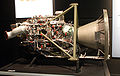
The descent propulsion system (DPS - pronounced 'dips') or lunar module descent engine (LMDE), internal designation VTR-10, is a variable-throttle hypergolic rocket engine invented by Gerard W. Elverum Jr.[3][4][5] and developed by Space Technology Laboratories (TRW) for use in the Apollo Lunar Module descent stage. It used Aerozine 50 fuel and dinitrogen tetroxide (N
2
O
4
) oxidizer. This engine used a pintle injector, which paved the way for other engines to use similar designs.

Requirements

[edit]

The propulsion system for the descent stage of the lunar module was designed to transfer the vehicle, containing two crewmen, from a 60-nautical-mile (110 km) circular lunar parking orbit to an elliptical descent orbit with a pericynthion of 50,000 feet (15,000 m), then provide a powered descent to the lunar surface, with hover time above the lunar surface to select the exact landing site. To accomplish these maneuvers, a propulsion system was developed that used hypergolic propellants and a gimballed pressure-fed ablative cooled engine that was capable of being throttled. A lightweight cryogenic helium pressurization system was also used. The exhaust nozzle extension was designed to crush without damaging the LM if it struck the surface, which happened on Apollo 15.[6]

Development

[edit]

According to NASA history publication Chariots for Apollo, "The lunar module descent engine probably was the biggest challenge and the most outstanding technical development of Apollo."[7] A requirement for a throttleable engine was new for crewed spacecraft. Very little advanced research had been done in variable-thrust rocket engines up to that point. Rocketdyne proposed a pressure-fed engine using the injection of inert helium gas into the propellant flow to achieve thrust reduction at a constant propellant flow rate. While NASA's Manned Spacecraft Center (MSC) judged this approach to be plausible, it represented a considerable advance in the state of the art. (In fact, accidental ingestion of helium pressurant proved to be a problem on AS-201, the first flight of the Apollo Service Module engine in February 1966.) Therefore, MSC directed Grumman to conduct a parallel development program of competing designs.[7]

Grumman held a bidders' conference on March 14, 1963, attended by Aerojet General, Reaction Motors Division of Thiokol, United Technology Center Division of United Aircraft, and Space Technology Laboratories, Inc. (STL). In May, STL was selected as the competitor to Rocketdyne's concept. STL proposed an engine that was gimbaled as well as throttleable, using flow control valves and a variable-area pintle injector, in much the same manner as does a shower head, to regulate pressure, rate of propellant flow, and the pattern of fuel mixture in the combustion chamber.[7]

The first full-throttle firing of Space Technology Laboratories' LM descent engine was carried out in early 1964. NASA planners expected one of the two drastically different designs would emerge the clear winner, but this did not happen throughout 1964. Apollo Spacecraft Program Office manager Joseph Shea formed a committee of NASA, Grumman and Air Force propulsion experts, chaired by American spacecraft designer Maxime Faget, in November 1964 to recommend a choice, but their results were inconclusive. Grumman chose Rocketdyne on January 5, 1965. Still not satisfied, MSC Director Robert R. Gilruth convened his own five-member board, also chaired by Faget, which reversed Grumman's decision on January 18 and awarded the contract to STL.[7][8]

To keep the DPS as simple, lightweight, and reliable as possible, the propellants were pressure-fed with helium gas instead of using heavy, complicated, and failure-prone turbopumps. Cryogenic liquid helium was loaded into the tank before liftoff and the tank sealed. Heat leak through the tank insulation warmed the liquid until it became supercritical helium. The helium warmed over time, increasing the tank pressure.[9]: 4  The helium was pressure regulated down to 246 psi (1.70 MPa) for the propellant tanks.[9]: 4  This allowed a sufficient inventory of pressurant gas to be stored in a relatively small volume, with a much lighter tank than would have been required to store the helium as a room temperature gas. The system was also equipped with a burst disk assembly that relieved the pressure when pre-set pressure (1,881 to 1,967 psi [12.97 to 13.56 MPa]) was reached, allowing the gas to vent harmlessly into space. Once the helium was gone however, DPS operation would be limited due to inability to maintain system pressure as the propellant was expelled from the tanks. This was not seen as an issue, since normally the helium release would not occur until after the lunar module was on the Moon, by which time the DPS had completed its operational life and would never be fired again.

The design and development of the innovative thrust chamber and pintle design is credited to TRW Aerospace Engineer Gerard W. Elverum Jr.[10][11][12] The engine could throttle between 1,050 and 10,125 pounds-force (4.67–45.04 kN) but operation between 65% and 92.5% thrust was avoided to prevent excessive nozzle erosion. It weighed 394 pounds (179 kg), with a length of 90.5 inches (230 cm) and diameter of 59.0 inches (150 cm).[6]

Performance in LM "life boat"

[edit]

The LMDE achieved a prominent role in the Apollo 13 mission, serving as the primary propulsion engine after the oxygen tank explosion in the Apollo Service Module. After this event, the ground controllers decided that the Service Propulsion System could no longer be operated safely, leaving the DPS engine in Aquarius as the only means of maneuvering Apollo 13.

Modification for Extended Lunar Module

[edit]
Decreased clearance led to buckling of the extended descent engine nozzle on the landing of Apollo 15 (upper right).

In order to extend landing payload weight and lunar surface stay times, the last three Apollo Lunar Modules were upgraded by adding a 10-inch (25 cm) nozzle extension to the engine to increase thrust. The nozzle exhaust bell, like the original, was designed to crush if it hit the surface. It never had on the first three landings, but did buckle on the first Extended landing, Apollo 15.

TR-201 in Delta second stage

[edit]

After the Apollo program, the DPS was further developed into the TRW TR-201 engine. This engine was used in the second stage, referred to as Delta-P, of the Delta launch vehicle (Delta 1000, Delta 2000, Delta 3000 series) for 77 successful launches between 1972–1988.[13]

References

[edit]
[edit]
Revisions and contributorsEdit on WikipediaRead on Wikipedia
from Grokipedia
The Descent Propulsion System (DPS), also known as the Lunar Module Descent Engine (LMDE), was a pressure-fed, variable-thrust hypergolic developed for 's to enable the controlled descent and soft of the (LM) on the Moon's surface from . It utilized nitrogen tetroxide (N₂O₄) as the oxidizer and —a 50/50 mixture of and (UDMH)—as the fuel, providing a maximum of approximately 9,870 to 10,500 pounds-force (lbf) while supporting a throttling range from 10% to 100% of rated thrust for precise and altitude control during landing maneuvers. Designed by TRW Inc. under NASA contract, the DPS formed the core of the LM's descent stage propulsion section, which included propellant tanks holding about 7,492 pounds of usable fuel and 11,953 pounds of usable oxidizer, along with a pressurization system using supercritical helium to maintain consistent propellant flow under zero-gravity conditions. The engine's ablative-cooled nozzle and gimbaled injector allowed for ±6° thrust vector control in two axes, essential for hover and site selection during the final descent phase, while its restart capability—up to 20 times—provided redundancy for potential aborts. This system was critical for missions from Apollo 9 through Apollo 17, successfully powering six lunar landings and demonstrating deep throttling in vacuum for the first time in human spaceflight history. Development began in 1963 as part of the broader LM propulsion effort, with the DPS evolving from early fixed-thrust designs to incorporate variable throttling to meet the challenges of lunar gravity and uneven terrain, ultimately saving approximately 280 pounds through the adoption of a lightweight cryogenic helium pressurization subsystem in 1965. Extensive testing at facilities like White Sands included full-duration firings and simulations of mission profiles, addressing issues such as propellant slosh and helium leaks observed in early flights like Apollo 5 and 9. In operational use, the DPS consumed up to 910 seconds of burn time per mission, with performance metrics closely monitored via onboard gauges and ground telemetry to ensure safe touchdowns, as exemplified by Apollo 11's historic landing in the Sea of Tranquility.

Background and Requirements

Mission Requirements

The Descent Propulsion System (DPS) of the was required to provide a delta-V of approximately 7,000 ft/s to transfer the 33,000-pound from lunar orbit to a safe surface touchdown, accommodating the vehicle's mass including crew, equipment, and descent stage propellants. This performance demand ensured the system could execute the powered descent initiation, braking phase, and final approach while accounting for gravitational losses and trajectory adjustments in the lunar environment. To support precise control during landing, the DPS needed throttling capability from 10% to 100% of nominal , spanning 1,050 to 10,500 lbf, enabling operations such as hovering for , fine attitude adjustments via reaction control systems integration, and rapid abort maneuvers if hazards were encountered. The system employed hypergolic propellants—nitrogen tetroxide (N₂O₄) as the oxidizer and (a 50/50 mixture of and ) as the —to guarantee reliable ignition without external aids, even in the vacuum of and under varying mission timelines. Additionally, a range of ±6° in the pitch and yaw axes was mandated for thrust vector control, allowing steering of the throughout the powered descent without relying solely on auxiliary thrusters. Beyond its primary lunar landing role, the DPS served as a contingency system in the event of Service Propulsion System failure in the Command and Service Module, necessitating design compatibility with command module docking interfaces and shared handling protocols to enable a safe return to Earth from or early phases. This dual-purpose requirement underscored the system's pressure-fed architecture using for pressurization, prioritizing operational simplicity and reliability across all mission scenarios.

Design Challenges

One of the primary design challenges for the Descent Propulsion System (DPS) was achieving deep throttling over a 10:1 in the of without inducing , as fixed-orifice injectors tested early in development exhibited significant high-frequency instabilities in the first-tangential mode and reduced performance at low levels. This requirement stemmed from the need to control the Lunar Module's descent from orbital velocity to a , necessitating precise modulation to avoid overshooting the surface while maintaining stability in zero-gravity conditions. The challenge was compounded by the engine's operation in , where traditional atmospheric cooling effects were absent, increasing the risk of unstable modes during throttle transitions from 10% to full . Propellant management posed significant difficulties due to sloshing in the and oxidizer tanks during low-gravity maneuvers, which could lead to premature low-quantity activations and disrupt consistent flow to the engine. In the lunar environment, this sloshing risked starvation or uneven distribution, potentially compromising the engine's ability to sustain thrust throughout the approximately 12-minute descent burn. To address weight constraints while ensuring reliable pressurization, engineers pursued cryogenic supercritical storage, which saved 280 pounds compared to ambient helium systems but introduced complexities in maintaining helium liquidity and preventing in low-gravity. Thermal management presented hurdles in designing an ablative-cooled capable of withstanding variable levels without excessive or , particularly at full where heat fluxes were highest. The use of hypergolic propellants—Aerozine-50 and nitrogen tetroxide oxidizer—demanded compatibility with lightweight materials to minimize overall mass, yet these propellants' corrosive nature accelerated degradation of metallic components under prolonged exposure and thermal cycling. Post-shutdown heat soakback in further risked freezing residual in the lines, potentially blocking flow and limiting reuse capabilities. Reliability was paramount given the DPS's role as a single-engine system critical for safety, with no available for abort during descent; this necessitated an design free of to eliminate potential points from mechanical wear or jamming in the harsh space environment. The injector's fixed core structure was pursued to ensure consistent atomization and mixing across throttle ranges, but early iterations suffered from material erosion under the propellants' chemical attack, heightening concerns over long-duration burns. Integration with the Lunar Module structure introduced interface challenges, including the precise alignment of gimbal actuators for thrust vector control up to ±6 degrees, where misalignment could induce unwanted vehicle rotations during critical landing phases. The pressurization system's coupling with the vehicle's tanks required safeguards against overpressurization, as rapid pressure rises from inefficiencies risked bursting components or inducing structural stresses in the descent stage.

Design and Development

Initial Concept and Selection

The Descent Propulsion System (DPS) for the Apollo Lunar Module originated in 1962-1963 amid the need for a reliable, throttleable to enable soft lunar landings. At Space Technology Laboratories (later TRW), engineer Gerard W. Elverum Jr. developed the initial concept, featuring a design that allowed for deep throttling to meet mission requirements for precise velocity control during descent. This innovative , with its central contoured and annular fuel orifices, ensured stability across a wide range, addressing the challenges of variable-area flow without the of earlier helium-injection methods. In early 1963, and initiated parallel development contracts for descent engine candidates, initially awarding Rocketdyne the primary role while tasking TRW with a design. By January 1965, following an 18-month evaluation, TRW's pressure-fed, ablatively cooled engine—leveraging the for simplicity and weight savings—was selected over Rocketdyne's higher-performance but heavier regenerative-cooled alternative, which promised better at the cost of added complexity and mass. The choice prioritized reliability and lunar mission constraints, with TRW becoming the sole contractor by late 1964. Early decisions favored hypergolic propellants—Aerozine 50 (a 50/50 mix of and ) as and nitrogen tetroxide as oxidizer—for their spontaneous ignition on contact, enabling instant restarts without igniters and supporting multiple burns if needed. A major redesign in February 1965 incorporated supercritical helium (SHe) pressurization, replacing ambient helium to achieve approximately 280 pounds of weight reduction by leveraging the fluid's density and heat absorption properties for sustained tank pressure during the mission. This shift, along with refinements to the pressure-fed architecture, marked a pivotal optimization for the Lunar Module's mass budget. The overall development spanned seven years, from conception in 1963 through qualification in April 1969, just in time for the mission.

Key Design Features

The Descent Propulsion System (DPS) featured a design that enabled precise variable control through axial displacement of the element, achieving a 10:1 throttling ratio from approximately 1,050 lbf to 10,500 lbf vacuum while maintaining stability across the range. This coaxial configuration included 36 primary and 36 secondary oxidizer orifices surrounding the central fuel annulus, with the movable sleeve providing face shutoff to minimize dribble volume and ensure reliable restarts. The design's inherent stability, validated through extensive testing, including 31 tests that produced spikes exceeding 150% of chamber but demonstrated rapid and no sustained instability, eliminated the need for additional acoustic suppression hardware common in other engines. The system employed a pressure-fed using supercritical (SHe) for pressurization, stored at approximately 10°R in a lightweight insulated tank with a heat of 8-10 Btu/hr, regulated to a constant 246 psia to support consistent flow. An ambient- start bottle provided initial prepressurization for ignition, transitioning to the SHe system post-start, which offered significant weight savings of about 280 lb compared to ambient- alternatives. consisted of nitrogen tetroxide (N₂O₄) as the oxidizer and —a 50/50 mixture of (UDMH) and —as the fuel, selected for their hypergolic ignition and storability. The system supported a total burn time capability of 1,000 seconds and up to four restarts, facilitated by the injector's shutoff mechanism and -driven valves. Key structural elements included engine dimensions of 85 to 100 inches in and 59 to 63 inches in diameter, with a dry mass of 394 lb, optimized for integration into the lunar module's descent stage. The featured an of 16:1 in the ablatively cooled thrust chamber, extending to 47.5:1 overall with a radiation-cooled columbium-alloy skirt for vacuum performance. Cooling relied on a phenolic resin ablative liner in the throat and chamber, while thrust vector control was achieved via a mount allowing ±6° steering in pitch and yaw axes. Overpressure protection was provided by a burst disk rated at 267.5 ± 7.5 psia, integrated into the supply lines to prevent system rupture.

Testing and Qualification

Ground Testing

Ground testing of the Descent Propulsion System (DPS) was conducted primarily at the (WSTF) from early 1966 to mid-1969, utilizing specialized rigs such as the PD-2 altitude chamber for high-altitude simulations and the LTA-5 Test Article for full-system evaluations. The PD-2 chamber facilitated vacuum-condition firings to assess start characteristics, component malfunctions, and pressure oscillations, while LTA-5, a full-scale descent stage mockup, underwent initial mission simulations before a heat exchanger rupture in 1967 necessitated its refurbishment as LTA-5D for continued testing. These efforts validated the system's reliability under simulated lunar environments, including over 1,000 individual engine firings across development and qualification phases. Mission-duty cycle tests replicated the full descent profile, incorporating throttling from 10% to 92.5% thrust via the mechanism, hover phases during the final 1,000 feet of approach, and abort scenarios such as service propulsion system contingencies with multiple firings separated by coast periods. LTA-5D completed five such cycles for the lunar landing configuration, using helium-saturated propellants to mimic operational conditions and confirming the engine's ability to handle off-nominal starts and restarts up to four times. These tests also verified pressure regulation under , with the helium regulator maintaining stable outputs despite transient spikes during slam-starts. Qualification of the supercritical helium (SHe) pressurization system emphasized cryogenic stability, with developmental tests at WSTF addressing vibration, thermal performance, and pressure rise rates up to 200 psi/hr due to heat leaks. Leak checks on regulators and quad check valves revealed contamination-induced issues, resolved through procedural improvements to limit leakage below 100 scc/hr, while early burst disk failures prompted a redesign from 288 ± 20 psia to 267.5 ± 7.5 psia for better margins, later incorporating Belleville springs post-Apollo 5 to prevent stress . slosh mitigation was evaluated through ground simulations identifying lateral and ring modes that affected quantity gauging; this led to the addition of baffles in descent stage tanks starting with Apollo 14. Endurance tests further confirmed ablative cooling effectiveness in the thrust chamber, supporting full durations without beyond design limits.

Flight Testing

The flight testing of the Descent Propulsion System (DPS) began with the unmanned mission on January 22, 1968, which served as the first in-space evaluation of the Lunar Module's propulsion capabilities. During the initial planned 38-second burn, the DPS experienced a premature shutdown after approximately 4 seconds due to a monitor triggered by insufficient detection from a slow rise in the absence of an ambient-helium start bottle. Additionally, out-of-phase indications from the shutoff valves were observed during subsequent burns, attributed to unreliable reed switches in the valve position sensors. Despite these anomalies, ground controllers successfully commanded two additional firings—a 33-second burn followed immediately by a 28-second burn—demonstrating reliable engine relight and validating basic restart capability beyond the design limit of two restarts, with up to three firings achieved in microgravity. Throttling was tested from 10% to 40% , and control for attitude adjustments performed nominally, confirming operational integrity in zero-gravity conditions following ground test preparations. The manned mission in March 1969 marked the first Earth-orbital crewed test of the DPS, focusing on integrated operations with the avionics. During the first 35-second burn, freezing occurred in the supercritical (SHe) , leading to a leak estimated at 0.1 lb/hr, likely from a defective squib braze joint. This issue caused regulator pressure to drop from 235 psia to 188 psia, and subsequent engine roughness was observed during a low-thrust phase at 27% in the second firing, resulting from ingestion due to a 60% volume in the propellant tanks. Integration with LM revealed minor risks of ingestion during low-thrust operations, but full throttling from 10% to 100% and maneuvers were successfully validated in microgravity, with two restarts confirming the system's reliability up to four potential cycles despite the two-restart design limit. Post-mission prompted redesigns, including improved insulation and reinforcements, to mitigate freezing and ingestion risks. Apollo 10 in May 1969 provided a lunar-orbit , testing the DPS during deorbit and phasing maneuvers without a . Low-level alarms activated during the deorbit due to gauge sensitivity, where a gas bubble in unsettled temporarily uncovered the low-level , but no actual degradation or issues occurred, and the system performed nominally. Gimballing and throttling in microgravity were reconfirmed effective, with integration showing no significant anomalies beyond the sensitivity, which was later addressed through procedural updates. These early flights collectively established the DPS's space operational viability, identifying and resolving key microgravity-specific challenges prior to manned lunar .

Operational History

Apollo Lunar Landing Missions

The Descent Propulsion System (DPS) played a pivotal role in the six successful Apollo lunar landings from 1969 to 1972, providing the controlled necessary for powered descent initiation, braking, and final touchdown on the lunar surface. Across these missions—Apollo 11, 12, 14, 15, 16, and 17—the DPS operated nominally, achieving zero propulsion failures and enabling precise landings within designated sites. The system's throttleable hypergolic engine, rated at 10,500 lbf , delivered an average burn time of approximately 720 seconds per descent, with throttling down to 10% for the final approach phase to facilitate hover and touchdown velocity control. All engines met the design of 311 seconds at full , ensuring the required delta-V of about 7,000 fps for lunar descent. During in July 1969, the first lunar landing, the DPS experienced minor propellant unbalance and slosh effects that triggered an early low-quantity warning light 36 seconds before actual depletion, due to oxidizer tank divergence and vehicle maneuvers during powered descent. Post-landing, superheated helium (SHe) freezing occurred in the fuel from venting operations, but this had no impact on the descent phase itself and was addressed in subsequent missions through procedural changes. The landing at proceeded successfully, marking the DPS's debut in operational lunar descent. Apollo 12, launched in November 1969, achieved a precise touchdown near the Surveyor 3 site with full delta-V performance and no alarms, though minor propellant slosh was observed during the hover phase. These slosh issues, similar to those on Apollo 11, prompted design refinements for later vehicles. Starting with Apollo 14 in February 1971, slosh baffles were incorporated into the DPS propellant tanks to dampen fluid motion and prevent premature low-quantity indications, improving stability during descent. This modification carried through to Apollo 15, 16, and 17. On Apollo 15 in July 1971, the extended nozzle skirt buckled upon touchdown due to insufficient ground clearance, but the anomaly did not affect hover or landing operations, and the mission proceeded without propulsion interruption. The DPS's abort capability, which allowed staging and ascent stage return to lunar orbit in case of descent failure, was extensively demonstrated in ground and flight simulations but never required during actual landings. Later missions incorporated minor modifications, such as enhanced venting, to further optimize performance.

Skylab Rescue Capability

During the Apollo 13 mission in April 1970, the Descent Propulsion System (DPS) of Aquarius became the primary source for the 's safe return to Earth after an explosion disabled the Service Module. The LM operated in "lifeboat" mode, supplying and while the crew conserved power by powering down non-essential systems to levels as low as 360 watts. The DPS executed four key burns for trajectory corrections: an initial 34.2-second burn at 61 hours 29 minutes ground elapsed time (GET) delivering 37.8 feet per second (ft/s) of delta-V to establish a ; a 263.8-second transearth injection burn at 79 hours 27 minutes GET providing 860.5 ft/s to accelerate the return and shift the splashdown site to the ; a 11.2-second midcourse correction at 10% at 105 hours 18 minutes GET yielding 7.8 ft/s; and a final 14-second manual burn at 137 hours 40 minutes GET achieving 3.1 ft/s. These maneuvers collectively supplied approximately 909 ft/s of delta-V, well within the system's capability of nearly 2,000 ft/s for the Command/Service Module-LM stack, ensuring precise adjustments despite the constraints. The DPS demonstrated exceptional restart reliability during these operations in translunar space, successfully igniting multiple times over an extended period exceeding the original mission design. The pressurization system performed effectively for the prolonged burns, with rise rates monitored at 7.0 to 33.5 pounds per per hour and the burst diaphragm rupturing nominally at 1,937 psi without freezing or other anomalies—benefits of post-Apollo 11 modifications that addressed ingestion risks during low-thrust phases by improving the regulator design and insulation. This performance underscored the DPS's versatility beyond nominal lunar descent, informing contingency planning for later programs. For the Skylab missions starting in 1973, prepared a dedicated based on a modified launched via , capable of carrying two astronauts to rendezvous with the station, extract up to three stranded crew members, and return five total—the vehicle retained the standard Service Propulsion System. The rescue configuration included extended oxygen supplies and additional batteries but was never required, as no emergencies arose during operations. A key outcome was the validation of the DPS's throttleability, ranging from 10% to full thrust, which allowed fine control during the corrections and would have supported abort-to-orbit scenarios by enabling precise velocity adjustments without excessive use—drawing briefly from lunar mission experience where similar throttling managed descent rates from 60 to 3 feet per second.

Modifications and Variants

Extended Lunar Module Adaptations

To support the extended lunar surface operations of Apollo 15 through 17, known as J-series missions, the Descent Propulsion System (DPS) underwent targeted hardware modifications to increase propellant capacity and operational reliability without altering the core engine design. The primary change involved enlarging the propellant tanks in the descent stage by lengthening them, which added approximately 1,200 pounds of usable propellant capacity compared to earlier missions. This enhancement allowed the Lunar Module to carry a total of around 22,000 pounds of propellants (aerozine-50 fuel and nitrogen tetroxide oxidizer), up from about 18,000 pounds in Apollo 11-14 configurations, enabling surface stays of up to three days rather than the previous one to two days. A key adaptation was the addition of a 10-inch nozzle extension to the DPS engine, constructed from a sheet-metal columbium-alloy that increased the expansion area ratio from 16:1 to 47.5:1, thereby improving vacuum from 311 seconds to higher efficiency levels for better fuel economy during descent. However, this extension reduced ground clearance, leading to buckling of the skirt upon touchdown during Apollo 15 due to a buildup from the tilted landing configuration, as evidenced by observations and post-mission photographs showing deformation around the periphery with a gap between the exit plane and the lunar surface. To address management challenges in the extended configuration, the lunar-dump system was modified: the oxidizer dump valve was reconfigured to match the Apollo 14 fuel valve design, incorporating reverse flow direction and an upstream orifice to safely vent excess propellants post-ascent and prevent system overload. Additionally, enhancements to the ambient-helium start bottle improved pressurization reliability by mitigating fuel freezing risks in the during engine ignition. Slosh baffles, first standardized in the descent stage tanks from Apollo 14 onward, were retained and proven effective in the extended Lunar Module to dampen fuel movement during prolonged hovers and maneuvers, reducing gaging errors and ensuring stable thrust delivery. Thrust levels remained unchanged at nominally 10,000 pounds, but the increased propellant load extended the maximum burn time to approximately 780 seconds, providing greater margin for powered descent and hover phases. Qualification testing, including ground simulations and component verifications conducted between 1969 and 1971, confirmed that these adaptations fully supported the Extended Lunar Module's gross liftoff mass of about 36,000 pounds without requiring redesign of the fundamental engine architecture, as demonstrated by nominal performance in vibration, thermal, and hot-fire trials.

TR-201 Variant for Delta Rockets

Following the conclusion of the , TRW adapted the Descent Propulsion System (DPS) into the TR-201 engine in as a low-cost, fixed-thrust variant for the second stage of Delta launch vehicles, specifically the Delta-P configuration used in models such as the 2914 and 3914. This post-Apollo modification retained the core design and hypergolic propellants (N2O4 and Aerozine-50) from the original DPS but optimized the engine for orbital insertion tasks, eliminating the variable throttling capability that had been essential for lunar landings. The first flight occurred on April 13, 1974, aboard a Delta 2914 launching the Westar 1 . The TR-201 delivered a fixed of 9,900 lbf at a chamber of 100 psia, achieved through an ablative-cooled with a fixed and no deployable extension mechanism, simplifying the design compared to the original DPS. It powered the second stage in 69 non-classified Delta launches between 1974 and 1988, deploying satellites including members of the Landsat series (such as Landsat 2 in 1975) and the GOES series (such as GOES-A in 1975). The engine's gimbaled mounting provided attitude control during burns, supporting precise orbital maneuvers for payload deployment. To enhance ground handling and operational simplicity, the TR-201 featured a pressure-fed system without the supercritical helium (SHe) pressurization used in the original DPS, relying instead on standard helium for propellant tank pressurization up to lift-off. It demonstrated restart capability for up to five ignitions, enabling multiple burns with single-burn durations ranging from 10 to 350 seconds and a total operational time of up to 500 seconds, though most missions required only one or two burns for perigee and apogee adjustments. This configuration highlighted the pintle injector's durability in a non-throttleable, fixed-thrust mode. The TR-201 achieved a perfect reliability record, with 100% success across all documented flights, underscoring the robustness of the technology in commercial launch applications. It was retired in 1988 as part of Delta program upgrades that introduced alternative upper-stage engines like the AJ10-118K, with no direct follow-on variants produced. However, the TR-201's design principles influenced subsequent hypergolic engines in various orbital insertion roles.

Performance and Legacy

In-Flight Performance Analysis

The of the Descent Propulsion System (DPS) was measured at 311 seconds in at full , decreasing to approximately 296.5 seconds at minimum throttle settings around 13% of full . This metric, defined by the equation Isp=Fm˙g0I_{sp} = \frac{F}{ \dot{m} \cdot g_0 } where FF is thrust, m˙\dot{m} is the mass flow rate, and g0=32.2g_0 = 32.2 ft/s² is standard gravity, quantifies the system's efficiency in converting propellant to velocity change. Across the Apollo missions, the DPS delivered an average of over 99% of the predicted delta-V, with propellant consumption typically within 2% of nominal values; for instance, in Apollo 16, the achieved delta-V was 6734 ft/sec against preflight expectations, utilizing 11,180 lbm of oxidizer and 7014 lbm of fuel. In Apollo 11, propellant slosh induced a 1% imbalance, triggering an early low-quantity warning 36 seconds before actual depletion, but the mission proceeded without significant impact due to manual adjustments. Throttling performance remained stable over a 10:1 range, from 10% to full thrust, enabling precise control during descent phases; hover burns in the final 1,000 feet consistently achieved descent rates below 60 ft/min, as demonstrated in Apollo 16 where the engine responded within 0.5 seconds to throttle commands from full to 59%. Key anomalies were effectively resolved through iterative improvements. Following Apollo 9, where supercritical helium (SHe) freezing occurred in the heat exchanger during the initial firing and self-resolved after 35 seconds, venting procedures and a bypass line were implemented on subsequent vehicles (LM-7 and later), reducing such incidents to less than 1% occurrence. In Apollo 15, nozzle skirt buckling upon touchdown caused no measurable thrust loss, owing to the ablative material's redundancy in maintaining structural integrity during the 734-second burn. The DPS exhibited zero in-flight failures across more than 10 uses, encompassing unmanned tests (), orbital demonstrations (, 10), and six lunar landings (, 12, 14, 15, 16, 17), including its repurposed role in Apollo 13's safe return; average burn durations ranged from 720 to 780 seconds, supporting reliable velocity changes of approximately 7000 ft/sec per mission. Gimbal steering proved effective in correcting trajectory deviations within 1 degree during powered descent.

Technological Legacy

The Descent Propulsion System (DPS) introduced the pintle injector design, which enabled precise throttling and combustion stability in a hypergolic , a technology later adopted by in its engines for throttleable performance critical to reusable lander concepts like . This injector, developed by TRW, allowed variable propellant flow for the 10:1 thrust ratio, influencing subsequent variable-thrust systems in orbital maneuvering and landing applications. The hypergolic pressure-fed architecture of the DPS, using and nitrogen tetroxide for reliable ignition without igniters, set a precedent for Apollo-derived engines in long-duration space missions, including satellites, deep-space probes, and descent stages where restartability and simplicity were paramount. These designs prioritized storable propellants to ensure multiple firings in vacuum, a reliability feature echoed in the thrusters on the 's powered descent phase for attitude control during entry. As the first engine to demonstrate continuous deep throttling in deep space—ranging from 10% to 100% —the DPS paved the way for variable- in modern lunar landers, such as the throttleable Raptor engines in NASA's Artemis Human Landing System, which require similar precision for soft landings near the . This innovation addressed the challenges of powered descent in low gravity, influencing requirements for human-rated systems with gimbaled, restartable engines. The DPS's weight-saving supercritical helium pressurization system, storing helium at cryogenic temperatures to achieve 280 pounds of savings over ambient methods, found echoes in cryogenic upper stages like , which employs helium for propellant tank pressurization to maintain efficiency in vacuum operations. Overall, the system's demonstrated reliability in single-engine manned configurations—achieving flawless performance across six lunar landings—helped establish standards for fault-tolerant propulsion in crewed deep-space vehicles. While no direct uses of the original DPS persisted after 1988, its design principles continue in commercial lunar landers, exemplified by Blue Origin's BE-7 engine, which features deep throttling for controlled descent in the Blue Moon vehicle. The TR-201 variant, adapted for Delta rockets, underscored the engine's versatility in achieving 77 successful orbital insertions before retirement.

References

Add your contribution
Related Hubs
User Avatar
No comments yet.