



Community hub
Recent from talks
Contribute something
Nothing was collected or created yet.
Maass wave form
View on Wikipedia | This article includes a list of general references, but it lacks sufficient corresponding inline citations. (September 2017) |
In mathematics, Maass forms or Maass wave forms are studied in the theory of automorphic forms. Maass forms are complex-valued smooth functions of the upper half plane, which transform in a similar way under the operation of a discrete subgroup of as modular forms. They are eigenforms of the hyperbolic Laplace operator defined on the upper half plane and satisfy certain growth conditions at the cusps of a fundamental domain of . In contrast to modular forms, Maass forms need not be holomorphic. They were studied first by Hans Maass in 1949.


General remarks
[edit]The group

operates on the upper half plane

by fractional linear transformations:
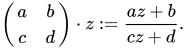
It can be extended to an operation on by defining:



The Radon measure
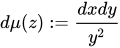
defined on is invariant under the operation of .

Let be a discrete subgroup of . A fundamental domain for is an open set , so that there exists a system of representatives of with



A fundamental domain for the modular group is given by


(see Modular form).
A function is called -invariant, if holds for all and all .

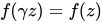


For every measurable, -invariant function the equation

holds. Here the measure on the right side of the equation is the induced measure on the quotient


Classic Maass forms
[edit]Definition of the hyperbolic Laplace operator
[edit]The hyperbolic Laplace operator on is defined as

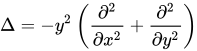
Definition of a Maass form
[edit]A Maass form for the group is a complex-valued smooth function on satisfying




If

we call Maass cusp form.
Relation between Maass forms and Dirichlet series
[edit]Let be a Maass form. Since
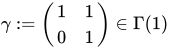
we have:

Therefore has a Fourier expansion of the form
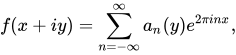
with coefficient functions

It is easy to show that is Maass cusp form if and only if .

We can calculate the coefficient functions in a precise way. For this we need the Bessel function .

Definition: The Bessel function is defined as

The integral converges locally uniformly absolutely for in and the inequality



holds for all .

Therefore, decreases exponentially for . Furthermore, we have for all .




Theorem (Fourier coefficients of Maass forms)—Let be the eigenvalue of the Maass form corresponding to There exist , unique up to sign, such that . Then the Fourier coefficients of are



Proof: We have
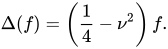
By the definition of the Fourier coefficients we get

for

Together it follows that
![{\displaystyle {\begin{aligned}\left({\frac {1}{4}}-\nu ^{2}\right)a_{n}(y)&=\int _{0}^{1}\left({\frac {1}{4}}-\nu ^{2}\right)f(x+iy)e^{-2\pi inx}dx\\[4pt]&=\int _{0}^{1}(\Delta f)(x+iy)e^{-2\pi inx}dx\\[4pt]&=-y^{2}\left(\int _{0}^{1}{\frac {\partial ^{2}f}{\partial x^{2}}}(x+iy)e^{-2\pi inx}dx+\int _{0}^{1}{\frac {\partial ^{2}f}{\partial y^{2}}}(x+iy)e^{-2\pi inx}dx\right)\\[4pt]&{\overset {(1)}{=}}-y^{2}(2\pi in)^{2}a_{n}(y)-y^{2}{\frac {\partial ^{2}}{\partial y^{2}}}\int _{0}^{1}f(x+iy)e^{-2\pi inx}dx\\[4pt]&=-y^{2}(2\pi in)^{2}a_{n}(y)-y^{2}{\frac {\partial ^{2}}{\partial y^{2}}}a_{n}(y)\\[4pt]&=4\pi ^{2}n^{2}y^{2}a_{n}(y)-y^{2}{\frac {\partial ^{2}}{\partial y^{2}}}a_{n}(y)\end{aligned}}}](https://wikimedia.org/api/rest_v1/media/math/render/svg/8dbb275ae73da95b706ad5d037dd29f6a1e249c3)
for
In (1) we used that the nth Fourier coefficient of is for the first summation term. In the second term we changed the order of integration and differentiation, which is allowed since f is smooth in y . We get a linear differential equation of second degree:

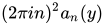

For one can show, that for every solution there exist unique coefficients with the property


For every solution has coefficients of the form


for unique . Here and are Bessel functions.


The Bessel functions grow exponentially, while the Bessel functions decrease exponentially. Together with the polynomial growth condition 3) we get (also ) for a unique . Q.E.D.




Even and odd Maass forms: Let . Then i operates on all functions by and commutes with the hyperbolic Laplacian. A Maass form is called even, if and odd if . If f is a Maass form, then is an even Maass form and an odd Maass form and it holds that .

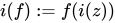



Theorem: The L-function of a Maass form
[edit]Let

be a Maass cusp form. We define the L-function of as
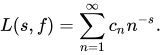
Then the series converges for and we can continue it to a whole function on .


If is even or odd we get

Here if is even and if is odd. Then satisfies the functional equation



Example: The non-holomorphic Eisenstein-series E
[edit]The non-holomorphic Eisenstein-series is defined for and as


where is the Gamma function.

The series converges absolutely in for and locally uniformly in , since one can show, that the series


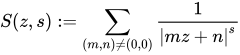
converges absolutely in , if . More precisely it converges uniformly on every set , for every compact set and every .




E is a Maass form
[edit]We only show -invariance and the differential equation. A proof of the smoothness can be found in Deitmar or Bump. The growth condition follows from the Fourier expansion of the Eisenstein series.

We will first show the -invariance. Let
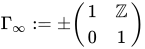
be the stabilizer group corresponding to the operation of on .


- Proposition. E is -invariant.

Proof. Define:
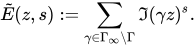
(a) converges absolutely in for and


Since

we obtain

That proves the absolute convergence in for

Furthermore, it follows that

since the map

is a bijection (a) follows.
(b) We have for all .


For we get


Together with (a), is also invariant under . Q.E.D.

- Proposition. E is an eigenform of the hyperbolic Laplace operator
We need the following Lemma:
- Lemma: commutes with the operation of on . More precisely for all we have:


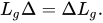
Proof: The group is generated by the elements of the form

One calculates the claim for these generators and obtains the claim for all . Q.E.D.

Since it is sufficient to show the differential equation for . We have:


Furthermore, one has

Since the Laplace Operator commutes with the Operation of , we get

and so

Therefore, the differential equation holds for E in . In order to obtain the claim for all , consider the function . By explicitly calculating the Fourier expansion of this function, we get that it is meromorphic. Since it vanishes for , it must be the zero function by the identity theorem.


The Fourier-expansion of E
[edit]The nonholomorphic Eisenstein series has a Fourier expansion
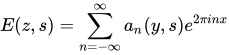
where

If , has a meromorphic continuation on . It is holomorphic except for simple poles at


The Eisenstein series satisfies the functional equation

for all .
Locally uniformly in the growth condition


holds, where

The meromorphic continuation of E is very important in the spectral theory of the hyperbolic Laplace operator.
Maass forms of weight k
[edit]Congruence subgroups
[edit]For let be the kernel of the canonical projection



We call principal congruence subgroup of level . A subgroup is called congruence subgroup, if there exists , so that . All congruence subgroups are discrete.


Let

For a congruence subgroup let be the image of in . If S is a system of representatives of , then


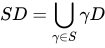
is a fundamental domain for . The set is uniquely determined by the fundamental domain . Furthermore, is finite.


The points for are called cusps of the fundamental domain . They are a subset of .


For every cusp there exists with .


Maass forms of weight k
[edit]Let be a congruence subgroup and

We define the hyperbolic Laplace operator of weight as



This is a generalization of the hyperbolic Laplace operator .

We define an operation of on by
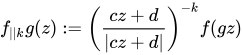
where

It can be shown that

holds for all and every .

Therefore, operates on the vector space
- .

Definition. A Maass form of weight for is a function that is an eigenfunction of and is of moderate growth at the cusps.


The term moderate growth at cusps needs clarification. Infinity is a cusp for a function is of moderate growth at if is bounded by a polynomial in y as . Let be another cusp. Then there exists with . Let . Then , where is the congruence subgroup . We say is of moderate growth at the cusp , if is of moderate growth at .


Definition. If contains a principal congruence subgroup of level , we say that is cuspidal at infinity, if

We say that is cuspidal at the cusp if is cuspidal at infinity. If is cuspidal at every cusp, we call a cusp form.
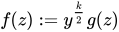
We give a simple example of a Maass form of weight for the modular group:

Example. Let be a modular form of even weight for Then is a Maass form of weight for the group .


The spectral problem
[edit]Let be a congruence subgroup of and let be the vector space of all measurable functions with for all satisfying


modulo functions with The integral is well defined, since the function is -invariant. This is a Hilbert space with inner product


The operator can be defined in a vector space which is dense in . There is a positive semidefinite symmetric operator. It can be shown, that there exists a unique self-adjoint continuation on


Define as the space of all cusp forms Then operates on and has a discrete spectrum. The spectrum belonging to the orthogonal complement has a continuous part and can be described with the help of (modified) non-holomorphic Eisenstein series, their meromorphic continuations and their residues. (See Bump or Iwaniec).


If is a discrete (torsion free) subgroup of , so that the quotient is compact, the spectral problem simplifies. This is because a discrete cocompact subgroup has no cusps. Here all of the space is a sum of eigenspaces.
Embedding into the space L2(Γ \ G)
[edit]is a locally compact unimodular group with the topology of Let be a congruence subgroup. Since is discrete in , it is closed in as well. The group is unimodular and since the counting measure is a Haar-measure on the discrete group , is also unimodular. By the Quotient Integral Formula there exists a -right-invariant Radon measure on the locally compact space . Let be the corresponding -space. This space decomposes into a Hilbert space direct sum:


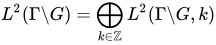
where

and

The Hilbert-space can be embedded isometrically into the Hilbert space . The isometry is given by the map


Therefore, all Maass cusp forms for the congruence group can be thought of as elements of .
is a Hilbert space carrying an operation of the group , the so-called right regular representation:

One can easily show, that is a unitary representation of on the Hilbert space . One is interested in a decomposition into irreducible subrepresentations. This is only possible if is cocompact. If not, there is also a continuous Hilbert-integral part. The interesting part is, that the solution of this problem also solves the spectral problem of Maass forms. (see Bump, C. 2.3)
Maass cusp form
[edit]A Maass cusp form, a subset of Maass forms, is a function on the upper half-plane that transforms like a modular form but need not be holomorphic. They were first studied by Hans Maass in Maass (1949).
Definition
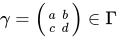
[edit]Let k be an integer, s be a complex number, and Γ be a discrete subgroup of SL2(R). A Maass form of weight k for Γ with Laplace eigenvalue s is a smooth function from the upper half-plane to the complex numbers satisfying the following conditions:
- For all and all , we have
- We have , where is the weight k hyperbolic Laplacian defined as
- The function is of at most polynomial growth at cusps.
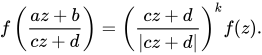

A weak Maass form is defined similarly but with the third condition replaced by "The function has at most linear exponential growth at cusps". Moreover, is said to be harmonic if it is annihilated by the Laplacian operator.
Major results
[edit]Let be a weight 0 Maass cusp form. Its normalized Fourier coefficient at a prime p is bounded by p7/64 + p−7/64. This theorem is due to Henry Kim and Peter Sarnak. It is an approximation toward Ramanujan-Petersson conjecture.
Higher dimensions
[edit]Maass cusp forms can be regarded as automorphic forms on GL(2). It is natural to define Maass cusp forms on GL(n) as spherical automorphic forms on GL(n) over the rational number field. Their existence is proved by Miller, Mueller, etc.
Automorphic representations of the adele group
[edit]The group GL2(A)
[edit]Let be a commutative ring with unit and let be the group of matrices with entries in and invertible determinant. Let be the ring of rational adeles, the ring of the finite (rational) adeles and for a prime number let be the field of p-adic numbers. Furthermore, let be the ring of the p-adic integers (see Adele ring). Define . Both and are locally compact unimodular groups if one equips them with the subspace topologies of respectively . Then:


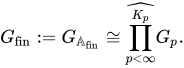
The right side is the restricted product, concerning the compact, open subgroups of . Then locally compact group, if we equip it with the restricted product topology.


The group is isomorphic to


and is a locally compact group with the product topology, since and are both locally compact.
Let

The subgroup
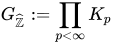
is a maximal compact, open subgroup of and can be thought of as a subgroup of , when we consider the embedding .

We define as the center of , that means is the group of all diagonal matrices of the form , where . We think of as a subgroup of since we can embed the group by .


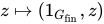
The group is embedded diagonally in , which is possible, since all four entries of a can only have finite amount of prime divisors and therefore for all but finitely many prime numbers .


Let be the group of all with . (see Adele Ring for a definition of the absolute value of an Idele). One can easily calculate, that is a subgroup of .


With the one-to-one map we can identify the groups and with each other.


The group is dense in and discrete in . The quotient is not compact but has finite Haar-measure.

Therefore, is a lattice of similar to the classical case of the modular group and . By harmonic analysis one also gets that is unimodular.

Adelisation of cuspforms
[edit]We now want to embed the classical Maass cusp forms of weight 0 for the modular group into . This can be achieved with the "strong approximation theorem", which states that the map


is a -equivariant homeomorphism. So we get

and furthermore

Maass cuspforms of weight 0 for modular group can be embedded into

By the strong approximation theorem this space is unitary isomorphic to

which is a subspace of

In the same way one can embed the classical holomorphic cusp forms. With a small generalization of the approximation theorem, one can embed all Maass cusp forms (as well as the holomorphic cuspforms) of any weight for any congruence subgroup in .
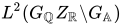
We call the space of automorphic forms of the adele group.
Cusp forms of the adele group
[edit]Let be a Ring and let be the group of all where . This group is isomorphic to the additive group of R.


We call a function cusp form, if
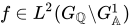
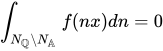
holds for almost all. Let (or just ) be the vector space of these cusp forms. is a closed subspace of and it is invariant under the right regular representation of

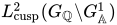


One is again interested in a decomposition of into irreducible closed subspaces.
We have the following theorem:
The space decomposes in a direct sum of irreducible Hilbert-spaces with finite multiplicities :
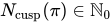
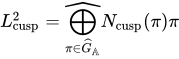
The calculation of these multiplicities is one of the most important and most difficult problems in the theory of automorphic forms.

Cuspidal representations of the adele group
[edit]An irreducible representation of the group is called cuspidal, if it is isomorphic to a subrepresentation of .

An irreducible representation of the group is called admissible if there exists a compact subgroup of , so that for all .




One can show, that every cuspidal representation is admissible.
The admissibility is needed to proof the so-called Tensorprodukt-Theorem anzuwenden, which says, that every irreducible, unitary and admissible representation of the group is isomorphic to an infinite tensor product

The are irreducible representations of the group . Almost all of them need to be umramified.

(A representation of the group is called unramified, if the vector space


is not the zero space.)
A construction of an infinite tensor product can be found in Deitmar,C.7.
Automorphic L-functions
[edit]Let be an irreducible, admissible unitary representation of . By the tensor product theorem, is of the form (see cuspidal representations of the adele group)
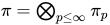
Let be a finite set of places containing and all ramified places . One defines the global Hecke - function of as
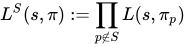
where is a so-called local L-function of the local representation . A construction of local L-functions can be found in Deitmar C. 8.2.

If is a cuspidal representation, the L-function has a meromorphic continuation on . This is possible, since , satisfies certain functional equations.

See also
[edit]References
[edit]- Bringmann, Kathrin; Folsom, Amanda (2014), "Almost harmonic Maass forms and Kac–Wakimoto characters", Journal für die Reine und Angewandte Mathematik, 2014 (694): 179–202, arXiv:1112.4726, doi:10.1515/crelle-2012-0102, MR 3259042, S2CID 54896147
- Bump, Daniel (1997), Automorphic forms and representations, Cambridge Studies in Advanced Mathematics, vol. 55, Cambridge University Press, doi:10.1017/CBO9780511609572, ISBN 978-0-521-55098-7, MR 1431508
- Anton Deitmar: Automorphe Formen. Springer, Berlin/ Heidelberg u. a. 2010, ISBN 978-3-642-12389-4.
- Duke, W.; Friedlander, J. B.; Iwaniec, H. (2002), "The subconvexity problem for Artin L-functions", Inventiones Mathematicae, 149 (3): 489–577, Bibcode:2002InMat.149..489D, doi:10.1007/s002220200223, MR 1923476, S2CID 121720199
- Henryk Iwaniec : Spectral Methods of Automorphic Forms (Graduate Studies in Mathematics). American Mathematical Society; Auflage: 2. (November 2002), ISBN 978-0821831601.
- Maass, Hans (1949), "Über eine neue Art von nichtanalytischen automorphen Funktionen und die Bestimmung Dirichletscher Reihen durch Funktionalgleichungen", Mathematische Annalen, 121: 141–183, doi:10.1007/BF01329622, MR 0031519, S2CID 119494842
Maass wave form
View on GrokipediaIntroduction
Overview and motivation
Maass forms are real-analytic functions on the upper half-plane that are invariant under the modular group and act as eigenfunctions of the hyperbolic Laplace operator.[3] These properties position them as non-holomorphic counterparts to classical modular forms, extending the theory of automorphic functions to real-analytic settings while preserving transformation laws under group actions.[4] Their introduction addresses key challenges in spectral theory, particularly the Selberg eigenvalue problem, which seeks to characterize the discrete spectrum of the Laplacian on non-compact hyperbolic surfaces such as .[5] Maass forms provide the cusp forms corresponding to discrete eigenvalues in this spectrum, enabling the decomposition of the space of square-integrable functions and facilitating applications in number theory, such as the study of L-functions.[6] In distinction from holomorphic modular forms, Maass forms lack an inherent weight parameter in their classical formulation and emphasize both cusp forms, which exhibit exponential decay at the cusps, and non-holomorphic Eisenstein series contributing to the continuous spectrum.[4] This framework broadens the scope beyond holomorphy, allowing for real-analytic behaviors that capture broader automorphic phenomena.[3] Hans Maass introduced these forms in 1949 to explore non-holomorphic automorphic functions, motivated by analogies with holomorphic cases and the need for tools to analyze Dirichlet series via functional equations.[7]Historical development
The concept of automorphic functions, which laid the groundwork for later developments in modular form theory, was pioneered by Henri Poincaré in the late 1880s and 1890s, particularly through his work on Fuchsian functions and their transformations under group actions on the upper half-plane.[8] In the 1950s, Atle Selberg advanced the spectral theory of automorphic forms by studying the eigenvalues of the hyperbolic Laplacian on quotient spaces, providing a framework for analyzing the continuous and discrete spectrum that would prove essential for non-holomorphic forms.[9] Hans Maass introduced non-holomorphic automorphic forms, now known as Maass forms, in his 1949 paper, where he constructed such functions for the modular group SL(2,ℤ) as eigenfunctions of the hyperbolic Laplace operator satisfying automorphy conditions, extending the classical holomorphic theory to real-analytic cases. Following this, Walter Roelcke's 1956 analysis of the spectrum of automorphic forms established the decomposition of the L²-space into discrete and continuous components, confirming the existence of Maass cusp forms as part of the discrete spectrum. In the 1970s, Dennis Hejhal developed numerical methods for explicit computations of Maass forms, enabling the determination of their eigenvalues and Fourier coefficients for specific examples on congruence subgroups, which facilitated further theoretical investigations. Maass forms gained prominence in the Langlands program from the late 1960s onward, as Robert Langlands incorporated them into his framework for automorphic representations of GL(2), linking their L-functions to Galois representations and broader reciprocity conjectures.[10] Advances in the 1980s and 2000s focused on analytic properties, notably subconvexity bounds for L-functions attached to Maass forms; Henryk Iwaniec established key estimates in 1983 for the conductor aspect, while Peter Sarnak contributed to spectral applications and equidistribution results in the 1990s, enhancing understanding of their distribution and arithmetic significance.Mathematical Prerequisites
Hyperbolic geometry and the upper half-plane
The upper half-plane is defined as the set , equipped with the hyperbolic Riemannian metric , which induces the hyperbolic distance and models the hyperbolic plane of constant curvature .[11][12] This metric ensures that the geometry of differs fundamentally from the Euclidean plane, with angles preserved but distances scaled inversely by the imaginary part .[11] In this model, geodesics—the shortest paths between points—are either vertical rays from the real axis (semicircles of infinite radius) or semicircular arcs centered on the real axis and orthogonal to it at their endpoints.[11][12] The hyperbolic area element is given by , which is invariant under the group actions preserving the metric; for instance, the area of hyperbolic triangles satisfies Gauss-Bonnet, relating it to the defect from .[11] The special linear group acts on by Möbius transformations , where with and , preserving the upper half-plane and acting as orientation-preserving isometries.[11][12] This action is transitive on , meaning any point can be mapped to any other, and it extends to the boundary via the projective line.[11] A key discrete subgroup is the modular group , consisting of matrices with integer entries and determinant 1, which acts on with a fundamental domain , a hyperbolic ideal triangle with vertices at , , and .[11][12] This domain tiles under the group action, and its hyperbolic area is , reflecting the finite-volume quotient .[11] Functions invariant under the action of such discrete subgroups, satisfying for all , are known as automorphic functions and form the basis for studying objects like Maass forms on this hyperbolic surface.[11]Hyperbolic Laplace operator
The hyperbolic Laplace operator is a fundamental differential operator acting on smooth functions on the upper half-plane . It is explicitly given by This operator is self-adjoint and positive semi-definite with respect to the invariant measure on , making it suitable for spectral analysis in the context of automorphic forms.[13] The operator is invariant under the action of on via Möbius transformations for , meaning for any smooth function . To see this, note that the hyperbolic metric is preserved by , as the transformation induces , which scales the partial derivatives in a way that compensates exactly to leave unchanged; a direct computation confirms that the chain rule applied to the coordinates yields the invariance.[14] This invariance arises because corresponds to the Casimir operator of the Lie algebra , the universal enveloping algebra element that commutes with the group action. Specifically, identifying , the Casimir , where are the basis generators satisfying the relations, realizes as when restricted to right--invariant functions, thus equating to up to normalization.[14] Eigenfunctions of satisfy the equation , where the spectral parameter parameterizes the spectrum. For the continuous spectrum, with and , yielding ; discrete eigenvalues below may occur on quotients but are absent on itself. This parameterization facilitates the study of eigenfunction expansions and relates to representation theory via principal series induced from the parabolic subgroup.Modular group and automorphic functions
The modular group, denoted , consists of all matrices with integer entries and determinant 1, acting on the upper half-plane via Möbius transformations for .[15] This group is generated by the transformations , corresponding to the matrix , and , corresponding to the matrix .[15] These generators satisfy the relations , , and together with the presentation, they fully describe the structure of as a free product amalgamated along a cyclic subgroup.[16] A fundamental domain for the action of on is the region , which tiles under the group action, with identifications along its boundaries via and .[15] Every point in is equivalent under to a unique point in the interior of , except for boundary points identified pairwise, ensuring that the quotient is a non-compact Riemann surface with a cusp at infinity.[15] An automorphic function for is a function satisfying the invariance condition for all and .[17] Such functions are constant on -orbits and descend to well-defined functions on the quotient . Automorphic functions for are classified into Eisenstein series, which are non-cuspidal and exhibit growth at the cusps of the fundamental domain, and cusp forms, which vanish at all cusps, including the point at infinity.[18] This distinction arises from the behavior at the boundary of , where cusp forms decay exponentially as , while Eisenstein series grow logarithmically.[18]Definition and Basic Properties
Classic Maass forms for SL(2,Z)
Classic Maass forms for the full modular group are real-analytic functions on the upper half-plane that satisfy the automorphy condition for all and are eigenfunctions of the hyperbolic Laplace-Beltrami operator with eigenvalue , where for ensures the eigenvalue .[3][19] These forms are non-holomorphic analogs of classical modular forms and arise as solutions to the spectral problem on the modular surface .[20] The distinction between types of Maass forms depends on their growth behavior at the single cusp of . For Maass cusp forms, the function satisfies as for every , ensuring square-integrability with respect to the hyperbolic measure over a fundamental domain.[3] In contrast, Eisenstein series, which are non-cuspidal Maass forms, exhibit polynomial growth as for every and correspond to continuous spectrum contributions.[19] Both types maintain moderate overall growth for some fixed in the fundamental domain.[20] A standard normalization for these forms, particularly Eisenstein series, is as , which aligns the asymptotic behavior with the parameter .[19] For the specific case of Eisenstein series on , there exists a unique such form up to scalar multiple satisfying the automorphy, eigenvalue, and growth conditions.[3] This uniqueness stems from the explicit construction via summation over the group, ensuring it spans the one-dimensional space of such functions.[19]Fourier expansion
The Fourier expansion of a Maass form provides a crucial decomposition that facilitates the study of its analytic properties and spectral behavior on the modular surface. For a Maass form on the upper half-plane associated to the modular group , with Laplace eigenvalue where , the expansion at the cusp is derived by considering the integral of against the additive characters for , yielding the coefficients via unfolding the automorphy factor.[19][21] The explicit form of this expansion is where , are the Fourier coefficients (with for real-valued forms), and denotes the modified Bessel function of the second kind. This series converges absolutely and uniformly on compact subsets of , reflecting the smooth and automorphic nature of .[19] For the constant term (), Maass cusp forms satisfy , ensuring rapid decay toward the cusp, whereas non-cuspidal Maass forms, such as Eisenstein series, have a non-vanishing term of the form , where is a normalization constant and is determined by the scattering matrix. This distinction underscores the role of the Fourier expansion in classifying forms by their growth at cusps.[19] The asymptotic behavior of the terms in the expansion highlights the form's properties across different regions of . As (approaching the cusp), the non-constant terms decay exponentially, since for , ensuring cusp forms vanish rapidly while Eisenstein series grow polynomially via the term. Conversely, as (near the real axis), the Bessel functions exhibit power-law growth, with for , modulated by the automorphy to maintain boundedness on fundamental domains. These asymptotics are essential for analytic continuation and spectral estimates.[19]Eigenvalue and automorphy conditions
A Maass form of weight zero for the modular group is defined as a smooth function that satisfies the eigenvalue equation , where is the hyperbolic Laplace-Beltrami operator on the upper half-plane , and the eigenvalue takes the form for a complex spectral parameter with , . This parametrization yields , ensuring the spectrum lies in the complementary series or principal series representations of . Eigenvalues below are exceptional and have not been observed for cusp forms on . The automorphy condition requires that be invariant under the action of , meaning for all and . For weight zero, this invariance is without a nontrivial automorphy factor; the standard factor , where , plays no role in the transformation law, as the weight is zero. This condition ensures descends to a well-defined function on the quotient . Combined with the eigenvalue equation, it positions Maass forms within the space of automorphic functions on . The eigenfunctions of the Laplacian, comprising constant functions, Maass cusp forms, and Eisenstein series, form a complete orthogonal basis for the Hilbert space with respect to the invariant measure . This completeness follows from the spectral decomposition of the self-adjoint Laplacian operator on this space. For the cuspidal subspace, eigenvalues are discrete, and it is conjectured that each such eigenvalue for Maass cusp forms has multiplicity one, though this remains unproven in general and holds under assumptions like the generalized Ramanujan conjecture in some cases.[22]Examples and Explicit Constructions
Non-holomorphic Eisenstein series
The non-holomorphic Eisenstein series serves as a fundamental example of a Maass form for the modular group . It is defined for (the upper half-plane) and by where is the stabilizer of the cusp at infinity.[23] This series converges absolutely in the indicated half-plane due to the rapid decay of for large .[23] The function admits a meromorphic continuation to all , satisfying the functional equation where incorporates the Riemann zeta function .[24] This equation arises from the Poisson summation formula applied to the Fourier expansion and reflects the symmetry under . The completed form is invariant under this transformation, facilitating the analytic continuation.[24] The series has simple poles at and ; at , the residue is , independent of , and connects to the pole of at .[25] As a prototypical Maass form, is automorphic under , meaning for all .[26] It is also an eigenfunction of the hyperbolic Laplace operator with eigenvalue , satisfying .[24] This eigenvalue condition, combined with the automorphy and moderate growth at the cusps, confirms its status as a singular Maass form.[26]Maass cusp forms
Maass cusp forms constitute a distinguished subclass of Maass forms characterized by their rapid decay toward the cusps of the fundamental domain for the modular group . A function is a Maass cusp form if it is non-zero and smooth, satisfies the automorphy condition for all and , acts as an eigenfunction of the hyperbolic Laplacian with eigenvalue , so , exhibits moderate growth bounded by for some as , and fulfills the cusp condition for all .[19] This integral condition ensures the vanishing of the constant term in the Fourier expansion , where and denotes the modified Bessel function of the second kind.[20] Consequently, decays exponentially at the cusp , and more precisely, the -norm along horizontal lines satisfies as .[20] The existence of infinitely many such forms was established by Atle Selberg in the 1950s through his development of the trace formula, which analyzes the spectrum of the Laplacian on .[27] Maass cusp forms belong to the discrete spectrum and are square-integrable in , forming an orthonormal basis for the cuspidal subspace thereof under the Petersson inner product.[19] Numerical investigations reveal that the lowest eigenvalue for Maass cusp forms on is , corresponding to spectral parameter where .[28]Computation and known examples
Computing Maass cusp forms involves numerical approximation of solutions to the eigenvalue equation on the fundamental domain of , subject to automorphy and cusp conditions at infinity. These approximations typically rely on discretizing the hyperbolic Laplace-Beltrami operator and solving the resulting boundary value problem via integral equations or finite element methods, often integrating over a truncated fundamental domain to handle the non-compactness. Hejhal developed a foundational algorithm in the 1990s for this purpose, enabling computation of eigenvalues and Fourier coefficients by expanding forms in a basis of modified Bessel functions and enforcing automorphy through matrix representations of the modular group; this method has been implemented to high precision and forms the basis for subsequent refinements.[29][30] In the 1980s and 1990s, Hejhal computed tables of the first several Laplacian eigenvalues for Maass cusp forms on , reaching spectral parameters up to approximately (corresponding to ) using early versions of his algorithm on supercomputers of the era. These computations confirmed the existence of infinitely many such forms and provided initial data for spectral statistics. More recent high-precision calculations, building on Hejhal's approach, have certified the first ten eigenvalues to over 1000 decimal places, demonstrating their irrationality and non-algebraicity for low-degree polynomials.[29] Specific known examples include the lowest-lying Maass cusp form, with eigenvalue (or spectral parameter ), and its Fourier expansion featuring coefficients normalized such that . The next few eigenvalues are similarly well-approximated:| Index | Eigenvalue (approx. first 6 decimals) |
|---|---|
| 1 | 91.141345 |
| 2 | 148.432132 |
| 3 | 190.131547 |
| 4 | 206.416796 |
| 5 | 260.687406 |
Analytic Properties
L-functions associated to Maass forms
For a Maass cusp form on with spectral parameter (satisfying the Laplace eigenvalue ) and Fourier coefficients , the associated -function is defined by the Dirichlet series in a normalization that aligns the critical line with . This series converges absolutely for .[32] Assuming is a Hecke eigenform (with eigenvalues for primes ), the Ramanujan conjecture implies that admits an Euler product decomposition where the local factors arise from the multiplicativity of the coefficients . This conjecture posits that (or bounded by Ramanujan-Petersson bounds on average), ensuring the product's validity in the critical strip.[32] The function extends to an analytic continuation on the entire complex plane , with the completed form satisfying the functional equation , where is the root number depending on the parity of . For cusp forms, is entire and of order 1, meaning for any and fixed away from the line of convergence.[32]Hecke operators and eigenvalues
Hecke operators act on the space of Maass forms for a Fuchsian group by averaging over double cosets in the Hecke algebra. For a positive integer , the Hecke operator is defined by where the sum runs over integer triples satisfying the conditions and the matrices generate the relevant double coset . This definition extends the classical Hecke operators from holomorphic modular forms to the non-holomorphic setting of weight zero. The operators preserve automorphy with respect to because the double coset representatives can be chosen to normalize under the group action, ensuring remains -invariant if is. The Hecke operators also preserve the eigenspaces of the hyperbolic Laplacian , commuting with due to their invariance under the group action and compatibility with the hyperbolic metric. If satisfies with , then lies in the same eigenspace. A Hecke-Maass form is a Maass form that is a simultaneous eigenfunction of all , satisfying for eigenvalues . These eigenvalues arise from the Fourier expansion of , where the coefficients satisfy Hecke relations linking them to the for primes . The eigenvalues \lambda_p satisfy the relations \rho(p n) = \lambda_p \rho(n) - \rho(n/p) for p \mid n and \rho(p n) = \lambda_p \rho(n) for p \nmid n, with the normalization \rho(1) = 1 for cusp forms. The eigenvalues exhibit multiplicativity: whenever . This follows from the commutativity of the Hecke algebra, which implies that simultaneous eigenforms diagonalize the operators and yield multiplicative characters on the algebra generated by the . The Fourier coefficients inherit this multiplicativity, so for coprime , enabling the construction of associated Dirichlet series. This property holds for automorphic forms, including Maass forms, as established in the classical theory. The Ramanujan-Petersson conjecture posits that for all primes , reflecting the unitarity of the associated automorphic representation. This bound is proved for holomorphic cusp forms by Deligne using étale cohomology and the Weil conjectures. For Maass forms, the conjecture remains open, though analogous subconvex bounds such as have been established, improving toward the conjectured trivial bound of 2.Spectral theory
The space , where and is the upper half-plane, admits a spectral decomposition into the orthogonal direct sum of the cusp space and the Eisenstein space spanned by the non-holomorphic Eisenstein series.[33] The cusp space consists of square-integrable functions with vanishing constant terms at all cusps, while the Eisenstein space captures the residual contributions from the boundary behavior at infinity.[34] This decomposition reflects the non-compact nature of the modular surface , separating the automorphic functions into discrete and continuous components under the action of the hyperbolic Laplacian .[35] The discrete spectrum arises from Maass cusp forms, which are eigenfunctions of with eigenvalues , where parameterizes the spectral parameter .[33] These eigenvalues correspond to the -normalized cusp forms, and it is conjectured that each is simple, meaning the eigenspace has dimension one, though this multiplicity-one property remains unproven for the full modular group.[36] In contrast, the continuous spectrum fills the interval and is generated by the Eisenstein series for , providing a direct integral representation over the spectral parameter.[34] The absence of eigenvalues in follows from the positive definiteness of on the cusp space.[35] The Selberg trace formula provides a fundamental link between this spectral data and the geometry of the modular surface, equating a weighted sum over the discrete eigenvalues plus an integral over the continuous spectrum to a sum over the lengths of primitive closed geodesics.[37] Specifically, for a suitable test function , the formula takes the form where relates to the scattering matrix, , and the sum runs over conjugacy classes of hyperbolic elements with geodesic lengths .[38] This identity, originally derived by Selberg, encodes the distribution of both spectra through orbital integrals. Asymptotic growth of the discrete spectrum is governed by the Weyl law, which asserts that the number of cusp form eigenvalues satisfying satisfies as .[39] This leading term arises from the volume contribution in the trace formula and holds for the modular group, confirming the expected density of Maass cusp forms without exceptional zeros below .[40] Higher-order terms, involving logarithmic corrections, have also been established, refining the count for applications in eigenvalue distribution.[41]Generalizations
Maass forms of weight k
Maass forms of weight , where is a nonzero integer, generalize the classical weight-zero case by incorporating a transformation law that accounts for the weight through the slash operator. The slash operator of weight acting on a function and is defined as where and is the upper half-plane. This operator ensures that the form transforms covariantly under the group action, preserving the modular structure while adjusting for the weight.[42] A Maass form of weight for the modular group is a smooth function on satisfying the automorphy condition for all , or equivalently, . It is also an eigenfunction of the weight- hyperbolic Laplacian with eigenvalue for some , typically with to ensure real eigenvalues . The explicit form of adjusts the standard weight-zero Laplacian by terms involving that couple the real and imaginary parts of the derivative, reflecting the weighted transformation.[42] For even integer weights , Maass forms are closely related to holomorphic modular forms through differential operators such as the Maass raising and lowering operators, which map between spaces of weight Maass forms and holomorphic forms of adjacent weights, facilitating connections in spectral theory and L-functions. In contrast, Maass forms of odd weight are less extensively studied, though examples exist and share similar analytic properties, with applications emerging in contexts like harmonic Maass forms of weight one.[43] Growth conditions for these forms are adapted to the weight: at the cusp , cusp forms exhibit exponential decay modulated by the weight, ensuring square-integrability on the fundamental domain, while non-cuspidal forms have bounded or polynomial growth adjusted by factors of .Forms for congruence subgroups
Congruence subgroups provide a framework for generalizing Maass forms beyond the full modular group SL(2,ℤ), allowing for level structures that capture arithmetic information related to integers N > 1. The congruence subgroup Γ₀(N) of level N is defined as Γ₀(N) = {γ = \begin{pmatrix} a & b \ c & d \end{pmatrix} ∈ SL(2,ℤ) : c ≡ 0 \pmod{N}}, which consists of all matrices in SL(2,ℤ) with the lower-left entry divisible by N.[44] This subgroup has finite index in SL(2,ℤ), and its quotient Γ₀(N)\H has a finite number of cusps, typically more than one for N > 1.[20] A Maass form of weight k for Γ₀(N) is a smooth function f: \H → ℂ that satisfies the automorphy condition f|_k γ = f for all γ ∈ Γ₀(N), where the slash operator is defined by (f|_k γ)(z) = (cz + d)^{-k} f(γz) with γz = (az + b)/(cz + d).[44] For the standard case of weight k = 0 relevant to Maass waveforms, this simplifies to f(γz) = f(z). Additionally, such forms are eigenfunctions of the hyperbolic Laplacian Δ = -y²(∂²/∂x² + ∂²/∂y²) with eigenvalue λ = s(1 - s), where s = ½ + it is the spectral parameter, and they exhibit moderate growth at the cusps.[20] Maass cusp forms further require rapid decay at all cusps, meaning the constant term in their Fourier expansions vanishes at each cusp. The fundamental domain for Γ₀(N)\H admits multiple inequivalent cusps, whose number equals ∑{d|N} φ(gcd(d, N/d)), where φ is Euler's totient function.[44] At each cusp q, one performs a Fourier expansion after translating by a suitable scaling matrix σ_q ∈ SL(2,ℝ), yielding f(σ_q z) = ∑{n ∈ ℤ} ρ_n(y) e( n x / h_q ), where h_q is the width of the stabilizer and e(u) = e^{2π i u}. For cusp forms, the n=0 term ρ_0(y) = 0 at every cusp, ensuring exponential decay as Im(z) → ∞ in the cusp sector.[20] These expansions satisfy modified Bessel equations, analogous to the full modular case. The Hecke algebra for Maass forms on Γ₀(N) is generated by operators T_p for primes p, acting on the space of forms via integral kernels that preserve the level when p ∤ N, but induce degeneracy for p | N.[44] Hecke-Maass cusp forms are joint eigenfunctions of the Laplacian and these Hecke operators, with eigenvalues λ_p satisfying Ramanujan-type bounds conjectured by Selberg and partially established. For squarefree N, the Atkin-Lehner involutions w_Q, for Q | N, defined by the matrix \begin{pmatrix} 0 & -1 \ N & 0 \end{pmatrix} normalized appropriately, commute with the Hecke operators and act on the space of forms, enabling a decomposition into eigenspaces.[45] The space of Maass cusp forms for Γ₀(N) decomposes orthogonally into oldforms and newforms under the action of the Hecke algebra. Oldforms arise as lifts from lower levels M | N via embedding operators that raise the level, while newforms are the primitive components, normalized to be eigenfunctions of the Atkin-Lehner operators with specific eigenvalues (typically +1 or -1 depending on the prime power factors).[46] This decomposition mirrors the holomorphic case and facilitates the study of the discrete spectrum, with newforms generating the irreducible representations.[44]Higher-dimensional analogs
Higher-dimensional analogs of Maass forms extend the classical construction from SL(2,\mathbb{R}) to more general semisimple Lie groups, where they are defined as smooth, automorphic functions on the quotient space G(\mathbb{R})/K that are eigenfunctions of the ring of bi-invariant differential operators, with G a reductive group over \mathbb{Q} and K a maximal compact subgroup.[47] For the general linear group GL(n,\mathbb{R}), these forms live on the symmetric space GL(n,\mathbb{R})/O(n) and satisfy eigenvalue equations under the universal enveloping algebra of the Lie algebra \mathfrak{gl}(n,\mathbb{R}), generalizing the Laplacian eigenvalue condition in the rank-one case.[48] Such forms are typically non-holomorphic and cuspidal, transforming under arithmetic subgroups like GL(n,\mathbb{Z}), and their Fourier expansions involve generalized Whittaker models that encode arithmetic data.[49] Non-holomorphic analogs of Siegel modular forms arise in the context of the symplectic group Sp(2g,\mathbb{R}), where the relevant space is the Siegel upper half-plane \mathcal{H}_g, realized as Sp(2g,\mathbb{R})/U(g). These Maass-type forms are real-analytic functions that transform under Sp(2g,\mathbb{Z}) and are annihilated by a suitable invariant differential operator, such as the Maass-Shimura operator or the Laplacian on \mathcal{H}_g, yielding eigenvalues that parameterize the discrete spectrum.[50] Unlike their holomorphic counterparts, these forms exhibit growth at the boundary and are often studied as harmonic weak Maass forms, with Fourier coefficients linked to arithmetic invariants like linking numbers in hyperbolic 3-folds for g=2.[51] The theory parallels the GL(2) case but involves higher-rank root systems, complicating the classification of representations. In dimension 3, corresponding to SL(3,\mathbb{R})/SO(3), Maass cusp forms provide examples connected to the arithmetic of cubic fields; their associated L-functions can incorporate cubic Dirichlet characters, reflecting the Galois structure of non-abelian cubic extensions, and equidistribution results for periodic orbits on these spaces yield analogs of Duke's theorem for the distribution of units in cubic fields.[52] These forms are Hecke eigenforms whose Fourier coefficients appear in moments of L-values twisted by cubic characters, offering insights into central values and non-vanishing properties for Dedekind zeta functions of cubic fields.[53] The spectral theory of these higher-dimensional Maass forms relies on generalizations of the Selberg trace formula to higher-rank groups, notably the Arthur-Selberg trace formula, which equates the geometric side—sums over conjugacy classes in the group—with the spectral side, involving traces of automorphic representations and their L-functions, applicable to arbitrary reductive groups over number fields.[54] This framework decomposes the automorphic spectrum into cuspidal and Eisenstein contributions, facilitating bounds on eigenvalues and sup-norms for forms on groups like SL(3,\mathbb{Z}).[55] Despite these advances, higher-dimensional Maass forms present significant challenges, including the scarcity of explicit examples due to computational difficulties in determining eigenvalues and Fourier coefficients beyond low-lying spectra, shifting emphasis to analytic properties of their associated L-functions, such as subconvexity bounds and moments in higher rank.[56] In particular, shifted convolution sums and sup-norm estimates remain intractable without new techniques, limiting progress on arithmetic applications compared to the GL(2) setting.[57]Automorphic Representation Perspective
Adelic groups and GL(2,A)
The adele ring is constructed as the restricted direct product , where denotes the archimedean completion at infinity, is the -adic completion for each prime , and the restricted product is over elements where all but finitely many components lie in the ring of -adic integers .[58] This ring embeds densely and serves as the coefficient ring for adelic groups, facilitating the uniform treatment of local and global structures in number theory.[58] The adelic general linear group is then defined as , the restricted direct product mirroring that of the adele ring, where handles the infinite place and the finite places.[58] This group structure allows for the adelization of classical objects, embedding the rational points diagonally into . A key relation to classical modular forms arises through the isomorphism , where is the upper half-plane, is the maximal compact subgroup at infinity stabilizing the point , and is the maximal compact open subgroup at the finite places, consisting of matrices congruent to the identity modulo all but finitely many primes.[58][59] This identification maps the classical action of on to the adelic quotient, preserving the geometry of modular curves.[59] The group is equipped with a Haar measure, constructed as the product of local Haar measures on each , normalized such that maximal compact subgroups like have volume 1 for finite places and appropriately for the archimedean place.[60] This measure is right-invariant and ensures the quotient has finite volume, specifically volume 1 under the Tamagawa measure, which is crucial for the convergence of integrals defining automorphic forms.[60] The finite volume reflects the strong approximation theorem for , allowing dense approximation of adelic points by rational ones outside compact sets.[60] Automorphic forms on are defined as smooth functions satisfying for all and , that transform under right multiplication by the center via a unitary character , are right -finite under a maximal open compact subgroup , -finite at the archimedean place ( the center of the universal enveloping algebra ), satisfy moderate growth conditions at infinity, and have a specified finite-dimensional -type.[58] These functions generalize classical modular forms to the adelic setting, where the invariance under corresponds to the transformation properties under .[58] The space of such forms is equipped with the Petersson inner product using the Haar measure, , which converges for cusp forms due to the finite volume.[60]Adelization of Maass forms
The adelization of a classical Maass form embeds it within the broader theory of automorphic forms on the adelic group . Given a Maass form invariant under a congruence subgroup , its adelic counterpart is an automorphic form on defined by where , is the base point, and the product runs over finite primes with local components .[61][60] The local factors are unramified outside the primes dividing the level of , meaning is fixed by the maximal compact subgroup for such . This ensures factors through the restricted product and aligns with the classical invariance under . For Maass cusp forms, the lifted is smooth on and has compact support modulo , capturing the rapid decay at the cusps in the classical picture.[60][61] At unramified primes , the value of is fully determined by the Satake parameters , which satisfy for unitary forms and relate to the classical Hecke eigenvalue via . The spherical vector is then the unique -fixed function normalized such that , with explicit expression .[60] The Fourier coefficients from the classical expansion of arise via the global Whittaker model of the automorphic representation generated by . The associated Whittaker function is where is the standard additive character of ; evaluating at (for ) yields , linking the adelic structure directly to the classical coefficients.[60]Cuspidal automorphic representations
Cuspidal automorphic representations corresponding to Maass cusp forms are irreducible unitary representations of that arise from the adelization of these forms. Such a representation decomposes as a restricted tensor product , where the product is over all places of , and each is an irreducible admissible representation of the corresponding local group .[60][4] The global representation is unitary, meaning it admits a positive definite invariant Hermitian form, which ensures the associated L-functions have the expected analytic properties.[60] At the archimedean place , the component belongs to the principal series of , reflecting the non-holomorphic nature of Maass forms, as opposed to the discrete series that correspond to holomorphic cusp forms.[4] For finite unramified primes , the local component is an unramified principal series representation, parametrized by Satake parameters with and , where is the Hecke eigenvalue associated to the prime . These parameters satisfy the Ramanujan-Petersson conjecture, which bounds and places on the unit circle for tempered representations. This conjecture has been proved for Maass forms on .[60][4][62] Globally, is cuspidal, meaning it has no nonzero vectors fixed by the unipotent radical of any parabolic subgroup of , which translates to the vanishing of constant terms in the Fourier expansion of the associated automorphic forms. Additionally, is generic, admitting a Whittaker model that realizes it via nonzero Whittaker functions.[60] Some such representations are linked via the Jacquet-Langlands correspondence to cuspidal representations on inner forms of , specifically quaternion algebras over , providing an alternative realization of the same L-functions and spectral data.[60]Applications and Connections
Number theory and Dirichlet series
Maass forms play a significant role in analytic number theory through their associated Dirichlet series, particularly in studying convolutions and moment estimates that extend beyond the standard L-functions L(s, f). The Rankin-Selberg convolution L(s, f × g) for two Maass forms f and g is a Dirichlet series whose coefficients are sums involving the Hecke eigenvalues of f and g, and it admits an Euler product over primes. This L-function has been instrumental in obtaining asymptotics for moments of central values, such as fourth power moment estimates for families of such convolutions in the level aspect, which provide insights into the distribution of special values and arithmetic correlations between forms.[64][65] The Hecke eigenvalues λ_p of a Maass form f, appearing as coefficients in the Fourier expansion and thus in L(s, f), connect directly to prime distribution via explicit formulas for the associated L-functions. Specifically, analogs of the von Mangoldt explicit formula relate sums over the nontrivial zeros of L(s, f) to oscillatory sums involving log p weighted by λ_p / √p, mirroring the prime number theorem and enabling estimates for discrepancies in prime distributions twisted by these eigenvalues. As a special case, L(s, f) itself satisfies such a formula, linking the Ramanujan conjecture on eigenvalue bounds to prime-related arithmetic.[66] Advances in subconvexity for L-functions of Maass forms have further deepened these number-theoretic applications. In the spectral aspect, subconvexity bounds of the form L(1/2 + ir, f) ≪ |r|^{1/2 - δ} for some δ > 0 (with analytic conductor Q ≈ |r|^2), improving upon the convexity bound of |r|^{1/2 + ε}, hold. These estimates, achieved through amplified moments and spectral methods, originated in works from the 2000s that unified approaches for GL(2) automorphic forms.[67][68] Such subconvexity bounds have practical implications for classical problems in number theory. For instance, they contribute to effective versions of Linnik's theorem on the smallest prime in arithmetic progressions by controlling L-values in families related to Maass forms, yielding improvements in the exponent for the least prime. Additionally, the adjoint square L-function L(s, f × \bar{f}) behaves analogously to Dirichlet L-functions in class number problems for quadratic fields, allowing bounds on coefficients of Maass forms that refine estimates for class numbers via Siegel zero analogs and non-vanishing criteria.[69][66]Quantum unique ergodicity
The quantum unique ergodicity (QUE) conjecture posits that for a sequence of Hecke-Maass cusp forms on a quotient , where is a Fuchsian group and the Laplace-Beltrami eigenvalues , the probability measures converge weakly to the normalized invariant hyperbolic measure on .[70] This conjecture, formulated by Rudnick and Sarnak, extends classical ergodicity of the geodesic flow to the quantum setting of eigenfunction mass distribution. In the spectral theory of Maass forms, this uniform limiting distribution would imply no concentration of mass along stable or unstable manifolds, contrasting with possible scarring in non-arithmetic cases. For arithmetic surfaces, such as those arising from congruence subgroups like , significant progress has established QUE. Lindenstrauss proved that any weak-* limit of the measures must be a scalar multiple of the uniform measure, ruling out escape of mass.[71] Combined with supnorm bounds and variance estimates by Soundararajan and Holowinsky, this confirms full QUE for Hecke-Maass forms on the modular surface .[72] These results rely on arithmetic structure, including Hecke operators, which enable equidistribution via dynamics on adelic groups.[73] In the 2020s, advances have yielded almost QUE results for broader families, quantifying the rate of convergence toward uniformity for Hecke-Maass forms beyond strictly arithmetic quotients. For instance, recent works (as of 2024) establish new variants of arithmetic quantum ergodicity for self-dual GL(2) Hecke–Maass newforms over in level and spectral aspects, and show that subconvexity implies effective QUE with quantified error terms such as or better using bounds on associated L-functions.[74][75][76] Numerical and partial analytic evidence supports near-uniformity even in non-arithmetic settings, though full QUE remains open there.[74] The QUE conjecture for Maass forms connects to random matrix theory, where the statistics of the eigenvalues are predicted to match those of the Gaussian Unitary Ensemble (GUE), suggesting universal chaotic behavior.[77] Extensive computations confirm GUE-like level spacings and pair correlations for Maass eigenvalues on arithmetic surfaces.[78] No counterexamples to QUE are known for Maass forms, but arithmetic cases admit proofs via number-theoretic tools, while non-arithmetic ones differ, relying instead on general quantum ergodicity theorems that yield weaker, positive-density equidistribution.[79]Langlands program overview
The Langlands program establishes a profound correspondence between cuspidal automorphic representations on and 2-dimensional irreducible Galois representations , where the associated -functions and -factors match at all places.[80] This reciprocity conjecture, central to the program for , has been proven in cases linked to elliptic curves via the modularity theorem, but remains conjectural in general.[80] Maass forms, as non-holomorphic cusp forms on , generate such cuspidal representations through adelization, fitting seamlessly into this framework as the automorphic side.[81] For Maass forms specifically, the corresponding is odd (i.e., for complex conjugation ), irreducible, and its Artin conductor aligns with the level of the form, reflecting the ramification at finite places.[82] This oddness arises from the sign of the functional equation for the associated -function, which is for standard cuspidal Maass forms. The Ramanujan conjecture for these forms posits that the normalized Fourier coefficients satisfy , equivalent to the local components being tempered; under the Langlands correspondence, this follows from the unitarity of , ensuring the Satake parameters have absolute value 1 at unramified primes .[83] The program extends beyond basic reciprocity through functoriality principles, enabling lifts such as base change to quadratic extensions and symmetric power constructions, which map to automorphic representations on . These predict matching -functions, like . For Maass forms, such functoriality remains largely conjectural but supports applications in analytic number theory; notable progress in the 2010s, including works by Harris and Labesse on endoscopic transfers and base change for unitary groups, has illuminated paths toward proving these lifts in broader contexts.[84]References
- http://math.bu.edu/people/jsweinst/[Teaching](/page/Teaching)/MA843/AutomorphicReps.pdf