


Community hub
Recent from talks
Contribute something
Nothing was collected or created yet.
Mahamaya Dham
View on Wikipedia
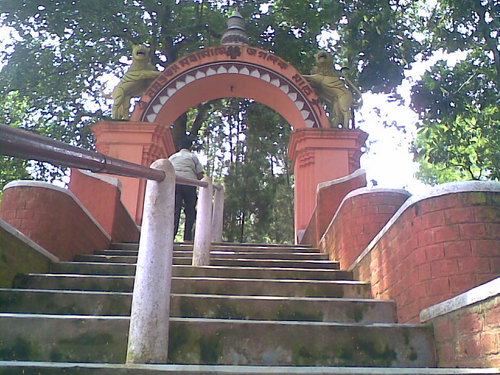
Mahamaya Dham or Mahamaya (supreme illusion) Temple of Bogribari, about 30 km east from Dhubri town and 10 km west from Bilasipara town, is regarded as a greatest Shakti Peethas[1] for Hindu pilgrims in Lower Assam, India. It is located under Parbatjhora sub-division of district Kokrajhar. In terms of attractions, this temple is the second to Kamakhya Temple of Guwahati to the pilgrims and tourists.[2] It is believed that the famous goddess Mahamaya was traditionally worshipped by the local people of Parvatjowar like Kacharies, Koches and Naths. It was also the presiding deity of the Zamindar (landlord) of Parvatjowar. Latter the goddess received wide acceptance and these days, all Hindus of Lower Assam worship mother Mahamaya.
Key Information


This temple has a 400-year-old tradition of animal sacrifice especially at the time of Durga Puja. Usually hundreds of animals or birds, like buffaloes, goats, pigeons and ducks are sacrificed. It is always rumoured that animals are sacrificed when new large scale construction especially bridge is undertaken. These days animal lovers are voicing against this ghastly tradition.[3]
Another place of worship connected to Mahamaya goddess is the Mahamaya Snaanghat Temple, which is situated few kilometers away from the main Mahamaya temple, on the bank of the Tipkai River which is a tributary of mighty river Brahmaputra. In the ancient time, as the local people belief, it is the place where the goddess Mahamaya used to take bath. From that time, the place came to be known as Mahamaya Snaanghat. Every year in the month of January around, a Shakti Yagya is performed here by the temple priests.
References
[edit]- ^ "Priceless heritage gets funds to survive". The Telegraph. Kolkata. 13 October 2007. Archived from the original on 10 November 2007.
- ^ Sharma, B. K. (24 January 2007). "Blueprint to develop tourist hotspots". The Telegraph. Kolkata.
- ^ "Fried Eye Killing the festive spirit, Oct 2011". Archived from the original on 20 December 2011. Retrieved 7 November 2011.
External links
[edit]Mahamaya Dham
View on GrokipediaMahamaya Dham is a Hindu temple complex and prominent Shakti Peetha dedicated to the goddess Mahamaya, an aspect of Durga embodying supreme illusion, situated in Bogribari village, Kokrajhar district, Assam, India. Located approximately 30 kilometers east of Dhubri town and 10 kilometers west of Bilasipara, it serves as a major pilgrimage destination for Shakti worshippers, ranking second in regional significance only to the Kamakhya Temple in Guwahati.[1][2] The site has roots in pre-Hindu tribal veneration by local communities such as the Kacharis, Koches, and Naths, who originally worshipped the mother goddess Mahamaya at nearby Parvatjowar before the establishment of the current temple structure. Local traditions hold that the location was a bathing site for the goddess in ancient times, contributing to its sanctity as a Shakti Peetha.[2][1] The temple maintains a centuries-old practice of animal sacrifice during rituals, reflecting tantric elements in its devotional customs, which draw large crowds especially during festivals like Durga Puja.[3] Mahamaya Dham's defining characteristics include its role in preserving indigenous-influenced Shakti worship amid Assam's diverse religious landscape, with the temple complex attracting devotees seeking spiritual fulfillment through offerings and meditative practices. Its proximity to the Assam-Bhutan border enhances its cultural exchange, though the site's prominence remains tied to empirical patterns of pilgrimage rather than unverified mythological claims.[2][1]
History
Legendary Origins
According to local traditions in the Parbatjowar region of Assam, the site of Mahamaya Dham has long been associated with the goddess Mahamaya, an aspect of the divine feminine embodying supreme illusion (maya), and was revered by indigenous communities including the Kacharis, Koches, and Nath yogis through pre-Vedic folk practices.[2][4] A prominent legend recounts the discovery of the goddess's idol through a wood merchant who ventured into the dense surrounding forests and experienced a divine encounter with Mahamaya, manifesting her presence to him.[4] The merchant relayed this revelation to the local zamindar, who subsequently received visions guiding the search; the idol was unearthed in the jungle, leading to the initiation of formal worship and the site's consecration as a sacred abode.[4] This narrative, preserved in regional oral histories, underscores the site's transition from informal tribal veneration to structured devotion, though its historicity remains unverified beyond folk transmission.[5] Some accounts link Mahamaya Dham to broader Shakti Peeth mythology, positing it as one of the 51 sites where fragments of Sati's body fell after her self-immolation, as described in tantric texts like the Kalika Purana; however, specific associations, such as with her paduka (sandals), are more explicitly tied to nearby Alokjhari, a forested extension maintaining parallel rituals.[6] These legends emphasize causal themes of divine intervention revealing hidden sanctity amid natural obscurity, reflecting the region's syncretic blend of animistic and Puranic elements without empirical archaeological corroboration.[6]Establishment and Early Worship
The initial establishment of the Mahamaya Temple, forming the core of Mahamaya Dham, is attributed to the Kachari community during the 8th to 9th century AD.[7][8] This early construction reflects the site's integration into regional indigenous practices, though the exact founding date remains undocumented in historical records. The structure faced repeated destruction due to natural calamities, such as floods common in the Brahmaputra valley, necessitating reconstructions over centuries.[7] Early worship centered on the goddess Mahamaya, a manifestation associated with supreme illusion and protection, primarily conducted by local ethnic groups including the Kacharis, Koches, and Naths.[2] These communities revered the deity at the Parvatjowar site to safeguard against wildlife threats, particularly tiger attacks on livestock and villagers in the forested Alokjhari region.[6] Rituals likely involved rudimentary offerings and invocations rooted in animistic and proto-Shakta traditions, predating formalized Hindu temple architecture.[6] Over time, these tribal practices evolved, with worship expanding beyond indigenous groups as Hindu pilgrims adopted the site. Formal endowments, such as the donation of 389 bighas of land as debattar property by Raja Prabhat Chandra Baruah for perpetual rituals, marked a transition toward institutionalized priesthood, including the hiring of two priests from Nalbari.[9] This development underscores the site's shift from localized veneration to a broader Shakti Peetha, though core early observances retained protective and agrarian emphases tied to the local ecology.[9]Modern Developments and Preservation Efforts
In the 21st century, Mahamaya Dham has experienced targeted infrastructure improvements to sustain its role as a prominent pilgrimage center amid increasing visitor numbers. In July 2021, renovation projects were inaugurated, encompassing structural repairs, decorative enhancements, and the erection of a boundary wall to bolster security and preserve the site's sanctity.[10] The Assam state government has integrated the temple into its tourism framework, listing it as a key Shakti Peetha alongside sites like Kamakhya, which facilitates funding and promotional activities for upkeep and accessibility.[1][2] District newsletters from 2025 highlight its draw for both devotees and tourists, reflecting ongoing local administrative support for maintenance without formal central monument status.[11] Preservation remains community-driven, rooted in the temple's active ritual use, with historical renovations noted in official records indicating periodic restorations to combat environmental wear in the Brahmaputra flood-prone region.[12] Its documentation by the Indira Gandhi National Centre for the Arts as an archaeological site aids in cultural advocacy, though no large-scale conservation programs by bodies like the Archaeological Survey of India are documented.[13]Location and Physical Description
Geographical Context
Mahamaya Dham is located in Bogribari, approximately 30-35 kilometers east of Dhubri town in western Assam, India, within the lower Brahmaputra Valley agro-climatic zone.[2] The site lies near the Brahmaputra River, which dominates the regional geography and supports fertile alluvial plains used for agriculture. This riverine setting contributes to the area's lush vegetation and seasonal flooding patterns, with the district experiencing inundation during monsoons due to the Brahmaputra's high discharge volume.[14] The terrain around Bogribari consists primarily of flat plains at an average elevation of about 30 meters above sea level, with occasional small hillocks such as those in nearby Tokorabandha.[15] Positioned on the periphery of Dhubri district, bordering Kokrajhar district to the east, the location is roughly 10 kilometers west of Bilasipara town and proximate to the international border with Bangladesh.[2] The Brahmaputra Valley's width averages 80 kilometers here, facilitating transportation and irrigation but also exposing the region to hydrological challenges from the river's meandering course.[14] Dhubri district, encompassing the site's vicinity, spans 2,176 square kilometers and features a subtropical climate with high humidity and rainfall exceeding 3,000 millimeters annually, influencing the local ecosystem and accessibility.[16] The area's geographical isolation from Assam's central highlands underscores its role as a peripheral pilgrimage hub, connected via road networks to major routes along the Brahmaputra.[17]
Architectural Features and Site Layout
The Mahamaya Dham temple exemplifies the Nilachal architectural style indigenous to Assam, characterized by a bulbous, beehive-shaped shikhara rising over a cruciform base.[3] This regional variant draws from Ahom influences, featuring terracotta plaques and intricate carvings depicting floral motifs, mythical figures, and geometric patterns on the facade.[7] The shikhara is typically rendered in striking red-and-white hues, enhancing its visual prominence against the surrounding landscape.[18] The temple's dome-like structure, evoking a medieval beehive form, lacks an enshrined idol in the sanctum, emphasizing aniconic worship akin to other Shakti pithas in the region.[19] Surrounding the main edifice are ancillary shrines and sculptures of deities such as Goddess Kali and Lord Hanuman, integrated into the complex to support extended rituals.[20] The site layout spans a hillock overlooking the Tipkai River, a tributary of the Brahmaputra, which functions as a sacred bathing ghat linked to the goddess's mythology.[5] The complex encompasses open courtyards for congregational gatherings and sacrifice platforms, historically situated amid forested environs before later developments added paved pathways and boundary walls.[6] This arrangement facilitates processions and seasonal observances, with the riverine proximity underscoring the site's hydrological and symbolic integration.[21]Religious Significance
Deity Worship and Theological Role
Goddess Mahamaya, the presiding deity of Mahamaya Dham, is a manifestation of Shakti, the primordial feminine energy in Hindu theology, embodying mahamaya—the supreme illusion that veils ultimate reality while facilitating creation, preservation, and delusion in the cosmic order. In Shaktism, she functions as the dynamic force binding souls to samsara (the cycle of birth and death) through material attachments, yet devotion to her is believed to pierce this veil, leading to moksha (liberation). This dual role aligns with broader Devi traditions, where Mahamaya parallels aspects of Durga or Kali in combating demonic forces that disrupt dharma (cosmic order), prosperity, and ethical living.[22][23] Theologically, Mahamaya's worship at the site underscores Assam's Sakta heritage, where she is invoked as the controller of worldly illusions, granting protection and wish fulfillment to devotees. Local traditions portray her as a warrior-protector, historically propitiated by indigenous groups such as Kacharis, Koches, and Nath communities to avert perils like wild animal attacks, reflecting a pragmatic, causality-driven reverence for her intervention in physical threats. Her paduka (sacred footprints) serve as the focal icon, symbolizing direct access to her grace; earnest prayer before them is said to manifest tangible boons, emphasizing personal agency in ritual efficacy over abstract metaphysics.[6][2] Worship practices center on tantric elements inherent to the temple's Sakta orientation, including invocations that harness her maya-transcending power for spiritual and material harmony. As the former deity of Parvatjowar's zamindars, her cult evolved from tribal animism to pan-Hindu acceptance, integrating empirical appeals for safety with esoteric realizations of illusion's impermanence. This synthesis highlights Mahamaya's role not as a passive idol but as an active theological agent fostering resilience against existential delusions.[24][6]Associated Myths and Symbolism
Mahamaya, the presiding deity of Mahamaya Dham, embodies the concept of mahamaya or supreme illusion in Hindu theology, representing the divine power that veils ultimate reality while enabling cosmic creation, preservation, and destruction. This illusory force, attributed to Shakti as the dynamic feminine energy, deludes demons and protects devotees, as described in texts like the Devi Mahatmya, where manifestations of the goddess overcome evil through strategic deception.[25] At the site, symbolism centers on transcendence of illusion toward enlightenment, with the temple's rituals invoking Mahamaya's role in granting wishes and averting calamities, such as historical protections against wild animals.[6] Local traditions link Mahamaya Dham to the broader Shakti Peeth mythology, positing it as a locus where Sati's paduka (divine feet) fell during Shiva's cosmic dance (tandava) following her self-immolation at Daksha's sacrifice, as recounted in the Joginitantra and Kalika Purana. Vishnu's discus dismembered Sati's body, scattering parts across 51 sites to pacify Shiva, with the paduka at this location symbolizing grounded divine presence and fertility—believed to bless childless couples with progeny upon sincere worship.[6] Complementary legends describe the nearby Mahamaya Snaanghat on the Tipkai River as the goddess's ancient bathing site, evoking purification and immersion in her illusory yet benevolent power, where annual Shakti Yagya rituals reaffirm her sovereignty over natural forces.[3][26] Further site-specific lore includes a 19th-century vision to zamindar Protap Chandra Baruah, revealing a guarded golden idol of Mahamaya, which tigers refrained from harming priests, symbolizing her dominion over primal instincts and forest wilderness—epitomized by "Alokjhari" (light of the forest), alluding to Shiva's meditative luminescence.[6] Holy springs like Thakuranir Jhora and an inscribed stone paduka represent curative waters and enduring footprints, metaphorically bridging mortal desires with divine intervention, fulfilling vows for health and prosperity. These elements underscore Mahamaya's dual symbolism: the binding maya of worldly attachments contrasted with liberating jnana (knowledge), fostering devotion amid Assam's tribal heritage of Koch, Kachari, and Nath worship.[6][4]Rituals and Practices
Major Festivals and Observances
The foremost observance at Mahamaya Dham is Durga Puja, typically held in September or October according to the Hindu lunar calendar, drawing thousands of pilgrims for elaborate rituals centered on the goddess's victory over Mahishasura.[3][27] Devotees participate in chanting, processions, and offerings, with the temple complex becoming a hub of continuous worship over the nine nights of Navratri culminating in the idol immersion on Vijaya Dashami.[26] This festival underscores the site's Shakti traditions, where priests perform pujas invoking Mahamaya's protective powers amid vibrant cultural displays unique to Assam's border regions.[20] A distinctive feature of Durga Puja at Mahamaya Dham is the adherence to a 400-year-old practice of animal sacrifice, believed by participants to appease the deity and fulfill vows for prosperity or health; offerings include hundreds of buffaloes, goats, pigeons, and other creatures ritually slaughtered at designated altar sites.[26][27] Priests assert this custom traces to ancient tantric rites, symbolizing the triumph of divine energy over evil, though it remains controversial and draws scrutiny from animal welfare advocates.[3] Additional annual observances include Kali Puja in late October or early November, featuring night-long vigils and fire rituals honoring the fierce aspect of the goddess, and Shivaratri in February or March, which involves fasting, all-night prayers, and symbolic offerings to Shiva alongside Mahamaya as his consort.[20] These events, while less massive than Durga Puja, reinforce the temple's role in regional Hindu devotion, with local communities contributing through music, dance, and communal feasts.[3] Daily aartis persist year-round but intensify during these periods, maintaining the site's sanctity as a living Shakti center.[26]Traditional Offerings and Animal Sacrifice
At Mahamaya Dham, traditional offerings to Goddess Mahamaya encompass daily rituals known as puja, which involve presenting items such as flowers, fruits, sweets, incense, and curd-flattened rice mixtures to invoke the deity's blessings.[1] These practices align with broader Shakta traditions in Assam, where non-violent offerings symbolize devotion and sustenance for the goddess during routine worship conducted by temple priests.[3] A distinctive element of the temple's 400-year-old customs is the practice of animal sacrifice, or bali, predominantly observed during major festivals like Durga Puja, particularly on the ninth day (Navami).[1] [28] Devotees offer animals including buffaloes, goats, pigeons, and ducks, with reports indicating hundreds sacrificed annually to fulfill vows, seek protection, or express gratitude, reflecting tantric Shakta beliefs in appeasing the goddess's fierce aspects through symbolic blood rites.[3] [26] The ritual is performed by trained priests in a designated area, adhering to prescribed Vedic and local tribal-influenced procedures inherited from Koch and Bodo communities.[28] This sacrificial tradition underscores the temple's role as a Shakti Peeth, where such offerings are viewed by practitioners as essential for spiritual efficacy, distinct from mainstream vegetarian Hindu practices elsewhere in India.[1] Post-sacrifice, the meat is often distributed among participants as prasada, integrating communal feasting into the rite, though the practice persists amid regional legal and ethical scrutiny.[3]Controversies and Criticisms
Debates on Animal Sacrifice
The practice of animal sacrifice at Mahamaya Dham, a 400-year-old tradition integral to its rituals, particularly intensifies during Durga Puja, involving offerings such as goats, buffaloes, pigeons, and ducks to appease the deity Mahamaya.[7] [29] Devotees and temple priests defend the ritual as sanctioned by tantric scriptures like the Yogini Tantra and Garuda Purana, viewing it as a necessary act of devotion to fulfill vows (man Nats) and symbolize the triumph of good over evil, with no scriptural prohibition against it in the context of Shakti worship.[30] Critics, including animal welfare activists in Assam, argue that the practice inflicts unnecessary cruelty on animals, contravening the Prevention of Cruelty to Animals Act, 1960, which prohibits causing avoidable suffering, and label it as superstition lacking firm Vedic or Puranic endorsement beyond selective tantric interpretations.[30] Figures like activist Sangeeta Goswami contend that it deviates from core Hindu ethics emphasizing ahimsa (non-violence), drawing parallels to historically abolished customs like sati, and question the substitution of mythical demons like Mahishasura with innocent livestock.[30] While some Assam temples, such as Manasha and Garal, have discontinued sacrifice in recent years amid such pressures, major Shakti peethas including Mahamaya Dham remain steadfast, with priests asserting that abrupt cessation would undermine longstanding theological and communal bonds.[30] Legally, animal sacrifice persists in Assam without statewide prohibition, contrasting with bans in states like Andhra Pradesh and Tamil Nadu, though broader judicial scrutiny—such as Tripura High Court's 2019 order halting it there—has prompted defenses of Assam's temple autonomy under Article 25 of the Constitution, which protects religious practices unless they violate public order or fundamental rights.[31] The debate reflects tensions between cultural preservation and evolving ethical standards, with no recorded court interventions specific to Mahamaya Dham as of 2025, allowing the ritual to continue amid periodic calls for symbolic alternatives like vegetable offerings.[30]Access and Infrastructure Challenges
The remote location of Mahamaya Dham in the forested, hilly terrain of Alokjhari Part II, Dhubri district, Assam—approximately 4 km from Tamarhat and 310 km west of Guwahati—poses inherent access difficulties for pilgrims and priests.[6][32] The site, situated on a zigzag hilly road amid Shivor Tilla peak and surrounded by rivers, prohibits motor vehicle use, requiring visitors to trek on foot while carrying offerings such as fruits, milk, and sweets in baskets.[6][32] Road infrastructure exacerbates these challenges, with the primary Dhubri-Kachugaon Road and the 4-km connecting stretch to the village in dilapidated condition, featuring potholes and neglect that render travel arduous.[33] Adjacent bridges linking the area to nearby villages are described as rickety and in a pathetic state, further hindering connectivity and safety.[33][32] These deficiencies have led to sharply reduced pilgrim footfall outside the annual Saat Besoma Mela in April, which draws thousands despite the obstacles, as poor access deters routine devotees and limits revenue from donations essential for site maintenance.[33][32] An acute financial crisis at the temple, intensified by COVID-19 lockdowns and ignored appeals to the state government for road upgrades and tourist infrastructure, perpetuates the cycle of underdevelopment and restricted accessibility.[32]Cultural and Economic Impact
Pilgrimage and Tourism
Mahamaya Dham functions as a key pilgrimage destination in Kokrajhar district, Assam, attracting Hindu devotees seeking darshan of Goddess Mahamaya, revered as a manifestation of Shakti. Pilgrims visit year-round for rituals and blessings, with peak attendance during Durga Puja, when elaborate pujas and community gatherings draw large crowds from across lower Assam and adjacent areas.[34][26]
The site's prominence as a Shakti Peetha, second only to Kamakhya Temple in Guwahati in regional appeal, enhances its draw for spiritual tourists exploring Assam's temple circuits. Accessibility supports pilgrimage, situated 30 kilometers east of Dhubri town—connected by road—and 10 kilometers west of Bilasipara, enabling visits from border regions near West Bengal and Bangladesh.[2][1][35]
Tourism infrastructure development includes initiatives by the Assam Tourism Development Corporation to establish facilities at Mahamaya Dham within the Dhubri-Mahamaya-Barpeta-Hajo circuit, funded partly by state resources to accommodate growing visitor numbers and promote eco-friendly amenities. These efforts aim to bolster the site's role in spiritual tourism, though detailed implementation updates post-2016 extensions are sparse.[36]