Hubbry Logo
PadukaPadukaMain
Open search
Paduka
Community hub
Paduka
logo
8 pages, 0 posts
0 subscribers
Be the first to start a discussion here.
Paduka
Paduka
from Wikipedia

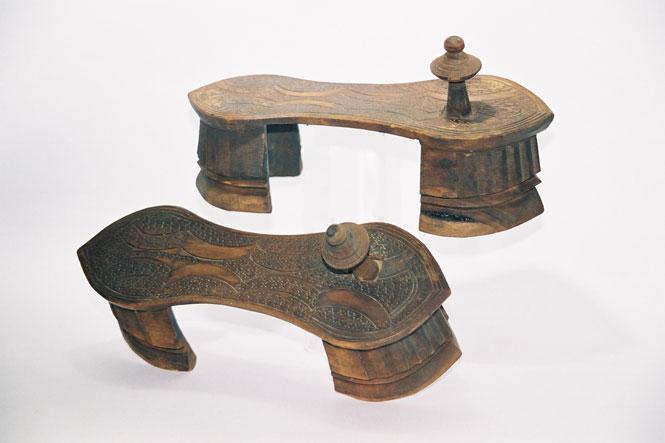
Elaborate paduka with high platform was part of a bride's trousseau.[1]

Paduka (Sanskrit: पादुक, romanizedpāduka) is an ancient form of footwear in India, consisting of a sole with a post and knob which is positioned between the big and second toe.[2] It has been historically worn in South Asia and Southeast Asia. Paduka exist in a variety of forms and materials. They might be made in the shape of actual feet, or of fish, for example, and have been made of wood, ivory and silver. They may be elaborately decorated, such as when used as part of a bride's trousseau, but could also be given as religious offerings or themselves be the object of veneration.[1]

Although simple wooden padukas could be worn by common people, padukas of fine teak, ebony and sandalwood, inlaid with ivory or wire, were a mark of the wearer's high status.[2] In the modern world, padukas are worn as footwear by mendicants and saints of Hinduism, Buddhism, and Jainism. Its significance in Hinduism is linked to the epic Ramayana. Paduka can also refer to the footprints of deities and saints that are venerated[3][4][5][6] in symbolic form in houses and purpose-built temples. One such temple is the Vishnupad Mandir in Gaya, India. Similarly, Buddha footprints are worshipped under the Bodhi Tree in Bodh Gaya.[6][7]

Paduka are the royal symbol in Malaysia. Seri Paduka denotes "His Majesty", which is a title bestowed as an honour of recognition to dignitaries of the Malaysian court.[8][9]

Detail of paduka on sculpture, Orissa State Museum, Bhubaneswar

Etymology

[edit]
Painted Indian pāduka collected by Hans Sloane (1660–1753), now in the collection of the British Museum
Female figure with paduka, 11th century

The Sanskrit word pāduka is derivative of pāda meaning 'foot'. This terminology was coined to define India's ancient archetypal footwear.[1]

Legends

[edit]

The word pada ('foot') is cited in the ancient Hindu scripture Rigveda as representing the universe, namely the Prithvi (earth), Vayu (air), Akasha (sky), and the element of the realm beyond the sky.[7]

In the Hindu epic Ramayana, King Dasharatha sent his son Rama (an incarnation of Vishnu) into exile for 14 years at the behest of his wife Kaikeyi (the stepmother of Rama), who wanted her son Bharata to be crowned in Rama's place. However, Bharata did not wish to rule the kingdom, and visited Rama in exile, beseeching him to return to Ayodhya. When Rama replied that he would return only after completing his exile, Bharata requested Rama's padukas to serve as his proxy, to be crowned and to serve as an object of veneration for Rama's followers. Bharata carried Rama's golden padukas with great reverence by placing them on his head as a mark of his obedience to his elder brother. Bharata ruled Kosala as Rama's regent in the name of "Rama's padukas".[7][8]

Construction

[edit]
Kashmiri Pandit woman wearing strapped paduka c. 1922

The footwear is basically a sandal, which has generally a wooden sole with a post and a stub to provide grip between the big and second toes. It does not have straps of any kind to adhere the sole to the foot, so the wearer has to actively grip the post between the two toes to keep the sandal in place while walking.[10]

It is also known as khadau, karrow, kharawan and karom, and used in the Indian subcontinent mostly by mendicants, saints and commoners.[1] Made in the shape of the footprints, with two narrow and curved stilts, the design is specific to ensure that the principle of non-violence – practised by the saintly followers of Hindu and Jain religions – is not violated by accidental trampling of insects and vegetation. The Brahmins wearing such a paduka may be heard praying: "Forgive me Mother Earth the sin of injury, the violence I do, by placing my feet upon you this morning."[11]

Padukas made of ivory were in popular use among royalty and saints. Hindu religious ethos requires that the ivory be taken from elephants which died naturally or harvested from domesticated elephants, in a manner which avoids cruelty.[12] People of high societal status wear padukas made of fine teak, ebony and sandalwood and inlaid with ivory or wire. They are also made in the shape of fish as a symbol of fertility.[13]

Other forms of padukas worn on special occasions may be incised with silver or of wood covered with silver plates and sometimes adorned with bells to sound upon walking. Bronze and brass padukas may be worn for ritual and ceremonial use.[14]

A unique pair of wooden padukas have their toe knobs inlaid with ivory lotus flowers and are minutely painted. At each step, a trigger mechanism in the sole signals the lotus to open from bud to blossom. They are also made in the shape of an hourglass or with carved toes.[4]

Eighteenth-century footwear used as ritual wear made of "wood with bed of sharp iron spikes" has been found. It is inferred that it was meant to be used to inflict pain to the wearer to demonstrate his conviction in religious forbearance of pain.[4]

Veneration

[edit]
Paduka of saint Dnyaneshwar is carried in a palanquin in a silver bullock cart in procession from Alandi to Pandharpur.

Paduka is often gifted as part of a bride's dowry. They are worshipped and given as votive offerings by faithful believers.[11]

In a festival associated with the Hindu god Vithoba, pilgrims travel to his Pandharpur temple from Alandi and Dehu towns that are closely associated with poet-saints Dnyaneshwar and Tukaram (respectively), carrying the padukas of the saints in a silver palkhi (palanquin).

A popular religious belief is of the contact (sparsh) with the salabhanjika sculpture yakshini's foot. It is said that when the yakshini encircles a dormant tree with her leg around it, it starts to blossom and bear fruit. Shalabhanjika yakshi is also an embellishment in the form of an architectural bracket in many Hindu temples.[7][relevant?]

Another notable feature of veneration is of the goddess Lakshmi, the goddess of prosperity. On Deepavali festival day, Lakshmi is devotionally ushered into the house through symbolic representation with a series of her footprints (paduka) drawn in paint or kolam and lit with oil lamps, from the main door to the private sanctum. This is done with the wish that good fortune shall be bestowed by her upon the householders.[5]

Below the Bodhi tree at Bodh Gaya where Buddha received enlightenment, there is a vacant throne that is adorned with the foot prints on a foot rest of the Buddha. This place is deeply venerated.[7]

In South Indian Vishnu temples, priests offer the satari, a gold or silver plated crown that features the feet of Vishnu to bless devotees, who bow low so that it is ritually placed upon their heads.[15]

Vishnupada temple

[edit]
These simple Padukas are worn by saints and mendicants.

The Vishnupada Temple is said to enshrine the footprints of Vishnu.[16] This footprint denotes the act of Vishnu subduing Gayasura by placing his foot on his chest. Inside the temple, the 40-centimetre-long (16 in) footprint is imprinted in solid rock and surrounded by a silver-plated octagonal enclosure.[17] The temple is 30 metres (98 ft) in height and has 8 rows of elegantly carved pillars that support the pavilion.[18]

Paduka Sahasram

[edit]

The Paduka Sahasram (lit.'1,000 verses on the footwear' (of Ranganatha)) is a devotional poem extolling the virtues of worshipping the paduka (feet) of Vishnu, enshrined in Sri Ranganathaswamy Temple of Srirangam, Tamil Nadu. The poem was composed in 1,008 verses in 32 chapters by Vedanta Desika, a proponent of the Vishishtadvaita philosophy. According to Sri Vaishnava tradition, the 1,000 verses of the Paduka Sahasra were composed in a single night by Vedanta Desika as a part of a literary contest. By doing so, the poet defeated Alagiya Manavala Perumal, a theologian of the Tenkalai sect, who had only been able to compose 300 verses during the allotted period.[19][20]

Paduka Poojan done during Satchidanand Utsav

Guru Paduka Stotram

[edit]

Adi Shankara has also written nine devotional verses under the title "Guru Paduka Stotram" as salutations to his guru. An English translation of the first verse is:[21]

Salutations and Salutations to the sandals of my Guru,
Which is a boat, which helps me, cross the endless ocean of life,
Which endows me, with the sense of devotion to my Guru,
And by worship of which, I attain the dominion of renunciation.

Satchidananda Utsav

[edit]

Satchidananda Utsav (celebration of truth, consciousness and bliss) is organised by Sadguru Shree Aniruddha Upasana Trust (Mumbai, India) and celebrated every year on the second Saturday of Margashirsha (the ninth month of the Hindu calendar). It is usually performed for two to five consecutive days. The holy padukas worshipped during the celebration are prepared from the paper pulp of Ram Naam books issued by Aniruddha's Universal Bank of Ram Naam and written by thousands of devotees across the world.[22][23][24][25]

[edit]

See also

[edit]

References

[edit]
[edit]
Revisions and contributorsEdit on WikipediaRead on Wikipedia
from Grokipedia
A paduka (Sanskrit: पदुक, romanized: paduka; from "pada", meaning foot) is a traditional form of ancient Indian , consisting of a simple wooden sole with a central post and knob that secures the foot by fitting between the big toe and the second toe, without the need for straps or enclosures. Dating back to the over millennia, it represents one of the earliest known designs, initially developed for practical protection against hot earth, debris, and as a tool for ascetic . Primarily associated with Hindu and Jain traditions, the paduka embodies simplicity, humility, and spiritual discipline, often worn by sages, monks, and ascetics to preserve bodily energy and align with principles of non-violence () by avoiding leather materials. The paduka's cultural and religious significance is deeply rooted in ancient Indian epics and iconography, where it transcends mere utility to symbolize divine authority and devotion. In the Ramayana, Lord Rama's golden padukas were venerated by his brother Bharata, who placed them on the throne of as a proxy for Rama's rule during his 14-year exile, highlighting their role as sacred emblems of kingship and piety. Similarly referenced in the as a toe-knob sandal (padu), it appears in temple sculptures and artifacts as footprints (charan paduka) of deities and saints, worshipped for their purifying and protective qualities. For ascetics, spiked or elevated variants served as instruments of self-mortification, while ornate versions—crafted with inlays of , , or precious stones—denoted status among royalty and were offered in temples. Historically crafted from durable hardwoods like , neem, or sheesham using traditional tools such as chisels and saws, padukas evolved from basic forms to regionally varied designs featuring floral, geometric, or figural motifs. In modern contexts, they persist in religious ceremonies, , and wellness practices, valued for promoting posture, benefits, and eco-friendly craftsmanship amid a revival of indigenous heritage.

Etymology and Overview

Etymology

The term paduka originates from , deriving from pāda, meaning "foot," with the suffix indicating protection or a form, thus denoting designed to support or guard the foot. This etymology reflects its function as a simple, archetypal in ancient Indian . In ancient Indian texts, such as the Mahabharata, paduka refers to toe-gripped sandals, setting it apart from other footwear types like upanah (leather-bound shoes). References to paduka also appear in classical Sanskrit literature and Jain scriptures, highlighting its early linguistic standardization for this minimalist design. Regional adaptations include the Tamil variant padukai or pātukai, borrowed directly from Sanskrit pādukā to denote similar foot coverings. Within religious traditions, the term paduka evolved beyond literal to symbolize the sacred footprints of deities or gurus, embodying , guidance, and in Hindu, Buddhist, and Jain contexts. This symbolic shift underscores its role as a revered of spiritual .

Physical Description

The paduka is characterized by its simple yet functional , consisting of a flat sole attached to a central post that rises to form a knob positioned between the big toe and the second toe, enabling the wearer to grip it securely without the need for straps or additional fastenings. This toehold design allows for basic mobility while keeping the foot elevated from direct ground contact. Typical padukas measure approximately 20-30 cm in length for adult sizes, with widths around 9 cm and heights up to 7 cm, accommodating ergonomic needs for varied foot shapes. The elevated sole, often supported by at the and , provides stability on uneven and reduces pressure points during prolonged wear, aligning with principles of minimal environmental impact rooted in the non-violent () ethos of and by limiting harm to ground-dwelling organisms. Variations in paduka style range from basic flat-soled versions suited for everyday practical use to more elaborate designs intended for ceremonial contexts, though both maintain the core toe-knob structure.

Historical and Legendary Context

Ancient References

The term "pada," meaning "foot" or "quarter," appears in the (circa 1500 BCE), symbolizing cosmic structure, as in various hymns. This metaphorical usage later evolved during the (circa 1200–500 BCE) to denote literal , with "paduka" emerging as a compound term for simple toe-post worn for practical purposes. Archaeological evidence for early forms of footwear dates back to the Indus Valley Civilization (circa 2500 BCE), with impressions and artifacts suggesting basic sandals made from leather or woven materials, though specific toe-post designs appear later. By the post-Mauryan Shunga era (circa 185–73 BCE), sculptures at sites like Sanchi and Bharhut depict figures, including ascetics and deities, in simple sandals, reflecting their integration into everyday and symbolic attire. Archaeological finds include a wooden sandal from Chandraketugarh (circa 200 BCE), illustrating early crafted footwear, though toe-post variants are more prominently documented in later texts and iconography. In ancient societies, paduka served as practical footwear for ascetics and rulers, as evidenced in Buddhist texts like the Mahavagga of the Vinaya Pitaka (compiled circa 5th–4th century BCE), which regulates monks' use of simple single-soled sandals made from non-leather materials such as wood or grass, prohibiting elaborate types to maintain humility. Similarly, Jain texts such as the Brihat-Kalpa-Sutra-Bhasya (circa 4th–5th century CE, drawing on earlier traditions) describe paduka as basic toe-knob sandals for mendicants, emphasizing non-violent materials and types like eka-putam for protection during travel. These references highlight paduka's role in fostering mobility and austerity among religious figures and elites.

Key Legends

One of the most prominent legends associating paduka with divine authority and moral duty appears in the , where Bharata, 's younger brother, receives 's wooden () as a symbol of proxy kingship over Kosala. After 's to the for 14 years, Bharata travels to Chitrakuta to implore him to return to and assume the , but remains steadfast in honoring his father's boons to . Unable to persuade , Bharata requests his , declaring that he will rule the kingdom not for himself but as a under 's symbolic presence, placing the on the and governing from Nandigrama outside the city while worshipping them daily as if they were himself. This act exemplifies Bharata's unwavering devotion () and the principle of , portraying paduka as an embodiment of righteous rule and fraternal loyalty. In , paduka features prominently in stories of 's cosmic role, particularly through his avatar, where his footprints mark the foundation of creation. As the dwarf , approaches the demon king during a and requests three paces of land; upon Bali's grant, expands into the giant Trivikrama, covering the with his first step, the heavens with the second, and placing the third on Bali's head to reclaim the for the gods. These strides, echoed in Vedic hymns, leave enduring footprints symbolizing the division and sustenance of the three worlds—, atmosphere, and sky—representing 's and the ordered structure of the . 's footprints thus embody divine intervention in creation, serving as sacred markers of his protective presence across mythological narratives. Paduka also holds significance in legends surrounding spiritual masters, notably , who composed the Guru Stotram to extol the 's sandals as conduits of enlightenment. According to tradition, while wandering along the , Shankara discovered the paduka of his , Bhagavatpada, which inspired the hymn praising their 25 glories, such as granting wisdom, destroying ignorance, and ferrying devotees across the ocean of samsara. In this , the paduka symbolize the 's grace and authority, equating them to a for spiritual liberation and humility before the divine teacher, underscoring the principle that the 's footsteps guide one to . Symbolically, paduka draw from Rigvedic cosmology, where "pada" (foot or step) denotes the foundational elements of the , as seen in Vishnu's three strides that measure and uphold creation. Hymns describe these padas as encompassing all existence, with the third step accessing the highest realm of nectar, portraying the foot as a cosmic pillar supporting , , and intermediate spaces. This interpretation elevates paduka to representations of universal stability and divine order, influencing later Hindu thought on the sanctity of sacred imprints.

Construction and Design

Materials and Craftsmanship

Paduka are primarily crafted from durable hardwoods selected for their longevity and resistance to environmental wear. Common materials include (Tectona grandis), valued for its strength and weather resistance; (Azadirachta indica), used for its natural insect-repellent qualities; and (Dalbergia sissoo), appreciated for its lightweight yet sturdy composition. These woods are sourced regionally, with particularly prevalent in southern due to local availability. For elite or ceremonial versions, artisans incorporate luxurious materials such as for carving the base or inlays, silver for ornate knobs or borders, and for on high-status pieces, often reserved for royalty or religious artifacts. Fine woods like () and () are also used for their aromatic and dense properties in such ornate designs. Inlays may also feature , , or semi-precious stones like mother-of-pearl to enhance aesthetic appeal and symbolize status. During the Mughal era, paduka with detailed carvings were common among the , showcasing advanced techniques blending Persian and Indian motifs. The craftsmanship begins with seasoning the wood for weeks or months to prevent cracking, followed by rough shaping using circular saws or adzes. South Indian artisans employ hand-carving techniques with chisels and hammers to create geometric, floral, or religious motifs on the sole and knob, ensuring ergonomic fit through precise hollowing under the footbed. Finishing involves sanding for smoothness and polishing with natural oils such as linseed to achieve a lustrous sheen, while ceremonial pieces may receive additional sealing with enamels for preservation. This artisanal process, passed down through generations, emphasizes precision to balance functionality and ornamentation.

Structural Features

The paduka's core structure revolves around three primary components that ensure functionality and balance: a central vertical post rising from the sole, a horizontal knob attached to the top of the post for gripping between the big and second s, and a curved sole designed for stability on uneven . Some variations, particularly for ascetics, feature two raised —one under the and one under the —along with the toe knob to further minimize ground contact in line with principles. The post, typically 5-10 cm in height, provides elevation and , allowing the foot to pivot naturally during movement while minimizing direct ground contact. The knob, often rounded and ergonomically shaped, secures the foot without straps, relying on toe pressure for retention and promoting a forward-leaning that enhances balance. The sole's gentle inward at the edges, particularly in versions crafted from dense hardwoods, absorbs shocks from rough surfaces like temple floors or forest paths, preventing slippage and supporting arch alignment for prolonged wear. In terms of design principles, paduka emphasize and , with ornate variants featuring or lotus-shaped soles that maintain the core elevation while adding aesthetic symbolism; the form narrows at the center for better weight centering, and the lotus silhouette incorporates flared edges mimicking petal openings to improve lateral stability. Lightweight construction is a key tenet, achieved through seasoned wood selection and minimal material use, aligning with the principle by reducing pressure on the ground to avoid harming small or organisms beneath the foot—the elevated and narrow contact points distribute force sparingly. This prioritizes durability without excess weight, often under 500 grams per pair, ensuring the wearer can traverse long distances comfortably. Adaptations for practical use include reinforced posts in travel-oriented versions, where the central pillar is thickened to withstand extended pilgrimages or rugged conditions without compromising the toe-grip mechanism. These modifications highlight the paduka's versatility while adhering to its minimalist engineering ethos.

Religious and Cultural Veneration

Temples and Sacred Sites

The Vishnupada Temple in Gaya, , , serves as a primary sacred site for the veneration of Vishnu's paduka, housing a natural indentation in a basalt rock interpreted as the deity's right footprint, measuring approximately 40 cm in length and enclosed within an octagonal silver-plated basin on a low pedestal. The temple structure, rising about 30 meters high with eight rows of intricately carved pillars supporting its pavilion, was renovated in 1787 CE by Queen of , though the site's origins trace back to at least the CE based on early references to footprint worship in the region. In , another key location nearby, multiple representations of are enshrined around the sacred Bodhi Tree and complex, marking the sites of his enlightenment and post-enlightenment meditations, with notable examples including large stone carvings under the tree symbolizing his physical presence. These footprints, often carved in stone and integrated into platforms or shrines, date from early Buddhist periods and continue to be central to the site's UNESCO-recognized status as a pilgrimage destination. complexes, such as those on Hill in , similarly enshrine paduka of tirthankaras like Neminath, featuring rock-carved footprints in pavilions or natural formations that denote their spiritual attainments and paths to liberation. Pilgrims make annual visits to these sites, particularly during auspicious periods like for Vishnupada, where rituals include anointing the footprints with milk, water, ghee, and flowers as part of charan puja to invoke divine blessings and facilitate ancestor liberation. At , devotees circumambulate and offer similar anointings to the near the Vajrasana throne, emphasizing and enlightenment. In Jain contexts, such as , annual pilgrimages involve foot-anointing practices with sacred substances to honor the tirthankaras' non-violent teachings and achieve spiritual merit. These temples draw from legends of divine feats, like Vishnu's triumph over Gayasura, to underscore their sanctity.

Literary Compositions

One of the most celebrated literary works dedicated to the paduka is the Paduka Sahasram, a poem comprising 1,008 verses composed by the 13th-century Sri Vaishnava philosopher and poet . Written in a single night—specifically one (a three-hour period)—at the Temple in , the poem praises the paduka of Lord , a form of , as symbols of and accessibility to the . According to tradition, Desika undertook this composition in response to a challenge from a rival scholar or devotee, who dared him to create a thousand verses on a seemingly mundane subject to prove his mastery as a mahakavi (great poet); Desika chose the paduka to elevate their spiritual profundity, completing the work overnight and presenting it the following morning. The poem's structure employs classical meters like anushtubh, with intricate patterns such as chitra kavya (ornamental ), including slokas arranged in grids mimicking a horse's gait or using limited phonemes for rhythmic emphasis. Thematically, Paduka Sahasram portrays the paduka as metaphors for the path to enlightenment, serving as a bridge (setu) across the ocean of samsara (worldly existence) and a guide to moksha (liberation). Desika depicts them as protective vessels that remove sins, ignorance, and threefold suffering (tapatrayam), equating their role to that of spiritual teachers (acharyas) like the Alvar saint Nammazhwar, who facilitate union with the divine. For instance, in sloka 241, the paduka are likened to a "bridge to cross the ocean of Samsara," emphasizing their function in elevating devotees from material bondage to divine realms. Other metaphors include the paduka as a lamp dispelling darkness, a chariot bearing the Lord, or gems symbolizing purified souls, with their sounds evoking Vedic chants that confer blessings. Sloka 100 describes them as the "shortest route to Moksham," underscoring their efficacy in granting direct access to Vishnu's abode, Sri Vaikuntha, and ensuring a blessed death where the devotee beholds the divine. These elements integrate poetic artistry with theological depth, affirming the paduka's inseparability from Vishnu's feet as embodiments of compassion and ultimate refuge. Another seminal composition is the Guru Paduka Stotram, a nine-verse hymn attributed to the 8th-century philosopher , venerating the paduka of his , Bhagavatpada. Composed in during Shankara's time at Govinda's cave in or as a reflection of his initiation, the stotram emerged from Shankara's profound reverence upon beholding the guru's sandals, which he circumambulated and prostrated before as symbols of transmitted wisdom. The verses follow a devotional stotram structure, each building on the previous to extol 25 glories of the paduka, using rhythmic anushtubh meter for meditative recitation. In the Guru Paduka Stotram, the paduka represent the guru's grace as the sole path to enlightenment in Advaita tradition, metaphorically functioning as a boat ferrying the soul across the "ocean of endless samsara" to self-realization (Brahman). Shankara employs imagery of the paduka granting speech to the mute, wealth to the destitute, and knowledge to the ignorant, thereby dissolving ego and illusions (avidya). The opening verse declares: "Anantasamsara samudratarayah kavithva galitham pariharan yasya / pratibhatam samadhi vidhanamritam nanu padukabhyam govinda bhidah" (O Guru's sandals! You are the boat that carries across the infinite ocean of samsara, granting the nectar of samadhi to those who meditate upon you). Subsequent verses, such as the third—"Natah yayoh sripatitam sami yuh kadachid api ashu daridra varyah / mukas cha vachaspatitam hi tabhyam namo namah sri guru padukabhyam" (Salutations to the Guru's paduka, which exalt the prostrate and swiftly enrich the poor, granting eloquence to the speechless)—highlight their transformative power, positioning them as embodiments of the guru's feet that lead to moksha by invoking devotion and inner awakening. This work underscores the paduka's role in Advaita as intermediaries of non-dual knowledge, where devotion to the guru's symbols dissolves duality and reveals the self.

Rituals and Festivals

In Hindu traditions, , observed on the full moon day in the month of , features rituals where disciples honor their gurus by offering and worshipping paduka as symbols of divine guidance and humility. During these ceremonies, devotees perform paduka puja by adorning the guru's sandals with paste, , flowers, and akshata (unbroken rice), followed by and prostrations to signify surrender to the guru's teachings. This practice underscores the paduka's representation of the guru's footsteps, believed to lead followers toward spiritual enlightenment and moral direction. Deepavali, the festival of lights celebrated in the of Kartika, incorporates paduka-inspired traditions to invoke through depictions of Goddess Lakshmi's footprints. Households draw these symbolic footprints using rice paste or mixed with vermilion powder, starting from the threshold and leading inward, to welcome the deity and ensure her blessings of wealth and abundance remain in the home. Accompanied by patterns and lit lamps, this ritual symbolizes Lakshmi's auspicious entry, warding off misfortune while attracting and familial harmony. The Satchidananda Utsav, an annual festival in the Hindu month of Margashirsha organized by devotees of Sadguru Bapu, centers on the veneration of specially crafted paduka made from the paper pulp of Ram Naam books. These paduka, embodying the saint's spiritual legacy, are installed in a grand accompanied by devotional chants, bhajans, and collective recitations of the Ram Naam , fostering a sense of communal devotion and divine connection. The event culminates in paduka poojan, where participants offer flowers, , and prasad, reinforcing themes of surrender and eternal guidance through the symbolic .

Broader Cultural Influence

In Southeast Asia

In , the paduka's influence arrived through ancient trade routes and cultural exchanges with , particularly during the 15th-century Melaka Sultanate, where Indian motifs shaped Malay royal symbolism. The term "paduka," denoting revered feet, evolved into an honorific title for rulers, such as "Sri Paduka," symbolizing sovereignty and divine authority in Malay courts. This linguistic and conceptual adaptation underscored the feet as emblems of power, integrated into ceremonies that blended Indian Hindu-Buddhist elements with local Islamic traditions, as evidenced in historical inscriptions from the region. Buddhist and Hindu sites across and further illustrate paduka's adaptation as symbolic footprints (buddhapada), venerated in shrines representing the Buddha's presence. In , temples like Wat Phra Phutthabat in Saraburi house natural rock depressions interpreted as the Buddha's footprints, drawing pilgrims for rituals that echo Indian devotional practices. Similarly, in , 's 8th-9th century reliefs depict figures wearing toe-post sandals akin to paduka, reflecting Indian artistic influences on Javanese Buddhist ; these panels, part of the Karmawibhangga , show everyday footwear in moral narratives, highlighting the sandal's cultural permeation. Local variations of paduka-style footwear emerged by incorporating regional materials and designs, such as for lightweight soles in rural Indonesian and Malaysian crafts, providing durability in tropical climates. In , particularly around , artisans adorned toe-post sandals with motifs—intricate wax-resist patterns featuring floral or geometric elements—transforming functional items into cultural artifacts worn during festivals. These adaptations, using pandan leaves or weaves for straps, preserved the Indian-inspired form while embedding Southeast Asian aesthetics, as seen in traditional Javanese upanat sandals revived for temple visits.

Modern Usage and Symbolism

In contemporary , handmade paduka have found a niche in the and sectors, where artisans craft them from sustainable woods like and for sale as cultural souvenirs and decorative items. These post-2000s productions emphasize eco-friendly sourcing to appeal to environmentally conscious tourists, often featuring intricate carvings that highlight traditional designs while adapting to modern aesthetics. For instance, platforms specializing in Indian crafts offer wooden paduka as premium gifts, blending functionality with ornamental value to promote . Beyond practical use, paduka hold symbolic significance in diaspora communities, where they represent devotion and cultural continuity during festivals. In the UK, for example, the 2025 Paduka Darshan event at the Ilford Hindu Centre drew hundreds of Maharashtrian devotees, showcasing ornate paduka as embodiments of Lord Vitthal's blessings to foster unity and spiritual pride among expatriates. In modern art, paduka symbolize humility and journey, as seen in GR Iranna's 2019 installation of nearly 200 wooden paduka in "The Many Faces of Gandhi" exhibition, evoking Gandhi's modest path and philosophical legacy. The daily wear of traditional paduka has declined amid and the rise of Western-style , eroding their everyday presence in favor of convenience and modernity. This shift, noted in cultural analyses, reflects broader losses in indigenous practices due to urban expansion. However, revivals have emerged since the in wellness contexts, with "yoga paduka" variants promoting foot health, circulation, and meditative balance through targeted pressure points, appealing to contemporary practitioners.

References

Add your contribution
Related Hubs
User Avatar
No comments yet.