


Community hub
Recent from talks
Contribute something
Nothing was collected or created yet.
Marching 100
View on Wikipedia
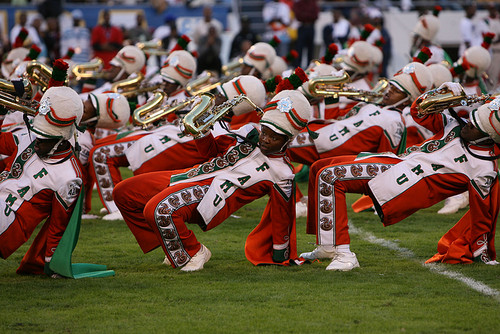
The marching band at Florida A&M University is commonly and widely known as the "Marching 100" or simply "The 100." Since its inception, the band has been credited with 30 innovative techniques that have become standard operating procedures for many high school and collegiate marching band programs.[1]
Key Information


History
[edit]
The first band at FAMU was organized in 1892, under Phillip Amos von Weller.[2] In 1946, when William P. Foster was selected as director of bands, there were only 16 members. Since then, the band has grown to as many as over 400 members. The band has performed at the Super Bowl (on several occasions), the Summer Olympics, the inaugural parades for U.S. presidents Bill Clinton and Barack Obama, and was selected in 1989 as the official United States representative in the Bicentennial Celebration of the French Revolution in Paris, France.
The band has also been featured as the opening act for the Louis Vuitton's men's fashion show at the Louvre during the 2022 Paris Fashion Week.[3][4]
Directors, assistant directors, and staff
[edit]Directors
[edit]- Phillip Amos Von Weller, 1892–1897
- Nathaniel Campbell Adderley, 1910
- Herman A. Spearing, 1912
- Arnold W. Lee, Sr., 1924–1928
- Captain W. Carey Thomas, 1928–1932
- Leander A. Kirksey, 1932–1945
- William P. Foster, 1946–1998
- Julian E. White, 1998–2012
- Sylvester Young, 2013–2016
- Shelby R. Chipman, 2016–present
Note: The official title of the band director was changed to director of marching and pep bands beginning in 2013.
Assistant directors and staff
[edit]- Shaylor L. James, Percussion, Director of Percussion Ensemble
- Lindsey B. Sarjeant, Chief Arranger and Chairman of the Department of Music
- Nicholas B. Thomas, Woodwinds, Coordinator of Graduate and Undergraduate Music Teacher Education
- Ralph Jean-Paul, Low Brasswinds, Director of Brass Ensemble
- Robert U. Griffin, Trombones, Director of Jazz Bands
- Longineau Parsons, Trumpets, Director of Trumpet Ensemble
- Byron Smith, Compliance Officer
- Joe Bullard, Announcer
- Donald Beckwith, Equipment Manager
- Melanie A. Parham, Office Manager
Band motto
[edit]The band motto was developed by William Patrick Foster at the beginning of his more than 50-year tenure as director of bands at FAMU. Their motto is as follows:[2]
Highest Quality of CHARACTER
Achievement in ACADEMICS
Attainment of LEADERSHIP
Perfection in MUSICIANSHIP
Precision in MARCHING
Dedication to SERVICE
Summer Band Camp
[edit] |
The Marching 100 Summer Band Camp has existed since 1990, when it had fewer than 100 members. The majority of those in attendance were from Burke HS (Charleston, South Carolina), and William M. Raines HS (Jacksonville, Florida). Apart from the marching band, there are three symphonic bands (Honor, Orange, and Green), two jazz bands, a percussion ensemble, keyboard and electronic music, and an ensemble for every instrument. The camp also includes drum majors and auxiliaries.
Hazing Cases
[edit]Evidence of hazing in the band made headlines after the death of a Marching 100 drum major in 2011.[5] On November 19, 2011, Robert Champion, the 26-year-old drum major, was beaten to death on the bus after the annual Blue Cross Blue Shield Florida Classic between Florida A&M University and Bethune Cookman University. Investigators found that hazing was involved in the incident. The Orange County Sheriff's Office ruled the death a homicide. An autopsy determined that he had "badly beaten muscles."[6] Florida A&M canceled all of the band's remaining scheduled performances for the 2011–12 school year and launched an investigation.[7][8][9]
In May 2012, two faculty members resigned in connection with the ensuing hazing investigation and 13 people were charged with felony or misdemeanor hazing crimes.[10][11] Later that month, FAMU president James Ammons announced that the band would not return until 2013–14 at the earliest out of respect for Champion, as well as to give school officials time for a root-and-branch restructuring of the band. Earlier, it had been revealed that at least 101 band members were not enrolled at FAMU.[12] Two months later, Ammons resigned.[13] On August 28, 2012, Dante Martin, identified as the "president" of the band bus, was accused of felony hazing in Robert Champion's death. He pleaded not guilty to a misdemeanor in connection with a separate hazing incident.[14] After an unsuccessful mediation session between university attorneys and attorneys representing the family of Robert Champion, FAMU offered to pay $300,000 to the family during the first week of November 2012 as settlement.[15] On March 4, 2013, prosecutors charged 12 former band members with manslaughter for the 2011 hazing death.[16] On June 27, 2013, Florida A&M lifted the suspension of the band. School officials instituted new academic requirements for the band, as well as a zero-tolerance policy for hazing that applies to all campus organizations.[17] On October 31, 2014, Dante Martin was found guilty of manslaughter and three counts of hazing[18] and on January 9, 2015, he was sentenced to six years in prison.[19]
References
[edit]- ^ Laurean Yates, Jacqueline (June 24, 2022). "Florida A&M Marching 100 delivers electrifying performance during Louis Vuitton Fashion Show". ABC News. Retrieved April 17, 2024.
- ^ a b "The Marching 100". FAMU. 2024.
- ^ "Louis Vuitton brings Florida marching band to the Louvre for Paris fashion week". Reuters. June 24, 2022. Archived from the original on June 25, 2022. Retrieved June 25, 2022.
- ^ "FAMU Marching 100 band performs at Louis Vuitton Men's Paris Fashion Show". WTXL. June 23, 2022. Archived from the original on June 24, 2022. Retrieved June 25, 2022.
- ^ Olorunnipa, Toluse (December 3, 2011). "Death at Florida university exposes ugly secret". The Miami Herald. Retrieved February 8, 2012.
- ^ "Expert: Autopsy of Florida A&M drum major shows badly beaten muscles". CNN. December 22, 2011. Archived from the original on August 19, 2014. Retrieved December 22, 2011.
- ^ "FAMU band leader fights to keep job". CNN. November 25, 2011. Archived from the original on June 16, 2015. Retrieved November 26, 2011.
- ^ "Florida A&M Band Suspended". CNN. Archived from the original on August 19, 2014. Retrieved November 26, 2011.
- ^ "FAMU band leader drummer". CNN. November 24, 2011. Archived from the original on August 19, 2014. Retrieved November 26, 2011.
- ^ "Death of Florida A&M's Robert Champion ruled a homicide". BBC News. December 17, 2011. Archived from the original on December 17, 2011. Retrieved December 16, 2011.
- ^ "13 Charged in Hazing Death". FOX News / Associated Press. May 2, 2012. Archived from the original on May 3, 2012. Retrieved May 3, 2012.
- ^ "FAMU Marching 100 to Remain on Suspension | firstcoastnews.com". www.firstcoastnews.com. Retrieved June 6, 2022.
{{cite web}}: CS1 maint: deprecated archival service (link) - ^ Douglas Stangin (July 11, 2012). "FAMU president resigns in wake of band hazing death". USA Today. Archived from the original on July 11, 2012. Retrieved July 11, 2012.
- ^ Hudak and Ordway, Stephen and Denise-Marie (August 28, 2012). "FAMU band hazing 'president' charged with felony in death of Champion". The Orlando Sentinel. Archived from the original on August 29, 2012. Retrieved August 29, 2012.
- ^ "FAMU offers $300,000 to hazing victim's family". WKMG TV. Retrieved November 8, 2012.
{{cite web}}: CS1 maint: deprecated archival service (link) - ^ Eversley, Melanie; Bacon, John (March 4, 2013). "Ex-Florida A&M band members charged with manslaughter". USA Today. Archived from the original on January 2, 2017. Retrieved March 4, 2013.
- ^ "Florida A&M lifts suspension for Marching 100 band". CFN13. Archived from the original on June 28, 2013. Retrieved June 27, 2013.
- ^ "Former FAMU band member guilty of manslaughter in Robert Champion hazing case". Archived from the original on November 1, 2014. Retrieved November 1, 2014.
- ^ Neuman, Scott (January 9, 2015). "Former Florida A&M Student Sentenced To 6 Years In Hazing Death". NPR. Archived from the original on April 26, 2015. Retrieved April 4, 2018.
External links
[edit]Marching 100
View on GrokipediaHistory
Founding and Early Years (1890s–1940s)
The first instrumental band at Florida A&M University (then known as the State Normal College for Colored Students) was organized in 1892 under the direction of P.A. Van Weller, beginning with a modest ensemble of 16 instruments focused primarily on concert performances.[6] This early group laid the groundwork for musical education at the institution, though detailed records of its activities remain sparse due to the era's limited documentation of programs at historically Black colleges.[1] The transition to a marching band occurred in 1910, when Nathaniel C. Adderley—uncle of jazz musicians Nat and Cannonball Adderley—organized the school's inaugural marching and concert band, enabling performances at athletic events, graduations, chapel services, and campus affairs when directors were available.[1] Adderley's tenure emphasized basic marching fundamentals and ensemble playing, reflecting the growing interest in military-style precision among early 20th-century college bands amid national trends influenced by World War I enlistment and parades.[7] Band operations fluctuated in subsequent decades due to inconsistent funding and leadership, with interim directors maintaining small-scale activities through the 1920s. By the 1930s, under Leander A. Kirksey's direction from 1930 to 1945, the band expanded its repertoire and visibility, incorporating more structured drills and participating in regional events, though it did not yet achieve the large-scale formations later associated with the program.[6] Kirksey's efforts focused on instrumental proficiency and early showmanship elements, training students who would influence Florida's broader music education scene.[8] World War II severely impacted membership, as many students enlisted or were drafted, reducing the ensemble to approximately 16 members by 1945 amid resource shortages and campus disruptions.[1] This period marked a foundational yet precarious phase, prioritizing survival and basic training over innovation, setting the stage for post-war revitalization.Dr. William P. Foster Era and Innovations (1946–1998)
Dr. William P. Foster assumed the role of director of bands at Florida A&M University in June 1946, where he founded and developed the Marching "100" into a premier ensemble known for its precision and showmanship.[9] Under his leadership, the band expanded to approximately 329 members, emphasizing rigorous discipline and innovative performance elements that distinguished it from traditional military-style marching bands.[10] Foster's tenure, spanning until his retirement on August 9, 1998, marked a period of sustained growth and international recognition for the group.[9] Foster introduced a high-stepping marching style characterized by dynamic, energetic movements that replaced rigid, militaristic formations with fluid, showmanship-driven routines incorporating elements of Black popular culture, jazz, and rock music.[11] [12] This approach, which featured precise choreography and high-energy execution, influenced marching bands at high schools and colleges across the United States, establishing a model for halftime pageantry focused on entertainment and visual spectacle.[13] [14] He authored the textbook Band Pageantry: A Guide for the Marching Band, which became a standard resource for designing such formations, and composed original works like Marche Brillante to support the band's repertoire.[9] Over his career, Foster created more than 200 unique halftime pageants, blending musical arrangements with intricate drills to captivate audiences.[10] [9] The band's training regimen under Foster prioritized physical conditioning, musical proficiency, and unwavering precision, with protocols that demanded perfection in step size, alignment, and timing—often described as the "marchingest, playingest band in the land."[9] These innovations elevated the Marching "100" to perform in high-profile venues, including three feature films, 34 nationally televised appearances reaching over 5 billion viewers, the 1989 Bastille Day Parade in Paris, Disney World events in 1986 and 1996, and U.S. presidential inaugurations in 1993 and 1997.[10] [9] In 1984, the ensemble received the Sudler Trophy, awarded to the nation's top college marching band, affirming Foster's impact on the field.[9] His methods not only built a legacy of excellence but also broke racial barriers by showcasing African American musical talent on global stages during an era of segregation.[12]Post-Foster Developments (1998–Present)
Following Dr. William P. Foster's retirement on August 9, 1998, after 52 years of leadership, Dr. Julian E. White assumed the role of director of bands, maintaining the Marching 100's emphasis on precision marching and halftime shows while expanding its national visibility.[6] White, a longtime assistant under Foster, led the band through continued performances at major events, including HBCU football classics, before the program encountered severe challenges.[15] The band's trajectory shifted dramatically in November 2011 amid a longstanding culture of hazing rituals. On November 19, 2011, 26-year-old drum major Robert Champion died from internal injuries sustained during a brutal initiation rite known as "Crossing Bus C," in which pledges were beaten by senior members using fists, knees, and other objects as they attempted to run through a gauntlet on a parked charter bus.[16] [17] The incident, investigated as manslaughter and hazing, revealed systemic violence within the band, including prior unreported assaults; Champion's autopsy confirmed death by "hemorrhagic shock" from blunt force trauma.[16] In response, Florida A&M University suspended the Marching 100 indefinitely in late November 2011, halting all activities for 21 months and prompting federal probes, lawsuits, and reforms to eliminate hazing.[18] Legal repercussions followed, with multiple band members convicted of manslaughter and hazing. Dante Martin, identified as the ritual's ringleader, was found guilty in October 2014 and sentenced to over six years in prison; three others, including Caleb Jackson, received manslaughter convictions in April 2015, with Jackson sentenced to four years after pleading no contest.[16] [17] White resigned as director in 2012 amid the fallout, though he later received acclaim for his contributions, including induction into a national band hall of fame in 2025.[15] The band resumed limited operations in 2013 under interim leadership and Dr. Sylvester Young, who directed from 2013 to 2016, focusing on rebuilding discipline and public trust through anti-hazing policies and oversight.[6] Dr. Shelby R. Chipman succeeded Young in 2016 as director, overseeing a resurgence in performances and innovations while upholding Foster-era standards.[6] Under Chipman, the band has participated in high-profile events, such as the 2025 U.S. Open tribute to FAMU alumna Althea Gibson, the first Black Grand Slam champion, and the Houston Battle of the Bands.[19] [5] Milestones include crowning Oluwamodupe "Dupe" Oloyede as the first female head drum major in 2025, leading 340 members, and commemorating 40 years since the 1985 Sudler Trophy award for collegiate marching excellence.[4] These developments reflect adaptations to post-scandal scrutiny, including stricter protocols, while preserving the band's reputation for technical precision and cultural impact.[6]Leadership and Organization
Primary Directors
Dr. William P. Foster served as Director of Bands at Florida A&M University from June 1946 until his retirement in 1998, during which he transformed the ensemble from 16 members into the renowned Marching 100, renowned for its precision marching and innovative formations.[2][10] Foster's tenure emphasized strict discipline, high musical standards, and the development of unique showmanship techniques that influenced marching bands nationwide.[14] Dr. Julian E. White succeeded Foster as Director of Bands from 1998 to 2012, having previously served as associate director since 1974.[15] White, a FAMU alumnus with over 50 years in music education, maintained the band's traditions while expanding its performance repertoire and administrative oversight as department chair.[20] His leadership focused on sustaining the ensemble's competitive edge amid growing institutional challenges.[21] Dr. Sylvester Young was appointed Director of Marching and Pep Bands in May 2013, following a period of transition after White's resignation, and served until 2016.[22] A FAMU alumnus and former director at Ohio University, Young aimed to rebuild the program post-scandal by prioritizing safety protocols and musical excellence during his tenure.[23][24] Dr. Shelby R. Chipman has been Director of Bands since May 2016, conducting the Marching 100, pep bands, and symphonic ensembles while serving as a professor of music.[25] A FAMU alumnus with prior experience directing high school bands in Miami-Dade County, Chipman has emphasized recruitment, innovative programming, and national recognition, including the band's selection as ESPN's Band of the Year in 2024.[3][26]Assistant Directors and Support Staff
The assistant directors of the Florida A&M University Marching 100 assist the primary director in managing daily operations, conducting section-specific rehearsals, and refining marching and musical techniques across instrument families.[6] These roles typically involve specialized oversight of brass, woodwinds, or percussion ensembles, contributing to the band's precision and innovation in formations and arrangements.[27] Support staff handle logistical and administrative functions, such as equipment maintenance and compliance, ensuring operational efficiency during tours and performances.[28] Current assistant directors include:- Dr. Shaylor James, Assistant Director of Bands and Director of Percussion[6]
- Dr. Nicholas Thomas, Assistant Director of Bands and Director of Woodwinds (piccolos, clarinets, saxophones)[6][27]
- Dr. Ralph Jean-Paul, Assistant Director of Bands and Director of Low Brass (baritones, sousaphones)[6][27]
- Mr. Tovah Lovely, Assistant Director of Percussion[28]