Hubbry Logo
Halftime showHalftime showMain
Open search
Halftime show
Community hub
Halftime show
logo
8 pages, 0 posts
0 subscribers
Be the first to start a discussion here.
Halftime show
Halftime show
from Wikipedia
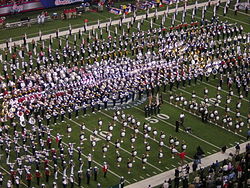
A group of high school marching bands performs at the halftime show of the 2006 Chick-fil-A Bowl.
Amy Gilliom sings at the halftime show for the 2007 Hawaii Bowl.

A halftime show is a performance given during the brief period between the first and second halves, or the second and third quarters, of a sporting event. Halftime shows are not given for sports with an irregular or indeterminate number of divisions (such as baseball or boxing), or for sports that do not have an extended period of stoppage in play. Ice hockey games consist of three periods, so there are in effect two halftimes at a hockey game: the first intermission is between the first and second periods, and the second intermission comes between the second and third periods. The intermissions are usually given over to contests involving randomly selected audience members, although for major games, like the Winter Classic, the Stanley Cup Finals, the NHL All-Star Game and the Frozen Four, the intermission between the 2nd and 3rd period often features entertainment typically found during halftime shows.[1]

The first instance of a halftime show was in November, 1892 at the University of Nebraska when General John J. Pershing required the ROTC band to march drills as a part of their performances. This was first showcased at a football game where the band marched drills at halftime. Since the band's military reviews had attracted significant crowds, the goal was to increase attendance at football games by conducting a military review while the team rested between halves.

Others generally attribute the invention of the halftime show to Walter Lingo. Lingo was the owner of a dog kennel and sponsored an all-Native American football team, the Oorang Indians, to tour the country and promote the kennel. In addition to playing football, the Indians would provide various forms of entertainment, including exhibiting the dogs, players demonstrating their prowess (Nick Lassa once wrestled a bear while Jim Thorpe would kick long-distance field goals), dancing, and demonstrations of native culture. Although the halftime show was in part designed to bring an additional draw to mask the fact that the Indians did not put much effort into the actual game, his halftime show was mostly the same from game to game, and the novelty wore off after two years.[2][3]

A modern halftime show can consist of cheerleading performances, majorette routines, marching bands playing music, or other spectacular performances. Halftime shows are particularly well known among historically black colleges and universities, which have elaborate "battles of the bands" between the opposing schools' marching bands during halftimes of the most prominent games (see, for instance, the Bayou Classic). More common in modern times, especially in major games, is to reserve the entire halftime period for a short concert by a major recording artist.[citation needed]

The halftime show also often describes television studio shows during the intermission which review scores and stories from across the league's schedule during that break between action.

Gridiron football

[edit]

A halftime show is a traditional element in an American football and Canadian football game. During the interval between the second and third quarters (normally 20 minutes) some form of entertainment is presented on the field. The entertainment frequently consists of performances by marching bands.

At high school and most college games, the school bands of the two competing teams perform at halftime with the marching band of the visiting team performing first followed by the marching band of the home team. Often, the cheerleaders and/or a dance team will perform. Other activities may also take place, and these vary widely. Until sometime in the early 1980s, these shows were typically included as part of the broadcast if the game was televised; since that time, it has become traditional for TV networks to devote the halftime to a roundup of other games' scores as well as providing analysis.[citation needed]

During a professional football game, a high school or college band may be brought in to perform. For the Super Bowl and Grey Cup games, an elaborate show involving musicians, dancers, fireworks and other special effects has become the norm. High-profile acts are generally chosen for their broad appeal, due to the games' large audiences, and choices that deviate from that tend to be poorly received.

Many football historians[who?] believe halftime shows originated with the Oorang Indians of the early National Football League. The team was a marketing ploy by Walter Lingo to sell and promote his Airedale Terriers. He would lure audiences to his games with the promise of an outrageous halftime show, instead of the promise of a good football game. The team was called the Indians because they were made up entirely of Native Americans, and Oorang came from Lingo's Oorang Kennel Company. The Indians players participated in helping the Oorang Airedales perform tricks for the crowd before and after the game. However, it was their halftime entertainment that made them such a huge attraction in the early 1920s. There were shooting exhibitions with the dogs retrieving the targets. There were Native American dances and tomahawk and knife-throwing demonstrations. Indians player Nick Lassa, also called "Long-Time-Sleep", even wrestled a bear on occasion. Another show was a demonstration of the United States Indian scouts actions during World War I. The show promoted Lingo's kennels by showing the Airedale Red Cross dogs administering first aid to wounded soldiers. Many of the scouts and Red Cross dogs taking part in the event were real veterans of the war, while the German troops were impersonated by local American Legion men who wore German uniforms furnished by Lingo. The halftime activities soon became more important than the results of the game for the Indians fanbase. The Indians only won 3 games in their two seasons of existence.[4][5]

Super Bowl

[edit]

In the United States, the halftime show for the Super Bowl is perhaps the highlight of the event and can cost millions to stage.

On February 1, 2004, the live halftime show for Super Bowl XXXVIII, produced by music video giant MTV, sparked outrage among many viewers when Justin Timberlake, one of the performers, exposed fellow performer Janet Jackson's right breast in what was later dubbed a "wardrobe malfunction". Since it was broadcast live, the exposure was seen by millions when it happened.[citation needed]

Grey Cup

[edit]

In Canada, the halftime show for the Grey Cup is a highlight of the event and can cost millions to stage. Performers over the years have included Justin Bieber, Shania Twain, Blue Rodeo, Black Eyed Peas, Keith Urban, Green Day and Imagine Dragons.

NBA All-Star Game

[edit]

Rugby football

[edit]

A halftime show is a traditional element in a Rugby league and Rugby union game during a Grand final.

Association football

[edit]

Due to the time format and fan nature of association football, halftime shows are quite rare for the sport, although there have been halftime shows in major competitions. For example, Colombian singer Shakira performed in the halftime show during the 2024 Copa América final at Hard Rock Stadium in Miami Gardens, Florida.

On September 28, 2024, FIFA announced that Global Citizen would co-produce a halftime show for the 2026 FIFA World Cup final in East Rutherford, New Jersey, the first halftime show in the history of the FIFA World Cup.[6]

See also

[edit]

References

[edit]
[edit]
Revisions and contributorsEdit on WikipediaRead on Wikipedia
from Grokipedia
A halftime show is the entertainment spectacle presented during the intermission of games, typically lasting 12 to 15 minutes and featuring , musical artists, dancers, and elaborate production elements such as and lighting. These performances originated in traditions where university marching bands provided musical interludes, a practice that extended to professional leagues like the by the mid-20th century. The most prominent example is the halftime show, introduced in 1967 with collegiate bands and evolving into a global media event after Michael Jackson's star-studded 1993 performance shifted focus to contemporary pop acts. Halftime shows serve to sustain audience engagement during the game's pause, with the edition often rivaling the match itself in viewership—exceeding 120 million for peak broadcasts—and generating significant ad revenue through sponsorships. Defining characteristics include high-energy and live , though they have faced scrutiny for production costs, estimated in tens of millions for recent Super Bowls, funded by sponsors like Apple and . Notable achievements encompass innovative sets, such as Prince's rendition of "Purple Rain" amid a rainstorm, which critics hailed for its improvisational artistry. Controversies have periodically overshadowed the entertainment, including the 2004 Super Bowl XXXVIII incident where Justin Timberlake's removal of part of Jackson's costume—dubbed a ""—resulted in FCC indecency fines totaling over $550,000 against and prompted stricter content regulations for future broadcasts. Other flashpoints involve artistic choices perceived as political, such as Beyoncé's 2016 formation salute to Black Panthers, igniting debates on cultural messaging in a family-oriented event, though empirical viewership data shows such moments often boost engagement without long-term audience decline. Recent iterations, including Kendrick Lamar's headlining of in 2025 with guests like , underscore the show's role in amplifying hip-hop while navigating critiques of lyrical content and staging.

Historical Development

Origins in American Football

The halftime interval in emerged from the sport's foundational rules, which structured games into two halves separated by a brief break for player rest and coaching adjustments. Derived from rugby influences in the 1870s and 1880s, early intercollegiate matches under Walter Camp's codifications featured unadorned pauses, typically lasting 10 minutes, without formalized entertainment to fill the time. This format prioritized gameplay recovery over spectator diversion, reflecting football's initial emphasis on athletic contest over ancillary activities. The origins of organized halftime shows trace to marching bands, which introduced musical and visual performances during these breaks to captivate audiences. The earliest documented instance occurred on October 19, 1907, when the University of ' band, directed by Albert Austin Harding, executed a field show during a game against the University of Chicago at Illinois Field. Harding, appointed as the university's first band director in 1894, pioneered scripted routines involving formations and synchronized marching, adapting drill traditions from 18th-century fife and drum corps to the gridiron context. This innovation addressed the practical need to utilize the field's downtime while enhancing event appeal amid growing attendance at games. Subsequent adoption by other institutions, such as claims of earlier rudimentary performances at the University of Nebraska, cemented marching bands as the core of halftime entertainment by the and 1920s. These shows evolved from simple parades to complex halftime spectacles, featuring precision drills that mirrored football tactics and fostered , though debates persist over exact precedence due to inconsistent historical records. By mid-century, this band-centric tradition had permeated professional and high school levels, laying groundwork for diverse entertainment forms while preserving a focus on communal, instrumental displays over individual artistry.

Evolution from Bands to Pop Spectacles

Halftime entertainment in originated with during college games in the early 20th century. The first recorded instance of a band performing at halftime occurred on October 19, 1907, when the University of Illinois' presented a field show during a football game against Ohio State, directed by Albert Austin Harding to fill the intermission with musical displays and formations. These performances evolved from basic parades and tunes into synchronized routines incorporating precision marching, musical selections ranging from military marches to popular songs, and thematic visuals, becoming a staple of university traditions by the and . In professional football, the tradition mirrored college practices, with local or university bands providing halftime shows at NFL games to entertain stadium crowds during the mid-20th century. The National Football League's inaugural championship game in 1933 did not feature formalized entertainment, but by the 1950s, bands were common at regular-season and playoff halftimes, emphasizing patriotic themes and community involvement. This format persisted into the Super Bowl era; the first Super Bowl on January 15, 1967, showcased the University of Arizona and Grambling State University marching bands performing marching routines and Grambling's famous "High Step" style. Through the 1980s, Super Bowl halftimes continued to rely on marching bands, choral ensembles like Up with People, and variety acts with simple productions, such as the 1970 Grambling State Band's appearance or the 1988 Disney-themed show with 3D glasses, prioritizing family-friendly, low-cost spectacles over star power. The shift toward pop spectacles accelerated in the early 1990s as the sought to boost television viewership among younger demographics, replacing band-centric shows with contemporary artists and elaborate staging. in 1991 introduced the boy band alongside military personnel, blending pop appeal with tradition, while in 1992 featured as the first major solo pop performer. The pivotal moment came at on January 31, 1993, when Michael Jackson's 12-minute set, including hits like "Billie Jean" and a stadium-wide "Heal the World" sing-along, drew 120-134 million viewers and established the halftime show as a high-production event with , lighting, and celebrity draw. Subsequent shows incorporated multi-artist lineups, , and massive budgets—reaching $10-20 million by the 2010s—transforming the format into global pop extravaganzas, though retained marching bands as core halftime features with ongoing innovations in drill design and technology. This evolution reflected broader entertainment trends, where visual spectacle and star-driven content supplanted instrumental ensembles to compete with prime-time programming.

Halftime Shows in American Football

Super Bowl Performances

The Super Bowl halftime show began on January 15, 1967, at Super Bowl I, featuring marching bands from the and , reflecting the event's modest origins focused on collegiate traditions rather than commercial entertainment. Early iterations through the 1980s emphasized themed spectacles with high school and college bands, groups, and occasional productions, such as the 1988 show's salute to the NFL's 100th anniversary with 3,000 cast members. These performances prioritized patriotism over star power, drawing limited attention compared to the game itself. A transformative moment arrived with Michael Jackson's solo set at on January 31, 1993, which included hits like "" and ended with a crowd-uniting stage invasion, boosting halftime viewership by 20 million and prompting the to recruit pop and rock acts thereafter. This evolution accelerated in the late 1990s amid sponsorships from brands like Visa and later , shifting from thematic variety acts to high-production concerts by artists including with 'N Sync in 2001, in 2002, and in 2006. The format's commercialization intensified post-1993, with production costs exceeding $10 million by the 2010s, emphasizing elaborate , , and medleys tailored for television audiences. Notable performances include Prince's rain-drenched guitar rendition of "Purple Rain" at on February 4, 2007, hailed for its musical innovation amid adverse weather, and Beyoncé's 2013 show at , which incorporated a surprise reunion with and faced scrutiny for pre-recorded vocals allegations later confirmed in audio leaks. The 2017 performance by at drew praise for aerial stunts but criticism from conservative outlets for promoting LGBTQ themes, while hip-hop focused lineups like , , , and at on February 13, 2022, sparked debates over explicit lyrics and cultural messaging. Controversies have marked several editions, most prominently the Super Bowl XXXVIII halftime on February 1, 2004, where Justin Timberlake's line "gonna have you naked by the end of this song" culminated in the unintended exposure of Jackson's breast during a costume reveal, resulting in over 540,000 FCC complaints, $550,000 fines against , and subsequent "" regulations that increased network caution and rehearsals. Other incidents include M.I.A.'s gesture during Madonna's 2012 set, leading to a $17 million settlement, and Beyoncé's 2016 Formation performance at , interpreted by some as anti-police due to imagery, prompting calls for boycotts amid polarized media coverage. These events highlight tensions between artistic expression and broadcast standards, with the NFL adapting via partnerships like since 2019 to balance entertainment and social themes. Recent shows under sponsorship since 2022 have featured solo spectacles like Rihanna's 2023 pregnancy announcement during aerial drops at and Usher's roller-skating medley at on February 11, 2024, before Kendrick Lamar's headlining set with at on February 9, 2025, which emphasized hip-hop narratives and drew record streaming views despite critiques of lyrical aggression from outlets like . The show's cultural weight is evident in its viewership, often rivaling the game's second half, underscoring its role as a platform for mainstream music validation amid evolving production demands.

Other Gridiron and Basketball Events

In regular season and playoff games excluding the , halftime durations are limited to 12 minutes, constraining entertainment to brief local performances such as cheerleader routines, fan contests, or occasional musical acts by regional artists. Unlike the 's extended 30-minute format, these intervals prioritize player rest and broadcast analysis over elaborate field shows, with television networks typically filling airtime in studios rather than showcasing on-field events. Notable exceptions occur in international games, such as Karol G's performance at the NFL's 2024 matchup between the and , or The Kid LAROI's scheduled halftime at the 2025 Berlin game. College football games, particularly at the level, traditionally feature university marching bands as the centerpiece of halftime entertainment during the standard 20-minute break. These ensembles, often numbering 200-400 members, execute synchronized formations, musical arrangements of popular tunes, and thematic shows tied to school spirit or current events, a practice rooted in traditions adapted for crowd engagement. In bowl games and rivalries, bands from both teams alternate or combine for joint routines; for instance, the presented "Pirates of the 'Shoe" at the 2025 Rose Bowl semifinal, while Grambling State University's World Famed Tiger Marching Band performed at the 2025 HBCU Classic. Historically Black college and university bands, like Jackson State's Sonic Boom of the South, emphasize high-stepping styles and dance-integrated drills, drawing large crowds independent of the game score. Basketball halftime shows in the NBA and NCAA differ markedly due to shorter 15-minute intermissions, focusing on compact, high-energy acts like , dunk exhibitions, and novelty stunts rather than full concerts. NBA arenas book touring performers such as the Red Panda's teacup-balancing routine or dog agility teams, with acts earning $1,500 to $5,000 per appearance pre-pandemic. College basketball has expanded this niche, employing jugglers, riders, and trampoline dunkers to sustain fan interest, with specialized agencies coordinating over 13,000 global bookings annually for such groups. These performances prioritize visual spectacle and quick setup within arena constraints, contrasting football's band-centric tradition.

Halftime Entertainment in Other Sports

Rugby and Association Football

In , halftime intervals typically last 15 minutes and prioritize player recovery, tactical discussions, coaching instructions, and pitch maintenance such as watering or repairing divots, rather than elaborate entertainment. This structure reflects the sport's continuous flow and global emphasis on competitive efficiency over spectacle, with stadium announcements or basic fan activities occasionally filling the time in domestic leagues like the . However, major international events have begun incorporating performances to enhance global appeal; for instance, the 2025 Club final featured a show with artists , , , and Emmanuel Kelly, staged off the pitch to preserve the grass surface. Similarly, announced a Super Bowl-style production for the 2026 Men's final in the United States, marking a departure from tradition driven by the event's North American hosting and aim to boost viewership. Rugby, encompassing both union and league codes, maintains short halftimes of 10 to 15 minutes focused on player substitution, medical assessments, and strategy reviews, with entertainment generally limited to avoid disrupting the sport's physical intensity and field conditions. In , such as in the Six Nations or , performances are rare and often met with fan skepticism for diluting the game's authenticity; a notable exception occurred during the 2024 England-Ireland match at , where singer delivered a halftime set. Guitarist Sophie Lloyd's cover of Bon Jovi's "Livin' on a Prayer" energized crowds at a 2023 fixture, though positioned amid broader event programming rather than standard league play. events, particularly in like the , have a longer history of halftime spectacles, including the 1989 New South Wales Rugby League final's "42nd Street" production featuring dancers and music, reflecting greater commercial integration in that code. Overall, these sports resist the resource-intensive shows common in due to logistical constraints and cultural preferences for unadorned athleticism, though high-profile tournaments increasingly experiment with hybrid formats.

Additional Sports and Variations

In , halftime entertainment during the standard 15-minute intermission between the second and third quarters commonly includes acrobatic feats, dance squads, and novelty performances to engage spectators in arenas. These acts, often featuring local or touring groups, range from high-flying stunt teams on pogo sticks—who have delivered over 13,000 global performances—to unicyclists balancing teacups, as exemplified by the Red Panda's routines at NBA games like those of the on April 7, 2024. NBA teams such as the facilitate group auditions for 4- to 5.5-minute court performances, requiring a minimum of 200 tickets purchased, emphasizing community involvement over large-scale spectacles. College basketball halftime shows similarly prioritize variety acts, including dunk teams, aerial silks, and musical ensembles, as seen in State University's 2021-22 season features like the FM Acro Team and Air Elite Dunkers. Unlike the marching band traditions dominant in football, these events focus on compact, high-energy routines suited to indoor venues, with universities like Vanderbilt actively soliciting performers for their games. In , which divides matches into three 20-minute periods without a traditional , entertainment occurs during the 15- to 18-minute breaks for ice resurfacing, featuring off-ice activities such as mascot-led games, puck-handling contests, or costumed character shows like the ZOOperstars, who parody sports icons in inflatable mascots and rank among top acts for NHL, AHL, and ECHL events. Special occasions, including NHL All-Star Games, incorporate musical performances, as with Tate McRae's set on February 4, 2024, though routine games prioritize quick, family-oriented diversions over extended productions due to logistical constraints like Zamboni operations. Variations across other team sports with segmented play, such as indoor or , adapt similar formats with scaled-down acts emphasizing agility in confined spaces, though documentation remains sparse compared to major leagues; these often mirror basketball's model but incorporate sport-specific elements like stick-handling demos. In non-traditional contexts, halftime has hosted unconventional events, including on-court weddings or animal-assisted routines, highlighting the flexibility of the format to boost attendance in diverse athletic settings.

Production and Organization

Performer Selection and Sponsorship

The selection of performers for prominent halftime shows, especially the , is overseen by the through its partnership with , established in 2019 to enhance live music entertainment strategy. , led by , curates headliners by evaluating artists' cultural impact, genre representation, and capacity for large-scale productions that complement the event's global audience. This collaboration has resulted in selections such as and for in 2020, for in 2021, and , , , , and for in 2022. The process typically begins with an internal shortlist developed by NFL entertainment executives and Roc Nation producers, focusing on performers who can deliver visually dynamic sets without overshadowing the game itself. Final decisions prioritize broad appeal and innovation, as seen in the 2025 choice of as a solo headliner, announced in September 2024, emphasizing lyrical depth and stage presence over ensemble formats. For non-Super Bowl or events, selection often defaults to marching bands or regional artists chosen by event organizers, such as the for the 2025 , with guest performers like for the Big 12 Championship selected for alignment with local fan demographics. Commercial sponsorship of the Super Bowl halftime show commenced with in 1998, marking a shift from themed band performances to branded pop spectacles. Pepsi secured title sponsorship in 2013, funding elaborate productions until 2021, after which assumed the role in a multi-year agreement announced on September 23, 2022, rebranding it the Super Bowl Halftime Show. Sponsors contribute tens of millions annually toward costs, including stage design and artist fees, while gaining and promotional tie-ins, though they exert limited influence over performer choices, which remain under NFL-Roc Nation control. In contrast, sponsorship for secondary halftime events, such as college bowls, is often tied to conference broadcasters like rather than individual performers, emphasizing band traditions over commercial pop acts.

Technical and Logistical Aspects

The Super Bowl halftime show requires assembling a custom stage structure spanning up to 235 linear feet in width, often incorporating elevated platforms, LED video walls, and systems capable of supporting thousands of pounds of and audio equipment, all designed to be erected and dismantled within 6 to 7.5 minutes during the to minimize disruption to the playing field. This rapid setup involves hundreds of stagehands coordinating hydraulic lifts, trusses, and modular components pre-positioned around the perimeter, with precision timing to avoid damaging the turf, as seen in performances using suspended aerial platforms to distribute weight. Audio production entails integrating stadium-wide speaker arrays with supplemental show-specific systems, where lead performers typically sing live while backup vocals and instrumentation are pre-recorded for , mixed over sessions lasting up to eight hours per track to ensure clarity across 70,000-plus seats. rigs, often numbering in the hundreds of fixtures, are pre-plotted for dynamic effects like color washes and spot follows, powered by temporary electrical grids delivering megawatts without interfering with broadcast signals. Pyrotechnics, confetti cannons, and are triggered via computerized cues, with safety protocols mandating remote firing to comply with venue fire codes. Logistically, preparations involve 2,000 to 3,000 personnel, including technicians from firms like PRG, who transport equipment via hundreds of trucks arriving days in advance, staging rehearsals on replica sets off-site since full-field access is limited until game day. For traditional halftime shows in college or games, logistics simplify to field formations without elaborate staging, relying on 100-200 musicians who rehearse patterns over weeks but execute in 10-15 minutes with minimal setup beyond instrument tuning and placement. In both cases, coordination with league officials ensures clearance within strict timelines, typically under seven minutes post-performance, to resume play.

Cultural Impact and Reception

Achievements and Viewership Milestones

The Super Bowl halftime show holds the record for the most-watched halftime entertainment in sports history, with Kendrick Lamar's at on February 9, 2025, attracting 133.5 million viewers across television and streaming platforms, surpassing the game's own audience of 127.7 million. This milestone eclipsed the previous high set by Michael Jackson's 1993 show, which drew 133.4 million viewers and marked a pivotal shift from traditional routines to high-profile pop spectacles, dramatically elevating the event's cultural prominence. Rihanna's 2023 performance achieved 121 million viewers, earning recognition from as the largest TV audience for a Super Bowl at the time, bolstered by her aerial stage design and hits like "." Earlier shows, such as the ' 2011 set with 110.2 million viewers, further illustrate the steady climb in viewership, driven by advancements in and digital streaming. These figures underscore the show's dominance over other sports events, where viewership rarely exceeds tens of millions, as no comparable milestones exist in rugby, soccer, or halftimes. Beyond raw numbers, achievements include transformative productions like Prince's 2007 rain-soaked guitar solo on "Purple Rain," which has been ranked among the most iconic for its artistic innovation amid adverse weather, and the 2013 Beyoncé-led show that reunited , amplifying post-performance album sales and chart impacts. The format's evolution since Jackson's milestone has generated billions in equivalent advertising value, with recent shows like Usher's 2024 performance contributing to sustained growth in global streaming metrics.

Criticisms of Commercialization and Quality

The Super Bowl halftime show has drawn criticism for its heavy commercialization, evolving from university s and local performers in the event's early years to a multimillion-dollar spectacle sponsored by corporations such as since 2013. This transformation, which gained momentum after the NFL partnered with in 1991 and featured high-profile acts like in 1993, prioritizes broad audience retention and advertising synergy over sport-specific entertainment, with production costs exceeding $10 million for recent iterations. Critics contend this corporate influence results in selections driven by marketability rather than artistic merit or thematic alignment with traditions. Performers benefit enormously from the exposure, often experiencing surges in streams and sales—such as a 400% increase in digital sales following past appearances—effectively positioning the show as a premier promotional platform in a fragmented media landscape. Detractors, including cultural commentators, argue this turns the halftime into an extension of branding, diluting its role as neutral intermission and contributing to perceptions of the as overly entangled with entertainment industry agendas. For example, initiatives like Turning Point USA's "All-American Halftime" counter-events explicitly critique the main production as emblematic of lost shared cultural ground in favor of corporate spectacle. Quality concerns have persisted, with specific shows faulted for technical shortcomings, overreliance on and at the expense of live musical prowess, and failure to deliver cohesive narratives. The 1999 "Beat of the Future" segment, featuring magicians and a Dorothy lookalike amid sci-fi motifs, was panned as "ridiculous" and among the weakest in history. The Who's 2010 set faced backlash for muddled audio, apparent lip-syncing, and diminished energy from aging performers. Such lapses, alongside accusations of formulaic repetition in recent pop-heavy lineups, have fueled claims of declining standards, evidenced by a 4% drop in U.S. household viewership for the 2025 performance compared to 2024.

Controversies and Debates

Indecency Incidents and Regulatory Changes

The most prominent indecency incident associated with Super Bowl halftime shows occurred during on February 1, 2004, broadcast by from Reliant Stadium in , . In the finale of a performance featuring and , Timberlake tore away a portion of Jackson's during the song "," briefly exposing her right breast, adorned with a sun-shaped shield, for approximately nine-sixteenths of a second. The event, later termed a "" by the performers, drew over 542,000 complaints to the (FCC), marking the largest volume of indecency complaints in the agency's history at that time. The FCC responded by declaring the broadcast indecent under its policy prohibiting obscene, indecent, or profane content on broadcast during hours when children might be viewing, as defined by 18 U.S.C. § 1464 and enforced through section 503(b) of the Communications Act. In September 2004, the agency issued a notice of apparent liability, fining $550,000—the maximum penalty then allowable, calculated at $27,500 per affected station across 's owned-and-operated outlets. This fine was upheld initially but later vacated by federal courts in 2008 and 2011 on grounds that the FCC had not proven willfulness and had deviated from prior precedents without sufficient notice, with the Supreme Court denying in 2012. Despite the fine's overturn, the incident catalyzed broader regulatory scrutiny of broadcast content. In response, passed the Broadcast Decency Enforcement Act of 2005 to strengthen penalties for such violations. Signed into law by President on June 15, 2006, the Act amended the Communications Act to raise the maximum FCC fine for indecency from $32,500 to $325,000 per violation or per day of continued violation, with caps increased to $3 million for repeat offenses within a year. It also authorized license revocation for broadcasters accumulating three or more indecent violations in a single year or repeat offenses over time, aiming to deter content deemed harmful to minors without relying solely on viewer complaints. These changes prompted the (NFL) and broadcasters to adopt stricter self-regulation for halftime productions, including enhanced pre-performance reviews, delayed broadcasts for live edits, and a pivot toward more conservative, family-oriented programming to mitigate legal risks. Subsequent shows faced occasional complaints—such as those alleging sexual suggestiveness in the 2020 performance by and —but no comparable fines were imposed, reflecting the chilling effect of heightened enforcement potential. The regulatory framework established post-2004 has endured, influencing broadcast standards amid ongoing debates over First Amendment boundaries and .

Political and Ideological Conflicts

The selection of performers for halftime shows has frequently sparked political debates, particularly when artists' prior statements or performances align with progressive causes, prompting accusations of ideological bias from conservative critics. In 2016, Beyoncé's performance of "Formation" drew backlash for its perceived endorsement of themes, including imagery of police as aggressors and references to ; the song's lyrics and visuals led to calls for boycotts from groups and conservative commentators who argued it promoted during a high-profile event. Similar tensions arose in 2019 when headlined alongside and amid the NFL's ongoing controversy over Colin Kaepernick's anthem protests; critics on the right viewed the inclusion of hip-hop artists as a superficial nod to without addressing broader player blackballing claims, while some on the left accused the league of diluting protest momentum. More recent selections have intensified ideological divides, with conservative outlets decrying perceived left-leaning favoritism in performer choices. For in February 2025, Kendrick Lamar's solo performance elicited 125 complaints, many citing the absence of white performers as reverse discrimination and elements like the dance as glorification of gang culture, reflecting broader grievances over policies in entertainment. The NFL's announcement of as headliner for in 2026 provoked immediate right-wing backlash, including comments from former President criticizing the choice and calls for replacement with American country artists; conservative group responded by organizing a competing "All-American Halftime" event featuring patriotic performers, framing the NFL's decision as prioritizing foreign artists with anti-U.S. stances over traditional values. These conflicts underscore a pattern where halftime show curation intersects with cultural wars, often amplifying partisan media narratives; NFL Commissioner defended the selection against reconsideration, emphasizing entertainment value over politics, yet petitions and boycott threats highlighted divisions between those viewing such shows as apolitical spectacles and others as vehicles for ideological signaling. In broader contexts, the emphasis on hip-hop and Latin artists since 2019 has been critiqued by some as compensatory for past anthem protest suppressions, though empirical viewership data shows sustained popularity without correlating dips tied to these choices.

References

  1. https://www.[youtube](/page/YouTube).com/watch?v=GwMmjgkzS80
Add your contribution
Related Hubs
User Avatar
No comments yet.