




Community hub
Recent from talks
Contribute something
Nothing was collected or created yet.
Michigan Marching Band
View on Wikipedia
The Michigan Marching Band (also known as the University of Michigan Marching Band or the MMB) is the official marching band of the University of Michigan.[1] The band performs at all Michigan Wolverines football home games, select away games, and numerous concerts, pep rallies, and parades.[2] A student musical ensemble,[3] the MMB evolved from the original Michigan Band of twenty-two players in 1896 to today's band of over 400 members.[4][5]
Key Information


.jpg)
History
[edit]Pre-1900
[edit]Though there is evidence of one or more bands formed at the University of Michigan between 1844 and 1859,[6] there is no continuous link between those early groups and the organization of a 22-member university band by Harry dePont on November 13, 1896.[7] At the start, the dePont-organized band received no financial support from the university.[8] The band's first performance was for the Law School's observance of Washington's Birthday on February 22, 1897.[7] University president James Burrill Angell granted dePont's request for rehearsal space in Room A of University Hall, and by 1898 the band was being referred to as the "University of Michigan Band" and performed at football games.[9]
1900–1929
[edit]The ensemble disbanded in early 1903, but reunited that fall. Eugene J. Fischer became the band's conductor with the start of the 1906 season.[8] During Wilfred Wilson's subsequent tenure as director, membership in the band grew to nearly 100 musicians and the university allocated permanent space for the band's use in Morris Hall. Nicholas Falcone was appointed as conductor in 1927.[8] The band became an adjunct part of the university in 1929.[8]


1930–1949
[edit]During the Michigan–Ohio State football game in 1932, the MMB first performed a "script Ohio" formation. That field formation was subsequently embellished by the Ohio State University Marching Band, which continues to perform a similar field routine today.[10] The band performed at the Century of Progress exhibition in Chicago in October 1933.[11]
On August 26, 1935, while Bernard Hirsch was serving as Acting Conductor during Nicholas Falcone's medical leave due to hearing loss, the university offered Falcone's position to William D. Revelli, who accepted.[12] By 1942, the band had been "voted 'All-American Band' by the nation's sportswriters" for two consecutive years.[13] The band was able to continue performing during the years of World War II.[8] The band's home was relocated to Harris Hall in 1946.[8]
1950–1969
[edit]Life featured the band's New York City performance in its October 30, 1950, edition that included an Alfred Eisenstadt photograph of children marching behind drum major Dick Smith.[14] During Homecoming Weekend in November 1950, sixty-five former Michigan bandsmen attended a reunion which resulted in the formation of the University of Michigan Band Alumni Association.[8] In 1953, the Alumni Band began to join the regular band playing and marching at the Homecoming pre-game and halftime shows.[15] George R. Cavender was appointed as Assistant Director of Bands for the University of Michigan in 1952.[16] The band was featured on a color broadcast of the "Today Show" with host Dave Garroway in October 1955.[17] The MMB performed in the so-called "Snow Bowl" game against Ohio State in late November,[18] and later traveled by train[19] to perform in the 1951 Rose Bowl.[20]
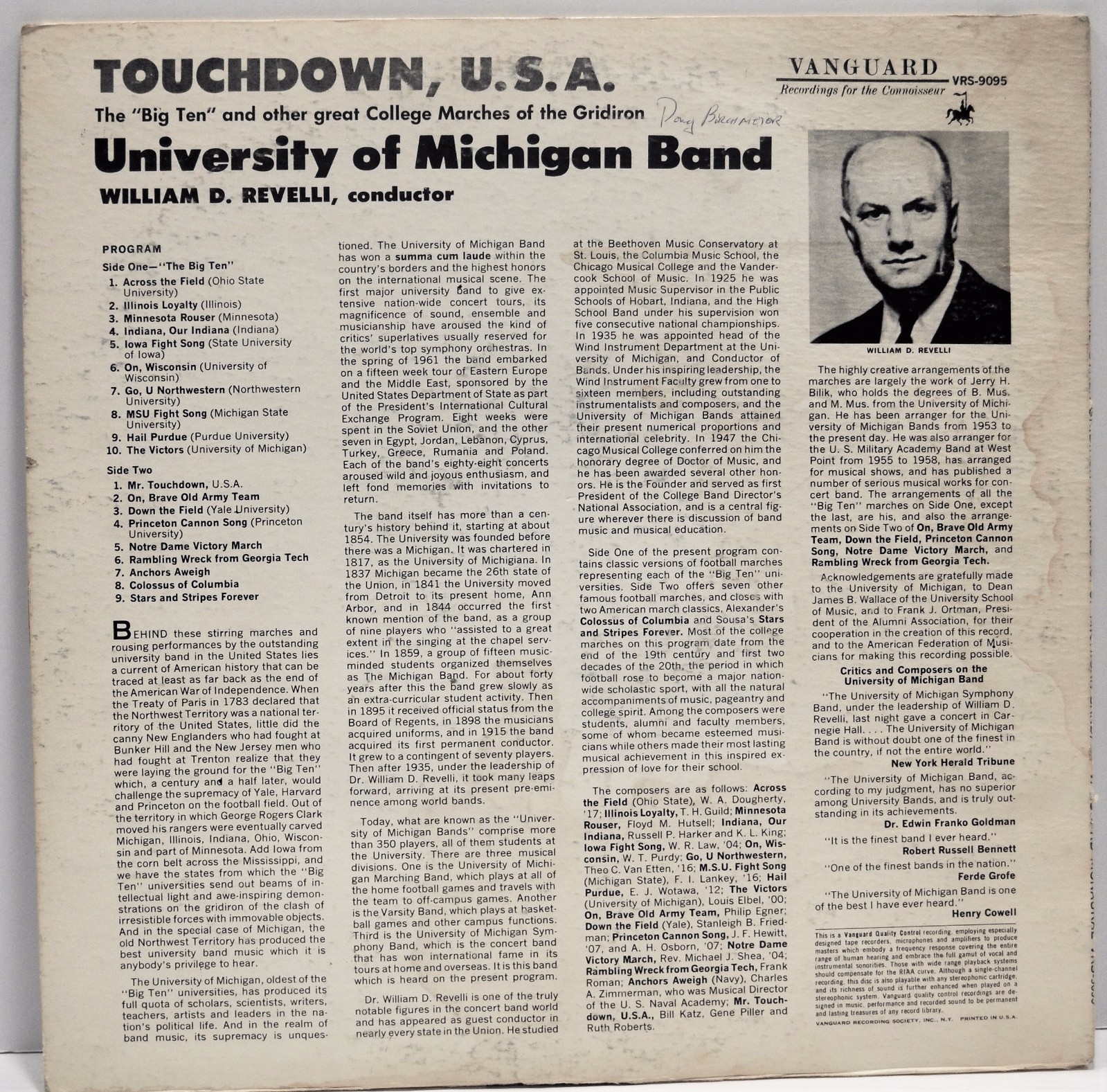
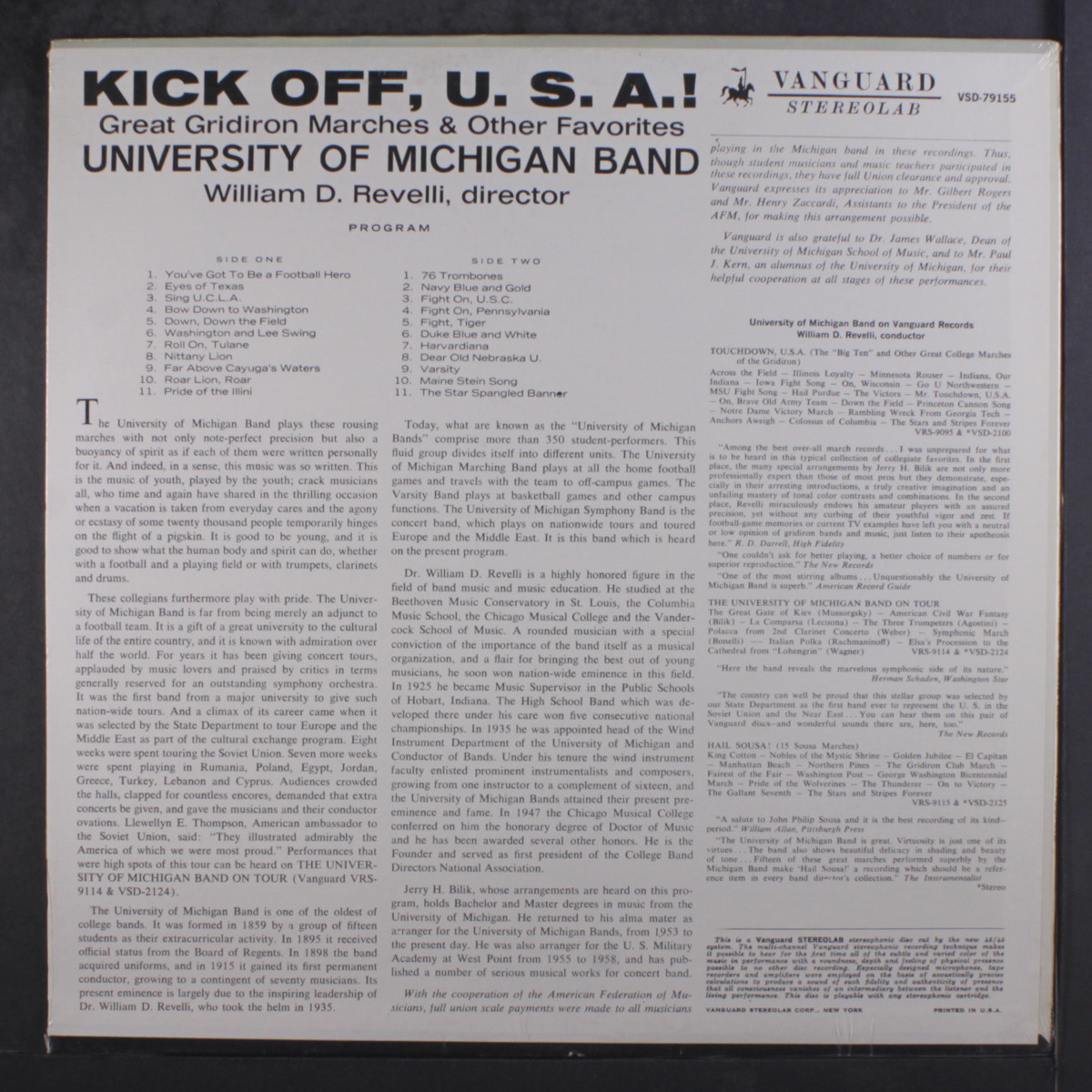
Starting in 1961, the Symphony Band recorded several music albums released by Vanguard Records that were credited to "University of Michigan Band". These albums documented the continued, functional specialization of the various ensembles comprising the Michigan Bands at that time. The Varsity Band played at basketball games and campus affairs. The Symphony Band performed in more traditional concert settings. The Marching Band performed at football games.[6][21] The band received new uniforms, percussion equipment, and fiberglass sousaphones in 1962.[22] The annual Band-O-Rama concert was first held in November 1964.[23] The band performed its "Peace Show" at the nationally televised Michigan-Ohio State football game in 1969.[24] The MMB also performed at the 1970 Rose Bowl following the 1969 season.[25]
1970–1989
[edit]In 1970, Carl Grapentine was appointed the band announcer, becoming the "Voice of the Michigan Bands" (and, since 2006, the "Voice of Michigan Stadium").[26][27] The performance block had grown to 210 members.[25] Dr. Revelli retired from the band in the summer of 1971 and was succeeded by Cavender. Women were allowed to join the marching band starting in 1972.[28] The MMB performed as part of the halftime show at 1973's Super Bowl VII, collaborating with Woody Herman and Andy Williams.[29] A new facility, named Revelli Hall, was built to house the marching band.[8] The MMB's practice field formally known as Wines Field was renamed Elbel Field.[30] Cavender retired in 1979 and was succeeded by Glenn Richter.[8] The MMB performed at the 1972,[31] 1977,[32] 1978,[33] and 1979 Rose Bowl games, as well as at the 1976 Orange Bowl game.[34] The 1978 Rose Bowl performance featured the first public performance of the John Williams' musical score to the movie, Close Encounters of the Third Kind.[35]
Eric Becher succeeded Richter as the MMB's conductor in 1980.[8] The band appeared on the television special, A Bob Hope Celebration on October 22, 1981.[36] In 1982, the MMB performed in Super Bowl XVI[37] and was selected as the inaugural winner of the Sudler Trophy.[38] The MMB also performed at the final game of the 1984 World Series[39] in Tiger Stadium[40] and survived a mob attack in the riot that followed.[41] In 1989, Jerry Luckhardt became the MMB's conductor.[8] The MMB performed at the 1981,[42] 1983,[43] 1987,[44] and 1989 Rose Bowl[45] games.
1990–2019
[edit]Dr. Gary Lewis became Director of the MMB in 1990.[8] On November 20, 1992, the MMB appeared as musical guests on the ABC television variety show, Live with Regis and Kathie Lee.[46] Jeff Grogan directed the band for the 1995 season.[8] Dr. Kevin Sedatole was appointed as Director of the MMB in 1996, with Grogan remaining as Assistant Director.[8][47] Dr. James Tapia was appointed as Director of the MMB in 1999.[48] The band performed at the 1990 Rose Bowl.[49]
In 2001, Jamie L. Nix was hired as the 13th Director of the MMB.[8] That same year, the MMB elected Karen England as its first female Drum Major.[50] On January 2, 2007, having performed at the Rose Bowl the previous day,[51] the Michigan Marching Band attended the arrival of President Gerald Ford's body in Grand Rapids, Michigan.[52] The MMB honored President Ford's funeral procession with somber performances of "Ruffles and Flourishes", "Hail to the Chief", "The Yellow and Blue", and "The Victors".[52][53] Dr. Scott Boerma succeeded Nix as director of the band that same year.[54]
In 2013, Dr. John Pasquale became Director of the MMB.[55] He replaced Dr. Scott Boerma, who announced his resignation as director following the 2013 Outback Bowl to take the position of Director of Bands at his alma mater, Western Michigan University.[55][56] Dr. Andrea Brown was hired as the band's Associate Director, becoming the first female Associate Director at the University of Michigan.[57] In 2015, the band collaborated with conductor Alan Gilbert and the brass section of the New York Philharmonic for a halftime performance consisting of 1,000 performers.[58] In 2018, Dr. Richard Frey was hired as the band's Associate Director.
2020–present
[edit]The Michigan Marching Band announced an entirely virtual season for the 2020–2021 academic year in response to the coronavirus pandemic.[59]
On September 11, 2021, for the 20th anniversary of the September 11 terrorist attacks on the United States, the Michigan Marching Band performed a tribute show entitled "We Remember", in conjunction with Durant Design.[60] The show featured selections from John Williams' Summon the Heroes; West Side Story's Mambo; Billy Joel's New York State of Mind; Jay-Z and Alicia Keys' Empire State of Mind; Hamilton's Who Lives, Who Dies, Who Tells Your Story; Woody Guthrie's This Land is Your Land; and John Philip Sousa's Stars & Stripes Forever.[61]
Past directors and drum majors
[edit]
| Year | Past directors:[8] | Year | Past drum majors:[62] |
|---|---|---|---|
| 1896 | Roy P. Warren[63] | ||
| 1897 | Lewellyn L. Renwick[64] | 1897 | Fredrick Lawrence Travers |
| 1900 | Allen Lynn Darr[64] | 1898–1912 | |
| 1903–04 | William Hoffman[8] | ||
| 1906–14 | Eugene "Ike" Fisher[8] | ||
| 1913–14 | George Olsen | ||
| 1914–15 | Herbert E. Richards[65] | 1914–15 | |
| 1915–26 | Captain Wilfred Wilson[8] | 1916–20 | Eugene A. Osius |
| 1921–22 | John P. Lawton | ||
| 1923–25 | Paul R. Sellards | ||
| 1924 | Robert V. Halsey | ||
| 1925–27 | Gordon Packer | ||
| 1926–27 | Norman J. Larson[66][67] | ||
| 1927–36 | Nicholas Falcone[8][12] | ||
| 1928 | Joe Narrin, Roger Kenneth Becker | ||
| 1928–29 | Joe Narrin | ||
| 1930–32 | Frank O. Riley | ||
| 1934–35 | Bernard Hirsch ("Acting Conductor")[12] | ||
| 1933–34 | Donald A. Strouse | ||
| 1935–71 | William D. Revelli[8] | 1935–36 | Robert W. Fox |
| 1936–37 | Frederick N. Wiest | ||
| 1937–38 | Robert W. Fox | ||
| 1939–40 | Gilbert Stevenson, John "Jack" Sherrill | ||
| 1940–41 | John "Jack" Sherrill | ||
| 1941–42 | Lynn Stedman | ||
| 1942–43 | Lynn Stedman, Pat McNaughton | ||
| 1943–44 | Lynn Stedman | ||
| 1944–45 | Douglas Clark | ||
| 1945–46 | Douglas Clark, John Harold Packer | ||
| 1946–47 | Lynn Stedman | ||
| 1947–48 | Noah Knepper | ||
| 1948–49 | Fred Briedenbach | ||
| 1950–52 | Dick Smith | ||
| 1953–54 | Floyd Zarbock | ||
| 1954–55 | Vic Walton, Gurdon "Champ" Patton | ||
| 1955–57 | Gurdon "Champ" Patton | ||
| 1958–59 | Gary Kocher | ||
| 1960–64 | Bill McCann | ||
| 1965–66 | Dave Smith, Lynn Cooper | ||
| 1966–67 | Dave Smith, Dick Follett | ||
| 1967–68 | Dick Follett | ||
| 1969–70 | Dave Smith, Mark Brown | ||
| 1970–71 | Mark Brown | ||
| 1971–79 | George R. Cavender[8] | ||
| 1972–74 | Albert Ahronheim | ||
| 1975–77 | Jeff Wilkins | ||
| 1978–80 | Guy Bordo | ||
| 1979–80 | Glenn Richter[8] | ||
| 1980–1989 | Eric A. Becher[8] | ||
| 1981–83 | Steve Roberts | ||
| 1984–85 | Andy Purvis | ||
| 1986–87 | Kevin Ross | ||
| 1987–88 | Andy Purvis | ||
| 1988–89 | Jeff Stokes | ||
| 1989–90 | Jerry Luckhardt[8] | 1989–90 | Jeff Stokes |
| 1990–95 | Gary J. Lewis[8] | 1990–91 | Rodney Weir |
| 1992–93 | Greg Macklem | ||
| 1993–95 | Matthew Pickus | ||
| 1995–96 | Jeff Grogan[8] | 1995–96 | Jason Wuellner |
| 1996–99 | Kevin L. Sedatole[8] | 1996–98 | Ramon Johnson |
| 1999–2001 | James R. Tapia[8] | 1999–2000 | Gregg Whitmore |
| 2001–02 | Karen England | ||
| 2001–06 | Jamie L. Nix[8] | ||
| 2002–03 | Matt Cavanaugh | ||
| 2004–05 | Dennis Lee | ||
| 2006–07 | Iden Baghdadchi | ||
| 2007–12 | Scott Boerma[8] | 2007–08 | Cody Martin |
| 2009–10 | David Hines, Jr. | ||
| 2011–12 | Jeffrey McMahon | ||
| 2013- | John Pasquale[8] | 2013–14 | Jeff Okala |
| 2015–16 | Matthew Cloutier | ||
| 2016–17 | McKenna Thayer | ||
| 2017–18 | Kevin Zhang | ||
| 2018–20 | Kelly Bertoni | ||
| 2020–22 | Walter Aguilar | ||
| 2022–23 | Rachel Zhang | ||
| 2023–24 | Blake Brdak | ||
| 2024–25 | Christian Nunez | ||
| 2025- | Miguel Retto |
Discography
[edit]Albums
[edit]- HAIL (2024)[68]
- Forever Valiant (2017)[69]
- This is Michigan (2012)[70]
- 2008 Season Highlights (2009)[71]
- Gameday Faves: Michigan Wolverines Classics (2009)[72]
- The Maize Album (2009)[73]
- The Blue Album (2008)[74]
- 2005 Season Highlights (2005)[75]
- The Victors Valiant (2003)[76]
- 2002 Season Highlights (2002)[77]
- It's All About Blue (2000)[8][78]
- Hurrah for the Yellow and Blue (1998)[8][79]
- A Saturday Tradition (1993)[8][80]
- Fire Up... It's Saturday (1985)[8][81]
- 1983 Rose Bowl Highlights (1983)[82]
- Halftime Classics (1978)[8][83]
- "Revelli's Michigan Stadium Echoes" 1935–1971 (Unknown date after 1970)[84]
- MICHIGAN (1972)[85]
- The Yellow And Blue / The Victors-March (1926)[86][87]
Other album appearances
[edit]- Various Artists: Gameday Faves: Classic College Fight Songs (Volume 2): "The Victors - Michigan Wolverines (Live)" (2008)[88]
- Destiny's Child: Destiny Fulfilled: "Lose My Breath", drum cadence sample (2004)[89]
Filmography
[edit]Documentaries
[edit]- Take The Field (2019)[90]
- The Band Director (1973)[91]
- Marching For Roses (1971)[92]
- Pow Pow (1960)[93]
- Here Comes the Band (1951)[94]
Soundtrack contributions
[edit]References
[edit]- ^ Shaw, Wilfred Byron; Donelly, Walter Arthur (1958), "Student Life and Organizations", The University of Michigan, an Encyclopedic Survey, vol. 4, Ann Arbor, MI: University of Michigan Press, p. 1873, archived from the original on May 7, 2019,
Thus, in 1914, the Band gained official recognition and became a unit of the University.
Alt URL - ^ Michigan Ensian, vol. 93, Ann Arbor, MI: UM Libraries, 1989, pp. 288–289,
In addition to preparing and performing new pre-game and half-time shows for all home games, the Michigan Marching Band plays numerous concerts, pep rallies, and parades
- ^ "Performance Opportunities | U-M School of Music, Theatre & Dance". smtd.umich.edu. Retrieved May 6, 2019.
Open to all U-M students, including those at Dearborn and Flint, the Michigan Marching Band has thrilled hundreds of thousands of fans with exciting performances for more than 100 years...
- ^ Dobos, Joe. "That Michigan Band - Chapter 3 "A Sincere Venture"" (PDF). umbaa.org. Retrieved May 6, 2019.
On the night of November 13, 1896, twenty-two musicians...
- ^ Mulholland, Mike (September 23, 2018). "I'm with the Michigan Marching Band; follow along for a football gameday - mlive.com". mlive.com. Retrieved May 6, 2019.
The band consists of about 400 members in all...
- ^ a b "Touchdown, U.S.A." Vanguard Stereolab. 1961. Retrieved May 8, 2019.
...in 1844 occurred the first known mention of the band... in 1859 a group of fifteen music-minded students organized themselves...
- ^ a b Shaw, Wilfred Byron; Donelly, Walter Arthur (1958), "Student Life and Organizations", The University of Michigan, an Encyclopedic Survey, vol. 4, Ann Arbor, MI: University of Michigan Press, pp. 1871–1872, archived from the original on May 7, 2019,
Much of the early data on the Band has been lost, however... Unfortunately, all too little is known about the Band between the time of the Civil War and the turn of the century... According to a short history written by Henri P. dePont ('02), who played the cornet, the first genuine University Band was organized in the fall of 1896.
Alt URL - ^ a b c d e f g h i j k l m n o p q r s t u v w x y z aa ab ac ad ae af ag ah ai aj ak "BHL: Band (University of Michigan) records". quod.lib.umich.edu. Bentley Historical Library. Retrieved May 1, 2019.
- ^ "For The Final Game", Detroit Free Press, p. 3, November 22, 1898,
Students will take the U of M Band to Chicago.
- ^ "Script Ohio Controversy". OSU v Michigan. Ohio State University Archives. October 12, 2002. Archived from the original on October 26, 2006. Retrieved March 7, 2019.
- ^ "Varsity Band Plans Concert at Exhibition". The Michigan Daily. October 24, 1933. Retrieved May 8, 2019.
- ^ a b c Dobos, Joseph; Berz, William. "Nicholas Falcone, The Band Director You've Probably Never Heard Of" (PDF). University of Michigan Band Alumni Association. The University of Michigan Band Alumni Association. Retrieved March 22, 2021.
- ^ "Marching Band Wins All-American Honors". The Michigan Daily. February 25, 1941. Retrieved March 19, 2021.
- ^ Eisenstadt, Alfred (October 30, 1950). "The Michigan Band: It Steps Fastest and Plays Best of the College Outfits That Provide Music and Spectacle on Football Fields". Life Magazine. pp. 108–115. Retrieved May 13, 2019.
- ^ "School of Music, Theatre & Dance Programs". University of Michigan School of Music. 1996. Retrieved May 6, 2019.
- ^ "History". Michigan Marching Band. Michigan Marching Band. Retrieved February 9, 2021.
- ^ "NBC To Transmit From Ann Arbor In Color TV". The Michigan Daily. October 27, 1955. Retrieved May 17, 2019.
- ^ "Michigan Band Pushes Through Ohio Blizzard". The Michigan Daily. November 28, 1950. Retrieved February 5, 2021.
- ^ Rea, Walter (1950). The President's Report to the Board of Regents for the Academic Year ... Financial Statement for the Fiscal Year. University of Michigan Libraries. p. 42. Retrieved March 20, 2021.
- ^ Wise, William. "Michigan Band on the field at 1951 Rose Bowl". Bentley Historical Library University of Michigan Bentley Image Bank. University of Michigan. Retrieved March 20, 2021.
- ^ "Kick Off, U.S.A.!". Vanguard Stereolab. 1964. Retrieved May 8, 2019.
This fluid group divides itself into different units. The University of Michigan Marching Band plays at all the home football games and travels with the team to off-campus games.
- ^ "New Band Uniforms". The Michigan Daily. October 6, 1962. Retrieved May 6, 2019.
- ^ "Band-O-Rama: True Blue! | Happening @ Michigan". October 21, 2018. Retrieved May 6, 2019.
A tried and true U-M tradition, Band-O-Rama: True Blue! celebrates its 54th anniversary with a mixture of classic repertoire from many musical genres including traditional favorites for fans of all things blue.
- ^ "Michigan Marching Band Performs Peace Show at Ohio State Game". YouTube. November 22, 1969. Retrieved May 5, 2019.
- ^ a b "U-M Band Is Tuning Up For Trip To Rose Bowl", Ann Arbor News, p. 13, December 16, 1969, retrieved May 1, 2019,
For 210 band members, the trip to the Rose Bowl will take work and concentrated effort.
- ^ Raskauskas, Stephen (February 20, 2018). "Classical radio host Carl Grapentine announces retirement from "dream job" at WFMT". wfmt.com. WFMT. Retrieved May 3, 2019.
...Carl has been the "stadium voice" of the University of Michigan Marching Band for forty-eight seasons – his voice being heard on national telecasts of sixteen Rose Bowls and numerous other bowl games. In 2006, he also assumed the responsibilities of game announcer at Michigan Stadium.
- ^ "Beyond Michigan football: Carl Grapentine is proud to be the voice of Michigan Stadium - mlive.com". mlive.com. MLive. October 19, 2013. Retrieved May 6, 2019.
- ^ Tobin, James (January 21, 2015). "Women, take the field!". Michigan Today. The Regents of the University of Michigan. Retrieved March 20, 2021.
- ^ White, R.J. (February 3, 2019). "Every Super Bowl halftime show performer: From Maroon 5 to marching bands and everything in-between - CBSSports.com". CBSSports.com. CBS. Retrieved May 1, 2019.
- ^ Schackman, Grace; Cummings, Wil. "A Century At State and Huron". Ann Arbor District Library. Ann Arbor Observer. Retrieved March 20, 2021.
- ^ "Shuffling The Cards - Band Rivalry Mellows", The Stanford Daily, p. 17, September 24, 1973, retrieved May 1, 2019,
...the LSJUMB gained national notoriety at the 1972 Rose Bowl when several members of the Stanford band ran through the Michigan marching formations during a practice session, tossed footballs around and allegedly threw rocks at some of the Michigan bandsmen.
- ^ Music at Michigan, vol. 10, The University of Michigan School of Music, March 1977, p. 18, retrieved May 1, 2019
- ^ Music at Michigan, vol. 12, The University of Michigan School of Music, April 1979, p. 8, retrieved May 1, 2019
- ^ "Blame Lee Corso? | This Week in Michigan Football History". The State Journal-Register. October 25, 2014. Retrieved March 20, 2021.
- ^ "Michigan Band Plans Premiere", Pasadena Star-News, pp. A7, December 30, 1977,
Conductor of the University of Michigan marching band George Cavender is proud of what he has lined up for the 1978 Rose Bowl, which will feature the first public performance of the musical score to "Close Encounters of the Third Kind."
- ^ Hyatt, Wesley (2017). Bob Hope on TV: Thanks for the Video Memories. BearManor Media. p. 197. ISBN 978-1629332185.
...the high-stepping University of Michigan Marching Band plays its fight song and exits around Bob when he enters.
- ^ Pasche, Paula (July 15, 2015). "When Silverdome hosted Super Bowl XVI reviews mixed". The Oakland Press. Archived from the original on May 2, 2019. Retrieved April 12, 2024.
- ^ "Past Sudler Trophy Recipients". sousafoundation.net. The Sudler Trophy Committee. Retrieved March 6, 2019.
- ^ Aardal, Kristen (1985). Michigan Ensian. University of Michigan. p. 179.
Due to their reputation for excellence, the band again performed at a Detroit Lions game at the Pontiac Silverdome and provided entertainment at Tiger Stadium the night Detroit clinched the World Series.
- ^ "1984 World Series Game 5 - San Diego Padres vs. Detroit Tigers". Retrosheet. Retrieved September 13, 2009.
- ^ Blackwell, Katie (October 16, 1984), "A great day for Tigers... ...but not for Detroit", The Michigan Daily, retrieved May 2, 2019,
The crowd attacked the bus that carried the Michigan Marching Band, breaking every window.
- ^ NBC Coverage of the 1981 Rose Bowl (Television). Pasadena: NBC. January 1, 1981.
- ^ Cobb, Adam (January 17, 2017). "UCLA Band - Chapter 9 – 1982 to 1992". uclaband.com. UCLA. Retrieved May 3, 2019.
1983 The Rose Bowl... Following the Michigan Band's performance at halftime...
- ^ Mike Powell / Allsport (January 1, 1987). Michigan Band (JPG) (Photograph). Pasadena, CA: Getty Images. 360994. Retrieved May 3, 2019.
The Michigan band plays during their 15-22 loss to Arizona State at the Rose Bowl in Pasadena, California.
- ^ "The Victors", The Michigan Daily, p. 3, January 5, 1989, retrieved May 3, 2019,
The drum section of the 225-member Michigan Marching Band warms up before marching in the Tournament of Roses Parade.
- ^ "Detroit comes a-LIVE! for Regis and Kathie Lee", Detroit Free Press, p. 34, November 21, 1992, retrieved April 30, 2019,
...Gifford entered the arena... with Philbin at her side and the marching band behind.
- ^ Nesbit, Joanne (March 19, 1996), "Sedatole named Marching Band director; Grogan will assist", The University Record, retrieved May 6, 2019,
Kevin Sedatole will assume the duties of director in July. Jeff Grogan, who has served the band as interim marching band director this past year, will become the assistant director.
- ^ Nesbit ., Joanne (September 7, 1999). "Michigan native Tapia returns to direct Marching Band". Retrieved May 9, 2019.
- ^ Verdi, Bob (January 2, 1990), "BO'S LAST HURRAH NOTHING TO CHEER - Chicago Tribune", Chicago Tribune, retrieved May 1, 2019,
Just as the Michigan marching band strikes up a preamble to impending victory...
- ^ Koivu, Lisa (September 5, 2001). "Woman Up Front". michigandaily.com. The Michigan Daily. Retrieved March 7, 2019.
LSA senior Karen England of Greenville made her debut as the band's first female drum major Saturday.
- ^ Klarecki, Carolyn (October 22, 2009). "A week in the life of the Michigan Marching Band". The Michigan Daily. The University of Michigan. Retrieved March 20, 2021.
- ^ a b "Memorial Services in the Congress of the United States and Tributes in Eulogy of Gerald R. Ford". United States Government Publishing Office. May 22, 2007. Retrieved May 8, 2023.
- ^ UM Marching Band honors President Ford (Video). Grand Rapids, Michigan: C-Span. January 2, 2007.
- ^ Bambery, Zoe (November 1, 2007), "New Man on the Ladder | The Michigan Daily", The Michigan Daily, retrieved May 6, 2019,
Nix left his post after last season to study for a doctoral degree at the University of Miami.
- ^ a b Stoppelmann, Danielle (January 23, 2013). "Marching Band Gets New Leader". michigandaily.com. The Michigan Daily. Retrieved March 6, 2019.
John Pasquale, assistant director of bands and associate director of marching and athletic bands, was named Wednesday as the next director of Michigan Marching and Athletics Bands, the Band announced on its Facebook page Wednesday. Pasquale will replace Scott Boerma, who resigned from the position on Jan. 8. to accept a position as director of bands at Western Michigan University, his alma mater.
- ^ "John Pasquale | U-M School of Music, Theatre & Dance". smtd.umich.edu. University of Michigan School of Music, Theatre & Dance. Retrieved May 6, 2019.
- ^ Shenouda, Stephanie (April 23, 2013). "Andrea Brown to be assistant director of Marching and Athletic Bands". michigandaily.com. The Michigan Daily. Retrieved May 6, 2019.
Brown is the first female in University history to be selected for this position...
- ^ "New York Philharmonic Brass Section to Play Halftime Show". usatoday.com. USA Today. September 25, 2015. Retrieved February 5, 2021.
The performance is at the Wolverines homecoming game against Northwestern on Oct. 10 at Michigan Stadium in Ann Arbor. Michigan announced Friday that New York Philharmonic music director Alan Gilbert will conduct the brass section during the show.
- ^ "The show must go on: Michigan Marching Band goes virtual | Arts & Culture". arts.umich.edu. Retrieved September 12, 2021.
- ^ "Michigan Marching Band's illuminated 9/11 halftime tribute wows fans at Michigan Stadium | Arts & Culture". arts.umich.edu. Retrieved September 12, 2021.
- ^ "Michigan Marching Band commemorates 20th anniversary of 9/11 with 'most spectacular halftime show to date'". University of Michigan News. September 8, 2021. Retrieved September 12, 2021.
- ^ "Drum Majors". umbaa.org. University of Michigan Band Alumni Association. Retrieved March 7, 2019.
- ^ Shaw, Wilfred Byron; Donelly, Walter Arthur (1958), "Student Life and Organizations", The University of Michigan, an Encyclopedic Survey, vol. 4, Ann Arbor, MI: University of Michigan Press, p. 1872, archived from the original on January 1, 2010,
[Roy P.] Warren was elected director.
- ^ a b "History". MichiganMarchingBand.com. Michigan Marching Band. Retrieved April 22, 2020.
- ^ The University of Michigan Bands Centennial Celebration 1897-1997. Ann Arbor, Michigan: The University of Michigan School of Music, Theatre & Dance. 1997. p. 11. Retrieved March 23, 2021.
- ^ M: University of Michigan Football: The First 100 Years, 1879-1979. Ann Arbor, Michigan: University of Michigan Football Centennial Committee. 1979. p. 87. Retrieved March 1, 2021.
- ^ Minnesota Legislators: Past & Present-Norman J. Larson
- ^ HAIL (Media notes). 2024.
- ^ Forever Valiant (Media notes). 2017.
- ^ This is Michigan (Media notes). Scott Boerma, Director. 2012.
{{cite AV media notes}}: CS1 maint: others in cite AV media (notes) (link) - ^ 2008 Season Highlights (Media notes). Regents Of The University Of Michigan. 2009. UMMBCDSPS.
- ^ "Gameday Faves: Michigan Wolverines Classics". Amazon.com. 2Thumbz Entertainment. Retrieved April 20, 2020.
- ^ The Maize Album (Media notes). Scott Boerma, Director. 2009.
{{cite AV media notes}}: CS1 maint: others in cite AV media (notes) (link) - ^ The Blue Album (Media notes). Jamie L. Nix, Director. 2008.
{{cite AV media notes}}: CS1 maint: others in cite AV media (notes) (link) - ^ 2005 Season Highlights (Media notes). 2005.
- ^ The Victors Valiant (Media notes). Jamie L. Nix, Director. 2003.
{{cite AV media notes}}: CS1 maint: others in cite AV media (notes) (link) - ^ 2002 Season Highlights (Media notes).
- ^ It's All About Blue (Media notes). Dr. James R. Tapia, Director. 2000.
{{cite AV media notes}}: CS1 maint: others in cite AV media (notes) (link) - ^ Hurrah for the Yellow and Blue (Media notes). Kevin L. Sedatole, Director. Regents Of The University Of Michigan. 1998. UMMBCD006.
{{cite AV media notes}}: CS1 maint: others in cite AV media (notes) (link) - ^ A Saturday Tradition (Media notes). Regents Of The University Of Michigan. 1993. UMMBCD001.
- ^ Fire Up... It's Saturday (Media notes). Eric A. Becher, Conductor. The University Of Michigan Marching Band. 1985.
{{cite AV media notes}}: CS1 maint: others in cite AV media (notes) (link) - ^ 1983 Rose Bowl Highlights (Media notes). Mark Custom Recording Service. PC 23719.
- ^ Halftime Classics (Media notes). George R. Cavender, Conductor. University of Michigan School of Music. 1978. SM0008.
{{cite AV media notes}}: CS1 maint: others in cite AV media (notes) (link) - ^ Revelli's Michigan Stadium Echoes" 1935 — 1971 (Media notes). William D. Revelli, Director. The University Of Michigan. CA-RM 111484.
{{cite AV media notes}}: CS1 maint: others in cite AV media (notes) (link) - ^ MICHIGAN (Media notes). George Cavender-Director. Five Star Records. 1972. FSRS-3302.
{{cite AV media notes}}: CS1 maint: others in cite AV media (notes) (link) - ^ "School of Music, Theatre & Dance Programs". books.google.com. 1996. Retrieved May 8, 2019.
In December of 1925, the Michigan "Varsity" Band traveled to Detroit to record Varsity, Victors, and The Yellow and Blue.
- ^ The Yellow And Blue / The Victors-March (Media notes). Wilfred Wilson, Director. Camden, NJ: Victor Talking Machine Co. 1926. 19971.
{{cite AV media notes}}: CS1 maint: others in cite AV media (notes) (link) - ^ "Gameday Faves: Classic College Fight Songs (Volume 2)". Amazon. Retrieved April 18, 2020.
- ^ "Free Samples". The Michigan Daily. University of Michigan. November 30, 2006. Retrieved January 26, 2013.
- ^ ""Take The Field" Documentary Series Renewed". College Marching Bands. Retrieved September 12, 2021.
- ^ ""The Band Director" Wins Two Awards", Music at Michigan, 9 (1), Ann Arbor: The University of Michigan School of Music: 1, July 1975
- ^ Educational film/video locator of the Consortium of University Film Centers and R.R. Bowker, vol. 2, 1986, p. 1953, ISBN 9780835221818, retrieved May 1, 2019,
Documents the University of Michigan Marching Band in its various stages of preparation for the 1970 Rose Bowl performance in Pasadena...
- ^ "Two Film Shows Set In Center Series", The National Jewish POST and OPINION, p. 2, November 15, 1963, retrieved April 13, 2024,
"Pow Pow" produced in 1960 is a lark, through the rain, with telephoto lens, dissecting the University of Michigan marching band. The band's purposefulness, high seriousness, and utter dedication are shown as never before.
- ^ Catalog of Copyright Entries: Third series. United States Copyright Office. 1952. p. 18. Retrieved April 30, 2019.
Summary: A behind-the-scene story which shows the practice and drilling required to train the University of Michigan's 150-men marching band for their performance at each football game.
- ^ a b c d e "University of Michigan Marching Band - IMDb". imdb.com. Retrieved April 29, 2019.
External links
[edit]


Michigan Marching Band
View on GrokipediaOverview
Establishment and role
The Michigan Marching Band was established in the fall of 1896 through the efforts of student Harry dePont, who organized the first meeting on November 13 at Harris Hall to form a campus band, marking the beginning of formalized musical support for university activities.[1] The ensemble's inaugural rehearsal followed shortly thereafter, led by Ray P. Warren as conductor, and it delivered its first public performance on February 22, 1897, during the Law School's observance of Washington's Birthday.[1] This student-initiated group quickly integrated into campus life, evolving from informal gatherings into a structured organization that performed at events such as track meets and Commencement Week ceremonies.[1] As the official marching band of the Michigan Wolverines athletic teams, the Michigan Marching Band primarily supports football by performing at home games in Michigan Stadium, pep rallies, and other university events, establishing itself as a longstanding tradition of Michigan Athletics since 1898.[3] Its performances energize crowds and contribute to the pageantry of college sports, including halftime shows and pregame routines that have become integral to the game-day experience.[3] The band is affiliated with the University of Michigan School of Music, Theatre & Dance, where participation is offered as a credited course open to students across all university colleges, fostering a collaborative educational environment.[2] Over the decades, the band has transformed from a modest pep ensemble of nearly 30 members into a prominent show-style marching group within the Big Ten Conference, incorporating precision drills introduced in 1914 under drum major George Olsen and advanced showmanship elements like high-step marching and dance routines developed in the 1940s and 1950s under leaders such as William D. Revelli.[1] This evolution reflects broader trends in collegiate marching traditions, positioning the Michigan Marching Band as an influential model for halftime entertainment and athletic spirit in the conference.[3]Size and instrumentation
The Michigan Marching Band (MMB) maintains a typical performing size of 235 to 276 members during football games, with a full roster that can exceed 400 students including reserves and auxiliaries.[2] This scale enables the band to execute large-scale formations on the field while supporting Michigan Wolverines athletics. The ensemble includes wind instruments, percussion, and auxiliary units such as the color guard and twirlers, all under the direction of university faculty and staff. Instrumentation is divided into woodwinds, brass, and percussion sections, with specific allocations reflecting the band's emphasis on balanced sound projection during outdoor performances. Woodwinds comprise piccolos, clarinets, alto saxophones, and tenor saxophones, providing melodic and harmonic support. Brass sections include trumpets, horns, trombones (including bass trombones), euphoniums, and tubas for powerful tonal depth. The percussion section, known as the drumline, features snare drums, tenor drums, bass drums, and cymbals, contributing rhythmic drive. Auxiliary units consist of one drum major for conducting, 36 flag members in the color guard, and four twirlers for visual elements. Below is a breakdown of the band's instrumentation based on recent rosters:| Section | Instruments | Total Members |
|---|---|---|
| Woodwinds | Piccolos, Clarinets, Alto Saxophones, Tenor Saxophones | 108 |
| Brass | Trumpets, Horns, Trombones (including Bass), Euphoniums, Tubas | 209 |
| Percussion | Drumline (Snare, Tenor, Bass Drums, Cymbals) | 38 |
| Auxiliaries | Drum Major, Flags (Color Guard), Twirlers | 41 |
| Total | 396 |
Organization and leadership
Membership and recruitment
The Michigan Marching Band is open to all students enrolled at any University of Michigan campus, including Ann Arbor, Dearborn, and Flint, regardless of academic major, year in school, or prior marching experience.[6][7] Membership requires successful completion of an audition process that evaluates instrumental proficiency on assigned excerpts and basic marching fundamentals, with options for video submissions or in-person evaluations opening on May 1 for the following season.[8] Accepted members must register for the 2-credit course ENS 348.001, which fulfills requirements for a Music Minor and includes a $125 lab fee covering essential gear like gloves and uniform maintenance.[2] Graduate students are explicitly welcome and have participated in recent seasons.[6] Recruitment efforts target prospective students through a dedicated sign-up portal for a mailing list that provides updates on audition dates and special events, encouraging high school musicians to express interest early.[7] Campus-based outreach includes invitations to visit Revelli Hall for informal sessions and demonstrations, allowing potential members to observe rehearsals and interact with current band members.[7] High school-specific initiatives, such as hosting game-day experiences for visiting ensembles, further promote the program to incoming freshmen.[7] Once accepted, new members integrate during Band Week, held from August 12 to 23, where the band's unique marching style and techniques are taught intensively, with hotel accommodations provided for non-local participants until dorms open.[7][2] Diversity initiatives have been central to the band's recruitment since the early 1970s, when protests by female students in 1971 led to the admission of the first 11 women in 1972 following the passage of Title IX, transforming the previously all-male ensemble.[9][10] Today, women represent approximately 42% of the band's membership, supported by a student-led Diversity, Equity, and Inclusion Committee that meets monthly to advance recruitment, education, and cultural programming for underrepresented groups across race, ethnicity, gender, sexual orientation, and socioeconomic backgrounds.[11][10] These efforts align with the University of Michigan's broader equity commitments, ensuring broad inclusivity in auditions and ongoing participation.[11] Retention is facilitated through structured academic support and rigorous performance commitments that build community and accountability.[2] After one year, members become eligible for merit-based scholarships and need-based financial aid, helping sustain involvement amid demanding schedules, while the program's average GPA of 3.59 (Fall 2023) reflects its compatibility with academic success.[6][2] Participants commit to daily rehearsals from late August through November, weekly sectionals, and all home football games, including pregame, halftime, and postgame performances, which reinforce ensemble cohesion and long-term dedication.[2]Directors
The musical directors of the Michigan Marching Band have played a pivotal role in shaping its artistic, organizational, and performative identity since the mid-20th century. As faculty members within the University of Michigan's School of Music, Theatre & Dance, these directors oversee musical preparation, rehearsal strategies, and performance standards for the band's approximately 400 members, while also managing administrative duties such as budgeting for operations, coordinating national tours, and fostering relationships with university athletics and alumni donors.[1] Their leadership has emphasized precision in the band's signature high-step marching style, innovative halftime shows, and a balance between traditional pep band functions and symphonic-quality musicianship. William D. Revelli served as director from 1935 to 1971, transforming the band into a national model for show-style marching ensembles. He required all male wind instrument majors to participate, expanding membership and elevating recruitment standards, which grew the band to over 200 performers by the 1960s. Revelli introduced the "Band-O-Rama" annual fundraising concert in 1949, featuring high school bands alongside the MMB to support operations and facility improvements. His innovations shifted the band away from rigid military formations toward dynamic, entertainment-focused choreography, including the first Rose Bowl performance in 1948. During World War II, Revelli maintained the program by converting it into an officer training center, ensuring its continuity.[12][13][1] George R. Cavender directed the band from 1971 to 1979, building on Revelli's foundation with expansions in administrative infrastructure and inclusive policies. He led fundraising efforts that resulted in the construction of Revelli Hall, a dedicated rehearsal facility completed in 1975, and advocated for renaming Wines Field to Elbel Field in honor of band supporter Fielding H. Yost. Cavender refined the high-step marching technique and introduced the band's upbeat entry cadence, enhancing its visual and auditory impact during stadium entrances. Under his tenure, women were admitted to the band in 1972, marking a significant step toward gender integration and increasing membership diversity. His oversight extended to budgeting for expanded travel, including bowl game appearances.[1][12][14] H. Robert Reynolds held the position from 1980 to 2001, focusing on artistic excellence and repertoire development. He propelled the band's standards by commissioning new works and emphasizing symphonic precision in marching contexts, which broadened its performance scope beyond athletics to include international tours. Reynolds managed university relations to secure funding for uniforms and instrumentation upgrades, while coordinating logistics for high-profile events like the 1997 and 2000 Orange Bowl trips. A key achievement was the band's selection as the inaugural recipient of the Louis Sudler National Intercollegiate Marching Band Trophy in 1983, recognizing sustained excellence in marching band artistry as voted by 700 college directors and sportswriters. Under his leadership, the MMB produced notable recordings, such as the 1990s series highlighting wind ensemble transcriptions.[15][1][12] Michael L. Haithcock directed from 2001 to 2023, upholding the band's reputation through innovative programming and administrative stability. He navigated post-9/11 travel challenges by optimizing budgets for domestic tours and international exchanges, while strengthening ties with the university's athletic department for integrated game-day experiences. Haithcock's contributions included themed halftime shows, such as tributes to historical events, and expansions in choreography that incorporated multimedia elements. His tenure saw the band maintain competitive edge in national exhibitions, with recordings like the 2010 University of Michigan Symphony Band album showcasing marching-adapted works. Haithcock also advanced faculty development, mentoring associate directors in pedagogy.[15][1][16] John D. Pasquale has served as director of the Michigan Marching and Athletic Bands since 2023, continuing the tradition of high-impact leadership. Holding the Donald R. Shepherd Professorship in Conducting, he oversees budgeting for the band's $2 million annual operations, including tours to Big Ten conferences and alumni engagement events. Pasquale's innovations draw from his expertise in wind band pedagogy, as detailed in his book The Directed Listening Model (2021), applying structured rehearsal techniques to enhance ensemble cohesion. His achievements include leading residencies in Africa, training over 700 musicians, and fostering collaborations with drum corps like the Cavaliers, which won three DCI World Championships (2002–2004, 2009) during his involvement. Under Pasquale, the band has emphasized diverse repertoire, such as contemporary compositions premiered in 2024 halftime shows.[17][5]Drum majors
The drum majors of the Michigan Marching Band are student leaders selected to guide the ensemble on the field, embodying the group's precision, spirit, and traditions during performances. As the visible representatives of the band, they conduct formations, signal transitions, and inspire members through commanding presence and technical skill, particularly during high-stakes events like football pregame shows.[1][18] Selection for the drum major position occurs through a competitive process involving band member input and demonstrations of leadership and performance abilities. Candidates, typically drawn from an initial pool of about 15 experienced members, undergo tryouts that include speaking to the group, marching demonstrations, conducting exercises, back bends for showmanship, and strutting to showcase poise. The band then elects the drum major via anonymous ballot, ensuring the choice reflects collective trust in the individual's ability to lead. This democratic approach emphasizes both musical conducting skills and mace twirling proficiency, with tryouts held in early spring for the upcoming season.[19][20] Recent drum majors include Miguel Retto, selected as the 60th drum major in April 2025, a fifth-year senior from East Stroudsburg, Pennsylvania; Christian Nunez, the 59th in 2024, a mechanical engineering senior from Grosse Pointe Farms, Michigan; and Blake Brdak, the 58th in 2023, from New Baltimore, Michigan. Historically, the role dates to 1914 with George Olsen as the first official drum major, who introduced military-style precision drills and the iconic baton toss over the goalposts, setting precedents for leadership that persist today.[1][21][22][23] Drum majors bear key responsibilities, including leading pregame sequences such as the band's tunnel entry and field maneuvers, signaling formations with precise gestures, and maintaining tempo through whistle commands that unify the ensemble before performances. They also represent band spirit by interacting with the football team, such as coordinating the joint run-through-the-banners tradition to energize players and fans alike. A signature element is the drum major's whistle, used to initiate chants, raise instruments, and synchronize the band's movements, transforming individual members into a cohesive unit.[18][24][1]Traditions
Uniforms and appearance
The Michigan Marching Band's current uniform, introduced in 2022 and crafted by Stanbury Uniforms, consists of a reversible blue shield with a maize side for "Maize-Out" games, featuring custom buttons, maize piping on the collar and pauldrons, and a simplified Block M emblem.[25] The ensemble includes a maize cape draped over the right shoulder, solid blue pants, white gloves, white spats, black shoes, and a shako hat adorned with a maize and blue plume.[25] This design emphasizes the university's signature maize and blue colors, symbolizing the "Go Blue!" spirit and the band's alignment with University of Michigan athletics traditions.[25] The band's uniforms have evolved significantly since their formal introduction in the 1920s, transitioning from military-inspired attire to more stylized modern ensembles. In 1923, the first official uniform featured an officer's cap, black jacket with braids, and trousers, reflecting the era's formal military-style marching bands influenced by figures like John Philip Sousa.[25] By 1949, a plume was added to the hat, and white spats were incorporated into the policeman-style uniform.[25] The 1950s redesign under director George Cavender shifted toward wool coats in maize and blue with block "M" lettering, establishing a more distinctive visual identity that has persisted with variations, such as the 1962 "tuxedo" style with tassels and shakos, and the 1985 introduction of the maize shield with white shoulder caps.[25][1] Auxiliary units, including the color guard and flag line, wear coordinated attire that complements the main band's uniform while incorporating performance-specific elements. The flag halftime section uses Pregame jackets from Fred J. Miller Inc., featuring flags and props for visual enhancement during routines.[25] These auxiliaries maintain a unified appearance with the band's maize and blue palette, often including shakos or capes for cohesion. Uniform maintenance and updates are supported by the Uniform Endowment, funded through donations to the Elbel Club since 1990, ensuring the attire's preservation and periodic refreshes to uphold the band's precise and traditional aesthetic.[25] The Block M and color scheme serve as enduring symbols of Michigan pride, reinforcing the band's role in university traditions.[25]Signature formations and style
The Michigan Marching Band is renowned for its show-style marching, which emphasizes synchronized visual choreography and musical performance during halftime shows. This approach, pioneered by director William D. Revelli from 1935 to 1971, incorporates precise corps-style steps with high knee marks—typically lifting the thigh to a 90-degree angle—and fluid transitions between formations to create dynamic, entertaining displays.[26][1] Revelli's innovations shifted the band from rigid military drill toward a more theatrical style, prioritizing exacting precision while allowing for creative movement that captivated audiences, as evidenced by the band's national acclaim at events like the 1948 Rose Bowl.[26] Iconic formations form a core element of the band's visual identity, including the Block "M," which first appeared in the 1952 pregame routine and symbolizes the University of Michigan's maize-and-blue spirit.[1] Other signature shapes feature wolverine outlines representing the school's mascot and scripted words or numbers that spell out messages, scores, or themes during halftimes, enabling the band to convey narratives through geometric precision on the field.[26][15] These elements, often numbering over 200 members in tight ranks, highlight the band's ability to execute complex patterns with minimal spacing errors. The band's style integrates a color guard unit, introduced in the 1970s, to enhance visual effects through flag tosses, rifle spins, and synchronized dances that complement the marching formations.[1] Under directors like Revelli and successors, this addition amplified the show's spectacle, with performers weaving through the ensemble to add color and motion without disrupting the core precision.[26] For Big Ten conference performances, the Michigan Marching Band adapts its style to emphasize showmanship and crowd engagement over traditional military drill, tailoring formations to stadium-scale venues like Michigan Stadium while maintaining Revelli-era standards of uniformity and timing.[26][1] This evolution ensures the band's routines remain competitive and visually striking against rivals, focusing on fluid, high-energy execution suited to large outdoor arenas.[15]Pep songs and cheers
The Michigan Marching Band's pep songs and cheers form the auditory backbone of University of Michigan athletic events, energizing crowds through spirited full-band performances that blend brass fanfares, percussion cadences, and crowd interactions. These traditions emphasize high-energy arrangements designed to rally fans, often incorporating vocal overlays where band members and spectators join in unison. Central to this repertoire is the band's rendition of official fight songs, which have evolved from early 20th-century marches to include more dynamic, chant-like elements suited for modern stadium atmospheres.[27][28] The band's signature fight song, "The Victors," has served as Michigan's official anthem since its composition in 1898 by Louis Elbel, a University music student inspired by the football team's Western Conference championship victory over the University of Chicago. The full-band arrangement features bold trumpet leads and rhythmic percussion to punctuate the lyrics, which open with "Hail! to the victors valiant, Hail! to the conquering heroes, Hail! Hail! to Michigan, the champions of the West!" This line, known as the "Champion of the West" cheer, prompts immediate crowd responses during games, fostering a sense of communal triumph. First publicly performed by John Philip Sousa's band in 1899 and praised by Sousa as the "best college march ever written," the song's arrangement has remained a staple, with the Michigan Marching Band delivering it at pregame sequences and post-touchdown celebrations.[28][4] Another key pep song, "Let's Go Blue," emerged in the 1970s as a concise, high-spirited addition to the band's cheer repertoire. Composed by Joe Carl, a former MMB tuba player, and first arranged for marching band by Albert Ahronheim in 1974—with a full version completed in 1975—the 40-second piece consists of 32 bars built around a simple, repetitive melody that encourages fan sing-alongs. Performed with layered brass swells and driving percussion, it serves as an upbeat counterpoint to "The Victors," often played after first downs or during timeouts to maintain momentum. Its adoption marked an evolution in the band's pep music toward shorter, more interactive formats that amplify stadium energy.[29] The band also leads custom cheers that integrate directly with fan participation, such as "It's Great to Be a Michigan Wolverine," a post-victory chant popularized in the early 1980s.[30] This call-and-response tradition, where the band initiates the phrase and the crowd echoes it, builds on the Wolverines' identity and is typically accompanied by full-ensemble fanfares and drum rolls for heightened excitement. These elements, including vocal overlays from band members, underscore the band's role in creating immersive, interactive experiences that extend beyond the field.History
Origins (pre-1900)
The origins of the Michigan Marching Band can be traced to informal student musical ensembles at the University of Michigan in the late 19th century, particularly during the 1880s and 1890s, when volunteer groups of students began performing at football games to energize crowds and foster university spirit. These precursor pep bands drew inspiration from the fife-and-drum corps prevalent during the American Civil War, adopting a simple repertoire suited to rudimentary outdoor settings and emphasizing rhythmic support for athletic events.[31] The band's first formal organization occurred in the fall of 1896, spearheaded by 17-year-old student Harry dePont, who convened nearly 30 musicians on campus for a meeting at Harris Hall on November 13 to form a group specifically for the Thanksgiving Day football game against Oberlin College. Ray P. Warren was elected as the inaugural student conductor at this rehearsal, marking the shift from ad hoc gatherings to a structured ensemble. Although the band aimed to debut at that November game, its first verified public performance took place on February 22, 1897, during the Law School's Washington's Birthday exercises at University Hall, after receiving tentative approval from University President James Burrill Angell.[1][32][15] Early instrumentation was limited to basic brass instruments, such as cornets, and percussion like drums, reflecting the military-style influences of the era and excluding woodwinds due to logistical constraints for outdoor marching. The ensemble operated without a full complement of musicians or professional oversight, relying on volunteer participation from students across disciplines.[31][1] These nascent efforts were hampered by chronic challenges, including no official university funding or administrative support, which forced the band to depend on voluntary collections from members and sporadic donations from the Athletic Association for essentials like sheet music and uniforms in 1897 and 1898. Lacking dedicated rehearsal space initially, the group practiced in borrowed locations such as Room A in University Hall—granted by Angell only after demonstrating commitment—highlighting the precarious, student-driven nature of the band's pre-1900 existence. This informal foundation persisted until greater institutional recognition emerged in the early 20th century.[12][1][31]Early development (1900–1949)
In the early 1900s, the Michigan Marching Band faced ongoing financial challenges, relying primarily on student-led fundraising efforts such as "passing the bucket" on Ann Arbor streets, as the university provided no formal support.[1] By 1897, the Athletic Association launched a successful campaign to fund the band for spring and fall games, marking the beginning of institutional backing from the athletic department that stabilized operations.[33] Under director Eugene "Ike" Fisher from 1906 to 1914, the band improved its musical quality and precision, culminating in the Board of Regents' approval of official funding in 1913, which ensured long-term financial security.[1] Uniforms during this era were rudimentary; in 1914, the first standardized set emerged with drum major George Olsen introducing makeshift canvas puttees, caps, and repurposed German band coats to enhance the band's appearance.[1] World War I disrupted the band's activities from 1917 to 1919, as many members enlisted in military service, leading to temporary reductions in personnel and operations.[12] Despite these interruptions, the band persisted under Captain Wilfred Wilson, its first salaried director appointed in 1915, who expanded membership from about 40 to nearly 100 by the mid-1920s through rigorous recruitment and training.[1] Wilson's leadership in the 1920s emphasized structured rehearsals and symphonic standards, fostering growth amid post-war recovery and introducing early recording sessions in Detroit in 1925.[1] These expansions laid the groundwork for more elaborate performances, including the band's role in supporting university athletics with increased visibility at games.[1] The 1920s also saw the evolution of halftime shows under Wilson's direction, shifting from simple gridiron entries—first dramatized in 1903—to more coordinated field routines that engaged crowds with precision marching.[1] By the late 1920s, Nicholas Falcone's tenure from 1927 to 1934 further refined these shows, introducing innovative formations like the first "Script Ohio" in 1932 during the Michigan-Ohio State game, which became a signature element of the band's style.[1] Leadership transitions during this period, including Wilson's departure in 1926, highlighted the band's maturing organizational structure, with directors focusing on both musical excellence and visual spectacle.[12] World War II profoundly impacted the band starting in 1941, as the university served as an officer training center, but frequent enlistments led to a sharp decline in membership to fewer than 50 by 1943, necessitating substitutions and scaled-back activities.[34] Halftime shows adapted with patriotic themes to boost morale, maintaining continuity despite the constraints.[1] Operations resumed fully in 1946 under William D. Revelli, who had taken over in 1935 and rebuilt the ensemble, incorporating faster tempos and high-step marching by 1947 for national appearances like the Rose Bowl.[1] This period of adversity underscored the band's resilience, ending the era with renewed vigor as post-war enrollment swelled university numbers.[1]Post-war expansion (1950–1969)
Following World War II, the Michigan Marching Band experienced significant growth under the continued leadership of Director William D. Revelli, who had assumed the role in 1935 and guided the ensemble through its post-war maturation until 1971.[26] Revelli emphasized rigorous recruitment and mandatory participation for male wind instrument majors, which swelled membership to over 100 by the mid-1960s, transforming the band into a larger, more disciplined unit capable of complex formations.[35] This expansion reflected broader post-war prosperity at the University of Michigan, with out-of-state applicants comprising over half of tryouts by 1952, broadening the band's talent pool and national appeal.[1] Revelli pioneered a show-style marching approach during this era, shifting from traditional military precision to innovative halftime spectacles that integrated high-step marching, faster tempos (up to 180 beats per minute), and intricate drill designs, influencing collegiate bands nationwide.[26][1] These stylistic evolutions were refined through intense daily rehearsals on Elbel Field, prioritizing musical excellence alongside visual spectacle, and were first prominently displayed in Big Ten away game tours starting in the early 1950s, including the notable 1950 "Snow Bowl" trip to Ohio State University.[36] The band's travels expanded to other conference venues like Purdue and Illinois, fostering regional rivalries and elevating its reputation through live performances that drew thousands.[35] In the 1960s, the band's profile rose further with high-profile national showcases, such as the 1965 Rose Bowl halftime show against Oregon State, where over 100 members executed a precision rendition of "Auld Lang Syne" under Revelli's direction, marking a milestone in the ensemble's visibility.[1][35] This performance, arranged by Jerry Bilik, highlighted the band's maturing show style and contributed to its acclaim as a leader in collegiate marching traditions.[1] Concurrently, events like Band Day evolved into major gatherings, hosting thousands of high school musicians by the mid-1960s and serving as informal national competitions that underscored the MMB's role in music education outreach.[1]Modern innovations (1970–1989)
Under the leadership of George Cavender, who served as director from 1971 to 1979 following William Revelli's retirement, the Michigan Marching Band navigated significant cultural and operational shifts while maintaining its commitment to precision marching and musical excellence. Cavender, who had been assistant director since 1952, emphasized continuity in the band's traditions but oversaw adaptations to evolving university demographics and facilities, including the dedication of Revelli Hall in 1973 as a state-of-the-art rehearsal space.[15][1] His tenure coincided with broader societal changes, fostering an environment where the band could respond to contemporary issues through its performances. A pivotal innovation during this period was the integration of women into the band, enabled by the passage of Title IX in 1972, which prohibited sex-based discrimination in federally funded education programs. Prior to this, the band had been all-male since its early years; in fall 1972, 12 women successfully auditioned and joined, marking the first co-educational season and sparking initial protests from some alumni but ultimately boosting overall enrollment. Female participation grew rapidly, reaching approximately 30% by the late 1970s and approaching 50% by the mid-1980s, diversifying the band's composition and enhancing its recruitment from a broader student base.[10][9][1] The 1980s, under director Eric Becher from 1980 to 1989, saw the band expand its reach through high-profile national and international engagements, reflecting its growing prestige. That same year, the band delivered a pregame performance at Super Bowl XVI in Pontiac, Michigan, at the Silverdome, showcasing its halftime routines to a national television audience of millions. These opportunities, including the band's receipt of the Louis Sudler Trophy in 1983—the first awarded to any marching band for exemplary contributions—highlighted adaptations to larger venues and media demands while addressing university-wide events through themed shows that occasionally incorporated social themes.[1][3][37]Contemporary achievements (1990–2019)
The Michigan Marching Band entered a period of sustained excellence and increased visibility from 1990 to 2019, led by a series of dedicated directors who built on the band's storied legacy. Gary J. Lewis served as director from 1990 to 1995, emphasizing innovative drill designs and musical arrangements that enhanced the band's halftime performances.[38] Jeff Grogan followed as director from 1995 to 1996, maintaining the band's high standards during a transitional year. Kevin L. Sedatole directed from 1996 to 1999, introducing dynamic shows that incorporated contemporary music and complex formations, while James R. Tapia led from 1999 to 2001, focusing on artistic expression and band cohesion.[1] From 2001 to 2023, Michael Haithcock, as Director of Bands, provided overarching leadership for the marching band, fostering growth in enrollment and performance quality during an era of technological advancement and cultural shifts.[39] The band's prominence surged in the digital age, with YouTube videos of their halftime shows achieving virality and drawing millions of views. A standout example was the 2013 "Beyoncé" tribute during the game against Notre Dame, which featured a surprise pre-recorded message from Beyoncé herself encouraging the performance; the show, including renditions of "Crazy in Love," "Single Ladies," and "Love on Top," was highlighted in national media for its energy and precision, exemplifying the band's ability to blend pop culture with marching traditions.[40] Other notable digital successes included shows like the 2018 "Game of Thrones" production, which further amplified the band's reach beyond college football audiences. Throughout the 1990s and 2000s, the MMB consistently earned accolades within the Big Ten Conference, including repeated selections for high-profile events that underscored their status as one of the conference's premier ensembles.[41] Diversity milestones marked significant progress in the 2010s, with women comprising nearly half of the band's membership by 2014—up from just 38 in 1973—reflecting deliberate recruitment and inclusion efforts that transformed the ensemble's composition while preserving its musical integrity.[42] The band also navigated challenges, including responses to broader scrutiny of hazing in collegiate marching bands following high-profile investigations in the Big Ten, such as Ohio State's 2014 case; this prompted internal reviews and reforms at Michigan to reinforce anti-hazing policies, training, and a supportive environment for all members.[43] Appearances in prestigious events like the Macy's Thanksgiving Day Parade in 1995 and 2012 highlighted the band's national stature, allowing them to perform for vast audiences and promote Michigan's spirit.Recent developments (2020–present)
The COVID-19 pandemic profoundly disrupted the Michigan Marching Band's operations in 2020, leading to the cancellation of all in-person performances and the adoption of virtual formats for the first time in the band's history. Members produced entirely student-led digital halftime shows, such as "Hail to the Frontline Heroes," which honored healthcare workers and premiered on November 28, 2020, and "The Virtual Victors," celebrating the Class of 2020 graduates on May 4, 2020. These adaptations allowed the band to maintain some sense of tradition and community amid restrictions that prevented live assemblies at Michigan Stadium.[44][45][46] In 2021, the band achieved a full return to live performances following a yearlong hiatus, resuming at Michigan Stadium on September 11, 2021, with a roster of 411 students for the football season opener against Washington. This marked the end of virtual-only activities, with the ensemble delivering traditional pregame and halftime routines under ongoing university health protocols, including mandatory vaccinations implemented for the 2021–2022 academic year. By 2022, operations normalized further, with the band performing full seasons without capacity limitations, including collaborations like the October 15, 2022 guest appearance with Wynton Marsalis and the Jazz at Lincoln Center Orchestra.[47][48][49] In January 2024, Jason Fettig succeeded Michael Haithcock as Director of University Bands.[50] A significant post-pandemic milestone occurred in summer 2025, when the band embarked on its first European tour since 2006, spanning June 26 to July 13 across seven cities in Austria, France, and Germany. The 18-day itinerary featured performances at events like the Mid Europe Festival in Schladming, Austria, on July 10–11, showcasing the band's signature style to international audiences and reinforcing its global reputation. This tour, funded through donor support, highlighted the ensemble's recovery and expansion beyond domestic venues.[51][52] In 2025, the band introduced new leadership with the selection of Miguel Retto as Drum Major #60 on April 19, a senior from East Stroudsburg, Pennsylvania, majoring in industrial and operations engineering. Retto led rehearsals and performances starting in Band Week on August 12, emphasizing leadership and collaboration. Halftime shows that season incorporated donor recognitions, such as the Sykes family's sponsorship of a performance honoring first-generation student Asa Randall, aligning with the band's tradition of community-supported programming.[53][54][55] Ongoing initiatives have focused on member well-being, particularly mental health support through integration with the University of Michigan's Counseling and Psychological Services (CAPS). The band provides access to brief therapy, drop-in workshops, crisis intervention, and psychiatric evaluations to address the demands of rigorous rehearsals and performances, fostering emotional resilience among its approximately 400 members. These resources, highlighted in band wellness guidelines, aim to support psychological development and prevent burnout in a high-pressure environment.[56][11]Repertoire and performances
Halftime shows
The Michigan Marching Band's halftime shows typically last 8 to 12 minutes and consist of 3 to 6 musical segments arranged into a cohesive thematic narrative, featuring intricate drill formations, color guard routines, and occasional dance elements.[55][57] These performances are designed to entertain over 100,000 spectators at Michigan Stadium, blending high-energy marching with visual storytelling to maintain audience interest during the football game's intermission.[58] The choreography process is led by the band's directors and staff arrangers, such as Richard Frey for music and drill, with significant student input through an annual show design committee that collaborates on scripting and planning.[59] Formations are plotted using specialized software to ensure precise movements across the field, incorporating the band's signature styles like high-step marching and block patterns.[2] Rehearsals for each show occur several times weekly during the fall semester, focusing on synchronization of brass, woodwinds, percussion, and the color guard led by choreographers like Joan Noble-Pruett.[6] Notable halftime themes often draw from pop culture and Broadway tributes, including Disney medleys such as the 2021 "Disney: Then and Now" show featuring classics from films like The Little Mermaid and Frozen, and the 1992 Disney performance during the Illinois game.[60][61] Other examples include 2025 productions like "Wicked," a collaboration with the U-M School of Music, Theatre & Dance following a 2023 performance, presenting songs such as "Defying Gravity," and "ABBA: Here We Go Again!" highlighting danceable hits from the pop group.[62][55] University milestones are occasionally honored, as in themed shows celebrating anniversaries or historical events, though pop culture remains a frequent focus for broad appeal.[1] Audience engagement is enhanced through interactive elements, such as invitations for fans to dance along during upbeat segments, and innovative props like LED-fitted flags and umbrellas in shows utilizing PixMob technology for synchronized lighting effects.[55][63] Guest artists from U-M's musical theatre and percussion programs have joined performances, adding vocal and rhythmic layers.[64] Costumes and thematic visuals, like those evoking mystery in the 2025 "Whodunnit?" narrative, further immerse viewers in the production.[55]Pregame and field routines
The Michigan Marching Band's pregame routine at home games in Michigan Stadium commences with a high-energy tunnel run, where the full ensemble of over 400 members emerges from the under-stadium tunnel amid roaring crowds exceeding 100,000 spectators, accompanied by an explosive entry cadence to build anticipation.[65][54] Once on the field, the band executes the M Fanfare—a bold brass-led announcement—followed immediately by a dynamic fanfare rendition of "The Victors," the university's official fight song composed in 1898, while rapidly forming the block "M" in the south end zone to symbolize Wolverine pride.[58][66] This sequence, lasting approximately 10 minutes, sets the tone for the game and has remained a staple since the band's formalized pregame traditions in the mid-20th century.[4] Integral to the pregame is the flag corps presentation, where the band's color guard—comprising dancers and rifle twirlers—unfurls and displays the American and Michigan state flags in synchronized routines, often incorporating choreography that highlights precision marching and visual flair to complement the musical elements.[67][68] These presentations occur just prior to or integrated with the national anthem, fostering a sense of patriotism and unity among fans, and are led by the drum majors' signature high-step signals for seamless transitions.[58] During the game, the band delivers concise field routines primarily during timeouts and television breaks, featuring rapid formations such as spell-outs of "GO BLUE" to rally spectators and maintain momentum, with the ensemble repositioning in under 90 seconds to spell the phrase using bodies and instruments for aerial visibility.[58] These quick spells, typically 1-2 minutes in duration, blend high-step marching with brass fanfares and percussion drives, emphasizing brevity to fit game interruptions while amplifying crowd energy.[69] The band's interactions enhance the game-day atmosphere through close coordination with the University of Michigan cheerleaders and direct engagement with fans; for instance, during key moments like touchdowns, the ensemble joins cheerleaders in leading synchronized chants of "Hail to the Victors," with members facing the stands, raising batons, and conducting audience participation to create a unified roar across the stadium.[70][71] This synergy extends to simulated football play elements, where the band mimics crowd-favorite moments like long-pass completions through choreographed waves and cheers, further immersing fans in the action.[58] For away games and bowl events, the pregame and field routines are adapted to venue constraints, such as smaller fields or differing tunnel configurations, with a subset of the band—often 200-300 members—performing a condensed version of the core sequence, including the tunnel entry (when available), M Fanfare, and "The Victors," as demonstrated at the 2024 Rose Bowl and ReliaQuest Bowl.[2][72][73] Timeout spells are similarly scaled for logistics, focusing on essential formations like "GO BLUE" to sustain spirit in hostile environments, while flag presentations remain prominent to uphold ceremonial standards regardless of location.[74]Tours and special events
The Michigan Marching Band has participated in numerous domestic tours, most notably multiple appearances at the Rose Bowl in Pasadena, California. The band's first Rose Bowl performance occurred on January 1, 1948, marking the initial Big Ten Conference marching band to travel there, and it has since made approximately 20 appearances in the Tournament of Roses Parade and associated events, including the 1998 halftime show against Washington State and the 2024 semifinal performance ahead of the College Football Playoff National Championship.[1][75] These tours involve extensive travel, with the band performing pregame, halftime, and parade routines to showcase university spirit to national audiences. Internationally, the band embarked on its first major overseas tour in summer 2025, spanning 18 days from June 26 to July 13 across Germany and Austria in seven cities, including Ettenheim and Kempten in Germany, and Schladming in Austria. Performances included street parades, stand-still concerts, and festival appearances such as the Mid Europe Festival's opening concert, Lange Nacht event, and Schladming Tattoo, often collaborating with local ensembles like the Bavarian Police Orchestra. The repertoire featured excerpts from halftime shows, "The Victors," and adaptations of regional tunes like "Böhmischer Traum" to engage audiences.[51][76] In addition to tours, the band has performed at various special events beyond football venues. It has made appearances at Walt Disney World, including a Main Street parade at the Magic Kingdom on December 30, 2019, and similar processional performances at Disneyland in 2023 to celebrate Wolverines athletics. The band also contributes to university commencements and events, such as the November 2, 2025, Band-O-Rama performance of "Can't Stop" by the Red Hot Chili Peppers alongside drummer Chad Smith, and participating in the main campus graduation procession with "The Victors."[77][78][79] Tour logistics for the Michigan Marching Band emphasize coordinated transportation and accommodations to support over 300 members. For the 2025 European tour, participants flew via three airlines—American, Lufthansa, and Delta—with large instruments like tubas and drums shipped directly to Munich via semitruck; ground travel involved six buses for intra-country movement, while accommodations were arranged in hotels near performance sites. Each member covered approximately $5,500 in costs, offset by donor support for meals and excursions, and required GeoBlue health insurance and valid passports. These efforts facilitate cultural exchanges, such as interactions with local musicians during joint performances and navigation assistance from German-speaking band members, fostering goodwill and musical dialogue.[76][51]Media appearances
Discography
The University of Michigan Marching Band has produced official audio releases primarily in digital and independent formats since the late 2000s, capturing its marching and pep band arrangements of fight songs, marches, and halftime medleys. Note: Early releases on major labels like Vanguard Records in the 1960s and 1970s were primarily by the University of Michigan Symphony Band (concert band) and credited to the "University of Michigan Band"; these are sometimes associated with the marching band tradition but were not performed by it.[80] The band's confirmed marching-specific recordings began with seasonal highlights in the 2000s. The 2008 Season Highlights (2009) album documents live and studio takes from that football season, including pep songs and medleys. Gameday Faves: Michigan Wolverines Classics (2009), available on platforms like Spotify, compiles enduring tracks such as "The Victors," "Let's Go Blue," and "Varsity," serving as an accessible entry point for fans. In the 2010s, digital singles and albums proliferated on Spotify, including This is Michigan (2012) with modern arrangements of Wolverines staples, and standalone pep song releases like "The Victors (Trio)" for streaming.[81] More recent studio albums include Forever Valiant (2017), featuring a tracklist of entry cadences, fight songs, and medleys like "Kings Medley" (incorporating "Also Sprach Zarathustra" and pop hits), produced independently and sold via the band's official channels. The latest release, HAIL (2024), produced by David Lau at Brookwood Studio, Inc., spans 25 tracks from 2017–2023 halftime shows and traditions, including "Star Wars (Main Theme)," "The Greatest Showman Medley," and "Abbey Road Medley," with arrangements by band directors like Scott Boerma. This album is available in physical CD and streaming formats, marking the band's continued emphasis on blending classics with contemporary pop and film scores. No guest artists are credited on these core releases, though arrangements often draw from licensed publishers.[82][83][84] For historical context, notable Symphony Band releases include Touchdown, U.S.A.: The Big Ten and Other Great College Marches of the Gridiron (1961, Vanguard VSD-2100; reissued 1991), featuring Big Ten fight songs like "The Victors"; Hail, Sousa! (1968, VSD-2125), with 15 tracks of John Philip Sousa compositions such as "The Stars and Stripes Forever" and "El Capitan"; and The Greatest College Football Marches (1971, VSD 29/30), a double LP compiling 40 fight songs and marches from various universities.[85][86][87]| Album Title | Year | Label/Platform | Key Tracks/Notes |
|---|---|---|---|
| Touchdown, U.S.A.: The Big Ten and Other Great College Marches of the Gridiron | 1961 (reissue 1991) | Vanguard (VSD-2100) | Big Ten marches including "The Victors"; Symphony Band recording. |
| Hail, Sousa! | 1968 | Vanguard (VSD-2125) | Sousa marches like "Stars and Stripes Forever"; Symphony Band. |
| The Greatest College Football Marches | 1971 | Vanguard (VSD 29/30) | 40 fight songs; double LP; Symphony Band. |
| 2008 Season Highlights | 2009 | Independent | Seasonal pep and halftime selections; Marching Band. |
| Gameday Faves: Michigan Wolverines Classics | 2009 | Spotify/Streaming | Classics like "Let's Go Blue," "Varsity"; Marching Band. |
| This is Michigan | 2012 | Spotify/Streaming | Modern Wolverines arrangements; Marching Band. |
| Forever Valiant | 2017 | Independent (michiganmarchingband.com) | Medleys including "Kings Medley"; Marching Band. |
| HAIL | 2024 | Brookwood Studio/Streaming | 25 tracks; 2017–2023 highlights, produced by David Lau; Marching Band. |