Hubbry Logo
SistrurusSistrurusMain
Open search
Sistrurus
Community hub
Sistrurus
logo
8 pages, 0 posts
0 subscribers
Be the first to start a discussion here.
Sistrurus
Sistrurus
from Wikipedia

Sistrurus
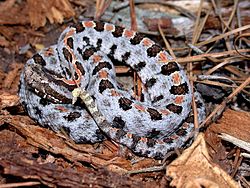
Pygmy rattlesnake (S. miliarius).
Scientific classification Edit this classification
Kingdom: Animalia
Phylum: Chordata
Class: Reptilia
Order: Squamata
Suborder: Serpentes
Family: Viperidae
Subfamily: Crotalinae
Genus: Sistrurus
Garman, 1884
Distribution (using two-species model)
Synonyms[1]
Common names: ground rattlesnakes, pygmy rattlesnakes, massasaugas[2]

Sistrurus is a genus of pit vipers in the subfamily Crotalinae of the family Viperidae. The genus is endemic to Canada, the United States, and Mexico.[1] Its generic name is a Latinized form of the Greek word for "tail rattler" (Σείστρουρος, seistrouros) and shares its root with the ancient Egyptian musical instrument, the sistrum, a type of rattle.[citation needed] Three species are currently recognized.[3]

Description

[edit]
Difference in head scalation between snakes of the genus Crotalus and the genus Sistrurus.

Sistrurus species differ from the larger rattlesnakes of the genus Crotalus in a number of ways. They are smaller in size, but also their scalation is different: Sistrurus species have nine large head plates (same as Agkistrodon), whereas in Crotalus (and almost all other viperids), the head is mostly covered with a large number of smaller scales. Sistrurus species have a relatively small rattle that produces more of a high-pitched, buzzing sound than does a larger rattle, like that of Crotalus.

Geographic range

[edit]

Species of Sistrurus are found in Canada, the Western, Southern, and Midwestern United States, and isolated populations in southern and eastern Mexico.[1]

Venom

[edit]

Although bites from Sistrurus species are regarded as less dangerous to humans than those from Crotalus rattlesnakes, primarily due to their lower venom yield, every venomous snake bite should be considered serious, and prompt medical treatment should always be sought.[citation needed]

Species

[edit]
Image[3] Species[3] Taxon author[3] Subsp.[3] Common name Geographic range[1]
S. catenatus (Rafinesque, 1818) - eastern massasauga It is found in the Great Lakes region from southeastern Ontario (Canada) and central and western New York west to Iowa. It occurs in various habitats ranging from swamps and marshes to grasslands, usually below 1,500 m (4,900 ft) altitude.
S. miliarius T (Linnaeus, 1766) 3 pygmy rattlesnake In the Southeastern United States from eastern and southern North Carolina southward through peninsular Florida and westward to Oklahoma and East Texas. It occurs in flatwoods, sandhills, mixed forests, and floodplains, and around marshes and lakes.
S. tergeminus (Say, 1823) 2 western massasauga Found throughout the Great Plains and southwestern states (from Kansas to Arizona) into disjunct populations in Mexico (Tamaulipas, southern Nuevo León, north-central Coahuila, and Samalayuca, Chihuahua). It inhabits grasslands, rocky hillsides, and woodland edges.

T) Type species.[1]

References

[edit]

Further reading

[edit]
[edit]
Revisions and contributorsEdit on WikipediaRead on Wikipedia
from Grokipedia
Sistrurus is a genus of small venomous pit vipers in the subfamily Crotalinae of the family Viperidae, endemic to North America and characterized by a rattle on the tail, heat-sensing loreal pits between the eye and nostril, vertical slit pupils, and typically nine large symmetrical scales on the crown of the head. The genus, established by Samuel Garman in 1884, includes three recognized species: the massasauga (S. catenatus), the pygmy rattlesnake (S. miliarius), and the western massasauga (S. tergeminus), all of which are relatively small, with adults generally measuring 30–60 cm in total length, though some reach up to 90 cm. These rattlesnakes inhabit a diverse array of environments across southern , the , and , ranging from wetlands, forests, and prairies to arid deserts and grasslands, often preferring areas with ample cover such as leaf litter or rocky outcrops. Their diet primarily consists of small vertebrates like , lizards, amphibians, and nestling birds, as well as such as centipedes, captured using predation strategies; they are primarily nocturnal or crepuscular, especially in warmer months. Venom in Sistrurus species is complex, comprising enzymatic proteins like snake venom metalloproteinases (SVMPs), serine proteases (SVSPs), and phospholipases A2 (PLA2s), alongside non-enzymatic components such as disintegrins and cysteine-rich secretory proteins (CRISPs), which facilitate prey immobilization and digestion while exhibiting ontogenetic and geographic variation. Bites to humans are rare and typically cause mild to moderate symptoms, including swelling and pain, due to the snakes' small size and relatively low yield, though medical attention is still required. Conservation concerns affect several taxa, particularly the eastern massasauga (S. catenatus catenatus), which is listed as threatened in the United States due to habitat loss from , , and wetland drainage; populations of other and vary, with some stable in remote areas but vulnerable to road mortality and collection. on Sistrurus venoms has contributed to biomedical advancements, including the development of antiplatelet drugs like derived from pygmy rattlesnake disintegrins.

Taxonomy

Etymology

The genus name Sistrurus is derived from the Greek words seistron (σείστρον), meaning "rattle" or "shaker," and oura (οὐρά), meaning "tail," collectively referring to the characteristic rattling tail of these venomous snakes. The name was coined by American herpetologist Garman in 1884 to distinguish this group from the larger rattlesnake genus . Common names for species within Sistrurus include "pygmy rattlesnake" for S. miliarius, reflecting its small size relative to other ; "massasauga" for S. catenatus, derived from the (Chippewa) term meaning "great river mouth," alluding to the snake's preference for marshy, riverine habitats; and "ground rattlesnake," a general descriptor emphasizing their terrestrial, low-profile habits compared to arboreal or larger congeners.

Classification

Sistrurus belongs to the kingdom Animalia, phylum Chordata, class Reptilia, order , family Viperidae, subfamily Crotalinae. The genus occupies a phylogenetic position as the to Crotalus within the monophyletic of rattlesnakes, forming a well-supported lineage that diverged from other crotaline pitvipers such as Agkistrodon. Three are currently recognized in the genus: S. catenatus, S. miliarius, and S. tergeminus. The genus Sistrurus was established in 1884 by Samuel Garman to separate smaller-bodied rattlesnakes previously classified under , based on morphological distinctions including rattle structure and scale patterns. This reclassification reflected early 19th-century observations of distinct zoogeographic and evolutionary patterns among North American viperids, as later elaborated in comprehensive studies. Subspecies recognition within Sistrurus has evolved with molecular evidence; for example, the nominate subspecies S. c. catenatus remains under S. catenatus, while S. c. tergeminus and S. c. edwardsii—formerly subspecies of S. catenatus—were elevated to subspecies under the newly recognized species S. tergeminus in 2011 based on multilocus phylogenetic analyses demonstrating deep genetic divergence. Similarly, S. miliarius includes three subspecies: S. m. miliarius, S. m. barbouri, and S. m. streckeri. S. tergeminus comprises two subspecies: S. t. tergeminus and S. t. edwardsii.

Description

Morphology

Sistrurus species are members of the Crotalinae, distinguished by several key anatomical features typical of this group. They possess a pair of heat-sensing loreal pits located between the eye and nostril on each side of the head, which function as infrared detectors to locate prey in low-light conditions. The head is triangular in shape, broader than the neck, with vertical slit-like pupils that enhance and low-light vision. Additionally, these snakes have long, hinged, hollow fangs at the front of the , capable of folding against the of the when not in use and injecting during strikes. A defining morphological trait of the genus is the scalation on the crown of the head, which consists of nine large, symmetrical plates, unlike the numerous small scales found in the closely related genus . This plate-like arrangement provides a robust covering for the and is a reliable diagnostic feature for distinguishing Sistrurus from other North American rattlesnakes. The body is generally stout and cylindrical, covered in imbricate dorsal scales that are strongly keeled, meaning each scale has a prominent longitudinal ridge that contributes to a rough texture and aids in by scattering light. At the tail's end, Sistrurus bears a small rattle composed of keratinous segments, typically numbering 2-3 in adults due to the snakes' relatively short lifespan and infrequent shedding, which produces a faint buzz-like sound rather than the louder whir of larger rattlesnakes. Coloration across the varies but commonly features a base of gray, brown, or pinkish tones, overlaid with a series of dark, irregular blotches along the dorsum that often fuse into bands toward the tail. The tail itself is marked by distinctive black-and-white or rings, providing contrast and aiding in species identification. These patterns serve primarily for in diverse habitats, blending with leaf litter, sand, or rocky substrates.

Size and variation

Species in the genus Sistrurus are generally smaller than those in the closely related genus , with adult total lengths typically ranging from 30 to 80 cm. This compact size distinguishes them from larger rattlesnakes like the (Crotalus horridus), which often exceed 90 cm in length. Neonates are born live, measuring 15 to 25 cm in total length at birth, and exhibit patterns similar to adults but with brighter coloration. Sexual dimorphism in Sistrurus is subtle, with females often attaining slightly larger body sizes than males, particularly in snout-vent length, to support reproductive demands. Males, however, possess relatively longer tails, which may aid in mating behaviors. This pattern of dimorphism varies slightly across species but is consistent in promoting sex-specific adaptations without extreme size differences. Geographic variation within Sistrurus manifests primarily in coloration and patterning, with subtle adaptations to local environments. For instance, populations in habitats may exhibit darker, more melanistic forms compared to those in arid regions, enhancing against boggy or forested backdrops. These differences underscore the genus's adaptability to diverse habitats across .

Distribution and habitat

Geographic range

The genus Sistrurus is endemic to , with a distribution spanning from southern Canada southward to . Populations of the genus occur in , ; across the central and eastern from New York and the states westward to , , , , , and , and southward through , , and the southeastern states including , , Georgia, , , , , and eastern ; and in , particularly Chihuahua and . Core areas of the include the , where S. catenatus maintains strongholds in and ; the , encompassing grasslands in , , , and for S. tergeminus; and southeastern wetlands and pine flatwoods from to and west to eastern for S. miliarius. These regions represent the primary concentrations of viable populations, with the genus favoring open habitats across diverse physiographic provinces. Disjunct populations exist in isolated pockets, such as in and for S. tergeminus edwardsii, where occurrences are separated from main continental ranges by hundreds of kilometers due to unsuitable arid barriers. Additional fragmented groups appear in southeastern and western , reflecting historical connectivity disrupted over time. The historical range of Sistrurus was more continuous across much of its current extent, but significant contraction has occurred due to habitat loss from , , and , resulting in isolated remnants and population declines, particularly at range peripheries. For instance, in the eastern portion, remaining populations are increasingly isolated, with approximately 53% of historical populations extirpated or of unknown status rangewide. Similar fragmentation affects western and southern distributions, exacerbating vulnerability to local extirpations.

Habitat preferences

_Sistrurus species, comprising small rattlesnakes such as the massasaugas and pygmy rattlesnake, exhibit versatile habitat preferences across diverse North American ecosystems, favoring environments that provide a balance of open areas for basking and cover for concealment. These snakes commonly inhabit wetlands, grasslands, prairies, savannas, forests, glades, and rocky areas, with a noted affinity for transitional zones between aquatic and terrestrial habitats. For instance, the (S. catenatus) thrives in fens, marshes, sedge meadows, and wet prairies, while the pygmy rattlesnake (S. miliarius) occupies forests, xeric uplands, and floodplains, and the western massasauga (S. tergeminus) prefers arid prairies and open grasslands. Seasonal shifts in habitat use are prominent among Sistrurus, driven by thermoregulatory needs and reproductive cycles, with individuals often migrating between and upland sites. In spring and fall, snakes preferentially utilize low-lying s and marshes for emergence and , transitioning to drier uplands, such as old fields, savannas, and openings, during summer to avoid flooding and access sunnier basking spots. This pattern is evident in S. catenatus, which occupies marshy grasslands and lake edges in cooler months but moves to upland meadows and prairies in warmer periods, while S. miliarius maintains smaller home ranges in forested and glade habitats year-round but adjusts for by reducing mobility. Microhabitat selection emphasizes sites offering dense vegetative cover, structural refuges, and proximity to prey-rich areas, enhancing survival through and thermal regulation. Sistrurus individuals frequently under logs, within woody piles, or near burrows and shrubs, avoiding exposed bare ground or deep leaf litter, with over 89% of observations in S. miliarius occurring in covered microhabitats. These preferences support near water sources in wetlands and provide ambush points in grasslands, where high prey density—such as small mammals and amphibians—correlates with habitat fidelity. Adaptations like small home ranges (often under 2.6 ha) allow efficient exploitation of these microhabitats, particularly in fragmented landscapes.

Ecology and behavior

Diet and foraging

Species of the genus Sistrurus are predators that employ a sit-and-wait strategy, remaining motionless and camouflaged in leaf litter or to detect prey via heat-sensing pit organs and chemical cues. They strike with precision from a coiled position, injecting to immobilize prey before consuming it whole, which minimizes energy expenditure in their often low-metabolic-rate lifestyle. This behavior is particularly evident in species like the pygmy (S. miliarius), where individuals select microhabitats based on prey preferences to optimize success. The diet of Sistrurus is opportunistic and diverse, encompassing small mammals such as (e.g., meadow voles Microtus pennsylvanicus and white-footed mice Peromyscus leucopus) and shrews (e.g., Blarina brevicauda), as well as amphibians (e.g., frogs and red-backed salamanders Plethodon cinereus), reptiles (e.g., like little brown skinks Scincella lateralis and small snakes such as Storeria dekayi), birds (e.g., field sparrows Spizella pusilla), and (e.g., centipedes and ). In S. catenatus, small mammals dominate, comprising up to 90% of identified prey in some populations, reflecting availability in and habitats. Similarly, S. miliarius frequently preys on and frogs, while S. tergeminus includes a mix of , , and frogs, with occasional birds and other snakes. Prey size is typically small relative to the snake's body length, allowing for quick strikes and efficient digestion; for instance, adult S. catenatus (up to 80 cm) target prey no larger than 20-30% of their own mass. An ontogenetic shift occurs in Sistrurus diet, with juveniles consuming more ectothermic prey and —such as , frogs, and centipedes—due to their smaller gape and developing efficacy, while adults transition to endothermic vertebrates like small mammals for higher caloric returns. In S. catenatus, neonates and juveniles consume fewer prey types (4-5 ) focused on smaller items like and amphibians, whereas adults exploit a broader array (up to 12 ) dominated by voles and mice. This pattern holds across the genus, as seen in S. miliarius where young snakes rely on to attract ectotherms, and in S. tergeminus where juveniles favor and frogs before shifting to . Such shifts support growth and survival by matching prey handling capabilities to physiological changes.

Reproduction

Sistrurus species are ovoviviparous, retaining developing embryos within the female's body until they hatch internally and are born live, typically enclosed in a thin, transparent that ruptures shortly after birth. This reproductive strategy is characteristic of the , allowing for protection and nourishment of during . Mating in Sistrurus occurs primarily in spring (April–May) for some species, such as the pygmy rattlesnake (S. miliarius), while in others like the (S. catenatus), it takes place in late summer () with females storing over winter for fertilization the following spring. Males engage in ritual combat to compete for access to females, involving , neck-biting, and body-pressing behaviors to establish dominance, as observed in both S. catenatus and S. miliarius. Gestation lasts approximately 4–5 months, culminating in the birth of 5–20 live young per , with litter size varying by maternal body size and environmental conditions. Females typically reach at 2–4 years of age, after which breeding is often biennial, allowing recovery from the energetic costs of .

Activity patterns

Species of the genus Sistrurus display flexible daily activity patterns adapted to environmental temperatures, typically being diurnal during cooler spring and fall seasons when they are active during the warmest parts of the day. In hotter summer conditions, they shift to nocturnal or crepuscular activity, often foraging in the evening or early morning to avoid excessive heat, with daytime periods spent coiled in shaded cover for . Seasonally, Sistrurus are active from late March or April through October, depending on latitude and climate, before entering hibernation (brumation) in late fall. Hibernation occurs from October or November to March or April, with snakes denning in crayfish burrows, rodent holes, rock fissures, or root systems, often communally in small groups that may include other snake species to share microhabitats near groundwater sources for stable temperatures. Emergence is triggered by warming temperatures, with most individuals leaving dens by late April. Home ranges for Sistrurus typically span 0.2–100 hectares, varying greatly by , , and reproductive status (e.g., often <3 ha for S. miliarius and 10–100 ha for S. catenatus and S. tergeminus), with males often exhibiting larger ranges than females. Seasonal migrations occur between sites and summer areas, covering distances up to 2–3 km, though daily movements are shorter, averaging 30–500 m. These patterns reflect high site fidelity to key habitats, with limited long-distance dispersal outside breeding periods. Recent research as of 2025 has advanced the study of Sistrurus behaviors, including fixed-field to observe free-ranging activity in S. miliarius (Perelman and Farrell 2025) and documentation of climbing behaviors in S. catenatus to access basking sites. In encounters with threats, Sistrurus primarily rely on and flight for defense, remaining motionless to blend with leaf litter or vegetation due to their mottled patterns, or fleeing into cover when possible. If cornered, they adopt defensive postures including coiling the body, vibrating the tail to produce a buzz-like rattle as a warning, and striking only as a last resort. These behaviors are consistent across species, emphasizing avoidance over aggression. Sistrurus are largely solitary throughout most of their active period, interacting minimally outside of hibernation aggregations or brief encounters in spring and summer. No evidence of territoriality or cooperative behaviors exists, with individuals maintaining independent home ranges except during denning.

Venom

Composition

The venom of Sistrurus species is predominantly hemotoxic, featuring cytotoxic and myotoxic components that induce local tissue destruction and muscle damage. These effects stem from a complex mixture of proteins and enzymes, including enzymatic constituents such as phospholipases A₂ (PLA₂), metalloproteinases (SVMP), and serine proteases (SVSP), as well as non-enzymatic components like disintegrins and cysteine-rich secretory proteins (CRISPs); yields are generally lower than those of larger congeners in Crotalus, ranging from 10–100 mg of dry weight per extraction, with ontogenetic and geographic variation influencing composition and potency. Delivery occurs via paired, hollow fangs that rotate forward during . Sistrurus employs a strike-and-hold or strike-and-release strategy, allowing efficient injection into small prey while minimizing risk to the predator. From an evolutionary perspective, this venom profile has adapted to immobilize ectothermic and small endothermic prey by rapidly disrupting vascular and muscular systems, facilitating subdual and predigestion.

Effects and treatment

Bites from Sistrurus species produce primarily local effects, including immediate severe , , and ecchymosis at the puncture site, which can progress to bullae formation and tissue within hours to days. Systemic manifestations, such as with prolonged and , may occur but are typically mild and resolve without long-term sequelae, owing to the limited yield of these small snakes. Fatal outcomes are exceedingly rare, with no recorded deaths from Sistrurus envenomations in recent decades despite occasional severe local tissue damage. Human encounters resulting in bites are infrequent, as Sistrurus snakes are generally shy and avoid confrontation, leading to far fewer incidents compared to larger genera. Of those bites that occur, approximately 20% to 25% are dry, involving no injection and thus minimal symptoms beyond . Envenomating bites often present with milder severity than those from species, attributable to the pygmy and massasauga rattlesnakes' smaller body size and fangs, which limit delivery. Management begins with immediate immobilization of the affected limb at or slightly below heart level to slow spread, followed by rapid transport to a medical facility for evaluation. Supportive measures include wound cleaning, prophylaxis, and monitoring for , while avoiding incision, suction, or tourniquets, which can exacerbate tissue damage. therapy with (CroFab) is indicated for progressive local swelling, systemic , or hematologic abnormalities, typically administered in initial doses of 4 to 6 vials intravenously, with no Sistrurus-specific product available; early intervention halts progression and reduces morbidity. Antibiotics are reserved for secondary infections, and surgical intervention is rarely needed except in cases of extensive .

Species

Sistrurus catenatus

The (Sistrurus catenatus) is a small to medium-sized characterized by a thick body and a maximum length of approximately 1 meter, though adults typically average 46–76 cm. Its coloration is predominantly gray, light brown, or gray-brown, providing effective in its preferred habitats, with a pattern of large, dark brown to black blotches—often - or butterfly-shaped—along the back and smaller ones on the sides; the tail features darker bands and a segmented keratinized rattle. The head is triangular with vertical slit pupils and heat-sensing pits between the eyes and nostrils, distinguishing it as a venomous crotaline. This species occupies a broad range across central and eastern , extending from in through the —including , , , , , New York, , and —southward through eastern and east-central . Historically more widespread, current populations are fragmented and concentrated in the northern portions of this range, particularly around the , with isolated occurrences at the southern edges. As a wetland specialist, the thrives in shallow such as marshes, bogs, , and swamps during spring, fall, and winter for and breeding, while shifting to adjacent drier uplands like grasslands, prairies, and forest edges in summer for and basking. It exhibits seasonal use within relatively small home ranges, often less than 4 hectares, relying on a mix of open sunny areas for and dense cover for shelter. Its diet is primarily carnivorous and opportunistic, consisting mainly of small mammals such as voles, mice, and , supplemented by amphibians like frogs, as well as , other snakes, birds, and , particularly for juveniles. The eastern massasauga was listed as threatened under the U.S. Endangered Species Act in due to ongoing population declines exceeding 70% across much of its range, driven primarily by habitat loss and fragmentation from urban development, , and succession, as well as road mortality and from human fear. These threats have resulted in the loss of over 50% of historical populations in most states and provinces within its distribution, with fewer than one-third of remaining populations considered stable or increasing. Conservation efforts focus on habitat protection, prescribed fire management to maintain open wetlands, and reducing mortality through road mitigation.

Sistrurus miliarius

Sistrurus miliarius, commonly known as the pygmy rattlesnake, is a small venomous endemic to the . Adults typically measure 30 to 60 cm in total length, making it one of the smallest species, with a stocky build and a distinct triangular head. Coloration varies regionally, often featuring shades of gray, tan, or pinkish hues accented by dark brown to black blotches along the body and a faint, button-like rattle at the tail tip that produces a soft buzzing sound rather than a pronounced rattle. Juveniles display a bright yellow tail tip used for to attract prey. The species includes three : the Carolina pygmy rattlesnake (S. m. miliarius) in the northern part of the range, the dusky pygmy rattlesnake (S. m. barbouri) in and southern , and the Florida pygmy rattlesnake (S. m. streckeri) in central and western . The species' distribution spans from coastal plain regions of southward through , Georgia, , , and , extending westward to eastern and occasionally into eastern , though it is absent from higher elevations and the . It thrives in diverse habitats including upland pine forests, hardwood swamps, wet prairies, and floodplains, where it seeks cover under logs, leaf litter, or in burrows for and ambush hunting. Ecologically, S. miliarius is a generalist predator with a diet emphasizing smaller prey items; such as centipedes and constitute a significant portion, supplemented by small reptiles like and anoles, amphibians including frogs, and occasionally nestling birds or small mammals. This opportunistic foraging strategy allows it to exploit varied microhabitats, often remaining camouflaged and inactive during cooler periods. Conservation-wise, S. miliarius is assessed as Least Concern on the due to its wide distribution and relatively stable populations across much of its range. However, certain , notably the dusky pygmy rattlesnake (S. m. barbouri) in and southern , are vulnerable to from urban development, , and fire suppression, which alters the open woodlands and wetlands they prefer, leading to localized declines. Overall, the species benefits from protected areas in national forests and wildlife refuges, though ongoing monitoring is recommended to address emerging threats like road mortality.

Sistrurus tergeminus

Sistrurus tergeminus, commonly known as the western massasauga, is a small venomous characterized by its brown-gray dorsal coloration accented with paired dark blotches along the body and a series of smaller blotches on the sides. Adults typically measure 40-70 cm in total length, with a robust build, a small rattle, and nine enlarged scales on the crown of the head distinguishing it from similar . This exhibits subtle , with males possessing longer tails relative to body size compared to females. It includes two : the prairie massasauga (S. t. tergeminus) in the central plains and the desert massasauga (S. t. edwardsii) in arid southwestern regions. The geographic range of S. tergeminus spans the and , from central and eastern northward through , , , , and , extending westward to southeastern and . It also occurs in , including the Tamaulipan Plains and states such as and . Populations are often patchy and isolated due to , with the species adapted to arid and semi-arid environments rather than the more mesic habitats preferred by eastern congeners. Ecologically, S. tergeminus inhabits arid grasslands, open prairies, flats, and desert edges, favoring areas with loose soil for burrowing and ample cover from grasses or rocks. It is a sit-and-wait , with its diet primarily consisting of small , , and occasionally small snakes or bird eggs, reflecting its opportunistic foraging in open terrains. Activity is seasonal, with individuals emerging in spring for diurnal hunting and shifting to nocturnal patterns during hot summer months, while hibernating in burrows or rocky crevices during winter. Conservation concerns for S. tergeminus center on habitat loss from agricultural expansion, , and , rendering it vulnerable across portions of its range. Globally, it is ranked as vulnerable (G3) by NatureServe, though it lacks federal protection under the U.S. Endangered Species Act. State-level protections vary, with designations such as threatened in and apparently secure in , emphasizing the need for targeted habitat management to mitigate ongoing declines.

References

Add your contribution
Related Hubs
User Avatar
No comments yet.