Hubbry Logo
Mei longMei longMain
Open search
Mei long
Community hub
Mei long
logo
8 pages, 0 posts
0 subscribers
Be the first to start a discussion here.
Mei long
Mei long
from Wikipedia

Mei long
Temporal range: Early Cretaceous, 125 Ma
Fossil specimen
Scientific classification Edit this classification
Kingdom: Animalia
Phylum: Chordata
Class: Reptilia
Clade: Dinosauria
Clade: Saurischia
Clade: Theropoda
Family: Troodontidae
Subfamily: Sinovenatorinae
Genus: Mei
Xu & Norell, 2004
Species:
M. long
Binomial name
Mei long
Xu & Norell, 2004

Mei (from Chinese: ; pinyin: mèi; lit. 'sleepy') is a genus of duck-sized troodontid dinosaur first unearthed by paleontologists from the Yixian Formation in Liaoning, China in 2004. Mei lived during the Early Cretaceous period. The binomial name of its only species, Mei long (Chinese 寐 mèi and 龍 lóng), means sleeping dragon.

Description

[edit]
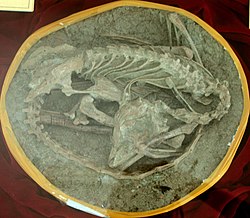
Holotype specimen of Mei long (IVPP V12733)
Life restoration of the juvenile type specimen
Size of the holotype, compared to a human.

Mei is a troodontid, a group of small, bird-like, gracile maniraptorans. All troodontids have many unique features of the skull, such as closely spaced teeth in the lower jaw, and large numbers of teeth. Troodontids have sickle-claws and raptorial hands, and some of the highest non-avian encephalization quotients, meaning they were behaviourally advanced and had keen senses.[1]

The type fossil is a young juvenile about 53 centimetres (21 in) long, complete and exceptionally well preserved in three-dimensional detail, with the snout nestled beneath one of the forelimbs and the legs neatly folded beneath the body, similar to the roosting position of modern birds. This posture provides another behavioral link between birds and dinosaurs.[2] The chemistry of the matrix stone and the resting pose indicate the living animal was probably buried instantly in volcanic ash. A second specimen, DNHM D2154, was also preserved in a sleeping posture. Although DNHM D2154 exhibits several juvenile-like features including free cervical ribs, unfused frontals and nasals, and a short snouted skull, other attributes, full fusion of all neurocentral synostoses and the sacrum, and dense exteriors to cortical bone, suggest a small, mature individual. Microscopic examination of tibia and fibula histology confirms maturity and suggests an individual greater than two years old with slowed growth. Mei is notable as a distinct species of troodontid based on several unique features, including extremely large nares. It is most closely related to the troodontid Sinovenator, which places it near the base of the troodontid (bird like) family.[3]

As a basal troodontid, unlike advanced troodontids, it has a bird like hip structure shared with many advanced maniraptorans.

Palaeoecology

[edit]

Mei lived in the Early Aptian stage of the Cretaceous period, about 125.8 million years ago. At this time, the Liaoning area was dominated by numerous volcanoes in a landscape that was covered in coniferous forest, with an understory of ferns and other plants like large horsetails. Several other trees were present, such as ginkgos and araucarias. Some of the earliest flowering plants were also found here. Rivers and streams coming down from the flanks of the volcanoes fed into lakes in the valleys.[citation needed]

There were many species of small birdlike theropod dinosaurs living in the area, although most of them were slightly larger than Mei. This probably led to a lot of niche partitioning. There were only five or six species of herbivorous non-theropod dinosaurs, however, and a large and varied fauna of early mammals and pterosaurs. The apex predator was the 9-meter-long tyrannosauroid Yutyrannus, which would have preyed on the two or more species of sauropod. Often, volcanoes erupted, entombing animals in ash and suffocating others with carbon monoxide, which accounts for the high level of preservation of fossils.[citation needed]

Mei probably fed on small lizards and insects on the forest floor. It probably climbed trees as well to shelter from larger predators, and was probably not omnivorous. Judging by the length of the legs, it was a fast runner. Nothing is known about its nesting habits.[citation needed]

When the first fossil of Mei was discovered, scientists were charmed to see the fossil in a birdlike sleeping posture. Mei long means 'sleeping dragon' in Chinese. The animal had probably died from carbon monoxide poisoning, then became entombed in ash.[citation needed]

See also

[edit]
  • Timeline of troodontid research
  • Changmiania
  • The dictionary definition of at Wiktionary

References

[edit]
[edit]
Revisions and contributorsEdit on WikipediaRead on Wikipedia
from Grokipedia
Mei is a of small troodontid theropod dinosaur from the epoch, renowned for its exceptionally preserved fossils showing an avian-like sleeping posture. The , Mei long (meaning "soundly sleeping dragon" in Chinese), was a feathered, bird-like approximately 53 cm long and weighing around 420 grams, comparable in size to a modern . Fossils of Mei long have been discovered in the of Province, northeastern , dating to about 125–129 million years ago during the stages. The specimen (IVPP V12733), a nearly complete juvenile , was found curled with its head tucked under its and wrapped around its body, suggesting it died while in a position similar to that of modern birds. This posture provides rare evidence of behavioral traits in non-avian dinosaurs and supports hypotheses of warm-bloodedness and close evolutionary ties to avialans. A second, more mature specimen (DNHM D2154) was later described, revealing additional details such as a large naris extending over half the maxillary row, unfused , and histological evidence of multi-year growth with lines of arrested growth indicating an age of over two years at death. This second specimen was also preserved in a posture similar to the . As a basal troodontid within , Mei long exhibits primitive features like a small and wide caudal vertebrae, alongside derived traits such as a U-shaped (wishbone) and long hindlimbs suited for agility. Its ecology likely involved an insectivorous or omnivorous diet, with possible scansorial () abilities inferred from its limb proportions. The discovery of Mei long, first reported in 2004 by Xu Xing and Mark Norell, underscores the importance of the in revealing transitional forms between dinosaurs and birds.

Discovery and naming

Etymology

The genus name Mei long is derived from Chinese, combining "mèi" (寐), meaning "sleeping" or "sound asleep," with "lóng" (龍), meaning "dragon." Paleontologists Xu Xing and Mark A. Norell formally named the taxon in 2004, publishing the description in the journal Nature. The name alludes to the holotype specimen's preservation in a bird-like sleeping posture, underscoring its avian affinities as a non-avian dinosaur.

History of discovery

The first specimen of Mei long (IVPP V12733) was discovered in 2004 within the of western Province, , a key site within the known for its exceptionally preserved fossils. This find was made by a collaborative team from the Institute of Vertebrate Paleontology and Paleoanthropology (IVPP) in and the (AMNH) in New York. The lead researchers, Xu Xing from the IVPP and Mark Norell from the AMNH, described the specimen in a 2004 publication in , formally naming it Mei long and highlighting its preservation in a bird-like sleeping posture. A second, nearly complete articulated specimen (DNHM D2154) was later recovered from the same formation, also preserved in a sleeping posture, and described in 2012. Histological analysis of the and from this specimen revealed multiple lines of arrested growth in the cortical , indicating an age of more than two years and confirming its maturity despite some juvenile-like features. This analysis involved thin-section preparation and microscopic examination, showing fibro-lamellar tissue consistent with rapid growth typical of small theropods. The fossils date to the Lower Cretaceous period, specifically the Early Aptian stage, approximately 125.8 million years ago, and are preserved in finely laminated deposits that facilitated their exceptional articulation. These taphonomic conditions, resulting from episodic volcanic activity, are characteristic of the and contributed to the rapid burial and mineralization of the specimens.

Description

Known specimens

The known specimens of Mei long comprise two nearly complete, articulated skeletons recovered from the Lujiatun Beds of the Lower in western Province, . The (IVPP V12733) consists of a single, nearly complete juvenile , measuring approximately 53 cm in total length from snout to tail tip. It is preserved in three dimensions without compression, with the curled in a sleeping posture—head tucked beneath the right forelimb and tail wrapped around the body—indicating rapid burial and no evidence of scavenging or post-mortem transport. The juvenile nature of this specimen, evidenced by unfused neurocentral sutures and other elements, influences size estimates for the species by representing an ontogenetically immature individual. A referred specimen (DNHM D2154) represents a more complete mature individual, including the , complete cervical series, partial dorsal series, complete and ilia, nearly complete hind limbs, caudal series, and most elements. Although its estimated total length is shorter at approximately 32.5–40 cm (with individual elements averaging 83% the size of those in the ) and mass around 0.42 kg, histology of the and reveals multiple lines of arrested growth, dense cortical , full neurocentral fusion, and of an external fundamental , confirming maturity, an age exceeding two years, and that it reached skeletal maturity at a small body size. Like the , it is preserved three-dimensionally in a mirrored sleeping posture, encased in green with fine sand-sized clasts, suggesting similarly rapid entombment without disturbance. As of 2025, no additional referred material for Mei long has been formally described.

Anatomical features

Mei long was a small-bodied, bipedal theropod dinosaur, measuring approximately 53 cm in total length, with a proportionally small that was about 75% the length of the , a short trunk, and notably long, slender hindlimbs that emphasized in locomotion. The forelimbs were , featuring a three-fingered hand with a slender that reached about 95% of the humeral length, allowing for avian-like folding. The hindlimbs exhibited subarctometatarsalian feet, with a that had wide proximal and distal ends, supporting efficient bipedal movement. The of Mei long displayed several distinctive features, including extremely large nares that extended posteriorly over more than half the length of the maxillary tooth row, accompanied by a large . It housed around 24 tightly packed, unserrated, and recurved maxillary teeth, with a short , a large , and reduced postorbital and squamosal bones, contributing to a low, steep anterior profile. Additional cranial details include a low (about 1.4 mm deep) with a small, narrow maxillary , a broad and posteriorly convex frontal that remained unfused, and a with a steep dorsal border and stout caudal process. As a troodontid, Mei long possessed one of the highest encephalization quotients among non-avian dinosaurs, indicating a relatively large that supported advanced , inferred from the enlarged orbits and overall cranial proportions. Mei long exhibited a hypertrophied, sickle-shaped on the second pedal digit (retracted hallux), which was less pronounced than in derived dromaeosaurids but still indicative of predatory adaptations. The ilium was strongly sigmoid in shape and wider caudally, while the metacarpal III was longer than metacarpal II (14.3 mm versus 13 mm). Feathers were not directly preserved in the known specimens of Mei long, but their presence is inferred based on the feathered condition of closely related troodontids and other theropods from the . The specimen was preserved in a unique posture, with the head tucked posteriorly under the right , the tail curled around the body, and the legs folded beneath, closely resembling the roosting position of modern birds and unprecedented among non-avian dinosaurs. The of Mei long represents a juvenile , as evidenced by unfused cranial sutures and proportionally larger head and eyes relative to body size compared to adults, though the astragalus and calcaneum were fused, suggesting it was approaching maturity. The included elongate with narrow, keeled centra and unfused ribs, a that widened caudally with an extremely elongate combined length of the fourth and fifth sacral processes (22.2 mm), and caudal vertebrae with elongate centra and a dorsal sulcus beginning around the tenth vertebra. The tibiotarsus featured a large distal articular surface that extended caudally onto the .

Classification

Taxonomic history

Mei long was formally described and named in 2004 by paleontologists Xing Xu and Mark A. Norell, based on a nearly complete articulated juvenile specimen ( IVPP V12733). They classified it within as a basal member, positioned as the sister to Sinovenator, supported by shared derived traits including a hypertrophied second pedal ungual and braincase features such as an expanded, hourglass-shaped supraoccipital crest with distinct epiotic and opisthotic ossifications. The type locality for Mei long is the Lujiatun Member of the at Shangyuan, near Beipiao City, western Province, . In a 2012 study, et al. described a second nearly complete specimen (DNHM D2154) and reaffirmed its troodontid status as a basal member through phylogenetic analysis, though the juvenile characteristics of the —such as unfused cranial elements and free —introduced early uncertainty regarding its precise placement. Subsequent phylogenetic work by Shen et al. in 2017 resolved this by placing Mei long within the Sinovenatorinae, a clade of small-bodied troodontids from the of eastern that includes Sinovenator, Sinusonasus, and Daliansaurus, highlighting a localized in the region. No synonyms have been proposed for Mei long, and the original binomial name remains valid with no major taxonomic debates as of 2025.

Phylogenetic position

Mei long is classified within the Troodontidae, a family of small-bodied theropod dinosaurs belonging to the Paraves clade of Maniraptora and the broader Coelurosauria subgroup of Theropoda. It occupies a basal position within Troodontidae, consistently recovered as such in cladistic analyses since its description. The closest relatives of Mei long include Sinovenator changii, with which it forms a sister taxon relationship at the base of the family. Together, they are part of the Sinovenatorinae subclade, which encompasses several Early Cretaceous troodontids from , such as Sinusonasus and Daliansaurus. This grouping highlights the early diversification of troodontids in the of northeastern . Key synapomorphies supporting Mei long's placement in include asymmetrical manual digits adapted for grasping, enlarged olfactory bulbs indicative of enhanced olfactory capabilities, and a specialized pedal morphology featuring an enlarged, sickle-shaped second ungual. These traits are shared across troodontids and underscore their paravian affinities, positioning the family as a close to (birds) within . For instance, the large relative to body size in Mei long, inferred from cranial proportions, and its skeletal features enabling flexed postures, bolster hypotheses of arboreal or adaptations in basal maniraptorans. Phylogenetic analyses incorporating Mei long have utilized character matrices focusing on cranial, postcranial, and pedal features, recovering it as a basal troodontid in studies from 2004 onward. Early analyses placed it as the sister to Sinovenator, while later matrices, including expanded datasets with additional Asian troodontids, yield a polytomy at the base involving Mei long, Byronosaurus, and Talos, with strong support (Bremer decay indices >1). Post-2010 studies, such as those incorporating new specimens, have not altered this basal positioning, reinforcing the stability of troodontid ingroup relationships.

Paleoecology

Paleoenvironment

Mei long inhabited the , the basal unit of the Jehol Group in western Province, northeastern , during the period, specifically the stage approximately 126 to 124 million years ago. This formation consists primarily of volcanic-influenced lacustrine deposits, including finely laminated shales, mudstones, and tuffaceous layers formed in a series of ancient lakes within a karst-dominated landscape surrounded by volcanic terrain, with ash falls from nearby eruptions contributing to the sedimentary record. The depositional environment reflects a dynamic landscape shaped by episodic volcanism and karst processes, where collapses of paleocave systems periodically disrupted the . The paleoclimate of the was temperate and humid, with mean annual air temperatures estimated at 5.9 to 10 °C (ranging from 5.9 ± 1.7 °C at higher-elevation sites like Sihetun to 10 ± 4 °C regionally), indicating cooler conditions than previously thought for the , accompanied by marked seasonality including wet summers and cold winters with possible snowfall. Vegetation was dominated by coniferous forests comprising araucarian conifers and ginkgophytes such as Ginkgoites, alongside ferns, cycads, and the earliest evidence of angiosperms like , preserved as compressed fossils in the fine sediments that capture a diverse adapted to this humid, forested lakeside habitat. Early palynological studies suggested a warm-temperate climate, though more recent analyses indicate overall cool temperate conditions with periodic aridity influenced by volcanic activity. The is renowned for the , a highly diverse terrestrial and freshwater assemblage that includes feathered theropods such as and , early avialans like , primitive mammals including , abundant fish such as Lycoptera, and a rich array of , amphibians, and pterosaurs, reflecting a complex with intricate food webs. Recent studies suggest mass mortality episodes resulted from collapsing paleokarst systems and fluvial events rather than volcanic catastrophes, as evidenced by concentrations of articulated skeletons and mixed terrestrial-aquatic assemblages within single horizons, which buried organisms rapidly and preserved them in death assemblages. Taphonomic conditions in the were exceptional due to the fine-grained, anoxic lacustrine sediments interbedded with volcanic ash, which facilitated the rapid entombment and mineralization of soft tissues, feathers, and even behavioral postures in fossils, minimizing decay and scavenging. This Lagerstätte-style preservation, often occurring within varved layers indicating seasonal deposition, has yielded over 100,000 specimens, providing unparalleled insights into the contemporaneous biota. collapses and fluvial reworking contributed to the and transport of some remains while protecting others from post-mortem alteration, enhancing the fidelity of the fossil record.

Inferred biology and behavior

Mei long was likely an or predator of small vertebrates, as inferred from its numerous unserrated, recurved, and closely packed teeth suited for piercing soft-bodied prey. The small size of , estimated at around 420 grams for the referred specimen, further supports a diet focused on or diminutive animals rather than larger quarry. Some evidence from tooth morphology also allows for possible omnivory, including incidental plant matter. Locomotion in Mei long was primarily bipedal, with long hindlimbs relative to the trunk enabling agile, knee-based running similar to that of modern birds. The elongated metatarsals and tibiotarsus indicate enhanced speed and maneuverability on the ground. Features such as relatively long forelimbs and grasping pedal claws suggest potential arboreal capabilities, allowing or perching in trees or elevated for foraging or rest. The specimen preserves Mei long in a bird-like roosting posture, with the head tucked under the , hindlimbs folded, and wrapped around the body, indicative of a stereotypical sleeping shared with modern avians. This posture implies homeothermic and possibly nocturnal or crepuscular activity to avoid daytime predators. The referred specimen's similar preservation suggests death by rapid asphyxiation, potentially from suffocation during or burial events in the . Growth in Mei long followed a pattern typical of maniraptoran theropods, with rapid early development transitioning to slower rates in maturity; bone histology reveals fibro-lamellar tissue with lines of arrested growth, indicating the referred specimen was over two years old and approaching adulthood. The shows juvenile traits like unfused cranial sutures, contrasting with the more mature referred specimen, highlighting ontogenetic variation without evidence for nesting or behaviors. As a small-bodied theropod, Mei long likely served as prey for larger carnivores in the ecosystem, such as the tyrannosauroid huali, the dominant capable of subduing diminutive dinosaurs through its size and predatory adaptations.
Add your contribution
Related Hubs
User Avatar
No comments yet.