Hubbry Logo
Mersey RailwayMersey RailwayMain
Open search
Mersey Railway
Community hub
Mersey Railway
logo
8 pages, 0 posts
0 subscribers
Be the first to start a discussion here.
Mersey Railway
Mersey Railway
from Wikipedia

Mersey Railway
The Illustrated London News showing the opening of the Mersey Railway Tunnel
Overview
Dates of operation1886–31 December 1947
SuccessorBritish Railways
Technical
Track gauge4 ft 8+12 in (1,435 mm)

The Mersey Railway was the passenger railway connecting the communities of Liverpool and Birkenhead, England. It is currently a part of the Merseyrail network. It was extended further into the Wirral Peninsula, which lies on the opposite bank of the River Mersey to Liverpool. Both sides of the river were connected via the Mersey Railway Tunnel. The railway opened in 1886 with four stations using steam locomotives hauling unheated wooden carriages; in the next six years the line was extended with the opening of three more stations. Using the first tunnel under the Mersey, the line is the world's oldest underground railway outside London.[1]

Because the steam locomotives created a polluted atmosphere in the tunnel despite the forced ventilation system, many passengers reverted back to using the river ferries making the railway bankrupt by 1900. Recovery came after the railway adopted electric traction in 1903. The Mersey Railway remained independent after the railway grouping of 1923, although it became closely integrated with the electric train services operated by the London, Midland and Scottish Railway over the former Wirral Railway routes after 1938. The Mersey Railway was nationalised, along with most other British railway companies, in 1948.

History

[edit]

Origins

[edit]

Records exist of a ferry service across the River Mersey between Birkenhead on the west bank and Liverpool on the east since the Middle Ages. In 1332 the monks of Birkenhead Priory were granted exclusive rights to operate a ferry; following the dissolution of the monasteries these rights passed through a number of operators eventually to the township of Birkenhead.[2]

Mersey Railway Act 1866
Act of Parliament
Citation29 & 30 Vict. c. cxxxix
Mersey Railway Act 1871
Act of Parliament
Citation34 & 35 Vict. c. cci
Dates
Royal assent14 August 1871
Text of statute as originally enacted

It is recorded that Marc Isambard Brunel suggested a road tunnel when designing the Birkenhead docks and from the 1850s a railway tunnel under the Mersey was proposed several times. The Mersey Pneumatic Railway Company received permission for a single line pneumatic railway in the Mersey Railway Act 1866 (29 & 30 Vict. c. cxxxix) but failed to raise the necessary capital. Renamed the Mersey Railway Company, they were given the necessary permissions in the Mersey Railway Act 1871 (34 & 35 Vict. c. cci) for an orthodox two track railway connecting the Birkenhead Railway near their Rock Ferry station through a tunnel under the Mersey to an underground station serving Liverpool.[3] However the company found it difficult to raise the necessary funds until Major Samuel Isaac undertook to build the railway in 1881. He contracted construction to John Waddell, who appointed Charles Douglas Fox and James Brunlees as Engineers.[4]

1886 illustration showing the ventilation and drainage system

Construction of the river tunnel started from two 180 feet (55 m) deep shafts, one on each bank, containing water pumps. Three tunnels were to be dug, one for the two tracks, a drainage tunnel and a ventilation tunnel. A 7 feet 2 inches (2.18 m) diameter ventilation tunnel was dug as the pilot heading. Some 38 million bricks were used for the construction of the main tunnel.[5] When the tunnel was opened, fans on both banks changed the air in the tunnel every seven minutes.[6]

The geology of the riverbed meant that the plans were changed and at the deepest section the drainage and ventilation tunnels combined. The grade on the Liverpool side was increased to 1 in 27.[7] Estimates of the influx of water varied from 5,000 imp gal (23,000 L) to 36,000 imp gal (160,000 L) per minute; after the works were completed the maximum pumped out of the tunnel has been 9,000 imp gal (41,000 L) per minute.[8] There were two pumping stations, Shore Road Pumping Station on the Birkenhead bank near Hamilton Square and Georges Dock Pumping Station on Mann Island on the Liverpool Bank.[9] The railway's workshop was built next to Birkenhead Central; stabling was also provided at Birkenhead Park.[10]

Opening and extensions

[edit]
Mersey Railway
Liverpool Central
0-0
James Street
0-53
Hamilton Square
1-67
1-72
2-69
Birkenhead Park
3-5
Birkenhead Central
2-30
Green Lane
2-64
Rock Ferry
3-46

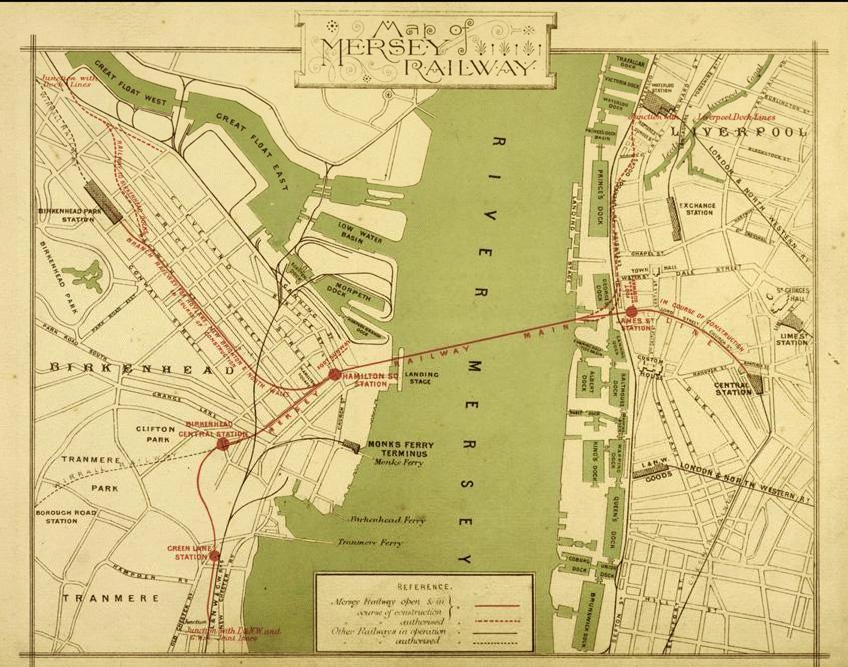
The Mersey Railway was formally opened on 20 January 1886 and public services started on 1 February.[11] The route had four new stations: Green Lane, Birkenhead Central and Hamilton Square in Birkenhead and James Street station in Liverpool. Green Lane and Birkenhead Central were below ground level in open cuttings whereas James Street and Hamilton Square were deep underground and accessed by lifts.[12]

In 1888 a branch tunnel to Birkenhead Park station opened, with a connection to the Wirral Railway. This was followed in 1891 by an extension from Green Lane to bay platforms at the Birkenhead Railway's Rock Ferry station, and in 1892 the tunnel was extended from James Street to a new underground station at Liverpool Central.[11]

The railway opened with steam locomotives hauling four-wheeled 27 feet (8.2 m)-long wooden carriages, with first-, second- and third-class accommodation provided in unheated compartments.[13] In 1900 in the peak periods trains left the Rock Ferry terminus every 7+12 minutes and the Birkenhead Park terminus every 15 minutes, giving a train every 5 minutes between Hamilton Square and Liverpool Central. At off-peak times this was reduced to a train every 7+12 minutes, alternately from the Rock Ferry and Birkenhead Park branches. The scheduled journey time between Rock Ferry and Central was 14 minutes; between Birkenhead Park and Central, 10 minutes.[14]

As well as some through working of carriages from the Wirral Railway at Birkenhead Park, in the summer of 1899 a through service worked from Liverpool to Folkestone Harbour; carriages were taken to Rock Ferry, and there attached to a GWR Paddington express train; the carriages were slipped at Reading before being taken on to Folkestone attached to another train.[15] Connecting ferries and trains allowed Paris to be reached in under 15 hours.[16]

Electrification

[edit]

The traffic peaked in 1890, when ten million passengers were carried, and then declined.[17] Two years previously the company had been declared bankrupt and receivers appointed, because it was unable to pay the charges on its debt. Steam locomotives running at five-minute headways left a dirty atmosphere in the tunnel that the mechanical ventilation was unable to remove, so many passengers preferred the ferries.[18]

Mersey Railway Act 1900
Act of Parliament
Long titleAn Act to authorise the working of the Mersey Railway and railways connected therewith by electricity to regulate the capital of the Mersey Railway Company and for other purposes.
Citation63 & 64 Vict. c. cxxxiv
Dates
Royal assent30 July 1900
Text of statute as originally enacted

Some other urban railways had been constructed for electric traction: in 1890 the City and South London underground tube had opened with electric traction, followed in 1893 by the more local Liverpool Overhead Railway. Plans for electrification of the Mersey Railway in 1895 were shelved because the company and its investors were fighting in the courts. In 1897 a new board of directors was elected, and in 1898, £500 was released for further expert advice that recommended electrification at a cost of £260,000[19] (equivalent to £36,580,000 in 2023).[20] By then, the railway had attracted the attention of George Westinghouse, an American in the UK looking for business for his UK works, the British Westinghouse Electric and Manufacturing Co. Ltd, that opened at Trafford Park in 1899.[21] Westinghouse considered the railway would be profitable with electric traction and undertook to fund the project, promising to complete in eighteen months. Electrification was approved by Parliament in the Mersey Railway Act 1900 (63 & 64 Vict. c. cxxxiv), which also terminated the bankruptcy, and in July 1901 the Westinghouse contract was signed.[22]

Sign advertising electric services at James Street.

All electrical equipment was shipped from the US, including power system plant equipment.[23] A power station was built at the Shore Road pumping station and was designed to accommodate the extension of electrification to the Wirral Railway, although that did not occur until 1938. The conductor rails were fed direct, without any distribution. Four-rail 600 V DC electrification was installed, with the positive outer rail set 22 inches (560 mm) from the running rail.[24][25] The new electric multiple units, initially marshalled as 2-car or 4-car sets, had British-built wooden bodies on US bogies. 24 motor cars and 33 trailer cars were provided. The driving positions controlled all the motors on the train by the means of a low voltage control signal.[25]

After inspection by the Board of Trade, the line was approved as fit for traffic on 3 April 1903. The last steam trains ran on Saturday 2 May and the current to the electrified rails was switched on at 3:30 am. At 4:53 am the first electric train arrived at Liverpool Central, and for the Sunday morning trains ran at 3-minute intervals without passengers. Passengers were admitted when the advertised Sunday service started at noon.[26]

The stations were cleaned, whitewashed and electrically lit. A service was provided every three minutes from Liverpool Central to Hamilton Square and journeys were faster: Central to Rock Ferry was eleven minutes, down from fifteen minutes and the Central to Birkenhead Park journey was reduced by two minutes, down to eight minutes.[27]

There was a maximum of four cars per train in 1904, which was raised to five cars in 1909.[28] In 1923, automatic signalling was commissioned at Liverpool Central[29] and in 1927 the island platform was widened, the work being completed in a weekend.[28] The maximum number of cars in a train was raised to six in 1936, after the tunnels at the east end of Liverpool Central had been extended.[30]

Wirral Railway

[edit]
A 1938 Class 503 unit in Liverpool.

As a local railway the Mersey Railway remained independent in the 1923 grouping, although the Wirral Railway became part of the London, Midland and Scottish Railway (LMS). The Wirral had authority to electrify its lines, but had not done so, and passengers making through journeys had to change at Birkenhead Park. In 1926 discussions started on electrification and through running.[31] The Wirral section was electrified with a DC third rail system, the Mersey Railway retaining its fourth rail but moving the positive conductor to 16 inches (410 mm) from the running rail. The Mersey Railway electric multiple units were modified to run to the Wirral railway,[32] and at the same time heaters and air compressors were added.[33]

In 1938 the LMS introduced new lightweight three car multiple units that were later, under British Rail, to be classified Class 503.

Nationalisation and legacy

[edit]

In 1948, on nationalisation of the railways, the Mersey Railway became the Mersey section of the London Midland Region.[34] In 1956 these trains were replaced by Class 503 units, similar to the LMS Class 502 design, and the fourth rail removed. The last of the American-designed cars was withdrawn a year later.[35]

A single track loop line was built between 1972 and 1977, and since 1977 trains from James Street have travelled round the loop calling at Moorfields, Liverpool Lime Street and a new platform at Liverpool Central before returning to James Street.[36][37] The original two platforms at Liverpool Central were reused as part of the Northern Line. The tunnel and railway are still in use today as part of the Wirral Line of the Merseyrail commuter rail network.

Shore Road Pumping Station in Birkenhead was a museum until closure sometime before 2014. Georges Dock Pumping Station on Mann Island in Liverpool is a grade II listed building.[38]

Rolling stock

[edit]

Steam locomotives

[edit]
Mersey Railway 0-6-4T No. 5 "Cecil Raikes" at Steamport, Southport in May 1988, showing the condensing pipes

For the opening of the line, eight powerful 0-6-4 tank locomotives were obtained from Beyer, Peacock and Company, fitted with condensing apparatus for working in the tunnel. Designated as Class I, a ninth followed within six months. Beyer Peacock also built six 2-6-2T tank locomotives in 1887 (Class II) and three further 2-6-2T (Class III) were built by Kitson and Company in 1892.[39][40]

The 0-6-4Ts were built with steam and vacuum brakes and steam reversing gear and weighed 67 long tons (68 t). The 2-6-2Ts were fitted with vacuum brakes only; those built by Beyer weighed 62+12 long tons (63.5 t) and Kitson's 67+12 long tons (68.6 t).[40]

As electrification progressed, the old rolling stock was advertised for sale. An attempt to sell the 18 locomotives and 96 carriages by auction in June 1903 proved unsuccessful – the auctioneer had to remind the bidders that he was not selling scrap.[41] It was September before the first locomotive was sold; it would take another two years to sell all-bar-one of the locomotives. The last locomotive — which had been retained for working permanent way trains — was sold in January 1908.[42]

The first to be sold was No. 5 Cecil Raikes, which was bought by Shipley Collieries for £750. They came back and bought No. 8 for £650; but not before Alexandra (Newport and South Wales) Docks and Railway had bought all six of the Class II locomotives for £3,450.[42] They became ADR 6–11 (not in order). Alexandra Docks later bought four more locomotives: Three 0-6-4T (Nos. 2, 3 and 6), and one Class III 2-6-2T (No. 16), these becoming 24–22 and 25.[42] All ten ADR locomotives passed to the Great Western Railway in January 1922, and were withdrawn between January 1923 and May 1932.[43][44]

The other two Class III locomotives were bought by Whitwood Colliery for £1,240.[42]

The last four locomotives (Nos. 1, 7, 9 and 4)[42] were sold to J & A Brown (as their Nos. 5–8) for use on the Richmond Vale railway line in New South Wales, Australia.[45] No. 4 Gladstone had been retained by the Mersey Railway until 1907 for departmental use, but was then replaced by Metropolitan Railway A Class (4-4-0T) No. 61, built by Beyer Peacock. This was replaced in 1927 by an earlier Metropolitan Railway 4-4-0T, No. 7.[46]

Two of the Class I locomotive have been preserved: No. 5 Cecil Raikes is preserved at the Museum of Liverpool;[47] and No. 1 The Major is preserved at the NSW Rail Museum, Thirlmere, New South Wales.

Locomotive-hauled coaching stock

[edit]

Between 1904 and 1907 thirteen four-wheeled gas-lit coaches were sold to the Liskeard and Looe Railway.[note 1] Built by the Ashbury Railway Carriage and Iron Company Ltd between 1885 and 1888, the sale price was between £20 and £70 each. In 1912, the six surviving examples were sold on to the Rhondda and Swansea Bay Railway.[48][49][page needed]

Electric multiple units

[edit]
Electric multiple unit on the Mersey Railway

In 1903 24 motor cars and 33 trailers were provided by Westinghouse. The stock was of an American design, with a clerestory roof and open gated ends. Unheated accommodation was in saloons and the wooden bodies were British built, and the bogies had been made by Baldwin Locomotive Works in America. First- and third-class cars were provided, the first-class seats being of natural rattan and the third-class seats being moulded plywood. The livery was maroon with white roofs and "Mersey Railway" in gold leaf on the upper fascia panels.[50] Air brakes were provided with storage reservoirs that were recharged from static compressors at the terminal stations.[33] The motor cars were powered with Westinghouse motors controlled by the Westinghouse low voltage multiple unit train control system.[25]

An additional four trailers were received in 1908[51] followed in 1923 by two more motor cars and in 1925 a new five-car train. To allow the introduction of 6-car trains in 1936, ten trailer units were ordered. The later cars did not have a clerestory roof,[note 2] but any car could work in multiple with any other car.[30]

When the cars were modified to run to the Wirral railway,[32] heaters and air compressors were added.[33] The cars were replaced by vehicles similar to the Wirral Railway units in 1956–57.

Car no. 1, a first-class motor coach, was destroyed in a fire at Derby Litchurch Lane Works, where it had been taken for overhaul in preparation for restoration and preservation.[53]

Preservation

[edit]

Only two of the Class I locomotive have been preserved: No. 5 Cecil Raikes is preserved at the Museum of Liverpool;[54] and no. 1 The Major is preserved at the NSW Rail Museum, Thirlmere, New South Wales, Australia.

References and notes

[edit]
[edit]
Revisions and contributorsEdit on WikipediaRead on Wikipedia
from Grokipedia
The Mersey Railway was a pioneering underground company in the , operating a 3.12-mile (5.02 km) double-track line through the first tunnel beneath the River Mersey, connecting on the north bank to on the south bank from its opening on 20 January 1886 until its absorption into British Railways on 1 January 1948. The line, authorized by in as the Mersey Tunnel Company and constructed under challenging engineering conditions including a maximum gradient of 1 in 27, initially relied on hauling wooden carriages, serving four stations: James Street in , Hamilton Square and Green Lane in , and . Despite rapid success—carrying over 10 million passengers annually by 1890—the railway faced financial difficulties exacerbated by the smoky and uncomfortable conditions of steam operation in the confined tunnel, leading to bankruptcy in 1900 and subsequent electrification in 1903 using a 600 V DC fourth-rail system supplied by George Westinghouse, making it the first underground railway in the UK to be fully converted from steam to electric traction and revitalizing passenger numbers. Extensions followed, including a connection to Liverpool Central station in 1892 and links to the Wirral Railway at Birkenhead Park in 1888 and Rock Ferry in 1891, enhancing regional connectivity. The tunnel itself, designed by civil engineers Sir Charles Fox and his son Douglas Fox and built by contractors John Waddell and Sons using innovative Beaumont shield tunnelling machines sunk from 170-foot-deep shafts on each side of the river, measured 26 feet wide and 19 feet high from rail to arch, representing a major feat of Victorian engineering that influenced later subaqueous projects. Post-nationalization, the infrastructure became integral to the modern network, with the original tunnel still in use on the today, underscoring its enduring legacy in urban .

History

Origins and Planning

During the industrial boom of the , and saw rapid population and , leading to severe overcrowding on the Mersey ferries that served as the primary crossing between the two towns. By 1862, the ferries transported over 10 million passengers annually, with below-deck cabins described as "the most miserable places" due to poor ventilation, dampness, and overcrowding, prompting calls for alternative transport solutions to alleviate the strain on river crossings. The Mersey Pneumatic Railway Company was incorporated in 1866 to address this need by proposing an underground railway tunnel beneath the River Mersey, with Sir Charles Fox serving as a principal involved in the early . The scheme received parliamentary authorization through the Mersey Railway Act 1866 (29 & 30 Vict. c. cxxxix), which empowered the company to construct a single-line pneumatic railway connecting to . Investor skepticism over the feasibility of pneumatic propulsion and delayed progress, as the company struggled to raise sufficient funds. In response, the Mersey Railway Company was restructured, and the Mersey Railway Act (34 & 35 Vict. c. cci) was enacted on 14 August 1871, authorizing a conventional steam-powered instead, with modifications to the route including requirements for a minimum depth of approximately 40 feet below the riverbed to ensure stability and provisions for systems to manage smoke and air quality in the . Prior to construction, extensive site surveys and geological assessments were conducted, confirming the suitability of the sandstone underlying the River Mersey, which offered a relatively stable medium for tunneling despite challenges from water-bearing strata. These evaluations involved triangulation measurements across the and the sinking of deep trial shafts up to 170 feet to test rock conditions and risks.

Construction and Opening

Construction of the Mersey Railway began in August 1881, following the company's incorporation by in 1866 and subsequent delays in securing funding and approvals. The project, the first to connect and via an under-river rail tunnel, was led by engineers Sir James Brunlees and Sir Charles Douglas Fox, with construction carried out by John Waddell and Sons as subcontractors under Major Samuel Isaac. The tunnel, measuring 5,029 meters in length, was excavated through a stable stratum of New Red Sandstone using conventional mining methods, avoiding the need for shield tunneling in the firm rock formation. By early , work had intensified, employing around 1,400 men and to advance the headings and surface . The tunnel breakthrough was achieved in , with the full line ready by late 1885. challenges included a significant flooding event in October 1883 during the driving of a ventilation heading beneath the river, which temporarily halted progress and underscored the hazards of subaqueous excavation. The project also saw five worker fatalities during , attributed to accidents in the demanding underground environment. Costs exceeded the original estimate of £500,000, reaching approximately £650,000 due to material shortages and geological surprises, though the line's completion marked a major milestone. The railway received formal approval for private opening on 20 January 1886, with public passenger services starting on 1 February 1886. The initial service operated between James Street station in and Green Lane station in , via underground stations at Hamilton Square and Birkenhead Central, using steam locomotives. Fares were set competitively at 3d for third class single tickets to rival the Mersey ferries, and the line quickly proved popular, carrying over 20,000 passengers in its first week of operation.

Extensions and Early Operations

Following its opening in 1886, the Mersey Railway expanded its network to enhance connectivity across the and beyond. In 1888, a tunnelled branch was constructed from Hamilton Square to , opening on 2 January and enabling an end-on connection with the Wirral Railway; this provided access to Bidston and further destinations on the Wirral system. Subsequent developments included a 1891 extension from Green Lane to bay platforms at , allowing interchange with the Birkenhead Railway and supporting growth toward Seacombe via the amalgamated Wirral network. In 1892, the tunnel was further extended eastward from James Street to a new underground Central Low Level station, improving Liverpool-side access. These additions, totaling around 3 miles of new track, integrated the Mersey Railway with broader routes reaching through Wirral and associated connections, effectively expanding operational scope by approximately 12 miles including linked lines. Early operations relied on equipped with condensing gear to manage ventilation, hauling unheated wooden carriages on intensive schedules. Services ran frequently between key stations like James Street and Hamilton Square, accommodating growing commuter demand. Passenger traffic peaked in 1890 at 10 million annually, reflecting daily peaks of around 30,000 users driven by cross-Mersey travel. The London and North Western Railway expressed acquisition interests as early as , leading to operational leases that influenced management through the . A notable incident occurred in with a collision at Hamilton Square station, resulting in injuries and prompting safety inquiries into signalling and operations. grew substantially from £50,000 in to £150,000 by 1900, fueled by commuter expansion. These steam-era developments laid the groundwork for later in the early 1900s.

Electrification

The electrification of the Mersey Railway was primarily driven by the severe smoke pollution generated by within the enclosed , which posed significant health and operational challenges. As early as , proposals were put forward to convert the line to electric traction to mitigate these issues and improve efficiency. After evaluating bids, the British Westinghouse Electric and Manufacturing Company was selected over competitors like to undertake the project, providing both the necessary equipment and financial backing. The technical implementation featured a fourth-rail (DC) system operating at 600 volts, which powered the trains without the need for overhead wires, suitable for the tunnel environment. Power distribution was supported by substations along the route to ensure reliable supply, with the main at Shore Road. The total cost of the electrification works amounted to approximately £600,000. Conversion began with experimental trials in 1902 to test the new infrastructure and rolling stock. Steam operations were fully withdrawn on 2 May 1903 to allow for final installations and cleaning of the tunnel, with electric services commencing on 3 May 1903, marking the world's first complete conversion of a steam underground railway to electric traction. The switch to electricity brought immediate performance enhancements, including an increase in maximum speed through the tunnel from 25 mph to 40 mph, which reduced the end-to-end journey time to 12 minutes. Initial operations supported a frequency of 15 trains per hour in each direction, contributing to a 20% rise in ridership within the first year.

Nationalisation and Closure

During , the Mersey Railway faced significant operational challenges due to increased military transport demands, which strained its infrastructure amid labor shortages and heightened traffic volumes across the British rail network. Blackout measures imposed nationwide further complicated operations, raising accident risks for railway staff and disrupting normal service patterns. The May Blitz of inflicted minor bomb damage on Liverpool's railways, including disruptions to tracks and facilities, though vital services were swiftly restored despite the broader devastation to the region's transport systems. Post-war, the Mersey Railway encountered mounting decline from competition with Mersey ferries and expanding bus services, exacerbated by the 1934 opening of the Queensway road tunnel, which shifted passenger preferences toward road-based travel. These factors contributed to reduced ridership, mirroring the broader contraction in urban rail usage as private vehicles proliferated. The 1947 Transport Act addressed the railways' financial and infrastructural woes by mandating nationalisation, vesting the Mersey Railway—along with other independent lines—into public ownership under the . The Mersey Railway's last independent operations concluded on 31 December 1947, with immediate integration into British Railways' Western Region on 1 January 1948, ending its status as a standalone entity while preserving its core tunnel route for continued suburban service. This transition marked the formal closure of the original company, though its infrastructure endured to underpin modern operations.

Infrastructure

Mersey Tunnel Engineering

The Mersey Tunnel represented a significant achievement in , with the section spanning about 2 miles within a approximately 3 miles long overall, internal dimensions of 26 feet wide by 19 feet high from rail to arch, and its crown situated 25-30 feet below the riverbed on average to navigate the challenging subaqueous environment. The tunnel's structure was lined with in , 2 feet 3 inches thick, in rock sections; cast-iron tubbing was used in water-bearing strata. These were installed progressively as excavation advanced, ensuring stability in the variable beneath the River Mersey. A sophisticated ventilation system was integral to the tunnel's design, featuring shafts approximately 170 feet deep to facilitate air circulation and remove fumes from . Steam-powered fans, supplied by , were positioned at these shafts and capable of circulating up to 232,000 cubic feet of air per minute total, dividing the tunnel into four ventilated sections to maintain breathable conditions for passengers and crew. This system, comprising four Guibal fans and one Indestructible fan driven by dedicated engines, addressed the unique challenges of smoke accumulation in a confined, enclosed space. Construction techniques were adapted to the geological conditions encountered, which included soft boulder clay overlying new red sandstone strata. In softer clay sections prone to water ingress, a shield method was utilized to protect workers during excavation, while hand-mining with picks, shovels, and controlled blasting using tonite was employed in the harder sandstone. Waterproofing was achieved through cement grout injection into fissures and the application of cast-iron tubbing with red-pine joints in water-bearing areas, supplemented by a 2-foot-3-inch-thick brick lining in cement mortar for additional impermeability. To support long-term maintenance, the tunnel incorporated emergency cross-passages connected to adjacent drainage and ventilation headings, providing escape routes and access for repairs; additionally, refuges spaced every 45 feet offered safe havens for track maintenance workers. These features ensured operational reliability in an environment subject to ongoing seepage and sediment shifts. The project's engineering drew direct inspiration from Marc Brunel's (1825), the world's first successful sub-river tunnel, adapting its shield-driven approach while innovating for railway use. Further advancements included early trials of electric lighting in 1885 using Hammond lamps powered by a , which illuminated works and previewed potential post-opening applications to reduce reliance on gas or oil lamps.

Stations and Route Layout

The Mersey Railway's core route, opened on 20 January 1886, comprised a 3.12-mile double-track line connecting James Street station in to Green Lane station in , traversing the River Mersey via an . The line featured steep gradients of up to 1 in 27 approaching the tunnel portals from both sides, with 1 in 30 gradients within the river section, necessitating powerful locomotives for steam operations. Initial stations included the underground termini at James Street () and Hamilton Square (), plus the surface stops at Birkenhead Central and Green Lane, providing direct links between the two cities. The route layout consisted of a single-bore approximately 26 feet wide and 19 feet high from rail to arch, accommodating twin tracks through the riverbed for about 2 miles, with the total extending roughly 3 miles including approach sections. At each end, the diverged into open cuttings and surface alignments, allowing trains to emerge above ground before re-entering short approach to the stations; the overall underground portion, including these extensions and later loops, measured around 6.5 miles. Underground stations at James Street and Hamilton Square were designed with island platforms, each 400 feet long, 51 feet wide, and 32 feet high, facilitating efficient passenger flow in the confined subterranean environment. Subsequent expansions altered the layout significantly. In 1888, a short branch from Hamilton Square extended to , enabling interchange with the Wirral Railway and access to its network. This was followed in 1891 by a 1.5-mile extension from Green Lane to , integrating with the Chester and Birkenhead Joint Railway. By 1892, a further extension from James Street reached the new Liverpool Central Low Level station, adding another underground mile and completing the primary alignment. These developments expanded the system to serve 14 stations collectively by 1892, through direct Mersey Railway stops and connected lines.
StationLocationOpening DateType
James StreetLiverpool1886Underground terminus (island platform)
Hamilton SquareBirkenhead1886Underground terminus (island platform)
Birkenhead CentralBirkenhead1886Surface
Green LaneBirkenhead1886Surface
Birkenhead ParkBirkenhead1888Surface (branch junction)
Rock FerryBirkenhead1891Surface (extension)
Liverpool Central Low Level1892Underground terminus (island platform)
Platform access evolved with the 1903 electrification, which introduced escalators at James Street and Hamilton Square to accommodate increased electric multiple unit services.

Signalling and Safety Systems

The Mersey Railway initially operated with manual semaphore signals upon its opening in 1886, manufactured by the Railway Signal Company of Fazakerley to control train movements through the tunnel and surface sections. These signals were supported by telegraph, telephone, and electric-repeating arrangements provided by John Lavender of Manchester, enabling communication between signal boxes and ensuring coordinated operations on the single-track tunnel sections. The line featured multiple signal boxes constructed between 1886 and 1892, built by the Railway Signal Company but varying in design to suit local requirements, such as those at Hamilton Square and James Street for managing tunnel entry and exit. By 1903, following the conversion to electric traction, the signalling system was upgraded to incorporate electric token block working, which replaced manual token exchange and improved on single-line sections by preventing unauthorized train entries into the tunnel. This upgrade coincided with the electrification, which eliminated steam locomotives and their associated smoke, thereby reducing accumulation in the enclosed tunnel environment from previous levels that had necessitated constant ventilation intervention. The original ventilation system, installed at opening and retained post-electrification, comprised five fans—four Guibal-type and one Indestructible-type—capable of circulating up to 232,000 cubic feet of air per minute to extract noxious gases, with the tunnel divided into four sections each served by dedicated fans for efficient air renewal. Emergency protocols for fire or gas buildup included manual fan activation and evacuation via station lifts and refuges spaced every 45 feet along the tunnel walls for worker . Safety innovations continued with the implementation of mechanisms at key points, such as tunnel portals, to avoid conflicting movements and ensure only one occupied the underground section at a time. These features were part of broader upgrades adhering to inspections, which mandated regular safety audits.

Rolling Stock

Steam Locomotives

The Mersey Railway initially relied on steam traction from its opening in 1886 until in 1903, employing tank locomotives designed specifically for the challenging conditions of the and steep gradients. The primary class consisted of nine 0-6-4T locomotives, known as Class I, built by between 1885 and 1886. These engines featured inside cylinders measuring 21 inches by 26 inches, the largest in Britain at the time, with a pressure of 150 psi and driving wheels of 4 feet 7 inches diameter, enabling them to haul 150-ton trains over inclines as steep as 1 in 27 and 1 in 30. A secondary class of seven 2-6-2T locomotives, designated Class II, supplemented operations, with six built by Beyer, Peacock in 1887–1888 and one by in 1892. Both classes incorporated condensing apparatus to minimize smoke and steam emissions within the confined environment, along with adaptations for reliable performance on curved track up to 14.5 degrees in sidings. The 0-6-4Ts had a capacity of 1,250 gallons and weighed approximately 67 tons 17 , generating a of 26,580 pounds to manage the route's demands. In service, these locomotives handled passenger trains through the 3.12-mile Mersey Tunnel between and , operating from maintenance facilities at . Notable among them was No. 5, named Cecil Raikes after the who championed the railway's enabling legislation. Each 0-6-4T cost £2,775 to build, reflecting their specialized design for underground . Upon in 1903, the condensing gear was removed from surviving engines, which were then sold for industrial use, including in Britain and .

Coaching Stock

The Mersey Railway's initial coaching stock comprised 50 four-wheeled third-class coaches constructed in 1885 by the Ashbury Railway Carriage and Iron Company Limited, each designed to seat 48 passengers and fitted with for illumination. The fleet was expanded with 20 composite coaches providing both first- and third-class accommodation, along with dedicated guards' vans equipped with braking mechanisms, reaching a total of approximately 100 vehicles by 1890 to support growing demand. These coaches featured adaptations for the tunnel environment, including smoke hoods positioned over the doors to mitigate exhaust accumulation during steam-hauled operations, while their construction utilized wooden frames atop iron undercarriages, resulting in an average weight of 12 tons per vehicle. Maintenance routines involved comprehensive overhauls every six months at the Central depot, where routine inspections and repairs ensured reliability; in 1902, selected units underwent modifications to prepare for the impending transition to electric traction. During peak operations in the steam era, typical train formations consisted of 4 to 6 coaches hauled by locomotives, enabling the railway to transport around 10 million passengers annually by 1890 and underscoring its role as a vital cross-Mersey link.

Electric Multiple Units

The Mersey Railway introduced its initial fleet of electric multiple units in 1903 following the completion of electrification works, comprising 12 three-car sets to a Westinghouse design with American-style clerestory roofs and open gated ends. Each motor car incorporated four 115 hp Westinghouse motors, allowing the units to achieve a top speed of 50 mph while operating through the tunnel and surface sections. These trains marked a significant shift from steam haulage, enabling more frequent services and improved reliability on the Liverpool to Birkenhead route. Additional trailers added in 1908 allowed for longer train formations to meet growing demand, with further four-car units built after by Cravens with equipment maintaining compatibility with the original and supporting extended operations to connect with the Wirral Railway network. The reflected the railway's adaptation to increasing passenger volumes, with modifications such as added heating and air compressors in 1938 to enhance comfort on longer runs. Key features of the electric multiple units included vestibuled gangways for seamless passenger movement between cars, for year-round comfort, and systems that recovered energy during deceleration, achieving approximately 20% energy savings compared to non-regenerative operation. Power collection was via a 600 V DC fourth-rail system, with rates of 2 mph per second enabling efficient handling of the steep gradients in the Mersey Tunnel. By 1947, the fleet had collectively covered 50 million miles, demonstrating the durability and operational success of the design. Under following nationalisation, the Mersey Railway units were progressively withdrawn during the 1950s as newer stock was introduced, with the final units phased out by around 1960.

Operations and Impact

Passenger and Freight Services

The Mersey Railway primarily focused on commuter passenger services connecting and from its opening in 1886 until nationalisation in 1948. Initial steam-hauled operations provided trains every 15 minutes, catering to the short 10-minute journey through the tunnel, with unheated carriages deemed sufficient for the brief duration. Following in 1903, services intensified to support growing demand, achieving peak-hour headways of 5 minutes and off-peak intervals of about 1 hour, emphasizing efficient urban transport. Fares were affordable for working-class commuters, starting at 1d for short trips between adjacent stations. Freight services were limited compared to passenger traffic, mainly handling goods to and from docks from 1888 into the 1940s. Nighttime trains transported , merchandise, and other commodities, often using the same as passenger lines to avoid congestion. These operations supported local industry but remained secondary, as the railway's design prioritized rapid passenger movement over heavy goods haulage. Timetables evolved significantly over the railway's lifespan to accommodate increasing usage and technological upgrades. Steam-era schedules in 1886 offered consistent 15-minute frequencies throughout the day, with minor adjustments for peak hours. By 1947, under British Railways management, electric services reached headways of 7.5 minutes during busy periods, reflecting improved capacity and reliability. Seasonal variations included enhanced frequencies in summer to serve , such as excursions to Wirral resorts, boosting off-peak ridership. Ticketing systems were designed to encourage regular use, with season tickets introduced in 1887 to attract daily commuters. By 1920, these had grown popular, which accounted for a substantial portion of annual revenue and stabilized passenger volumes. Single and return tickets complemented this, issued at stations and via onboard staff for convenience. The railway employed staff who managed the intensive operations. Union activities were prominent, particularly during the national railway strike of 1919, when Mersey Railway workers joined broader demands for better wages and conditions, halting services for a week and highlighting labor tensions in the post-war era.

Economic and Social Influence

The Mersey Railway, operational from , played a pivotal role in stimulating economic activity across the and regions by providing a direct underground connection beneath the River Mersey, thereby facilitating the movement of goods and passengers between the bustling Liverpool docks and the . This linkage supported the growth of trade in Liverpool's port facilities, which were central to Britain's maritime commerce during the late , by offering a reliable alternative to ferry services and enabling more efficient cross-river logistics. Indirect employment opportunities arose from the railway's operations and extensions, including and roles, as well as ancillary jobs in related sectors, contributing to the regional economy's expansion during a period of industrial prosperity. The railway's infrastructure encouraged urban development on the Wirral side, particularly in , by enabling the emergence of commuter suburbs attractive to 's middle-class workers seeking more away from the city's dense core. Extensions to in 1888 and in 1891 integrated the line with existing networks, allowing daily cross-Mersey travel that reduced times and made suburban living viable for a growing number of professionals. This shift promoted residential expansion and lowered relative housing pressures in central , as families relocated to the greener, less congested Wirral areas while maintaining access to employment opportunities in the city. Electrification of the Mersey Railway in 1903 marked a significant social transformation, introducing faster, smoke-free electric multiple units that improved travel reliability and comfort, thereby broadening access to Liverpool's job market for Wirral residents, including women entering the workforce in clerical and service roles amid early 20th-century urbanization. The enhanced service times post-electrification—reducing journeys to under 10 minutes—also spurred leisure travel, boosting tourism to Wirral's coastal attractions and parks, which drew increasing day-trippers from Liverpool and beyond, fostering social integration across the estuary. By the interwar period, these developments had solidified the railway's role in daily life, with passenger numbers reflecting its embedded position in regional mobility. The economic challenges of the , including the post-World War I depression and rising competition from , led to a general decline in British railway ridership, affecting the Mersey Railway through reduced passenger volumes and strained revenues, though specific mitigation via fare adjustments helped sustain operations. Despite these pressures, the line's strategic importance endured, supporting local economies until in 1948. Culturally, the Mersey Tunnel and railway captured public imagination in the late , appearing in period novels and local narratives as a symbol of prowess and an "underworld" adventure, embedding it in folklore as a gateway linking the two shores.

Technical Innovations

The Mersey Railway introduced one of the earliest forced ventilation systems for an underground , operational from its opening in 1886, to mitigate the smoke and fumes produced by in the confined environment. The system, designed and supplied by of , featured five large steam-driven fans—four of the improved Guibal type positioned two each at the and ends, and one 'Indestructible' type near —designed to move 232,000 cubic feet of air per minute to dilute and exhaust noxious gases at a ratio of 1:500, with the fans having a collective capacity of approximately 500,000 cubic feet per minute. These fans were powered by tandem compound steam engines with standby cylinders for reliability, dividing the into four sections for targeted , and included a 30-foot-diameter fan specifically serving James Street station in . This innovative approach to in a deep-level set a for managing air quality in subterranean transport, addressing challenges that plagued early steam-operated underground lines. In 1903, the Mersey Railway achieved a significant milestone by becoming the first underground railway in the to fully convert from steam to electric traction, eliminating the issues associated with locomotives while enabling more frequent services. The , carried out by British Westinghouse Electric and Manufacturing Company, utilized a 600 V DC system initially with a fourth rail for power return, later simplified to third-rail collection, powering multiple-unit trains with four 115 hp motors per unit. As a relatively small-scale project, it did not require large-scale rotary converters for AC-to-DC conversion, relying instead on direct supply arrangements that ensured efficient power distribution without the complexities of later systems. This conversion not only resolved ventilation demands but also demonstrated the feasibility of complete for urban tunnels, influencing subsequent underground rail developments in Britain and abroad. The railway's route incorporated exceptionally steep gradients for a British main-line operation, descending at 1 in 30 from and ascending at 1 in 27 toward James Street in , necessitating specialized traction solutions from the outset. Initial steam locomotives, built by , were fitted with condensing apparatus to capture exhaust and reduce smoke emissions, allowing reliable adhesion and performance on these inclines despite the challenges of wet conditions. Post-electrification, the multiple units provided enhanced starting torque, enabling consistent operation without auxiliary aids like those developed later for leaf-contaminated rails. These gradients, among the steepest sustained on any adhesion railway, highlighted early engineering adaptations for power delivery in submerged environments. Advancements in monitoring technology were implemented in the 1920s, with the Mersey Railway hosting Britain's first installation of track circuits for automatic point operation at Liverpool Central (Low Level) station in 1923. These circuits detected train occupancy by completing an electrical path through the rails, enabling safer of signals and switches to prevent conflicts in the busy tunnel network. By integrating such detectors, the system improved operational reliability in a high-density urban setting, contributing to reduced incident risks during peak hours. The Mersey Railway's construction techniques left a lasting legacy in tunnel engineering, particularly through the reuse of pioneering boring equipment. The French shield-driven from the aborted 1880s project was relocated to in 1886 and employed to excavate a key ventilation shaft for the Mersey line, demonstrating adaptive reuse of advanced machinery in challenging subaqueous conditions. This application influenced later subterranean projects by showcasing the viability of relocated, purpose-built excavators for ventilation infrastructure in urban rail .

Preservation and Legacy

Preserved Locomotives and Artefacts

Several locomotives from the Mersey Railway's original Class I steam fleet have survived into preservation. No. 5, named Cecil Raikes, is held in the permanent collection of the , where it was donated by the in 1965 following its withdrawal from industrial service at Shipley Colliery. Built by Beyer, Peacock & Co. in 1885 and delivered to the railway in 1892, the 0-6-4T operated until the line's in 1903 and later worked for over 50 years at the colliery before preservation efforts ensured its survival. No. 1, named The Major, was exported to in 1903 and is preserved at the New South Wales Rail Transport in . Acquired by the museum in 1973 after decades of industrial use on the Richmond Vale Railway operated by J&A Brown, the retains its original Mersey Railway and represents one of four engines sent abroad from the fleet. Other artefacts from the Mersey Railway include a conserved promotional at the in , which depicts the tunnel and services; the item, measuring over 2 meters by 3 meters and mounted on linen-backed wood, underwent extensive cleaning and restoration between 2012 and 2014 to remove varnish and stabilize its condition for public display. Preservation of Mersey Railway material traces back to the line's nationalisation in 1948 under British Railways, which saw the integration of the London, Midland and Scottish Railway's assets. This period facilitated the salvage of select items from scrapping as operations had ended decades earlier with in 1903. Enthusiast groups, including those focused on rail heritage, intensified recovery efforts in the 1970s by sourcing scattered parts and documents from former sites to support ongoing conservation. Restoration projects have included work on surviving locomotives, though detailed costs for boiler rebuilds remain part of broader museum funding initiatives without specific public breakdowns. Public access to these items expanded with the railway's 1986 centenary celebrations, featuring open days at Birkenhead North depot that showcased exhibits and allowed visitors to view preserved elements of the original infrastructure. Annual open days at associated museums continue to provide opportunities for public engagement with the collection.

Influence on Modern Merseyrail

The Mersey Railway's original , opened in as the world's first underwater railway , and its core route connecting and were retained under following nationalisation in 1948 and during the 1960s rationalisation of the network, avoiding closure under the due to its vital suburban role. This infrastructure formed the foundational element of the when the network was established in 1977 by the Merseyside Passenger Transport Executive, integrating it with new underground loops and links to create a cohesive commuter system serving the . The 's continued use underscores the railway's seamless transition into modern operations, with the now spanning 33 miles and 34 stations, maintaining the historic cross-Mersey connectivity. In the 2010s, undertook significant upgrades to the , including platform extensions at multiple stations to accommodate longer trains and enhanced accessibility ahead of the introduction of the new Class 777 fleet in 2023, while the network's third-rail electrification was standardised at 750 V DC to support efficient operations. These improvements have boosted capacity to a maximum of 20 trains per hour on key sections, enabling higher services during peak times and contributing to the line's role in handling substantial commuter volumes— stations alone recorded over 18 million passenger journeys in 2019-20, part of the broader network's 28.3 million annual passengers in 2023-24. James Street station, one of the original 1886 stops and a key underground hub on the , remains fully operational as a busy interchange, with ongoing maintenance including a £40 million refurbishment programme completed across five underground stations by 2014 to ensure structural integrity and modern amenities. The Mersey Railway's cultural legacy endures through public commemorations and media portrayals that highlight its pioneering status, such as BBC explorations of Liverpool's subterranean history in 2015, which featured the tunnel's innovative engineering, and heritage tours organised by Merseyrail in 2019 to showcase the network's historical routes. Although the tunnel itself lacks a direct Grade II listing, associated structures like the Monument to the Building of the Mersey Tunnel in Birkenhead, erected in 1886, received Grade II protection from Historic England, recognising the railway's architectural and historical significance. Looking ahead, the Liverpool City Region's Long Term Rail Strategy from 2018 discusses potential extensions and enhancements to the Wirral Line, including better integration with regional services and capacity expansions to support economic growth, building on recent investments like the battery-equipped Class 777 trains for non-electrified spurs.

References

Add your contribution
Related Hubs
User Avatar
No comments yet.