
Hubbry Logo
Mess of pottageMess of pottageMain
Open search
Mess of pottage
Community hub
Mess of pottage
logo
8 pages, 0 posts
0 subscribers
Be the first to start a discussion here.
Mess of pottage
Mess of pottage
from Wikipedia

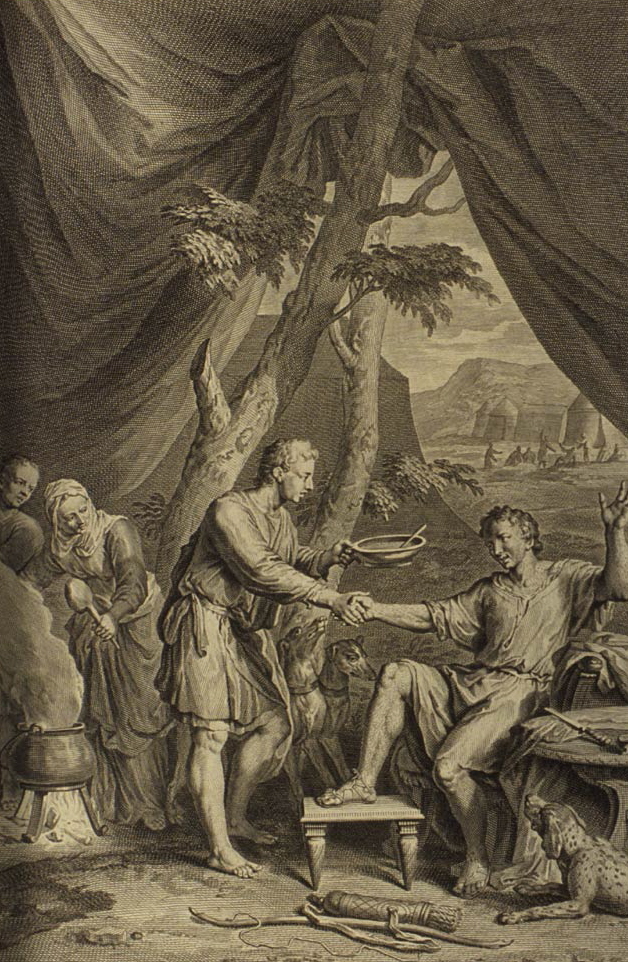
Engraving
Esau Sells His Birthright for Pottage of Lentils, a 1728 engraving by Gerard Hoet.

A mess of pottage is something immediately attractive but of little value taken foolishly and carelessly in exchange for something more distant and perhaps less tangible but immensely more valuable. The phrase alludes to Esau's sale of his birthright for a meal ("mess") of lentil stew ("pottage") in Genesis 25:29–34 and connotes shortsightedness and misplaced priorities.

The mess of pottage motif is a common theme in art, appearing for example in Mattia Bortoloni's Esau selling his birthright (1716) and Mattias Stomer's painting of the same title (c. 1640).[1]

Biblical usage

[edit]

Although this phrase is often used to describe or allude to Esau's bargain, the phrase itself does not appear in the text of any English version of Genesis. Its first attested use,[2] already associated with Esau's bargain, is in the English summary of one of John Capgrave's sermons, c. 1452, "[Jacob] supplanted his broþir, bying his fader blessing for a mese of potage."[3] In the sixteenth century it continues its association with Esau, appearing in Bonde's Pylgrimage of Perfection (1526) and in the English versions of two influential works by Erasmus, the Enchiridion (1533)[4] and the Paraphrase upon the New Testament (1548):[5] "th'enherytaunce of the elder brother solde for a messe of potage". It can be found here and there throughout the sixteenth century, e.g. in Johan Carion's Thre bokes of cronicles (1550)[6] and at least three times in Roger Edgeworth's collected sermons (1557).[7] Within the tradition of English Biblical translations, it appears first in the summary at the beginning of chapter 25 of the Book of Genesis in the so-called Matthew Bible of 1537 (in this section otherwise a reprint of the Pentateuch translation of William Tyndale), "Esau selleth his byrthright for a messe of potage";[8] thence in the 1539 Great Bible and in the Geneva Bible published by English Protestants in Geneva in 1560.[9] According to the OED, Coverdale (1535) "does not use the phrase, either in the text or the chapter heading ... but he has it in 1 Chronicles 16:3 and Proverbs 15:7."[10] Miles Smith used the same phrase in "The Translators to the Reader", the lengthy preface to the 1611 King James Bible, but by the seventeenth century the phrase had become very widespread indeed and had clearly achieved the status of a fixed phrase with allusive, quasi-proverbial, force.

Examples of usage

[edit]

In different literary hands, it could be used either earnestly, or mockingly.[11] Benjamin Keach (1689) falls into the former camp: "I know not ... / whether those who did our Rights betray, / And for a mess of Pottage, sold away / Our dear bought / Freedoms, shall now trusted be, / As Conservators of our Libertie."[12] As does Henry Ellison (1875) "O Faith ... The disbelieving world would sell thee so; / Head turned with sophistries, and heart grown cold, / For a vile mess of pottage it would throw / Away thy heritage, and count the gold!".[13] Karl Marx' lament in Das Kapital has been translated using this phrase: The worker "is compelled by social conditions, to sell the whole of his active life, his very capacity for labour, in return for the price of his customary means of subsistence, to sell his birthright for a mess of pottage."[14]

Esau and the Mess of Pottage, by Jan Victors.

Swift and Byron use the phrase satirically: "Thou sold'st thy birthright, Esau! for a mess / Thou shouldst have gotten more, or eaten less."[15] The Hindu nationalist V. D. Savarkar borrowed the phrase, along with quotations from Shakespeare, for his pamphlet Hindutva (1923), which celebrated Hindu culture and identity, asking whether Indians were willing to 'disown their seed, forswear their fathers and sell their birthright for a mess of pottage'.

Perhaps the most famous use in American literature is that by Henry David Thoreau: "If I should sell both my forenoons and afternoons to society, as most appear to do, I am sure that for me there would be nothing left worth living for. I trust that I shall never thus sell my birthright for a mess of pottage. I wish to suggest that a man may be very industrious, and yet not spend his time well. There is no more fatal blunderer than he who consumes the greater part of his life getting his living."[16]

Another prominent instance of using the phrase in American fiction is James Weldon Johnson's famous protagonist Ex-Coloured Man who, retrospectively reflecting upon his life as a black man passing for white, concludes that he has sold his "birthright for a mess of pottage".[17]

By a conventional spoonerism, an overly propagandistic writer is said to have "sold his birthright for a pot of message," a bit of enduring wordplay documented as early as 1850.[18] Terry Pratchett has a bystander ("who was anxious not to break the flow") say this in Feet of Clay, after Nobby of the Watch has guessed that the phrase is "a spot of massage" and Sgt Colon attempted to correct it to "a pot of message". Theodore Sturgeon had one of his characters say this about H. G. Wells in his 1948 short story Unite and Conquer; and Roger Lancelyn Green (in 1962) ascribed it as a saying of Professor Nevill Coghill, Merton Professor of English Literature at the University of Oxford, who was born 49 years after its first documented appearance in print.

The phrase also appears in Myra Brooks Welch's poem "The Touch of the Master's Hand," in which "a mess of pottage – a glass of wine – a game" stand for all such petty worldly pursuits, contrasted to life after a spiritual awakening.

The phrase also appears in the 1919 African-American film Within Our Gates, as used by the preacher character 'Old Ned' who having ingratiated himself by acting the clown with two white men turns away and states, "again, I've sold my birthright. All for a miserable mess of pottage."

Notes

[edit]
[edit]
Revisions and contributorsEdit on WikipediaRead on Wikipedia
from Grokipedia
The mess of pottage refers to the red stew that , faint from , demanded from his twin brother in exchange for his as the son, as described in Genesis 25:29–34 of the . In this account, prioritized immediate physical relief over his hereditary privileges, including leadership of the family and a double portion, thereby "despising" his according to the text. The incident exemplifies a causal where short-term appetite overrides long-term , later interpreted in the as evidence of 's profane character ( 12:16). This biblical episode originated the English "to sell one's for a of ," where "" denotes a serving or portion of the stew-like , signifying the of bartering substantial future benefits for trivial present gains. The , absent from the original Hebrew but popularized in English from the onward, has endured in and discourse to impulsive decisions that undermine enduring value, such as prioritizing comfort over spiritual or principled commitments. Its usage underscores a first-principles recognition of human tendencies toward , where empirical observations of such trades reveal predictable patterns of regret and diminished legacy.

Origins and Biblical Context

The Account in Genesis

In the biblical narrative recorded in Genesis 25:29-34, , the elder twin son of and Rebekah, returned from hunting in the field exhausted and faint with hunger. His younger twin brother was at that time cooking a of lentils. demanded a portion of the , exclaiming his exhaustion, which later contributed to his name being called , meaning "red." Jacob opportunistically conditioned giving Esau the stew upon Esau selling him his birthright as the firstborn son. Esau, prioritizing his immediate survival, declared, "I am about to die; of what use is a birthright to me?" and swore an oath transferring the birthright to Jacob. Jacob then provided Esau with bread and the lentil stew; Esau ate and drank, rose, and departed, thus despising his birthright. The New Testament alludes to this event in Hebrews 12:16, characterizing Esau as unholy for selling his birthright for a single meal.

Historical and Cultural Setting of the Narrative

The patriarchal narratives in Genesis, including the account of and , are set in the , approximately 2000–1500 BCE, during a period of semi-nomadic in the . In such societies, family structure emphasized patrilineal inheritance, with the firstborn son holding a that entitled him to a double portion of the father's estate—typically two-thirds of movable property and land—along with leadership authority over the household and clan. This custom, attested in texts from contemporaneous Mesopotamian and Canaanite cultures, ensured continuity of familial power and economic resources in agrarian and herding economies prone to environmental instability. Esau, depicted as the firstborn, embodied the archetype of a rugged hunter reliant on wild game, contrasting with Jacob's role as a tent-dweller tending flocks, which aligned with the pastoral subsistence strategies of semi-nomadic groups in the Levant. This sibling dichotomy reflected common tensions in extended kin groups, where hunters faced irregular food access due to seasonal migrations and arid terrains, while herders maintained more predictable dairy and grain-based sustenance through encampments. Such dynamics in Bronze Age Canaan fostered rivalries over scarce resources, with firstborn privileges often contested amid clan expansions and territorial pressures. The "pottage" in question was a basic , a nutrient-dense staple cultivated in the region's marginal soils and valued for its protein content during famines or hunts yielding no prey. Lentils, requiring minimal water and thriving in semi-arid conditions, served as a survival food for nomadic populations facing periodic from droughts or failed harvests. Acute from prolonged exertion, as experienced by after fieldwork, triggers physiological responses including elevated levels that heighten impulsivity and prioritize immediate caloric intake over long-term considerations, impairing functions involved in foresight and restraint.

Development of the Phrase

The phrase "mess of pottage" does not appear in the original Hebrew text of Genesis 25:29–34, which describes Esau trading his birthright for a stew of lentils, rendered literally as "red pottage" or similar without reference to a "mess" as a portion. Early English translations, such as the Wycliffe Bible (late 14th century), used terms like "potage" for the stew but lacked the compound "mess of pottage." The exact phrasing emerged in 16th-century Protestant Bible editions, notably the Geneva Bible of 1560, where marginal notes or section summaries employed "mess of pottage" to denote the served portion of lentil stew Jacob prepared, drawing on contemporary English usage of "mess" for a dish allocated to an individual. The term "mess" derives from Old French mes, from Latin missus (past participle of mittere, "to send"), originally signifying a portion of dispatched from the to diners, often as a pulpy or ed serving suitable for communal or individual allotments. "Pottage," attested in English by the 13th century, referred to a thick, boiled or cooked in a pot, derived from potage and evoking simple, everyday fare in medieval diets. This linguistic pairing in the reflected not a direct scriptural but an idiomatic that rendered the Hebrew accessible to English readers familiar with table service customs. By the early 17th century, following the King James Version's publication—which retained "pottage of lentiles" in the text without "mess" but reinforced the story's cultural prominence—the phrase evolved from a literal descriptor into a proverbial expression for a poor exchange. English proverbs and commentaries began abstracting it to signify forfeiting enduring value for immediate gratification, with the full "to sell one's for a mess of pottage" solidifying in non-biblical around this period, independent of the King James narrative's wording. This shift marked its transition into a fixed English , detached from strict biblical fidelity yet rooted in the translational choices of Reformation-era Bibles.

Core Meaning and Interpretations

Traditional Theological Interpretation

In traditional , 's exchange of his for a of lentil in Genesis 25:29-34 represents the of despising one's eternal spiritual for momentary bodily satisfaction. The , as , conferred covenantal privileges including leadership of the family, a double portion of , and priestly duties under the Abrahamic promises, which undervalued amid physical hunger, declaring it useless since "I am about to die." The explicitly condemns this as the act of a "profane person," warning believers against similar godlessness that prioritizes temporal appetites over divine blessings. Esau's subsequent remorse, when he "sought it carefully with tears" yet could not reverse the loss ( 12:17), underscores the irreversible consequences of such profaneness, serving as a cautionary example of failed due to hardened disregard for sacred obligations. This interpretation emphasizes Esau's impulsivity as a rejection of covenantal fidelity, contrasting with the enduring value of God's promises tracing through to the priesthood and messianic lineage. Jacob's acquisition, though involving cunning, aligns with divine in Genesis 25:23—"the older shall serve the younger"—revealing God's sovereign election independent of human merit or ethical conduct. Traditional views as the vessel of providence, where deception fulfills rather than thwarts God's purpose, highlighting that divine favor rests on the chosen line despite human flaws. This framework prioritizes God's eternal plan over immediate moral qualms, portraying the event as a lesson in valuing spiritual posterity above transient needs. From the patristic period through the , theologians invoked this narrative in sermons to exhort against spiritual shortsightedness, with figures like interpreting Esau's profaneness as emblematic of and unbelief, urging diligence in pursuing holiness to avoid forfeiting heavenly . The moral imperative cautions against hyperbolic temporal discounting in faith, insisting on covenantal priorities that safeguard long-term divine communion over ephemeral gratification.

Secular and Economic Analyses

The narrative of Esau exchanging his birthright—a entitlement to a double portion of inheritance, familial leadership, and future status—for immediate sustenance illustrates a classic case of intertemporal choice failure, prioritizing short-term relief over long-term value. In economic terms, this represents an acute manifestation of opportunity cost, where the forgone alternative (the birthright's prospective economic and social benefits) vastly exceeded the transient utility of the lentil stew, estimated in ancient Near Eastern contexts as a modest meal insufficient to justify relinquishing primogeniture rights. Esau's decision, driven by reported exhaustion from hunting, underscores how visceral states like hunger can distort valuation, rendering future gains—such as inherited wealth and authority—seemingly negligible against present deprivation. Behavioral economics frames Esau's action through the lens of hyperbolic discounting, a pattern where individuals apply steeper discount rates to delayed rewards compared to immediate ones, often leading to dynamically inconsistent preferences. Under acute hunger, Esau exhibited present bias, overvaluing the stew's immediate satiation while undervaluing the birthright's compounded future returns, akin to how visceral drives amplify short-term impulses in experimental settings. This aligns with causal mechanisms in decision theory, where physiological overrides—such as low blood glucose—temporarily impair prefrontal cortex functions responsible for foresight, making the choice locally rational for survival but globally suboptimal absent mechanisms like commitment devices. From a perspective, Esau's trade reflects cognitive constraints under stress, where incomplete information processing and limited willpower preclude fully appraising the birthright's enduring value against a one-time caloric intake. Empirical parallels appear in studies, such as the (conducted 1968–1974), where children who resisted immediate consumption of a treat for a larger delayed reward later demonstrated superior outcomes in academic and behavioral metrics, mirroring the long-term costs Esau incurred by forgoing his . Such findings, replicated across cultures, highlight how failures in , exacerbated by immediate needs, yield persistent economic disadvantages, as evidenced by correlations between early delay capacity and adult .

Critiques and Alternative Viewpoints

Some scholars argue that Esau's decision reflected pragmatic realism amid acute , where immediate sustenance outweighed an abstract vulnerable to family discord, potential paternal disfavor, or untimely death before inheritance. In this perspective, the birthright's value was speculative, as Esau's hunting lifestyle and twin rivalry already jeopardized his claim, positioning as an exploitative figure capitalizing on desperation rather than demonstrating moral superiority. Jewish midrashic interpretations emphasize Esau's character as embodying unchecked , evident in his hasty dismissal of eternal spiritual stakes for transient relief, in contrast to calculated foresight in prioritizing covenantal legacy over momentary urges. This view frames the transaction not as mere but as a divine of disciplined reasoning prevailing over instinctual shortsightedness. Feminist and postcolonial critiques have challenged the narrative's reinforcement of patriarchal , interpreting the as a mechanism entrenching male lineage dominance and marginalizing alternative models, potentially at the expense of communal equity. Such readings, however, encounter for projecting modern egalitarian ideals onto an ancient where firstborn ensured economic cohesion and succession clarity, as corroborated by Near Eastern practices prioritizing eldest sons to avert fragmentation of familial holdings. Portrayals romanticizing Esau as an authentic, rugged rebel against duplicitous intellect often overlook biblical depictions of Esau's subsequent malice, including his explicit plan to slay upon Isaac's death, which underscores a pattern of reactive rather than principled defiance. This textual detail tempers idealizations by highlighting causal links between Esau's initial disregard and escalating familial rupture.

Historical Usage

In Early Literature and Proverbs

In Elizabethan and early modern English religious polemics, the "mess of pottage" motif appeared figuratively to denounce trading spiritual or principled inheritance for fleeting worldly gain. The pseudonymous Puritan author Martin Marprelate employed it in the late 1580s tracts against Anglican bishops, likening compromises to Esau's bargain as a profane exchange devoid of lasting value. Similarly, 17th-century Puritan divines like Thomas Brooks invoked the phrase in sermons and treatises to critique those who prized "empty things" over divine birthrights, framing it as a perennial warning against base appetites overriding covenantal fidelity. John Bunyan's (1678) integrated the allusion as a moral allegory for spiritual vigilance amid . During the of Little-Faith, robbed of his jewels representing faith's evidences, Faithful speculates that the pilgrim might have bartered them—like Esau's —for "a mess of pottage," invoking Hebrews 12:16 to underscore profane recklessness. Christian counters that true believers, unlike Esau, retain their core jewel of despite losses, thus deploying the phrase to distinguish resilient piety from Esau's impulsive forfeiture and to exhort endurance over temporal ease. By the 17th through 19th centuries, the expression permeated English proverbs and as a shorthand for myopic decisions favoring minor immediate benefits over substantial future ones, paralleling "penny wise, pound foolish" in critiquing thrift that invites greater loss. Collections of proverbial lore documented it alongside idioms decrying short-sighted trades, often applied to scenarios of undervalued heritage or assets, reinforcing its role as a cultural against greed-driven in everyday moral discourse.

Applications in Moral and Philosophical Texts

In 18th-century moral , the Esau narrative illustrated the peril of subordinating enduring rights to transient appetites, serving as a cautionary exemplar in discussions of and self-command. Adam Smith invoked the motif of selling a birthright "not like for a mess of pottage" to underscore how individuals might irrationally forfeit inherent liberties through shortsighted actions, leading to unintended long-term deprivations in social and economic orders. Similarly, Francis Hutcheson framed Esau's exchange as motivated primarily by the anticipated of consumption rather than raw aversion to , thereby highlighting how sensory desires could eclipse reflective in . These analyses emphasized causal sequences wherein an initial concession—driven by bodily exigency—compounded into irrecoverable losses, such as Esau's subsequent forfeiture of , reinforcing the need for rational restraint over impulsive gain. Victorian-era moralists extended this framework to critique the era's industrial transformations, portraying the abandonment of ancestral holdings for urban prospects as a modern echo of Esau's folly. In Charles Dickens's Hard Times (1854), characters like embody the tragedy of trading familial and communal legacies for precarious factory remuneration, with the author likening such choices to "sell[ing] his for a mess of pottage," a betrayal yielding only amplified destitution amid mechanized exploitation. Sermons and ethical , such as George Shaw's Selling the Birthright: A Lecture to Young Men (circa 1870s), warned against analogous appetitive surrenders, equating youthful indulgences or vocational haste with Esau's "abnormal appetite" that sacrificed spiritual and hereditary inheritance for fleeting satiation. , in his idealist ethics, dissected Esau's act not as mere physiological desperation but as a willful undervaluation of one's "station and its duties," arguing that true motives revealed a deeper ethical lapse in prioritizing visceral relief over covenantal obligations. While these texts predominantly admonished the trade as imprudent—privileging legacy over —some interpretations acknowledged Esau's acute as a legitimate exigency, potentially rationalizing the if the carried negligible prospective utility to him, thus balancing immediate survival against speculative . This duality informed broader 19th-century doctrines, urging discernment of compounded causal outcomes: short-term acquisitions often engendered cascading forfeitures, as evidenced by Esau's narrative arc from birthright sale to irremediable displacement.

Modern Applications and Examples

In Economics and Decision Theory

In decision theory, the biblical exchange of Esau's for a "mess of pottage" serves as an archetype for , where agents exhibit time-inconsistent preferences that prioritize immediate rewards over larger future gains. This model posits that the subjective value of delayed outcomes decays hyperbolically rather than exponentially, leading to choices like Esau's that appear rational in the moment of hunger but suboptimal . Such dynamics underpin analyses of , as seen in economic models where erodes long-term wealth accumulation. Behavioral economics frames Esau's decision as an instance of undervaluing probabilistic future benefits, akin to reference-dependent preferences in , where immediate certainty (relief from ) outweighs the of despite its higher potential payoff. Empirical analogs appear in studies of windfall dissipation; for instance, increase consumption by approximately 5-10% of prizes annually but large-prize recipients ($1 million+) typically retain 60-80% of winnings after 10-20 years, contradicting myths of near-universal . This pattern highlights systematic errors in assessing inheritance-like assets, with dissipation rates higher among smaller winners due to behavioral traps like over-optimism in spending. In principal-agent frameworks applied to family enterprises, the narrative illustrates agency costs where heirs, acting as agents for patriarchal or intergenerational principals, undervalue controlling stakes or birthrights, potentially triggering premature divestitures that erode firm value. Economists like reference the motif to underscore trade-offs between short-term gains and long-term institutional returns, as in models of where forgoing democratic safeguards mirrors Esau's undervaluation of sustained . These interpretations emphasize verifiable discounting parameters over moralizing, with calibration from lab experiments showing discount rates of 20-50% for near-term delays aligning with Esau-like impulsivity.

In Politics and Public Policy

In devolution agreements, such as the 2018 North of Tyne Combined Authority deal, local governments traded elements of fiscal and administrative autonomy for centralized funding streams, including £600 million over 30 years tied to specific investment priorities like skills and housing, which critics argued resembled Esau's bargain by prioritizing short-term capital infusions over sustainable local governance structures. This arrangement, lacking a unified rational framework for regional economic development, exemplified policy expediency where immediate resource allocation undermined long-term self-determination, as the deal's conditions reinforced national oversight rather than empowering independent decision-making. Government bailouts during financial crises, like those in 2008-2009, have drawn scrutiny for offering immediate liquidity to avert collapse—totaling over $700 billion in the U.S. —while fostering that erodes fiscal discipline and incentivizes reckless risk-taking by financial institutions expecting future rescues. Critics contend these interventions prioritize transient stability over structural reforms, akin to trading enduring fiscal birthrights for , as evidenced by post-bailout persistence of high leverage ratios in bailed entities, which prolonged systemic vulnerabilities rather than enforcing accountability. Right-leaning analyses often frame concessions to supranational entities—such as trade pacts or climate accords—as forfeiting national sovereignty for illusory global benefits, where commitments like those under the impose regulatory burdens without commensurate enforcement from major emitters, effectively selling policy independence for vague cooperative gains. Empirical reviews of such arrangements highlight uneven compliance, with developing nations facing fewer penalties, underscoring causal asymmetries that favor short-term diplomatic over robust national leverage. Welfare expansions have been critiqued for engendering dependency cycles that erode , with studies showing intergenerational transmission: children of parents on face a 12 higher likelihood of program participation over a decade, perpetuating reliance on state support at the expense of attachment and personal agency. While left-leaning views decry as neglecting social entitlements, data on prolonged recipiency—such as multi-generational welfare use correlating with reduced labor market entry—reveal that expansive policies often yield in development, prioritizing immediate relief over incentives for independence.

In Contemporary Culture and Media

In political op-eds surrounding the 2024 U.S. , commentators applied the "mess of pottage" idiom to warn against prioritizing immediate partisan gains over enduring democratic institutions. An October 2024 Deseret News piece questioned whether voters would "sell our glorious constitutional for a mess of pottage" in supporting movements perceived as undermining foundational principles. Similarly, a 2024 West Virginia Gazette-Mail column asserted that a majority of American voters had effectively "sold their " through electoral choices, echoing Esau's biblical . A March 2024 Monthly article extended this to critiques of candidates flouting constitutional norms for short-term power. During the 2008 global financial crisis, the phrase surged in economic commentary to describe policies trading long-term stability for transient relief. In a May 2009 UK debate, speakers accused the government of transforming a worldwide downturn into a national "catastrophe" by exchanging fiscal prudence for immediate interventions akin to a "mess of pottage." Analogies persisted in analyses of housing bubbles and , framing consumer and policymaker decisions as forfeiting future security for present consumption. The maintains idiomatic vitality in English-speaking religious media, with recent sermons using it to illustrate impulsive choices. A 2025 sermon at Emmanuel Baptist Church in , , dissected Esau's trade as a caution against undervaluing spiritual inheritance. In German, the equivalent "Linsengericht" preserves the in cultural and biblical discourse, denoting as a symbol of shortsighted exchange in translations of Genesis 25:34. This linguistic persistence underscores the phrase's role in post-2000 non-academic critiques of regret-laden decisions across crises and elections.

Broader Implications and Lessons

On Human Decision-Making

The idiom illustrates how acute physiological needs, such as , can impair in the , promoting myopic favoring immediate rewards over long-term value. and behavioral studies demonstrate that hunger enhances reliance on reinforcement-driven processes rather than deliberate , leading individuals to prioritize short-term satiation at the expense of strategic foresight. This aligns with Esau's biblical choice to trade his —entailing rights and covenantal priority—for stew, reflecting a temporary override of rational evaluation by visceral urgency. To mitigate such impulses, precommitment strategies, such as binding rules or Ulysses-like contracts that restrict future options, enable individuals to enforce long-term preferences against momentary weaknesses. From a causal standpoint, Esau's transaction directly precipitated the transfer of patriarchal primacy to , whose lineage formed the nation of , while Esau's Edomite descendants faced subjugation and enmity, underscoring how individual choices propagate unintended generational outcomes independent of providential narratives. This challenges deterministic interpretations by highlighting the agent's agency in forgoing irrecoverable spiritual and material assets, as Esau later sought repentance without finding reversal of the causal chain. Short-termism, while individually ruinous here, retains evolutionary utility in scarcity environments, where prioritizing immediate caloric intake ensured survival amid unpredictable resources, as ancestral humans navigated famine risks through hyper-focus on present opportunities. Conversely, long-term orientation fosters civilizational progress by compounding deferred gains, with longitudinal research linking in children to superior academic, socioeconomic, and health outcomes decades later. Yet excessive future-orientation risks decision in volatile contexts, balancing the idiom's caution against unbridled . Narratives glorifying "living in the moment" as liberated , often amplified in media, overlook evidence that chronic correlates with elevated risks of , financial ruin, and relational instability, as it systematically undervalues probabilistic future costs.

Cultural and Idiomatic Persistence

The phrase "mess of pottage" endures in English-language discourse due to its vivid biblical imagery, which encapsulates the between immediate and long-term more memorably than abstract alternatives like "." Derived from the Genesis account of exchanging his for lentil stew—a concrete of visceral hunger overriding future claims—the leverages sensory details absent in modern economic terminology, fostering retention across generations. This memorability stems from the King James and earlier Bibles' influence, where the story's dramatic elements embed the lesson in , outperforming drier conceptual language in conveying causal trade-offs. Cross-cultural analogs exist, such as cautioning against short-term impatience, like "hòu jī bó fā" (厚积薄发), which advises deep accumulation before sudden release, highlighting the risks of hasty gains over sustained effort. However, the English phrase's dominance arises from the Bible's pervasive role in shaping Western idioms, with no exact equivalents matching its specificity; other traditions emphasize abstractly but lack the pottage's tangible . This persistence resists because it addresses universal tensions in human valuation—prioritizing tangible present needs against intangible future securities—evident in ongoing applications to real-world forfeitures, such as trading constitutional rights for transient benefits. In truth-seeking contexts, the idiom's utility lies in its unvarnished depiction of meritocratic realism: from historical and economic analyses shows that undervaluing birthrights or equivalents often yields suboptimal outcomes, as seen in cases where immediate appeasements erode enduring advantages. Unlike favoring short-term equity over proven hierarchies, it privileges causal chains where impatience forfeits verifiable long-term gains, maintaining relevance amid diverse ideologies by grounding abstract warnings in a falsifiable, form.

References

Add your contribution
Related Hubs
User Avatar
No comments yet.