


Community hub
Recent from talks
Contribute something
Nothing was collected or created yet.
Metadynamics
View on WikipediaMetadynamics (MTD; also abbreviated as METAD or MetaD) is a computer simulation method in computational physics, chemistry and biology. It is used to estimate the free energy and other state functions of a system, where ergodicity is hindered by the form of the system's energy landscape. It was first suggested by Alessandro Laio and Michele Parrinello in 2002[1] and is usually applied within molecular dynamics simulations. MTD closely resembles a number of newer methods such as adaptively biased molecular dynamics,[2] adaptive reaction coordinate forces[3] and local elevation umbrella sampling.[4] More recently, both the original and well-tempered metadynamics[5] were derived in the context of importance sampling and shown to be a special case of the adaptive biasing potential setting.[6] MTD is related to the Wang–Landau sampling.[7]
Introduction
[edit]The technique builds on a large number of related methods including (in a chronological order) the deflation,[8] tunneling,[9] tabu search,[10] local elevation,[11] conformational flooding,[12] Engkvist-Karlström[13] and Adaptive Biasing Force methods.[14]
Metadynamics has been informally described as "filling the free energy wells with computational sand".[15] The algorithm assumes that the system can be described by a few collective variables (CV). During the simulation, the location of the system in the space determined by the collective variables is calculated and a positive Gaussian potential is added to the real energy landscape of the system. In this way the system is discouraged to come back to the previous point. During the evolution of the simulation, more and more Gaussians sum up, thus discouraging more and more the system to go back to its previous steps, until the system explores the full energy landscape—at this point the modified free energy becomes a constant as a function of the collective variables which is the reason for the collective variables to start fluctuating heavily. At this point the energy landscape can be recovered as the opposite of the sum of all Gaussians.
The time interval between the addition of two Gaussian functions, as well as the Gaussian height and Gaussian width, are tuned to optimize the ratio between accuracy and computational cost. By simply changing the size of the Gaussian, metadynamics can be fitted to yield very quickly a rough map of the energy landscape by using large Gaussians, or can be used for a finer grained description by using smaller Gaussians.[1] Usually, the well-tempered metadynamics[5] is used to change the Gaussian size adaptively. Also, the Gaussian width can be adapted with the adaptive Gaussian metadynamics.[16]
Metadynamics has the advantage, upon methods like adaptive umbrella sampling, of not requiring an initial estimate of the energy landscape to explore.[1] However, it is not trivial to choose proper collective variables for a complex simulation. Typically, it requires several trials to find a good set of collective variables, but there are several automatic procedures proposed: essential coordinates,[17] Sketch-Map,[18] and non-linear data-driven collective variables.[19]
Multi-replica approach
[edit]Independent metadynamics simulations (replicas) can be coupled together to improve usability and parallel performance. There are several such methods proposed: the multiple walker MTD,[20] the parallel tempering MTD,[21] the bias-exchange MTD,[22] and the collective-variable tempering MTD.[23] The last three are similar to the parallel tempering method and use replica exchanges to improve sampling. Typically, the Metropolis–Hastings algorithm is used for replica exchanges, but the infinite swapping[24] and Suwa-Todo[25] algorithms give better replica exchange rates.[26]
High-dimensional approach
[edit]Typical (single-replica) MTD simulations can include up to 3 CVs, even using the multi-replica approach, it is hard to exceed 8 CVs in practice. This limitation comes from the bias potential, constructed by adding Gaussian functions (kernels). It is a special case of the kernel density estimator (KDE). The number of required kernels, for a constant KDE accuracy, increases exponentially with the number of dimensions. So MTD simulation length has to increase exponentially with the number of CVs to maintain the same accuracy of the bias potential. Also, the bias potential, for fast evaluation, is typically approximated with a regular grid.[27] The required memory to store the grid increases exponentially with the number of dimensions (CVs) too.
A high-dimensional generalization of metadynamics is NN2B.[28] It is based on two machine learning algorithms: the nearest-neighbor density estimator (NNDE) and the artificial neural network (ANN). NNDE replaces KDE to estimate the updates of bias potential from short biased simulations, while ANN is used to approximate the resulting bias potential. ANN is a memory-efficient representation of high-dimensional functions, where derivatives (biasing forces) are effectively computed with the backpropagation algorithm.[28][29]
An alternative method, exploiting ANN for the adaptive bias potential, uses mean potential forces for the estimation.[30] This method is also a high-dimensional generalization of the Adaptive Biasing Force (ABF) method.[31] Additionally, the training of ANN is improved using Bayesian regularization,[32] and the error of approximation can be inferred by training an ensemble of ANNs.[30]
Developments since 2015
[edit]In 2015, White, Dama, and Voth introduced experiment-directed metadynamics, a method that allows for shaping molecular dynamics simulations to match a desired free energy surface. This technique guides the simulation towards conformations that align with experimental data, enhancing our understanding of complex molecular systems and their behavior.[33]
In 2020, an evolution of metadynamics was proposed, the on-the-fly probability enhanced sampling method (OPES),[34][35][36] which is now the method of choice of Michele Parrinello's research group.[37] The OPES method has only a few robust parameters, converges faster than metadynamics, and has a straightforward reweighting scheme.[38] In 2024, a replica-exchange variant of OPES was developed, named OneOPES,[39] designed to exploit a thermal gradient and multiple CVs to sample large biochemical systems with several degrees of freedom. This variant aims to address the challenge of describing such systems, where the numerous degrees of freedom are often difficult to capture with only a few CVs. OPES has been implemented in the PLUMED library since version 2.7.[40]
Algorithm
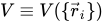
[edit]Assume we have a classical -particle system with positions at in the Cartesian coordinates . The particle interaction are described with a potential function . The potential function form (e.g. two local minima separated by a high-energy barrier) prevents an ergodic sampling with molecular dynamics or Monte Carlo methods.


Original metadynamics
[edit]A general idea of MTD is to enhance the system sampling by discouraging revisiting of sampled states. It is achieved by augmenting the system Hamiltonian with a bias potential :


- .

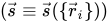
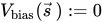
The bias potential is a function of collective variables . A collective variable is a function of the particle positions . The bias potential is continuously updated by adding bias at rate , where is an instantaneous collective variable value at time :



- .
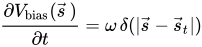
At infinitely long simulation time , the accumulated bias potential converges to free energy with opposite sign (and irrelevant constant ):



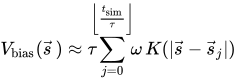
For a computationally efficient implementation, the update process is discretised into time intervals ( denotes the floor function) and -function is replaced with a localized positive kernel function . The bias potential becomes a sum of the kernel functions centred at the instantaneous collective variable values at time :


- .
Typically, the kernel is a multi-dimensional Gaussian function, whose covariance matrix has diagonal non-zero elements only:
- .
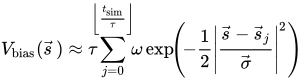
The parameter , , and are determined a priori and kept constant during the simulation.

Implementation
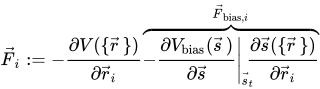
[edit]Below there is a pseudocode of MTD base on molecular dynamics (MD), where and are the -particle system positions and velocities, respectively. The bias is updated every MD steps, and its contribution to the system forces is .


set initial and set every MD step: compute CV values: every MD steps: update bias potential: compute atomic forces: propagate and by




Free energy estimator
[edit]The finite size of the kernel makes the bias potential to fluctuate around a mean value. A converged free energy can be obtained by averaging the bias potential. The averaging is started from , when the motion along the collective variable becomes diffusive:


Applications
[edit]Metadynamics has been used to study:
- protein folding[22]
- chemical reactions[41]
- molecular docking[42][43]
- phase transitions.[44]
- encapsulation of DNA onto hydrophobic[45] and hydrophilic[46] single-walled carbon nanotubes.
Implementations
[edit]PLUMED
[edit]PLUMED[47] is an open-source library implementing many MTD algorithms and collective variables. It has a flexible object-oriented design[48][49] and can be interfaced with several MD programs (AMBER, GROMACS, LAMMPS, NAMD, Quantum ESPRESSO, DL_POLY_4, CP2K, and OpenMM).[50][51]
Other
[edit]Other MTD implementations exist in the Collective Variables Module[52] (for LAMMPS, NAMD, and GROMACS), ORAC, CP2K,[53] EDM,[54] and Desmond.
External links
[edit]See also
[edit]References
[edit]- ^ a b c Laio, A.; Parrinello, M. (2002). "Escaping free-energy minima". Proceedings of the National Academy of Sciences of the United States of America. 99 (20): 12562–12566. arXiv:cond-mat/0208352. Bibcode:2002PNAS...9912562L. doi:10.1073/pnas.202427399. PMC 130499. PMID 12271136.
- ^ Babin, V.; Roland, C.; Sagui, C. (2008). "Stabilization of resonance states by an asymptotic Coulomb potential". J. Chem. Phys. 128 (2): 134101/1–134101/7. Bibcode:2008JChPh.128b4101A. doi:10.1063/1.2821102. PMID 18205437.
- ^ Barnett, C.B.; Naidoo, K.J. (2009). "Free Energies from Adaptive Reaction Coordinate Forces (FEARCF): An application to ring puckering". Mol. Phys. 107 (8): 1243–1250. Bibcode:2009MolPh.107.1243B. doi:10.1080/00268970902852608. S2CID 97930008.
- ^ Hansen, H.S.; Hünenberger, P.H. (2010). "Using the local elevation method to construct optimized umbrella sampling potentials: Calculation of the relative free energies and interconversion barriers of glucopyranose ring conformers in water". J. Comput. Chem. 31 (1): 1–23. doi:10.1002/jcc.21253. PMID 19412904. S2CID 7367058.
- ^ a b Barducci, A.; Bussi, G.; Parrinello, M. (2008). "Well-Tempered Metadynamics: A Smoothly Converging and Tunable Free-Energy Method". Physical Review Letters. 100 (2) 020603. arXiv:0803.3861. Bibcode:2008PhRvL.100b0603B. doi:10.1103/PhysRevLett.100.020603. PMID 18232845. S2CID 13690352.
- ^ Dickson, B.M. (2011). "Approaching a parameter-free metadynamics". Phys. Rev. E. 84 (3): 037701–037703. arXiv:1106.4994. Bibcode:2011PhRvE..84c7701D. doi:10.1103/PhysRevE.84.037701. PMID 22060542. S2CID 42243972.
- ^ Christoph Junghans, Danny Perez, and Thomas Vogel. "Molecular Dynamics in the Multicanonical Ensemble: Equivalence of Wang–Landau Sampling, Statistical Temperature Molecular Dynamics, and Metadynamics." Journal of Chemical Theory and Computation 10.5 (2014): 1843-1847. doi:10.1021/ct500077d
- ^ Crippen, Gordon M.; Scheraga, Harold A. (1969). "Minimization of polypeptide energy. 8. Application of the deflation technique to a dipeptide". Proceedings of the National Academy of Sciences. 64 (1): 42–49. Bibcode:1969PNAS...64...42C. doi:10.1073/pnas.64.1.42. PMC 286123. PMID 5263023.
- ^ Levy, A.V.; Montalvo, A. (1985). "The Tunneling Algorithm for the Global Minimization of Functions". SIAM J. Sci. Stat. Comput. 6: 15–29. doi:10.1137/0906002.
- ^ Glover, Fred (1989). "Tabu Search—Part I". ORSA Journal on Computing. 1 (3): 190–206. doi:10.1287/ijoc.1.3.190. S2CID 5617719.
- ^ Huber, T.; Torda, A.E.; van Gunsteren, W.F. (1994). "Local elevation: A method for improving the searching properties of molecular dynamics simulation". J. Comput.-Aided Mol. Des. 8 (6): 695–708. Bibcode:1994JCAMD...8..695H. CiteSeerX 10.1.1.65.9176. doi:10.1007/BF00124016. PMID 7738605. S2CID 15839136.
- ^ Grubmüller, H. (1995). "Predicting slow structural transitions in macromolecular systems: Conformational flooding". Phys. Rev. E. 52 (3): 2893–2906. Bibcode:1995PhRvE..52.2893G. doi:10.1103/PhysRevE.52.2893. hdl:11858/00-001M-0000-000E-CA15-8. PMID 9963736.
- ^ Engkvist, O.; Karlström, G. (1996). "A method to calculate the probability distribution for systems with large energy barriers". Chem. Phys. 213 (1): 63–76. Bibcode:1996CP....213...63E. doi:10.1016/S0301-0104(96)00247-9.
- ^ Darve, E.; Pohorille, A. (2001). "Calculating free energies using average force". J. Chem. Phys. 115 (20): 9169. Bibcode:2001JChPh.115.9169D. doi:10.1063/1.1410978. hdl:2060/20010090348. S2CID 5310339.
- ^ http://www.grs-sim.de/cms/upload/Carloni/Presentations/Marinelli.ppt[permanent dead link]
- ^ Branduardi, Davide; Bussi, Giovanni; Parrinello, Michele (2012-06-04). "Metadynamics with Adaptive Gaussians". Journal of Chemical Theory and Computation. 8 (7): 2247–2254. arXiv:1205.4300. doi:10.1021/ct3002464. PMID 26588957. S2CID 20002793.
- ^ Spiwok, V.; Lipovová, P.; Králová, B. (2007). "Metadynamics in essential coordinates: free energy simulation of conformational changes". The Journal of Physical Chemistry B. 111 (12): 3073–3076. doi:10.1021/jp068587c. PMID 17388445.
- ^ Ceriotti, Michele; Tribello, Gareth A.; Parrinello, Michele (2013-02-22). "Demonstrating the Transferability and the Descriptive Power of Sketch-Map". Journal of Chemical Theory and Computation. 9 (3): 1521–1532. doi:10.1021/ct3010563. PMID 26587614. S2CID 20432114.
- ^ Hashemian, Behrooz; Millán, Daniel; Arroyo, Marino (2013-12-07). "Modeling and enhanced sampling of molecular systems with smooth and nonlinear data-driven collective variables". The Journal of Chemical Physics. 139 (21): 214101. Bibcode:2013JChPh.139u4101H. doi:10.1063/1.4830403. hdl:2117/20940. ISSN 0021-9606. PMID 24320358.
- ^ Raiteri, Paolo; Laio, Alessandro; Gervasio, Francesco Luigi; Micheletti, Cristian; Parrinello, Michele (2005-10-28). "Efficient Reconstruction of Complex Free Energy Landscapes by Multiple Walkers Metadynamics †". The Journal of Physical Chemistry B. 110 (8): 3533–3539. doi:10.1021/jp054359r. PMID 16494409. S2CID 15595613.
- ^ Bussi, Giovanni; Gervasio, Francesco Luigi; Laio, Alessandro; Parrinello, Michele (October 2006). "Free-Energy Landscape for β Hairpin Folding from Combined Parallel Tempering and Metadynamics". Journal of the American Chemical Society. 128 (41): 13435–13441. doi:10.1021/ja062463w. PMID 17031956.
- ^ a b Piana, S.; Laio, A. (2007). "A bias-exchange approach to protein folding". The Journal of Physical Chemistry B. 111 (17): 4553–4559. doi:10.1021/jp067873l. hdl:20.500.11937/15651. PMID 17419610.
- ^ Gil-Ley, Alejandro; Bussi, Giovanni (2015-02-19). "Enhanced Conformational Sampling Using Replica Exchange with Collective-Variable Tempering". Journal of Chemical Theory and Computation. 11 (3): 1077–1085. arXiv:1502.02115. doi:10.1021/ct5009087. PMC 4364913. PMID 25838811.
- ^ Plattner, Nuria; Doll, J. D.; Dupuis, Paul; Wang, Hui; Liu, Yufei; Gubernatis, J. E. (2011-10-07). "An infinite swapping approach to the rare-event sampling problem". The Journal of Chemical Physics. 135 (13): 134111. arXiv:1106.6305. Bibcode:2011JChPh.135m4111P. doi:10.1063/1.3643325. ISSN 0021-9606. PMID 21992286. S2CID 40621592.
- ^ Suwa, Hidemaro (2010-01-01). "Markov Chain Monte Carlo Method without Detailed Balance". Physical Review Letters. 105 (12) 120603. arXiv:1007.2262. Bibcode:2010PhRvL.105l0603S. doi:10.1103/PhysRevLett.105.120603. PMID 20867621. S2CID 378333.
- ^ Galvelis, Raimondas; Sugita, Yuji (2015-07-15). "Replica state exchange metadynamics for improving the convergence of free energy estimates". Journal of Computational Chemistry. 36 (19): 1446–1455. doi:10.1002/jcc.23945. ISSN 1096-987X. PMID 25990969. S2CID 19101602.
- ^ "PLUMED: Metadynamics". plumed.github.io. Retrieved 2018-01-13.
- ^ a b Galvelis, Raimondas; Sugita, Yuji (2017-06-13). "Neural Network and Nearest Neighbor Algorithms for Enhancing Sampling of Molecular Dynamics". Journal of Chemical Theory and Computation. 13 (6): 2489–2500. doi:10.1021/acs.jctc.7b00188. ISSN 1549-9618. PMID 28437616.
- ^ Schneider, Elia; Dai, Luke; Topper, Robert Q.; Drechsel-Grau, Christof; Tuckerman, Mark E. (2017-10-11). "Stochastic Neural Network Approach for Learning High-Dimensional Free Energy Surfaces". Physical Review Letters. 119 (15) 150601. Bibcode:2017PhRvL.119o0601S. doi:10.1103/PhysRevLett.119.150601. PMID 29077427.
- ^ a b Zhang, Linfeng; Wang, Han; E, Weinan (2017-12-09). "Reinforced dynamics for enhanced sampling in large atomic and molecular systems. I. Basic Methodology". The Journal of Chemical Physics. 148 (12): 124113. arXiv:1712.03461. doi:10.1063/1.5019675. PMID 29604808. S2CID 4552400.
- ^ Comer, Jeffrey; Gumbart, James C.; Hénin, Jérôme; Lelièvre, Tony; Pohorille, Andrew; Chipot, Christophe (2015-01-22). "The Adaptive Biasing Force Method: Everything You Always Wanted To Know but Were Afraid To Ask". The Journal of Physical Chemistry B. 119 (3): 1129–1151. doi:10.1021/jp506633n. ISSN 1520-6106. PMC 4306294. PMID 25247823.
- ^ Sidky, Hythem; Whitmer, Jonathan K. (2017-12-07). "Learning Free Energy Landscapes Using Artificial Neural Networks". The Journal of Chemical Physics. 148 (10): 104111. arXiv:1712.02840. doi:10.1063/1.5018708. PMID 29544298. S2CID 3932640.
- ^ White, Andrew D.; Dama, James F.; Voth, Gregory A. (2015). "Designing Free Energy Surfaces That Match Experimental Data with Metadynamics". Journal of Chemical Theory and Computation. 11 (6): 2451–2460. doi:10.1021/acs.jctc.5b00178. OSTI 1329576. PMID 26575545.
- ^ Invernizzi, Michele; Parrinello, Michele (2020-04-02). "Rethinking Metadynamics: From Bias Potentials to Probability Distributions". The Journal of Physical Chemistry Letters. 11 (7): 2731–2736. arXiv:1909.07250. doi:10.1021/acs.jpclett.0c00497. ISSN 1948-7185. PMID 32191470. S2CID 202577890.
- ^ Invernizzi, Michele; Piaggi, Pablo M.; Parrinello, Michele (2020-07-06). "Unified Approach to Enhanced Sampling". Physical Review X. 10 (4) 41034. arXiv:2007.03055. Bibcode:2020PhRvX..10d1034I. doi:10.1103/PhysRevX.10.041034. ISSN 2160-3308. S2CID 220381217.
- ^ Invernizzi, Michele; Parrinello, Michele (2022-06-14). "Exploration vs Convergence Speed in Adaptive-Bias Enhanced Sampling". Journal of Chemical Theory and Computation. 18 (6): 3988–3996. doi:10.1021/acs.jctc.2c00152. ISSN 1549-9618. PMC 9202311. PMID 35617155.
- ^ Parrinello, Michele (2022-01-12). "Breviarium de Motu Simulato Ad Atomos Pertinenti". Israel Journal of Chemistry. 62 (1–2) e202100105. doi:10.1002/ijch.202100105. ISSN 0021-2148. S2CID 245916578. Retrieved 2022-12-06.
- ^ "On-the-fly Probability Enhanced Sampling (OPES)". www.parrinello.ethz.ch. Retrieved 2022-06-12.
- ^ Rizzi, Valerio; Aureli, Simone; Ansari, Narjes; Gervasio, Francesco Luigi (2023-09-12). "OneOPES, a Combined Enhanced Sampling Method to Rule Them All". Journal of Chemical Theory and Computation. 19 (17): 5731–5742. doi:10.1021/acs.jctc.3c00254. ISSN 1549-9618. PMC 10500989. PMID 37603295.
- ^ "PLUMED - OPES". www.plumed.org. Retrieved 2022-06-12.
- ^ Ensing, B.; De Vivo, M.; Liu, Z.; Moore, P.; Klein, M. (2006). "Metadynamics as a tool for exploring free energy landscapes of chemical reactions". Accounts of Chemical Research. 39 (2): 73–81. doi:10.1021/ar040198i. PMID 16489726.
- ^ Gervasio, F.; Laio, A.; Parrinello, M. (2005). "Flexible docking in solution using metadynamics". Journal of the American Chemical Society. 127 (8): 2600–2607. doi:10.1021/ja0445950. PMID 15725015. S2CID 6304388.
- ^ Vargiu, A. V.; Ruggerone, P.; Magistrato, A.; Carloni, P. (2008). "Dissociation of minor groove binders from DNA: insights from metadynamics simulations". Nucleic Acids Research. 36 (18): 5910–5921. doi:10.1093/nar/gkn561. PMC 2566863. PMID 18801848.
- ^ Martoňák, R.; Laio, A.; Bernasconi, M.; Ceriani, C.; Raiteri, P.; Zipoli, F.; Parrinello, M. (2005). "Simulation of structural phase transitions by metadynamics". Zeitschrift für Kristallographie. 220 (5–6): 489. arXiv:cond-mat/0411559. Bibcode:2005ZK....220..489M. doi:10.1524/zkri.220.5.489.65078. S2CID 96851280.
- ^ Cruz, F.J.A.L.; de Pablo, J.J.; Mota, J.P.B. (2014), "Endohedral confinement of a DNA dodecamer onto pristine carbon nanotubes and the stability of the canonical B form", J. Chem. Phys., 140 (22): 225103, arXiv:1605.01317, Bibcode:2014JChPh.140v5103C, doi:10.1063/1.4881422, PMID 24929415, S2CID 15149133
- ^ Cruz, F.J.A.L.; Mota, J.P.B. (2016), "Conformational Thermodynamics of DNA Strands in Hydrophilic Nanopores", J. Phys. Chem. C, 120 (36): 20357–20367, doi:10.1021/acs.jpcc.6b06234
- ^ "PLUMED". www.plumed.org. Retrieved 2016-01-26.
- ^ Bonomi, Massimiliano; Branduardi, Davide; Bussi, Giovanni; Camilloni, Carlo; Provasi, Davide; Raiteri, Paolo; Donadio, Davide; Marinelli, Fabrizio; Pietrucci, Fabio (2009-10-01). "PLUMED: A portable plugin for free-energy calculations with molecular dynamics". Computer Physics Communications. 180 (10): 1961–1972. arXiv:0902.0874. Bibcode:2009CoPhC.180.1961B. doi:10.1016/j.cpc.2009.05.011. S2CID 4852774.
- ^ Tribello, Gareth A.; Bonomi, Massimiliano; Branduardi, Davide; Camilloni, Carlo; Bussi, Giovanni (2014-02-01). "PLUMED 2: New feathers for an old bird". Computer Physics Communications. 185 (2): 604–613. arXiv:1310.0980. Bibcode:2014CoPhC.185..604T. doi:10.1016/j.cpc.2013.09.018. S2CID 17904052.
- ^ "MD engines - PLUMED". www.plumed.org. Archived from the original on 2016-02-07. Retrieved 2016-01-26.
- ^ "howto:install_with_plumed [CP2K Open Source Molecular Dynamics ]". www.cp2k.org. Retrieved 2016-01-26.
- ^ Fiorin, Giacomo; Klein, Michael L.; Hénin, Jérôme (December 2013). "Using collective variables to drive molecular dynamics simulations". Molecular Physics. 111 (22–23): 3345–3362. Bibcode:2013MolPh.111.3345F. doi:10.1080/00268976.2013.813594. ISSN 0026-8976.
- ^ "Cp2K_Input / Motion / Free_Energy / Metadyn".
- ^ https://github.com/whitead/electronic-dance-music Plugin for LAMMPS