Hubbry Logo
Methana VolcanoMethana VolcanoMain
Open search
Methana Volcano
Community hub
Methana Volcano
logo
8 pages, 0 posts
0 subscribers
Be the first to start a discussion here.
Methana Volcano
Methana Volcano
from Wikipedia
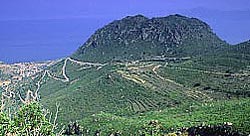
Panoramic view of Methana peninsula.

Key Information

The Methana volcano peninsula is situated approximately 50 kilometres (31 mi) southwest of Athens in Greece.

Geological history

[edit]

The Methana (Μέθανα) peninsula contains some 32 volcanoes, including the Methana volcano, that are mostly andesitic and dacitic lava domes. The volcanic activity in the peninsula began 1 million years ago and continued sporadically until 300 years ago. The last eruptions took place in 1700 at a submarine volcano north of Kameni Chora. On land there is also the historic lava dome of Kameni Chora that erupted in 230 BC. In August 1922 there were numerous reports of a possible eruption in the Kaimeno Vouno crater, however, this still remains unconfirmed. Methana is in the northwestern part of the group of Cycladic volcanoes that are considered active (Milos, Santorini and Nisyros). The rocks are mostly dacites and andesites. On Methana there are thermal springs and mofettes (gas exhalations). Methana is cut by many tectonic faults, and so it is an area in high danger of earthquakes. The major fault cuts the town of Methana from west to east.

Archaeological history

[edit]

The Methana peninsula has been inhabited since about 10,000 BC. The first settlements were founded about 6,000 BC. Excavations have brought to light a village and sanctuary from Mycenaean times near the town of Methana at the chapel of Sts. Constantine & Helen. Items dating from about 1500–1200 BC are preserved in the museums of Poros island and in Piraeus Archaeological museum in Athens. There were ancient sanctuaries in Geometric times, about 800–700 BC, such as the Geometric temple near Kounoupitsa village. There are also two ancient acropoleis (Paliocastro acropolis and Oga acropolis) and many ancient farm sites. The ancient writers Ovid, Strabo and Pausanias described the historic eruption of the volcano dome near the village of Kameni Chora in the northwestern part of the Methana peninsula.[1][2] Pausanias also described hot springs after the eruption. Later there were many new buildings and sanctuaries founded near the village Vathy, at the Paliocastro hill and around it. Methana was also the site of a Phoenician base called Arsinoe.

References

[edit]
[edit]
Revisions and contributorsEdit on WikipediaRead on Wikipedia
from Grokipedia
Methana Volcano is a comprising numerous lava domes and associated flows that form the Methana , a 44 km² landform extending into the Saronic Gulf on the northeastern coast of the Peloponnese Peninsula in . Located at approximately 37.62°N, 23.34°E, it constitutes the westernmost center of the , a chain of volcanoes resulting from the of the African Plate beneath the Eurasian Plate. The volcano's magmas range in composition from to rhyodacite, and the peninsula rises to a maximum elevation of about 740 m at Mount Helona (also known as Chelona). Volcanic activity at Methana initiated around 0.9 million years ago, producing a dense cluster of approximately 30 lava domes and associated flows overlying limestone basement rocks. The eruptive history features predominantly effusive events, though explosive activity has occurred, as evidenced by the formation of pyroclastic deposits and maars. The most notable and well-documented eruption took place in 258 BCE at the Kameno Vouno vent on the northwestern , involving explosions, dome extrusion, and a lava flow that extended 1.25 km to the sea, advancing the shoreline by 500 m and registering a (VEI) of 3. An uncertain explosive event was reported in August 1922, but no confirmation exists. Although quiescent since antiquity, Methana remains geodynamically and hydrothermally active, influenced by its position along active fault systems in the seismically dynamic Saronic Gulf. Manifestations include low-temperature (<40°C) hot springs, saline and sulphurous waters used historically for therapeutic spas, and diffuse CO₂ with a total output estimated at less than 0.05 kg s⁻¹. Geochemical analyses of fluids indicate a mantle-derived component (up to 40%) and CO₂ primarily from dissolution, suggesting subsurface temperatures around 210°C and a low but persistent potential from gas emissions.

Geography

Location

Methana Volcano is situated on the Methana Peninsula in the Saronic Gulf, , with its central coordinates at approximately 37.62°N, 23.33°E. The peninsula itself measures about 12 km in length and 8 km in width, forming a roughly mushroom-shaped connected to the mainland by a narrow approximately 1.25 km long and 240 m wide at its narrowest point. Positioned roughly 50 km southwest of Athens as the crow flies, the Methana Peninsula lies at the northeastern edge of the Peloponnese region while administratively falling under the Attica regional unit. It occupies the northwestern extent of the Saronic Gulf, a semi-enclosed sea arm of the Aegean Sea bordered by the Attica peninsula to the north and the Peloponnese to the south and west. Geologically, Methana Volcano forms part of the Hellenic volcanic arc, a chain of volcanic centers resulting from the subduction of the African Plate beneath the Aegean microplate at a rate of about 4-5 cm per year along the Hellenic Trench. This convergent boundary drives the region's volcanism, with Methana representing one of the arc's northernmost and least active segments. Access to the Methana Peninsula is facilitated primarily by ferry services from the in , operated by companies such as Saronic Ferries, with crossings taking 70 minutes to 2 hours depending on the vessel. By road, it is reachable via the E94 highway from to , crossing the bridge, and then following coastal routes through Trizina, a journey of about 160 km that takes 2-2.5 hours by car.

Physical Characteristics

The Methana features a rugged, hilly shaped by extensive volcanic activity, characterized by numerous lava domes, craters, and flows that dominate the landscape. The peninsula rises from to a maximum of approximately 740 at the Chelona dome in the central region, creating a complex of steep slopes, valleys, and plateaus covered in volcanic breccias and debris. This volcanic substrate, primarily dacitic-andesitic in composition, contributes to the area's distinctive, often barren or rocky appearance in higher elevations, interspersed with tectonic faults that enhance its dramatic relief. Vegetation on the is adapted to the volcanic soils and Mediterranean environment, forming dense maquis shrublands dominated by sclerophyllous such as evergreen oaks, , and myrtle, alongside scattered Aleppo forests in more sheltered valleys and plateaus. The unique nutrient-rich volcanic soils support a diverse comprising over 620 taxa, including 35 Greek endemics and protected like various orchids and rare wildflowers that thrive in the rocky, mineral-laden ground. This ecological mosaic reflects the interplay between and local , fostering habitats for endemic plants while limiting large-scale forest cover due to the terrain's aridity and exposure. Hydrogeological features include several thermal springs emerging along the coasts, driven by ongoing geothermal activity within the volcanic system. Notable sites are Nea Loutra and Agios Nikolaos on the east coast, and Palea Loutra on the north, where waters emerge at temperatures ranging from 27°C to 41°C, enriched with minerals like and that impart therapeutic properties. These springs, controlled by east-west fault systems, indicate subsurface heat flow and contribute to localized wetlands amid the otherwise dry landscape. The peninsula experiences a with mild, wet winters (average temperatures 5–15°C) and hot, dry summers (24–32°C), resulting in annual of less than 400 mm concentrated in the cooler months. This seasonal pattern promotes erosion of the friable volcanic rocks, sculpting gullies and exposing fresh lava surfaces, while the arid conditions limit soil development and favor drought-resistant maquis over denser forests.

Geology

Formation

The Methana Volcano complex formed as part of the , driven by the ongoing of the African plate beneath the Aegean at a convergence rate of approximately 40 mm/year. generation is primarily triggered by the of hydrous minerals in the subducting slab at depths of 100-140 km, which releases aqueous fluids into the mantle wedge, lowering its melting point and inducing flux melting to produce basaltic parental magmas. These processes are characteristic of convergent margin volcanism and have sustained activity across the arc since the . Volcanic activity specific to the Methana region commenced around 1 million years ago during the late Pliocene/early Pleistocene, within the broader arc initiation at approximately 4.7 Ma, and continued through the Pleistocene to historical times. Early eruptions likely included activity during the initial phase, building foundational deposits beneath the Saronic Gulf. The preserved stratigraphic record largely reflects late to Pleistocene products, with some coastal outcrops dated to about 1 Ma. The magma compositions evolved progressively from basaltic andesites to rhyodacites, indicating increasing degrees of differentiation through processes such as fractional crystallization, magma mixing with crustal components, and assimilation in a shallow chamber. Early magmas were more mafic and calc-alkaline, sourced from the mantle wedge, while later stages became more felsic and shoshonitic, reflecting enrichment in potassium and silica due to prolonged residence and interaction with the continental crust. This compositional shift underscores the volcano's maturation from primitive arc tholeiites to evolved, dome-forming lavas. The formation unfolded in distinct phases: an early submarine stage around 1-0.5 Ma, during which effusive and explosive activity accumulated beneath ; an emergence phase from ~0.5 Ma, raising the volcanic pile above to form the ; and a post-caldera dome-building phase dominated by viscous dacitic-andesitic extrusions that constructed the majority of the 32 lava domes. Tectonic influences, including E-W listric normal faulting and NE-SW strike-slip systems within the Saronikos Gulf , modulated eruption styles, with early N-S aligned vents giving way to more dispersed, fault-controlled domes in the .

Volcanic Features

The Methana volcanic complex is characterized by over 30 discrete volcanic centers, primarily consisting of craters and that form the peninsula's rugged landscape. These features developed through effusive , with prominent examples including the oldest exposed lava dome at Sounio and the youngest at Kammeni Chora, which exhibits well-preserved summit morphology. Other notable domes, such as Kameno Vouno on the northwest side and Malja Khoriou on the east, contribute to the dense clustering of these landforms across the 50 km² area. The dominant rock types are and , often forming steep-sided lava domes with phenocrysts of , alongside subordinate . Structures include blocky, viscous lava flows that extend from the domes, creating thick, rugged accumulations up to several kilometers long, as well as pyroclastic deposits from minor explosive phases that mantle the terrain. Regional have influenced the complex through fault lines, including NE-SW trending normal faults that dissect the domes and control ascent paths. Geothermal activity manifests in active fumaroles and solfataras, particularly around Kammeni Chora, where sulfur-rich gases and yellow deposits encrust the rocks, indicating ongoing from shallow magmatic sources. These features align along the NE-SW structural trends, reflecting fault-controlled within the volcanic edifice.

Eruptions

The eruptive of Methana Volcano spans from the early to antiquity, characterized by predominantly effusive activity that constructed the peninsula through successive formations and flows. initiated around 1 million years ago, with the oldest preserved products consisting of small andesitic to dacitic domes aligned along north-south faults, reflecting early tectonic influences in the . Over the subsequent phases, approximately 14 major eruptive episodes occurred, including the development of a central andesitic around 1 Ma and flank eruptions producing flows, all primarily effusive in style and yielding thick, viscous lavas that built a volcaniclastic around the edifice. Explosive events were subordinate, limited to about three occurrences that generated layers, but the overall activity emphasized dome-building and flow extrusion rather than large plinian blasts. In the to (from approximately 130 ka), multiple dome-forming eruptions continued, transitioning toward more localized vents on the 's flanks and producing andesitic to dacitic products with occasional effusive-explosive transitions driven by magma-water interactions. Geological mapping identifies over 30 volcanic cones and domes across the , with several late Quaternary eruptions, predominantly phreatomagmatic in nature with dome extrusions and minor ash deposits, concentrated in the central and northwestern sectors such as the Kounoupitsa and Agios Andreas areas. These events contributed to the final shaping of the landscape, with thick lava flows ponding in topographic lows and occasional explosive phases indicating interactions with or coastal waters. No large-volume explosive eruptions are recorded in this period, maintaining the volcano's relatively low-threat profile compared to other arc systems. The sole confirmed historical eruption took place around 258 BCE ± 18 years at the Kameno Vouno (Kammeni Chora) vent in the northwest, involving initial explosive activity followed by andesitic lava that formed a dome and a 1.25 km-long flow reaching the sea. This event, with a of 3, was documented by the ancient geographer in his , noting flames and lava visible from , and may have produced localized ash fallout impacting nearby settlements in the Saronic Gulf region. An unconfirmed report of activity in August 1922 suggests possible minor unrest, but lacks geological evidence. Methana has remained dormant since the 3rd century BCE, with no verified eruptions in the intervening two millennia, though persistent geothermal manifestations like hot springs at Palea and Nea Loutra indicate ongoing hydrothermal activity. Modern monitoring efforts, including the Methana Magmatic Observational Experiment (MeMaX) initiated in recent years, employ seismic networks and gas sampling to track low-level unrest, revealing microseismicity and elevated CO₂ emissions suggestive of shallow magmatic degassing without imminent eruptive risk. These observations underscore the volcano's potential for future reactivation within the active Arc.

Human Interaction

Prehistoric and Ancient Settlement

Archaeological surveys on the Methana Peninsula have revealed no confirmed evidence of occupation, likely due to the area's rugged terrain despite its fertile volcanic soils. By the , settlement patterns became more pronounced, particularly during the Late Helladic period (ca. 1500–1200 BCE), when Mycenaean communities established sites such as the sanctuary at Agios Konstantinos, featuring ritual structures, infant burials, and cult artifacts indicative of organized religious practices. These early settlements exploited the peninsula's volcanic landscape for basic resources, though evidence of widespread exploitation remains sparse compared to later periods. During the Mycenaean and Classical Greek eras (ca. 1600–300 BCE), human activity intensified, with fortifications emerging as key features of the landscape. The at Paleokastro near Vathy, constructed from durable volcanic stone, includes well-preserved walls and a gate dating to the 4th–3rd centuries BCE, serving as a defensive stronghold overlooking the Saronic Gulf. Additional ruins of ancient settlements and walls near Agios and other coastal areas point to a network of fortified communities, reflecting strategic control over maritime routes. Temples and sanctuaries also dotted the region, including remains of an temple north of Vathy, underscoring the integration of religious sites into the volcanic terrain. The peninsula's volcanic rocks were quarried extensively in antiquity for construction and tool-making, with andesitic lavas providing hard, workable material for walls, as seen in the Paleokastro fortifications, and potentially for implements like grindstones and building elements in nearby settlements. This resource utilization highlights how ancient inhabitants adapted to the harsh environment, using local geology to support agricultural terraces and urban development during the Classical and Hellenistic periods. Ancient texts reference Methana's volcanic nature, with Strabo describing it as a site of dramatic geological activity in his Geography (1.3.18), noting the earth's swelling and bursting that produced lava flows, evoking the fiery domain of Hephaestus. Coins minted in Methana during the Hellenistic period further tie the area to Hephaestus worship, featuring the god's head on the obverse, symbolizing the peninsula's identity as a volcanic forge in Greek mythology. The eruption in 258 BCE, documented by as an effusive event forming lava domes at Kameno Vouno, likely disrupted local populations, with archaeological layers in Hellenistic sites showing ash deposits and signs of abandonment. This activity contributed to urban decline in the BCE, reshaping settlement patterns as communities shifted away from affected areas toward more stable coastal zones.

Modern Use and Activity

Following the decline of ancient settlements, the Methana peninsula experienced sparse human occupation during the late medieval and Ottoman periods, largely due to its rugged volcanic terrain and relative isolation as a semi-peninsular extension into the Saronic Gulf. Historical records indicate minimal documented presence, with no significant references in Byzantine or Ottoman archives, though archaeological evidence reveals scattered ruins from the 6th-7th centuries and isolated churches dating to the 13th century, suggesting small-scale and subsistence activities. Residents adapted to the challenging by terracing the nutrient-rich volcanic soils, which proved fertile for cultivating olives and vines, key crops that supported limited agricultural communities despite the rocky conditions. With Greece's independence in the , Methana saw gradual and economic diversification, particularly through the exploitation of its thermal springs for therapeutic purposes. Under the Kapodistrias administration (1828–1831), early efforts to modernize the region's curative waters began, establishing Methana as one of the first spa towns with formalized thermal bath facilities by the 1830s, attracting visitors for treatments of and skin ailments linked to the volcanic mineral content. This development coincided with broader post-Ottoman expansion in and small-scale trade, though the peninsula's remoteness constrained rapid urbanization. In the , remained geologically quiescent, with no confirmed volcanic eruptions since 258 BCE, despite unverified accounts from the 1700s describing submarine activity north of the . Minor seismic events, such as the 1981 Alkyonides earthquakes in the nearby (magnitudes 6.7 and 6.3), caused tremors felt in but resulted in no major local damage or volcanic unrest. As of the 2021 census, the municipal unit supports a of about 1,352 residents, centered in town with roughly 1,200 inhabitants, sustaining a modest through in the Saronic Gulf, and cultivation on terraced volcanic slopes, and limited , such as small-scale processing of agricultural products.

Significance

Scientific Value

Scientific research on Methana Volcano dates back to the late , when early petrographical studies provided initial insights into its volcanic composition and structure. In 1894, Henry S. Washington conducted a detailed petrographical analysis of rocks from and nearby , producing one of the first geological maps and describing the dominance of andesitic and dacitic lavas in the peninsula's dome complex. Subsequent expeditions in the early further advanced mapping efforts; between 1929 and 1931, Rudolf von Leyden's team from systematically mapped the volcanic domes and lava flows, including the prominent Kameni Hora dome, while documenting the landscape through pioneering scientific photography. Modern investigations, building on these foundations, have incorporated advanced geochemical techniques to analyze sources and since the late . Methana's scientific significance lies in its contributions to understanding arc volcanism within the . Isotopic studies of volcanic rocks reveal extreme variations in Sr-Nd-Hf-Pb ratios, indicating the influence of slab-derived fluids on generation and highlighting how can modify subduction-related geochemical signatures. These findings underscore Methana's role as a natural laboratory for examining fluid-mantle interactions in convergent margins. Additionally, assessments of geothermal potential have utilized geophysical methods, such as magnetotelluric surveys, to delineate low-resistivity zones linked to magmatic remnants and , estimating a resource suitable for low-enthalpy exploitation. Comprehensive fluid geochemistry surveys further reveal CO₂-dominated emissions with minor magmatic inputs, providing proxies for ongoing volcanic unrest. Ongoing monitoring programs enhance Methana's value in volcanology by tracking potential reactivation in this potentially active system. The Greek Institute of Geological and Mineral Exploration (IGME) has contributed to long-term geological surveillance, including seismic and geochemical networks established in the 1990s as part of national volcanic monitoring efforts. Recent integrations of Sentinel-1 InSAR, GNSS, and seismic data from the Methana Magmatic Observational Experiment (MeMaX) since 2019 detect subtle ground deformation and low-level seismicity, informing hazard models for phreatic activity. In March 2024, an additional 15 seismic stations were deployed as part of MeMaX, extending monitoring through 2026. These efforts emphasize hazards such as ground deformation and seismicity observed at Methana. Methana serves as an educational hub for , with its accessible outcrops and diverse features used in university field courses to teach arc magma evolution and hazard assessment.

Tourism and Conservation

Methana Volcano attracts visitors interested in its unique volcanic landscape, offering opportunities for and relaxation through springs. The features over 35 kilometers of marked trails that wind through craters, villages, and archaeological sites, catering to various skill levels from to experienced hikers. A popular route is the Volcano Trail near Kammeni Chora, a moderate 6-mile path that ascends to the summit for panoramic views of lava fields and the Saronic Gulf, typically taking 2-4 hours to complete. The thermal spas, particularly in the Loutra area near Agios Nikolaos, draw wellness seekers with their naturally heated, mineral-rich waters believed to benefit skin and joint conditions. There are three main public hot springs: the sulfurous springs in town, the alkaline spring at Agios Nikolaos, and the ancient Pausanias Baths on the north coast, all accessible year-round and free of charge. These sites, powered by the region's geothermal activity, support eco-tourism initiatives that promote relaxation alongside educational tours of the volcanic features. Tourism contributes to the local economy by fostering sustainable practices, including guided hikes and wellness retreats that highlight the peninsula's . Visitors can explore viewpoints like the Agios Panteleimonas chapel, offering vistas of the and surrounding islands, while emphasizing low-impact activities to preserve the environment. Conservation efforts focus on protecting Methana's , recognized for its rich with 620 plant taxa, including 35 Greek endemics and 101 species under protection status. The peninsula is integrated into the European Union's network, which safeguards and endemic species through designated sites that cover volcanic terrains and coastal areas. These measures support ongoing monitoring and restoration to mitigate threats from human activity and natural processes.

References

Add your contribution
Related Hubs
User Avatar
No comments yet.