Hubbry Logo
Microcosmic orbitMicrocosmic orbitMain
Open search
Microcosmic orbit
Community hub
Microcosmic orbit
logo
8 pages, 0 posts
0 subscribers
Be the first to start a discussion here.
Microcosmic orbit
Microcosmic orbit
from Wikipedia
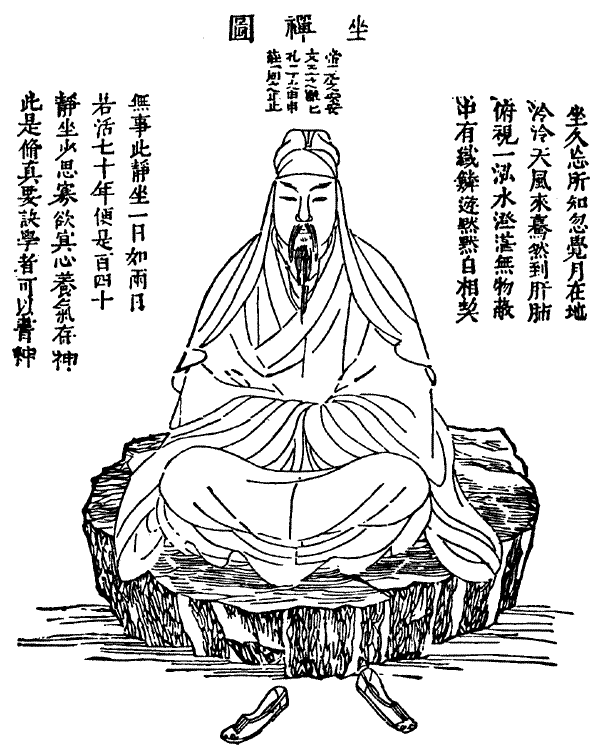
"Gathering the Light", Taoist meditation from The Secret of the Golden Flower

The microcosmic orbit (小周天), also known as the Self Winding Wheel of the Law, is a Taoist qigong energy cultivation technique. It involves deep breathing exercises in conjunction with meditation and concentration techniques which aim to develop the flow of qi along certain pathways of energy in the human body which may be familiar to those who are studying traditional Chinese medicine, qigong, tai chi, Neidan and Chinese alchemy. The exercise can be performed usually at first in a sitting position, but it can also be practiced standing as in Zhan zhuang or with movements included as with tai chi.

The clear understanding of the microcosmic orbit technique is very important not only because of its historical context in the story of Chinese alchemy but because it is at the heart of many Taoist forms of exercise performed throughout the world by many millions of people today.

History

[edit]
Microcosmic orbit

The history of the microcosmic orbit dates back to prehistoric times in China, and the underlying principles can be found in the I Ching which according to legend was written by the Emperor Fu Xi approximately five thousand years ago or at least two centuries before the time of the Yellow Emperor. For example, the Chinese character for the I Ching hexagram number 5, Waiting, depicts a person sitting in meditation and the commentary pertains to the flow of energy from one of the psychic energy channels to another during meditation:

The commentary on the Image for hexagram 5 reveals the entire process of meditation. "The clouds rise up to heaven" symbolizes the meditator's energy rising upward as it evaporates into the head, where it is distilled into a saliva like nectar (referred to in the phrase "the superior man eats and drinks"), which returns to the abdomen. " It furthers one to cross the great water" alludes to crossing the great water of the abdomen and mouth.[1]

An 1886 stone carving in the White Cloud Temple in Beijing contains a pictorial representation of some of the symbols which describe the processes involved in the microcosmic orbit meditation technique. These particular techniques are derived from the Taoist Patriarch Lü Dongbin who was born in 798 AD.[2] Lü Dongbin was one of the Eight Immortals.

Lü Dongbin and his teacher, Chung-li Ch'üan, were two of the "Eight Immortals”, pa-hsien. While a fugitive after an abortive Chinese military expedition against Tibet, Chung-li Ch'uan encountered Master Tung-hua. He "earnestly begged for the secrets of immortality. Master Tung-hua thereupon imparted to him not only an infallible magic process for attaining longevity, but also the method to produce the Philosopher's Stone."[3]

Practice

[edit]
Building the bridge with the tip of the tongue touching the palate

The exercise itself usually begins with preparation designed to relax the physical body and develop the ability to concentrate. Students may indeed be encouraged to practice Taoist Yoga exercises or tai chi as a way of building enough energy to begin performing the microcosmic orbit exercise as it can induce a strain on the nervous system and cause energy depletion if practiced without adequate preparation.[4]

To begin with the student is encouraged to develop deep abdominal breathing into the primary dantian or Taoist energy centre to develop heat and pressure in the lower abdomen or "Golden Stove". A preparatory exercise known by some as the Lesser Heavenly circulation[5] involves moving energy between two areas known as the seat of fire near the heart or the solar plexus where a psychic centre symbolised by the trigram Li from the I Ching is located, and the seat of water in the area of the kidneys where a psychic centre symbolised by the trigram kan is located.

Normally essence or jing can flow either way through the eight extra meridians or energy pathways in the body, but in the microcosmic orbit meditation exercise jing is encouraged to flow upwards along the Governor vessel during inhalation and then downwards along the conception vessel returning to the dantian on the exhalation.[6] This means that energy flows from the dantian downwards to the base of the spine then up the back along the centre line of the body to the crown of the head, then over the head and down the front centre line of the body and back to the starting point again making a full circle or orbit.[7] This prevents the body's natural essences from becoming depleted as they normally flow downwards from the brain or 'sea of marrow' and are lost during ejaculation or menstruation during the reproductive processes. It is this jing or essence which is responsible for the reproductive processes in the body which allow the body to rejuvenate itself as well as for the reproductive processes which give rise to offspring. Essence is also an important component in the manufacture of qi which can be translated into English as vitality or energy, the primary motive force which is life itself. This raising and lowering Jing through the microcosmic orbit and returning it to the dantian purifies the essence and transforms it into qi or vitality.

As well as the lower dantian or cauldron there are other important points along the circuit of energy flow which include the 'three gates' which are areas where it is considered that energy may stagnate, these are the wei-lu or Tailbone gate, the Dorsal gate on the back roughly level with the heart, and the Jade pillow on the back of the head.[8] Other important areas include the Ming Men or gate of fire on the back about level with the kidneys and the Baihui or Niwan which is directly on top of the head.[9]

The Three Passes (sanguan 三関) of Internal Alchemy

The microcosmic orbit should be viewed in the context of a variety of Taoist exercises and techniques designed to purify the body physically, mentally and spiritually, improve health and longevity, and prepare the way for meditation, and also including other techniques such as the macrocosmic orbit which means circulating energy into the other psychic energy meridians which flow around the torso and out into the arms and legs. These types of exercises are best practiced under the guidance of suitably qualified teachers who can help the beginner avoid any pitfalls and misunderstandings along the way rather than copied from books, especially if the subject may have a history of mental illness or emotional imbalance. For example, according to Lu Kuan Yu: "It is harmful to pinpoint places in the body, the very idea of which should be relinquished since it hinders the course of the inner fire and of vitality."[10]

References

[edit]

Further reading

[edit]
[edit]
Revisions and contributorsEdit on WikipediaRead on Wikipedia
from Grokipedia
The Microcosmic Orbit, also known as the Small Heavenly Cycle or Xiao Zhou Tian, is a foundational Taoist meditation practice that involves the intentional circulation of (vital energy) through two primary meridians: the Governing Vessel (Du Mai) along the spine and the Conception Vessel (Ren Mai) along the front midline of the body, forming a continuous loop from the to of the head. This technique integrates the body's jing (essence), , and shen (spirit) across the three energy centers—lower (abdominal), middle (chest), and upper (head)—to harmonize energies and refine . Rooted in ancient Taoist internal alchemy (neidan), the Microcosmic Orbit traces its origins to prehistoric Chinese practices, potentially predating early medical texts and linked to the I Ching, with parallels in Buddhist traditions such as the Shaolin Temple's Luohan Gong system. In modern contexts, it was popularized through lineages including that of the Taoist hermit Yi Eng (White Cloud), who transmitted alchemical formulas—including this orbit—to Mantak Chia in the 20th century, with cross-cultural similarities in practices like Kriya Yoga. According to traditional Taoist teachings, the practice involves preparatory breathing and techniques to facilitate flow and serves as a foundation for advanced stages, with emphasis on guidance from a teacher to prevent energy imbalances. Proponents claim benefits such as relaxation, improved vitality, and spiritual development, though scientific evidence is limited primarily to general effects of and on stress reduction. As a core element of nei gong (internal work), it underscores Taoism's emphasis on for health and enlightenment, influencing contemporary and integrative wellness practices.

Fundamentals

Definition and Purpose

The microcosmic orbit, known in Chinese as xiao zhou tian or "small heavenly cycle," is a foundational technique in that involves the bidirectional circulation of (vital energy) through the Ren meridian (Conception Vessel, along the front midline of the body) and the Du meridian (Governing Vessel, along the back midline), forming a closed orbital loop from the perineum upward through the spine and head, then descending via the front channel, with the tongue placed against the palate to connect the circuits. This practice emphasizes mental focus (yi) to guide the energy flow, starting typically from the lower (energy center below the navel) and passing through key points such as the , , and of the head. The primary purpose of the microcosmic orbit is to transform jing (essence, often associated with reproductive and vital fluids) into qi through controlled circulation, thereby promoting rejuvenation, balancing yin and yang energies, and fostering internal harmony for physical vitality and spiritual cultivation. In the context of neidan (internal alchemy), it serves as an entry point to higher practices aimed at refining qi into shen (spirit) and ultimately achieving immortality or enlightenment by integrating personal energy with cosmic forces, while also nourishing organs and clearing blockages to support longevity and self-healing. Distinguished from broader forms that may emphasize external movements or breath alone, the microcosmic orbit specifically targets this "small" orbital pathway as an accessible, foundational method for cultivation, contrasting with more advanced "grand" circulations involving additional meridians. Its prehistoric roots lie in ancient Chinese cosmology, where the is viewed as a microcosm reflecting the universe's energetic cycles, enabling practitioners to align internal flows with universal patterns.

Key Concepts and Terminology

The microcosmic orbit centers on the circulation of through two primary extraordinary meridians: the Ren Mai, also known as the Conception Vessel, which runs along the front midline of the body from the (Ren-1) upward through the , chest, , and face to the lower (Ren-24); and the Du Mai, or Governor Vessel, which ascends the back midline from the (Du-1) along the spine, neck, and head to the upper (Du-28). These channels form a continuous loop, with the Ren Mai governing yin aspects and the Du Mai regulating yang energies, facilitating the balanced flow of vital energy throughout the torso and head. Central to this practice are the three , or fields, which serve as key energy centers. The lower , located approximately 1.3 to 3 inches below the in the abdominal region, functions as the primary reservoir for (jing) and storage, supporting physical vitality and the initial stage of alchemical transformation. The middle , situated at the level of the heart or solar plexus (Crimson Palace), regulates breath () and emotional equilibrium, acting as a harmonizing point for the second alchemical stage. The upper , positioned in the forehead or brain area (Muddy Pellet), houses the spirit (shen) and facilitates spiritual awareness in the final transformative phase. Along the Du Mai pathway, three gates mark critical junctures for qi passage during circulation. The Wei-lu gate, at the or base of the spine (), connects to five points and serves as the initial barrier for upward energy flow, with blockages potentially affecting lower body functions. The Jia-ji gate, located between the shoulder blades (approximately at the T4-T7 vertebral level), links to twelve points and regulates mid-spinal energy dynamics. The Yu-zhen gate, or Jade Pillow at the (occipital region), associates with seven points and governs entry to the head, where obstructions may contribute to headaches or . At the core of these concepts lies , the vital life force permeating the body and universe, essential for health, vitality, and physiological harmony in . Circulation of through the microcosmic orbit prevents stagnation, which can impair organ function and lead to disharmony if the flow becomes disordered. This process integrates with principles, where the orbit's yin-yang balance mirrors the trigrams—such as pure yang (heaven) and pure yin (earth)—to foster cosmic harmony within the practitioner. The term "microcosmic orbit" derives from xiao zhou tian (small circulation or small heavenly cycle), referring to the foundational loop through the Ren and Du channels, in contrast to da zhou tian (grand circulation or ), which extends flow to the limbs and entire body in advanced stages.

Historical Development

Ancient Origins

The roots of the microcosmic orbit trace back to prehistoric Chinese shamanic traditions, where practices of breath control and energy alignment were used to harmonize vitality with cosmic forces, emerging around 5,000 years ago according to traditional accounts linked to the legendary figure Fu Xi and the foundational cosmology of the . These early shamanic breathing techniques aimed to connect earthly and heavenly energies, reflecting a in which physiology mirrored universal patterns, as explored in ancient ritual practices documented in later compilations. At its core, the microcosmic orbit embodies ancient Chinese cosmological principles, portraying the as a microcosm of the wherein circulation emulates natural cycles, the interplay of yin-yang duality, and the generative dynamics of the five elements (, , , metal, ). This holistic framework, integral to early Taoist thought, posits that balanced flow through the body's pathways fosters alignment with broader environmental and celestial rhythms, a concept foundational to and spiritual cultivation. Early textual allusions to the meridian flows central to the microcosmic orbit appear in the (Yellow Emperor's Inner Canon), compiled around 200 BCE, which describes the Ren (Conception Vessel) and Du (Governing Vessel) meridians as primary conduits for , regulating energies along the body's midline. These vessels, part of the eight extraordinary meridians, serve as reservoirs that influence overall vitality, providing an indirect basis for later orbit practices. Possible origins also lie in ancient sexual yoga techniques for jing (essence) retention, practiced over 2,000 years ago to conserve vital energy during intercourse, as associated with early Taoist fangzhongshu (bedchamber arts) from the onward. Archaeological evidence supporting these concepts includes the (Chart of the Inner Landscape), a dated 1886 at Beijing's (Baiyun Guan), which visually maps the body's energy pathways in a microcosmic framework aligned with orbit circulation. Engraved by Liu Chengying based on an earlier silk scroll, the diagram illustrates key anatomical and energetic sites—such as the spine as a cosmic waterway and organs symbolizing stellar bodies—emphasizing meditative energy flow for .

Key Figures and Texts

The shift from (external alchemy), which involved compounding physical elixirs from minerals and metals, to (internal alchemy) emphasizing within the body, gained prominence post-Tang dynasty (618–907 CE), with the microcosmic orbit established as a core foundation for refining energy into higher elixirs. This evolution integrated meditative and breathing techniques, adapting earlier cosmological principles to internal processes for spiritual transcendence. Lü Dongbin (b. 796 CE), renowned as one of the and a key figure in the Zhong-Lü school of internal alchemy alongside his teacher , is credited with systematizing the microcosmic orbit as a method for circulating through the body's meridians to achieve . In hagiographies and Daoist lore, he is depicted as a Tang-Song era scholar who attained enlightenment by mastering energy circulation, teaching disciples to refine essence (jing) into vital energy () and spirit (shen) via the orbit's pathways, including the lower, middle, and upper fields. As patron of , Lü Dongbin's legendary instructions, often conveyed through poetry and dialogues, influenced subsequent generations in harmonizing yin-yang forces for longevity and transcendence. Influential texts formalizing these practices include The Secret of the Golden Flower (Taiyi Jinhua Zongzhi), a Ming dynasty treatise from 1688–1692 attributed to Lü Dongbin via spirit-writing, which describes the circulation of inner light along the microcosmic orbit to cultivate the "golden flower" as an alchemical symbol of enlightenment. Another seminal work, the original Chinese text Xingming Gujue (Secrets of Cultivating Essential Nature and Eternal Life) by Zhao Bichen (b. 1860), details the orbit's role in purifying generative force and forming the immortal embryo through sixteen progressive stages of internal refinement. Daoist traditions at Wudang Mountain, preserved by monastic lineages, further refined the microcosmic orbit as an entry point to neidan, blending it with qigong and meditation to align bodily energies with cosmic principles. The orbit's methods also connect briefly to other immortals, such as , the semi-legendary founder of Taijiquan, whose attributed teachings incorporated dynamic, moving variations of energy circulation to integrate internal alchemy with martial forms.

Practice

Preparation Techniques

Preparation for the Microcosmic Orbit begins with establishing a stable physical posture to facilitate the free flow of and promote relaxation of the body and mind. Practitioners typically adopt a seated position, either in the full or half-lotus posture on the floor or comfortably on the edge of a chair with the back straight and unsupported to encourage natural spinal alignment. The feet should be flat on the ground, shoulders slightly relaxed and bowed, and the chest gently collapsed to avoid tension, while the hands rest in the lap with the right palm over the left to seal energy circulation. This posture aligns the body's central axis, allowing for an integrated body-mind state that supports subsequent energy work. Breathing techniques form the foundational layer of preparation, focusing on natural, abdominal respiration to gather in the lower and calm the practitioner. Initial practice involves 36 cycles of soft, nasal abdominal breathing, where exhalation contracts the to internal organs, and allows the diaphragm to descend gently without force. This method, often termed natural belly breathing, directs attention to the lower approximately 1.5 inches below the , building a reservoir of over 10-15 minutes daily. Advanced variations may include reverse breathing, involving slight chest contraction during to enhance gathering, though emphasis remains on smooth, unregulated patterns to avoid strain. Qi-building exercises prepare the practitioner by accumulating and refining vital energy prior to orbit circulation. The Inner Smile technique serves as a key warm-up, where one begins by smiling into the eyes to generate a feeling of warmth and joy, then directs this sensation sequentially to major organs—such as the heart, lungs, liver, kidneys, and spleen—while visualizing each receiving loving energy to release tension and emotional blockages. This is followed by energy collection at the navel through gentle spiraling motions with the mind: men spiral clockwise 24 times, women counterclockwise, to store jing (essence) in the lower dantian. Complementary practices include testicular breathing for men and ovarian breathing for women, focusing awareness on the reproductive centers (sperm palace for men, 1.5 inches above the penis base; ovarian palace for women, below the pinky finger) to draw up sexual energy via light finger pressure or inhalation for 1-5 minutes, transforming it into usable qi. These exercises, practiced daily for 10-15 minutes, stabilize energy accumulation without forcing circulation. Mental focus techniques anchor the preparation by cultivating inner awareness and clearing subtle obstructions. Practitioners visualize a warm, golden light gathering at the lower , using the mind's eye to guide without creating rigid images, starting with concentration on the point for 2-4 weeks to build stability. Grounding methods, integrated via the Inner , involve releasing emotional residues by observing and smiling away negativity in the organs and spine, fostering a calm, centered state. The is pressed lightly against the upper (9, 18, or 36 times) to connect the functional and channels, acting as an energetic bridge. This mental discipline ensures emotional equilibrium and prevents dissipation of built-up .

Circulation Methods

The circulation of the microcosmic orbit involves guiding along the Du Mai (Governing Vessel) in an ascending phase and the Ren Mai (Conception Vessel) in a descending phase, forming a complete loop through the body's primary energy channels. Practitioners assume a seated posture with the spine upright, eyes closed, and palms resting on the lower abdomen to center awareness on the lower dantian. The is positioned against the upper palate to bridge the circuit between the channels. In the ascending phase along the Du Mai, qi begins at the lower and moves downward slightly to the , known as the Wei-lu or Hui Yin gate. From there, it rises through the and up the spine, passing key points such as the Ming Men (at the lower back, opposite the ) for vitalizing energy and the Jade Pillow (base of the skull) to release tension, before reaching the crown at Baihui. The flow then descends briefly over the head to the upper palate, where the tongue tip touches to complete the connection. This phase is typically guided by , drawing the energy upward with focused intention. The descending phase follows along the Ren Mai, with qi flowing from the palate down the throat and through the chest to the middle (at the solar plexus or heart level), then continuing down the midline of the abdomen back to the lower . This return path nourishes the internal organs and balances yin . often accompanies this descent, allowing the qi to settle gently. One full cycle—from lower up the back and down the front—completes the , with practitioners repeating 9 to 36 cycles per session, starting with fewer for beginners to build familiarity. Visualization enhances the circulation by imagining a warm, glowing pearl or golden-white light orbiting the path, starting small at the lower and expanding with each cycle to illuminate the route. Breath coordination—inhaling to ascend and exhaling to descend—assists beginners in directing the flow, while advanced practitioners cultivate a spontaneous circulation without deliberate syncing, allowing to move naturally once the channels open. Sessions typically last 15 to 30 minutes daily, performed consistently to strengthen the orbit over time.

Safety Considerations

Practicing the microcosmic orbit requires caution to avoid qi deviations, which can manifest as symptoms similar to kundalini syndrome, including sensations of excessive heat, anxiety, , and strain on unprepared energy channels due to forcing the circulation or neglecting preparatory exercises. These deviations often arise from excessive intention or incorrect posture, leading to energy rushing upward and causing , headaches, or emotional . Certain conditions contraindicate the practice, such as acute illnesses or issues like , where it may exacerbate symptoms or trigger psychotic episodes; is also contraindicated according to some teachings. Individuals with energy blockages should consult experienced teachers before proceeding. Improper practice heightens risks in those with psychiatric vulnerabilities, potentially resulting in somatic complaints like or . To mitigate risks, practitioners should learn the microcosmic orbit from qualified instructors trained in established lineages to ensure proper technique and progression. If discomfort such as vertigo or panic arises, stop immediately and apply relaxation methods like total body loosening or the Six Words formula to restore balance. Following sessions, integrate grounding practices, such as focusing on the lower body and limbs to sink energy downward, to stabilize the flow and prevent imbalances. Some traditional Taoist sources caution against improper circulation, which can generate "poison fire" affecting the heart and leading to internal disruptions if breath and intention are not harmonized. Adhering to standardized procedures and avoiding overexuberance further ensures safety in this advanced qigong method.

Physiological and Health Aspects

Energetic Mechanisms

In traditional Taoist theory, the microcosmic orbit serves as a foundational mechanism for circulating , the vital life force, through the body's meridian system to maintain energetic balance and health. This circulation primarily involves the Ren Mai (Conception Vessel) and Du Mai (Governing Vessel), which form a continuous loop connecting the front and back of the body, starting from the lower near the and ascending along the spine to the crown before descending the midline. By activating this Ren-Du pair, the practice unblocks the 12 principal meridians, allowing to flow freely and regulate the interconnected network of energy channels. Furthermore, this flow tonifies the internal organs according to the five elements theory—Wood for liver and gallbladder, Fire for heart and , Earth for spleen and , Metal for lungs and , and for kidneys and bladder—thereby harmonizing energies and supporting overall physiological equilibrium. From a physiological perspective, the microcosmic orbit is correlated with activation of the to promote relaxation and restorative processes throughout the body. The circulation along the Ren and Du meridians is thought to influence key endocrine glands, such as the adrenal glands located near the Ming Men (Gate of Life) point at the lower back, enhancing and stress response regulation. Additionally, the rhythmic focusing on breath and energy pathways improves blood circulation by dilating vessels. The core energetic transformation in the microcosmic orbit involves converting jing (essence or primal substance, often linked to reproductive and genetic energies) into through dynamic processes in the , particularly the lower acting as an internal generator via focused friction-like compression from breath and intention. This refinement prevents qi stagnation, which (TCM) views as the cause of by disrupting organ harmony and meridian flow, instead fostering a continuous upward and downward circulation that builds vital energy reserves. In cross-cultural interpretations, this mechanism integrates with concepts, where the lower aligns with the () and sacral (svadhisthana) chakras, serving as reservoirs for grounding and creative energies that parallel Taoist jing cultivation.

Health Benefits and Evidence

The microcosmic orbit practice is traditionally linked to physical health benefits such as improved circulation, reduced , and endocrine balance. In , which includes this circulation technique, randomized controlled trials have shown significant improvements in hemodynamic parameters, including lowered systolic and diastolic in hypertensive individuals, with effects comparable to moderate exercise. regulation, a key aspect of endocrine balance, has been observed in studies where practices reduced stress-induced elevations, potentially mitigating chronic . Conservation of jing, the vital essence in Taoist , is believed to support by preserving reproductive and foundational energies, though ties this more broadly to enhanced and reduced fall risk in older adults through . Mentally and emotionally, the practice promotes enhanced focus, stress reduction, and emotional stability. Qigong meditative movements, akin to the microcosmic orbit, have been found to decrease anxiety and depressive symptoms by modulating the , shifting toward parasympathetic dominance for greater relaxation. Emotional benefits extend to reproductive , where jing-focused practices are reported to improve hormonal harmony and sexual vitality, including stronger orgasms, through balanced energy flow in the lower . These effects align with broader outcomes, such as improved cognitive function and mood regulation in clinical populations. Scientific evidence for the microcosmic orbit specifically remains limited, with most research examining as a whole. A systematic review of over 77 randomized controlled trials highlighted consistent benefits for anxiety reduction and management, attributing these to meditative movement's impact on cardiovascular and psychological parameters. A 2017 analysis of exercises further supported immune enhancement and inflammation mediation, analogous to for autonomic regulation. More recent systematic reviews, including a 2022 overview and a 2025 meta-analysis on cancer patients, continue to affirm improvements in , , and psychological . Though no large-scale randomized controlled trials target the orbit directly as of 2025, traditional claims in emphasize organ tonification, with the Ren Mai nourishing yin organs like the lungs and the Du Mai strengthening yang organs such as the kidneys, thereby preventing disease through balanced circulation.

Modern Applications

Integration with Contemporary Practices

The microcosmic orbit has been integrated into contemporary and practices to enhance circulation and overall flow during movement sequences. In systems like Qigong Shibashi, practitioners incorporate the orbit by using coordinated breath and gentle arm swings to guide along the Ren (Conception) and Du (Governing) meridians, forming a foundational circuit that clears blockages and supports immune function. This approach aligns with the slow, deliberate motions of , where the orbit's upward spinal ascent and downward frontal descent mirror the form's silk-reeling spirals, promoting a seamless loop within the . For advanced integration, the macrocosmic orbit extends this circuit by incorporating limb pathways, allowing to flow through the arms and legs for a full-body energetic alignment that amplifies 's martial and therapeutic benefits. Parallels between the microcosmic orbit and yoga's subtle energy systems facilitate cross-disciplinary adaptations, particularly in practices. The orbit's circuit along the spine and front midline corresponds to the ida (lunar, left-side) and (solar, right-side) s flanking the central sushumna nadi, enabling a balanced awakening of energy without overwhelming the practitioner. In , this alignment is used to safely circulate , preventing energetic imbalances by mirroring the orbit's controlled ascent and descent, which supports gradual activation and emotional stability. In modern wellness routines, the microcosmic orbit appears in digital tools and guided audio sessions, making it accessible for stress reduction and . Platforms like Insight Timer offer numerous meditations from 2023 to 2025, such as those focusing on visualization to circulate and release tension, often lasting 10-20 minutes for daily integration into routines. These practices are applied therapeutically for management, where visualizing the orbit's flow along the torso meridians helps alleviate stagnation and promote relaxation in areas like the lower back and . Unlike the macrocosmic orbit, which broadens to include extremities for comprehensive embodiment, the microcosmic version emphasizes the core loop, providing a focused for beginners in these hybrid wellness contexts.

Current Teachings and Interpretations

In the late , emerged as a pivotal figure in disseminating the microcosmic orbit practice to Western audiences, founding the Universal Healing Tao system in the 1970s and popularizing it through accessible books and workshops starting in the . Chia's teachings, drawn from Taoist traditions, emphasize the Microcosmic Orbit as a key energy channel running up the spine (Governor Vessel) and down the front of the body (Conception Vessel), used in techniques like the Big Draw to circulate refined sexual energy throughout the body for healing and higher awareness. This is achieved through circulating chi through the body's meridians via breath and visualization, as detailed in works like Awaken Healing Light of the Tao: The Microcosmic Orbit Meditation, which integrates the practice into daily health routines. However, Chia's methods have drawn criticism from some traditional Taoist practitioners, who argue they deviate from classical internal alchemy, may provide incomplete instructions leading to energetic imbalances or harm, and lack authenticity. This dissemination coincided with the boom in the West, spurred by increased interest in Eastern wellness amid cultural exchanges and immigration from , transforming the orbit from an esoteric Taoist method into a mainstream tool for energy cultivation. More recently, teachers like Nick Loffree of Flowing Zen have adapted the microcosmic orbit for contemporary practitioners, highlighting its role in emotional regulation and mental focus as of 2023. Loffree's approach, rooted in lineages, promotes the practice for releasing stagnant and enhancing vitality, often through guided online sessions that build on Chia's foundations while addressing modern stressors like anxiety. Lineage evolutions continue through schools such as Universal Healing Tao, which structures the orbit within a broader curriculum of inner , and Wudang traditions, where methods like the Red Dragon Spinning Pearl refine circulation for and applications. Modern interpretations increasingly frame the microcosmic orbit through a scientific lens as a form of training, particularly stimulating the via coordinated breathing to promote parasympathetic balance and stress reduction. Spiritually, it is viewed as fostering a universal connection by mirroring cosmic energy flows, with parallels drawn to systems where the orbit aligns lower and upper energy centers for holistic integration. In somatic therapy contexts, the practice aids trauma release by circulating to dissolve blockages in the conception and governing vessels, supporting regulation as evidenced in integrative wellness programs. Post-COVID-19, online platforms have enhanced to microcosmic teachings, enabling global participation through live-streamed classes and apps that guide visualization, though practitioners caution against oversimplified versions that may dilute traditional depth. This digital shift, accelerated by restrictions, has integrated the into hybrid wellness routines, preserving lineage integrity via certified instructors from Universal Healing Tao and Wudang lineages.

References

Add your contribution
Related Hubs
User Avatar
No comments yet.