


Community hub
Recent from talks
Contribute something
Nothing was collected or created yet.
Middle latitudes
View on Wikipedia | This article needs additional citations for verification. (October 2019) |


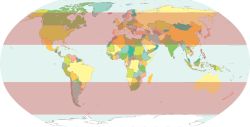
The middle latitudes, also called the mid-latitudes (sometimes spelled midlatitudes) or moderate latitudes, are spatial regions on either hemisphere of Earth, located between the Tropic of Cancer (latitude 23°26′09.4″) and the Arctic Circle (66°33′50.6″) in the Northern Hemisphere and between the Tropic of Capricorn (-23°26′09.4″) and the Antarctic Circle (-66°33′50.6″) in the Southern Hemisphere.[1][2] They include Earth's subtropical and temperate zones, which lie between the two tropics and the polar circles. Weather fronts and extratropical cyclones are usually found in this area, as well as occasional tropical cyclones or subtropical cyclones, which have traveled from their areas of formation closer to the Equator.[3]
The prevailing winds in the middle latitudes are often very strong. These parts of the world also see a wide variety of fast-changing weather as cold air masses from the poles and warm air masses from the tropics constantly push up and down over them against each other, sometimes alternating within hours of each other, especially in the roaring forties (latitudes between 40° and 50° in both hemispheres)[citation needed], even though the winds on the Northern Hemisphere are not as strong as in the Southern Hemisphere, due to the large landmasses of North America, Europe and Asia.[4]
There are six types of mid-latitude climates consisting of: mediterranean, desert, humid subtropical, oceanic, humid continental and subarctic.[5]
See also
[edit]References
[edit]- ^ "Weather & Climate Change: Climates around the world". Education Scotland. Archived from the original on 14 April 2016.
- ^ Service, NOAA's National Weather. "Glossary - NOAA's National Weather Service". w1.weather.gov. Retrieved 2023-01-19.
- ^ "Mid-latitudes | climateprediction.net". www.climateprediction.net. Archived from the original on 2019-10-22. Retrieved 2019-10-22.
- ^ US Department of Commerce, National Oceanic and Atmospheric Administration. "What are the Roaring Forties?". oceanservice.noaa.gov. Retrieved 2023-01-19.
- ^ "Midlatitude Climates (Group II)". geography.name. Retrieved 2019-10-22.

|
Middle latitudes
View on GrokipediaDefinition and Extent
Latitudinal Boundaries
The middle latitudes, often synonymous with the temperate zones in broader geographical contexts, extend from the tropics to the subpolar regions. In the Northern Hemisphere, this spans approximately from 23.5°N—the latitude of the Tropic of Cancer—to 66.5°N, corresponding to the Arctic Circle. Similarly, in the Southern Hemisphere, the range runs from 23.5°S (Tropic of Capricorn) to 66.5°S (Antarctic Circle). These boundaries are determined by Earth's axial tilt of 23.44°, which defines the inclination of the tropics as the points where the Sun reaches its zenith at the solstices. The precise position of the Tropic of Cancer, for instance, is currently at about 23°26′ N, shifting gradually due to axial precession.[8][9][10] In common meteorological usage, however, the middle latitudes are more narrowly defined as the band between 30° and 60° N/S, focusing on the core area of temperate influences where dynamic weather patterns dominate. This narrower range emphasizes the transition from subtropical highs to polar fronts, excluding the outer subtropical and subpolar margins.[11][3] Definitions of the middle latitudes exhibit variations across disciplines and historical periods. Subtropical zones are typically delineated from 23.5° to about 35° N/S, temperate core areas from 35° to 60° N/S, and subpolar transitions beyond that up to the polar circles. Historically, ancient classifications like Aristotle's viewed the temperate zones holistically from 23.5° to 66.5° N/S as habitable mid-regions. Modern meteorological definitions often refine these through climate classification systems, such as the Köppen scheme, which uses temperature thresholds (e.g., coldest month above 0°C but below 18°C for temperate climates) rather than rigid latitudinal lines, allowing for overlaps based on local conditions.[3][12]Geographical Coverage
The middle latitudes, defined as the regions between approximately 30° and 60° north and south of the equator, extend across diverse continental and oceanic areas, with a pronounced asymmetry in land distribution favoring the Northern Hemisphere. In the Northern Hemisphere, these latitudes encompass much of North America, including the contiguous United States and southern portions of Canada; Europe, ranging from the Mediterranean shores northward to Scandinavia; and Asia, covering central and eastern regions such as much of China and European Russia extending to the southern fringes of Siberia.[13][14] These areas feature prominent landforms, including the Rocky Mountains in North America, which traverse from northern New Mexico to the Yukon Territory, and the Alps in Europe, a major fold mountain system spanning eight countries from France to Slovenia. The southern portion of the Andes, the world's longest continental mountain range, lies within the middle latitudes of the Southern Hemisphere, extending from about 30°S to 55°S along the western edge of South America in countries such as Peru, Bolivia, Chile, and Argentina.[15] In the Southern Hemisphere, the middle latitudes include parts of South America from southern Brazil to Patagonia, the southeastern and southwestern regions of Australia, and the southern tip of Africa around South Africa.[13] The southern middle latitudes are predominantly oceanic, with oceans covering about 80% of the area, including extensive portions of the Atlantic, Indian, and Pacific Oceans south of 30°S, in contrast to the land-rich Northern Hemisphere middle latitudes.[16] This uneven distribution means that while the middle latitudes as a whole occupy roughly 37% of Earth's surface, the Northern Hemisphere portion contains a disproportionately larger share of the planet's landmass, estimated at around 40-50% of global land area when accounting for temperate zone overlaps.[17]Climate and Weather Patterns
Climate Classifications
The middle latitudes, spanning approximately 30° to 60° latitude in both hemispheres, host a variety of climate types primarily classified under the Köppen system as group C (temperate or mesothermal) and group D (continental), with limited occurrences of group B (arid) in transitional zones near the subtropics.[3] Group C climates feature the coldest month between 0°C and 18°C, the warmest month above 10°C, and at least one month above 10°C, encompassing subtypes such as Mediterranean (Csa and Csb), characterized by dry summers and wet winters due to the influence of subtropical high-pressure systems; oceanic (Cfb), with mild temperatures and year-round precipitation moderated by maritime air masses; and humid subtropical (Cfa), featuring hot, humid summers and mild winters with even precipitation distribution.[18] Group D climates, dominant in continental interiors, have the coldest month below 0°C and at least one month above 10°C, including humid continental (Dfa and Dfb) with hot summers, cold winters, and moderate to high precipitation, and subarctic (Dfc) with short, cool summers and severe winters.[19] Transitional arid B climates, such as steppes (BSk), appear in rain shadows or leeward positions within mid-latitudes, receiving less than potential evapotranspiration but more than true deserts.[3] Alternative classification systems like Trewartha refine these by emphasizing thermal regimes and humidity thresholds, categorizing mid-latitude climates into subtropical (C, with 8 or more months above 10°C) and temperate (D, with 4 to 7 months above 10°C), which better accounts for seasonal extremes in continental areas compared to Köppen's focus on monthly averages.[20][21] The Thornthwaite system, based on a moisture index derived from potential evapotranspiration and precipitation, highlights humidity regimes in mid-latitudes by classifying them as humid (positive moisture surplus) or subhumid (balanced), particularly useful for assessing agricultural potential in variable precipitation zones.[22] These systems collectively define D climates by warmest-month temperatures exceeding 10°C and coldest below 0°C, underscoring the thermal boundaries that distinguish mid-latitude variability from polar or tropical regimes.[23] Seasonal contrasts in middle latitudes are pronounced, with continental interiors experiencing four distinct seasons—hot summers, cold winters, and transitional spring and fall—due to large annual temperature ranges often exceeding 20°C, while maritime-influenced coastal areas exhibit milder variations with smaller ranges of 10–15°C and less extreme winters.[3] In humid C and D regions, annual precipitation typically ranges from 500 to 1500 mm, concentrated in growing seasons for continental types and more evenly distributed in oceanic subtypes, supporting diverse vegetation but prone to summer droughts in transitional areas. Mediterranean Csa/Csb zones exemplify transitional influences, where subtropical highs suppress summer rainfall, leading to dry periods contrasted by wet winters from mid-latitude storms.[18]Atmospheric Circulation and Storms
In the middle latitudes, the prevailing westerlies dominate atmospheric circulation, manifesting as west-to-east winds driven by the combined effects of the Coriolis force and pressure gradients between the subtropical high-pressure systems and the subpolar low-pressure regions. These winds arise from the thermal contrasts that create a poleward flow in the upper troposphere, which is deflected eastward by the Coriolis effect, resulting in a broad band of westerly flow at the surface. Wind speeds generally increase with latitude, becoming particularly intense in the Southern Hemisphere's Roaring Forties between 40° and 50°S, where uninterrupted ocean expanses allow for sustained gales exceeding 50 knots.[25][26][27] Closely associated with these westerlies are the jet streams, narrow bands of high-speed winds in the upper atmosphere that steer weather systems across the middle latitudes. The polar front jet stream, positioned at approximately 50° to 60° latitude and altitudes of 9 to 16 km, forms along the boundary between cold polar air and warmer mid-latitude air, with core speeds reaching up to 400 km/h during winter. This jet influences storm tracks by guiding low-pressure systems eastward, often meandering in a wavy pattern that can amplify weather variability in regions like North America and Europe.[28][29][30] Extratropical cyclones, the primary storm systems in middle latitudes, develop as low-pressure centers along the polar front where contrasting air masses converge, often initiated by upper-level divergences associated with the jet stream. These cyclones feature distinct warm and cold fronts, with the warm front advancing ahead of the system and the cold front following, leading to a characteristic comma-shaped cloud pattern observable in satellite imagery. The lifecycle typically progresses through cyclogenesis, where the low deepens rapidly due to baroclinic instability; maturation, marked by intense precipitation and winds; and occlusion, as the cold front overtakes the warm front, lifting the warm air mass aloft and eventually dissipating the system over warmer waters or land. In the North Atlantic, these cyclones occur with a frequency of approximately 120 per year, or roughly 2 to 3 per week, contributing significantly to seasonal weather patterns. Recent research as of 2025 suggests that anthropogenic climate change is enhancing the intensity of these extratropical cyclones, potentially leading to more severe storms in mid-latitude regions.[31][32][33][34] Associated with these cyclones are phenomena such as frontal rainfall, where uplift along the fronts produces widespread precipitation, often as steady rain or snow in the middle latitudes. Occasionally, tropical cyclones undergoing extratropical transition extend into middle-latitude regions, retaining significant energy as they interact with the westerlies and polar front, potentially intensifying local storms. A notable historical example is the Great Storm of 1987 in the North Atlantic, an intense extratropical cyclone that produced gusts up to 115 mph across the UK, felling 15 million trees and causing 18 fatalities due to its rapid deepening along the jet stream.[35][36]Ecosystems and Biodiversity
Vegetation and Biomes
The vegetation in middle latitudes is dominated by biomes adapted to distinct seasonal variations in temperature and precipitation, ranging from humid continental to Mediterranean climates. These biomes feature plant communities with structural adaptations such as leaf morphology and root systems that optimize resource use during favorable periods while minimizing losses during stress. Temperate deciduous forests, temperate coniferous forests, grasslands and steppes, and Mediterranean shrublands represent the primary types, each exhibiting functional traits like nutrient cycling and drought tolerance that enhance resilience to mid-latitude weather patterns. Temperate deciduous forests are characterized by broadleaf trees such as oaks (Quercus spp.) and maples (Acer spp.), which undergo seasonal leaf drop to conserve water and nutrients during cold winters.[37] This adaptation involves leaves changing color in autumn, abscising in winter, and regrowing in spring, allowing survival in regions with freezing temperatures and moderate annual precipitation.[38] These forests are primarily located in eastern North America, much of Europe, and eastern Asia, where they form biodiversity hotspots supporting diverse understory flora and epiphytes.[39][40] In cooler and wetter middle-latitude zones, temperate coniferous forests prevail, dominated by evergreen species like pines (Pinus spp.) and firs (Abies spp.) that retain needle-like leaves year-round for efficient photosynthesis in low-light conditions.[41] These forests thrive in areas such as the Pacific Northwest of North America, where high rainfall supports tall, dense canopies, and they often mix with deciduous species in transitional zones influenced by varying elevation and moisture gradients.[42][43] Grasslands and steppes occupy drier middle-latitude interiors, featuring drought-resistant grasses with deep root systems that access subsurface water and extensive fibrous roots that stabilize soil against erosion.[44] Examples include the tallgrass prairies of North America, the pampas of South America, and the Eurasian steppes, where plants are fire-adapted through basal meristems that regenerate after burning and thick-walled cells that withstand periodic droughts.[45][46] The deep, fertile soils of these biomes, enriched by organic matter from decaying roots, support high primary productivity during growing seasons.[47] Mediterranean shrublands, known as chaparral in California or maquis in the Mediterranean Basin, consist of sclerophyllous plants with small, leathery leaves that reduce transpiration and thick cuticles for water retention.[48] These shrubs enter summer dormancy to endure dry periods, relying on deep roots to tap groundwater and resprouting from lignotubers after fires.[49] Similar formations occur in the Australian mallee, where multi-stemmed eucalypts exhibit comparable adaptations to seasonal aridity.[50] Biome transitions in middle latitudes occur gradually from humid subtropical edges, where deciduous forests blend into warmer broadleaf zones, to subarctic taiga boundaries marked by coniferous dominance giving way to boreal evergreens. These ecotones play key roles in carbon sequestration, with temperate forests and grasslands storing significant atmospheric CO₂ in biomass and soils through enhanced photosynthesis and root decomposition, contributing notably to global carbon sequestration.[51][52] Seasonal precipitation variations drive these shifts, influencing plant distribution and ecosystem services across latitudinal gradients.[53]Fauna and Adaptations
The fauna of middle latitudes, encompassing temperate zones between roughly 30° and 60° north and south, features a rich array of species adapted to pronounced seasonal shifts in climate and food availability. These animals inhabit diverse ecosystems such as forests, grasslands, and coastal waters, where behavioral and physiological strategies enable survival amid cold winters and productive summers. Supported by biomes like temperate deciduous forests and prairies, this fauna includes mammals that hibernate or migrate, birds and insects with seasonal cycles, and aquatic species undertaking long journeys. Mammals in these regions exhibit hibernation as a primary adaptation to winter scarcity; for instance, black bears (Ursus americanus) in North American temperate forests enter prolonged dormancy for 4–6 months, drastically reducing metabolic rates to conserve energy from fat reserves accumulated during warmer months.[54] While larger herbivores like white-tailed deer (Odocoileus virginianus) do not fully hibernate, they minimize activity, relying on insulated coats and browsing on available twigs and bark to endure cold periods.[55] In grasslands, American bison (Bison bison) serve as keystone herbivores, grazing extensively on prairie grasses and promoting vegetation diversity through their foraging patterns.[56] Mammalian migration also occurs, particularly among ungulates in northern temperate areas, where species travel to access seasonal resources.[57] Birds and insects in middle latitudes synchronize breeding and activity with summer abundance to maximize reproductive success. Many birds, such as the barn swallow (Hirundo rustica), migrate from European temperate breeding grounds to sub-Saharan Africa, covering up to 6,000 miles annually to escape winter and exploit insect peaks.[58] Raptors like the golden eagle (Aquila chrysaetos) thrive in Mediterranean and forested temperate zones, breeding seasonally and hunting small mammals in open habitats.[59] Insects, including diverse bees, exhibit similar phenology, with pollinator activity peaking in summer to coincide with floral resources in Mediterranean climates, where wild bee communities support high plant diversity despite dry summers.[60] Aquatic life in middle latitudes benefits from oceanic influences, with species adapted to temperate currents and river systems. Atlantic salmon (Salmo salar) perform anadromous migrations, spawning in freshwater rivers of the North Atlantic rim after maturing in cooler marine waters, timing runs to leverage seasonal stream flows.[61] In coastal temperate zones, Atlantic cod (Gadus morhua) inhabit the Northwest Atlantic, preferring cold, nutrient-rich waters around 0–10°C for feeding and reproduction.[62] Physiological and behavioral adaptations are central to temperate survival, including dense fur in mammals and feathering in birds for thermal insulation during freezes, which minimizes heat loss in subzero conditions. Small mammals frequently use torpor, a reversible state of reduced body temperature and metabolism, to bridge daily or seasonal energy gaps, as observed in Australian bats during cool periods. Endemism is pronounced in isolated temperate ecoregions, such as eastern Australia's forests, where unique fauna like velvet worms (Onychophora) have evolved specialized moisture-retention traits suited to local mild, wet winters.[63] Faunal biodiversity in middle latitudes is markedly higher in the Northern Hemisphere, driven by larger contiguous landmasses that foster varied habitats and evolutionary opportunities for mammals and birds. Habitat fragmentation exacerbates threats, isolating populations and elevating local extinction risks through diminished gene flow and resource access, particularly for temperate vertebrates.[64][65]Human Geography and Impacts
Population Distribution and Settlement
The middle latitudes, spanning approximately 30° to 60° from the equator in both hemispheres, host a substantial portion of the global population, with over 50% residing primarily in the Northern Hemisphere band (30°–60° N) as of recent estimates, owing to the region's fertile soils, moderate temperatures, and reliable precipitation that facilitate agriculture and long-term habitation. In contrast, the Southern Hemisphere middle latitudes (30°–60° S) remain sparsely populated, accounting for less than 5% of the world's total, due to limited land availability, predominantly arid or semi-arid landscapes, and historical barriers to large-scale settlement. This uneven distribution underscores the Northern Hemisphere's dominance in middle-latitude demographics, where the broad geographical coverage from western Europe to eastern Asia supports dense human occupancy. Prominent urban centers in the Northern middle latitudes include megacities like New York (40.7° N), London (51.5° N), and Tokyo (35.7° N), which have grown into economic hubs leveraging temperate conditions and access to trade routes. Complementing these are extensive rural settlements in grassland biomes, such as the North American Great Plains and the Eurasian steppes, where agricultural communities have thrived on vast arable lands suitable for grain production. In the Southern Hemisphere, settlements are more dispersed, with notable concentrations around coastal areas like Buenos Aires (34.6° S) and Melbourne (37.8° S), reflecting adaptation to variable climates. Human settlement in middle latitudes traces back to post-Ice Age migrations around 12,000 years ago, when retreating glaciers enabled colonization of Europe and northern Asia by early modern humans from lower latitudes. Later historical expansions, including European colonial migrations from the 16th to 19th centuries, further populated these zones, as settlers from mid-latitude Europe established communities in North America (e.g., along the 40° N parallel) and Australia (around 35° S). Key factors shaping population distribution include proximity to coasts and major river systems, which provide water resources, transportation, and moderation of climate extremes, as seen in dense settlements along the Mississippi River and the Rhine. Populations tend to avoid continental interiors with harsh continental climates, such as central Asia's steppes and deserts, where low precipitation and temperature fluctuations limit viability, resulting in lower densities compared to coastal or fluvial zones. As of 2025, urbanization in middle latitudes exceeds 50% overall, with rates surpassing 70% in Northern Hemisphere developed regions like Europe and Northern America, driven by economic opportunities and infrastructure development. Demographic shifts are evident in ongoing rural-to-urban migration, particularly toward coastal megacities, as populations seek better services and employment, a trend projected to intensify through mid-century. Emerging climate-induced migrations, such as movements northward within North America due to increasing heat and drought in southern areas, are beginning to influence distribution patterns in mid-latitude regions.[66]Economic Activities and Environmental Effects
The middle latitudes, spanning approximately 30° to 60° north and south, support extensive agricultural activities centered on temperate crops suited to seasonal variations in temperature and precipitation. Fertile plains in these regions facilitate the cultivation of staple grains such as wheat and corn, alongside fruits like apples and berries, with yields heavily influenced by distinct growing seasons that allow for crop rotation and harvest cycles. In the United States Midwest, often termed the "breadbasket" due to its vast corn and wheat production exceeding 127 million acres of farmland, these activities underpin global food supplies and contribute significantly to export economies. Mediterranean zones within mid-latitudes, such as those in southern Europe and California, specialize in viticulture, where mild, wet winters and dry summers enable high-value wine grape production, accounting for over 55% of global wine-growing areas in mid-latitude climates. Industrial and trade sectors thrive in mid-latitude hubs, leveraging natural resources and transportation advantages. Manufacturing concentrations, like the Ruhr Valley in Germany with its historical focus on coal, steel, and heavy industry, and the Great Lakes region in North America, which supports automotive and machinery production through integrated steel and chemical sectors, drive regional economic output. Trade benefits from prevailing westerly winds, facilitating efficient shipping along routes such as the North Atlantic corridor connecting Europe and North America, which handles a substantial portion of global container traffic and energy commodities. Energy production in these latitudes increasingly draws from renewables, including hydropower from rivers like those in the Alps and Rockies, which supplied 16% of worldwide electricity capacity by 2008 and continues to expand for low-carbon generation. These economic pursuits have induced notable environmental effects, including habitat loss and resource depletion. Twentieth-century deforestation in Europe, driven by agricultural expansion and urbanization, reduced forest cover by up to 50% in some areas, fragmenting ecosystems and diminishing biodiversity. Overfarming in mid-latitude grasslands, such as the North American prairies, has accelerated soil erosion, with models projecting increased sediment loss under intensified tillage and rainfall variability, compromising long-term land productivity. Urban heat islands in densely industrialized mid-latitude cities, like those around the Great Lakes, amplify local warming by 2–5°C through impervious surfaces and emissions, exacerbating climate change effects in surrounding regions. Sustainability initiatives address these challenges through targeted restoration and adaptation measures. As of 2025, China's reforestation programs, including the Grain for Green Project, have restored over 36.6 million hectares of forest, enhancing carbon sequestration and soil stability in northern mid-latitude zones. In Europe, similar efforts under the EU Green Deal have reforested millions of hectares since 2020, focusing on native species to mitigate erosion and biodiversity loss. Adaptation strategies include northward crop migration in response to warming; for instance, maize planting boundaries in Northeast China have shifted poleward by hundreds of kilometers since the 1980s, allowing yields to stabilize amid rising temperatures. Economically, mid-latitude regions, encompassing major economies like the United States, European Union, and Japan, contribute approximately 50% to global GDP through integrated agriculture, manufacturing, and trade networks, with corridors like the North Atlantic underscoring their role in international commerce.[67]References
- https://earthobservatory.[nasa](/page/NASA).gov/biome/biotemperate.php