
Recent from talks
Geographical zone
Knowledge base stats:
Talk channels stats:
Members stats:
Geographical zone
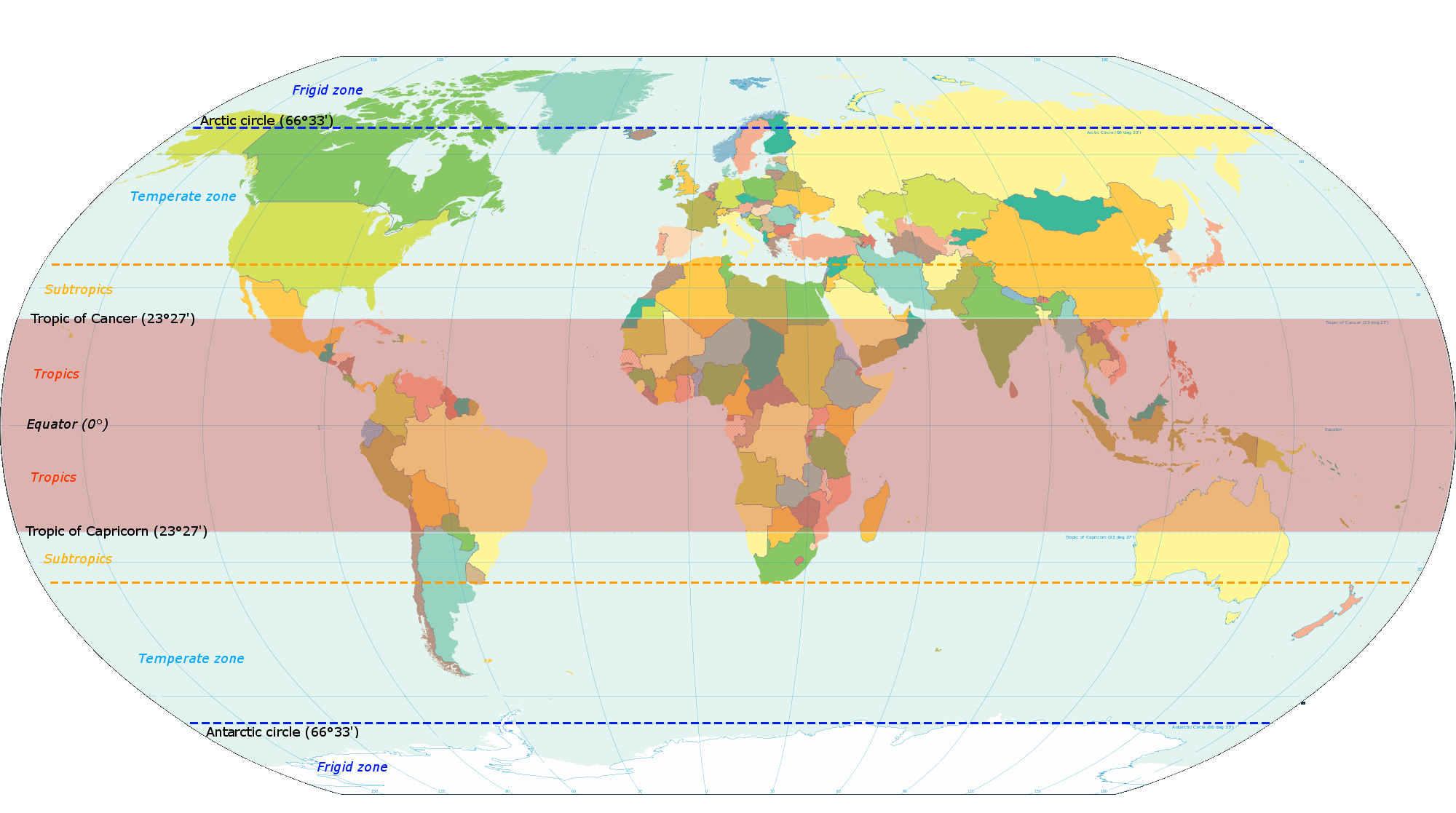
The five main latitude regions of Earth's surface comprise geographical zones, divided by the major circles of latitude. The differences between them relate to climate. They are as follows:
On the basis of latitudinal extent, the globe is divided into three broad heat zones.
The Torrid Zone is also known as the tropics. This zone is bounded on the north by the Tropic of Cancer and on the south by the Tropic of Capricorn; these latitudes mark the northern and southern extremes in which the Sun passes directly overhead. This happens once annually on these cusps, but in the tropics proper, the Sun passes overhead twice a year.
Within the northern tropics, the Sun passes overhead its first time for that year before the June solstice, at which time it does so as to the Tropic of Cancer. It passes over these latitudes in turn again, on its apparent southward journey, to and before the September equinox. After then, the center of the Sun at the high point, the zenith, of the sky (which makes for the subsolar point beneath) aligns with successive latitudes in the southern tropics. The Sun passes overhead of these then does so once per year for the Tropic of Capricorn at the December solstice, then passes back again over those latitudes to return to the equator for the March equinox.
The Torrid zone includes southern Mexico, Central America, the Caribbean, northern South America (larger parts of Brazil, the Guyanas, Caribbean South America, Andean states and the northern tip of the Southern Cone), the Sudan, the southern regions of Western Sahara, Algeria, Libya and Egypt, West Africa, Central Africa, East Africa, larger parts of Southern Africa (Malawi, Zambia, Zimbabwe, northern Namibia and northern Botswana), southern Middle East (southern Saudi Arabia, southern United Arab Emirates, Oman and Yemen), southern Indian subcontinent (south-central and southern India, southern Bangladesh, Sri Lanka and Maldives), most of Southeast Asia, southern Taiwan, northern Australia (the northern regions of the Australian states of Western Australia and Queensland, the northern regions of the Northern Territory, and the entire territory of the New Guinea island), the northern tip of Zealandia (New Caledonia), and a great part of Oceania (Melanesia, Micronesia, and Polynesia, this later not including New Zealand).
In the two temperate zones, consisting of the tepid latitudes (including subtropical areas), the Sun is never directly overhead, and the climate is mild, generally ranging from warm to cool. The four annual seasons, spring, summer, autumn, and winter, occur in these areas.
The North Temperate Zone includes North America (including northern Mexico and the northern Bahamas), Europe, North Africa (Morocco, Tunisia and the northern regions of Western Sahara, Algeria, Libya and Egypt), Northern Asia, East Asia, Northern Vietnam, Central Asia, northern Indian subcontinent (Pakistan, northern India and northern Bangladesh) and northern Middle East (northern Saudi Arabia, Qatar, Bahrain, northern United Arab Emirates, Iraq, Iran, Afghanistan, the Levant (Syria, Lebanon, Jordan, Israel, Palestine), and Turkey).
The South Temperate Zone includes Southern Australia (the southern regions of the Australian states of Western Australia and Queensland, the southern regions of the Northern Territory, and the entire territories of the states of New South Wales, South Australia, Tasmania and Victoria), great part of Zealandia (New Zealand), southern South America (large part of the Southern Cone), and Southern Africa (southern Namibia, southern Botswana, great part of South Africa, the entire territories of Lesotho and Eswatini, and the southern tips of Mozambique and Madagascar).
Hub AI
Geographical zone AI simulator
(@Geographical zone_simulator)
Geographical zone
The five main latitude regions of Earth's surface comprise geographical zones, divided by the major circles of latitude. The differences between them relate to climate. They are as follows:
On the basis of latitudinal extent, the globe is divided into three broad heat zones.
The Torrid Zone is also known as the tropics. This zone is bounded on the north by the Tropic of Cancer and on the south by the Tropic of Capricorn; these latitudes mark the northern and southern extremes in which the Sun passes directly overhead. This happens once annually on these cusps, but in the tropics proper, the Sun passes overhead twice a year.
Within the northern tropics, the Sun passes overhead its first time for that year before the June solstice, at which time it does so as to the Tropic of Cancer. It passes over these latitudes in turn again, on its apparent southward journey, to and before the September equinox. After then, the center of the Sun at the high point, the zenith, of the sky (which makes for the subsolar point beneath) aligns with successive latitudes in the southern tropics. The Sun passes overhead of these then does so once per year for the Tropic of Capricorn at the December solstice, then passes back again over those latitudes to return to the equator for the March equinox.
The Torrid zone includes southern Mexico, Central America, the Caribbean, northern South America (larger parts of Brazil, the Guyanas, Caribbean South America, Andean states and the northern tip of the Southern Cone), the Sudan, the southern regions of Western Sahara, Algeria, Libya and Egypt, West Africa, Central Africa, East Africa, larger parts of Southern Africa (Malawi, Zambia, Zimbabwe, northern Namibia and northern Botswana), southern Middle East (southern Saudi Arabia, southern United Arab Emirates, Oman and Yemen), southern Indian subcontinent (south-central and southern India, southern Bangladesh, Sri Lanka and Maldives), most of Southeast Asia, southern Taiwan, northern Australia (the northern regions of the Australian states of Western Australia and Queensland, the northern regions of the Northern Territory, and the entire territory of the New Guinea island), the northern tip of Zealandia (New Caledonia), and a great part of Oceania (Melanesia, Micronesia, and Polynesia, this later not including New Zealand).
In the two temperate zones, consisting of the tepid latitudes (including subtropical areas), the Sun is never directly overhead, and the climate is mild, generally ranging from warm to cool. The four annual seasons, spring, summer, autumn, and winter, occur in these areas.
The North Temperate Zone includes North America (including northern Mexico and the northern Bahamas), Europe, North Africa (Morocco, Tunisia and the northern regions of Western Sahara, Algeria, Libya and Egypt), Northern Asia, East Asia, Northern Vietnam, Central Asia, northern Indian subcontinent (Pakistan, northern India and northern Bangladesh) and northern Middle East (northern Saudi Arabia, Qatar, Bahrain, northern United Arab Emirates, Iraq, Iran, Afghanistan, the Levant (Syria, Lebanon, Jordan, Israel, Palestine), and Turkey).
The South Temperate Zone includes Southern Australia (the southern regions of the Australian states of Western Australia and Queensland, the southern regions of the Northern Territory, and the entire territories of the states of New South Wales, South Australia, Tasmania and Victoria), great part of Zealandia (New Zealand), southern South America (large part of the Southern Cone), and Southern Africa (southern Namibia, southern Botswana, great part of South Africa, the entire territories of Lesotho and Eswatini, and the southern tips of Mozambique and Madagascar).
Recent media