


Milstar
View on Wikipedia | This article has multiple issues. Please help improve it or discuss these issues on the talk page. (Learn how and when to remove these messages)
|


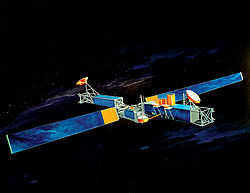
 Artist's impression of a Milstar Block I spacecraft | |
| Manufacturer | Lockheed Martin (prime, formerly Lockheed Missiles and Space) Northrop Grumman (formerly TRW) Boeing (formerly Hughes) |
|---|---|
| Country of origin | United States |
| Operator | U.S. Space Force |
| Applications | Military communications |
| Specifications | |
| Bus | Milstar Block I Milstar Block II |
| Launch mass | 4,500 kilograms (9,900 lb) |
| Regime | Geosynchronous |
| Design life | 10 years |
| Production | |
| Status | Out of production Active |
| Built | 6 |
| Launched | 6 |
| Operational | 5[citation needed] |
| Lost | 1 |
| Maiden launch | USA-99, 1994-02-07 |
| Last launch | USA-169, 2003-04-08 |
Milstar (Military Strategic and Tactical Relay)[1] is a constellation of military communications satellites in geosynchronous orbit, which are operated by the United States Space Force, and provide secure and jam-resistant worldwide communications to meet the requirements of the Armed Forces of the United States. Six spacecraft were launched between 1994 and 2003, of which only five were operational after launch; the third launch failed, both damaging the satellite and leaving it in an unusable orbit.
History
[edit]Milstar Block I spacecraft, or Milstar Developmental Flight Satellite (DFS)-1 and -2, were designed with a Low Data Rate (LDR) payload in the +X wing of the satellite that broadcast in the Super High Frequency (SHF) and Extremely High Frequency (EHF) ranges, and also a classified communication payload in the -X wing. The DFS-1 satellite was launched on 7 February 1994 aboard the first Titan IV(401)A rocket, but with the classified -X wing payload deactivated. It was followed by the DFS-2 spacecraft on 7 November 1995. DFS-2 was similar to DFS-1, but the classified payload was replaced by ballast in the form of a precision machined aluminum block to maintain the weight and balance characteristics of the satellite. Both Block I satellites (USA-99 and USA-115) are still operational as of March 2025, over 25 years since they were launched.
The four later satellites were Block II spacecraft, which featured an additional medium data-rate payload. The first Block II satellite (DFS-3m, a hybrid mix of largely Block I support systems and LDR payload and a MDR (Medium Data Rate) Block II payload) was launched on 30 April 1999, using a Titan IV(401)B rocket. Due to a database error affecting the attitude control system of the Centaur upper stage of its carrier rocket, it was placed into a lower orbit than had been planned, and damaged by deployment at excessive rates. It could not be raised into its operational orbit due to fuel limitations. Its orbit was raised as much as possible to increase the expected lifetime and then it was permanently turned off after 10 days.[2][3] It was the third consecutive, and last, failure of a Titan IV rocket. The remaining three satellites (DFS-4, -5, and -6) were launched on 27 February 2001, 15 January 2002, and 8 April 2003.
The Milstar system consists of three segments; the space segment which consists of the six satellites, ground terminals and users, and stations to command and control the satellites. The Military Satellite Communications Systems Wing (MCSW) division of the Space and Missile Systems Center, located at Los Angeles AFB was responsible for development and acquisition of the Milstar space and mission control segments. The Electronic Systems Center at Hanscom AFB is responsible for the US Air Force portion of the terminal segment development and acquisition. The 4th Space Operations Squadron at Schriever SFB and the 148th Space Operations Squadron at Vandenberg SFB are responsible for providing real-time satellite control and communications payload management.
In August 2010 control of the Milstar system was transferred to the Advanced Extremely High Frequency program, in preparation for the launch of the first AEHF satellite, USA-214. Advanced Extremely High Frequency satellites are intended to replace Milstar.[citation needed]
Characteristics
[edit]Milstar satellites provide secure, jam resistant, worldwide communications to meet the requirements of the United States military. They were built by Lockheed Martin Missiles and Space Corporation, at a cost of US$800 million each. Each satellite has a design life of 10 years. Six were built, of which five reached their operational geosynchronous orbits, and remain in service. Launches were made using Titan IV rockets with Centaur upper stages, and all six occurred from Space Launch Complex 40 at the Cape Canaveral Air Force Station. The satellites are designed to provide communications which are hard to detect and intercept, and to be survivable in the event of nuclear warfare.
The spacecraft have a mass of 4,500 kilograms (9,900 lb), and are equipped with solar panels which generate eight kilowatts of electric power to power its transponders. Both Block I and Block II satellites provide low data-rate communications at bandwidths between 75 bit/s and 2,400 bit/s, whilst the Block II spacecraft can also provide medium data-rate communications between 4.8 kbit/s and 1.544 Mbit/s. The satellites' uplinks operate in the Q band, while their downlinks operate within the K band. The uplink corresponds to the extremely high frequency band while downlink corresponds to the super high frequency radio band.[citation needed]
Spacecraft
[edit]| USA ID | Name | Block | Launch date/time (UTC) | COSPAR ID | Rocket | Remarks |
|---|---|---|---|---|---|---|
| USA-99 | DFS-1 | Block I | 1994-02-07, 21:47:01 | 1994-009A | Titan IV(401)A | |
| USA-115 | DFS-2 | Block I | 1995-11-06, 05:15:01 | 1995-060A | Titan IV(401)A | |
| USA-143 | DFS-3M | Block I/II hybrid | 1999-04-30, 16:30:00 | 1999-023A | Titan IV(401)B | Launch failure |
| USA-157 | DFS-4 | Block II | 2001-02-27, 21:20 | 2001-009A | Titan IV(401)B | |
| USA-164 | DFS-5 | Block II | 2002-01-16, 00:30:00 | 2002-001A | Titan IV(401)B | |
| USA-169 | DFS-6 | Block II | 2003-04-08, 13:43:00 | 2003-012A | Titan IV(401)B |
See also
[edit]References
[edit]- ^ "MILITARY STRATEGIC AND TACTICAL RELAY (MILSTAR) SATELLITE SYSTEM - FY00 Activity".
- ^ "NASA - NSSDCA - Spacecraft - Details". nssdc.gsfc.nasa.gov. Retrieved 2023-03-23.
- ^ "Milstar-2 1, 2, 3, 4 (Milstar 3, 4, 5, 6)". Gunter's Space Page. Retrieved 2023-03-23.
- King, Mak and Riccio, Michael J. (Spring 2010). "Military Satellite Communications: Then and Now". Crosslinks Magazine. Aerospace Corp.
External links
[edit]| Divisions, subsidiaries |
|  | ||||
|---|---|---|---|---|---|---|
| Joint ventures | ||||||
| Facilities | ||||||
| Active products | ||||||


Milstar
View on GrokipediaDevelopment and History
Origins and Strategic Rationale
The Milstar program originated from assessments in the late 1970s identifying deficiencies in the U.S. Air Force Satellite Communications System, prompting debates over successors such as the single-purpose Strategic Satellite System (STRATSAT). Congress rejected STRATSAT proposals between 1979 and 1981, leading to a Department of Defense review in 1981 that refined requirements into the Milstar concept, emphasizing integrated strategic and tactical relay capabilities across services.[9] The Air Force formally initiated the program in November 1981, forming a joint program office in January 1982 at the Air Force Space Division to incorporate technologies from entities like the Naval Ocean Systems Center and Lincoln Laboratory, ensuring interoperability for Army, Navy, and Air Force users.[9] Strategically, Milstar was positioned within President Reagan's fall 1981 strategic modernization initiative, which prioritized resilient command and control communications amid Cold War nuclear threats. The system aimed to deliver jam-resistant, nuclear-survivable satellite links using geostationary orbits, enabling secure wartime exchanges for the President, unified commanders, and high-priority military forces where terrestrial networks might fail.[9] This focus addressed vulnerabilities to Soviet anti-satellite weapons, electronic warfare, and electromagnetic pulses, providing low-probability-of-intercept signals at extremely high frequencies (EHF) for global coverage without reliance on vulnerable ground relays. In 1983, President Reagan elevated Milstar to the highest national priority status, allocating initial funding of $16 million in fiscal year 1982 for advanced space communications development, reflecting its role in bolstering deterrence through assured continuity of operations in contested environments.[10] The program's joint-service architecture further rationalized resource allocation, merging strategic nuclear command needs with emerging tactical demands to avoid service-specific silos, though early scoping adjustments in 1982-1983 balanced ambitious survivability goals against budget constraints.[9]Program Implementation and Launches
The Milstar program implementation proceeded in phases, beginning with two Block I satellites equipped for low-data-rate (75-2400 bps) secure voice and data communications, followed by three Block II satellites incorporating medium-data-rate (up to 274 kbps) crosslinks and enhanced payload processing. Lockheed Martin Space Systems served as the prime contractor for the satellite buses, integrating payloads developed by Northrop Grumman (formerly TRW), with launches executed via Titan IVB/Centaur rockets from Cape Canaveral Air Force Station under U.S. Air Force oversight.[2][11][12] The first satellite (USA-108) launched successfully on February 7, 1994, achieving geosynchronous orbit after separation from the Titan IV upper stage.[13][5] The second Block I satellite (USA-112) followed on November 7, 1995, completing the initial constellation segment; both underwent on-orbit testing, with initial operational capability declared in July 1997 after validation of nuclear-hardened, jam-resistant links.[13][14][15] Block II implementation addressed post-Cold War requirements for higher throughput, with the third satellite (USA-150) launched on February 27, 2001, following multiple delays from payload integration and launch vehicle availability issues originally targeted for 1999.[13][16] The fourth (USA-165) lifted off January 15, 2002, and the fifth (USA-169) on April 8, 2003, both confirming medium-data-rate functionality during post-launch checkouts.[13][17] A sixth Block II satellite was procured but never launched, as program priorities shifted toward the Advanced Extremely High Frequency successor system.[12][4]| Satellite | Block | Launch Date | Launch Vehicle | Orbit Outcome |
|---|---|---|---|---|
| USA-108 | I | Feb. 7, 1994 | Titan IVB/Centaur | Successful GEO insertion[13] |
| USA-112 | I | Nov. 7, 1995 | Titan IVB/Centaur | Successful GEO insertion[13] |
| USA-150 | II | Feb. 27, 2001 | Titan IVB/Centaur | Successful GEO insertion[13] |
| USA-165 | II | Jan. 15, 2002 | Titan IVB/Centaur | Successful GEO insertion[13] |
| USA-169 | II | Apr. 8, 2003 | Titan IVB/Centaur | Successful GEO insertion[13][17] |
Technical Specifications
Satellite Bus and Payload Design
The Milstar satellite bus, developed by Lockheed Martin as the prime contractor, features a unique three-box configuration that folds compactly for launch aboard Titan IV rockets and deploys in geostationary orbit.[18] This design supports a launch mass of approximately 4500 kg, with a designed operational life of 10 years, powered by two deployable solar arrays and batteries for energy storage.[18] Propulsion is provided by two R-4D-12 engines for orbit maintenance and station-keeping.[18] The bus integrates payloads from subcontractors, including Northrop Grumman for low data rate (LDR) components, enabling onboard processing to enhance survivability by minimizing reliance on ground stations.[19] Block I satellites, designated as developmental flight satellites (DFS-1 and DFS-2), incorporate an LDR payload capable of handling nearly 200 user channels for secure teletype and voice communications at data rates from 75 to 2400 bits per second.[18] The payload receives uplink signals via nine extremely high frequency (EHF) antenna beams at 44 GHz, demodulates them onboard using custom large-scale integrated circuits, and routes them to super high frequency (SHF) downlinks at 20 GHz or ultrahigh frequency (UHF) at 250 MHz.[6] [18] A V-band crosslink payload at 60 GHz facilitates inter-satellite communications, supporting global connectivity without terrestrial relays.[18] Block II satellites augment the LDR payload with a medium data rate (MDR) capability, enabling transmission rates up to 1.544 Mbps for real-time voice, video, and data over 32 EHF channels.[6] [20] The MDR payload includes eight independently steerable EHF antennas: two nulling antennas for jamming resistance and six distributed user coverage antennas (DUCAs) forming narrow spot beams for directed, secure links.[6] Onboard digital signal processing, utilizing 14 application-specific integrated circuits (ASICs) and 397 LSI circuits in CMOS technology, handles demodulation, user authentication, dynamic resource allocation, and bandwidth-on-demand routing.[6] The V-band crosslinks extend MDR functionality across the constellation, maintaining compatibility with the bus's autonomous operations hardened against nuclear effects and electronic warfare.[20]Communication Architecture and Frequencies
The Milstar system's communication architecture centers on a constellation of geosynchronous satellites equipped with phased-array antennas and onboard processing to enable secure, low-probability-of-intercept voice and data transmission for military users.[6] It incorporates inter-satellite crosslinks operating in the 60 GHz V-band, allowing direct connectivity between satellites to form a global network without reliance on vulnerable ground relays, thereby enhancing survivability in contested environments.[6][18] The architecture supports both low data rate (LDR) payloads for highly secure, jam-resistant communications at rates up to 2,400 bps and medium data rate (MDR) payloads on Block II satellites for higher throughput up to approximately 1 Mbps per channel.[21] Milstar utilizes extremely high frequency (EHF) bands for its primary anti-jam capabilities, with uplinks at 44 GHz and downlinks at 20 GHz to minimize susceptibility to interference and detection.[21][20] Compatibility with legacy systems is provided through ultrahigh frequency (UHF) uplinks at around 300 MHz and super high frequency (SHF) downlinks, including crossbanded services such as EHF uplink to UHF downlink.[18][22] These frequency allocations, combined with frequency-hopping and nulling techniques via the phased arrays, ensure robust performance against electronic warfare threats.[2]| Frequency Band | Range | Role |
|---|---|---|
| EHF Uplink | 44 GHz | Primary secure uplink for LDR/MDR payloads |
| EHF Downlink | 20 GHz | Primary secure downlink |
| Crosslink | 60 GHz | Inter-satellite connectivity |
| UHF | ~300 MHz | Legacy compatibility uplink/downlink |