Hubbry Logo
Misnay–Schardin effectMisnay–Schardin effectMain
Open search
Misnay–Schardin effect
Community hub
Misnay–Schardin effect
logo
8 pages, 0 posts
0 subscribers
Be the first to start a discussion here.
Misnay–Schardin effect
from Wikipedia

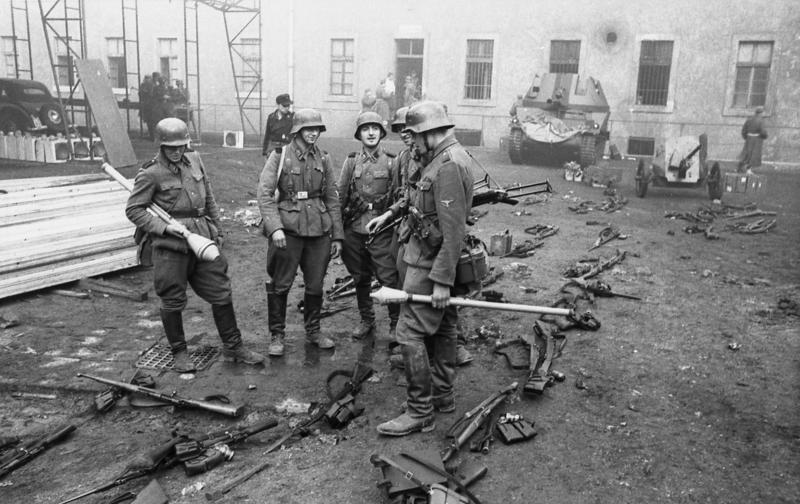
44M LŐTAK EFP mines at the upper left corner of the picture. Taken on 15 October 1944, Operation Panzerfaust, after surrender and disarmament of the royal guards of the Hungarian Army
MPB mine showing a cylindrical, concave Misnay–Schardin warhead

The Misnay–Schardin effect, or platter effect, is a characteristic of the detonation of a broad sheet of explosive.

Description

[edit]

Explosive blasts expand directly away from, and perpendicular to, the surface of an explosive. Unlike the blast from a rounded explosive charge, which expands in all directions, the blast produced by an explosive sheet expands primarily perpendicular to its plane, in both directions. However, if one side is backed by a heavy or fixed mass, most of the blast (i.e. most of the rapidly expanding gas and its kinetic energy) will be reflected in the direction away from the mass.[1][2]

Uses

[edit]

The Misnay–Schardin effect was studied and experimented with by explosive experts József Misnay (sometimes spelled Misznay incorrectly), a Hungarian, and Hubert Schardin, a German, who initially sought to develop a more effective antitank mine for Nazi Germany.[3][4] Some sources[which?] claim that World War II ended before their design became usable, but they and others continued their work.[5] Misnay designed two weapons: the 43M TAK antitank mine and the 44M LŐTAK side-attack mine. The Hungarian army used these weapons in 1944–1945.[6]

The later AT2 and M18 Claymore mines rely on this effect.[7]

See also

[edit]

References

[edit]
Revisions and contributorsEdit on WikipediaRead on Wikipedia
from Grokipedia
The Misnay–Schardin effect is a phenomenon observed in flat or shallowly concave charges, where the accelerates a metal plate or liner away from the surface as a coherent, high-velocity or , rather than fragmenting it or forming a stretching jet as in traditional shaped charges. This effect, also known as the plate effect, results in the achieving velocities often exceeding 2 km/s, enabling deep penetration into armored targets through impact. Unlike the Munroe effect, which relies on a conical cavity to produce a jet, the Misnay–Schardin mechanism leverages the perpendicular expansion of the front to forge a compact penetrator from the liner material. The Misnay–Schardin effect, first described by R.W. Wood in 1936, was independently discovered and developed during by Hungarian military officer József Misnay, who experimented with cylindrical charges to propel intact metal discs, and German physicist Hubert Schardin, who documented and analyzed the principle in a technical paper. Early demonstrations involved simple setups, such as a tin filled with TNT detonated to launch a lid as a projectile, highlighting the effect's potential for directed energy without complex liners. Post-war, Allied forces, including the British and French, refined the design for munitions, incorporating it into anti-tank mines and aerial bombs by the late and . Key design parameters for achieving the Misnay–Schardin effect include a liner thickness of at least 12 mm for mild steel, an explosive mass roughly equal to the liner's weight, and initiation at the edge to ensure uniform acceleration, with optimal geometries featuring a concave radius of about 1.5 times the liner's chord length. Explosives like TNT, Torpex, or melinite are commonly used, as they provide the rapid pressure buildup needed to forge the penetrator without excessive fragmentation. In modern applications, the effect underpins explosively formed projectiles (EFPs) in improvised explosive devices and precision-guided munitions, where it delivers armor-piercing capabilities over longer standoff distances compared to shaped charge jets.

History

Discovery and Development

József Misnay, a Hungarian military engineer born in 1904, initiated research on advanced explosive charges at the Hungarian Royal Military Technical Institute in 1943, under the auspices of the Hungarian armed forces. His early work built on a 1942 lecture he delivered on hollow charges, focusing on innovations to enhance antitank capabilities amid pressures. By 1944, Misnay's efforts had produced prototypes such as the 43M and 44M Lőtak mines, marking the first documented applications of broad-sheet explosives paired with metallic platters designed for side-armor penetration. In mid-1944, Misnay's research integrated into broader Nazi German wartime programs through collaboration with Hubert Schardin, a prominent German and director of the Ballistic Institute in Berlin-Gatow. Schardin visited that summer to review Misnay's documentation and experiments, facilitating the exchange of findings within Axis research networks. This partnership occurred against the backdrop of escalating German interest in technologies, though Misnay's contributions originated independently in Hungarian facilities. Initial tests during 1943–1944 at the institute demonstrated the potential for directed effects, laying the groundwork for practical antitank weaponry. Misnay continued his work on explosives until 1950. He died in 1968. The effect was formally named the Misnay–Schardin effect in recognition of both inventors' roles, with Schardin providing early theoretical insights into the perpendicular propagation of blast forces following his postwar analysis. Schardin documented and published on the phenomenon postwar, solidifying its identification as a distinct behavior observed in their joint evaluations. This naming reflected the collaborative culmination of Misnay's Hungarian-led experiments and Schardin's German expertise, distinct from concurrent research elsewhere during the war.

World War II Applications

During World War II, the Misnay–Schardin effect found its first practical implementations in Hungarian antitank mines developed amid the intensifying Eastern Front campaigns. In 1944–1945, Hungarian military engineer József Misnay, working at the Royal Hungarian Institute of Military Technology, designed the 43M TAK (Tányér Akná, or plate mine) and the 44M LŐTAK (Lövő Tányér Akná, or firing plate mine), which exploited the effect to propel a metal platter forward in a directed blast against armored vehicles. The 43M TAK featured a 6.5 kg total weight with 4.6 kg of trinitrotoluene (TNT) or pentritol explosive in a wood and paper casing, activated by pressure fuze to demolish armor or fortifications without significant shrapnel scatter. The 44M LŐTAK, employing 4.5 kg of nitropenta explosive behind an aluminum plate, targeted vehicle tracks and side armor for enhanced directional impact. These devices represented early wartime adaptations of the effect, independently pioneered by Misnay alongside parallel German research by Hubert Schardin. The Hungarian army deployed these mines extensively in defensive operations during the final year of the war, particularly along lines in the Eastern Carpathians and in urban defenses around . The 43M TAK and 44M LŐTAK were positioned to counter Soviet armored advances, with the LŐTAK demonstrating field utility in scenarios like penetrating building walls during in areas such as Ostrom utca. Although specific integration into broader German defensive systems remains undocumented, Schardin's concurrent work on explosive effects informed Axis-wide interest in directional charges, with Hungarian prototypes occasionally tested in joint contexts against Allied tanks. Wartime trials highlighted the mines' ability to generate a high-velocity platter for armor penetration, though exact field ranges and depths varied by setup. Despite their innovative design, the mines faced significant challenges in deployment. Field conditions often led to inconsistent performance due to variable and impacts on reliability, compounded by the surrounding their development that limited and . Production was severely constrained by Hungary's shortages in 1944–1945, as Allied bombings and supply disruptions hampered manufacturing at the Haditechnikai Intézet, resulting in only limited numbers reaching frontline units. These factors, alongside the overwhelming Soviet numerical superiority, prevented the mines from significantly altering defensive outcomes, though they provided localized antitank capabilities in desperate late-war scenarios.

Mechanism

Physical Description

The Misnay–Schardin effect describes the behavior observed during the detonation of a broad, sheet-like or cylindrical explosive charge backed by a heavy metallic platter, such as a disc, in which the resulting blast wave propagates primarily in a direction perpendicular to the plane of the charge. This configuration confines and directs the explosive energy, preventing significant lateral expansion and focusing the detonation products forward. The effect was first systematically documented through experimental observations involving such setups, where the backing platter serves to reflect and channel the shock wave. A key characteristic of the Misnay–Schardin effect is the of the metallic platter forward as a coherent, intact , achieving high velocities typically ranging from 2,000 to 3,000 m/s. Unlike conventional omnidirectional explosions, where dissipates uniformly in all directions, the interaction between the detonating and the dense backing material causes the blast to reflect off the platter's rear surface, imparting nearly all of the in the forward direction. This results in the platter undergoing minimal initial disruption, maintaining structural integrity during before potential deformation in flight. The process relies on the explosive's and the between the charge and the platter to achieve this directed transfer. In contrast to the Munroe effect, which utilizes a conical metallic liner to generate a high-velocity, elongated metal jet for deep penetration, the Misnay–Schardin effect produces a more stable, disc-shaped or slug-like without requiring a shaped cavity. This distinction arises from the flat or slightly curved of the platter, which avoids the stretching and separation seen in jet formation, instead yielding a compact mass suitable for broader impact over varying distances. The effect's coherence stems from the uniform across the platter's surface, driven by the blast propagation. High-speed photography has been instrumental in visualizing the dynamics of the Misnay–Schardin effect, capturing the sequential deformation of the platter as it lifts off and follows a flight path. These images reveal the initial uniform upward motion, followed by edge curling or fragmentation in some cases, while the central portion remains relatively rigid, highlighting the effect's predictability in formation. Such experimental techniques, advanced during the effect's early study, underscore the observable stability and forward-directed concentration.

Design Principles

The core components of a device exploiting the Misnay–Schardin effect include a cylindrical charge, a concave disc serving as the platter liner, an initiator for , and an optional air gap or protective cover to enhance stability and prevent premature fragmentation. The charge is typically filled with high explosives such as TNT or melinite to ensure consistent , while the disc is positioned at the forward end to be accelerated as a coherent . An annular margin around the disc and a cover plate may be incorporated to confine the blast and maintain disc integrity during acceleration. Key engineering ratios and guidelines optimize uniform and formation. The disc radius RR is approximately 1.5 times the chord length DD across the dished surface, ensuring proper for coherent flight. The dishing depth dd is set to about D/12D/12, providing the necessary concave shape without excessive deformation. The charge height is designed such that the initiator aligns tangentially to the disc periphery, promoting even propagation perpendicular to the disc face. Additionally, the mass should approximate the disc mass for balanced momentum transfer, though some designs use up to twice the disc weight. Material specifications emphasize durability and compatibility with detonation dynamics. The disc, typically made of mild steel, requires a minimum thickness of 12 mm to withstand acceleration without fracturing prematurely. Explosives like TNT are preferred for their reliable around 6,900 m/s. The disc weight is calibrated to match the explosive mass, ensuring efficient energy coupling. Performance is governed by factors such as projectile velocity, derived from principles where the explosive's EE converts to of the platter mass mm, yielding v2E/mv \approx \sqrt{2E/m}
Add your contribution
Related Hubs
User Avatar
No comments yet.