Hubbry Logo
search
logo
1680476

Mitre Square

logo
Community Hub0 Subscribers
Read side by side
from Wikipedia

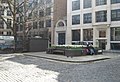
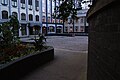
Mitre Square in 2019.

Mitre Square is a small square located in Aldgate inside the City of London. It measures about 77 feet (23 m) by 80 feet (24 m) and is connected via three passages with Mitre Street to the south west, to Creechurch Place to the north west and, via St James's Passage (formerly Church Passage), to Duke's Place to the north east.

History

[edit]

The square occupies the site of the cloister of Holy Trinity Priory, Aldgate which was demolished under Henry VIII at the time of the Dissolution of the Monasteries.[1] The south corner of the square was the site of the murder of Catherine Eddowes by Jack the Ripper. Her mutilated body was found there at 1:44 in the morning on 30 September 1888. This was the westernmost of the Whitechapel murders and the only one located within the City of London. [2]

Eddowes' murder on the site of the old monastery is ascribed to an ancient curse in a contemporary penny dreadful entitled The Curse Upon Mitre Square A.D. 1530–1888 by J.F. Brewer.[3][4]

One Mitre Square

[edit]

A 19-storey, 79m-high office development is proposed for the square, known as One Mitre Square.[5][6]

[edit]

51°30′50″N 0°04′41″W / 51.5138°N 0.078°W / 51.5138; -0.078

References

[edit]
Revisions and contributorsEdit on WikipediaRead on Wikipedia
from Grokipedia
Mitre Square is a small, irregularly shaped public space in the Aldgate ward of the City of London, England, accessible via entrances from Mitre Street, Church Passage, and St. James's Place.[1] The site occupies part of the former cloister grounds of the Holy Trinity Priory, an Augustinian religious house founded in the late 11th century and dissolved in 1532 during the reign of Henry VIII.[2] The square achieved lasting infamy on 30 September 1888, when Police Constable Edward Watkins discovered the mutilated body of 46-year-old Catherine Eddowes in its southwest corner at approximately 1:45 a.m., less than 45 minutes after her release from police custody for public drunkenness.[3][4] This murder, occurring within the City of London jurisdiction—the only canonical Jack the Ripper killing outside the Metropolitan Police area—involved extensive abdominal mutilations and removal of the left kidney and uterus, consistent with the modus operandi of the unidentified serial killer who targeted impoverished women in the Whitechapel district.[3][4] Contemporary police investigations, including the inquest led by Wynne Baxter, documented the crime scene's poor lighting and seclusion, factors that facilitated the rapid attack despite nearby patrols.[4] Subsequent urban redevelopment transformed much of Mitre Square into commercial office space, including buildings like International House erected in the 1970s, while preserving its historical footprint as a reminder of Victorian London's social decay and unsolved criminal violence.[5] The site's enduring association with the Ripper case draws ongoing scholarly and public interest, underscoring the limitations of 19th-century policing amid dense, impoverished urban environments.[3]

Geography and Layout

Physical Description and Boundaries

Mitre Square constitutes a small, irregularly shaped open space in the Aldgate area of the City of London, forming a partially enclosed public realm bounded by Mitre Street to the west, Creechurch Lane to the north, Duke's Place to the south, and properties along Aldgate to the east.[5] [6] Access to the square is provided through narrow passages, including St. James's Passage linking to Duke's Place and another connecting to Creechurch Place, which integrate it into the surrounding network of lanes and streets.[5] The square's layout reflects its origins as the former cloister garth of Holy Trinity Priory, resulting in a compact, roughly quadrilateral form surrounded by high-rise commercial and institutional buildings, such as International House and the Sir John Cass School. Paved primarily with stone or concrete, it serves as a pedestrian thoroughfare with minimal greenery, emphasizing its utilitarian role within the dense urban grid.[7] Historical surveys from 1888 indicate dimensions of approximately 77 feet (23 m) by 80 feet (24 m), though modern encroachments and developments have slightly altered the precise footprint.[8]

Surrounding Infrastructure and Access

Mitre Square was accessible via three narrow passages linking it to adjacent streets, which facilitated its use as a short cut but also rendered it somewhat secluded. The entrances included one directly from Mitre Street to the southwest, a second through the constricted Church Passage from Duke Street to the north, and a third from St James's Place to the east.[1][9] Surrounding the square in 1888 were predominantly commercial structures, including warehouses and the extensive premises of the tea merchants Kearley and Tonge along the northern boundary. The area featured cobblestone paving and sparse gas lighting, with illumination concentrated near the entrances but leaving corners in shadow; an arched passage occupied the northeast side.[9][1] Proximity to major routes such as Aldgate High Street and Duke Street placed Mitre Square about an 8-minute walk from Bishopsgate Police Station, integrating it into routine foot patrols. Constable Edward Watkins, on duty that night, accessed the square via one of the passages at intervals of roughly 12-15 minutes, underscoring its position within a network of interlinked City of London lanes despite the limited entry points.[9][1]

Historical Origins and Evolution

Medieval and Early Modern Period

The site now occupied by Mitre Square formed part of the Holy Trinity Priory, an Augustinian foundation established circa 1108 by Queen Matilda, consort of King Henry I, as the first such priory in London.[10] By the early 13th century, the complex had expanded to include stone-built structures such as a church, cloisters, and domestic ranges, encompassing an area that extended to the modern locations of Mitre Street (along the former nave) and Mitre Square (over the cloisters).[11] The priory held significant local influence, managing lands and rights within Aldgate ward, though its priors occasionally faced criticism for mismanagement.[12] In the early modern period, the priory was among the earliest monastic houses suppressed during Henry VIII's Dissolution of the Monasteries, closing in 1532 amid limited local opposition due to the unpopularity of its prior.[12] The site was subsequently granted to secular owners, including Sir Thomas Audeley, Lord Chancellor, with the church briefly serving parish functions before demolition began.[13] Over the 16th and 17th centuries, surviving structures were progressively razed for redevelopment into tenements and commercial properties, while street names like Mitre derived from a local tavern adopting the prior's mitre as its sign, reflecting lingering associations with the ecclesiastical past.[14] By the late 18th century, the area had transitioned to urban warehousing and housing, setting the stage for the formal layout of Mitre Square in the following century, though remnants of medieval masonry persisted underground until modern excavations.[11]

19th-Century Formation and Urban Development

Mitre Square occupies the approximate site of the cloisters and chapter house of the medieval Holy Trinity Priory, Aldgate, which was dissolved in 1532 during Henry VIII's Dissolution of the Monasteries and subsequently redeveloped into housing and warehouses by the 1670s.[15][11] The square's current layout took shape in the early 19th century when Mitre Street was cut through the area, formalizing its boundaries as a small open space roughly 77 feet by 80 feet, bounded by Mitre Street to the west, Duke Street (now part of Duke's Place) to the east, and other passages including Church Passage to the south.[15] This reconfiguration reflected broader urban improvements in the City of London, where irregular medieval plots were rationalized into more navigable streets and squares to accommodate growing commercial traffic near Aldgate, the eastern gateway to the financial district.[16] During the mid-to-late 19th century, Mitre Square underwent further urbanization as the surrounding Aldgate area industrialized, transitioning from mixed residential use to predominantly non-residential commercial functions amid the expansion of London's port trade and warehousing needs.[15] By the 1880s, the square was enclosed by large warehouses—four in total, one housing offices—a commercial building, a dingy yard, and remnants of older structures, with gas lighting illuminating its dimly lit corners.[17] This development mirrored the City of London's demographic shift, where population declined as residential tenants relocated eastward to Whitechapel and Stepney, leaving the core for business premises that supported import-export activities via nearby Thames docks.[1] Archaeological awareness of the priory's subsurface remains, including walls visible in late 19th-century records, underscored the site's layered history amid these changes, though no major excavations occurred until the 20th century.[15]

The 1888 Murder of Catherine Eddowes

Sequence of Events on 30 September 1888

Catherine Eddowes was released from Bishopsgate Police Station at approximately 1:00 a.m. on 30 September 1888, after having been arrested the previous evening at 8:30 p.m. on 29 September for public drunkenness on Aldgate High Street.[18][19] Upon release, she appeared sober and informed the desk sergeant of her intention to return to her residence at 55 Flower and Dean Street in Spitalfields, though no further confirmed sightings of her movements immediately followed until later that hour.[18] At around 1:30 a.m., Police Constable Edward Watkins of the City of London Police entered Mitre Square during his routine beat patrol and observed no irregularities in the dimly lit space.[19] Five minutes later, at approximately 1:35 a.m., three men—Joseph Lawende, Joseph Hyam Levy, and Harry Harris—exited the Imperial Club on Duke Street and reported seeing a woman, possibly Eddowes based on later identification efforts, standing with a man near the entrance to Church Passage, which adjoins Mitre Square; the woman had her hand on the man's chest in an apparently intimate or negotiating posture, while the man faced her directly.[20][19] These witnesses provided descriptions of the man as about thirty years old, of medium build, wearing a pepper-and-salt jacket, a dark cap with a peak, and no necktie, though Levy's account was noted for some reticence in contemporary press interviews.[20] Watkins' subsequent patrol returned him to Mitre Square at 1:44 a.m., when he discovered Eddowes' body lying on her back in a pool of blood in the southwest corner near the fence, her skirts raised above her waist, with extensive mutilations to her face, abdomen, and genitals evident even in the poor lighting.[19][21] Watkins immediately alerted PC James Harvey at the adjacent Aldgate police box at 1:45 a.m., initiating the official response.[19] The interval between Watkins' prior check at 1:30 a.m. and the discovery aligned with his standard beat duration of twelve to fourteen minutes.[19]

Discovery, Initial Police Response, and Crime Scene Details

Police Constable Edward Watkins of the City of London Police discovered the body of Catherine Eddowes in the southwest corner of Mitre Square at approximately 1:44 a.m. on 30 September 1888.[19] [22] Watkins had patrolled the same location just 14 minutes earlier, at 1:30 a.m., and observed no suspicious activity or presence of the body.[23] [19] The victim was found lying on her back in a large pool of blood, with her clothing pulled up over her waist, her left arm extended outward, and her right arm resting across her abdomen.[19] Her throat had been deeply severed, her face severely mutilated with cuts across the eyelids and bridge of the nose partially severed, multiple incisions across the abdomen exposing internal organs, and portions of intestine placed over her right shoulder.[19] Upon discovery, Watkins immediately blew his police whistle to raise the alarm and alerted George Morris, the night watchman at the adjacent Kearley and Tonge warehouse, who confirmed the gruesome scene.[19] Morris then summoned Police Constable Holland from a nearby station, who arrived shortly thereafter and proceeded to fetch Dr. George William Sequeira from his residence on Jewry Street.[19] Sequeira reached the scene by 1:55 a.m. and pronounced Eddowes dead, estimating the time of death at around 30 minutes prior.[19] [24] Initial police actions focused on securing the isolated crime scene in the dimly lit square, with no immediate evidence of the perpetrator remaining, as the murder occurred within the brief window since Watkins' last patrol.[19]

Forensic Evidence, Autopsy Findings, and Investigative Challenges

The body of Catherine Eddowes was discovered at approximately 1:44 a.m. on 30 September 1888 in the southwest corner of Mitre Square by City Police Constable Edward Watkins during his routine patrol.[25] The corpse lay on its back in a pool of blood, with clothing pulled up over the waist, exposing the lower body; the throat was deeply severed, and extensive mutilations were evident to the face and abdomen.[19] Initial examination by Dr. George William Sequeira, who arrived at 1:55 a.m., confirmed instantaneous death from severance of the windpipe and major blood vessels, with no signs of struggle or defensive wounds observed at the scene.[19] Forensic evidence included a portion of a bloodstained apron matching Eddowes' garment, later found in Goulston Street with anti-Semitic graffiti nearby, though its direct linkage to the perpetrator remained inconclusive.[25] The autopsy, conducted by Dr. Frederick Gordon Brown, City of London police surgeon, revealed a throat incision approximately six to seven inches long, cutting through the carotid artery and causing rapid exsanguination as the primary cause of death.[25] Facial mutilations comprised cuts to the eyelids, bridge of the nose (severing it from the bone), upper and lower eyelids, right cheek, lips, and mouth, along with a jagged wound to the right ear and an abrasion beneath the left ear; these were inflicted post-mortem with a sharp instrument.[25] Abdominal injuries included a deep vertical cut from sternum to pubes, with transverse incisions exposing and displacing intestines over the right shoulder; the uterus was excised cleanly, and the left kidney was removed with precision suggesting some anatomical familiarity, as the cuts avoided major vessels.[25] The body retained warmth with limbs flaccid and no rigor mortis, indicating death occurred 30 to 40 minutes prior to Brown's 2:20 a.m. arrival, aligning with an estimated time of 1:40 to 1:50 a.m.[25] The weapon was inferred to be a sharp, pointed knife at least six inches long, capable of the observed incisions without evidence of hesitation marks.[25] Investigative challenges stemmed from the crime's execution in Mitre Square's darkest corner, poorly lit by a single gas lamp and shielded from street view, enabling a silent kill with no reported noise despite proximate watchmen and residents.[19] Watkins' 15-minute patrol cycle left a narrow window for the attack, yet multiple escape routes—via Church Passage, Duke's Place, or Aldgate—yielded no eyewitness sightings, compounded by the absence of left-behind weapons or blood trails.[19] Jurisdictional overlap between Metropolitan and City Police, following Elizabeth Stride's murder 45 minutes earlier, hindered coordination, while rudimentary 1888 forensics lacked photography at the scene (unlike later victims) and techniques like fingerprinting, allowing potential contamination before securing the area.[26] The absence of struggle evidence suggested victim incapacitation or surprise, but pervasive East End overcrowding, transient populations, and media sensationalism flooded inquiries with hoax letters and false leads, diluting focus on verifiable traces like the apron fragment.[26]

Post-1888 Changes and Legacy

Immediate Aftermath and Policing Reforms

The discovery of Catherine Eddowes's mutilated body in Mitre Square at approximately 1:45 a.m. on 30 September 1888 by City of London Police constable Edward Watkins prompted an immediate alert via whistle, drawing responses from nearby officers including PC Morris and PC Holland.[19] Inspector Edward Collard arrived shortly from Bishopsgate Police Station, directing a door-to-door search of the surrounding neighborhood and instructing patrols to check alleys and buildings for suspects or evidence.[19] Police surgeon Dr. Frederick Gordon Brown reached the scene around 2:00 a.m., confirming death from throat severance and abdominal mutilations, with the body subsequently transported to the City Mortuary for postmortem examination.[27] The murder's occurrence just 45 minutes after Elizabeth Stride's killing in Metropolitan Police jurisdiction—termed the "double event"—intensified public panic across East London, as it suggested the perpetrator evaded capture mid-rampage and crossed into the City of London Police area, highlighting jurisdictional frictions between the two forces.[28] Coordination ensued, with Metropolitan Police detectives like Edward Abberline consulting on links to prior Whitechapel murders, though no immediate arrest resulted from the searches.[19] The inquest, opened on 4 October 1888 by coroner Samuel Frederick Langham, revealed extensive organ removal (including the uterus and left kidney), fueling speculation of surgical skill and press sensationalism that amplified demands for accountability.[29] These events exacerbated scrutiny of Metropolitan Police Commissioner Sir Charles Warren, whose leadership faced criticism for inadequate street lighting, insufficient plainclothes officers, and reliance on traditional beats amid Whitechapel's darkness and overcrowding; Warren resigned on 8 November 1888, citing policy disputes with Home Secretary Henry Matthews, though contemporaries attributed it partly to cumulative pressure from unsolved Ripper killings.[30] In response, police presence surged in Whitechapel and adjacent areas, with hundreds more constables deployed on patrols and house-to-house inquiries intensified to reassure residents and deter further attacks.[31] The Mitre Square murder, as the only canonical Ripper killing in City jurisdiction, underscored inter-force communication gaps, prompting ad hoc joint operations but no formal merger; however, it accelerated tactical shifts like expanded use of photography for crime scenes—first notably applied here alongside Stride's—and trials of bloodhounds for tracking, though the latter proved ineffective.[26] Broader immediate measures included enhanced alleyway illumination and civilian vigilance groups supplementing official efforts, reflecting public distrust yet yielding no perpetrator capture before the murders ceased after 9 November.[32] These adaptations, while reactive, laid groundwork for later forensic emphases without resolving core investigative limitations evident in 1888.[31]

20th-Century Alterations Including World War II Damage

During the 20th century, Mitre Square transitioned from its late-19th-century configuration of warehouses, commercial buildings, and residual housing to a landscape dominated by post-war office developments, reflecting the City of London's broader reconstruction efforts following extensive wartime disruption. Adjacent sites, such as that of International House at 26 Creechurch Lane, were acquired by the City Corporation in July 1958 under the Town and Country Planning Act 1947 explicitly to address war damage sustained during World War II bombings, with subsequent appropriation in December 1958 for comprehensive redevelopment.[33] This facilitated the erection of utilitarian 1970s office blocks around the square's perimeter, including 1 Mitre Square, a 2,602 square meter structure deemed obsolete by the early 21st century due to outdated design and market unsuitability.[33] While direct bomb impacts on Mitre Square proper are not prominently recorded in official surveys, the Aldgate vicinity endured heavy Luftwaffe assaults during the Blitz from 1940 to 1941, including the destruction of nearby landmarks like the Great Synagogue on Duke's Place in 1941, which prompted area-wide clearances and rebuilding.[34] These pressures contributed to the square's incremental modernization, with the majority of pre-existing structures demolished between 1979 and 1980 to accommodate further commercial expansion and landscaping aligned with contemporary urban planning.[34] By mid-century, the square had lost much of its original enclosure, evolving into an open, functional space amid rising office density rather than retaining its earlier industrial character.

21st-Century Redevelopment and Preservation Efforts

In 2011, plans were approved for the redevelopment of the site encompassing International House adjacent to Mitre Square, involving the demolition of existing structures and the construction of a 19- to 20-storey office building known as One Mitre Square, designed by Sheppard Robson to abstractly reference the footprint of the medieval Holy Trinity Priory cloister.[35] The project aimed to integrate modern commercial space while respecting the area's historical layout. Demolition of buildings on the north, east, and west sides of Mitre Square commenced in 2016 as part of the wider Aldgate regeneration initiative, clearing outdated 20th-century structures to accommodate new office developments.[36] By 2018, the Aldgate Project had transformed the square into a landscaped garden with improved paving, lighting, and greenery, preserving the open public space amid surrounding high-rise offices.[37] This enhancement facilitated continued access for historical tours focused on the 1888 murder site, without erecting barriers or altering the square's core footprint. Preservation efforts emphasized maintaining Mitre Square's visibility as a Jack the Ripper landmark, with the City of London Corporation ensuring the redevelopment did not encroach on the central area where Catherine Eddowes' body was discovered.[38] No major archaeological excavations were reported during the works, though the site's priory heritage informed design constraints to avoid complete infill.[39] The resulting configuration supports both commercial viability and public commemoration, with the square remaining a pedestrian-only enclave bounded by modern facades.[36]

Contemporary Significance

Current Buildings and Land Use

One Creechurch Place, a 19-storey office building completed in 2017, dominates the northern side of Mitre Square, providing approximately 272,500 square feet (25,300 m²) of grade A office accommodation across 17 floors in a T-shaped configuration.[40][41] The structure, developed by Helical and constructed by Skanska, features high-quality facilities including changing rooms, showers, and panoramic views, supporting multi-tenant occupancy primarily by financial and insurance firms.[42][43] By 2019, the building reached full occupancy with seven tenants, reflecting its role in the City of London's insurance district.[43] The square itself serves as enhanced public realm space, incorporating pedestrian-friendly paving, seating, and landscaping as part of post-2015 redevelopment efforts to integrate historical commemoration with modern urban function. Surrounding sites feature additional commercial properties, with no residential elements; land use emphasizes office-based employment in line with the City Cluster's economic policies.[44][45]

Role in Jack the Ripper Tourism and Historical Commemoration

Mitre Square functions as a central attraction in Jack the Ripper tourism, routinely featured as a key stop on guided walking tours traversing London's East End. These tours, conducted by organizations including London Walks and independent Ripperologists, reconstruct the events of Catherine Eddowes' murder on 30 September 1888, with groups assembling at the southwest corner where her body was found at approximately 1:45 a.m. by PC Edward Watkins.[46] [9] Operators emphasize historical context, victim narratives, and investigative details, attracting participants seeking to engage with the unsolved canonical five murders.[47] The site's inclusion in itineraries underscores its status as the westernmost Ripper crime scene and the sole murder within the City of London jurisdiction, differentiating it from Whitechapel-based killings. Tours often incorporate then-and-now comparisons, highlighting post-war reconstructions and modern office developments while noting the absence of the original buildings.[38] High-rated experiences on platforms like GetYourGuide report thousands of bookings yearly, reflecting sustained interest in 1888's "Double Event" involving Eddowes and Elizabeth Stride.[48] Historical commemoration at Mitre Square remains informal, lacking an on-site plaque or official monument to Eddowes; instead, remembrance centers on annual tours, documentaries, and enthusiast visits that mark the murder's anniversary. Eddowes' legacy is preserved through a memorial plaque at her grave in City of London Cemetery, unveiled to honor her life amid the Ripper narrative.[49] This approach to dark tourism has sparked local backlash for potentially sensationalizing tragedy, though proponents argue it educates on Victorian poverty and policing failures.[50]

References

User Avatar
No comments yet.