
_Mughal._1585-90._National_Museum,_New_Delhi..jpg/250px-Tansen_of_Gwalior._(11.8x6.7cm)_Mughal._1585-90._National_Museum,_New_Delhi..jpg)


_Mughal._1585-90._National_Museum,_New_Delhi..jpg)
Community hub
Recent from talks
Contribute something
Nothing was collected or created yet.
Tansen
View on Wikipedia
Key Information

![Portrait of Mian Tansen, c. 1585–90[1]](https://en.wikipedia.org/wiki/File:Tansen_of_Gwalior._(11.8x6.7cm)_Mughal._1585-90._National_Museum,_New_Delhi..jpg)
Rāmtanu Panday (c. 1493 – 26 April 1589), popularly referred to as Mian Tānsen (lit. 'the Learned One'), or Sangeet Samrāt (lit. 'Monarch of Hindustani Music'), was a Hindustani classical musician.[4] Born into a Hindu Gaur Brahmin family in Gwalior,[5] he learnt and perfected his art in the northwest region of modern Madhya Pradesh. He got his first break as musician and composer in the court of Raja Man Singh Tomar of Gwalior and spent most of his adult life in the court and patronage of the Hindu king of Rewa, Raja Ramchandra Singh Baghel (r. 1555–1592), where Tānsen's musical abilities and studies gained widespread fame.[4] This reputation brought him to the attention of the Mughal Emperor Akbar. In 1562, at about the age of 60, Tānsen joined Akbar's court, and his performances became the subject of many court historians.[4]
Numerous legends have been written about Tānsen, mixing facts and fiction, and the historicity of these stories is doubtful.[6] Akbar considered him one of the Navaratnas Nine Ministers (the nine jewels) and gave him the title Mian, an honorific, meaning learned man.[7]Tansen was a great composer musician and vocalist, to whom many compositions have been attributed in the northern regions of the Indian subcontinent. He was also an instrumentalist who popularized and improved musical instruments. He is among the most influential personalities in the North Indian tradition of Indian classical music, called Hindustani. His 16th-century studies in music and compositions inspired many, and he is considered by numerous North Indian gharana (regional music schools) to be their lineage founder.[8][9]
Tānsen is remembered for his epic Dhrupad compositions, creating several new rāgs, as well as for writing two classic books on music, Sri Ganesh Stotra and Sangita Sara.[10]
Early life
[edit]Tansen's date of birth is unclear, but most sources place his birth about 1493 CE, or between 1493 and 1506. His biography is also unclear and many conflicting accounts exist, with some common elements. Historical facts about Tansen are difficult to extract from the extensive and contradictory legends that surround him.[11]
According to the common elements in the various stories, Tansen's name as a child was Ramtanu.[12] His father Mukund Ram (also known as Mukund Gaud or Mukund Chand)[13] was a wealthy poet and accomplished musician of Gwalior, who for some time was a Hindu temple priest in Varanasi.[12] According to some versions of the story, it is believed that Tansen was born profoundly mute and did not speak until the age of 5.
Tansen learnt and perfected his art in the city of Gwalior, in modern-day Madhya Pradesh. He began his career from the Imperial Court of Gwalior Kingdom and spent most of his adult life in the court and patronage of the Hindu king of Rewa, Raja Ramchandra Singh, where Tansen's musical abilities and studies gained him widespread fame and following.[4] He was a close confidant of Raja Ramchandra Singh, and they used to make music together. Tansen's reputation brought him to the attention of the Mughal Emperor Akbar, who sent messengers to Raja Ramchandra Singh, requesting Tansen to join the musicians at the Mughal court. Tansen initially refused to go and sought to retire instead into solitude, but Raja Ramchandra Singh sent him to Akbar's court. In 1562, about the age of sixty, Tansen who was still a Vaishnava musician, arrived for the first time in Akbar's court.[14]
Tansen's influence was central to create the Hindustani classical ethos as we know today. He was instrumental in establishing the very first musical gharana the "Gwalior Gharana". A number of descendants and disciples trace him to be their lineage founder. Many gharanas (schools) of Hindustani classical music claim some connection to his lineage. To these gharanas, Tansen is the founder of Hindustani classical music.[15]
Schooling
[edit]
The legendary oral versions about Tansen's early life and schooling particularly differ depending on whether the story has origins in Hindu legends (Vaishnavism) or Muslim legends (Sufism).[11] The Hindu bhakti saint, poet and court musician of Raja Man Singh Tomar of Gwalior Swami Haridas was the major influence on Tansen. In Islamic biographies, the Sufi Muslim mystic named Muhammad Ghaus Gwaliori is said to have influenced Tansen. According to Bonnie Wade – a professor of Music specializing in South Asia Studies, Swami Haridas is widely accepted to have been Tansen's teacher, and it is clear that Tansen connected with Muhammad Ghaus as well, but the evidence suggests that Tansen is less affiliated with either religion, more with music.[11][16]
Tansen showed musical talent at the age of 6. At some point, he was discipled to Swami Haridas, for a brief period, the legendary composer from Vrindavan and court musician of the stellar Gwalior court of Raja Man Singh Tomar (1486–1516 AD), specialising in the Dhrupad style of singing. His talent was recognised early and it was the ruler of Gwalior who conferred upon the maestro the honorific title 'Tansen'. Haridas was considered to be a legendary music teacher in that time. It is said that Tansen had no equal apart from his teacher. From Haridas, Tansen acquired not only his love for dhrupad but also his interest in compositions in the local language. This was the time when the Bhakti tradition was fomenting a shift from Sanskrit to the local idiom (Brajbhasa and Hindi), and Tansen's compositions also highlighted this trend. During some point of his apprenticeship, Tansen's father died, and he returned home, where it is said that he used to sing at a local Shiva temple in Gwalior.[citation needed]
Hagiographies mention that Tansen met the Sufi mystic Muhammad Ghaus. The interaction with Ghaus brought a strong Sufi influence on Tansen.[17] Later in his life, he continued to compose in Brajbhasha invoking traditional motifs such as Krishna and Shiva.[18]
The presence of musicians like Tansen in Akbar's court was an attempt to accept and integrate the Hindu and Muslim traditions within the Mughal Empire.[19] Tansen became one of the treasured Navaratnas (lit. nava=nine, ratna=jewel) of Akbar's court. He received the honorific title Mian there, and the name Mian Tansen.
Compositions
[edit]Tansen's musical compositions covered many themes, and employed Dhrupad. Most of these were derived from the Hindu Puranas, composed in Braj Bhasha, and written in praise of gods and goddesses such as Ganesha, Saraswati, Surya, Shiva, Vishnu (Narayana and Krishna avatar).[20][21] He also composed and performed compositions dedicated to eulogizing kings and emperor Akbar.[20]
.jpg)
Family
[edit]Tansen married a girl named Hussaini, who was from Gwalior, and from this marriage he had four sons and one daughter, namely: Surat Sen, Sarat Sen, Tarang Khan, Bilas Khan and Saraswati. All five became proficient musicians of Gwalior in their own right. His daughter, Saraswati, later married Misri Singh, a notable veena player and music composer from Singhalgarh, who was the grandson of Raja Samokhan Singh of Kishangarh.[22] One legend states that Tansen had also been married to a daughter of Akbar, named Mehrunissa, for which he had to convert to Islam.[23]
Death
[edit]The year of the death of Tansen, like much of his biography, is unclear. According to one version, written by Islamic historians, Tansen died in 1586 in Delhi, and that Akbar and much of his court attended the funeral procession which was completed according to Muslim customs in Gwalior.[12][24] Other versions, written in Akbarnama, written by Abul Fazl, as well as by Hindu historians give 26 April 1589 as the date of his death and that his funeral observed mostly Hindu customs.[25][26] Scholars states reason to refute the viewpoint of Tansen being converted to Islam due to his belief on Hindu tradition and various composition on Hindu gods. However, his composition shows no trace of Islamic influence.[27] Tansen's remains were buried in the mausoleum complex of his Sufi master Shaikh Muhammad Ghaus in Gwalior. Every year in December, an annual festival, the Tansen Samaroh, is held in Gwalior to celebrate Tansen life and legacy.[28]
Popular culture
[edit]Several Hindi films have been made on Tansen's life, with mostly anecdotal story lines. Some of them are Tansen (1943), a musical hit produced by Ranjit Movietone, starring K. L. Saigal and Khursheed Bano.[29] Tansen (1958) and Sangeet Samrat Tansen (1962). Tansen is also a central character, though remaining mostly in the backdrop, in the historical musical Baiju Bawra (1952), based on the life of his eponymous contemporary.[citation needed]
-
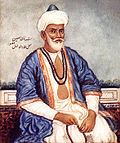 Modern Artist impression of Tansen
 -
 Mughal painting of Tansen c.1580
 -

-
 Inside Tansen's tomb
 -
 Fatehpur Sikri audience chambers, with Anup Talao on the left.
 -
 20th century depiction of Tansen


.jpg)


Legacy
[edit]Tansen award
[edit]
A national music festival known as 'Tansen Samaroh' is held every year in December, near the tomb of Tansen at Hazira, Gwalior as a mark of respect to his memory. The Tansen Samman or Tansen award is given away to exponents in Hindustani Classical music.
Buildings
[edit]The fort at Fatehpur Sikri is strongly associated with Tansen's tenure at Akbar's court. Near the emperor's chambers, a pond was built on a small island in the middle, where musical performances were given. Today, this tank, called Anup Talao, can be seen near the public audience hall Diwan-i-Aam – a central platform reachable via four footbridges. It is said that Tansen would perform different ragas at different times of day, and the emperor and his select audience would honour him with coins. Tansen's supposed residence is also nearby.
Miracles and legends
[edit]The bulk of Tansen's biography as found in Akbar court historians' accounts and gharana literature consists of inconsistent and miraculous legends.[7] Among the legends about Tansen are stories of his bringing down the rains with Raga Megh Malhar and lighting lamps by performing Raga Deepak.[30][31] Raga Megh Malhar is still in the mainstream repertoire, but raga Deepak is no longer known; three different variants exist in the Bilaval (thaat), Poorvi (thaat) and Khamaj (thaat) thaats. It is not clear which, if any, corresponds to the Deepak of Tansen's time. Other legends tell of his ability to bring wild animals to listen with attention (or to talk their language). Once, a wild white elephant was captured, but it was fierce and could not be tamed. Finally, Tansen sang to the elephant who calmed down and the emperor was able to ride him. Besides this, there is also the theory of him being the inventor of rabab-a stringed instruments.[16]
Crater
[edit]A crater on the planet Mercury has been named in Tansen's honor.[32]
References
[edit]- ^ Stuart Cary Welch; Metropolitan Museum of Art (1985). India: Art and culture, 1300–1900. Metropolitan Museum of Art. pp. 171–172. ISBN 978-0-03-006114-1.
- ^ Abul Fazl. Akbarnama. Translated by Henry Beveridge. Asiatic Society of Bengal. p. 816.
- ^ Susheela Misra (1981). Great masters of Hindustani music. Hem Publishers. p. 16.
- ^ a b c d Bonnie C. Wade (1998). Imaging Sound: An Ethnomusicological Study of Music, Art, and Culture in Mughal India. University of Chicago Press. pp. 108–110. ISBN 978-0-226-86841-7.
- ^ "Tansen, Famous Hindustani Classical Singer Tansen". indiaonline.in. Retrieved 15 January 2022.
- ^ Nazir Ali Jairazbhoy (1995). The Rāgs of North Indian Music: Their Structure and Evolution. Popular Prakashan. pp. 19–20. ISBN 978-81-7154-395-3.
- ^ a b Davar, Ashok (1987). Tansen – The Magical Musician. India: National book trust.
- ^ Andrea L. Stanton; Edward Ramsamy; Peter J. Seybolt; et al. (2012). Cultural Sociology of the Middle East, Asia, and Africa: An Encyclopedia. SAGE Publications. p. 125. ISBN 978-1-4522-6662-6.
- ^ Bruno Nettl; Ruth M. Stone; James Porter; et al. (1998). The Garland Encyclopedia of World Music: South Asia : the Indian subcontinent. Taylor & Francis. pp. 376–377. ISBN 978-0-8240-4946-1.
- ^ Bonnie C. Wade (1998). Imaging Sound: An Ethnomusicological Study of Music, Art, and Culture in Mughal India. University of Chicago Press. p. 117. ISBN 978-0-226-86841-7.
- ^ a b c Bonnie C. Wade (1998). Imaging Sound: An Ethnomusicological Study of Music, Art, and Culture in Mughal India. University of Chicago Press. pp. 113–114. ISBN 978-0-226-86841-7.
- ^ a b c Maryam Juzer Kherulla (12 October 2002). "Profile: Tansen — the mesmerizing maestro". Dawn newspaper. Archived from the original on 21 November 2007. Retrieved 18 November 2024.
- ^ Sunita Dhar (1989). Senia gharana, its contribution to Indian classical music. Reliance. p. 19. ISBN 978-81-85047-49-2.
- ^ Edmour J. Babineau (1979). Love of God and Social Duty in the Rāmcaritmānas. Motilal Banarsidass. p. 54. ISBN 978-0-89684-050-8.
- ^ Bruno Nettl (1995). Heartland Excursions: Ethnomusicological Reflections on Schools of Music. University of Illinois Press. p. 68. ISBN 978-0-252-06468-5., Quote: "This is a recital of the identities of their teachers, perhaps the teachers' own teachers and association with gharanas, or schools, of musicianship, and often an attempt to link the main performer of the day through student-teacher genealogies to one of the early great figures of music, such as the revered Tansen, the mythical culture hero and founder of Hindustani music". When he was a member in the court of Mughal Emperor Akbar he was forced to sing Raga Deepak (dieing song) by his enemies. He was saved by Singing Raga Megh by his daughter and her friend
- ^ a b "Tansen".
- ^ Wade, Bonnie C. (1998). Imaging Sound : An Ethnomusicological Study of Music, Art, and Culture in Mughal India. University of Chicago Press. pp. 113–114. ISBN 0-226-86840-0.
- ^ Wade, Bonnie C. (1998). Imaging Sound : An Ethnomusicological Study of Music, Art, and Culture in Mughal India. University of Chicago Press. pp. 114–115. ISBN 0-226-86840-0.
- ^ Wade, Bonnie C. (1998). Imaging Sound : An Ethnomusicological Study of Music, Art, and Culture in Mughal India. University of Chicago Press. ISBN 0-226-86840-0.
- ^ a b José Luiz Martinez (2001). Semiosis in Hindustani Music. Motilal Banarsidass. pp. 186–187. ISBN 978-81-208-1801-9.
- ^ Françoise Delvoye (1990), Tânsen et la tradition des chants dhrupad en langue braj, du XVIe siècle à nos jours, Thèse d'État non publiée. Paris : Université de la Sorbonne Nouvelle (in French), OCLC 416547961; For a review, see Allison Busch (2010), Hidden in Plain View: Brajbhasha Poets at the Mughal Court, Modern Asian Studies, Cambridge University Press, Vol. 44, No. 2 (MARCH 2010), pages 275, 267-309
- ^ Haldar, Amal (February 1964). "Miya Tansen". The Modern Review. CXV (2): 131.
- ^ Dhar, Sunita (1989). Senia Gharana, Its Contribution to Indian Classical Music. Reliance Publishing House. p. 24. ISBN 978-81-85047-49-2.
- ^ Stephen F. Dale (2009). The Muslim Empires of the Ottomans, Safavids, and Mughals. Cambridge University Press. p. 160. ISBN 978-1-316-18439-4.
- ^ Bonnie C. Wade (1998). Imaging Sound: An Ethnomusicological Study of Music, Art, and Culture in Mughal India. University of Chicago Press. p. 115. ISBN 978-0-226-86840-0.
- ^ Fazl, Abul. Akbarnama. Translated by Beveridge, Henry. Asiatic Society of Bengal. p. 816.
- ^ "Imaging sound : An ethnomusicological study of music, art, and culture in Mughal India". 1998.
- ^ Roshan Shahani (11 January 2004). "Strains of a raga ... in Gwalior". The Hindu newspaper. Archived from the original on 30 September 2004. Retrieved 18 November 2024.
- ^ Nettl, Bruno; Arnold, Alison (2000). The Garland Encyclopedia of World Music: South Asia : the Indian subcontinent. Taylor & Francis. p. 525. ISBN 978-0-8240-4946-1.
- ^ George Ruckert; Ali Akbar Khan (1998). The Classical Music of North India: The first years study. Munshiram Manoharlal. p. 270. ISBN 978-81-215-0872-8.
- ^ Deva, Bigamudre (1995). Indian Music. India: Taylor & Francis.
- ^ "Tansen". Gazetteer of Planetary Nomenclature. IAU/USGS/NASA. Retrieved 12 May 2022.
External links
[edit]
| International | |
|---|---|
| National | |
| Artists | |
| Other | |

Tansen
View on GrokipediaBiography
Early life
Tansen, originally known as Ramtanu Pande (also spelled Pandey), was born around 1500 CE in the village of Behat (also referred to as Behla in some accounts) near Gwalior in present-day Madhya Pradesh, India, into a Hindu Gaur Brahmin family.[4][5] His father, Mukund Pande (known variously as Mukund Mishra or Makrand Mishra), was a notable poet and musician whose profession immersed the household in musical traditions and provided Ramtanu with early familial exposure to the art form.[5][6] From childhood, Ramtanu exhibited exceptional vocal talent, as recounted in traditional anecdotes where he flawlessly imitated the calls of birds and animals, captivating those around him and hinting at his innate prodigious abilities.[7][8] He grew up in the socio-cultural milieu of Gwalior, a thriving hub of Hindustani music under the patronage of the Rajput Tomar dynasty, particularly during the reign of Raja Man Singh Tomar (r. 1486–1516 CE), whose court attracted poets, musicians, and scholars, nurturing the development of the Dhrupad style and the Gwalior gharana.[9][10]Education
Tansen received his initial musical instruction from his father, Mukund Pande, a poet and skilled musician who introduced him to the dhrupad style of Hindustani classical music during his early childhood.[6][11] This informal training laid the foundation for Tansen's technical proficiency in vocal and instrumental forms, emphasizing rhythmic precision and textual depth characteristic of dhrupad.[12] At around the age of six, Tansen traveled to Vrindavan, where he sought guidance from the renowned bhakti saint and musician Swami Haridas, a master of devotional singing. Haridas initially refused to formally teach Tansen, citing the young musician's inclination toward secular rather than purely devotional styles; undeterred, Tansen learned by eavesdropping on Haridas's lessons from behind a tree or wall, absorbing techniques in classical Hindustani music, bhajans, and devotion-infused performances. Over time, Haridas recognized Tansen's exceptional talent and accepted him as a disciple, imparting advanced knowledge of melodic structures and spiritual expression in music.[6][13][14] Tansen also apprenticed under the Sufi saint Muhammad Ghaus Gwaliori, a prominent figure in the Shattari order who integrated yogic and mystical practices. This period exposed Tansen to Persian and Islamic musical traditions, including qawwali forms and esoteric elements that emphasized emotional transcendence and divine union through sound.[15][16] Through these experiences, Tansen synthesized the Hindu bhakti devotional approach from Haridas with the Sufi mystical dimensions from Ghaus, creating a unique syncretic style that bridged cultural divides in North Indian music. Historical accounts make no mention of formal academic schooling beyond this musical apprenticeship.[14][15][16]Court career
Tansen's court career commenced in the mid-16th century under the patronage of Raja Ramchandra Singh of Rewa, a Hindu king in present-day Madhya Pradesh, where he served as a musician and gained widespread recognition for his exceptional talents during the 1540s and 1550s.[2] In 1562, Mughal Emperor Akbar, having heard accounts of Tansen's unparalleled musical abilities while he was still in Rewa, summoned him to the imperial court; the Raja of Rewa, acknowledging Akbar's overlordship, complied by sending Tansen to Agra.[17] Upon arrival, Tansen was appointed as a principal court musician and honored with the title "Miyan," a prestigious designation denoting mastery and respect in musical circles.[18] He quickly became one of the Navaratnas, the nine eminent figures in Akbar's durbar, alongside scholars and advisors like Birbal and Abul Fazl, reflecting the emperor's emphasis on assembling intellectual and artistic luminaries.[19] As court musician, Tansen performed daily, instructed the Mughal princes in music, and composed pieces for imperial ceremonies and state events, earning an annual salary of 200,000 dams as noted in contemporary records.[18] Abul Fazl, in the Ain-i-Akbari, praised him as "the crest-jewel of musicians" and the greatest singer since the ancient sage Narada, underscoring his unmatched status with no equal in past or future generations.[20] Tansen's interactions with Akbar extended beyond performances; he advised the emperor on music's potential to foster social harmony and governance, aligning with Akbar's policy of religious tolerance exemplified in the Ibadat Khana assemblies and later the syncretic Din-i-Ilahi (founded 1582), which facilitated Tansen's integration of Hindu and Persian musical elements into a unified Hindustani tradition.[18]Family life
Tansen's personal life intertwined with the multicultural ethos of the Mughal court. According to some accounts, he married a woman named Hussaini from Gwalior. Whether this involved conversion to Islam remains disputed, with scholars citing his Hindu devotional compositions as evidence against it.[21][2] He fathered several children who carried forward his musical heritage, including two sons—Bilas Khan (also referred to as Siddharaj) and Suraj Khan (known as Surat Khan)—and a daughter named Saraswati (or Sarda).[22] These children received rigorous training in music directly from Tansen, perpetuating the dhrupad vocal style central to his repertoire.[23] Bilas Khan distinguished himself as a virtuoso instrumentalist, developing the beenkar gharana focused on string instruments like the veena and rabab, and later serving in Emperor Jahangir's court.[24] Saraswati, described in historical narratives as a musical prodigy, was particularly noted for her vocal talents in dhrupad, contributing to the familial legacy of artistic excellence.[25] The family resided primarily in the imperial centers of Fatehpur Sikri and Agra, where Tansen's domestic life provided stability amid his demanding court duties, allowing his children to immerse themselves in the vibrant musical environment of the Mughal durbar.[26]Death
Tansen died in Delhi on 8 May 1586, at the age of approximately 85–90, due to natural causes following a prolonged illness.[6] Some historical accounts, including those by Hindu chroniclers and the Akbarnama by Abul Fazl, date his death to 26 April 1589 instead.[27] Mughal records like the Akbarnama provide the primary verification for these events, though discrepancies exist between Muslim and Hindu sources regarding the precise year and location, with some placing the death in Agra.[6] Prior to his passing, Tansen requested burial in Gwalior near the tomb of his guru, the Sufi saint Muhammad Gaus (d. 1562).[19] His remains were transported there, and a makbara (tomb) was constructed adjacent to Muhammad Gaus's mausoleum in the Hazira complex; the site is now a protected monument of national importance under the Archaeological Survey of India.[28] The funeral rites incorporated elements of both Hindu and Muslim traditions, reflecting Tansen's syncretic life and the multicultural ethos of Akbar's court.[29] Emperor Akbar, along with much of the royal court, attended the procession, and Akbar expressed profound mourning for the loss of one of his most valued Navaratnas.[19]Musical contributions
Compositions
Tansen's compositions are predominantly in the dhrupad genre, a vocal form characterized by structured poetic texts set to elaborate melodic and rhythmic frameworks, often exploring devotional and philosophical themes. These works typically employ Braj Bhasha, a medieval Hindi dialect, alongside Hindi and Persian, reflecting the multicultural milieu of the Mughal court. According to musicologist Françoise 'Nalini' Delvoye, many such dhrupads attributed to Tansen derive from Hindu Puranic sources and bhakti poetry, emphasizing spiritual devotion and divine love, with examples preserved in court musicians' repertoires from the 16th century onward.[30] A prominent example is a dhrupad in Raag Malkauns, composed by Tansen and rendered in the 12-matra Chautaal tala, which has long served as a benchmark for musical purity and authenticity in Hindustani traditions. Performed by lineages like the Dagar brothers, this piece exemplifies Tansen's skill in blending rhythmic complexity with lyrical depth, though its exact text varies slightly across oral transmissions. Scholar Aneesh Pradhan highlights its enduring role in establishing legitimacy among performers claiming descent from Tansen's gharana.[31] Authorship of these compositions remains debated among scholars, as numerous anonymous dhrupads from the period were retrospectively ascribed to Tansen to enhance their prestige, a practice common in oral musical lineages. Ritwik Sanyal's analysis in his dissertation underscores how such attributions rely on genealogical claims rather than verifiable documentation, leading to variations in texts and interpretations. Preservation occurred primarily through guru-shishya parampara (teacher-disciple tradition), resulting in regional divergences, until modern notations emerged; Vishnu Narayan Bhatkhande, in his Kramik Pustak Malika series, transcribed over 1,200 traditional pieces, including several dhrupads linked to Tansen, standardizing them for wider dissemination.[32][33]Ragas and innovations
Tansen is credited with the invention of several ragas that remain staples in Hindustani classical music, each designed to evoke specific emotions and suited to particular times of day. Among these, Miyan ki Todi, an evening raga associated with pathos and devotion, features a scale with komal re and dha, allowing for intricate melodic explorations that convey melancholy and introspection.[34] Similarly, Miyan ki Malhar, intended for the rainy season, incorporates notes like komal ni and gandhar to mimic the sound of falling rain, blending serenity with a sense of rejuvenation. Darbari Kanada, created for performance in royal courts, employs a pentatonic structure derived from the Kanada family, emphasizing sustained notes and slow, majestic phrases to inspire awe and tranquility, often rendered in the late evening. In addition to these creations, Tansen refined existing ragas such as Yaman and Bilaval, enhancing their expressive potential through nuanced phrasing and ornamentation. For Raga Yaman, an evening melody known for its romantic and peaceful mood, Tansen's compositions introduced subtle variations in the use of tivra ma, enriching its lyrical flow while maintaining its core structure akin to the Kalyan thaat.[36] He similarly developed aspects of Raga Bilaval, the foundational scale mirroring the Western major scale, by composing in variants like Shukla Bilawal, which added devotional depth through precise aroha-avroha patterns and emphasis on shuddha swaras.[37] Tansen's technical innovations extended to instrumental techniques and rhythmic elements, employing jor and jhala to enhance the structure of performances in dhrupad style. Jor marks the transition from the unmeasured alap to a pulsed rhythm, building intensity with repeated notes, while jhala accelerates this into a fast, interlocking pattern dominated by the drone string, particularly on instruments like the veena or sitar.[38] He also pioneered the use of meends (glides between notes) and gamaks (oscillations) in dhrupad, drawing from Persian influences to add fluidity and emotional vibrancy, transforming rigid melodic lines into more expressive vocal and instrumental interpretations.[39] Furthermore, Tansen blended talas with Persian rhythmic patterns to create hybrid forms that bridged Indian and Central Asian traditions, enriching the temporal framework of compositions. Historical evidence for these contributions appears in contemporary accounts from Akbar's court, such as those in the Ain-i-Akbari, which praise Tansen's role in advancing musical forms, and later preserved in the Gwalior gharana, which traces its lineage to him and emphasizes his ragas in its repertoire.[20] The gharana's texts and oral traditions document how Tansen's innovations, including his ragas and techniques, formed the bedrock for subsequent developments in Hindustani music.[40]Influence on Hindustani music
Tansen's tenure at the Mughal court under Emperor Akbar significantly elevated dhrupad to a prominent courtly form in Hindustani music, transforming it from a primarily devotional practice into a refined secular tradition patronized by royalty.[41] This shift marked the beginning of a golden era for dhrupad, where it became the dominant vocal style, emphasizing rhythmic precision, textual depth, and melodic elaboration suited to imperial settings.[34] Through his compositions and performances, Tansen standardized aspects of dhrupad's structure, including the integration of poetic lyrics with complex improvisations, which influenced its enduring role in classical repertoires. His legacy profoundly shaped subsequent gharanas, with many tracing their lineages to Tansen's descendants in the Senia tradition. The Jaipur Gharana, for instance, emerged from the Seni line specializing in dhrupad interpretations like the Goudhar bani, maintaining Tansen's emphasis on robust vocal techniques and rhythmic cycles. Similarly, the Kirana Gharana claims indirect connections through early dhrupad influences, incorporating Tansen's melodic purity in its khayal renditions, though such lineages often blend historical fact with oral tradition.[42] Tansen's innovations in dhrupad thus provided a foundational framework for these schools, promoting stylistic diversity while preserving core principles of raga elaboration.[43] Tansen exemplified syncretism by fusing Hindu devotional elements with Persian and Mughal influences, laying groundwork for later forms like khayal and thumri. His adoption of courtly aesthetics, such as incorporating Urdu poetry and subtle ornamental techniques (gamakas), bridged indigenous and Islamic musical idioms, fostering a hybrid Hindustani tradition.[44] This cultural integration is evident in his family's dual naming conventions and the evolution of genres that blended bhakti themes with Sufi expressiveness, influencing the emotive flexibility of khayal.[45] Through training court musicians and his progeny, Tansen ensured the transmission of his techniques, notably via his son Bilas Khan, who advanced the beenkar tradition on the veena-like been instrument. Bilas Khan, a skilled instrumentalist, extended dhrupad principles to stringed music, establishing the rababiya and beenkar lineages that emphasized drone-based improvisation and raga fidelity.[34] These efforts disseminated Tansen's methods among disciples, sustaining dhrupad's instrumental variants in subsequent generations.[46] In the long term, Tansen is traditionally credited with contributing to raga classifications that prefigured the standardization of ten thaats as parent scales, though this system was formalized centuries later by scholars like Vishnu Narayan Bhatkhande. Modern scholarship critiques the over-attribution of such systematizations to Tansen, noting that many claims stem from hagiographic accounts rather than contemporary evidence, urging a nuanced view of his role amid evolving musical theory.[31]Legends and folklore
Miracles attributed
Numerous legends attribute supernatural powers to Tansen's mastery of music, particularly through specific ragas that were said to influence natural elements. The most renowned tale centers on Raga Deepak, a melody purportedly capable of igniting fire and generating intense heat. According to folklore, rivals in Emperor Akbar's court, envious of Tansen's favor, urged him to perform this raga during a musical assembly. Aware that the raga would scorch his voice and body, Tansen complied, causing unlit lamps to spontaneously burst into flame and filling the air with warmth. However, the performance left him feverish and weakened, nearly fatal. To remedy this, Tansen had secretly instructed his daughter Saraswati (or in variant accounts, two daughters Tana and Riri) to follow with Raga Megh Malhar, a rain-invoking composition; her rendition summoned a sudden downpour that extinguished the metaphorical fire and restored him.[47] Another prominent legend involves Raga Megh Malhar independently, highlighting Tansen's ability to summon rain and avert personal peril. In this narrative, courtiers or Akbar himself challenged Tansen to prove his prowess by bringing rain during a drought or as part of a test, threatening his life if he failed. Tansen's rendition of the raga is said to have drawn clouds and unleashed a refreshing monsoon, saving him and quenching the land's thirst. This story underscores the raga's association with seasonal invocation and Tansen's reputed command over atmospheric forces.[47] Additional folklore credits Tansen with taming wild animals through his melodies, portraying music as a harmonizing force in nature. One account describes a rampaging white elephant captured for Akbar's court that resisted all handlers; Tansen's singing soothed the beast, allowing it to be controlled without force. Similar tales recount him calming lions in the forest or drawing deer and birds to listen entranced.[2][5] These miracles originate from oral folklore embedded in Mughal court tales and later biographies of Tansen, blending elements of bhakti devotion and sufi mysticism to symbolize music's transcendent potential in uniting the human spirit with the divine and natural world.[48] Scholars interpret them as metaphorical expressions of the emotional and spiritual depth of Hindustani music, rather than historical facts, noting the absence of such supernatural accounts in contemporary records like Abul Fazl's Ain-i-Akbari, which praises Tansen's artistry but omits any miraculous feats.[43]Rivalries and stories
One of the most famous legends surrounding Tansen involves his rivalry with the folk singer Baiju Bawra, another purported disciple of Swami Haridas. According to popular accounts, Emperor Akbar, impressed by tales of Baiju's prowess, arranged a musical duel between the two musicians to determine superiority, with the loser facing execution. During the contest, Tansen's tanpura string snapped, seemingly dooming him, but Baiju intervened, pleading with Akbar to spare Tansen's life, lift any associated bans on music, and release innocent bystanders caught in the intrigue. This narrative, drawn from oral traditions and 19th-century retellings, underscores the competitive dynamics of Mughal court music while portraying Baiju as magnanimous despite the high stakes.[43] Tansen's prominence in Akbar's court also bred jealousy among other courtiers and fellow musicians, leading to several anecdotal conflicts designed to undermine him. Envious of the title "Miyan" bestowed upon Tansen by the emperor, which elevated him above his peers, rival musicians and ministers plotted to exploit his talents fatally. In one well-known story, they convinced Akbar that Tansen's rendition of Raga Deepak could miraculously light lamps without fire, but the raga's power would inevitably consume the singer in flames. Reluctantly, Tansen performed it, igniting his body, only to be saved when his wife Husseini sang Raga Megh Malhar to summon rain and extinguish the blaze. These tales, rooted in oral folklore and documented in historical narratives from the period, highlight the interpersonal tensions within the Navratna circle and the perilous envy Tansen faced due to his unmatched favor with Akbar.[49] Humorous anecdotes further humanize Tansen, revealing his wit amid courtly pressures. A celebrated story involves Akbar's desire to hear Tansen's guru, Swami Haridas, perform after Tansen praised his master's divine singing. Upon arriving at Haridas's riverside hut at dawn, the guru refused, stating he sang solely for God. To demonstrate, Tansen began performing but deliberately erred in his notes, prompting Haridas to open his eyes in disapproval and remark that Tansen had ruined the devotional atmosphere with mere showmanship. This lighthearted episode, preserved in oral traditions and later accounts like those in 19th-century biographical sketches, illustrates Tansen's clever humility and quick thinking to honor his teacher while deflecting the emperor's insistence. Such stories from "Tansen Charitra" and similar texts emphasize the blend of rivalry and camaraderie that shaped Tansen's legendary persona in Mughal lore.[43]Legacy
Cultural festivals and awards
The Tansen Sangeet Samaroh, an annual music festival honoring the legendary musician Tansen, has been held in Gwalior, Madhya Pradesh, since 1925, initially under the patronage of the Scindia rulers and evolving into a prominent celebration of Hindustani classical music.[50] Organized by the Madhya Pradesh government, the four-to-five-day event typically takes place in December at Tansen's tomb in Behat village or nearby historic sites like Gwalior Fort, featuring performances in dhrupad, khayal, and other classical forms by renowned artists.[51] The 2024 edition marked the 100th anniversary, drawing thousands of attendees and achieving a Guinness World Record for the largest Hindustani classical band with 546 musicians performing ragas such as Miyan ki Todi and Darbari Kanada.[52] Post-independence, the festival expanded under national cultural initiatives, incorporating broadcasts by All India Radio and Doordarshan to reach wider audiences, and in the 21st century, it has embraced digital streaming via platforms like Utsav Portal for global access during events like the 2024 centenary.[53] This growth underscores Tansen's role in India's musical heritage, blending traditional reverence with modern dissemination. The Rashtriya Tansen Samman, instituted by the Madhya Pradesh government in 1980, recognizes outstanding contributions to Hindustani classical music and is presented annually during the Sangeet Samaroh.[54] Recipients receive a cash prize of ₹5 lakh, a citation, shawl, and coconut; notable awardees include santoor maestro Pandit Shivkumar Sharma in the early 2000s and tabla exponent Pandit Swapan Chaudhary in 2023.[55][56] India Post has commemorated Tansen through special stamps, including a 1986 issue depicting him as a court musician and a 2024 release marking the Tansen Samaroh centenary, highlighting his enduring influence on classical traditions.[57]Monuments and memorials
The tomb of Tansen, a prominent 16th-century structure in Gwalior, Madhya Pradesh, serves as the primary physical memorial to the legendary musician and is situated adjacent to the mausoleum of his spiritual mentor, the Sufi saint Muhammad Ghaus. Constructed shortly after Tansen's death in 1586, the tomb features a simple yet elegant marble cenotaph set within a walled enclosure, reflecting early Mughal architectural influences with Indo-Islamic elements such as arched openings, geometric patterns, and a low dome supported by pillars.[58][59] The site, enclosed in a serene garden complex, underscores Tansen's enduring connection to Gwalior, where he spent much of his early life and developed the local gharana of Hindustani classical music.[60] As a centrally protected monument of national importance under the Archaeological Survey of India (ASI), the tomb has undergone periodic maintenance to preserve its historical integrity, including repairs following natural damages like the 1934 earthquake that affected structural elements such as pillar brackets.[61][28] In the 2020s, preservation efforts gained renewed focus amid legal disputes, with the Madhya Pradesh High Court in 2025 upholding ASI's authority to restrict unauthorized religious and cultural activities at the site to prevent vandalism and ensure long-term conservation.[62][63] This decision is currently under appeal before the Supreme Court of India, which issued notice on September 29, 2025, with the matter pending as of November 2025.[64] Other commemorative structures linked to Tansen include the debated Tansen Mahal in Gwalior, sometimes identified in historical accounts as a possible former residence or assembly hall associated with his musical gatherings, though its direct connection remains unconfirmed by primary records. Limited memorials exist elsewhere, such as a portrait of Tansen housed in Delhi's National Museum, honoring his role in Akbar's court, while associations with Vrindavan—where Tansen studied under Swami Haridas—lack dedicated physical sites but are evoked through local musical traditions.[65][66]Popular depictions
Tansen has been a prominent figure in Indian cinema, often portrayed through a lens that blends historical elements with legendary tales of his musical prowess. The 1943 film Tansen, directed by Jayant Desai and starring K. L. Saigal in the titular role alongside Khursheed Bano, depicts his rise as a musician in the Mughal court, emphasizing his compositions and courtly life.[67] Similarly, the 1952 musical drama Baiju Bawra, directed by Vijay Bhatt and featuring Bharat Bhushan as the rival singer Baiju with Surendra portraying Tansen, dramatizes a fictional musical duel inspired by folklore, highlighting themes of rivalry and divine talent.[68] Later adaptations include the 1962 biopic Sangeet Samrat Tansen, directed by S. N. Tripathi and starring Bharat Bhushan, which focuses on miraculous aspects of his early life, such as his childhood muteness cured by music.[69] In the 1990s and 2000s, television serials like the 1994-1995 Hindi series Sangeet Samrat Tansen extended these portrayals, fictionalizing his court experiences and innovations in ragas for broader audiences.[70] In literature, Tansen appears in historical chronicles and modern biographies that romanticize his life story. The Akbarnama, the official biography of Emperor Akbar written by Abul Fazl in the late 16th century, recounts Tansen's recruitment to the court from Raja Ramchandra of Rewa, portraying him as a revered musician integral to Mughal cultural patronage.[71] Folk tales, preserved in oral traditions and regional anthologies, amplify myths of his supernatural abilities, such as summoning rain or fire through ragas, which have influenced subsequent narratives. Modern works include Tansen: Master of Melody (2017) by Dolly Rizvi, a children's biography that weaves factual accounts with legendary episodes to illustrate his journey from a village boy to court legend.[72] Visual arts have long captured Tansen in Mughal-era depictions, evolving into romanticized modern interpretations. Mughal miniatures from the Akbar period, such as a circa 1590 portrait in the National Museum, New Delhi, show him as a dignified courtier with a rabab, emphasizing his status among the Navratnas.[73] Another painting from the same era illustrates Akbar listening to Tansen perform, underscoring the emperor's admiration.[66] In contemporary arts, plays like Tansen (2019) by The Trialogue Company blend drama, dance, and live classical music—including dhrupad and khayal—to explore his internal quest for musical perfection, drawing on legends of his guru Swami Haridas to evoke emotional depth.[74] Depictions of Tansen have shifted over the 20th and 21st centuries from relatively historical accounts in early films to increasingly mythical narratives that amplify folklore, such as his rivalries and miracles, to captivate modern viewers. This evolution is evident in OTT series like Tansener Tanpura (2020), a Bengali mystery-adventure on Hoichoi (dubbed in Hindi on Prime Video), where protagonists hunt for his legendary tanpura amid ancient melodies and hidden secrets, blending historical reverence with fictional intrigue.[75] Such portrayals perpetuate myths from folklore—like his ability to control elements through music—shaping public perception of Tansen as a near-divine figure rather than solely a historical musician.References
- https://www.[researchgate](/page/ResearchGate).net/publication/371250307_Music_the_Performing_Art_Its_Excellence_Appreciation_and_Cultural_Progression