Hubbry Logo
MontrachetMontrachetMain
Open search
Montrachet
Community hub
Montrachet
logo
8 pages, 0 posts
0 subscribers
Be the first to start a discussion here.
Montrachet
Montrachet
from Wikipedia
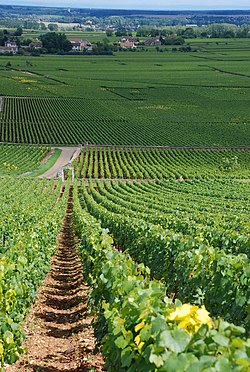
Looking down the vines of Chevalier-Montrachet with Montrachet below and Batard-Montrachet just beyond. The village of Puligny-Montrachet is in the distance.

Montrachet (pronounced Mon-rashay; French pronunciation: [mɔ̃ʁaʃɛ]) is an Appellation d'origine contrôlée (AOC) and Grand Cru vineyard for white wine made of Chardonnay in the Côte de Beaune subregion of Burgundy. It straddles the border between the two communes of Chassagne-Montrachet and Puligny-Montrachet and produces what many consider to be the greatest dry white wine in the world.[1] It is surrounded by four other Grand Cru vineyards all having "Montrachet" as part of their names. Montrachet itself is generally considered superior to its four Grand Cru neighbours, and this is reflected in its higher price.

Montrachet is located in the south of the Côte de Beaune, which is the southern half of the Côte d'Or, which in turn is the most important of the several wine producing subregions of Burgundy.

The Montrachet vineyard is almost equally divided between Puligny-Montrachet and Chassagne-Montrachet. Both of these appellations have, as is customary, appended the name of their most famous vineyard (in this case a shared one) to the name of their main village. The wine from the Chassagne side is usually known as Le Montrachet while the wine from the Puligny side is known as Montrachet.

History

[edit]

The Montrachet vineyard was first planted in the Middle Ages. Although the date of its establishment is unknown, Pierre and Arnolet de Puligny gifted wines in "Mont Rachaz" to the Abbey of Maizières [fr] in 1252.[2]

During the 19th century, Montrachet, along with Burgundy as a whole, was ravaged by a succession of vineyard diseases. In the mid-nineteenth century oidium struck. At the end of the nineteenth century phylloxera struck, eventually overcome by the grafting of European vines on American stock.

The Appellation Controlée system was introduced in Burgundy in 1935. Montrachet and Bâtard-Montrachet (see below) were both recognised as AOC Grands Crus in 1937.

Production

[edit]

In 2008, 7.99 hectares (19.7 acres) of vineyard surface was in production within the AOC, and 349 hectolitres (9,200 US gal; 7,700 imp gal) of wine was produced,[3] corresponding to just under 47,000 bottles.

AOC regulations

[edit]

Wines from Montrachet are composed almost entirely of Chardonnay, unlike in other white Burgundy wines, where up to 15% of Pinot Blanc can be added. These are, like most French wines, referred to by their place of origin rather than by grape variety. The allowed base yield of Montrachet is 40 hectoliter per hectare, and the minimum grape maturity is 12.0 per cent potential alcohol.[4]

Producers

[edit]

There were 18 owners and 26 producers as of October 2007 (an owner can own different subdivisions and/or lease to different producers). The largest owner is the de Laguiche family (an aristocratic family from 1300), which leases its subdivision to Joseph Drouhin. The highest prices are typically charged for Montrachet produced by Domaine de la Romanée-Conti, which owns 0.67 hectares (1.7 acres) and produces around 3,000 bottles per year.

The last sale of a subdivision occurred in 1993 when the Crédit Foncier bank (owner of Château de Puligny) bought 428 m2 (4606 sq. ft.) for over half a million Euros.

Montrachet wines are the most expensive dry white wines in the world: prices can range from €150 to €2500 per 75 cl bottle.[citation needed] The price depends on the reputation of the producer (in Burgundy, vineyards are divided among multiple growers, and there can be substantial variation in quality) and the vintage.

Montrachet and its Grand Cru neighbours

[edit]

Four additional Grand Cru vineyards lie alongside Montrachet and incorporate its name as part of their own; these are Chevalier-Montrachet, which is situated immediately above Montrachet on the slope, Bâtard-Montrachet, which is situated immediately below Montrachet and is separated from it by the Route des Grands Crus, Bienvenues-Bâtard-Montrachet, which is situated immediately beyond Bâtard-Montrachet, in the direction of Puligny-Montrachet, and Criots-Bâtard-Montrachet, which is situated next to Bâtard-Montrachet in the direction of Chassagne-Montrachet. Chevalier-Montrachet and Bienvenues-Bâtard-Montrachet lie entirely within the commune of Puligny-Montrachet. Criots-Batard-Montrachet lies entirely within Chassagne-Montrachet. Batard-Montrachet, like Montrachet itself, is split between the two villages.

Grand Cru Relative position Vineyard surface (2007)[5] Average production (2003-2007)[5]
Montrachet Centre 7.99 hectares (19.7 acres) 310 hl
Bâtard-Montrachet East 11.09 hectares (27.4 acres) 502 hl
Chevalier-Montrachet West 7.08 hectares (17.5 acres) 305 hl
Bienvenues-Bâtard-Montrachet Northeast 3.70 hectares (9.1 acres) 163 hl
Criots-Bâtard-Montrachet South 1.57 hectares (3.9 acres) 73 hl

See also

[edit]

References

[edit]
Revisions and contributorsEdit on WikipediaRead on Wikipedia
from Grokipedia
Montrachet is a prestigious Grand Cru in the subregion of , , renowned for producing some of the world's finest white wines from 100% grapes. Straddling the communes of and , this southeast-facing vineyard spans approximately 8 hectares of limestone-marl soils at altitudes between 250 and 270 meters, yielding rich, structured wines noted for their buttery, honeyed aromas, dried fruit flavors, and exceptional aging potential. The vineyard's history dates back to the 13th century, with early records linking it to monastic donations, including to the Cistercian abbey of Maizières, before its prominence grew in the among . Officially classified as a Grand Cru (AOC) on July 31, 1937, Montrachet represents the pinnacle of Burgundy's hierarchical wine system, where only 1-2% of regional production achieves this status. Its features a gentle slope with variations in depth—shallower and more limestone-dominant on the Puligny side for , and richer clay on the Chassagne side for power—contributing to the wine's complexity and harmony. The site's limited size results in fragmented ownership among about 18 producers, including notable domaines like Romanée-Conti and Drouhin, with bottles often commanding prices starting at €500 and reaching thousands due to scarcity and acclaim. Montrachet wines typically exhibit a golden hue with emerald reflections in youth, evolving to deeper amber tones; on the palate, they offer unctuous texture, firm acidity, and notes of white flowers, toast, and spices, making them benchmarks for Chardonnay worldwide.

Geography and Terroir

Location and Boundaries

Montrachet is a prestigious Grand Cru vineyard situated in the Côte de Beaune subregion of Burgundy, France, primarily spanning the communes of Puligny-Montrachet and Chassagne-Montrachet. This narrow strip of land represents one of the most revered sites for Chardonnay production in the world, benefiting from its position along the eastern escarpment of the Côte d'Or escarpment. The vineyard occupies a compact area of approximately 8 hectares, with recent surveys recording a total surface of 7.998 hectares. It forms a rectangular plot oriented northeast to southwest, bisected nearly equally by the communal boundary between and . Specifically, the portion in measures 4.0107 hectares, while the section in covers 3.9873 hectares, resulting in a balanced among multiple owners with precise parcel allocations. Topographically, Montrachet lies on a gentle east-southeast facing at elevations ranging from 250 to 270 meters, providing ideal sun exposure throughout the day. This moderate incline ensures optimal drainage and warmth, contributing to the site's exceptional . The is bordered to the north by Chevalier-Montrachet and to the south by Bâtard-Montrachet, forming part of a contiguous cluster of elite Grand Cru sites along the hillside.

Soil Composition and Climate

The soils of the Montrachet consist of a thin layer, typically 20-50 cm deep, composed of brown overlying fractured hard from the period. This includes a band of reddish iron-rich material, contributing to variations in clay content (around 32-36%) and pebble content (64-68%) across different parcels, which enhances heterogeneity. The high calcium content in the promotes excellent drainage, preventing waterlogging while retaining sufficient moisture for roots to penetrate the fractured . Montrachet experiences a temperate continental , characterized by warm days and cool nights during the , with an average annual of about 11°C. The vineyard's southeast-facing slope at elevations of 250-270 provides protection from prevailing westerly winds and ensures optimal sunlight exposure, while annual rainfall averages 700-800 mm, distributed relatively evenly but with higher amounts in spring and autumn. Frost risks, common in the , are somewhat mitigated by the slope's aspect and elevation, though occasional spring frosts remain a concern. The terroir's limestone-dominated soils impart a distinctive mineral character to the Chardonnay grapes, enhancing acidity, structure, and aging potential in the resulting wines. The southeast-facing exposure accelerates ripening, allowing grapes to achieve full phenolic maturity while preserving freshness, which contributes to the wines' renowned complexity, balance, and longevity—often exceeding 20-30 years. Since the early 2000s, warming trends in have led to earlier harvests, with average picking dates advancing by about two weeks compared to the mid-20th century, increasing variability. The 2020 , for instance, was marked by intense summer heatwaves that accelerated but risked over-maturity and reduced acidity in some parcels. More recently, the 2024 faced excessive rain and pressure, resulting in low yields, while 2025 saw a volume recovery with variable quality due to weather extremes. These changes challenge the traditional expression of Montrachet's , prompting adaptations in canopy management to preserve typicity.

Historical Development

Origins and Early Ownership

The origins of the Montrachet vineyard trace back to the , with its name deriving from "Mont Rachaz" or "Mont rachet," meaning "bald hill" in reference to the area's barren, scrubby landscape at the time. The site was first documented in 1250 in the archives of the Cistercian Abbey of Maizières as "Montrachet territory," linked to a donation of land by local lords to the monastery. In 1252, brothers and Arnaud de Puligny further contributed vines and parcels in "Mont Rachas" to the abbey, establishing early monastic cultivation focused on white grape varieties. The Cistercian monks of Maizières, known for their systematic viticultural innovations, expanded ownership through additional donations and exchanges, such as a 1286 transaction with Bererus of Chagny, solidifying the vineyard's role in the abbey's prestigious holdings by the . By the late 16th century, secular ownership began to dominate as Charles de Boutières, Lord of Chagny and Chassagne, progressively acquired the entire 100 ouvrées (approximately 4 hectares) of Montrachet between 1577 and 1596, marking a shift from monastic control to noble estates. This period saw the vineyard's wines gain early acclaim, with Abbot Arnoux of Maizières extolling their quality in international circles as early as 1728. The disrupted this trajectory in the 1790s, when monastic and noble lands were confiscated as national property; in 1791, Maizières Abbey's holdings, including about 128 ouvrées in nearby , were seized and auctioned off, fragmenting Montrachet into smaller parcels sold to local families and merchants. Post-revolutionary redistribution allowed notable families, such as the Latours, to acquire plots in the early , contributing to the site's consolidation under private ownership while its reputation grew through sales to European nobility and initial exports to markets like . The late 19th century brought severe challenges with the epidemic, which first struck the near in 1878 and rapidly devastated Burgundy's vineyards, including Montrachet, by the 1880s. The insect destroyed vast swaths of vines, reducing production and forcing widespread uprooting; in response, growers in Puligny- and replanted using phylloxera-resistant American rootstocks grafted to European vines, a practice that reshaped the vineyard's by the 1890s. Despite these setbacks, Montrachet's prestige endured, earning references in 19th-century literature and auctions as the "king of white wines" for its unparalleled richness and , cementing its status as a benchmark for before the .

20th-Century Recognition and Changes

In 1937, Montrachet received official recognition as a Grand Cru appellation under the French (AOC) system, administered by the Institut National des Appellations d'Origine (INAO), which precisely delimited its boundaries spanning approximately 8 hectares across the communes of and . This elevation, shared with neighboring vineyards like Bâtard-Montrachet, formalized the site's longstanding prestige and established strict parameters to protect its unique , marking a pivotal step in Burgundy's regulatory framework for elite production. Following , Montrachet gained heightened international acclaim as exports expanded significantly, driven by reconstruction in key markets like the and , where demand for premium surged among affluent consumers. The 1970s economic boom further amplified this trend, with exceptional vintages such as 1971 and 1978 elevating the vineyard's profile and spurring sharp increases in pricing and investment, as global interest from emerging collectors transformed Montrachet into a symbol of luxury. Ownership dynamics in Montrachet underwent notable consolidations and challenges during the , exemplified by the Marquis de Laguiche family's retention of the largest single parcel—about 2.06 hectares—through strategic inheritances dating back to the , though overall holdings diminished slightly to around 25% of the total by late century. French inheritance laws, rooted in the , exacerbated parcel fragmentation, compelling frequent divisions among heirs and leading to over 16 distinct owners by the 1980s, which heightened the site's exclusivity and value despite complicating management. Culturally, Montrachet featured prominently in mid-20th-century wine literature, with proclaiming it "the greatest in the world" at its best, underscoring its ethereal qualities in works that popularized among English-speaking audiences. By the , this reverence translated to auction milestones, where bottles from prestigious producers like Domaine de la Romanée-Conti commanded record sums, reflecting the wine's ascent as a benchmark for excellence and .

Viticulture Practices

Grape Varieties and Cultivation

Montrachet is planted exclusively with , the only grape variety permitted in this Grand Cru , which ensures a focused expression of the site's character in the resulting wines. Vines here are often notably mature, with an average age exceeding 40 years, as older plantings are highly valued for their ability to produce grapes with greater concentration and depth due to deeper root systems and balanced vigor. Cultivation in Montrachet emphasizes high-density planting, typically ranging from 10,000 to 12,000 vines per , which promotes competition among roots for nutrients and water, yielding more intense flavors while adapting to the site's limestone-rich . Vines are trained using vertical shoot positioning systems, where shoots are lifted and secured to trellis wires to optimize canopy management, ensuring adequate sunlight penetration and air circulation for healthy development. Since the early , many top producers have shifted toward organic and biodynamic practices, reducing synthetic inputs and enhancing vitality to sustain long-term health in this prestigious . Pruning follows the simple method, predominant in , where a single cane with 8 to 15 buds is retained to limit vegetative growth and direct energy toward fruit production, thereby controlling vigor and emphasizing quality over quantity. This approach, combined with the terroir's influence on uniform ripeness, supports the production of grapes renowned for their complexity. Pest and management in Montrachet addresses key challenges such as and powdery mildew, which thrive in the region's humid conditions, and spring frost events that can damage emerging buds. Sustainable strategies predominate, including the use of - and sulfur-based treatments permissible under organic standards, alongside cover crops between rows to suppress weeds, improve , and foster that naturally mitigates pest pressures. Recent variability has heightened frost risks, prompting more widespread use of protective measures like wind machines.

Harvesting and Yield Management

Harvesting in the Montrachet is conducted exclusively by hand due to the steep slopes and fragmented small parcels, which preclude mechanical harvesting and necessitate careful navigation to preserve integrity. Selective sorting occurs directly in the during picking, allowing workers to remove unripe or damaged clusters on-site for optimal quality. The timing of harvest traditionally falls in late September to early October, but in recent years has shifted earlier, often beginning in mid-to-late August due to and warmer growing seasons, with decisions heavily influenced by vintage-specific weather patterns. It often involves multiple passes through the vines—known as "tries"—to ensure grapes reach phenolic ripeness. For instance, the 2010 vintage benefited from ideal conditions with harvests spanning early to late , resulting in balanced volumes and fruit maturity. In contrast, 2021 presented challenges from a severe frost that decimated yields, followed by during harvest, leading to significantly reduced volumes across the . Yield management emphasizes low production to concentrate flavors, with averages typically ranging from 35 to 50 under strict oversight by producers; the AOC maximum yield is 48 hl/ha. This approach traces back to the post-phylloxera era in the late , when replanting efforts in , including Montrachet, initially resulted in diminished outputs as vines reestablished on resistant rootstocks.

Winemaking and Production

Fermentation Techniques

In the production of Montrachet, a prestigious Grand Cru from , the process begins with careful pressing to preserve the delicate aromas and characteristics of the grapes. Whole clusters are subjected to long, gentle pneumatic pressing, which extracts the juice without excessive pressure that could introduce harsh phenolics or . This method typically yields free-run juice, which flows naturally, and press juice from subsequent fractions; the two are often separated initially to allow for selective use, with the free-run portion prized for its purity and the press wines contributing structure if blended later. Following pressing, the must undergoes static decanting for approximately 24 hours at cool temperatures to allow solids to settle, clarifying the while retaining essential lees for later complexity. The clarified must is then racked into barrels—frequently 20-100% new depending on the producer, with some estates like Domaine Leflaive employing 100% new for Montrachet—to initiate alcoholic . This process relies on indigenous yeasts naturally present on the skins, avoiding commercial strains to enhance site-specific flavors, and proceeds under controlled temperatures of 18-22°C for 2-3 weeks, ensuring a slow, complete conversion of sugars to alcohol while preserving fruit purity. Malolactic fermentation typically follows fully, converting sharp malic acid to softer via indigenous bacteria, which imparts creaminess and rounds out the wine's texture without diminishing its minerality. This step occurs in barrel on fine lees, often with minimal stirring (bâtonnage) between alcoholic and malolactic phases to integrate lees character subtly. Producers may vary slightly—opting for partial malolactic in riper vintages to retain acidity—but full conversion is standard for Montrachet's opulent style. Early blending of free-run and select press fractions emphasizes minimal intervention, aiming to capture the vineyard's primary and expressions from the outset. This restrained approach, combined with no added at pressing in some cases, allows the terroir's limestone-driven precision to shine through subsequent maturation.

Aging and Bottling Processes

Following fermentation, Montrachet wines undergo barrel aging for 12 to 18 months in French oak barriques to develop complexity and integrate flavors. This period typically includes every 3 to 6 months, which aerates the wine gently and promotes the buildup of nuanced layers without excessive oxidation. The wines are aged on fine lees, stirring (bâtonnage) may occur periodically to enhance texture, and the process emphasizes slow evolution in a cool cellar environment. The barrels are sourced from renowned French forests such as or Tronçais, selected for their tight grain and ability to impart subtle spice. New oak usage varies among producers, often ranging from 30% to 50% to introduce notes of and toast while preserving the wine's purity and minerality. Higher percentages, up to 100% new oak in some cases, are employed for Grand Cru parcels to amplify structure without overpowering the terroir-driven character. Prior to bottling, wines from multiple parcels are often blended (assemblage) to achieve balance and consistency across the domaine's production. Light fining and filtration are applied by many producers to ensure clarity, though some opt for minimal intervention or no filtration to retain a more natural style and preserve aromatic intensity. Bottling usually occurs in late summer or early autumn, approximately 18 to 24 months after harvest, with total annual production across all Montrachet producers estimated at 3,500 to 4,500 cases.

Appellation Regulations

AOC Classification History

Prior to the formal establishment of the (AOC) system, Montrachet enjoyed informal recognition as a premier site in by the 19th century, rooted in its historical prestige that originated in the with monastic ownership and achieved global acclaim by the 17th century for producing the finest white wines. This reputation persisted despite 19th-century challenges like and oidium outbreaks that affected vineyards. The modern AOC era for Montrachet began with the formation of the Institut National des Appellations d'Origine (INAO) in 1935, leading to the official delimitation of Grand Cru vineyards in during 1936-1937. On July 31, 1937, Montrachet was classified as a Grand Cru , one of 33 such sites in the region, exclusively for white wines. This status was granted based on its centuries-old prestige—evidenced by medieval Cistercian records and 17th-century accounts praising its unmatched delicacy—and its exceptional terroir, including east/south-facing slopes at 250-270 meters altitude on with thin, reddish soils. In the post-war period, the evolved through refinements to ensure precision and consistency. The 7.99-hectare expanse is split between (4 hectares) and (3.99 hectares), integrating it seamlessly into these communal AOCs while maintaining its standalone Grand Cru designation. These adjustments reinforced the site's protected status without altering its core definition. Within 's hierarchy, Montrachet stands at the apex as a top-tier Grand Cru, surpassing Premier Cru levels and comprising roughly 1-2% of the region's total production, underscoring its rarity and role as the benchmark for elite white . Its symbolic importance lies in exemplifying the pinnacle of terroir-driven expression, influencing standards across the .

Specific Production Rules

The Specific Production Rules for Montrachet Grand Cru, as defined in the official cahier des charges by the Institut National de l'Origine et de la Qualité (INAO), enforce strict standards to ensure the wine's quality, typicity, and authenticity. These regulations, approved on September 14, 2010, cover viticultural practices, processes, and administrative compliance, applying exclusively to the delimited area spanning approximately 8 hectares between and communes. Grape variety restrictions mandate the use of 100% Chardonnay (Vitis vinifera L.), prohibiting any other cultivars to preserve the wine's characteristic elegance and structure. The minimum natural alcoholic strength must reach 12% vol., while the maximum total alcoholic strength after any authorized enrichment cannot exceed 14.5% vol., ensuring balance without excessive intervention. Additionally, grapes must achieve a minimum ripeness threshold of 195 grams of sugar per liter of must at harvest, corresponding to the potential for the required alcohol level and emphasizing physiological maturity over mere volume. Yield limits are tightly controlled to maintain concentration and quality, with a base maximum of 48 hectoliters per (hl/ha); however, a plafond of 54 hl/ha may be authorized in exceptional cases to adjust for climatic variations while prioritizing health and quality. These caps, enforced through declarations, prevent and support the terroir's expression. Winemaking mandates focus on minimal intervention to highlight the site's purity. Enrichment via or similar methods is permitted but strictly limited to achieve no more than 14.5% total alcohol, with all processes occurring within the area. Wines must undergo a minimum aging period until June 15 of the year following , maintained at temperatures not exceeding 25°C to allow controlled evolution without oxidation. Operators must retain analytical certificates for at least six months post-bottling to verify compliance. Labeling must prominently feature "Montrachet" followed immediately below by "Grand Cru" in lettering at least two-thirds the size of the name, ensuring clear identification without additional climat references. Compliance is overseen by the INAO through regular audits, including documentary reviews of and transaction declarations (submitted within 6 to 15 working days) and on-site inspections of vineyards, cellars, and wines for adherence to yield, ripeness, and quality parameters. These controls, conducted annually or as needed, uphold the appellation's integrity, with non-compliance risking declassification or penalties.

Producers and Ownership

Key Domains and Estates

Montrachet Grand Cru, spanning approximately 8 hectares across and , is fragmented among around 17 owners and over 20 producers, with parcels typically ranging from 0.1 to 0.5 hectares due to historical divisions. Among the primary estates, Maison Joseph Drouhin holds the largest parcel through its Marquis de Laguiche ownership, totaling 2.06 hectares in the northern Puligny section, managed as a family-owned entity since acquiring the rights in the . This significant holding, the biggest single block in the vineyard, contributes to Drouhin's production of balanced, aromatic Montrachet wines emphasizing finesse and longevity. Domaine Bouchard Père & Fils, a prominent négociant-éleveur, controls 0.89 hectares on the Puligny side, south of the Ramonet parcel, where gravelly soils yield structured wines with and notes. Their approach integrates estate farming with blending expertise, producing Montrachet expressions noted for precision and aging potential. Domaine de la Romanée-Conti (DRC) possesses 0.68 hectares of old vines (over 60 years old) on the side, practicing biodynamic that enhances the site's inherent depth and complexity. DRC's Montrachet is renowned for its powerful, opulent style, featuring concentrated fruit, hazelnut, and mineral intensity, often evolving into profound, long-lived expressions. Domaine Leflaive, a biodynamic pioneer, owns a modest 0.08-hectare parcel on the side, crafting elegant, refined wines that highlight purity, floral aromas, and chalky minerality over overt power. This contrasts with DRC's more robust profile, illustrating how nuances and estate philosophies yield diverse interpretations within the same vineyard. Another major holding is that of Baron Thénard (1.83 hectares on the side), vinified by Remoissenet Père et Fils, producing structured wines with depth and longevity. The top holdings—primarily Drouhin, Thénard/Remoissenet, Bouchard, DRC, and Jacques Prieur—collectively control over 60% of the surface, underscoring the concentration of prestige amid broader fragmentation. Recent shifts in the have seen some smaller parcels transition to institutional investors, reflecting rising global demand, though major estates like those above remain stable.

Ownership Distribution and Notable Figures

The Montrachet vineyard, encompassing roughly 8 hectares split between the communes of and , is divided among approximately 17 owners, resulting in average holdings of about 0.4 hectares per proprietor. This high degree of fragmentation stems primarily from France's of 1804, which requires equal inheritance among heirs and has progressively subdivided vineyard parcels across generations in . Production distribution reflects this mosaic ownership, with an estimated 60% bottled directly by domaine proprietors and 40% sold as grapes to négociants for vinification. The largest holding is that of the Marquis de Laguiche, comprising over 2 hectares in and vinified exclusively by Maison Joseph Drouhin under the Marquis de Laguiche label; Domaine de la Romanée-Conti owns the next substantial parcel at 0.68 hectares on the side. Smaller plots often go to négociants, amplifying the diversity of Montrachet expressions available. Influential figures shaping Montrachet's legacy include , who as co-director of Domaine de la Romanée-Conti from 1974 to 2021 championed terroir-driven biodynamic viticulture on the domaine's holdings. Pierre-Yves Colin-Morey oversees a minuscule 0.01-hectare plot of ancient vines, applying precision farming techniques like horse-plowing and minimal intervention to highlight site-specific nuances. Historically, Lalou Bize-Leroy, co-manager of DRC alongside de Villaine until 1992, advanced the estate's reputation for elegant, age-worthy whites during a pivotal era of quality elevation. Economically, Montrachet commands premium prices, with average bottles retailing above $1,000, underscoring its status as Burgundy's pinnacle . Auction highlights include 2007 Domaine de la Romanée-Conti Montrachet fetching over €15,800 per bottle in 2024, shattering prior records for the vintage and affirming the wine's investment allure.

Surrounding Vineyards and Comparisons

Adjacent Grand Cru Sites

Montrachet is bordered to the north by the Grand Cru vineyard of Chevalier-Montrachet, which covers 6.95 hectares on the mid-to-upper slopes of the hill in . This site features steeper terrain at elevations of 265-290 meters, with thin, stony rendzina soils derived from marls and marly-limestones, contrasting slightly with Montrachet's mid-slope position. To the south, Montrachet adjoins Bâtard-Montrachet, the largest in the Montrachet family at 11.22 hectares, spanning the lower slopes shared between and at 240-250 meters elevation. Further south lies the diminutive Criots-Bâtard-Montrachet, entirely within and measuring just 1.57 hectares, also at 240-250 meters with similar brown limestone soils that are deeper and more clayey toward the slope's base. On its eastern and western flanks, Montrachet is delimited by Premier Cru vineyards within the and communes, such as Les Caillerets to the east, which aligns directly with Montrachet's slope line. These adjacent sites form part of the broader cluster of elite vineyards straddling the Puligny-Chassagne boundary in the . All these neighboring Grand Crus share a foundational terroir of Jurassic-era , though with variations in soil depth, stoniness, and elevation that influence drainage and exposure; Montrachet itself occupies a balanced mid-slope position at 250-270 meters amid this continuum.

Stylistic and Quality Differences

Montrachet wines are renowned for their opulent, full-bodied character, featuring rich textures and layered flavors of , , and striking undertones derived from the site's soils. These wines exhibit exceptional balance, with vibrant acidity supporting their density, allowing them to evolve gracefully over 20 to 50 years in exceptional vintages, developing deeper notes of honey, toast, and flint. In contrast, Chevalier-Montrachet, situated at a higher adjacent to Montrachet, produces lighter and more tense wines with pronounced floral aromas, such as and white flowers, alongside and elements that emphasize elegance and precision over sheer power. This vertical structure and bracing acidity stem from the stonier, thinner soils and steeper slope, resulting in a more restrained and incisive profile compared to Montrachet's expansiveness. Bâtard-Montrachet, positioned below Montrachet, yields broader wines with greater volume and opulent textures, often showcasing notes like ripe and alongside honeyed richness and . While sharing Montrachet's power, these wines typically display slightly less and refinement, offering a denser, more approachable fruit-forward intensity due to the site's deeper content and gentler slope. As the pinnacle of white Burgundy, Montrachet consistently achieves top quality benchmarks, with many examples earning scores of 95 or higher from critics like Robert Parker, reflecting its unmatched depth and harmony. In vintages like 2014, where balanced ripeness met refreshing acidity across the , all three sites excelled, but Montrachet's synergy of power and finesse shone particularly brightly.

References

Add your contribution
Related Hubs
User Avatar
No comments yet.