


Community hub
Recent from talks
Contribute something
Nothing was collected or created yet.
Morris CS9
View on Wikipedia
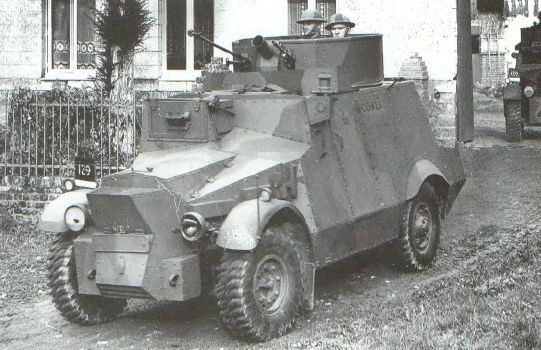
The Morris CS9/Light Armoured Car was a British armoured car used by the British Army in the Second World War.
Key Information


History
[edit]The vehicle was based on a Morris Commercial C9 4x2 15 long cwt (760 kg) truck chassis. On this chassis, a riveted hull was mounted with an open-topped two-man armored basket (as it had no roof it wasn't properly a turret). The armament consisted of either a Boys anti-tank rifle and a Bren light machine gun or a 12.7mm Vickers HMG. It also carried a smoke grenade discharger and a No. 19 radio set.[1][2]
The prototype was tested in 1936. A further 99 cars were ordered; these were delivered in 1938. Thirty-eight of these cars were used by the 12th Royal Lancers in the Battle of France, where all of them were destroyed or abandoned. The Lancers found that the vehicle had a slow turning radius and poor off-road capability, and that while the armament was sufficient for scouting purposes it did not perform well when the car had to be used in rearguard actions such as at Dunkirk. Another 30 served with the 11th Hussars in the North African Campaign, where they took part in attacking the forts at Sidi Omar and Capuzzo, as well as in the fighting in Cyrenaica. It was found that, when fitted with desert tyres, the vehicle had good performance on soft sand. However, its 7mm armour and armament were insufficient and the vehicles were removed from front line service by the end (one source says halfway through) the campaign. Some were captured and used by both German and Italian forces.[1][2][3]

References
[edit]- ^ a b bocquelet, david. "Morris CS.9 armoured car (1938)". tank-afv.com.
- ^ a b "Morris CS9/ Light Armoured Car". www.historyofwar.org.
- ^ "Britain's Morris Armored Cars - World War II Vehicles, Tanks, and Airplanes". www.wwiivehicles.com. Archived from the original on 26 February 2010.
- Forty, George - World War Two Armoured Fighting Vehicles and Self-Propelled Artillery, Osprey Publishing 1996 ISBN 1-85532-582-9

Morris CS9
View on GrokipediaDevelopment and production
Origins and requirements
In the mid-1930s, the British Army sought to modernize its reconnaissance capabilities amid growing international tensions, aiming to replace outdated First World War-era vehicles such as the Austin and Rolls-Royce armoured cars, which were ill-suited for extended road-based patrols.[1] These older models lacked the speed and reliability needed for effective long-range reconnaissance, prompting the War Office to prioritize a new light armoured car that could operate efficiently on roads while supporting light tank units.[2] The development of the Morris CS9 stemmed directly from a 1936 War Office requirement for an interim reconnaissance vehicle, emphasizing high speed, extended operational range, and minimal weight to ensure rapid deployment and maneuverability, rather than robust armour protection.[4] The specification called for a 4x2 wheel configuration to simplify design, reduce costs, and leverage existing commercial components, reflecting the Army's need for a cost-effective stopgap solution during rearmament.[2] This approach allowed for quicker production compared to more complex 4x4 or 6x4 alternatives being considered for future models.[4] Morris Commercial Cars, a subsidiary of Morris Motors, responded to the War Office tender by adapting its reliable C9 4x2 truck chassis, chosen for its proven commercial availability and durability in civilian use.[1] The company's expertise in truck manufacturing enabled a swift prototype development in 1936, which met the core requirements for road reconnaissance and led to an order for 99 vehicles.[5]Prototyping and manufacturing
The prototyping phase for the Morris CS9 armoured car commenced in 1936, with Morris Commercial Cars constructing initial prototypes on the C9 4x2 truck chassis to meet British Army reconnaissance requirements. These prototypes underwent testing in various configurations to assess mobility, stability, and armament integration, achieving satisfactory results including a top road speed of approximately 43 mph.[4] Following the trials, modifications were made to the design, including lengthening the C9 chassis by 45 cm for enhanced internal space and handling, leading to formal acceptance by the War Office in 1937.[4] In response to the successful evaluations, an order for 99 production units was placed in 1937, with all vehicles delivered that same year by Morris Commercial Cars.[5][6] The manufacturing process emphasized efficiency by utilizing off-the-shelf commercial components from the Morris C9 truck series, such as the engine and suspension, allowing for quick assembly of the riveted armoured superstructure at Morris's Birmingham facilities.[5][6] Completed vehicles entered service in early 1939 and were initially allocated to armoured reconnaissance regiments, with 38 units assigned to the 12th Royal Lancers and 30 to the 11th Hussars for training and operational preparation.[5]Design
Chassis, engine, and mobility
The Morris CS9 armoured car utilized a 4x2 wheeled chassis derived from the Morris Commercial C9 15 cwt truck, which was lengthened to accommodate the armoured body for reconnaissance duties.[1] This modification extended the wheelbase by approximately 18 inches (46 cm), resulting in overall dimensions of 15 ft 6 in (4.77 m) in length and 6 ft 9 in (2.05 m) in width, providing a stable platform for road travel while maintaining the truck's inherent simplicity.[1][7] Propulsion was provided by a Morris 6-cylinder petrol engine delivering 96 hp (72 kW), paired with a standard 4 forward/1 reverse gearbox, which emphasized reliability over complexity in line with its commercial origins.[1] This setup endowed the vehicle with a power-to-weight ratio of about 21.3 hp per tonne, enabling a maximum road speed of 45 mph (73 km/h) and an operational range of 240 miles (385 km) on standard fuel loads.[1] The suspension system employed leaf springs on the 4x2 configuration, with rear-wheel drive suited to high-speed reconnaissance on firm surfaces, though steering was conventional rack-and-pinion without advanced off-road adaptations.[1] At a combat weight of 4.5 tonnes and an overall height of 7 ft (2.13 m), the CS9 prioritized mobility and low silhouette over heavy protection, facilitating rapid deployment in forward areas.[1] For operations on varied terrain, particularly in desert environments, the vehicle could be equipped with optional desert tyres, which improved traction and performance on soft sand without compromising its road-biased design.[1] This adaptability allowed effective mobility in reconnaissance roles, though the 4x2 layout limited extreme cross-country capability compared to tracked alternatives.[2]Armament, armour, and crew
The Morris CS9 was equipped with a primary armament consisting of a 0.55-inch Boys anti-tank rifle mounted in the turret alongside a 0.303-inch Bren light machine gun for suppressive fire.[1] Some units substituted the Bren with a Vickers machine gun for similar anti-infantry roles.[8] Secondary equipment included a No. 19 radio set, enabling effective communication during reconnaissance missions.[4] The vehicle's armour provided limited protection, with 7 mm steel plating on both the hull and the open-topped turret, sufficient to deflect small-arms fire but offering no defense against artillery shrapnel or heavier anti-tank weapons.[2] This thin, riveted construction prioritized mobility over survivability, leaving the crew exposed from above.[6] The CS9 accommodated a crew of four: a commander who also operated the radio, a dedicated gunner for the armament, a driver positioned forward, and a radio operator who assisted with loading ammunition.[1] The layout featured a boxy hull with side doors for access and a wide, open-topped turret that enhanced visibility for scouting but increased vulnerability to overhead threats.[2]Operational history
Battle of France
The Morris CS9 armoured cars equipped the 12th Royal Lancers, serving as the primary reconnaissance regiment for the British Expeditionary Force (BEF) in France from late September 1939. During the Phoney War period, the vehicles conducted routine patrols and security operations along the Franco-Belgian frontier, including movements near Villiers-Saint-Simon in September 1939 to monitor potential threats.[9] These early deployments focused on establishing forward positions and gathering intelligence without significant combat, contributing to the BEF's defensive posture. With the German invasion on 10 May 1940, the 12th Royal Lancers, operating 38 Morris CS9s, advanced rapidly into Belgium as part of the Dyle Plan, crossing the frontier that afternoon and reaching the River Dyle by nightfall to screen the main BEF forces.[10] Their reconnaissance role involved aggressive patrols along the Franco-Belgian border and eastward, making initial contact with German units east of the Dyle on 13 May while providing critical early warning of enemy movements.[10] These actions, including skirmishes during the advance, helped delay German probes and supported the Allied line until the withdrawal order on 14 May, when the Lancers fell back across the Dyle in coordination with French forces.[10] The light armour of the CS9s proved vulnerable to even small-arms fire and artillery, limiting their effectiveness in direct confrontations.[1] As the German Blitzkrieg overwhelmed the Allies, the 12th Royal Lancers covered the BEF's fighting retreat toward Dunkirk, engaging in rearguard actions amid chaotic conditions.[11] All 38 vehicles were ultimately lost—either destroyed by enemy action, abandoned due to mechanical breakdowns and fuel shortages, or scuttled to prevent capture—marking the complete elimination of the CS9 from British service in Europe.[12] Despite these setbacks, their screening efforts provided valuable time for the BEF's evacuation, with the regiment's personnel escaping via Dunkirk while leaving the armoured assets behind.[13]North African Campaign
Following the heavy losses incurred by the 12th Royal Lancers during the Battle of France, exactly 30 Morris CS9 armoured cars were transferred to the 11th Hussars (Prince Albert's Own) and shipped to Egypt in the spring of 1940 to bolster reconnaissance capabilities in the Western Desert.[4][1] These vehicles arrived as reinforcements for the 7th Armoured Division, where they supplemented older Rolls-Royce armoured cars in the regiment's squadrons.[4] To suit the demanding desert terrain, the Morris CS9s were adapted with wide desert tyres, which significantly improved traction and mobility on soft sand, allowing for effective long-range patrols along the Libyan frontier.[1][4] Additional modifications included mounting a Bren gun in an anti-aircraft position and adding practical features like flag and map holders to support operational needs in the arid environment.[4] In early operations, such as the Italian invasion of Egypt in September 1940 and Operation Compass from December 1940 to February 1941, the 11th Hussars' CS9s conducted vital reconnaissance missions, crossing the frontier wire on 11 June 1940 to probe Italian positions and engaging outposts in skirmishes that helped map enemy dispositions.[4] By spring 1941, the Morris CS9's thin armour and light armament rendered it obsolete against evolving Axis threats, leading to its withdrawal from front-line reconnaissance roles within the 11th Hussars.[4][1] It was gradually replaced mid-campaign by more capable vehicles like the Daimler armoured car, which began entering service with the regiment around November 1941.[1] Some CS9s lingered in secondary duties or were repurposed as radio command vehicles, though a few were captured by Italian forces during engagements such as the Battle of Bir el Gobi in November 1941 and subsequently reused by Axis troops.[4][1]Evaluation and legacy
Operational assessment
The Morris CS9 excelled in reconnaissance roles due to its high speed, which enabled rapid scouting and evasion, and its reliable commercial chassis that simplified maintenance in field conditions. In the North African Campaign, modifications such as sand tires enhanced its mobility on soft terrain, allowing units like the 11th Hussars to conduct effective patrols against Italian forces. Additionally, the vehicle's standard radio equipment supported command coordination, aligning with British emphasis on wireless communication for armoured reconnaissance.[2][14][8] Despite these advantages, the CS9's 7 mm armour offered minimal protection against small arms fire and anti-tank weapons prevalent in 1940, exposing crews to significant risk during engagements. Its armament, limited to a Boys anti-tank rifle and Bren light machine gun, lacked the firepower to confront armoured threats or provide suppressive fire effectively, resulting in high vulnerability in combat. These deficiencies led to its withdrawal from front-line service by 1941, as it proved inadequate for evolving tactical demands.[2][14] In comparison to contemporaries like the Humber and Daimler armoured cars, which featured thicker armour and more versatile armament, the CS9 functioned primarily as an interim stopgap solution to equip reconnaissance units pending superior designs. It replaced older models such as the Lanchester in formations like the 12th Royal Lancers but was soon supplemented by World War I-era Rolls-Royce cars in mixed operations. All CS9s deployed with the British Expeditionary Force in France were lost or abandoned during the Dunkirk evacuation, underscoring its limitations in sustained combat.[6][14][2] The CS9's operational experience shaped early British reconnaissance doctrine by validating the priority of mobility and communication but exposed the critical need for enhanced protection and firepower in armoured vehicles facing modern warfare. Its brief service highlighted transitional challenges in British armoured car development, paving the way for more robust successors in subsequent campaigns.[2][6]Surviving vehicles
No known complete examples of the Morris CS9 survive as of 2025, with all 99 vehicles produced having been lost, scrapped, or destroyed during wartime service.[1] Comprehensive surveys of preserved British armoured cars from World War II confirm the absence of any intact CS9 specimens in museums or private collections.[15] Although the Morris CS9 utilized the chassis of the Morris Commercial C9 15-cwt truck, for which unmodified examples remain in existence, no confirmed partial remnants or restorations incorporating such components have been documented in public institutions.[1] Study of the Morris CS9 today relies on historical documentation, including wartime photographs archived by institutions like the Imperial War Museum, technical blueprints from preserved records, and personal accounts from veterans such as trooper Frederick Hunn's recollections of operating the vehicle.[16][17][18] Enthusiasts maintain interest through scale recreations, notably resin model kits offered by manufacturers like Warlord Games for tabletop wargaming.[19]References
- https://commons.wikimedia.org/wiki/Category:Morris_CS9